
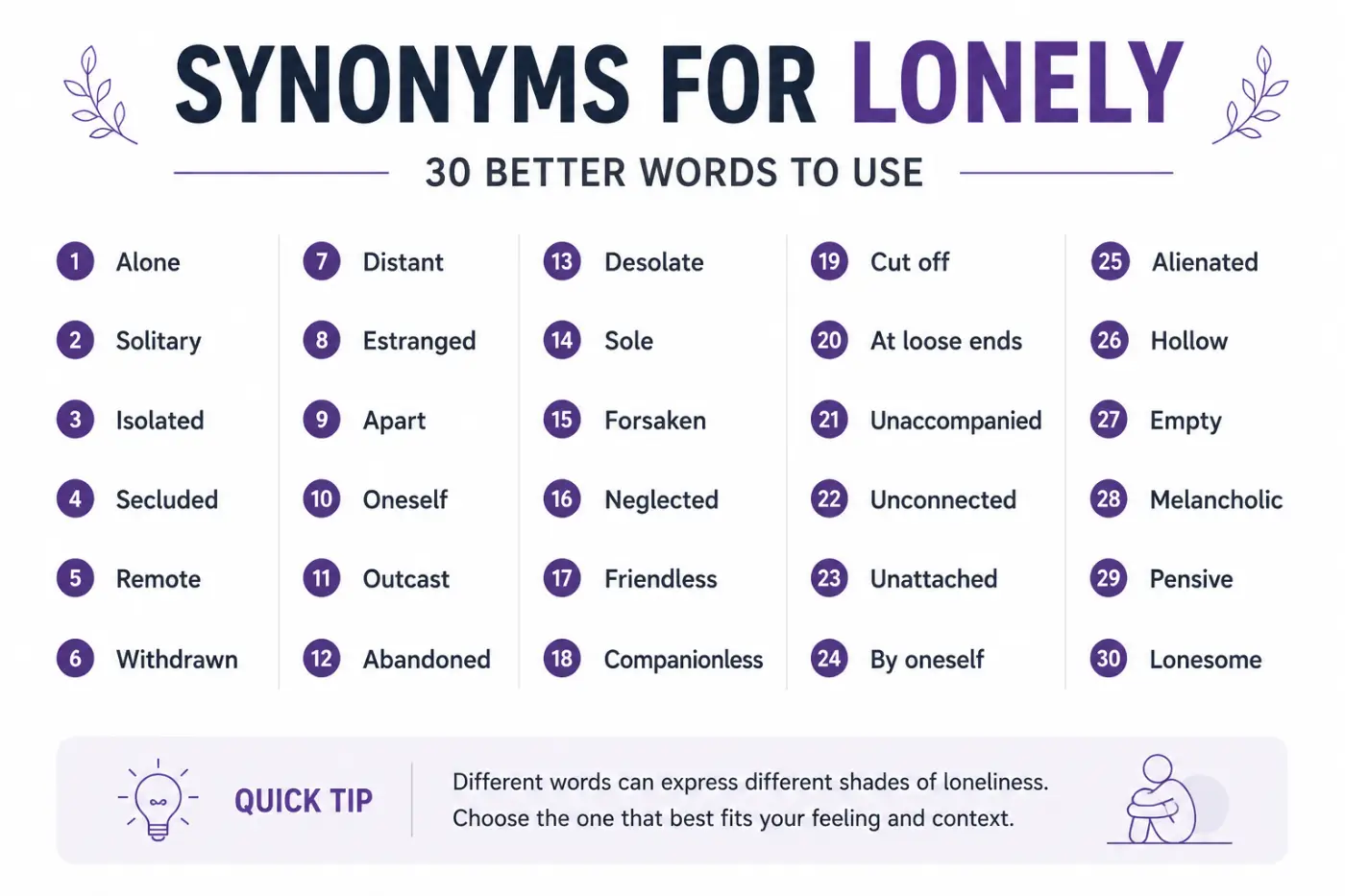
Writing an essay, sending a text, working on a novel, or updating a social media post can leave you searching for better words. You know you want to describe someone who feels alone, but using the same word again and again can make your writing sound flat. That’s when synonyms for lonely become useful. The right choice helps you match the exact feeling you want to express.
Some words describe a short moment of being alone. Others express deep emotional pain, isolation, or even peaceful solitude. Picking the right one makes your writing more natural and more accurate.
In this guide, you’ll learn where the word came from, what it really means, how it differs from similar words, and which alternatives work best in essays, emails, conversations, and creative writing. You’ll also find a large collection of useful synonyms grouped by tone and strength so you can choose the perfect word every time.
Short Answer
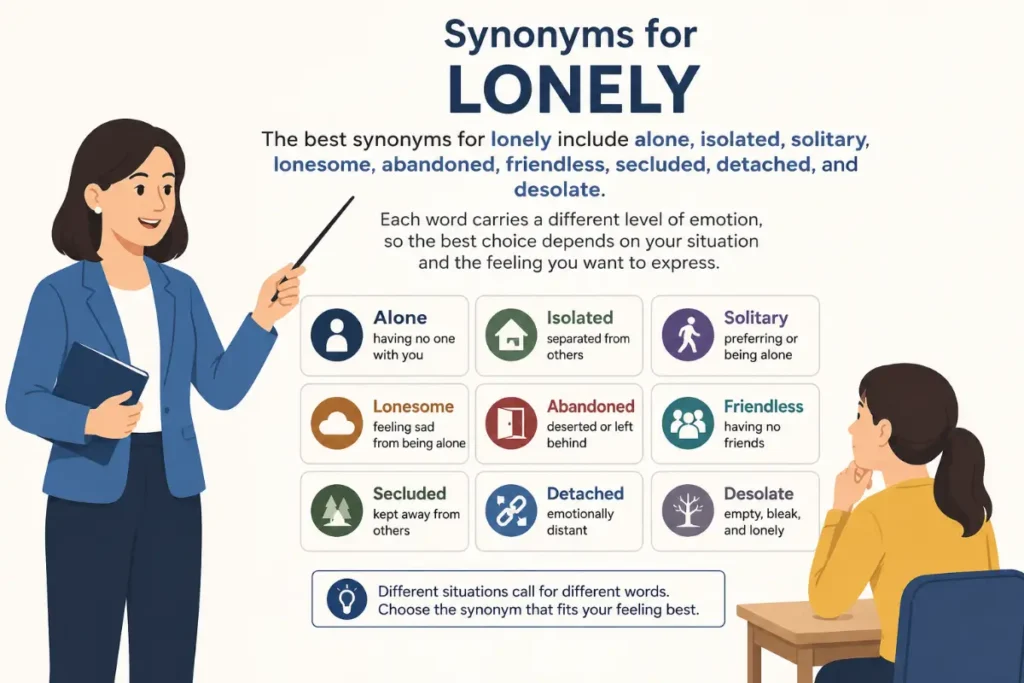
The best synonyms for lonely include alone, isolated, solitary, lonesome, abandoned, friendless, secluded, detached, and desolate. Each word carries a different level of emotion, so the best choice depends on your situation and the feeling you want to express.
What Does Lonely Mean in Simple English
The word lonely describes a person who feels sad because they have little or no companionship. It can also describe places, moments, or objects that seem empty, quiet, or isolated. Many people confuse being alone with being lonely, but they are not the same. Someone can spend the whole day alone and still feel happy. Another person can stand in the middle of a crowded room and still feel lonely because they lack a meaningful connection with others.
Here are a few simple examples.
- She felt lonely after moving to a new city.
- The old cabin stood on a lonely hill.
- He spent the weekend alone but never felt lonely.
- The empty playground looked lonely at sunset.
The meaning changes slightly depending on the situation, but the common idea stays the same. Lonely usually suggests emotional distance, missing companionship, or feeling disconnected.
Where Does the Word Lonely Come From
Many articles list synonyms but never explain the history behind the word. Understanding its origin makes its meaning much easier to remember. The word lonely comes from the older English word alone, which originally meant by oneself. During the Middle English period, speakers began adding the ending ly, which often turned words into descriptive adjectives. At first, lonely simply described a place that was remote or far away from other people. A lonely road or a lonely forest meant a place with very few people nearby. Over time, English speakers started using the word to describe emotions as well. Instead of only referring to empty places, lonely came to describe the sadness that people sometimes experience when they lack friendship, love, or companionship. Today, the emotional meaning is much more common than the physical one, although both uses remain correct.
Why Finding Better Synonyms Matters
Using the same word too often makes writing repetitive. Replacing lonely with a more precise word helps readers understand exactly what you mean.
For example, these sentences create different pictures.
- The traveler felt isolated after losing contact with the group.
- The old man looked lonesome after his wife passed away.
- The abandoned house stood desolate at the end of the road.
- She enjoyed a solitary walk through the mountains.
Each word describes a different kind of loneliness. That’s why learning synonyms for lonely improves essays, stories, emails, journal entries, and everyday conversations.
Master List of Synonyms for Lonely
The English language offers dozens of alternatives, but they don’t all fit the same situation. Some sound casual. Others fit formal writing. A few are mostly used in literature or emotional storytelling. The table below introduces the first group of commonly used words.
| Word | Meaning | Tone | Example |
|---|---|---|---|
| Alone | By yourself without other people | Neutral | She was alone in the office after everyone left. |
| Isolated | Separated from others physically or emotionally | Neutral | He felt isolated after changing schools. |
| Solitary | Existing alone by choice or circumstance | Formal | The eagle lived a solitary life. |
| Lonesome | Feeling sad because of being alone | Everyday | The child became lonesome during summer vacation. |
| Friendless | Having no close friends | Strong | The newcomer felt friendless at first. |
| Abandoned | Left behind or forgotten | Emotional | The puppy looked abandoned beside the road. |
| Desolate | Empty and filled with sadness | Formal | The beach appeared desolate after the storm. |
| Secluded | Quiet and away from crowds | Neutral | They rented a secluded cabin in the woods. |
| Detached | Emotionally disconnected | Formal | He remained detached during the meeting. |
| Remote | Far away from populated areas | Neutral | The village sits in a remote valley. |
| Withdrawn | Keeping away from social interaction | Neutral | She became withdrawn after the accident. |
| Alienated | Feeling separated from society or a group | Formal | Many teenagers feel alienated at times. |
| Neglected | Not given enough care or attention | Emotional | The neglected garden looked lonely all winter. |
| Deserted | Empty because everyone has left | Neutral | The streets were deserted after midnight. |
These words cover many situations, but each one creates a slightly different emotional picture.
Simple Everyday Synonyms for Lonely
Most conversations don’t need dramatic vocabulary. These words sound natural in daily speech.
| Word | Meaning | Tone | Example |
|---|---|---|---|
| Alone | By yourself | Casual | I spent the evening alone. |
| On your own | Without help or company | Casual | She finished the project on her own. |
| By yourself | Without another person | Casual | He traveled by himself across the state. |
| Lonesome | Feeling lonely | Casual | I get lonesome during long business trips. |
| Left out | Excluded from others | Casual | She felt left out at the party. |
| Unwanted | Feeling rejected | Casual | The student felt unwanted after being ignored. |
| Unnoticed | Not receiving attention | Casual | He sat unnoticed in the corner. |
These alternatives work well in conversations, blogs, school assignments, and personal writing.
Formal Synonyms for Lonely
Academic writing, professional reports, and literary analysis often require more precise vocabulary.
| Word | Meaning | Tone | Example |
|---|---|---|---|
| Solitary | Existing alone | Formal | The scientist worked in solitary conditions. |
| Isolated | Separate from others | Formal | The research station remained isolated all winter. |
| Alienated | Emotionally separated | Formal | Employees may feel alienated after major changes. |
| Detached | Emotionally distant | Formal | The witness appeared detached during questioning. |
| Secluded | Hidden away from others | Formal | The monastery sits in a secluded valley. |
| Desolate | Empty and hopeless | Formal | The novel describes a desolate landscape. |
| Remote | Far from populated areas | Formal | Medical care is limited in remote regions. |
These words sound more polished in essays and professional writing while keeping the meaning clear.
Slang and Informal Alternatives
Modern conversations and social media often use more relaxed expressions instead of saying someone is lonely.
| Word or Phrase | Meaning | Tone | Example |
|---|---|---|---|
| Solo | Alone | Informal | I’m flying solo this weekend. |
| By myself | Alone | Informal | I watched the movie by myself. |
| On my own | Without company | Informal | I learned the guitar on my own. |
| Feeling left out | Emotionally excluded | Informal | I felt left out during lunch. |
| Flying solo | Doing something independently | Informal | She’s been flying solo since graduation. |
| On the sidelines | Not included | Informal | He stayed on the sidelines during the discussion. |
These phrases fit casual speech much better than formal documents.
Synonyms for Lonely From Mild to Strong
Not every synonym expresses the same level of emotion. Some simply describe being alone. Others suggest deep sadness or complete emotional isolation.
| Intensity | Synonyms | Typical Feeling |
|---|---|---|
| Very Mild | Alone, by yourself, on your own | Simply without company |
| Mild | Solitary, secluded, remote | Quiet or physically separate |
| Moderate | Lonesome, isolated, withdrawn | Missing companionship |
| Strong | Friendless, neglected, alienated | Emotional separation |
| Very Strong | Abandoned, desolate | Deep loneliness or hopelessness |
Understanding this scale helps you avoid exaggerating your message.
For example, calling someone desolate when they simply spent one afternoon alone sounds too dramatic. On the other hand, describing someone who lost all social connections as merely alone may not fully express the emotional impact. Choosing the right level of emotion is one of the easiest ways to make your writing feel more natural and believable.
Which Synonym Should You Choose
If you simply mean someone has no company, alone is usually the safest choice. If you’re describing a place instead of a person, words like remote, deserted, secluded, and desolate often create stronger imagery. The best synonyms for lonely always depend on the context, the emotion, and the audience. In the next section, you’ll learn which words work best in essays, resumes, emails, texting, conversations, and creative writing. You’ll also see more than ten original examples and detailed comparisons between similar words that many writers confuse.
Do Synonyms for Lonely Work as Different Parts of Speech
Most synonyms for lonely are adjectives because they describe people, places, or feelings. A few related words can also appear as nouns or verbs, but the adjective form is the most common. The table below shows how these words are usually used.
| Word | Part of Speech | Example |
|---|---|---|
| Lonely | Adjective | She felt lonely after the move. |
| Alone | Adjective or adverb | He lives alone. |
| Solitary | Adjective | A solitary bird flew overhead. |
| Isolated | Adjective | The town remained isolated for weeks. |
| Lonesome | Adjective | The old ranch looked lonesome. |
| Friendless | Adjective | He arrived in the city friendless. |
| Secluded | Adjective | They bought a secluded house. |
| Desolate | Adjective | The landscape looked desolate. |
| Alienated | Adjective | She felt alienated from her classmates. |
| Withdrawal | Noun | His social withdrawal worried his family. |
| Isolation | Noun | Long periods of isolation can affect mental health. |
| Solitude | Noun | She enjoys solitude while reading. |
In everyday writing, you’ll mostly choose an adjective to replace lonely. If you need a noun instead, words like solitude, isolation, and withdrawal often fit naturally.
Do Americans and British People Use Different Words
Most synonyms for lonely are understood in both American and British English. The biggest differences come from frequency, not meaning.
| Word | American English | British English | Notes |
|---|---|---|---|
| Lonely | Very common | Very common | Standard everywhere |
| Alone | Very common | Very common | No difference |
| Isolated | Very common | Very common | Used in everyday and formal writing |
| Solitary | Common | Common | Often appears in books and news |
| Lonesome | Fairly common | Less common | More common in American speech and music |
| Secluded | Common | Common | Often describes places |
| Desolate | Common | Common | Frequently used in literature |
American English uses lonesome more often, especially in country music, novels, and casual conversation. British English usually prefers lonely unless a writer wants a poetic or old fashioned style. For most situations, you can safely use alone, isolated, solitary, friendless, or lonely anywhere English is spoken.
What’s the Best Word for an Essay
School essays and academic papers need words that sound clear and precise without becoming overly dramatic. Here are some excellent choices.
| Word | Best Use |
|---|---|
| Isolated | Social issues, geography, psychology |
| Solitary | Literature, history, science |
| Alienated | Sociology, education, relationships |
| Detached | Emotional analysis |
| Secluded | Geography and descriptive writing |
Example sentences:
- The novel explores the life of a solitary traveler.
- The main character feels alienated from society.
- The author creates a secluded setting that builds suspense.
These choices sound polished while remaining easy to understand.
What’s the Best Word for a Resume
Most resumes never need the word lonely. However, you may want to describe working independently without creating a negative impression. Use positive alternatives instead.
| Better Word | Why It Works |
|---|---|
| Independent | Shows confidence and self direction |
| Self motivated | Highlights initiative |
| Self directed | Suggests responsibility |
| Autonomous | Common in professional settings |
| Able to work independently | Clear and positive |
Examples:
- Worked independently on customer projects.
- Successfully managed assignments with minimal supervision.
- Completed complex research as a self directed team member.
Avoid words like isolated, friendless, or lonely on a resume because employers may misunderstand your meaning.
What’s the Best Word for an Email
Professional emails usually benefit from neutral language.
Instead of writing:
- I felt lonely during the project.
You might write:
- I felt isolated from the rest of the team.
- I worked independently for most of the project.
- I had limited interaction with other departments.
These choices sound more professional while communicating the same idea. For personal emails, casual words like alone or lonesome often sound warmer.
Example:
- I’ve been feeling a little lonesome since everyone moved away.
What’s the Best Word for Text Messages
Texts usually sound more natural with simple language.
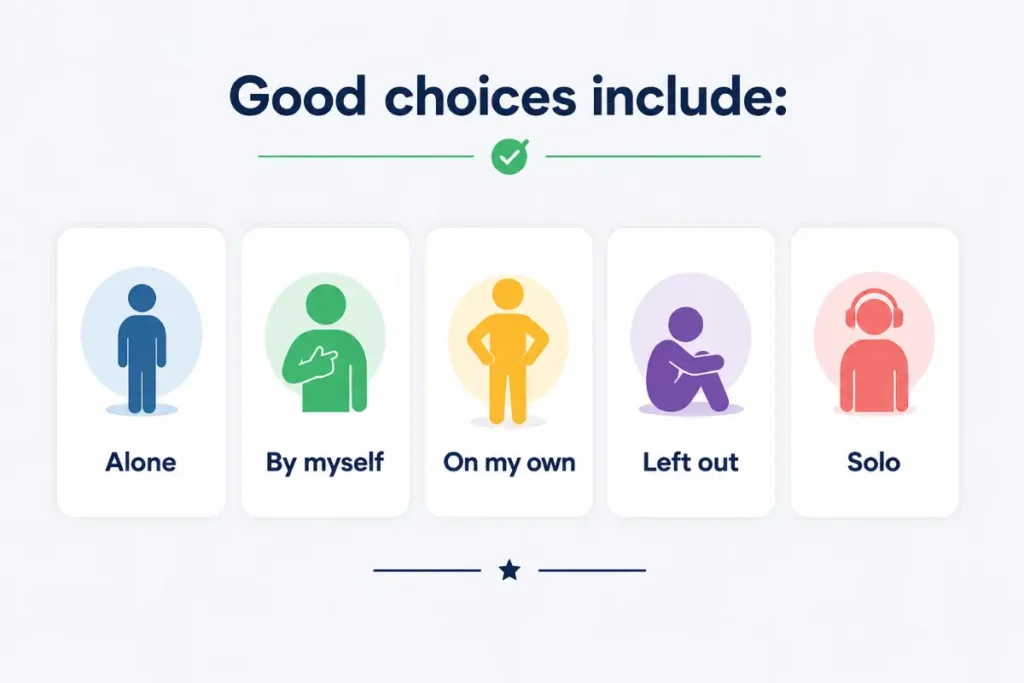
Good choices include:
- Alone
- By myself
- On my own
- Left out
- Solo
Examples:
- I’m home alone tonight.
- I’ve been feeling kind of left out lately.
- I’m flying solo this weekend.
- Everyone canceled, so I’m by myself.
These expressions match how people actually talk with friends.
What’s the Best Word When Speaking
When talking face to face, people usually choose shorter, familiar words. These are the most natural options.
| Situation | Best Word |
|---|---|
| Casual conversation | Alone |
| Talking about emotions | Lonely |
| Describing distance | Isolated |
| Talking about peaceful quiet | Solitary |
| Describing exclusion | Left out |
Using everyday language helps people understand your meaning immediately.
Original Example Sentences Using Different Synonyms
Seeing words in real situations makes them much easier to remember.
- She felt lonely after her best friend moved across the country.
- The small farmhouse stood isolated at the end of a dirt road.
- He enjoyed a solitary morning walk before work.
- The abandoned amusement park looked completely desolate.
- I spent the afternoon alone, but I wasn’t unhappy.
- The new student felt friendless during the first week of school.
- Their cabin sat in a secluded valley surrounded by tall trees.
- After the argument, she became emotionally detached from everyone around her.
- Working remotely sometimes makes employees feel alienated from their coworkers.
- The little boy looked left out while the other children played together.
- The hikers reached a remote mountain village before sunset.
- He became withdrawn after losing his longtime mentor.
Each sentence highlights a different shade of meaning instead of simply replacing one word with another.
Alone vs Lonely What’s the Difference
These two words are often confused because they seem similar.
| Alone | Lonely |
|---|---|
| Describes being by yourself | Describes an emotional feeling |
| Can be positive or neutral | Usually negative |
| Doesn’t automatically mean sadness | Suggests missing companionship |
| Physical situation | Emotional experience |
Compare these examples.
- She enjoys being alone while reading.
- She feels lonely when nobody calls.
A person can be alone without feeling lonely.
Likewise, someone surrounded by people can still feel lonely if they don’t feel understood.
Isolated vs Lonely What’s the Difference
These words overlap, but they aren’t identical.
| Isolated | Lonely |
|---|---|
| Focuses on separation | Focuses on emotion |
| Can describe places, people, or groups | Mostly describes feelings |
| May not involve sadness | Usually includes sadness |
| Often physical distance | Usually emotional distance |
Examples:
- The research station became isolated during the snowstorm.
- The scientists started feeling lonely after several months away from home.
Isolation often causes loneliness, but the two words don’t always appear together.
Solitary vs Lonely What’s the Difference
Many writers mix these words up, but they create very different impressions.
| Solitary | Lonely |
|---|---|
| Often peaceful | Usually unhappy |
| Can be intentional | Rarely intentional |
| Suggests privacy | Suggests emotional need |
| Frequently positive | Usually negative |
Examples:
- She enjoys a solitary afternoon in the garden.
- He feels lonely every weekend.
The first sentence sounds peaceful.
The second expresses emotional pain.
Understanding this difference makes your writing much more accurate.
Lonesome vs Lonely What’s the Difference
These words are very close, but they create slightly different feelings.
| Lonesome | Lonely |
|---|---|
| Often sounds softer | More common everyday word |
| Frequently appears in songs and stories | Used in every type of writing |
| Can sound nostalgic | Usually sounds direct |
| More common in American English | Common worldwide |
Examples:
- The cowboy felt lonesome after months on the trail.
- She felt lonely after moving into her new apartment.
Both are correct, but lonesome often creates a warmer, more emotional image.
What Are the Most Common Mistakes When Using Synonyms for Lonely
Many words seem interchangeable at first, but using the wrong one can change your meaning. These are the mistakes writers make most often.
Using alone when you mean lonely
Being alone simply means no one else is with you. It doesn’t describe how someone feels.
Correct:
- She was alone in the house.
- She felt lonely after everyone left.
Using solitary for sadness
Solitary often suggests peace, privacy, or a personal choice. It doesn’t always carry a negative feeling.
Less natural:
He felt solitary after losing his friends.
Better:
He felt lonely after losing his friends.
Using desolate for everyday situations
Desolate is a very strong word. It usually describes extreme sadness or empty places.
Too dramatic:
- I felt desolate because my friend canceled lunch.
Better:
- I felt disappointed.
- I felt lonely.
Using isolated only for emotions
Isolated can describe both physical distance and emotional separation.
Examples:
- The island is isolated from the mainland.
- She felt isolated at her new job.
Repeating the same synonym
Even if you avoid the word lonely, repeating another synonym can make your writing sound dull.
Instead of this:
The village was isolated. The people felt isolated. Their homes were isolated.
Try this:
The village was remote. The people felt isolated. Their homes stood far from neighboring towns.
Variety keeps your writing interesting.
What Are the Opposites of Lonely
Sometimes the best way to improve your writing is by knowing the opposite meaning.
| Antonym | Meaning | Example |
|---|---|---|
| Connected | Having close relationships | She feels connected to her community. |
| Included | Accepted as part of a group | Everyone felt included during the meeting. |
| Social | Enjoying time with others | He’s naturally social and outgoing. |
| Surrounded | Having people nearby | She was surrounded by family. |
| Companionable | Pleasant to spend time with | They shared a companionable silence. |
| Welcomed | Accepted warmly | The new employee felt welcomed immediately. |
| Supported | Given help and encouragement | He always feels supported by his friends. |
| Together | With other people | The family spent the holiday together. |
These words help create balance when you’re describing relationships or emotions.
How Do You Choose the Right Synonym
The best choice depends on what you want your reader to picture. Use this quick guide.
| If you want to describe… | Best Choice |
|---|---|
| Simply being by yourself | Alone |
| Feeling emotionally sad | Lonely |
| Physical separation | Isolated |
| Peaceful independence | Solitary |
| Having no friends | Friendless |
| Being forgotten | Abandoned |
| Empty places | Desolate |
| Quiet locations | Secluded |
| Emotional distance | Detached |
| Feeling excluded | Left out |
Ask yourself one simple question before choosing a word. Am I describing a situation, a feeling, or a place? The answer usually points you toward the right synonym.
Quick Tips for Choosing the Right Word
- Use alone for facts, not emotions.
- Choose lonely when someone misses companionship.
- Pick isolated for physical or emotional separation.
- Use solitary when being alone is peaceful or intentional.
- Save desolate for very strong emotions or empty landscapes.
- Use friendless only when the lack of friends is the main idea.
- Read your sentence aloud. If the word sounds too dramatic, choose a milder option.
- Match the tone to your audience. Casual writing usually sounds better with simple words.
Following these tips will help you choose natural sounding synonyms for lonely every time.
Conclusion
Learning synonyms for lonely helps you express ideas with more accuracy and emotion. While words like alone, isolated, solitary, lonesome, friendless, and desolate all relate to loneliness, each one creates a different picture in the reader’s mind. Some describe peaceful independence, while others express sadness, distance, or abandonment.
Before choosing a synonym, think about your purpose. Are you describing a person’s emotions, a quiet place, or simply the fact that someone is by themselves? Matching the word to the situation makes your writing clearer and more natural. The next time you need a stronger or more specific alternative, you’ll have a wide range of synonyms for lonely ready to use with confidence.
Frequently Asked Questions
What’s another way to say lonely?
Some of the best alternatives include alone, isolated, solitary, lonesome, friendless, abandoned, detached, and desolate. The best choice depends on the emotion and the situation.
What are the best synonyms for lonely in writing?
The best synonyms for lonely include isolated for formal writing, alone for everyday situations, solitary for peaceful independence, and lonesome for emotional storytelling. Pick the word that matches your message instead of choosing the most dramatic option.
Is alone the same as lonely?
No. Alone describes a situation, while lonely describes a feeling. You can enjoy being alone, and you can feel lonely even in a crowd.
Which synonym sounds most formal?
Isolated, alienated, detached, and solitary are the most common formal alternatives. They work well in essays, reports, and professional writing.
Which word should I use in an essay?
For most essays, isolated, solitary, alienated, and detached are excellent choices because they sound precise and professional without being difficult to understand.
Can lonely describe places?
Yes. Lonely can describe empty or remote places as well as people’s emotions. For example, you can say, “A lonely road stretched across the desert.”
What are the strongest synonyms for lonely?
The strongest synonyms for lonely include desolate, abandoned, and friendless. These words express much deeper emotional pain than alone or solitary.
