
If you’ve ever stopped while writing a sentence and wondered about begun or began, you’re dealing with a common English grammar question. Both forms are real words. The difference comes from how the verb begin changes across different tenses.
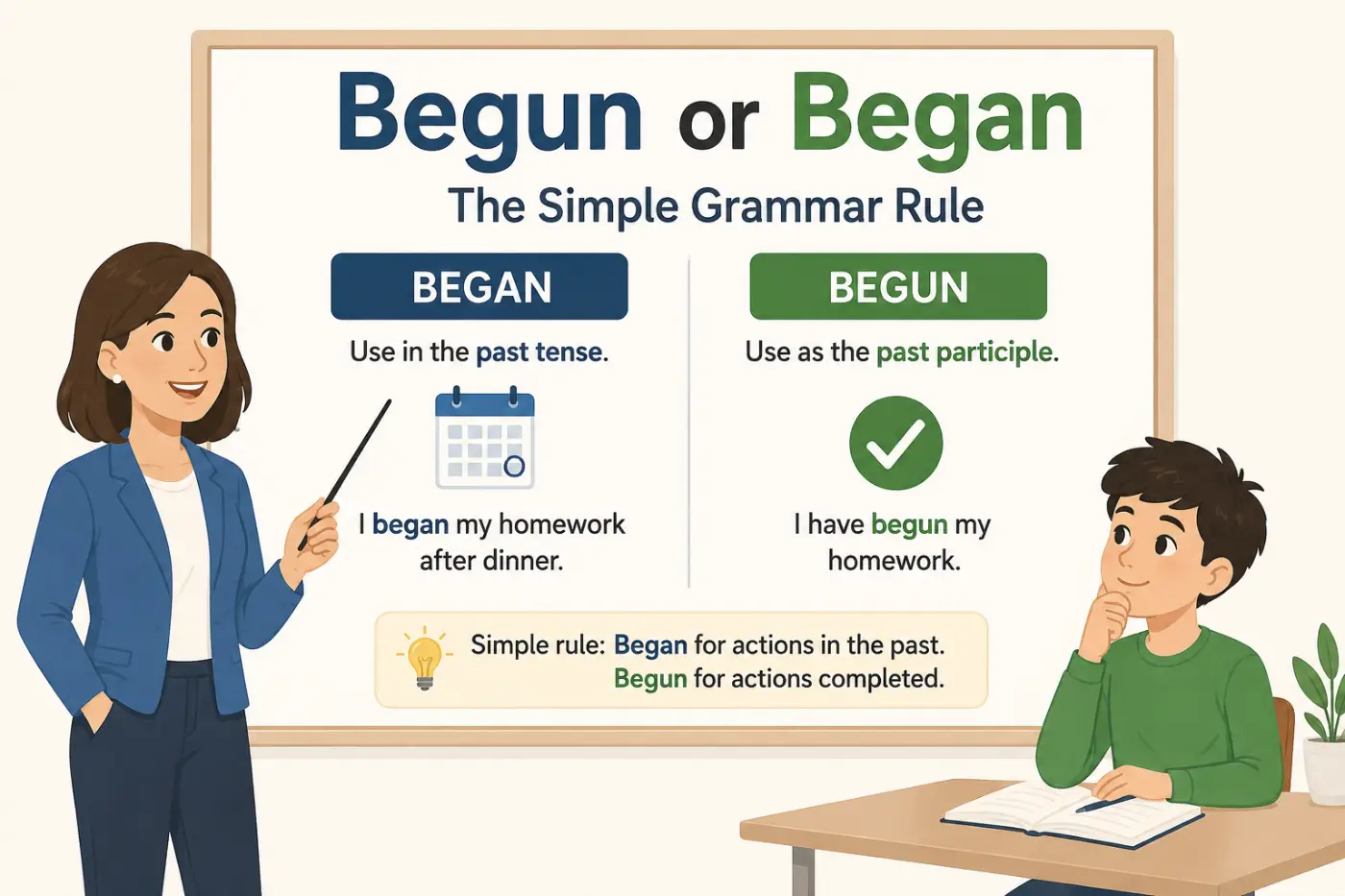
The short answer is simple. Began is the simple past form of begin. Begun is the past participle and normally needs an auxiliary verb such as has, have, or had. You say She began the meeting at nine but She has begun the meeting.
The confusion happens because both words describe an action that started. The grammar behind them is easy to miss because English uses different forms of some irregular verbs instead of simply adding ed. Once you understand the role of each form you’ll know exactly which one belongs in your sentence. This guide explains their meanings grammar rules pronunciation sentence placement common mistakes regional usage and natural examples so you can choose the right form with confidence.
Quick Definition
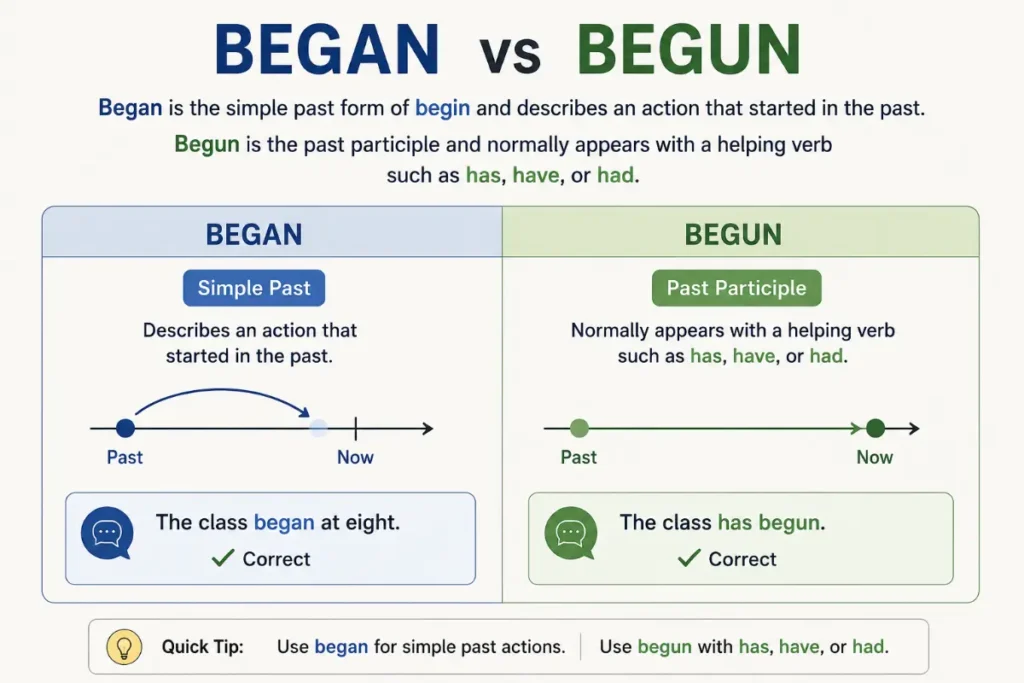
Began is the simple past form of begin and describes an action that started in the past. Begun is the past participle and normally appears with has, have, or had. For example The class began at eight uses simple past while The class has begun uses the present perfect.
Quick Answer
Use began when you’re talking about a completed action that happened in the past.
Use begun after an auxiliary verb in perfect constructions. Common patterns include has begun, have begun, and had begun.
The easiest rule is this.
Begin → began → begun.
For example.
I begin work at eight.
I have begun work on the project.
That three form pattern is the key to the entire distinction.
Comparison Table
| Correct Form | Meaning | Part of Speech | Origin | Usage Frequency | Formality | Common Contexts | Example |
|---|---|---|---|---|---|---|---|
| Began | Started in the past | Verb | Old English origin | Very common | Neutral | Stories conversations reports | The movie began at seven. |
| Begun | Started as a past participle | Verb | Old English origin | Very common | Neutral | Perfect tenses formal writing speech | The movie has begun. |
Meaning and Definition
Meaning of Began
Began is the simple past form of the verb begin. It tells your reader that an action started at a specific point or during a past period.
For example.
The concert began at eight.
She began studying after dinner.
The rain began during the night.
In each sentence the action started in the past. The verb doesn’t need has, have, or had to make the sentence grammatical.
Began is an irregular verb form. You don’t write begined in standard English. English has preserved an older pattern in which the vowel changes inside the verb.
The basic forms are.
Begin
Began
Begun
This pattern is similar to other irregular verbs such as sing, sang, sung and drink, drank, drunk.
Meaning of Begun
Begun is the past participle of begin. A past participle usually works with an auxiliary verb to create a perfect tense.
You’ll commonly see it with has, have, or had.
The show has begun.
The students have begun their work.
The storm had begun before we arrived.
The word itself still carries the idea of starting. The grammatical difference comes from the construction around it.
You wouldn’t normally write I begun the project yesterday in standard English. The correct sentence is I began the project yesterday.
You also wouldn’t normally write I have began the project. The correct form is I have begun the project.
This distinction is one of the most useful irregular verb rules to remember.
Key Differences Explained
- Spelling.
Began and begun have different spellings because they represent different forms of the irregular verb begin. - Grammar role.
Began functions as the simple past form. Begun functions as the past participle. - Meaning.
Both words relate to starting something. The main difference is grammatical rather than lexical. - Tone.
Neither form is more formal than the other. Both are standard English words. - Context.
Use began for simple past statements. Use begun with perfect constructions such as has begun or had begun.
A useful test is to look for an auxiliary verb.
If you have has, have, or had, begun is usually the form you need.
If you’re simply describing something that started in the past, began is usually correct.
Which Form Is Correct
Both began and begun are correct. They aren’t interchangeable.
The correct choice depends on the tense and grammatical structure of your sentence.
The Oxford English Dictionary and major modern English dictionaries treat begin as an irregular verb with the forms begin, began, and begun. Standard dictionary entries distinguish the simple past from the past participle.
This gives you a reliable linguistic rule rather than a guess.
Use began for simple past.
The lesson began at noon.
Use begun for perfect constructions.
The lesson has begun.
Use begun after had in the past perfect.
The lesson had begun before I arrived.
One practical test can save you a lot of second guessing. Look at the words immediately before the verb. If the sentence contains has, have, or had, the past participle begun is usually required.
Sentence Examples
Here are natural examples using began.
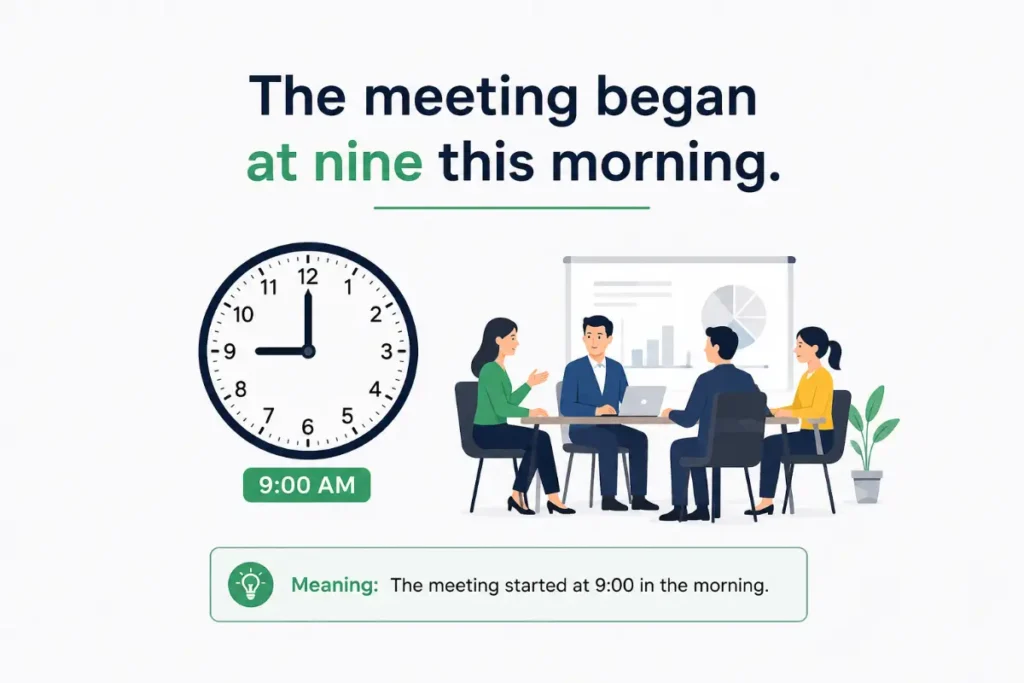
- The meeting began at nine this morning.
- She began reading the book on Monday.
- The children began playing outside after lunch.
- He began his new job last week.
- The movie began before we found our seats.
- The teacher began the lesson with a short question.
- The company began operations in 2005.
- I began feeling tired after the long drive.
- The snow began falling shortly after midnight.
- They began planning the trip months ago.
Now compare those examples with begun.
- The meeting has begun.
- She has begun reading the book.
- The children have begun playing outside.
- He has begun his new job.
- The movie had begun before we arrived.
- The teacher has begun the lesson.
- The company has begun expanding into new markets.
- I have begun feeling more confident.
- The snow had begun falling before midnight.
- They have begun planning the trip.
The pattern becomes clear when you compare the pairs.
The meeting began at nine.
The meeting has begun.
She began reading.
She has begun reading.
The first sentence in each pair uses simple past. The second uses a perfect construction.
Examples With the Common Error
The following sentences contain the common mistake.
- I have began my homework.
Correct form: I have begun my homework. - She has began working on the report.
Correct form: She has begun working on the report. - They had began the project before we arrived.
Correct form: They had begun the project before we arrived. - He begun the meeting yesterday.
Correct form: He began the meeting yesterday. - We begun the discussion last night.
Correct form: We began the discussion last night.
These errors happen because English speakers and learners sometimes mix the simple past form with the past participle form.
Common Mistakes and Misspellings
Several patterns cause confusion around this verb.
- Using began after have.
The sentence I have began is incorrect in standard English. After have, use the past participle begun. - Using begun as simple past.
The sentence She begun the meeting yesterday is incorrect. The simple past form is began. - Writing begined.
Some learners assume that begin follows the regular ed pattern. It doesn’t. Begined isn’t the standard past form. - Using begun without the required auxiliary.
In a sentence such as They begun the work, the verb needs correction. Write They began the work or They have begun the work depending on the intended tense. - Mixing tense patterns.
A sentence such as He has began last year combines a perfect construction with a finished past time expression. A natural correction would be He began last year.
From an NLP perspective the confusion makes sense. The words are semantically close because both express the idea of starting. Their forms are also visually and phonetically related. That creates a form confusion problem where the writer remembers the meaning but selects the wrong grammatical variant.
This is especially common with irregular verbs because their past forms don’t follow a simple rule.
Pronunciation Guide
The pronunciation of began is straightforward.
Began is pronounced approximately like bih GAN.
Its IPA pronunciation is commonly represented as /bɪˈɡæn/ in American English.
The second syllable receives the main stress.
beGAN
The pronunciation of begun is approximately bih GUN.
Its IPA pronunciation is commonly represented as /bɪˈɡʌn/ in American English.
Again the second syllable carries the main stress.
beGUN
The first vowel changes between the forms.
Began has the vowel sound found in words such as cat in many American English accents.
Begun has the central vowel sound found in words such as cup in many American English accents.
A common pronunciation mistake is giving both forms the same vowel sound. Native speakers clearly distinguish began and begun.
Etymology and Word Origin
The verb begin has very old Germanic roots. It comes from Old English beginnan and related forms found in other Germanic languages.
Over centuries the verb developed into the modern English forms begin, began, and begun.
The changing vowel pattern is part of a much older Germanic system often called ablaut. In simple terms the vowel inside a verb changes to show grammatical distinctions.
You can see similar patterns in English today.
Sing → sang → sung.
Ring → rang → rung.
Drink → drank → drunk.
Begin → began → begun.
Modern English no longer creates new irregular verbs through this system in the same productive way. However many older verbs have kept these historical forms.
That’s why began and begun may feel less predictable than regular verbs such as walk, walked, and walked.
The irregularity isn’t random. It reflects the long history of English and the way older Germanic verbs changed their internal vowels.
Regional Usage
American English
American English uses began and begun in the same basic grammatical pattern as standard English elsewhere. You’ll hear sentences such as The game began at six and The game has begun every day in ordinary American speech. Neither form is considered unusually formal or old fashioned.
British English
British English also uses began as the simple past and begun as the past participle.
The grammar is essentially the same.
A British speaker can naturally say The meeting began at ten and The meeting has begun.
Regional differences in vocabulary or pronunciation don’t change this core rule.
Australian English
Australian English follows the same standard pattern.
Began is the simple past form while begun is the past participle.
You may encounter different vocabulary choices in Australian writing but this verb distinction remains stable.
Canadian English
Canadian English also follows the standard pattern found in American and British English.
Use began for simple past and begun after perfect auxiliary verbs.
There isn’t a standard Canadian variant that replaces one form with the other.
Grammar Rules and Part of Speech
Both forms come from the verb begin, but they occupy different grammatical positions.
Simple Past
Use began when you’re describing an action that started in the past.
The class began at nine.
The conversation began after dinner.
The simple past often appears with a finished time reference.
Yesterday.
Last night.
Two hours ago.
In 2020.
For example.
The project began last year.
Present Perfect
Use begun after has or have in the present perfect.
The project has begun.
We have begun the process.
This construction connects a past action to the present.
Past Perfect
Use begun after had in the past perfect.
The project had begun before I joined the team.
The past perfect shows that one past event happened before another past event.
Future Perfect
You can also see begun in future perfect constructions.
By next month the project will have begun.
The structure is will have begun.
Placement in a Sentence
The position of began or begun depends on the sentence structure.
She began the lesson.
She had begun the lesson before lunch.
You can also use the verb with an infinitive or a gerund.
He began to study.
He began studying.
Both patterns are natural in many contexts.
Punctuation
The words themselves don’t require special punctuation.
Use normal punctuation based on the sentence.
Finally the meeting began.
The meeting finally began.
The meeting has finally begun.
If finally appears at the beginning of a sentence as an introductory adverb, a comma is often used after it.
That punctuation rule is separate from the distinction between began and begun.
Real Life Usage Examples
Daily Talk
The movie began before we got there.
The kids have begun eating dinner.
These sentences sound natural in everyday American conversation.
The training began at nine this morning.
The team has begun reviewing the documents.
Both forms work naturally in workplace emails without sounding overly formal.
Academic Writing
The study began in 2023.
Researchers have begun examining the results.
Academic writers frequently use both forms because they need to describe research that started at a particular time and research that has recently entered a new stage.
News Writing
The trial began Monday morning.
Officials have begun an investigation.
News writing often uses simple past for reported events and perfect constructions for developments that remain relevant.
Literature
The journey began before sunrise.
By then the storm had begun.
Narrative writing uses the two forms to establish the timing and sequence of events.
Related and Confused Terms
The verb begin has several related expressions that can overlap in meaning but aren’t always interchangeable.
- At last.
This means something happened after a long wait or delay. It often expresses relief. - Eventually.
This means something happened after some time or after a series of events. It doesn’t always refer directly to the moment something starts. - Ultimately.
This points to a final result or conclusion rather than simply the beginning of an action. - At the end.
This refers to the final point of a period or event. It contrasts strongly with the idea of beginning. - Conclusively.
This means in a way that settles an issue or establishes something firmly. - In the end.
This usually introduces the final outcome of a situation. - Lastly.
This usually introduces the final item in a sequence. - Eventually.
This can sometimes replace a phrase that describes something happening after a delay but doesn’t always carry exactly the same meaning.
These terms are useful for semantic understanding because English speakers often choose among them based on time sequence. Starting something is different from reaching a final result even when the words appear in the same paragraph.
Expert Editor Insight
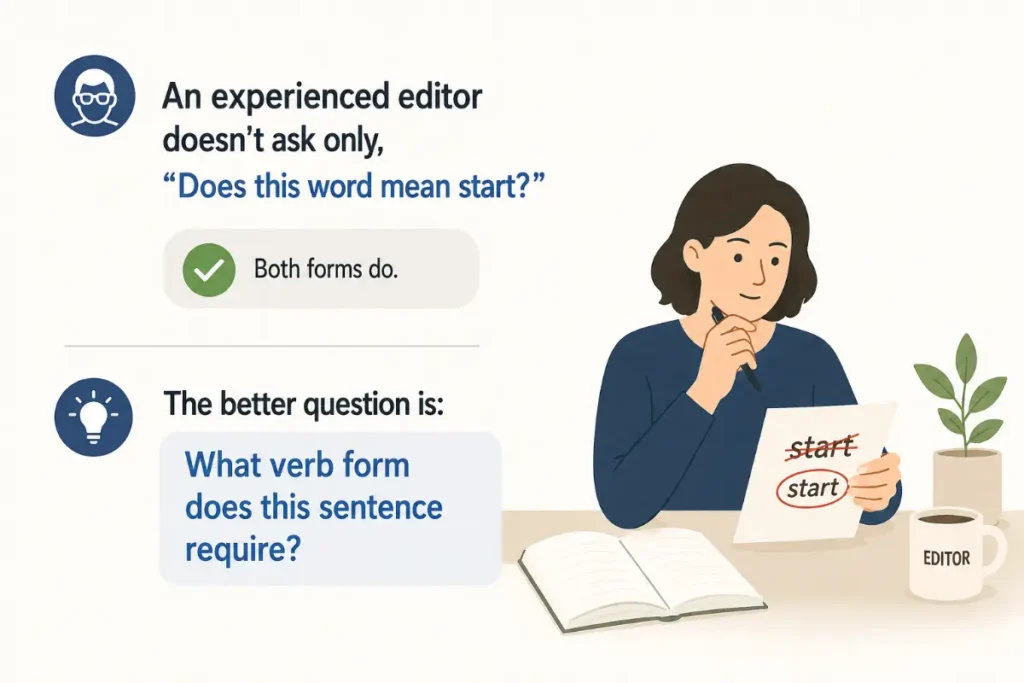
As a senior editor I’d use one simple diagnostic question. Ask yourself if you’re describing a past event by itself or connecting that event to another time through a perfect construction. If the sentence simply reports a past beginning then began is usually right. If the sentence contains has, have, or had then begun is usually the right choice. Grammar checkers often catch these errors but they work best when you understand the pattern yourself. Don’t rely on software to make the decision blindly. Read the entire sentence and identify the tense first.
Conclusion
The choice between begun or began becomes easy once you identify the verb tense. Began is the simple past form of begin, while begun is the past participle. Write The meeting began at nine when you’re describing a past event. Write The meeting has begun when you’re using the present perfect.
Both forms are correct English. The mistake happens when one form is placed in the grammatical position meant for the other. That’s why I have begun is correct while I have began isn’t. Likewise She began yesterday is correct while She begun yesterday isn’t.
A practical tip is to memorize the three forms together: begin, began, begun. Then check the helping verb before choosing the form. If you see has, have, or had, begun is usually your answer. If you’re simply reporting a completed past action, began is normally the right choice.
FAQs
Is Began Correct English?
Yes. Began is the simple past tense of begin. Use it for an action that started and happened in the past.
Is Begun Correct English?
Yes. Begun is the past participle of begin. It must be used with an auxiliary verb such as has, have, or had.
What Is The Difference Between Began And Begun?
Began is the simple past form, while begun is the past participle. For example, “She began the lesson” is correct, while “She has begun the lesson” is correct.
Can I Use Begun Without Has Have Or Had?
Usually, no. Begun normally needs an auxiliary verb. Say “They have begun the project” rather than “They begun the project.”
Is It Began Or Begun Yesterday?
Use began because “yesterday” refers to a completed time in the past. For example, “The meeting began yesterday.”
Is It Has Began Or Has Begun?
Use has begun. The present perfect tense requires the past participle begun. For example, “The movie has begun.”
Is It Had Began Or Had Begun?
Use had begun. After had, you need the past participle begun. For example, “The class had begun before I arrived.”
What Is The Correct Form Of Begin In The Past?
The three main forms are begin, began, and begun. Begin is the base form, began is the simple past, and begun is the past participle.
