
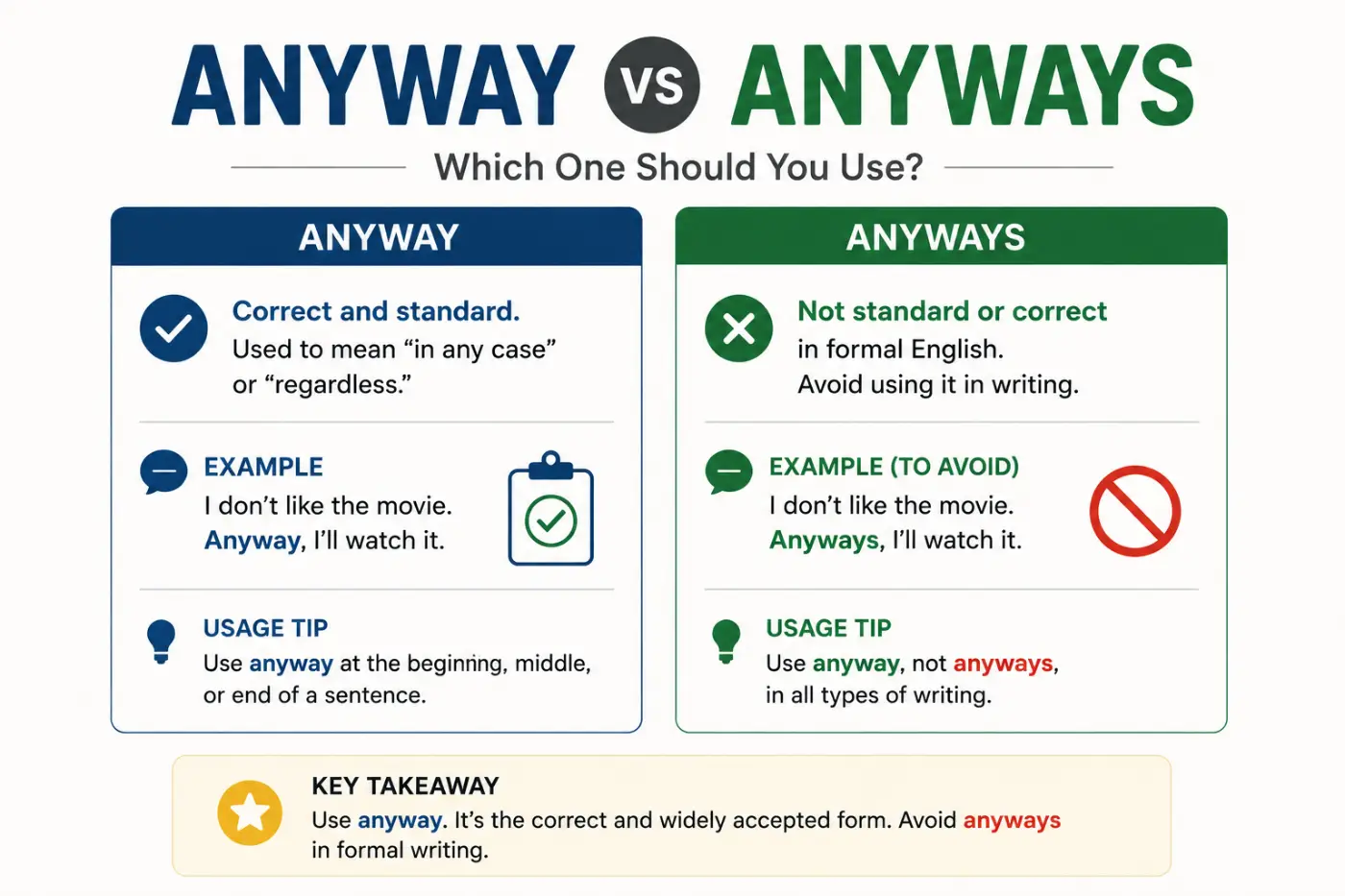
If you’ve ever typed anyway vs anyways and stopped to wonder which one belongs in your sentence you’re not alone. Both forms appear constantly in everyday English. You’ll hear both in conversation and you may see both in texts comments and casual messages.
The short answer is clear. Anyway is the standard form and the safest choice in all types of writing. Anyways is also used in English especially in informal American speech and writing but many style guides and editors consider it less formal.
The confusion exists because English often develops informal forms that sound natural long before they become accepted in formal writing. The ending in anyways can feel perfectly logical because English has many words that take an s ending. Native speakers also use it naturally in casual conversation.
Quick Definition
Anyway is the standard adverb used to mean regardless of that returning to the main point or finally. Anyways has the same basic meaning in casual English but is generally more informal. For professional academic and polished writing anyway is the better choice.
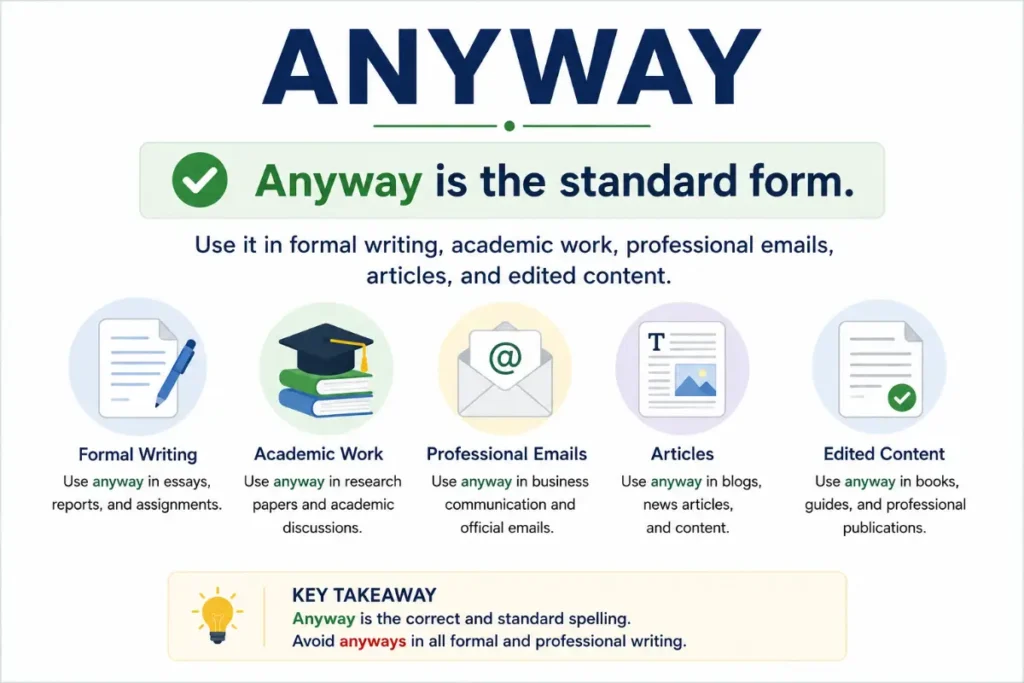
Quick Answer
Anyway is the standard form. Use it in formal writing academic work professional emails articles and edited content.
Anyways appears frequently in casual American English. It isn’t usually treated as a spelling mistake in informal speech but it has a distinctly conversational flavor. If you want the safest choice simply use anyway.
Comparison Table For Anyway Vs Anyways
| Correct Form | Meaning | Part of Speech | Origin | Usage Frequency | Formality | Common Contexts | Example |
|---|---|---|---|---|---|---|---|
| Anyway | Regardless of that or returning to a subject | Adverb | Developed from Middle English expressions involving any and way | Very high | Standard | Formal writing conversation email academic writing | Anyway I decided to go. |
| Anyways | Informal form of anyway | Adverb | Developed as an informal variant of anyway | High in casual speech | Informal | Conversation texting social media casual dialogue | Anyways I decided to go. |
The table shows the practical distinction. The two forms usually communicate the same basic idea. The biggest difference is register. Register simply means the level or style of language appropriate for a particular situation.
That distinction matters because a word can be understandable and common without being the best choice for every setting.
Meaning And Definition
Meaning Of Anyways
Anyways is an informal variant of anyway. It generally means the same thing and can serve similar grammatical functions.
For example:
- Anyways I think we should leave now.
- I was tired but I went anyways.
- Anyways what were you saying?
You’ll hear sentences like these in casual conversation. You may also see them in texts social media posts online comments and dialogue designed to sound natural.
The word isn’t simply a random typo. It has a real history of usage and appears in established dictionaries as an informal form. The problem comes when writers use it in situations that call for standard formal English.
Think of anyways as a relaxed version of a familiar word. It can sound friendly and conversational. In polished prose however it can make the writing feel noticeably casual.
Meaning Of Anyway
Anyway is a standard English adverb with several closely related uses.
One common meaning is regardless of that.
For example:
- It was raining but we went anyway.
- I knew the plan might fail but I tried anyway.
Here anyway means that the previous circumstance did not change the final action.
Another use helps a speaker return to the main topic.
For example:
- Anyway let’s get back to the meeting.
- Anyway I wanted to tell you about the new project.
It can also mean finally or in any case depending on context.
For example:
- Anyway we reached the station before dark.
- I don’t know exactly what happened but anyway the problem is solved.
This flexibility explains why anyway is such a useful word. A single adverb can connect ideas while also signaling a shift in the speaker’s thought.
Key Differences Explained
The difference between these forms becomes much easier when you focus on five areas.
Spelling
Anyway is the standard spelling.
Anyways adds an s at the end. That extra letter doesn’t change the basic meaning but it changes the tone.
If you’re writing an essay a business email a report or an application then anyway is the stronger choice.
Grammar Role
Both forms function primarily as adverbs.
They can modify an action or connect one thought with another. Anyway has a much wider acceptance in edited English while anyways remains strongly associated with informal usage.
Meaning
In most everyday contexts both forms communicate essentially the same idea.
They can express continuation dismissal a return to the main point or a result that happened despite an earlier circumstance.
The difference is rarely about literal meaning. It’s mainly about style.
Tone
Anyway is neutral.
Anyways is more casual and conversational.
That distinction is similar to the difference between speaking carefully during a job interview and chatting with a close friend. Both situations involve English but the language can sound different.
Context
Use anyway when you want your writing to work almost anywhere.
Use anyways when you deliberately want an informal conversational voice and the setting allows it.
That makes anyway the practical default.
Which Spelling Is Correct
Anyway is the standard and preferred form.
Major English dictionaries recognize anyway as an established standard word. Merriam Webster defines it as an adverb with meanings that include regardless of something and in any event. Cambridge Dictionary also lists anyway as the standard adverb and provides examples showing its use in everyday English.
Anyways is also recorded by major dictionaries as an informal variant. That distinction matters. Calling it simply wrong would oversimplify modern English.
The better editorial rule is this. Anyways exists but anyway is the standard form.
Professional editors normally choose anyway unless the writer specifically wants to preserve a casual spoken voice.
This is a useful lesson in English. Dictionary status and editorial suitability aren’t always identical. A word can exist in real English while still being a poor fit for formal prose.
Expert Tip
If you’re unsure which form to use replace anyways with anyway. You’ll almost never create a problem by choosing the standard form.
Sentence Examples
The easiest way to understand usage is to see the word working naturally in real sentences.
Natural Examples With Anyway
- I was tired but I went to the store anyway.
- Anyway I think we should discuss the second option.
- She didn’t agree with the decision but supported the team anyway.
- The weather wasn’t great but we had a good time anyway.
- Anyway let’s focus on what we can do next.
- He knew the answer anyway.
- I wasn’t planning to stay but I stayed anyway.
- Anyway thanks for helping me with the project.
- The restaurant was crowded but we found a table anyway.
- I don’t know why it happened but everything worked out anyway.
Notice how naturally the word moves through different positions. It can appear at the beginning of a sentence or near the end depending on its function.
Examples With Anyways
- Anyways I’ll call you tomorrow.
- I didn’t really want to go but I went anyways.
- Anyways what are we doing tonight?
- She said she was busy but she came anyways.
- Anyways I think we should move on.
These sentences sound conversational. You could easily imagine hearing them in a casual conversation.
In formal writing however the same sentences would usually become:
- Anyway I’ll call you tomorrow.
- I didn’t really want to go but I went anyway.
- Anyway what are we doing tonight?
- She said she was busy but she came anyway.
- Anyway I think we should move on.
The meaning barely changes. The tone does.
Examples Showing The Common Misspelling Problem
Although anyways is a real informal variant many learners treat it as a mistake because formal writing usually calls for anyway.
- I was going to leave anyway.
- We should finish the report anyway.
- Anyway we need to make a decision.
- She knew the answer anyway.
- I decided to help anyway.
These examples demonstrate why anyway remains the safest form for learners and professional writers.
Common Mistakes And Misspellings
Several mistakes appear around this word because people often confuse spelling with pronunciation and informal speech.
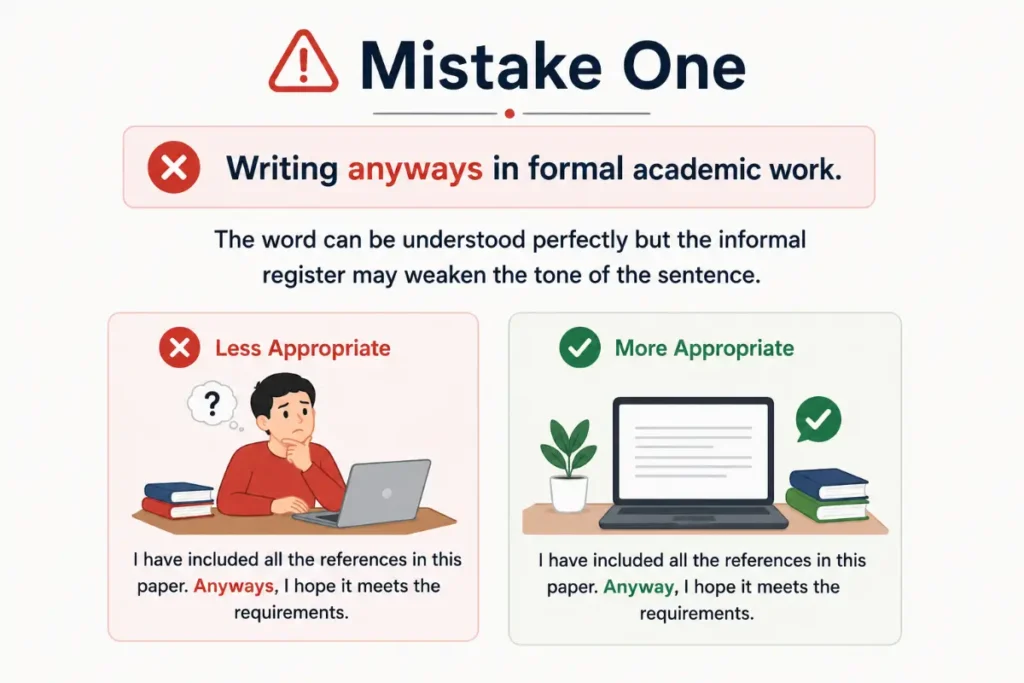
Mistake One
Writing anyways in formal academic work.
The word can be understood perfectly but the informal register may weaken the tone of the sentence.
Mistake Two
Assuming that anyways is always grammatically wrong.
That goes too far. Anyways has a genuine place in informal English. It simply doesn’t have the same standard status as anyway.
Mistake Three
Using anyway without understanding its meaning.
Some learners treat anyway as a filler word. It can act as a discourse marker but it also has a clear meaning related to regardless of a previous circumstance.
Mistake Four
Adding an unnecessary s because other adverbs have similar endings.
English spelling doesn’t always work through simple patterns. Native speakers also develop informal forms based on speech habits.
Mistake Five
Confusing sound with written form.
In fast conversation the final sound of anyways can seem natural. That can reinforce the spelling in memory.
From an NLP perspective this is a useful example of orthographic confusion. Orthography refers to the written representation of language. When a spoken pattern feels familiar the brain can map that sound to a spelling that isn’t the preferred written form.
This is especially common when a learner encounters a word repeatedly in informal conversations online comments and messages.
Pronunciation Guide
Anyway is commonly pronounced with four syllables.
The IPA pronunciation is approximately /ˈeniweɪ/.
You can think of it as:
EN ee way
The main stress falls on the first syllable.
Anyways is commonly pronounced approximately /ˈeniweɪz/.
That can be remembered as:
EN ee ways
The main difference is the final z sound.
A common pronunciation mistake happens when learners stress the wrong part of the word. Native speakers usually give the strongest stress to the first syllable.
Listen mentally to the rhythm:
EN ee way
Not:
en EE WAY
When speaking naturally the word often becomes lighter and faster because it functions as a common connecting adverb.
Etymology And Word Origin
The history of anyway is more interesting than its simple appearance suggests.
The word developed from older English combinations involving any and way. The basic idea was connected to proceeding by any manner or by any means. Over time the expression developed into the modern adverb anyway.
English has long created adverbs and expressions by combining ordinary words. This process helped produce many forms that now feel completely natural to native speakers.
The modern meaning developed from the broader idea of proceeding regardless of circumstances. That explains why anyway can mean something like regardless of that or in any case.
For example:
I knew it would be difficult but I tried anyway.
The sentence carries the original conceptual idea. The difficulty existed but it didn’t stop the action.
The word also developed a discourse function. Speakers began using anyway to return to a topic or move a conversation forward.
For example:
Anyway let’s talk about the next issue.
Here the word doesn’t describe an action directly. Instead it helps organize the conversation.
Anyways developed as a variant of the established form. Its history reflects a broader pattern in English where speakers add endings or reshape familiar words in casual speech.
That doesn’t automatically make the newer form incorrect. It simply gives the form a different place in the language.
Regional Usage In The US
In the United States both forms can be heard in everyday conversation.
Anyway is standard across American English and appears in formal and informal settings.
Anyways is common in casual speech and informal writing. You may encounter it in conversations texts social media comments and dialogue.
American speakers may use it without thinking about the distinction. Still many American editors teachers and style guides favor anyway in polished writing.
For an American audience the safest rule is simple. Use anyway by default. Save anyways for intentionally casual situations.
Regional Usage In The UK
British English also uses anyway as the standard form.
Anyways appears in informal speech and can be found in British usage. It isn’t the normal choice for formal edited prose.
If you’re writing for a British publication university or workplace then anyway is the better choice.
The difference isn’t really an American versus British spelling issue. It’s primarily a standard versus informal usage issue.
Regional Usage In Australia
Australian English follows much the same pattern.
Anyway is the standard form used across ordinary and formal writing.
Anyways can appear in casual conversation and informal communication. It may sound natural in relaxed speech but it isn’t generally the preferred form for polished professional writing.
So Australian readers won’t usually need a different spelling rule. The standard choice remains anyway.
Regional Usage In Canada
Canadian English also uses anyway as the standard form.
Anyways occurs in informal communication and conversational language. Canadian writers who follow formal editorial standards will generally choose anyway.
This means there isn’t a major regional spelling divide here. The distinction is mainly based on formality and context.
Grammar Rules And Part Of Speech
Anyway functions primarily as an adverb.
One of its most common uses expresses that something happened despite a previous condition.
For example:
I was exhausted but I finished the assignment anyway.
The word modifies the overall situation. It tells the reader that the previous condition did not prevent the result.
Another common use places anyway at the beginning of a sentence as a discourse marker.
For example:
Anyway I need to get back to work.
Here it helps signal a transition.
It can also appear in the middle of a sentence.
For example:
I anyway planned to call her later.
This position is grammatically possible but often sounds less natural in everyday American English. Writers usually prefer a placement that makes the sentence flow naturally.
At the end of a sentence it can emphasize continuation despite circumstances.
For example:
I didn’t think we would win but we did anyway.
Punctuation With Anyway
When anyway begins a sentence as a transition it can often be followed by a comma.
For example:
Anyway I decided to stay.
Many writers may also use:
Anyway I decided to stay.
The punctuation depends on the role and rhythm of the word. If anyway is functioning as a sentence adverb or discourse marker a comma can help signal the pause.
At the end of a sentence it normally doesn’t require special punctuation.
For example:
I decided to go anyway.
The key is not to treat punctuation as a fixed rule for every sentence. Consider the function of the word and the natural rhythm of the sentence.
Real Life Usage Examples
Daily Talk
Everyday conversation is where you’re most likely to hear both forms.
- Anyway I’ve got to go home.
- I didn’t want dessert but I ordered it anyway.
These sound completely natural in casual speech.
In professional email writing anyway is normally the better choice.
- Anyway I’ve attached the updated document for review.
- I appreciate your help anyway and hope we can resolve the issue soon.
For a formal business message you can often replace anyway with a more precise phrase if needed.
Academic Writing
Academic writing generally favors standard neutral vocabulary.
- The evidence was limited but the researchers continued anyway.
- Anyway should not normally replace a more precise logical connector when the argument requires one.
In serious academic prose clarity matters more than conversational flavor. Use the word only when it contributes a clear meaning.
News Writing
News writing typically uses standard English.
- The team faced several setbacks but continued anyway.
- Anyway can be useful in quoted speech when a journalist wants to preserve the speaker’s natural voice.
A news article may contain anyways inside a direct quotation because the reporter is reproducing the speaker’s wording.
Literature
Fiction gives writers more freedom.
A novelist may use anyways to make dialogue sound relaxed authentic or regionally natural.
- Anyway I’ll see you tomorrow.
- Anyways I wasn’t going to stay long.
In literature the choice can help characterize a speaker. That doesn’t mean the author considers the informal form standard. It means the form serves a stylistic purpose.
Related And Confused Terms
Several words and phrases overlap with the meaning of anyway. They aren’t perfect substitutes in every sentence but they can help you understand the semantic field.
- At last usually emphasizes that something happened after a long wait.
- Eventually means something happened after some time or after a sequence of events.
- Ultimately points toward the final result or conclusion.
- At the end usually refers to the final point in a sequence or location.
- Conclusively means in a way that settles an issue or proves something decisively.
- In the end commonly introduces the final outcome after considering earlier events.
- Lastly introduces the final item in a sequence.
- In any case is one of the closest alternatives to anyway in many contexts.
These words shouldn’t be swapped mechanically. Each one carries its own shade of meaning.
For example:
I was tired but I went anyway.
The closest natural replacement is:
I was tired but I went in any case.
But:
Eventually I went.
has a different meaning because eventually focuses on time rather than simply ignoring an obstacle.
Expert Editor Insight
As an editor I’d treat anyway as the default form without hesitation. It’s standard neutral English and works in everything from casual conversation to formal prose. I’d allow anyways when the context is deliberately conversational especially in dialogue or quoted speech. Grammar and spell checking software may flag anyways in formal contexts because many style systems prefer the standard form. That doesn’t mean the software is claiming the variant has never existed. It usually means the word doesn’t match the expected register.
A useful editing test is to read the sentence aloud. If the word sounds like a casual conversational aside ask yourself if the surrounding writing has the same tone. If it does then the choice may be intentional. If the rest of the passage is formal then anyway will usually fit better.
Why Native Speakers Use Anyways
Language doesn’t stay frozen.
People shorten phrases reshape words and create variants through everyday speech. Some of these forms disappear. Others become accepted. Some remain informal for generations.
Anyways belongs to this broader pattern.
The ending can feel natural because English has many words that change form through suffixes. Speakers also learn language through conversation rather than dictionaries alone. If someone repeatedly hears anyways from family friends classmates or media then the form becomes familiar.
That familiarity explains why people sometimes assume the word must be standard everywhere.
But familiarity and formality aren’t the same thing.
You can know a word extremely well and still choose another form for professional writing.
That’s exactly how you should think about this comparison.
When To Use Anyway
Use anyway when you want a neutral standard choice.
It works well in:
- Academic assignments.
- Business emails.
- Professional reports.
- Articles and blog posts.
- Formal correspondence.
- Resumes and applications.
- Educational materials.
- General edited writing.
- Everyday conversation.
- Most situations where you’re unsure about the appropriate register.
There’s very little downside to choosing anyway.
It’s the linguistic equivalent of a dependable pair of shoes. It works almost everywhere.
When Anyways Can Work
Anyways can work when the writing intentionally sounds informal.
Good contexts include:
- Casual text messages.
- Friendly conversations.
- Informal social media posts.
- Fictional dialogue.
- Personal messages.
- Casual online discussions.
Even in these settings you don’t need to use anyways. It’s a style choice rather than a requirement.
If you’re writing for a broad audience and want clean standard English then anyway remains the better option.
Why The Extra S Causes Confusion
The extra s is easy to overlook because the spoken forms can sound similar.
Human language processing relies heavily on patterns. Once a familiar sound sequence enters your memory your brain can retrieve it quickly without consciously checking every letter.
This is one reason spelling errors can survive even in experienced writers.
The writer isn’t necessarily confused about the meaning. The writer may simply be retrieving a familiar spoken form and converting it into written language.
This kind of mistake is especially common with words that have informal variants.
The solution isn’t memorizing a complicated grammar rule.
The solution is remembering one simple editorial principle:
Anyway is the standard default.
Once that rule becomes automatic you won’t need to pause every time you type the word.
Anyway Vs Anyways In Formal Writing
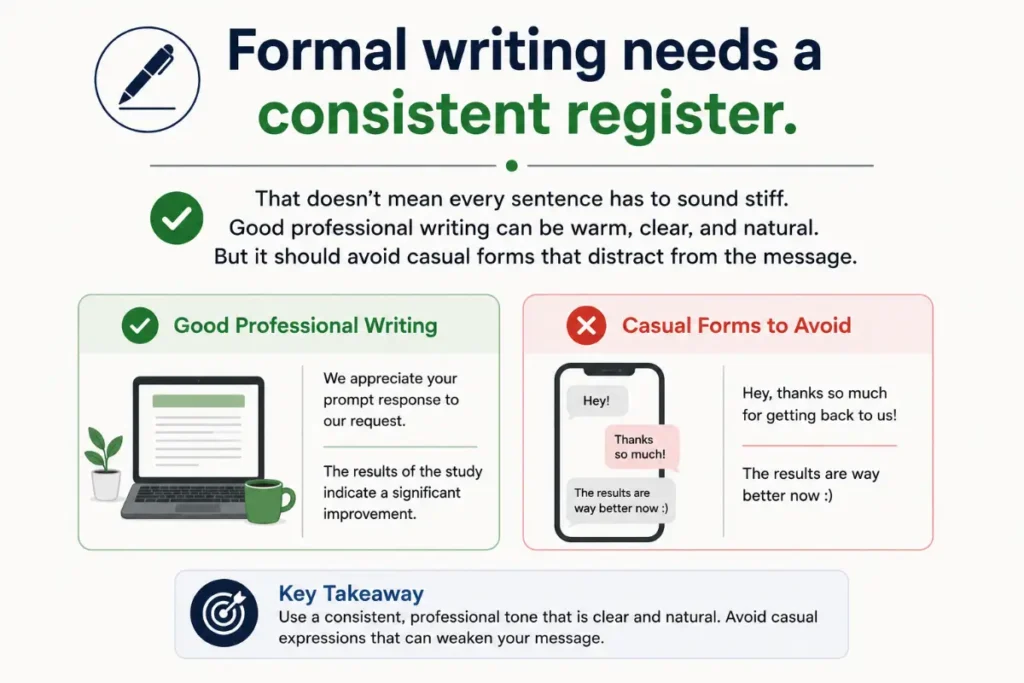
Formal writing needs a consistent register.
That doesn’t mean every sentence has to sound stiff. Good professional writing can be warm clear and natural. But it should avoid casual forms that distract from the message.
That’s why anyway usually wins.
Consider:
I was disappointed but I submitted the application anyway.
This sounds neutral and polished.
Now compare:
I was disappointed but I submitted the application anyways.
The second sentence is perfectly understandable but sounds more conversational.
Neither version creates a serious communication problem. The first simply fits a wider range of situations.
When your reputation or credibility matters choose the standard form.
Anyway Vs Anyways In Casual Speech
Casual speech is different.
People rarely speak with the same level of editing they use in formal writing. Conversation includes shortcuts fillers repetitions informal expressions and regional patterns.
Anyways can fit naturally into that environment.
For example:
Anyways I’ve got to head home.
The speaker may sound relaxed and informal.
A more neutral version is:
Anyway I’ve got to head home.
Both communicate the same basic idea.
The choice is largely about voice.
Conclusion
When comparing anyway vs anyways the safest answer is simple. Anyway is the standard form and works in both formal and informal English. Anyways is an informal variant that appears frequently in casual conversation and relaxed writing. The two forms usually carry the same basic meaning so the main difference is tone rather than meaning. If you’re writing for school work business publication or any professional audience choose anyway.
If you’re writing realistic dialogue or an informal message then anyways can sound natural. One practical tip can save you from second guessing yourself. When you’re unsure use anyway. It’s standard clear familiar and accepted across English varieties.
Frequently Asked Questions
Is Anyway Or Anyways Correct?
Anyway is the standard form in English. Anyways is an informal variant that’s common in casual speech and writing. For formal writing such as essays emails reports and professional content anyway is the safer choice.
Is Anyways A Real Word?
Yes. Anyways is an established informal variant of anyway. It isn’t usually treated as a simple spelling mistake. However it sounds more casual and is less suitable for formal or academic writing.
Can I Use Anyways In Formal Writing?
You can but it’s usually better to avoid it. Standard edited English generally favors anyway. Use anyways mainly when you want your writing to sound relaxed conversational or intentionally informal.
What Is The Difference Between Anyway And Anyways?
The main difference is tone rather than meaning. Anyway is the standard neutral form. Anyways is more informal. Both can express ideas such as regardless of that or in any case.
Is Anyway More Common Than Anyways?
Yes. Anyway is the standard form and has much broader use across formal and informal English. Anyways appears often in casual conversation texting social media and informal dialogue.
Can Anyway Start A Sentence?
Yes. Anyway can naturally begin a sentence when you want to return to a topic or move the conversation forward. For example: Anyway I need to finish this report before lunch.
Should I Use Anyway Or Anyways In An Essay?
Use anyway. Academic writing generally favors standard neutral English. Anyways may sound too conversational for an essay or research paper unless you’re intentionally reproducing someone’s speech.
Which One Should I Use In American English?
Use anyway as your default choice. American speakers commonly use anyways in casual conversation but anyway works naturally in both casual and formal American English.
