
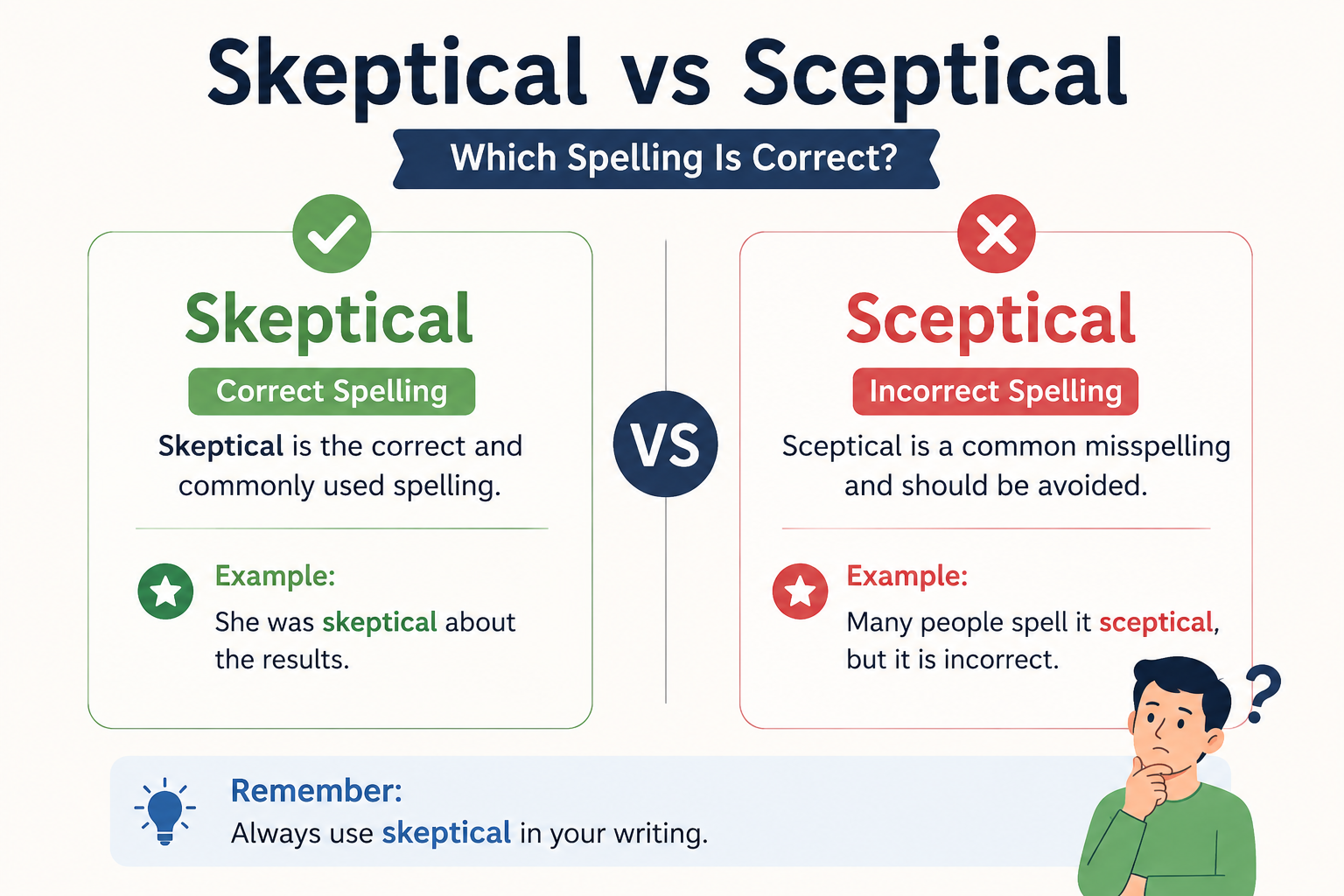
If you’ve seen two different spellings of the same word and wondered which one is correct, you’re not alone. Skeptical vs sceptical comes down to a simple difference in regional spelling. Both forms describe a person who questions a claim or wants evidence before accepting something as true.
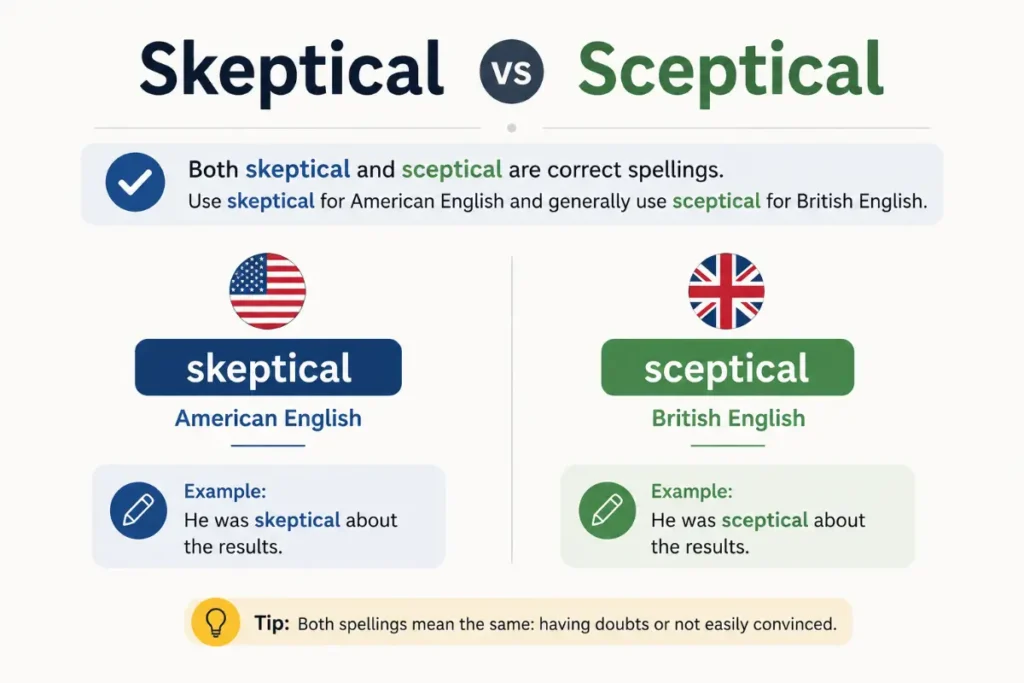
In American English, skeptical is the standard spelling. In British English, sceptical is also widely accepted and traditionally preferred, although skeptical appears in British writing too. The meaning stays the same, so you don’t need to learn two definitions or use the words differently in a sentence.
The confusion often comes from the way English spelling developed across different regions. American English commonly uses the letter combination sk in this word, while traditional British spelling often uses sc. Similar patterns appear in other words, such as skeptic and sceptic.
Understanding this distinction helps you write with confidence at school, at work, in academic papers, and online. The key is to match your spelling to your audience and stay consistent throughout your writing.
Quick Answer
Skeptical is the standard spelling in American English, while sceptical is a standard variant commonly used in British English and other varieties of English. Both words mean questioning a claim or requiring evidence before accepting it. Neither spelling is inherently incorrect. Choose the form that fits your audience and follow one spelling convention consistently.
Comparison Table
| Feature | Skeptical | Sceptical |
|---|---|---|
| Meaning | Doubting a claim or idea | Doubting a claim or idea |
| Part of speech | Adjective | Adjective |
| Standard in American English | Yes | Less common |
| Standard in British English | Accepted variant | Traditional preferred form |
| Pronunciation | /ˈskɛptɪkəl/ | /ˈskɛptɪkəl/ |
| Word origin | Greek through Latin and French traditions | Greek through Latin and French traditions |
| Formality | Suitable for formal and informal writing | Suitable for formal and informal writing |
| Common contexts | US news, schoolwork, business, everyday speech | UK publications, British schoolwork, everyday speech |
| Related noun | Skeptic | Sceptic |
| Related noun for the attitude | Skepticism | Scepticism |
Major dictionaries recognize both spellings and identify their regional preferences. Cambridge labels the form with a k as mainly American and the form with a c as usually British. Oxford also distinguishes North American and British usage while giving both forms the same basic meaning.
Meaning and Definition
What Does Skeptical Mean
Skeptical is an adjective that describes someone who doubts a claim, questions an explanation, or wants stronger evidence before believing something. It can also describe an attitude, response, expression, or point of view that shows doubt.
For example, imagine a friend tells you that a new phone battery lasts five days on one charge. You might feel skeptical because the claim sounds unlikely. Instead of accepting it immediately, you ask to see independent tests or reviews.
The word doesn’t automatically mean that someone rejects an idea. A skeptical person may accept the claim after reviewing reliable evidence. The central idea is a willingness to question rather than believe without enough support.
Common grammatical patterns include these.
- Skeptical about something. Example: She is skeptical about the proposed schedule.
- Skeptical of someone or something. Example: The committee remained skeptical of the explanation.
- Skeptical that something will happen. Example: I’m skeptical that the plan will succeed.
- A skeptical attitude or response. Example: His skeptical response prompted the team to provide more evidence.
All four patterns work in standard English. The best choice depends on the sentence and the point you want to express.
Is Sceptical a Real Word
Yes. Sceptical is a legitimate English spelling, not a typo or an invented alternative. It is the traditional British form of the adjective and appears in established dictionaries.
The spelling doesn’t create a new meaning. A British writer can describe a doubtful customer as sceptical, while an American writer can describe the same customer as skeptical. Both sentences communicate the same idea.
The same distinction applies to the noun forms. A skeptic is a person who questions a claim, while a sceptic is the equivalent form commonly used in British English. Neither noun changes the underlying meaning of the adjective.
What Does the Word Mean in Different Contexts
The word can express different degrees of doubt depending on the situation.
- In everyday conversation, it may show mild doubt. For example, a person might be skeptical about a restaurant’s claim that it serves the best pizza in town.
- In science, it can describe a careful approach that asks for reliable evidence, repeatable results, and sound reasoning.
- In business, it may describe a manager who wants proof that a proposed strategy will improve sales.
- In journalism, it can describe a reporter who checks a public claim instead of repeating it without verification.
- In personal relationships, it can describe someone who has doubts about a promise or explanation.
Context matters because doubt can be reasonable or unreasonable. A scientist who questions weak evidence may be applying sound judgment. A person who rejects every available fact simply because it conflicts with a personal belief may be acting more rigidly than thoughtfully.
Key Differences Explained
Spelling
The clearest difference is one letter. The American form uses k after the initial s, while the traditional British form uses c.
- American English uses skeptical.
- British English commonly uses sceptical.
- Both spellings follow recognized English usage.
- The spelling difference doesn’t change the definition.
The same pattern appears in related words. American English generally uses skeptic and skepticism, while British English traditionally uses sceptic and scepticism. The related adverbs are skeptically and sceptically.
This pattern is useful because it helps you keep a whole family of words consistent. If your article follows American spelling, using skeptical, skeptic, skepticism, and skeptically will usually make sense. If you’re following a British style guide, the forms with c may fit better.
Meaning
Neither form expresses more doubt than the other. The spelling alone doesn’t tell readers how strongly someone questions an idea.
For example, an American writer might say, “The voters were skeptical about the proposal.” A British writer might write, “The voters were sceptical about the proposal.” The sentences have the same meaning.
The degree of doubt comes from the surrounding words. Someone can be slightly skeptical, deeply skeptical, openly skeptical, or increasingly skeptical. Those descriptions work with the British spelling too.
Grammar and Part of Speech
Both spellings function as adjectives. They describe nouns or follow linking verbs to explain a person’s attitude or a situation.
Consider these examples.
- Before a noun. The skeptical customer requested a refund.
- After a linking verb. The customer seemed skeptical.
- After an adverb. The customer remained highly skeptical.
- In a longer description. The proposal sounded promising but left the board skeptical.
The grammatical rules remain the same across both regional forms. You don’t need a different sentence structure when switching between them.
Pronunciation
In standard American and British dictionary pronunciations, the two forms sound alike or very nearly alike. The initial consonant sound is /sk/, and the main stress falls on the first syllable. The letter c in the British spelling doesn’t create a separate pronunciation.
That point can surprise learners who expect a change in sound whenever the spelling changes. English doesn’t always work that way. Some spelling differences reflect historical and regional conventions rather than differences in speech.
Formality
Both forms are suitable for formal writing. You can use either in a research paper, business report, newspaper article, professional email, or academic discussion.
The main concern is consistency. An American university paper will generally look more natural with skeptical and skepticism. A British publication may prefer sceptical and scepticism according to its house style.
Neither version sounds more intelligent or more professional by itself. A clear sentence supported by good reasoning matters far more than the choice between k and c.
Standard and Nonstandard Usage
A common misconception is that one spelling must be wrong because a word processor marks it with a red underline. In many cases, the software simply uses a dictionary set to a different regional variety.
For example, an American spellchecker may flag sceptical because it expects American spelling. A British spellchecker may prefer sceptical and flag skeptical as a regional variant. That warning doesn’t prove that the other form is incorrect.
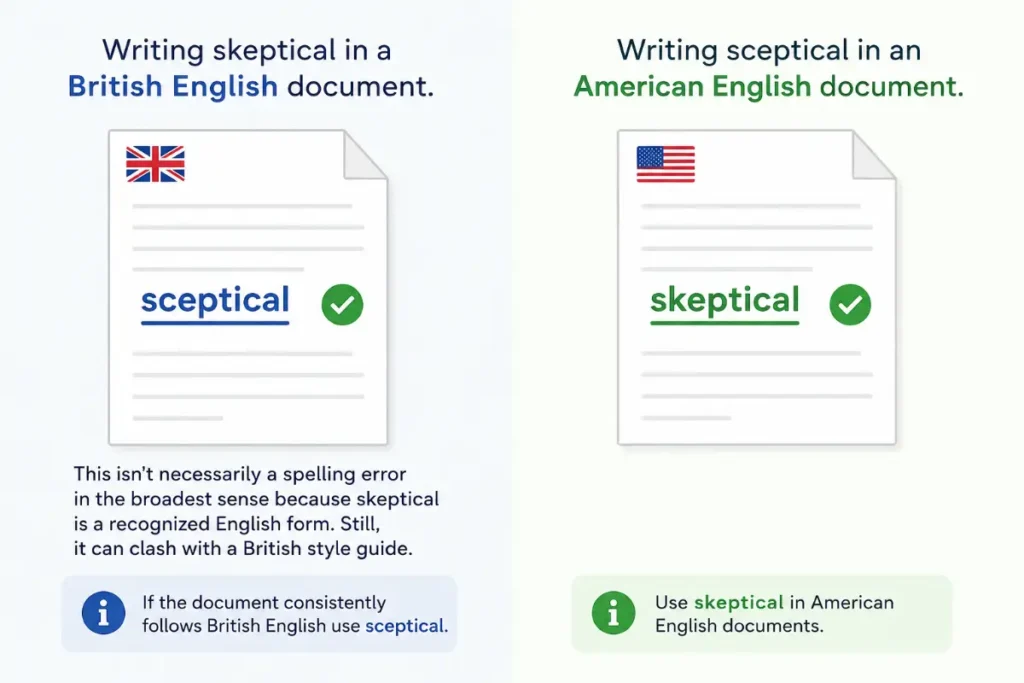
Check the document’s language settings before changing a spelling. If the audience is American, use the American form. If the audience is British, follow the publication’s preferred convention.
Which Form Is Correct
Both forms are correct, but the best choice depends on your audience. For writing intended for readers in the United States, use skeptical. It is the usual American spelling recognized by major dictionaries. The same convention applies to skeptic, skepticism, and skeptically.
For writing intended for readers in the United Kingdom, sceptical is a traditional and widely accepted choice. British publications may still use skeptical, especially when a particular organization, subject area, or editorial policy favors that spelling.
The underlying linguistic reason is regional spelling variation. English developed different written conventions in different places, and not every word followed a single worldwide standard. Both forms preserve the same word and meaning.
Use this simple decision rule.
- Writing for an American audience. Choose skeptical.
- Writing for a British audience. Choose sceptical unless the publication says otherwise.
- Writing for an international audience. Pick one recognized convention and apply it consistently.
- Quoting a source or preserving an official name. Keep the original spelling when accuracy requires it.
You don’t need to correct a British writer for using sceptical or an American writer for using skeptical. Instead, check the intended audience and the relevant style guide.
Sentence Examples
The following examples show how the American spelling works in ordinary and professional writing.
- Everyday conversation. I’m skeptical about the deal because the price seems too good to be true.
- Text messages. I’m still skeptical, so send me the reviews before I buy it.
- Workplace communication. Our team remains skeptical of the proposed changes until we see the results.
- Schoolwork. A skeptical reader should examine the evidence before accepting the author’s argument.
- Academic writing. The researchers were skeptical of the initial findings and requested additional testing.
- Formal writing. The committee expressed a skeptical view of the plan because its costs remained unclear.
- Social situations. He looked skeptical when his friend claimed to have learned Spanish in a week.
- Online communication. Be skeptical of posts that make dramatic claims without showing reliable evidence.
- News reporting. Several lawmakers remained skeptical about the agency’s explanation.
- Storytelling. Mara gave him a skeptical glance, folded her arms, and waited for him to explain.
These sentences use the same spelling in different settings. Notice that the word describes doubt rather than proving that a claim is false.
For British English, you can use the same examples and replace skeptical with sceptical. The grammar and meaning remain unchanged.
Common Spelling Mistakes
The main issue is regional spelling, but several related errors can cause confusion. Learning the correct word family makes these mistakes easier to spot.
1. Using sceptical in American writing without a reason. The spelling is legitimate, but skeptical is the usual American choice. For example, write “The customer was skeptical” in a document that follows US English.
2. Mixing skeptical and scepticism. Both forms exist, but they follow different regional conventions. American writing generally uses skepticism, while traditional British writing uses scepticism. Keep the adjective and noun consistent.
3. Writing sceptic when the document uses American spelling. Sceptic is a recognized variant, but skeptic is the usual American noun. A sentence such as “The skeptic asked for proof” fits standard US spelling.
4. Confusing skeptical with sceptical pronunciation. The spelling changes, but the standard pronunciation remains essentially the same. Avoid inventing a different sound for the c version.
5. Treating skeptical as a synonym for cynical in every context. The words overlap, but they aren’t interchangeable in all situations. A skeptical person asks for evidence, while a cynical person may assume that people act from selfish motives.
Another common error is using the adjective where a noun is needed. For example, “She is a skeptical” is incomplete in ordinary English. Write “She is skeptical” or “She is a skeptic” instead.
Pronunciation Guide
Both forms have essentially the same standard pronunciation.
Skeptical and sceptical
IPA pronunciation
/ˈskɛptɪkəl/
Syllables
skep · ti · cal
Easy pronunciation
SKEP tih kuhl
Stress pattern
Stress the first syllable.
The first sound is /sk/, as in skill and skin. The middle syllable has a short, unstressed vowel, and the final syllable sounds like a reduced form of the word call without a strong, separate emphasis.
A common mistake is to pronounce every syllable with equal force. English usually gives the first syllable the strongest stress in this word. Another mistake is to assume the c in the British spelling changes the sound. It doesn’t create a meaningful difference in standard pronunciation.
The related noun skeptic or sceptic has two syllables and is commonly represented as /ˈskɛptɪk/. The related noun skepticism or scepticism has four syllables in typical pronunciation, with the main stress on the first.
Etymology and Word Origin
The word traces back to the Greek term skeptikos, associated with inquiry, examination, and doubt. It entered English through the historical development of philosophical vocabulary, with French and Latin forms contributing to its transmission. Oxford identifies the related noun sceptic as dating from the late sixteenth century in a philosophical sense.
The spelling with sc reflects older European spelling traditions, while the form with sk more directly reflects the consonant sound at the beginning of the Greek root. English retained both forms, and regional preferences developed over time.
The American preference for skeptical fits a broader pattern of spelling differences between American and British English. However, the history of this individual word is more specific than a simple rule about American spelling. The two forms coexist because English spelling preserves influences from different historical stages.
You don’t need to memorize the full history to use the word correctly. The useful point is that both spellings have legitimate roots, and neither is a modern typo.
Regional Usage
American English
Skeptical is the normal spelling in the United States. American dictionaries and general editorial practice favor the k form in the adjective, noun, and related words.
Use these forms in US writing.
- Skeptical.
- Skeptic.
- Skepticism.
- Skeptically.
These forms work in everyday messages, academic papers, business reports, newspapers, and government documents. A US audience will generally recognize sceptical as a British spelling rather than a different word.
British English
Sceptical is the traditional British spelling and remains widely used. The related forms are sceptic, scepticism, and sceptically.
British English also recognizes skeptical and its related forms. Some publications and specialist communities use the k spelling, so the intended house style matters more than a blanket rule that one form is always wrong.
Australian English
Australian English generally follows many British spelling conventions, so sceptical is a familiar and appropriate choice. However, usage can vary by publisher and context. Follow the spelling guide used by the organization or publication you’re writing for.
Canadian English
Canadian English combines features of British and American spelling. In practice, both forms can appear, though the preferred spelling may depend on the publisher, dictionary, or style guide. For a Canadian document, check the required standard instead of assuming that every word follows one regional pattern.
Across all four varieties, the meaning stays the same. Regional spelling guides help readers recognize the expected written form without changing the idea being expressed.
Grammar Rules and Part of Speech
Both spellings are adjectives. They describe a person’s attitude or the quality of a statement, response, or viewpoint.
How to Use the Word in a Sentence
You can place the adjective before a noun.
- The skeptical investor requested more financial details.
- We received a sceptical response from the review panel.
You can also place it after linking verbs such as be, seem, look, and remain.
- The audience was skeptical.
- Her explanation seemed sceptical to the committee.
The adjective commonly appears with about, of, and that.
- Skeptical about. He is skeptical about the offer.
- Skeptical of. She remained skeptical of the explanation.
- Skeptical that. I’m skeptical that the deadline can be met.
These patterns are all grammatical. Choose the one that communicates your point most naturally.
Adverbs and Nouns
The adjective also has related forms that serve different grammatical functions.
| Word | Part of speech | Example |
|---|---|---|
| Skeptical | Adjective | The skeptical buyer asked questions. |
| Skeptically | Adverb | She looked at the claim skeptically. |
| Skeptic | Noun | The skeptic asked for evidence. |
| Skepticism | Noun | His skepticism was understandable. |
British spelling typically changes these to sceptical, sceptically, sceptic, and scepticism. The grammatical role of each word remains the same.
Capitalization and Punctuation
The word doesn’t need a capital letter unless it begins a sentence or appears in a title that follows title case. It doesn’t require special punctuation or a different sentence structure.
For example, “I’m skeptical about the result” is a complete sentence. You don’t need quotation marks around the word unless you’re discussing the spelling itself or quoting someone.
Real Life Usage Examples
Daily Conversation
In ordinary speech, the word often expresses doubt without sounding hostile.
- “I’m skeptical about that restaurant’s five star claim. Let’s read a few reviews first.”
- “She was skeptical at first, but the demonstration changed her mind.”
Email and Workplace Communication
In professional settings, the adjective can communicate caution while keeping the tone respectful.
- “I’m skeptical of the projected savings until we review the full budget.”
- “The client remains skeptical about the timeline, so we should share the latest progress report.”
Academic Writing
Academic use often connects doubt with evidence, method, and critical thinking.
- “The author takes a skeptical approach to the earlier interpretation.”
- “Researchers remained skeptical of the initial results until other teams replicated the experiment.”
News and Journalism
In reporting, the word can describe public reactions or the response of officials to a claim.
- “Residents were skeptical of the proposed redevelopment plan.”
- “Several officials remained skeptical about the promised cost reductions.”
Literature and Storytelling
In fiction, the word can reveal a character’s feelings through speech, expression, or behavior.
- “He gave her a skeptical look, unsure that her story added up.”
- “Although skeptical of the stranger’s promise, she decided to hear him out.”
These examples demonstrate the word’s range. It can describe careful reasoning, personal hesitation, professional caution, or a character’s reaction. The surrounding context determines the tone.
Related and Confused Terms
Several words describe doubt, but each carries a slightly different meaning. Choosing the right one helps you express your point more precisely.
1. Doubtful. This describes uncertainty about a claim or outcome. For example, “I’m doubtful that the package will arrive today” focuses on uncertainty about a specific event.
2. Questioning. This describes someone who examines an idea or asks for clarification. A questioning approach can involve skepticism, but the word doesn’t always imply disbelief.
3. Suspicious. This suggests concern that something may be wrong, dishonest, or unsafe. A suspicious customer may suspect fraud, while a skeptical customer may simply want more evidence.
4. Cynical. This describes a tendency to expect selfish motives or negative behavior. Cynicism often reflects distrust of people, while skepticism focuses more directly on claims and evidence.
5. Wary. This means cautious because of a possible risk. A wary traveler may check a booking carefully before paying.
6. Incredulous. This describes strong disbelief or difficulty accepting something as true. It often expresses a more intense reaction than ordinary skepticism.
7. Credulous. This is close to the opposite of skeptical. A credulous person tends to believe claims too readily, sometimes without checking the evidence.
8. Open minded. This describes someone who is willing to consider different ideas. A person can be open minded and skeptical at the same time by listening fairly while asking for good evidence.
These distinctions matter in careful writing. Use skeptical when you want to show a reasoned doubt, cynical when you want to highlight distrust of motives, and suspicious when you want to suggest possible wrongdoing.
Expert Editor Insight
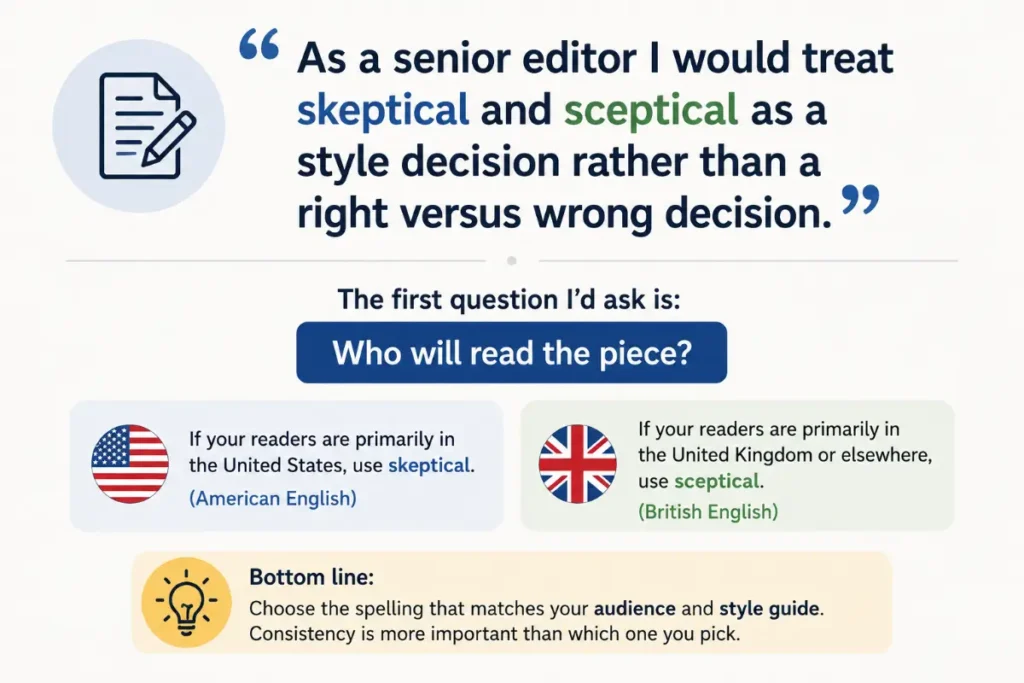
An experienced editor treats the spelling choice as a matter of audience and consistency, not intelligence or correctness in isolation. In a US publication, I’d normally standardize the text to skeptical, skeptic, and skepticism. If a British source uses sceptical, I’d preserve it in a direct quotation and follow the publication’s rules elsewhere. Spellcheckers can help, but they may flag valid regional forms when their language settings don’t match the document. The best editing habit is to check the audience, confirm the intended spelling convention, and apply it across the entire piece.
Conclusion
The choice in skeptical vs sceptical depends on your audience, not the meaning of the word. Both spellings are correct, and both describe a person who questions claims or looks for evidence before accepting an idea. For American readers, use skeptical. For British readers, sceptical is the traditional choice.
In international writing, follow the style guide that best fits your audience and keep related words consistent. Here’s an easy memory tip. American English favors the k spelling in skeptical, skeptic, and skepticism. British English traditionally favors the c spelling in sceptical, sceptic, and scepticism. Once you know your audience, the choice becomes simple.
FAQs
Is sceptical a real word in English?
Yes. Sceptical is a recognized English adjective, especially common in British English. It has the same meaning as skeptical and describes someone who doubts a claim or wants evidence before accepting it. American English generally prefers the spelling with k, but the spelling with c isn’t inherently wrong.
What does skeptical mean in simple words?
Skeptical means not fully convinced that something is true. A skeptical person asks questions or looks for evidence before deciding what to believe. For example, you might feel skeptical about an online advertisement that promises unusually fast results. That doesn’t mean the claim must be false. It means you need more information.
Which spelling should I use in the United States?
Use skeptical in American English. It’s the standard spelling for school assignments, business emails, articles, reports, and everyday writing. Use the related forms skeptic, skepticism, and skeptically to maintain consistency. If you’re following a specific publisher’s style guide or preserving an official name, follow that requirement instead.
How do you pronounce both spellings?
Both spellings are pronounced essentially the same way in standard English. The IPA transcription is /ˈskɛptɪkəl/, with the strongest stress on the first syllable. The opening sound matches the beginning of skill, and the remaining syllables are unstressed. The extra c in the British spelling doesn’t require a different pronunciation.
Can skeptical start a sentence?
Yes. You can begin a sentence with the adjective when it describes a person or group. For example, “Skeptical of the results, the researchers requested another test.” The opening phrase describes the researchers. Make sure the sentence clearly identifies the person or group being described so the meaning remains easy to follow.
What is a good synonym for skeptical?
Doubtful is a useful synonym when you want to express uncertainty. Questioning works when someone examines a claim, while wary suggests caution about possible risks. Cynical has a stronger focus on distrust of motives. Choose the word that matches your intended meaning instead of replacing skeptical with a synonym in every situation.
Why do people confuse the two spellings?
People often encounter both American and British English online, in books, and at work. Since the words have the same meaning and pronunciation, the single letter difference can be easy to miss. Spellcheckers can add to the confusion when their regional settings differ from the spelling used in a document.
Is skeptical appropriate for formal writing?
Yes. Skeptical is appropriate in formal American English, including academic papers, professional reports, journalism, and business communication. It can describe a careful response to evidence without sounding rude. For a British audience, sceptical may better match the publication’s preferred style. Consistency and clear reasoning matter more than choosing one regional spelling over another.
