
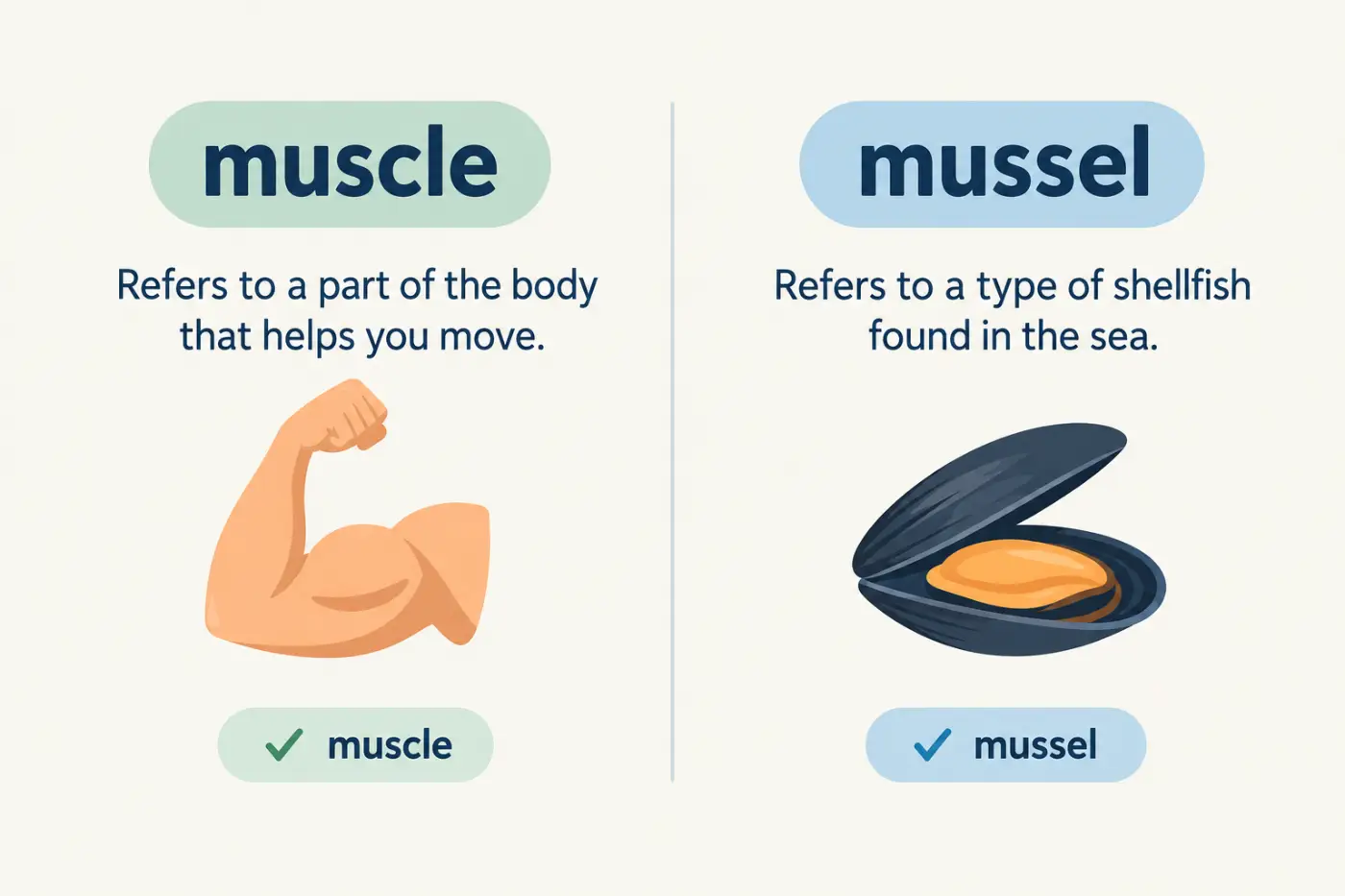
Muscle vs mussel is a common source of confusion because both words sound almost identical in American English. However, they refer to very different things. A muscle is body tissue that helps you move, maintain posture, and perform physical activities. A mussel is a shellfish that lives in water and is often served as seafood.
The confusion makes sense. English contains many words that share the same pronunciation but have different spellings and meanings. These words are called homophones. In this case, just one letter separates the two spellings, yet that small difference changes the meaning completely.
Knowing which word to use is useful in school assignments, health discussions, cooking instructions, restaurant menus, science reports, and everyday conversations. For example, you might strengthen your muscles at the gym, but you would order mussels at a seafood restaurant.
The easiest way to remember the difference is to connect the letter c in muscle with your body’s movement and the double s in mussel with the shellfish. Once you understand their meanings and see them in context, choosing the right spelling becomes much easier.
Quick Answer
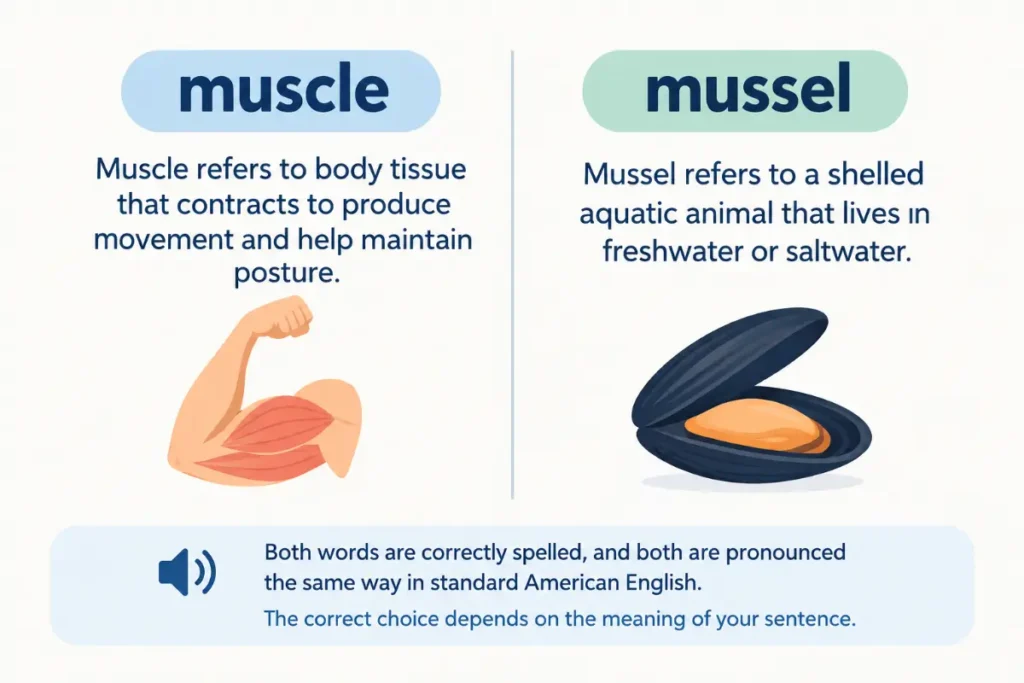
Muscle refers to body tissue that contracts to produce movement and help maintain posture. Mussel refers to a shelled aquatic animal that lives in freshwater or saltwater. Both words are correctly spelled, and both are pronounced the same way in standard American English. The correct choice depends on the meaning of your sentence.
Comparison Table
| Feature | Muscle | Mussel |
|---|---|---|
| Meaning | Body tissue that produces movement | An aquatic shellfish |
| Part of speech | Noun | Noun |
| Plural form | Muscles | Mussels |
| Pronunciation | /ˈmʌsəl/ | /ˈmʌsəl/ |
| Main context | Anatomy, fitness, medicine, biology | Seafood, cooking, marine biology |
| Common example | My leg muscle feels sore. | We ordered steamed mussels. |
| Correct spelling | Muscle | Mussel |
| Common confusion | Misspelled as mussel when referring to the body | Misspelled as muscle when referring to shellfish |
The two words are nouns, and neither spelling is incorrect by itself. The difference lies in the object or idea each word describes.
Meaning and Definition
What Does Muscle Mean?
A muscle is a type of body tissue that can contract and relax to create force. Muscles help you walk, run, lift objects, smile, breathe, and perform countless other actions. They also help maintain posture and support important functions inside the body.
The human body contains hundreds of muscles. Some are easy to see, such as the biceps in the upper arm. Others work inside the body without conscious effort, including muscles involved in digestion and the movement of blood.
The word also has figurative meanings. People sometimes use muscle to describe strength, power, or the ability to influence an outcome.
For example:
- The athlete developed stronger leg muscles through regular training.
- The heart muscle pumps blood throughout the body.
- The company used its financial muscle to compete with larger rivals.
In the first two examples, the word refers to actual body tissue. In the third, it describes power or influence rather than a physical body part.
What Does Mussel Mean?
A mussel is a type of shelled aquatic animal. Most familiar mussels have two hinged shells that protect their soft bodies. Many species live in the sea, while others live in freshwater rivers, lakes, and streams.
Mussels are important in aquatic ecosystems. Many filter tiny particles from the water as they feed. Some freshwater species also play a major role in supporting other organisms and maintaining healthy river habitats.
People also eat certain mussel species. They are commonly steamed, boiled, baked, or added to soups and pasta dishes. Their shells are usually dark blue, black, brown, or green, depending on the species.
For example:
- The restaurant served mussels with garlic and white wine sauce.
- Freshwater mussels can help scientists study changes in river ecosystems.
- We found several mussel shells along the beach.
The word can describe the living animal, the shellfish served as food, or its shell in an appropriate context.
Is Mussel a Misspelling of Muscle?
No. Mussel is a legitimate English word, just like muscle. It becomes an error only when someone uses it in the wrong context.
For example, writing My mussel hurts after lifting weights is incorrect if you mean body tissue. The correct sentence is My muscle hurts after lifting weights.
Likewise, writing We ate grilled muscle for dinner is incorrect if you mean the shellfish. In that context, mussel is the correct spelling.
The key lesson is simple. Neither word is inherently wrong. The mistake comes from choosing the spelling that does not match the intended meaning.
Key Differences Explained
Spelling
The main spelling difference appears near the end of each word.
- Muscle contains the letter c before the final letters le.
- Mussel contains a double s and has no c.
Although the words look similar, the spelling difference helps identify two unrelated meanings in everyday use. Remembering the meaning first is often more useful than trying to memorize every letter in isolation.
Meaning
The meaning is the most important distinction. A muscle belongs to the body or describes strength and influence figuratively. A mussel is an aquatic animal or a reference to that animal as food.
Think about the subject of your sentence. If it involves exercise, anatomy, soreness, strength, or movement, you probably need muscle. If it involves shells, seafood, rivers, oceans, or marine life, you probably need mussel.
Grammar and Part of Speech
Both words function mainly as countable nouns. You can use them with articles such as a and the, and you can make them plural.
Examples include a muscle, the muscle, and strong muscles. For the shellfish, you can write a mussel, the mussel, and fresh mussels.
Both words can also appear before another noun to describe a related subject. For example, muscle pain refers to pain in muscle tissue, while mussel shells refers to the shells of those animals.
Pronunciation
In standard American English, both words are pronounced /ˈmʌsəl/. They sound alike despite their different spellings and meanings.
The first syllable carries the stress. The vowel sounds similar to the vowel in cup, and the final syllable has a relaxed sound, similar to the ending of little.
Because pronunciation cannot reliably distinguish these words, spelling and context do most of the work. You need to understand the subject of the conversation to choose the correct written form.
Formality and Context
Both words are standard English and work in formal and informal settings. Neither is slang, and neither is limited to a particular level of education or style.
You can use muscle in a medical report, a fitness plan, a school essay, or a casual conversation. Similarly, mussel fits naturally in a restaurant menu, a biology textbook, a fishing report, or a message about dinner.
The setting does not determine the spelling. The intended meaning does.
Regional Usage
American, British, Canadian, and Australian English use both words with the same basic meanings and standard spellings. There is no major regional spelling difference between the two terms.
Pronunciation may vary slightly among speakers because of regional accents. However, the words are homophones in standard American English, so an accent is not a reliable way to tell them apart in writing.
Which Form Is Correct?
Both forms are correct. Muscle is the right choice for body tissue, physical strength, and figurative power. Mussel is the right choice for the aquatic shellfish.
The spelling rule is based on meaning rather than grammar. You do not choose one form because it is more formal or more grammatically correct. You choose the form that accurately represents the subject of your sentence.
Consider these examples.
- Correct: My shoulder muscle feels tight after swimming.
- Incorrect for the intended meaning: My shoulder mussel feels tight after swimming.
- Correct: The chef prepared mussels with fresh herbs.
- Incorrect for the intended meaning: The chef prepared muscles with fresh herbs.
The incorrect examples are understandable, but they name the wrong thing. In formal writing, schoolwork, professional communication, and published content, these errors can distract readers and change the meaning of a sentence.
A useful editing habit is to check the words around the disputed spelling. Terms such as biceps, exercise, soreness, and strength often point toward muscle. Words such as shell, seafood, steamed, and ocean often point toward mussel.
Sentence Examples
The following examples show how each word works in natural American English.
Examples Using Muscle
- My leg muscle started aching after a long hike.
- Regular exercise can help build muscle and improve strength.
- The doctor examined the muscle near my injured shoulder.
- She needs to strengthen her core muscles to improve her balance.
- The biology class learned how muscles contract and relax.
- His arm muscles became stronger after months of weight training.
- Muscle recovery takes time after an intense workout.
- The athlete suffered a muscle strain during the final quarter.
- The company used its financial muscle to expand into new markets.
- The story follows a young boxer who relies on skill rather than muscle alone.
Examples Using Mussel
- We ordered a bowl of steamed mussels for dinner.
- The chef added fresh mussels to the seafood pasta.
- A mussel uses its shell to protect its soft body.
- Researchers studied freshwater mussels in the local river.
- The seafood market sells mussels alongside clams and oysters.
- She cleaned the mussel shells before preparing the meal.
- The restaurant serves mussels with garlic, herbs, and lemon.
- Scientists examined how mussels filter particles from water.
- We collected empty mussel shells during our beach walk.
- The coastal town is known for its mussel farms and seafood dishes.
Common Mistakes and Misspellings
Confusing these words is easy because they sound alike. Most errors happen when someone relies on sound alone instead of checking the meaning.
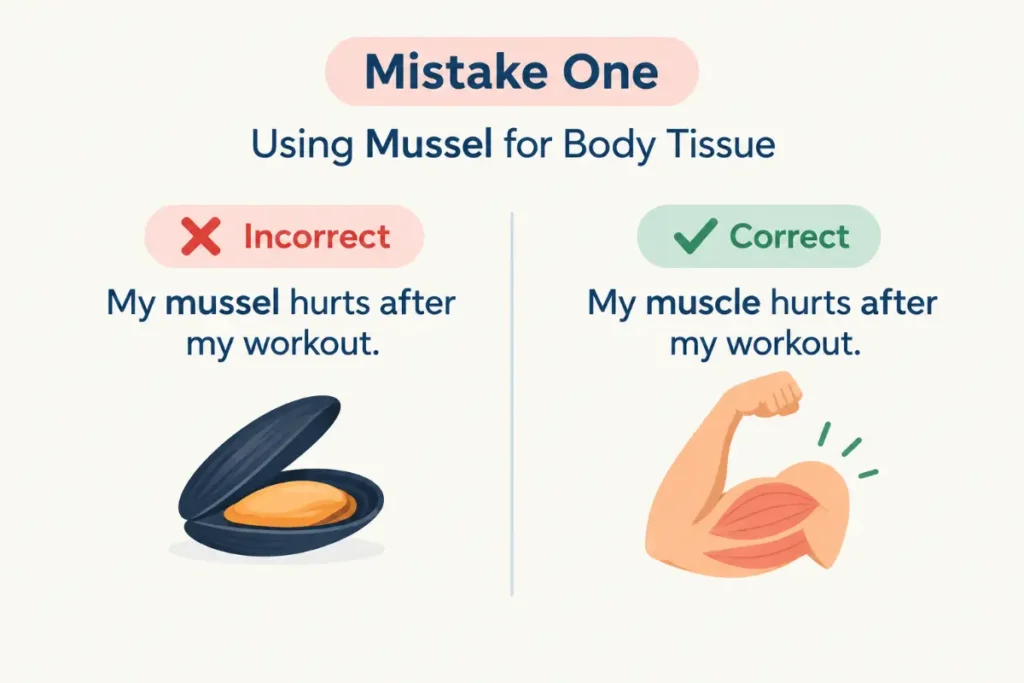
Mistake One Using Mussel for Body Tissue
Incorrect: My mussel hurts after my workout.
Correct: My muscle hurts after my workout.
The sentence refers to body tissue, so muscle is the correct choice. The spelling mussel refers to shellfish and does not fit the intended meaning.
Mistake Two Using Muscle for Seafood
Incorrect: We ordered grilled muscles at the restaurant.
Correct: We ordered grilled mussels at the restaurant.
The context involves food, so the sentence needs mussels. Although the incorrect version sounds the same, it refers to body tissue rather than shellfish.
Mistake Three Assuming Similar Sounds Mean Similar Meanings
Incorrect assumption: Since both words sound the same, either spelling works.
Correct understanding: Each word has its own meaning and spelling.
English has many homophones, including sea and see and right and write. Their shared pronunciation does not make them interchangeable. The same principle applies to the two words in this article.
Mistake Four Forgetting the Correct Plural
Incorrect: The athlete trained her mussels every morning.
Correct: The athlete trained her muscles every morning.
The plural form of muscle is muscles. The plural form of mussel is mussels. Both forms add the same ending, but the original spelling must match the meaning.
Mistake Five Relying Only on Spellcheck
A spelling tool may accept both words because both are legitimate English terms. It may not flag a sentence that uses the correct spelling for the wrong meaning.
For example, The fisherman studied the muscle contains a correctly spelled word, but the sentence may be wrong if the fisherman is studying a shellfish. Proofreading requires checking meaning as well as spelling.
Pronunciation Guide
Both words have the same standard American English pronunciation.
Muscle
/ˈmʌsəl/
Two syllables. Stress the first syllable.
Mussel
/ˈmʌsəl/
Two syllables. Stress the first syllable.
How to Say Both Words
A simple pronunciation guide is MUSS uhl. This is an informal sound guide rather than a formal spelling. Say the first part clearly, then finish with a relaxed second syllable.
The initial vowel is the same vowel heard in common American English words such as cup and luck. The second syllable is unstressed, so it sounds lighter than the first.
Avoid trying to pronounce the c in muscle as a separate sound. The spelling does not match a simple letter by letter reading. The c is silent in this word.
Why Pronunciation Causes Confusion
The two words are homophones because they share the same pronunciation but differ in spelling and meaning. A listener can usually understand the intended word from the surrounding conversation, but a writer must select the correct spelling.
For example, if someone says, I pulled a muscle, the conversation may involve exercise or an injury. If someone says, I ordered mussels, the context is likely about food.
Pronunciation alone cannot settle the spelling. Meaning is the deciding factor.
Etymology and Word Origin
The two words have different histories, even though modern English speakers pronounce them alike.
The Origin of Muscle
The English word muscle came through French from Latin musculus, a diminutive form related to mus, meaning mouse. The name reflected an old comparison between a moving muscle and a mouse moving beneath the skin.
This historical connection explains why the modern spelling contains the letter c. The word developed through earlier language forms before reaching its present English spelling and pronunciation.
Today, muscle refers to the body’s contractile tissue. It also has figurative uses related to physical force, power, or influence. Expressions such as political muscle and economic muscle extend the basic idea of strength into other areas.
The Origin of Mussel
The English word mussel developed through older European language forms, including Middle English and Anglo French. Its history is separate from that of muscle, even though the two words eventually came to sound alike in English.
The term names a group of bivalve mollusks. Bivalves have two shells joined by a hinge, and mussels belong to this broader group of aquatic animals.
The spelling with double s helps distinguish the shellfish from body tissue in modern writing. Their similar pronunciation is a feature of how English words developed over time, not evidence that the words share the same meaning.
What Their Origins Teach Us
Word history can explain why two spellings differ, but you do not need to memorize their full histories to use them correctly. The practical distinction remains simple. One word concerns body tissue and strength. The other concerns shellfish.
Regional Usage
American English
Both spellings are standard in the United States. Americans use muscle in fitness, anatomy, medicine, sports, and figurative expressions about power. They use mussel when discussing seafood, aquatic animals, and marine or freshwater ecosystems.
In American English, the two words are normally pronounced alike. This makes them a common source of spelling mistakes in schoolwork, online messages, and written descriptions of food or exercise.
British English
British English uses the same spellings and basic definitions. A British writer would use muscle to describe body tissue and mussel to describe the shellfish.
Some speakers may have regional pronunciation differences, but these do not create a different spelling rule. The intended meaning still determines which form belongs in the sentence.
Australian English
Australian English follows the same distinction. The word muscle appears in discussions of exercise, health, and anatomy, while mussel appears in seafood and environmental contexts.
There is no established Australian spelling variation that makes the words interchangeable.
Canadian English
Canadian English also uses both forms with their standard meanings. Writers should select the spelling based on context, just as they would in American or British English.
Across these varieties, the main challenge is not regional spelling. It is recognizing the meaning behind the sound.
Grammar Rules and Part of Speech
Both words function primarily as nouns, but their meanings determine the expressions they form.
Using Muscle as a Noun
The word can refer to one body structure, a group of structures, or strength in a figurative sense.
Common patterns include:
- A muscle or the muscle. Use the singular form when referring to one muscle or a specific muscle group treated as a unit. For example, The muscle in his calf tightened.
- Muscles. Use the plural when referring to multiple muscles. For example, Her muscles felt tired after the race.
- Muscle strength. Use the word to describe the force muscles can produce. For example, The exercise helps improve muscle strength.
- Muscle as figurative power. Use it to describe influence or force. For example, The organization has enough muscle to support the project.
In compound expressions such as muscle pain, the noun acts as a modifier that tells readers what kind of pain is involved.
Using Mussel as a Noun
The word refers to an aquatic animal or to the animal as food.
Common patterns include:
- A mussel. Use the singular when discussing one animal. For example, A mussel attached itself to the rock.
- Mussels. Use the plural when discussing several animals or a serving of seafood. For example, The chef prepared fresh mussels.
- Mussel shells. Use the noun before another noun to describe shells belonging to mussels. For example, Mussel shells covered part of the shoreline.
- Mussel farming. Use the word in discussions of raising shellfish for food or commercial production. For example, Mussel farming supports some coastal communities.
Articles and Agreement
Both words follow ordinary countable noun rules. Use a or an with a singular countable noun as appropriate. Because both begin with a consonant sound, the correct phrase is a muscle or a mussel.
The choice between is and are depends on the number of the noun. For example, The muscle is sore is singular, while The muscles are sore is plural. Similarly, The mussel is small is singular, while The mussels are small is plural.
The words do not need different grammar rules just because their meanings differ. The main task is selecting the right spelling before applying standard noun grammar.
Real Life Usage Examples
The best way to remember the difference is to see how each word appears in different situations.
Daily Conversation
- My muscles are sore because I spent the afternoon moving furniture.
- We should order mussels next time we visit that seafood restaurant.
In everyday speech, context usually makes the intended meaning clear. In writing, choosing the correct spelling prevents confusion.
Email and Workplace Communication
- Please allow a day of rest before repeating the muscle strengthening exercise.
- The catering team confirmed that mussels will be available for Friday’s dinner.
These examples show how the terms fit into practical workplace messages. The first concerns physical training, while the second concerns a food order.
Academic Writing
- Skeletal muscles contract in response to signals from the nervous system.
- Freshwater mussels can serve as useful subjects in studies of aquatic ecosystems.
In academic writing, accuracy matters because each word identifies a specific subject. A spelling mistake can make a sentence confusing or undermine the precision of an explanation.
News and Journalism
- The runner withdrew from the competition after suffering a muscle injury.
- Environmental researchers warned that declining water quality could threaten native mussel populations.
News writers need to distinguish the terms clearly because the stories may concern health, sports, food production, or environmental protection.
Literature and Storytelling
- He tightened every muscle as he prepared to lift the heavy gate.
- She watched the tide retreat and noticed mussel shells glistening among the rocks.
In storytelling, the correct word helps readers picture the scene. One suggests physical effort or tension, while the other evokes a shoreline or an aquatic setting.
Related and Confused Terms
These eight terms can help you build a clearer understanding of the words and their meanings.
Muscle Related Terms
- Muscle tissue. The specialized body tissue that contracts to produce force and movement.
- Muscle strength. The ability of muscles to produce force against resistance.
- Muscle strain. An injury involving overstretched or torn muscle fibers.
- Muscular. An adjective describing something related to muscles or a person with well developed muscles.
Mussel Related Terms
- Clam. A bivalve mollusk that often lives in sand, mud, or other aquatic habitats. Clams and mussels are related animals but are not the same thing.
- Oyster. Another type of bivalve mollusk. Oysters are known for their rough shells and their role in some coastal ecosystems.
- Shellfish. A broad everyday term for aquatic animals with shells or shell like coverings. It includes mussels, clams, oysters, and other groups.
- Mollusk. An invertebrate animal belonging to a large group that includes mussels, snails, clams, and octopuses.
These related terms are useful because they connect each word to a broader subject. The first four concern muscles and physical function. The remaining four help identify mussels in the wider world of aquatic animals.

Expert Editor Insight
An experienced editor checks the meaning of a sentence rather than relying on a spelling checker alone. Both forms are valid English words, so a basic grammar tool may accept either one even when the writer has used the wrong meaning. The surrounding words provide the strongest clue. References to exercise, injury, or physical strength usually point to muscle, while references to shells, seafood, or aquatic habitats usually point to mussel. A quick context check can prevent an otherwise easy mistake.
Conclusion
Muscle vs mussel comes down to meaning rather than pronunciation. A muscle is body tissue that helps you move and produce force. A mussel is an aquatic shellfish that can live in freshwater or saltwater and is often eaten as seafood. Both spellings are correct, but they cannot replace each other without changing the meaning of a sentence.
Remember this simple trick. Connect muscle with movement and physical strength. Connect mussel with shells and seafood. When proofreading, look at the surrounding words instead of relying only on sound or spellcheck. This small habit will help you choose the right spelling in everyday messages, school assignments, professional documents, and formal writing.
FAQs
Is Mussel a Real Word?
Yes. Mussel is a standard English word for an aquatic shellfish with a two part shell. It can refer to an animal living in freshwater or saltwater or to the shellfish served as food. It is not an incorrect version of muscle. The spelling becomes an error only when someone uses it to mean body tissue or physical strength.
What Does Muscle Mean in Simple English?
A muscle is body tissue that helps you move and produce force. You use muscles when you walk, lift a bag, smile, or climb stairs. The word can also describe power or influence in a figurative sense. For example, a business with financial muscle has enough resources or influence to achieve its goals.
Which Spelling Is Correct for Seafood?
Use mussel when you mean the shellfish. For example, We ate mussels with garlic sauce uses the correct spelling. The word muscle refers to body tissue or strength and does not name this animal. If your sentence mentions a seafood dish, shells, or aquatic life, mussel is usually the spelling you need.
How Do You Pronounce Both Words?
In standard American English, both words are pronounced /ˈmʌsəl/. Each has two syllables, with stress on the first syllable. The c in muscle is silent, so the word does not sound like it contains a separate k sound. Since pronunciation does not distinguish the words, you must use context to choose the correct spelling.
Can Muscle Start a Sentence?
Yes. Muscle can begin a sentence as a subject or as part of a descriptive phrase. For example, Muscle recovery takes time after strenuous exercise. The word follows normal capitalization rules at the start of a sentence. You can also begin a sentence with mussel, as in Mussels thrive in a range of aquatic habitats.
What Is a Synonym for Muscle?
The best alternative depends on the meaning. Muscle tissue is a precise term for the body structure. Strength or power may work when the word describes physical ability or influence. These terms are not perfect substitutes in every sentence. For example, muscle pain cannot always be replaced with strength pain without changing the meaning.
Why Do People Confuse These Two Words?
People confuse the terms because they sound alike in standard American English and differ by only a few letters. When someone writes from memory or types quickly, the wrong spelling may slip into a sentence. Spellcheck may not catch the error because both words are valid. Reading the sentence for meaning is often the best way to find the mistake.
Is Muscle Appropriate for Formal Writing?
Yes. Muscle is a standard word used in medical writing, scientific explanations, fitness guidance, journalism, and everyday communication. Mussel is also appropriate in formal writing when the subject is shellfish. Neither word is informal or incorrect by nature. The important point is to use the spelling that matches the subject and intended meaning.
