
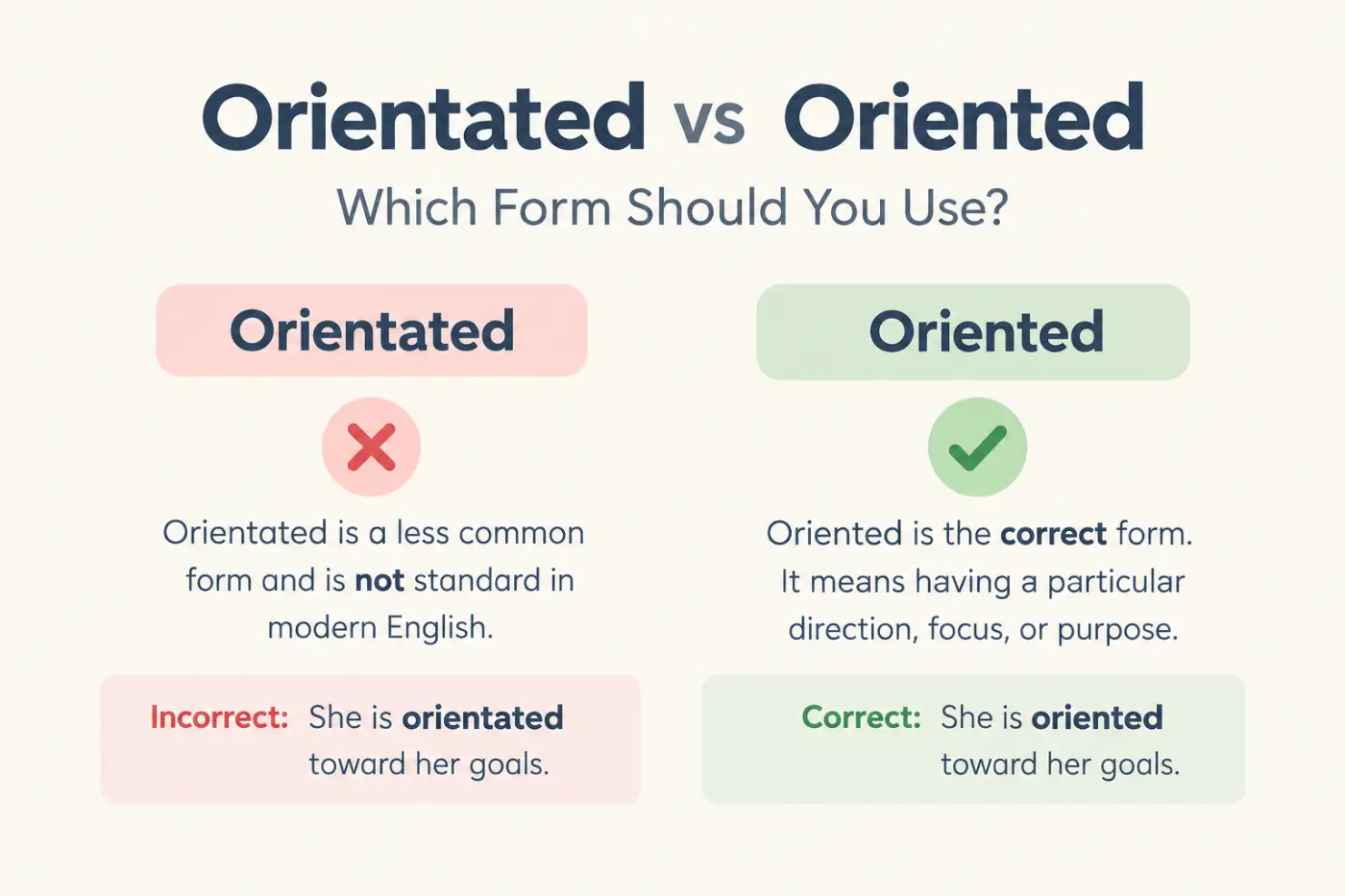
If you have ever hesitated between orientated vs oriented while writing an email or an assignment, you are not alone. Oriented is the preferred choice in the United States, while orientated is also correct and appears more often in some varieties of British English.
The confusion comes from the verb orient, which means to position something, find your direction, or help someone understand a situation. English speakers use both oriented and orientated to express related meanings. However, the two forms do not appear equally often in every region or type of writing.
Choosing the right form is simple once you understand the difference between grammatical correctness and common usage. This guide explains what each word means, how to pronounce it, when to use it, and how it works in everyday speech and professional writing. You will also find clear examples, common mistakes, and practical editing tips to help you choose the right form with confidence.
Quick Answer
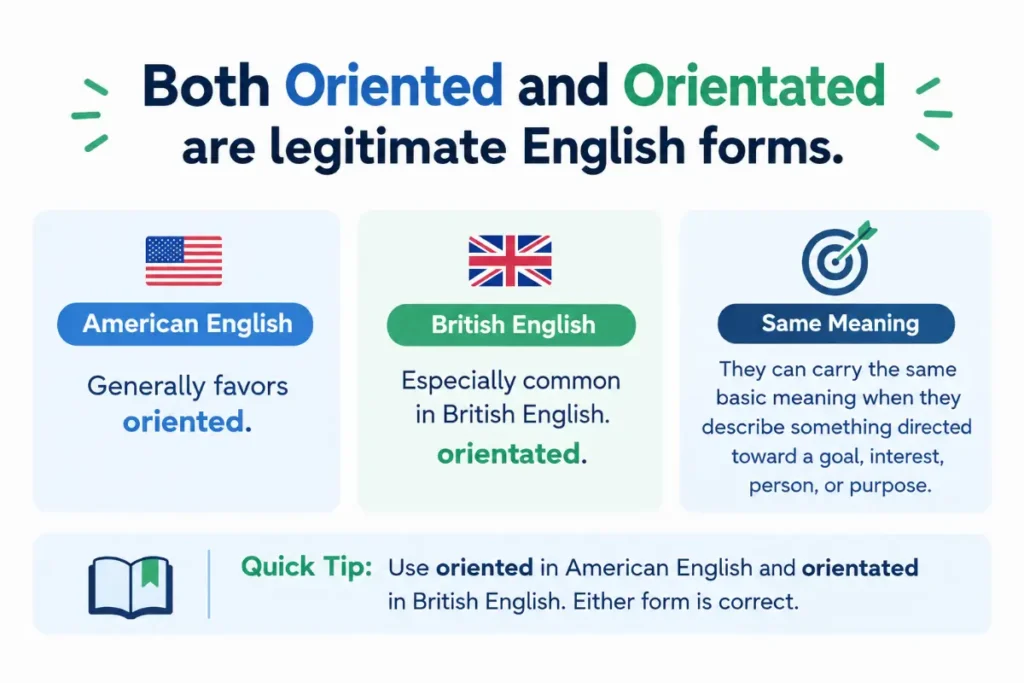
Oriented and orientated are both correct English forms. They can mean directed toward something, familiar with a situation, or organized around a particular goal. For most US readers, oriented is the safest and most natural choice.
Comparison Table
| Feature | Oriented | Orientated |
|---|---|---|
| Correct spelling | Yes | Yes |
| Main meaning | Directed or adapted toward something | Directed or adapted toward something |
| Part of speech | Verb form or adjective | Verb form or adjective |
| American English | Preferred and more common | Less common |
| British English | Common and accepted | Also used and accepted |
| Formality | Suitable for formal and informal writing | Suitable for formal and informal writing |
| Common contexts | Goal oriented work, customer oriented service, spatial direction | Direction, training, introductions, and regional usage |
| Example | The course is oriented toward beginners. | The course is orientated toward beginners. |
Meaning and Definition
What Does Oriented Mean
Oriented is the past tense and past participle of the verb orient. It can also function as an adjective. The word describes something positioned in a particular direction or someone who understands a situation and knows how to respond to it.
For example, a house oriented toward the south faces that direction. In both cases, the word suggests direction, awareness, or adjustment.
The word also appears in compound expressions that describe priorities or interests. A customer oriented business focuses on customer needs. A detail oriented employee pays close attention to small facts and possible errors.
Common uses include the following.
- Familiarity. The guide helped us become oriented to the city.
- Organization. The team follows a results oriented approach.
In each example, the word connects a person, place, system, or activity to a direction, purpose, or area of focus.
What Does Orientated Mean
It can also work as an adjective. Its meaning is generally the same as that of oriented. Both expressions describe the process of helping the student understand the new environment.
The difference usually concerns regional preference rather than meaning. American readers are more accustomed to the shorter form. Some British speakers use the longer form naturally, particularly in contexts involving training or becoming familiar with a new place or system.
The longer spelling is not automatically an error. However, its acceptance does not mean it is the best choice for every audience. Writers should consider their readers, the conventions of the organization, and consistency throughout the document.
Is Orientated a Real Word
Yes. Orientated is a legitimate English word, not simply a spelling mistake. It follows a recognized pattern in which a verb can form its past tense and past participle with the ending ated.
If you write for an American audience, use oriented unless a particular name, quotation, or established expression requires the other form. If you write for a British audience, either form may be appropriate, depending on local usage and the style of the publication.
Key Differences Explained
Spelling
The visible difference is the extra syllable and letters in orientated. The shorter form contains the base orient followed by ed. The longer form adds ated to the base.
This difference can make the words look more distinct than they really are. Their spelling differs, but their central meaning remains the same.
Meaning
Neither spelling has a general meaning that the other lacks. Both can describe physical direction, awareness, adaptation, or a focus on a particular goal.
Context still matters. In a sentence about a person who feels disoriented after waking up in an unfamiliar place, neither alternative is a direct replacement for disoriented. Related words have their own grammatical and semantic roles.
Grammar
Both forms can function as past tense verbs, past participles, and adjectives.
As a verb, the form describes an action completed in the past.
The instructor oriented the students to the new equipment.
As a past participle, it can appear with a helping verb.
As an adjective, it can describe a quality or focus.
The same patterns generally work with orientated. The choice does not change the basic grammar of the sentence.
Pronunciation
The two spellings have different syllable counts in their usual pronunciations.
This difference may influence a speaker’s choice, but it does not create a difference in meaning. Both forms are recognizable to English speakers.
Formality
Both forms can appear in formal writing. Neither is inherently informal, slang, or unsuitable for professional communication.
However, frequency affects how natural a word feels to a particular audience. In a US business report, oriented will usually sound more familiar. In a British publication that regularly uses orientated, changing every occurrence may be unnecessary.
Regional Usage
American English generally favors the shorter spelling. British English accepts both, and the longer spelling is more established in some British contexts than it is in the United States.
These are broad tendencies rather than strict rules. English usage varies among writers, industries, publications, and individual speakers.
Which Form Is Correct
Both forms are correct. The best choice depends on your audience and the kind of English you are writing.
For most American writing, choose oriented.
Here is a simple rule to follow.
- Use oriented for American readers.
- Use oriented or orientated for British readers when either fits the publication’s style.
- Follow the spelling used in an organization’s existing documents if consistency matters.
- Keep the same form throughout a document unless you are discussing the difference itself.
This approach gives you a clear default without treating a legitimate alternative as a mistake.
Sentence Examples
The following examples show how the shorter form works in everyday and professional English.
- Text message. I finally feel oriented after a busy first week.
- Workplace communication. The manager oriented the new staff members to their duties.
- School. The teacher oriented the class to the rules for the science lab.
- Customer service. The company uses a customer oriented approach to solve problems.
Notice that the word does not always appear in the same grammatical structure. It can describe an action, a completed process, or a lasting characteristic.
- The instructor orientated the visitors before the tour.
- We became orientated to the new schedule after a few days.
These examples show why it is useful to separate correctness from frequency. A form can be valid without being the most common choice in every region.
Common Mistakes and Spelling Confusion
The main mistake is assuming that the longer spelling is always wrong. Several other errors can occur when writers confuse the word with similar forms or use it in the wrong grammatical pattern.
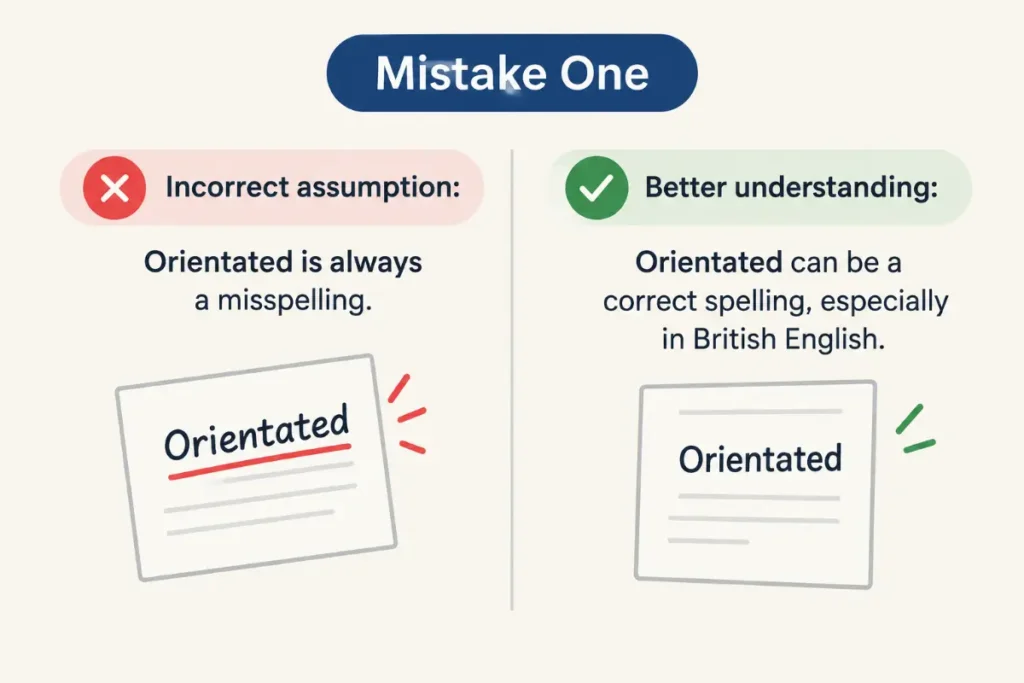
Mistake One Treating Orientated as a Misspelling
Incorrect assumption: Orientated is never correct.
The confusion comes from differences in regional usage. A spelling checker set to American English may prefer the shorter form. That preference does not prove the longer spelling is invalid in every variety of English.
Mistake Two Confusing Orient With Orientation
Orient is a verb, while orientation is a noun.
Incorrect: The manager gave us a detailed orient.
Correct: The manager gave us a detailed orientation.
The noun names the introduction or process of becoming familiar with a place, organization, or subject. The verb describes the action of directing or helping someone become familiar with something.
Mistake Three Using Oriented Without a Clear Connection
The word often needs a phrase that explains the direction or focus.
The first sentence is not always grammatically wrong. It may be suitable when the surrounding context already explains the direction. However, the second sentence gives readers more useful information.
Mistake Four Confusing Oriented With Orienting
These forms serve different grammatical purposes.
- Oriented often describes a completed action or an existing quality.
- Orienting commonly describes an ongoing action or something that provides direction.
Example: The guide is orienting the visitors to the building.
Here, orienting describes what the guide is doing now. Saying the guide has oriented the visitors would describe a completed action.The first example emphasizes familiarity. The second emphasizes the intended audience. The third emphasizes the central focus. Choose the preposition that best expresses your intended meaning.
Pronunciation Guide
The two forms are easy to recognize once you notice their syllable patterns. American pronunciation usually gives the shorter form three syllables and the longer form four.
| Word | IPA | Syllables | Simple pronunciation guide |
|---|---|---|---|
| Oriented | /ˈɔːriˌɛntɪd/ | Three | OR ee en tid |
| Orientated | /ˈɔːriənˌteɪtɪd/ | Four | OR ee en tay tid |
Pronunciation can vary by accent, and dictionaries may show slightly different transcriptions. The IPA forms above are broad guides rather than a claim that every English speaker uses exactly the same sounds.
Where the Stress Falls
In common American speech, the first syllable of oriented carries the main stress. The longer form also commonly receives its main stress near the beginning, although the extra syllable creates a different rhythm.
Say each form slowly at first. Then use it in a sentence rather than trying to memorize each sound in isolation. Reading the word aloud in context helps you recognize its natural rhythm.
Common Pronunciation Problems
- Dropping a syllable from the longer form. Some speakers pronounce the longer form so quickly that it sounds close to the shorter one. This is a normal feature of connected speech.
- Adding an extra syllable to the shorter form. Writers sometimes expect the word to follow the longer spelling and pronounce it with an additional vowel sound.
- Overemphasizing the ending. The ending should fit naturally into the sentence instead of receiving unusual stress.
You do not need to change your accent to use either word correctly. Clear pronunciation and correct grammar matter more than imitating one particular regional voice.
Etymology and Word Origin
Both forms come from the same English verb, orient. Their shared history explains why their meanings overlap.
The verb developed from the word orient, which referred to the east.
Over time, the verb developed the broader meaning of determining position or helping someone understand where they are. Its figurative meaning also expanded.
The longer form developed as an alternative verb form. English has several patterns for creating related verb forms, and not every accepted form becomes equally common across all regions.
The historical connection explains the core meaning of both words. It does not establish that one modern spelling is more correct than the other. Current usage and audience expectations provide the more useful guide for choosing between them.
Regional Usage
American English
American English strongly favors oriented. It is the normal choice in US schools, workplaces, newspapers, technical documents, and general writing.
Examples include the following.
The longer form is still understandable and grammatically accepted, but it may sound less familiar to some American readers. If you are writing for a US audience and have no special reason to choose the longer spelling, use the shorter one.
British English
British English uses both forms. Orientated is an established option, and some British speakers use it naturally in workplace training, education, and everyday speech.
The shorter form is also common. You should not assume that all British writers prefer the longer spelling or that the shorter form is an Americanism.
For British publications, consistency with the house style is more useful than trying to impose one spelling on every writer. If the publication consistently uses orientated, retain that choice unless an editor has a clear reason to change it.
Australian English
Australian English also recognizes both forms. Individual preferences can vary, and the longer form may sound natural to some speakers.
For general Australian writing, oriented remains a clear and widely understood option. Follow the publication’s established spelling conventions rather than relying on assumptions about how every Australian speaker talks.
Canadian English
The shorter form is a safe choice in general writing, particularly when the intended readers are familiar with American spelling conventions.
The longer form may also appear. There is no need to label it incorrect solely because a Canadian writer chooses the shorter alternative.
Does the Region Change the Meaning
No. The core meaning remains the same across these varieties of English. Regional differences mainly affect familiarity and preference, not the basic definition or grammatical function.
Grammar Rules and Part of Speech
Understanding the grammar makes it easier to use both forms correctly. Each form can appear in more than one sentence pattern, depending on the role it plays.
As a Past Tense Verb
Use the form to describe an action that happened in the past.
Example: The guide oriented the visitors before they entered the museum.
The guide performed the action. The visitors received the help or direction.
The same structure works with the longer form.
Example: The guide orientated the visitors before they entered the museum.
Both sentences are grammatically acceptable. The shorter form is generally the better choice for American readers.
As a Past Participle
A past participle can follow a helping verb to form a passive sentence or another verb construction.
The sentence focuses on the staff and their preparation rather than on the person who provided the instruction.
As an Adjective
The word can describe the focus or direction of a person, organization, product, or activity.
Example: The school offers a career oriented program.
In this sentence, the expression describes the program’s focus.
However, usage varies by dictionary, style guide, and editorial preference. If your publication follows a specific rule for compound modifiers, apply it consistently.
Punctuation and Compound Expressions
The word itself does not require special punctuation. However, expressions such as customer oriented and detail oriented can raise questions about compound modifiers.
Other style guides prefer open compounds for familiar expressions. The main goal is to make the relationship between words clear and follow one consistent style.
For example, a customer oriented approach is understandable without a hyphen. Do not confuse this punctuation question with the spelling choice between the two verb forms.
Real Life Usage Examples
The word appears in many settings because it can describe both physical direction and a person’s focus. These examples show how the shorter form works across different types of communication.
Daily Conversation
- I felt lost at first, but I soon became oriented to the area.
- The map helped us stay oriented during the hike.
In conversation, the word often refers to finding your way or becoming familiar with an unfamiliar place.
Email and Workplace Communication
The first sentence describes an introduction to a system. The second explains the department’s main focus.
Academic Writing
Academic writing often uses the word to describe the scope, focus, or purpose of a study or course. It can help express an idea precisely without adding a long explanation.
News and Journalism
Journalists can use the word to explain the purpose of a policy, campaign, or public initiative. The surrounding details should make the intended focus clear.
Literature and Storytelling
- When Maya entered the unfamiliar town, she needed a moment to become oriented.
- The young explorer kept his compass nearby so he could stay oriented in the forest.
In storytelling, the word can establish a character’s position or describe how a person responds to an unfamiliar setting. It can also suggest a character’s interests or priorities.
Related and Confused Terms
Several words share part of the meaning of these two forms. They are useful alternatives in some sentences, but they are not always interchangeable.
Orient
Orient is the base verb. It means to position something in a particular direction or help someone become familiar with a place, task, or situation.
Example: The instructor will orient the new students before classes begin.
Orientation
Example: The school holds an orientation session for new students.
Reorient
Reorient means to change direction or adjust your understanding or priorities.
Example: The company had to reorient its strategy after customer needs changed.
Reorientation
Reorientation is the noun form of reorient. It describes the process of changing direction, focus, or understanding.
Example: The department began a reorientation of its training program.
Disoriented
Disoriented describes someone who feels confused about their location, situation, or surroundings.
Example: I felt disoriented after leaving the crowded station.
Unlike the two main forms in this article, this word expresses a lack of clear direction or awareness.
Directional
Directional describes something related to direction or the way something points.
Example: The sign provides directional information for visitors.
Use this word when the main idea concerns the direction itself rather than familiarity or focus.
Goal Oriented
Goal oriented describes a person or activity focused on achieving a specific result.
Example: She takes a goal oriented approach to her studies.
This expression is useful when discussing motivation, planning, and achievement. Its focus is narrower than the general meaning of oriented.
Purpose Driven
Purpose driven describes a person, organization, or activity guided by a clear purpose.
Example: The organization follows a purpose driven approach to community work.
The expression highlights motivation and intention. It can replace oriented in some contexts, but it adds a stronger emphasis on the reason behind an action.
Expert Editor Insight
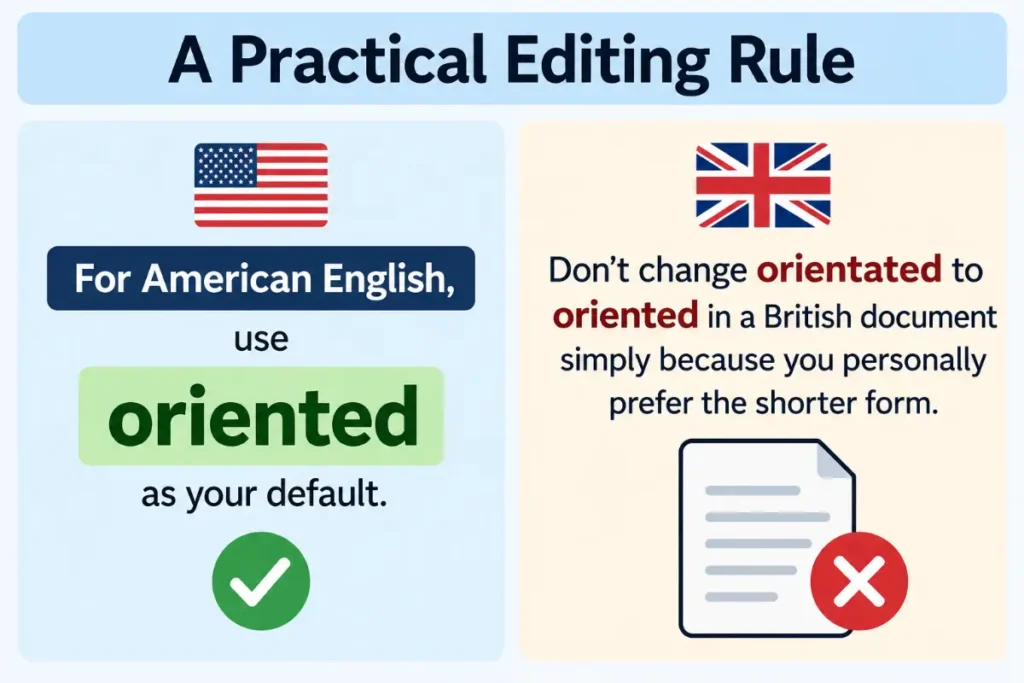
An experienced editor would usually choose oriented for an American audience because it is familiar, concise, and widely used across professional and everyday writing. The longer form deserves a different treatment from a genuine misspelling because it is an accepted variant. A spelling checker may flag it based on regional settings or a preferred dictionary. Before changing it, check the audience, the intended meaning, and the document’s existing style. Also review the surrounding sentence to confirm that the word has the right grammatical role and that the intended direction or focus is clear.
Conclusion
The difference between orientated vs oriented comes down to spelling preference rather than meaning. Both forms are correct and can describe direction, awareness, or a particular focus. However, oriented is the more familiar and widely preferred choice in American English, making it the safest option for most US readers.
The longer form remains acceptable in other English varieties, especially British usage. To remember the rule, think about your audience first and follow its established writing conventions. If you are writing for American readers, choose oriented and use it consistently throughout your document. This simple habit keeps your writing clear and natural.
FAQs
Is Orientated a Real Word?
Yes. Orientated is a recognized English word and a valid past tense and past participle of orient. It can also function as an adjective. The main difference is regional preference. Its lower frequency in the United States does not make it universally incorrect.
What Does Oriented Mean?
Oriented means directed toward something or adjusted to a particular situation. It can describe the position of an object, a person’s understanding of a place, or the focus of an organization or activity. The exact meaning depends on the words around it.
Which Is Correct for American English?
Oriented is the preferred choice for most American English writing. It appears naturally in school assignments, business communication, technical documents, and everyday conversation. Orientated is also a valid form, but it may sound less familiar to some US readers. When writing for an American audience, choose the shorter form unless a particular style requirement calls for something else.
How Do You Pronounce Oriented and Orientated?
Oriented is usually pronounced with three syllables, while orientated generally has four. Pronunciation varies somewhat by accent. Both forms are easy to recognize in ordinary conversation, and neither requires a special change in speaking style. If you are unsure, say each word slowly and then practice it in a complete sentence to hear its natural rhythm.
Can You Use Oriented in a Formal Document?
Yes. Oriented is appropriate for formal reports, academic papers, business plans, technical manuals, and professional emails. It can describe the direction of an object or the focus of a project, policy, or organization. For a US audience, it is usually the clearest choice. The word is not limited to casual speech or informal writing.
Is Oriented an Adjective or a Verb?
It can be both. Oriented is the past tense and past participle of the verb orient. It also works as an adjective that describes direction, focus, or familiarity. In the sentence The guide oriented the visitors, it is a verb. In The program is oriented toward beginners, it functions as part of an adjective phrase describing the program.
What Is a Synonym for Oriented?
The best synonym depends on the sentence. Directed may work when discussing physical direction. Focused can describe a project or organization with a clear purpose. Aligned may fit a plan that supports a goal. Familiar can work when describing someone’s knowledge of a place or system. These words have related meanings, but none replaces oriented in every context.
Why Do People Confuse the Two Spellings?
People confuse the forms because they share the same basic meaning and grammatical function. The longer spelling also follows a recognizable pattern in English verb formation. Regional habits add to the confusion because British and American writers may have different preferences. The easiest solution is to remember that both forms are accepted and choose the one that fits your audience.
