
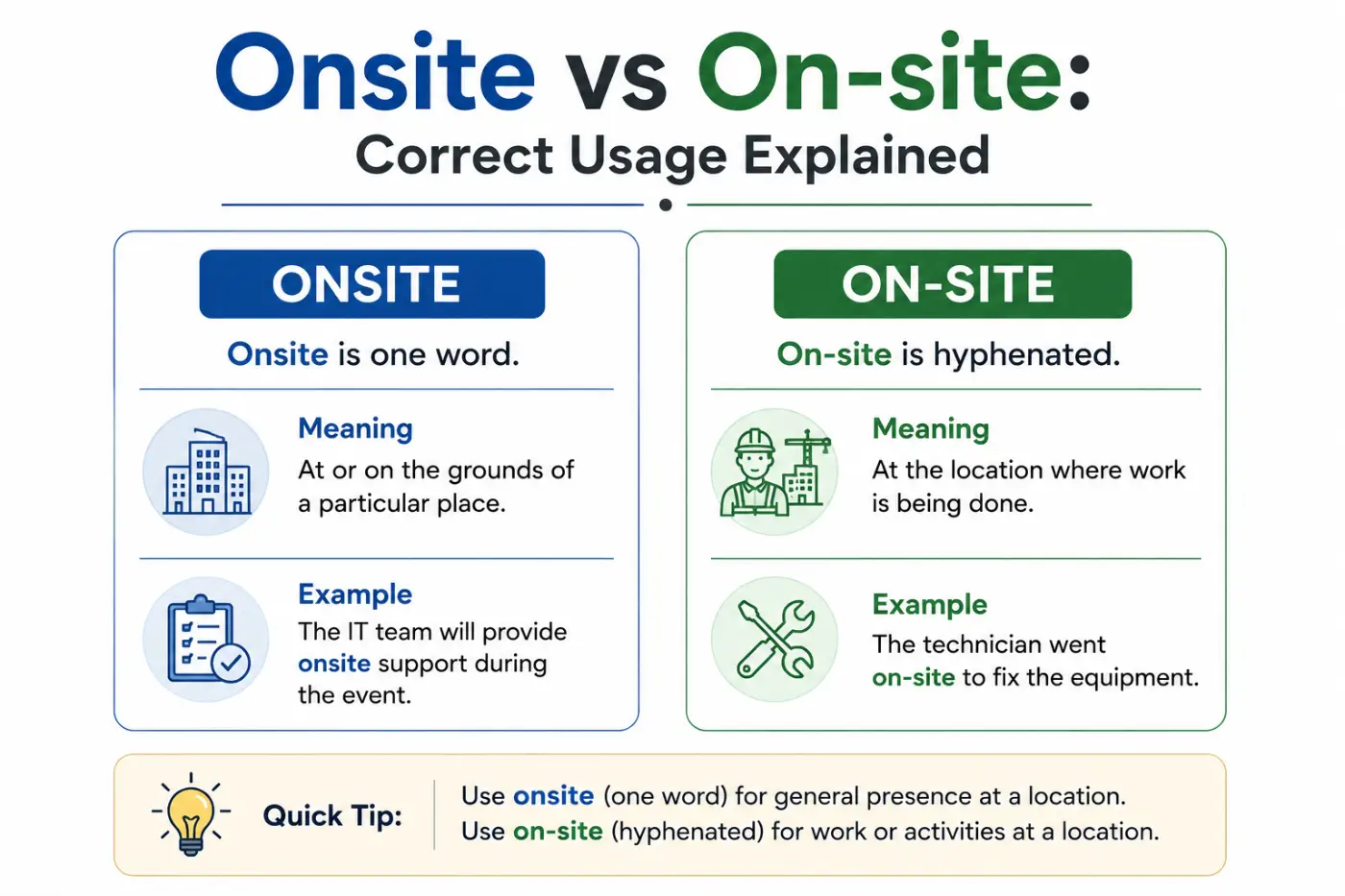
If you’ve ever paused while writing an email to decide between onsite vs on-site, you’re not alone. Both forms appear in professional documents, job descriptions, school assignments, and everyday messages. The good news is that both spellings are acceptable in English, but the best choice depends on how you use the phrase and which style guide you follow.
The closed form, onsite, often describes something that happens at a particular location. The open form, on site, commonly emphasizes the place where an activity takes place. For example, a company might offer onsite training, while an employee might say that a technician is on site.
The distinction can feel small, but consistent spelling makes your writing easier to read and more professional. Once you understand how the phrase functions in a sentence, choosing the right form becomes much easier.
Quick Answer
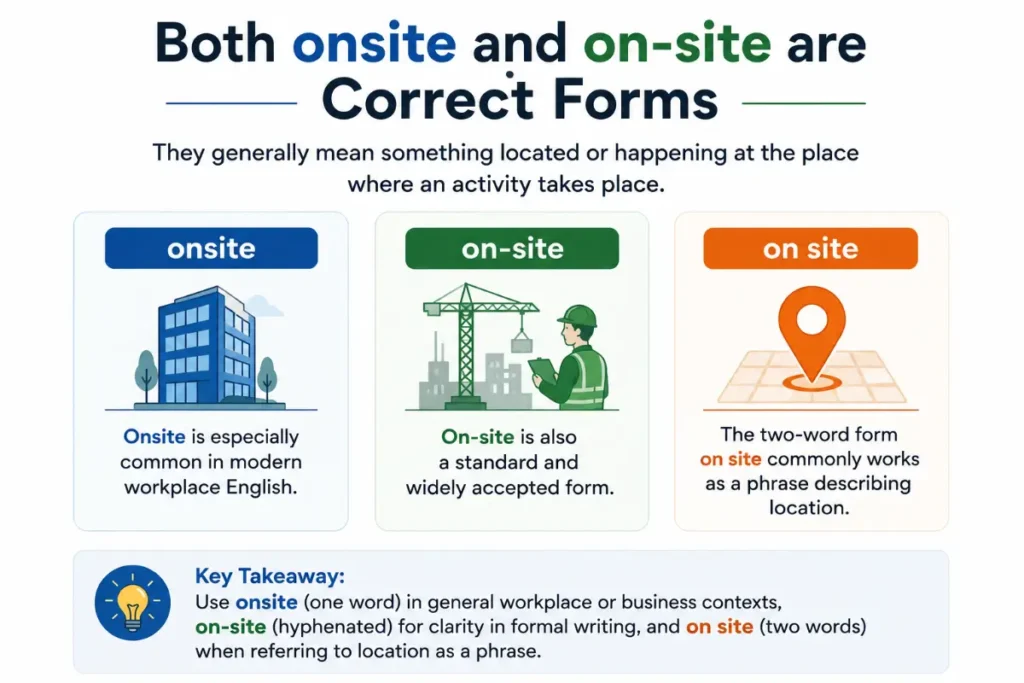
Both onsite and on site are correct English forms. Use onsite when it functions as a single descriptive word, such as in onsite training or onsite support. Use on site when you want to emphasize a physical location, as in The technician is on site. Follow your organization’s preferred style when both forms fit.
Comparison Table
| Feature | Onsite | On site |
|---|---|---|
| Spelling | One closed word | Two separate words |
| Main function | Adjective or adverb | Prepositional phrase |
| Meaning | At a particular location or provided there | At a particular location |
| Common example | Onsite parking is available. | The crew is on site. |
| Workplace use | Onsite services and training | Staff working on site |
| Formality | Standard in modern professional writing | Standard in general English |
| Grammar | Often modifies a noun or describes an activity | Usually follows a verb or completes a phrase |
| Regional use | Common in American English | Common in American and British English |
| Editorial preference | Often favored in compound descriptions | Often favored when the location is the focus |
The table offers a useful starting point, but grammar matters more than word count alone. The two forms can overlap in meaning, so you should consider the sentence rather than assume that one spelling always wins.
What Onsite Means
Onsite is an adjective or adverb that describes something located at or happening at a particular place. The location usually comes from the surrounding context. In a workplace, for example, it might mean an office, factory, warehouse, construction project, or customer facility.
As an adjective, the word commonly appears before a noun. An employer may advertise onsite childcare, a school may provide onsite counseling, and a hospital may offer onsite testing. In each example, the word tells readers that the service is available at the location being discussed.
As an adverb, it can describe where an action happens. A company might say that its engineers work onsite during a major installation. The sentence explains where the engineers work without requiring a longer phrase.
The closed form is especially useful in business writing because it creates a compact description. It also works well in headings, service listings, internal documents, and job advertisements. Readers can quickly understand that a service or activity takes place at a specific physical location.
However, onsite does not automatically mean inside a company’s main office. A consultant may work onsite at a customer’s building, and a repair crew may provide onsite service at someone’s home. The relevant location depends on the situation.
Common Uses of Onsite
You will often see the closed form in professional and practical settings.
1. Onsite training means employees receive training at a designated workplace or facility.
2. Onsite support means help is provided at the location where the customer or equipment is based.
3. Onsite parking means parking is available on the property or at the facility being discussed.
4. Onsite interviews means candidates attend interviews at a specified physical location.
5. Onsite testing means testing takes place at the relevant facility rather than at a separate location.
These expressions are easy to scan and work well in brochures, policies, job listings, and service descriptions. Still, the surrounding sentence should make the location clear.
What On Site Means
On site is a phrase made up of the preposition on and the noun site. It generally means at a particular place where an activity, project, or service takes place. The phrase often appears after a verb and tells readers where someone or something is located.
Consider the sentence The electrician is on site. The phrase explains the electrician’s current location. It does not need to describe a noun that follows it.
You might also write The inspectors arrived on site early. Here, the phrase tells readers where the inspectors arrived. The same pattern appears in construction reports, fieldwork notes, emergency updates, and workplace conversations.
The open form is useful when the location itself deserves attention. For example, a manager might write that the team must remain on site until the inspection ends. The location is central to the instruction because employees need to stay at the work area.
The phrase can also appear in sentences that compare locations. A project manager might explain that a repair can happen on site instead of at an external workshop. This wording makes the place of the work clear.
Common Uses of On Site
The open form often fits naturally after verbs that describe movement, presence, or activity.
1. The contractor is on site and ready to begin.
2. Our supervisor arrived on site before the rest of the crew.
3. The safety officer remained on site throughout the inspection.
4. The team completed the repairs on site rather than sending the equipment away.
5. Several specialists will be on site during the installation.
Each sentence treats the phrase as a location expression. That pattern can help you decide which form sounds most natural in your own writing.
Key Differences Explained
The main difference involves how the phrase works in a sentence. Both forms can communicate a location, but they often serve different grammatical roles.
Spelling
Onsite is a closed compound, which means two word elements combine into one word. On site remains an open phrase with a space between the words.
English compounds often change spelling over time. A phrase may begin as two words, later appear with a hyphen, and eventually become a closed word. This process does not happen uniformly across all terms, so spelling conventions can vary.
That explains why you may encounter both forms in reputable workplace documents. Their presence does not mean one must be a typo. You should check the sentence and follow a consistent editorial standard.
Meaning
The basic meaning stays much the same. Both forms refer to a location connected to an activity, service, or event.
Onsite training and training conducted on site can describe the same arrangement. The difference is often one of sentence structure and editorial preference rather than a major change in meaning.
The closed form tends to package the idea as a compact description. The open form often presents the location as part of the action or situation.
Grammar
Onsite commonly works as an adjective before a noun. For instance, onsite medical services describes medical services provided at the relevant facility.
On site often follows a linking or action verb. In The nurse is on site, the phrase describes the nurse’s location. In The team worked on site, it tells readers where the work took place.
These are useful patterns, not absolute rules. Some editors use onsite adverbially, and some contexts allow either form. The key is to read the complete sentence and decide which construction expresses the intended meaning most clearly.
Pronunciation
The two forms usually share the same pronunciation in ordinary speech. Speakers generally say them as one connected expression, even when the written version contains a space.
That means pronunciation rarely helps you choose the spelling. You need to consider grammar, meaning, and the style used by your organization.
Formality
Both forms work in formal and informal writing. You can use either in a workplace report, a company policy, a customer email, or a casual message, provided the form fits the sentence and matches the chosen style.
The closed form is common in compact professional descriptions, while the open form often feels natural in narrative sentences. Neither form is automatically more educated or more professional than the other.
Regional Usage
American and British writers use both forms. There is no broad rule that makes onsite exclusively American or on site exclusively British.
Individual dictionaries, publishers, and organizations may prefer one form. When writing for a particular employer, publication, or client, use its established style rather than assuming that a regional spelling rule settles the matter.
Which Form Is Correct
Both forms are correct, so you do not need to treat one as a misspelling. The best choice depends on grammatical function, context, and editorial consistency.
Use onsite when you want a compact modifier such as onsite services, onsite staff, or onsite training. Use on site when you want to express location naturally in a sentence such as The staff are on site or The engineer arrived on site.
A reliable editing method is to examine the word that follows the expression. If the phrase directly describes a noun, the closed form often reads smoothly. If the phrase follows a verb and tells readers where an action occurs, the open form often feels natural.
This method is a practical guide rather than an inflexible grammar law. Established dictionaries and house style guides can differ in their treatment of compounds. A professional editor should check a trusted dictionary when a publication requires a specific spelling and then apply that choice consistently.
Most importantly, avoid changing between forms at random within the same document. Consistency helps readers focus on the information rather than the spelling.
Ten Natural Sentence Examples
These examples show how the two spellings work in everyday English. Notice how the closed form often describes a service or facility, while the open form often tells readers where an action takes place.
1. Our company provides onsite technical support for new customers.
2. The school offers onsite counseling for students who need extra help.
3. Is onsite parking available for visitors?
4. The hiring manager scheduled an onsite interview for Friday.
5. We provide onsite training for employees who use the new software.
6. The technician is on site and checking the equipment now.
7. All contractors must remain on site until the safety inspection ends.
8. The research team collected samples on site instead of sending them to another location.
9. Our supervisor arrived on site before the construction crew began work.
10. The repair team completed the job on site, saving time and avoiding a trip to the workshop.
The examples demonstrate a useful pattern. When you describe a service, resource, or feature, the closed form often works well. When you describe someone’s presence or an activity at a location, the open form often fits naturally.
Common Spelling Mistakes
Writers often confuse these forms because English compounds do not follow one universal spelling rule. A small change in spacing can also make a sentence look inconsistent, even when the meaning stays clear.
Mistake One Using Different Forms Randomly
Incorrect example. Our company offers onsite training, and all instructors must be onsite at the training center on site.
Corrected example. Our company offers onsite training, and all instructors must be on site at the training center.
The original sentence switches between forms without a clear editorial reason. Although the individual forms can be correct, unnecessary variation makes the sentence less polished.
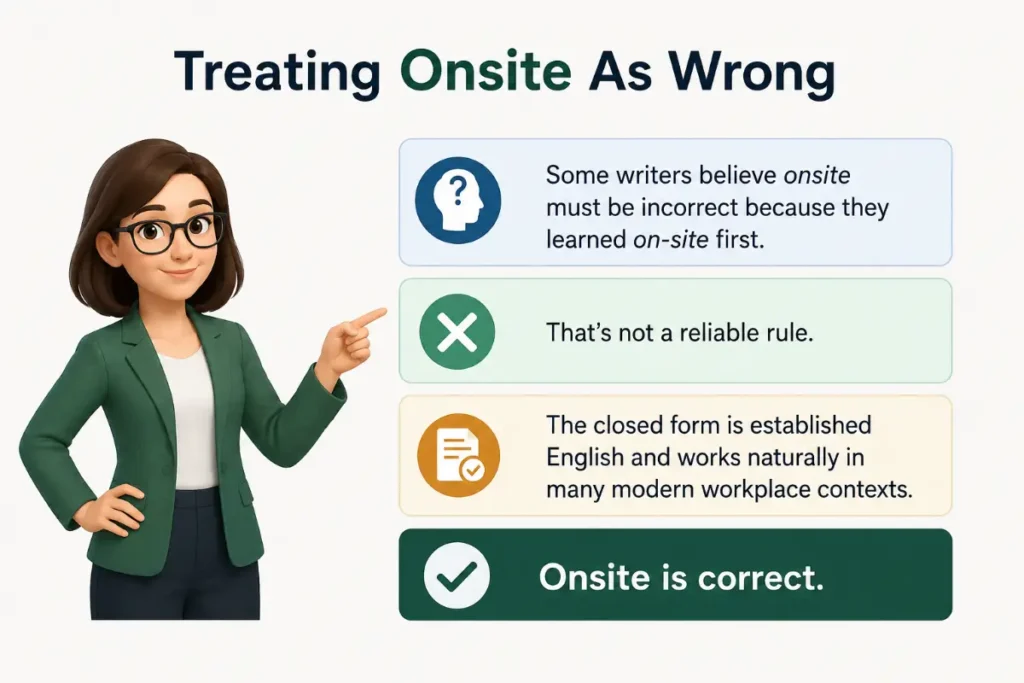
Mistake Two Treating On Site as Incorrect
Incorrect claim. You must always write onsite because the two word form is wrong.
Correct explanation. Both spellings are accepted. Choose the form that suits the sentence and your style guide.
The confusion comes from assuming that a closed compound must replace every open phrase with a similar meaning. English does not work that way. Many compounds have more than one accepted spelling.
Mistake Three Assuming Onsite Always Needs a Noun
Incorrect claim. Onsite can only appear before a noun.
Correct example. The support team will work onsite during the installation.
The closed form can also function as an adverb. Its role depends on the sentence, not just the spelling.
Mistake Four Confusing a Location With a Service Description
Less natural example. The technician is onsite support for the afternoon.
Clearer example. The technician will provide onsite support this afternoon.
The first sentence uses the phrase in a way that does not clearly express the intended role. The revised version makes support the service and explains what the technician will provide.
Mistake Five Assuming a Spell Checker Always Knows Best
A writing tool may prefer one form based on its dictionary, language settings, or editing rules. That does not automatically make the alternative incorrect.
For example, an editor may accept on site in a narrative sentence and use onsite in a service heading. If a spell checker flags one form, review the full sentence and your style requirements before changing it.
Pronunciation Guide
Both forms generally have the same pronunciation in American English. Most speakers connect the words naturally, so the written space does not create a major difference in how the phrase sounds.
Pronunciation reference
Onsite and on site
IPA: /ˈɑnˌsaɪt/ in a common American pronunciation.
Syllables: on site, with one main beat on the first part.
Easy guide: ahn site.
Stress: Usually on the first part of the expression.
Pronunciation can vary slightly by speaker and accent. In American English, the vowel in on often sounds like the vowel in words such as hot, although exact pronunciation depends on the speaker’s regional accent.
A common mistake is to pause noticeably between on and site simply because the phrase contains two written words. Natural speech usually connects them. You do not need to pronounce the open form differently from the closed form to make the distinction clear.
If you’re learning English, focus on the sentence pattern instead of trying to hear a spelling difference. The pronunciation usually won’t tell you which written form an editor expects.
Etymology and Word Origin
The expression comes from ordinary English words rather than from a specialized technical term. On is a long established English preposition, while site entered English through French from Latin roots associated with position or location.
The noun site refers to a particular place. It can describe a construction area, a workplace, a building, an archaeological location, or another defined area where an activity takes place.
The phrase on site developed naturally from the meaning of its individual words. It describes a person or activity located at the relevant place. Over time, writers also began using onsite as a closed compound, especially in descriptive and professional contexts.
English spelling often shifts as common phrases become familiar. Some compounds remain open, others take a hyphen, and others become closed words. These changes do not always happen at the same pace across industries or publications.
There is no need to memorize a complicated historical rule for this expression. Its modern usage is more useful than its history for most writers. Remember that both accepted forms describe a location, then select the spelling that fits your sentence and editorial standards.
Regional Usage
The difference between the two forms is not mainly a matter of national spelling. American, British, Canadian, and Australian English all use expressions built around the idea of being at a particular site.
American English
In the United States, onsite appears frequently in workplace language. Employers advertise onsite jobs, companies offer onsite services, and schools describe onsite programs. The open form also appears naturally in sentences such as The crew is on site.
American writers can use either form. For business documents, the closed form often provides a compact description, while the open form works well when location is part of the sentence.
British English
British English also uses both forms. Writers may use onsite in descriptions of services and facilities, while on site appears in construction reports, workplace instructions, and descriptions of activity at a location.
Some British publications may favor one spelling through their house style. That preference does not create a universal rule for all British writing.
Australian English
Australian English follows a similar pattern. Both forms can describe work, services, and activities at a particular location. A company might advertise onsite assistance, while a project report might state that inspectors were on site.
The safest approach is to follow the organization’s preferred dictionary or style guide.
Canadian English
Canadian English also permits both forms in ordinary use and Canadian workplaces may refer to onsite training or staff working on site, depending on sentence structure and editorial preference. For all four varieties, the main lesson remains the same. Do not assume that one form belongs to a specific country unless a reliable local style guide establishes that preference.
Grammar Rules and Sentence Structure
Understanding the grammatical role of the phrase makes the spelling decision easier. You do not need advanced grammar knowledge. A few common sentence patterns will help you choose confidently.
Use Onsite Before a Noun
The closed form often works as an adjective that describes a person, service, feature, or activity.
Examples include onsite childcare, onsite medical care, onsite interviews, and onsite repairs. In each phrase, the word describes the type or location of the noun that follows.
You can use this structure in complete sentences. The company provides onsite childcare for employees. The hospital offers onsite diagnostic services. The examples are direct and easy to understand.
Use On-Site After a Verb
The open form often appears after verbs that express location, movement, or activity.
Examples include remain on site, arrive on site, work on site, and stay on site. The phrase tells readers where the action happens or where someone remains.
For example, The workers remained on site until the supervisor approved the repairs. The phrase completes the sentence by explaining the workers’ location.
Understand Adverbial Use
An adverbial expression gives information about an action, including its location. Both onsite and on site can fill this role in established usage.
Consider these examples. The engineer will work onsite tomorrow. The engineer will work on site tomorrow.
Both sentences communicate the same general idea. An editor might prefer one based on the publication’s style guide, the surrounding text, or the desired rhythm.
Keep the Sentence Clear
Avoid forcing a particular spelling into a sentence just to follow a simple formula. The reader should understand the intended location and activity without rereading the sentence.
For example, The company provides onsite support is clear because the closed form describes support. The statement The support team is on site is equally clear because the open phrase describes the team’s location.
Follow Punctuation Rules
Neither form requires special punctuation. Do not add quotation marks, apostrophes, or extra marks simply because the expression describes a location.
Use ordinary sentence punctuation. Write Onsite parking is available. Write The technician is on site. Capitalize the expression at the start of a sentence as you would any other word.
Maintain Consistency in Formal Writing
Reports, proposals, policies, and training materials benefit from a consistent spelling choice. If you use onsite in service descriptions, check similar descriptions throughout the document.
Consistency does not mean every sentence must use the same form regardless of grammar. It means applying the same editorial logic to comparable uses and avoiding arbitrary changes.
Real Life Usage Examples
The best way to understand a spelling distinction is to see it in real situations. The following examples show how the phrase fits different kinds of communication.
Daily Conversation
In everyday speech, people usually choose the form that sounds natural in the sentence. The spoken meaning matters more than the visible space between the words.
1. Can you meet me on site when the delivery arrives?
2. The gym has onsite childcare, so parents can exercise while their children are supervised.
The first example focuses on a person’s location. The second describes a facility offered at a particular place.
Email and Workplace Communication
Work emails need clear wording because employees may rely on them to plan meetings, visits, and services. Both forms work well when used consistently.
1. Our technician will provide onsite support during the software installation.
2. Please confirm that the safety inspector will be on site by 9 a.m.
The first sentence describes a service. The second gives information about the inspector’s location and arrival time.
Academic Writing
Academic writing often requires precise descriptions of research locations and methods. The open form can work naturally in narrative descriptions, while the closed form can describe a service or resource.
1. Researchers collected soil samples on site to reduce the risk of contamination during transport.
2. The university provides onsite counseling for students who need additional support.
These examples show how the form depends on the grammatical role of the phrase. Academic writers should also follow the style guide required by their institution or journal.
News and Journalism
News writing often favors direct language that helps readers understand where an event occurred. The open phrase can fit naturally into reports about a specific location.
1. Emergency crews remained on site after the fire was brought under control.
2. The company announced onsite medical services for employees at its regional facility.
The first sentence reports activity at a location. The second describes a service available at a facility.
Literature and Storytelling
Stories often describe where characters go, work, or remain. The open form can fit naturally into narration, while the closed form can describe a feature of a setting.
1. By sunrise, the builders were already on site, preparing the ground for the new house.
2. The small factory had onsite housing for workers who lived far from the nearest town.
Both examples use straightforward language. The spelling follows the role of the phrase rather than an artificial rule that forces one form into every sentence.
Related Terms and Expressions
Several related expressions can help you describe locations more precisely. They are not all direct synonyms, so choose them according to the meaning you want to convey.
1. Offsite. This usually describes an activity or service that takes place away from a designated workplace or facility. For example, the team attended an offsite planning session.
2. Remote. This describes work or access that happens away from a central location. Remote work often takes place from home or another location using digital tools.
3. In person. This means people meet or participate physically rather than communicating only through a digital connection. An in person interview usually takes place with the interviewer and candidate physically present.
4. At the workplace. This is a plain alternative when you want to identify the location directly. For example, the training will take place at the workplace.
5. On location. This phrase often describes filming, photography, reporting, or other work carried out at a specific place rather than in a studio or office.
6. Fieldwork. This refers to research or practical work carried out in a real world setting. Scientists, researchers, and survey teams may perform fieldwork outside a laboratory or office.
7. In house. This means something is handled within an organization rather than outsourced. An in house support team may work at the company, but the phrase mainly describes who provides the service rather than the team’s physical location.
8. At the facility. This is a clear alternative when a particular building or site matters. For example, all equipment inspections will take place at the facility.
These expressions overlap in some situations, but they do not mean exactly the same thing. Offsite describes a different location from the designated site, while remote often emphasizes distance or work arrangements. In house focuses on internal responsibility. Choosing a precise alternative can make your writing clearer than repeating the same phrase throughout a document.
Expert Editor Insight
An experienced editor looks at the whole sentence before changing this spelling. The closed form often works well in service descriptions and noun phrases, while the open form frequently fits sentences about a person’s location or an activity. Spell checkers may favor one version because of their dictionaries or language settings, but that preference does not settle every case. A good editor checks the grammatical role, consults the relevant style guide, and applies the same rule to similar sentences. The goal is not to make every phrase look identical. It is to make the writing clear, accurate, and consistent.
Conclusion
The choice between onsite vs on-site comes down to grammar, context, and consistency. Both forms are correct, and neither deserves to be labeled a universal misspelling. Use onsite for compact descriptions such as onsite training or onsite services. Use on site when you want to describe someone’s location or explain where an activity takes place.
When both options fit, follow your organization’s style guide and apply its preference throughout your writing. Here’s a simple editing tip. Read the full sentence before making a spelling change. The clearest form is the one that communicates your meaning naturally and helps readers understand your message without distraction.
FAQs
Is Onsite a Real Word?
Yes. Onsite is an established English word used as an adjective and an adverb. It describes something located at or happening at a particular place. You will commonly see it in phrases such as onsite training, onsite services, and onsite parking. It is not simply a typing shortcut or an informal replacement for a more correct spelling.
Is On Site Also Correct?
Yes. On site is a standard English phrase that means at a particular location. It commonly appears after verbs that describe presence, movement, or activity. For example, The technician is on site tells readers where the technician is. The open form is not automatically incorrect just because a writer could use the closed form in another sentence.
What Is the Difference Between Onsite and On Site?
The main difference is grammatical use and editorial preference. Onsite often works as a compact adjective before a noun, as in onsite support. On site commonly functions as a location phrase, as in The team arrived on site. Both can communicate the same basic idea, so sentence structure and consistency help determine the better choice.
Is Onsite One Word or Two Words?
Onsite is written as one word. On site is written as two words. Both spellings are accepted in modern English, although particular dictionaries and style guides may prefer one form in certain contexts. If you are writing for a company, school, or publication, check its style rules and use the preferred form consistently throughout the document.
How Do You Pronounce Onsite and On Site?
Both forms generally share the same pronunciation in American English. They sound like the familiar expression on site, with the main stress on the first part. The written space usually does not change the spoken form. Since pronunciation offers little help in choosing the spelling, focus on grammar, meaning, and the style used in your document.
Is Onsite Appropriate in Formal Writing?
Yes. Onsite is appropriate in professional reports, business emails, service descriptions, job postings, and other formal documents. The open form is also appropriate. The best choice depends on the sentence and the style guide you follow. Consistent usage and clear meaning matter more than choosing one form simply because it looks more formal.
Can You Use On Site at the Beginning of a Sentence?
Yes. You can begin a sentence with the phrase when the location is the main point. For example, On site, the inspectors checked every piece of equipment. The comma helps separate the introductory location phrase from the main clause. You can also write Onsite inspections begin at eight, where the closed form modifies inspections.
What Is a Good Synonym for Onsite?
The best alternative depends on the intended meaning. At the workplace, at the facility, and at the location can all work in suitable sentences. In person may fit situations involving physical attendance, while on location often suits filming or reporting. Remote and offsite describe different arrangements, so they are not direct replacements in every context.
