
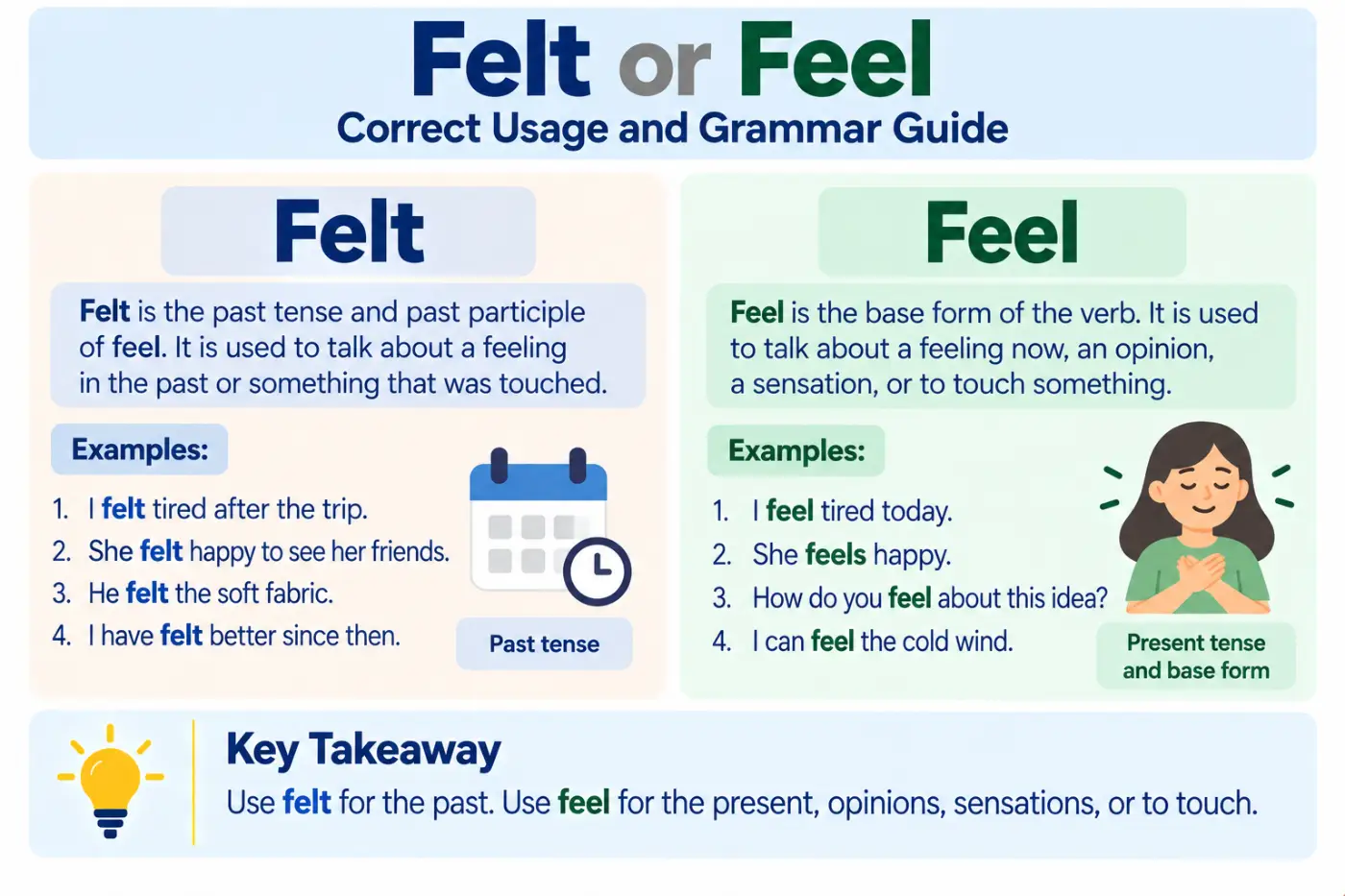
Choosing between feel or felt can be confusing because both words describe emotions, physical sensations, opinions, and personal experiences. The difference is simple once you understand how English verbs show time. One form describes a present experience or a habit. The other usually describes something that happened in the past.
For example, you might say that you feel tired after a long day at work. If you are talking about yesterday, you would say that you felt tired after work. Both sentences are correct, but they refer to different times.
The challenge goes beyond choosing a verb. You also need to know how these words work with helping verbs, how they appear in questions, and how they fit into formal writing and everyday conversation. The meaning can also change slightly depending on the situation. You might feel cold, feel happy, feel that a decision is unfair, or feel a rough surface with your fingers.
Understanding these patterns will help you choose the right form naturally. You will also learn common mistakes, pronunciation tips, and simple ways to remember the difference.
Quick Answer.
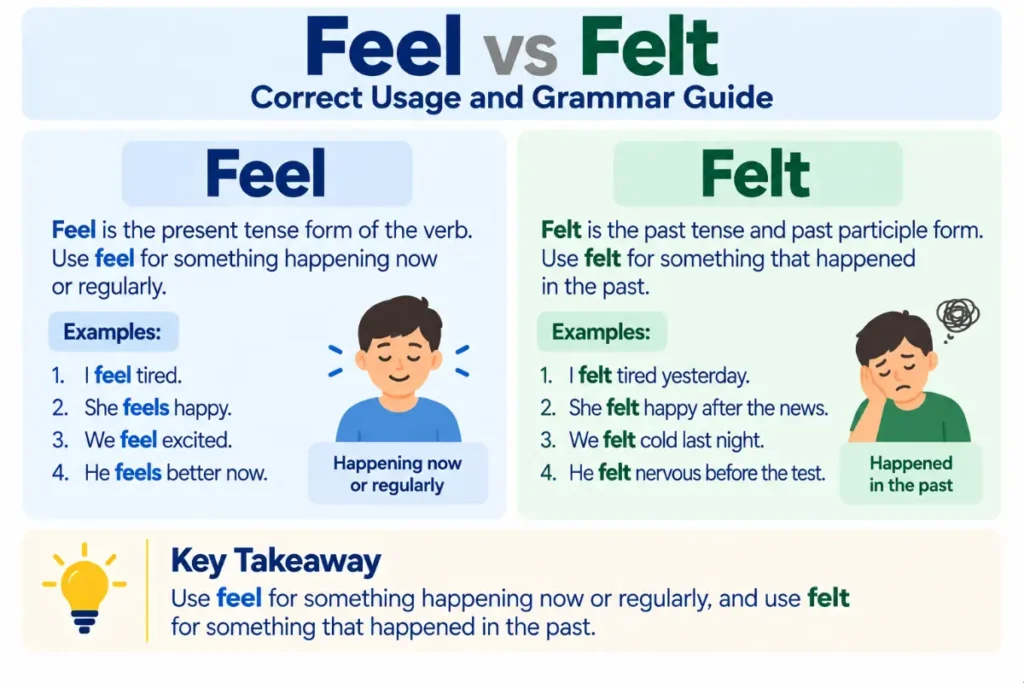
Feel is the base form of the verb and is commonly used for present experiences, habits, and opinions. Felt is its simple past form and past participle. Use feel for something happening now or generally, and use felt for a past experience or with a helping verb such as have, has, or had.
Comparison Table for Feel and Felt.
| Feature | Feel | Felt |
|---|---|---|
| Basic meaning | Experience a sensation or emotion | Experienced a sensation or emotion |
| Verb form | Base form and present tense form | Simple past and past participle |
| Part of speech | Verb | Verb |
| Time reference | Present or general situations | Past events or completed experiences |
| Pronunciation | /fiːl/ | /fɛlt/ |
| Common use | I feel better today. | I felt better yesterday. |
| With helping verbs | I will feel better. | I have felt better lately. |
| Formality | Standard in all settings | Standard in all settings |
| Common contexts | Emotions, opinions, touch, health | Past emotions, sensations, and experiences |
Meaning and Definition.
What Does Feel Mean.
Feel is a verb that describes experiencing a physical sensation, an emotion, or an impression. It can also describe touching something to learn what it is like or expressing an opinion about a situation.
The word has several common uses.
- Physical sensation. You can feel cold, pain, pressure, heat, or a soft fabric.
- Emotion. You can feel happy, nervous, excited, disappointed, or relieved.
- Opinion. You can feel that a decision is unfair or that a plan needs more work.
- Touch. You can feel a surface with your hands to check its texture.
- General condition. You can feel healthy, tired, weak, or energetic.
For example, the sentence I feel nervous before an exam describes an emotional state in the present. The sentence This blanket feels soft describes the quality of an object through touch.
The verb also appears in expressions such as feel like, feel free, and feel better. These phrases have their own patterns and meanings, so the words around the verb matter.
What Does Felt Mean.
Felt is the simple past form and past participle of feel. It describes an experience in the past or appears in verb constructions that use a helping verb.
Consider these examples.
- I felt nervous before my first interview.
- She felt a sharp pain in her shoulder.
- We felt that the plan was too expensive.
- He has felt more confident since joining the team.
- They had felt uneasy before the announcement.
In the first three examples, the verb describes an experience or opinion that belongs to the past. In the last two examples, the word appears in a perfect tense construction with has or had.
Felt is not an incorrect version of the present form. It is an essential part of the verb’s normal grammar. English uses different forms of many verbs to show time and grammatical relationships. For example, go becomes went in the simple past, and feel becomes felt.
Is Felt Ever a Noun or Adjective.
Yes. Felt can also name a type of fabric made by pressing or matting fibers together. This noun has a different grammatical function from the past tense verb.
For example, the sentence She felt the fabric describes an action in the past. The sentence The hat is made of felt uses the word as a noun that names a material.
Felt can also work as an adjective in expressions such as felt pressure or felt need. In these cases, it describes something experienced or perceived. Context helps readers identify the intended meaning.
Key Differences Explained.
The Difference in Time.
The main distinction is the time of the experience.
- Present. I feel sick today.
- Past. I felt sick yesterday.
- General habit. I feel nervous before public speaking.
- Completed experience with a present connection. I have felt nervous about this presentation for days.
The present form can describe a current state or a repeated experience. The past form usually places the experience before the present moment.
However, the verb itself does not always tell the full story. Time expressions such as today, last night, and recently help establish the intended time. The helping verb also matters. For example, have felt connects a past experience to a period that continues into the present or to a relevant present result.
The Difference in Grammar.
Feel is the base form. It appears after modal verbs such as can, could, will, and should. It also follows to when the sentence uses an infinitive.
Examples include the following.
- I can feel the difference.
- You should feel proud of your progress.
- She wants to feel more confident.
- We will feel better after resting.
Felt appears in the simple past without a helping verb and as the past participle after have, has, or had.
Examples include the following.
- I felt the floor shake.
- She has felt lonely lately.
- They had felt ready before the schedule changed.
A common mistake is to add the past form after a modal verb. For example, I will felt better is incorrect because will must be followed by the base form. The correct sentence is I will feel better.
The Difference in Meaning.
The core meaning remains similar in both forms. The difference usually concerns time rather than the type of experience.
I feel happy means happiness describes the speaker’s current state. I felt happy means the happiness belonged to an earlier time. Neither sentence tells the reader how long the emotion lasted unless the surrounding context provides that detail.
The same distinction applies to opinions. I feel that we need more time presents an opinion now. I felt that we needed more time reports an earlier opinion. The surrounding verbs may change too because the sentence shifts into the past.
Pronunciation Differences.
The two words differ in their vowel sounds and final consonants.
- Feel has one syllable and rhymes with real and deal. Its vowel is the long ee sound.
- Felt has one syllable and rhymes with belt and melt. Its vowel is the short e sound.
The final sound in feel is an l. Felt ends with a t after the l. Pronouncing these endings clearly helps listeners understand which word you mean.
Which Form Is Correct.
Both forms are correct. Neither is a misspelling, and neither is automatically more formal than the other. The right choice depends on the sentence’s grammar and intended time.
Use feel for present experiences, habits, and the base form after modal verbs. Use felt for past experiences and as the past participle in perfect tenses.
Compare these sentences.
- Correct. I feel confident about the test.
- Correct. I felt confident about the test yesterday.
- Correct. I have felt confident since I began studying.
- Incorrect. I have feel confident since I began studying.
- Incorrect. I felt confident tomorrow.
The fourth example uses the wrong verb form after have. The fifth combines a past form with a future time reference in a way that does not fit the intended meaning. A different sentence structure would be needed to express a future feeling.
English dictionaries list both forms as part of the same verb. A reliable way to check your writing is to identify the time reference and then check the verb pattern around it.
Sentence Examples.
These ten examples show how the two forms work in everyday and professional situations.
- Everyday conversation. I feel much better after getting a full night’s sleep.
- Text message. I felt bad about missing your call, so I wanted to check in.
- Workplace communication. I feel that the team needs another day to review the proposal.
- School. The students felt excited when their teacher announced the science fair.
- Academic writing. Participants felt less anxious after completing the practice session.
- Formal writing. The committee felt that additional evidence was needed before making a decision.
- Social situation. She feels comfortable talking to her closest friends.
- Personal reflection. I felt proud of myself for finishing the project on time.
- Health and wellness. He has felt tired for several days and plans to rest this weekend.
- Online communication. We feel lucky to have such helpful people in our community.
Notice how the helping verbs and time expressions guide the choice. The examples also show that the verb can describe emotions, opinions, physical states, and reactions.
Common Mistakes and How to Avoid Them.
Even fluent English speakers sometimes choose the wrong verb form when writing quickly. Most errors happen because the writer overlooks a helping verb, mixes up time references, or applies a regular verb pattern to an irregular verb.
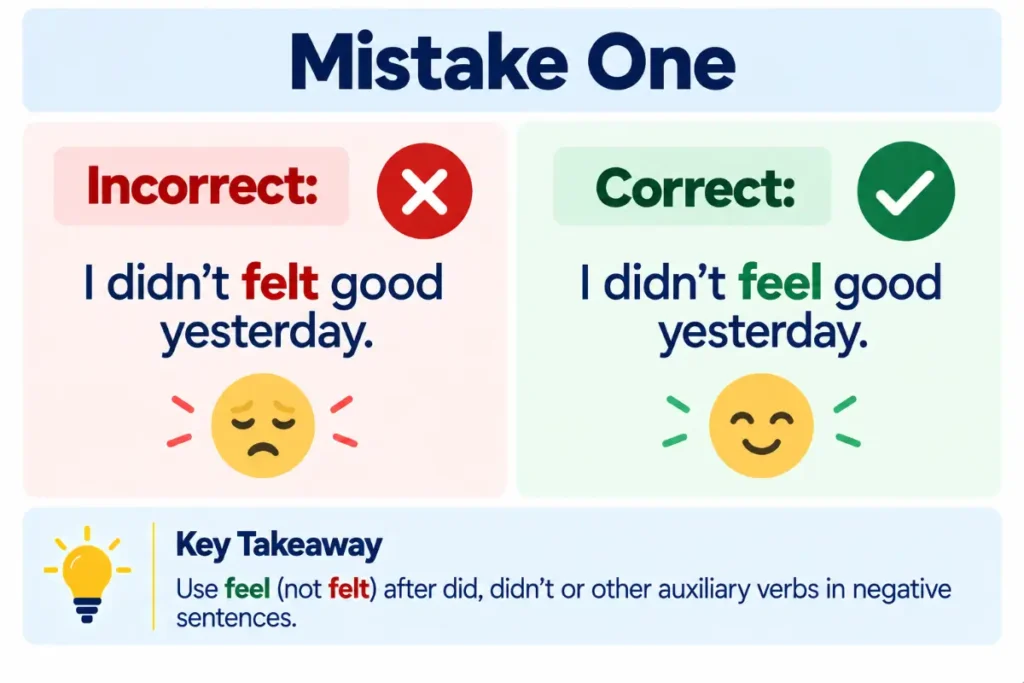
Mistake One With Did.
Incorrect. Did you felt nervous during the interview?
Correct. Did you feel nervous during the interview?
When did introduces a question about the past, the main verb returns to its base form. The word did already marks the past tense, so the main verb does not need to do it again.
The same rule applies to negative sentences.
Incorrect. I did not felt well.
Correct. I did not feel well.
Mistake Two With Have and Has.
Incorrect. She has feel better since Monday.
Correct. She has felt better since Monday.
The helping verb has requires the past participle in this construction. For feel, that form is felt. The same rule applies to have and had.
For example, you should write We have felt welcome here and They had felt uncertain about the decision.
Mistake Three With Will and Can.
Incorrect. I will felt better tomorrow.
Correct. I will feel better tomorrow.
Incorrect. I can felt the vibration.
Correct. I can feel the vibration.
Modal verbs such as will, can, could, should, and might take the base form of the main verb. Remember this pattern when writing about future plans, abilities, or possibilities.
Mistake Four With Present and Past Time.
Incorrect. Yesterday I feel exhausted after work.
Correct. Yesterday I felt exhausted after work.
The word yesterday clearly places the event in the past. The verb must match that time reference. In contrast, Today I feel exhausted uses the present form because it describes the current situation.
Writers sometimes overlook these small time clues when a sentence contains several ideas. Reading the sentence aloud can help reveal the mismatch.
Mistake Five With Feelings That Continue.
Incorrect. I am felt nervous about the presentation.
Correct. I feel nervous about the presentation.
You can also write I was feeling nervous about the presentation to describe an ongoing state in the past. In standard English, felt does not normally follow am directly in this pattern.
However, be felt is possible in passive constructions with other meanings. For example, The impact was felt across the country uses felt as a past participle in the passive voice. Grammar depends on the full sentence rather than one word alone.
Pronunciation Guide.
How to Pronounce Feel.
The IPA pronunciation of feel is /fiːl/. It has one syllable, with the long ee vowel sound found in words such as see and green.
To say it clearly, begin with the consonant sound /f/. Keep your lips close together and let air pass between them. Then produce the long vowel sound before ending with /l/.
The vowel should sound long and steady. Avoid shortening it so much that it sounds like the vowel in felt.
How to Pronounce Felt.
The IPA pronunciation of felt is /fɛlt/. It also has one syllable, but its vowel is the short e sound heard in bed and help.
Begin with /f/, move into the short vowel, and finish with the connected /lt/ sounds. The final t should be audible without adding an extra vowel after it.
A useful practice is to say the word pairs feel and fill, then felt and belt. This helps you notice the vowel and ending differences.
Common Pronunciation Problems.
- Shortening the vowel in feel too much can make the word sound closer to fill.
- Using a long ee vowel in felt changes its normal pronunciation.
- Dropping the final t in felt may make the word harder to recognize in careful speech.
- Adding an extra vowel after the final t can make the word sound like it has two syllables.
The goal is clear speech rather than an exaggerated accent. Listen to standard American English examples and repeat the words in full sentences. The surrounding sounds can also affect how clearly a word is heard during fast conversation.
Etymology and Word Origin.
Feel comes from Old English fēlan, a verb associated with touching, perceiving, or experiencing something through the senses. The word developed over centuries and retained its connection to physical sensation while expanding into emotional and mental experience.
The past form felt developed as part of the verb’s irregular pattern. English contains many verbs that change their internal vowel or ending to mark the past rather than adding the regular ending used by verbs such as walk and worked.
For example, walk becomes walked, but feel becomes felt. This difference comes from the historical development of English verb patterns.
The modern verb now covers several related ideas. People can feel an object through touch, feel an emotion, feel pain, or feel that an argument is convincing. These meanings share the central idea of experiencing or perceiving something.
The noun felt, which names a type of fabric, is also an established English word. Its use should not be confused with the past tense form simply because the spelling is identical.
Regional Usage.
American English.
Both forms are standard in the United States. Americans use feel to describe current sensations, emotions, habits, and opinions. They use felt for past experiences and in perfect tense constructions.
For example, I feel great today is natural American English. I felt great after the game is equally natural when describing a past experience.
The same forms appear in school assignments, professional emails, news reports, and everyday conversation. There is no special American spelling rule that changes felt into another form.
British English.
British English uses the same basic verb forms and grammatical rules. A British speaker can say I feel tired today or I felt tired yesterday without changing the spelling.
Differences in accent may affect the exact sound of the vowel, but the grammatical distinction remains the same. There is no general British rule that makes one form correct and the other incorrect.
Australian English.
Australian English also uses feel and felt according to the same standard verb patterns. Pronunciation may differ from American and British varieties, but the tense distinction does not change.
Canadian English.
Canadian English follows the same core grammar. Writers and speakers use feel for present or general situations and felt for past experiences or perfect tense constructions.
Across these varieties, the essential rule is consistent. Choose the verb form that matches the sentence structure and intended time rather than the country of the reader.
Grammar Rules and Part of Speech.
Feel as a Main Verb.
Feel commonly acts as a main verb that expresses sensation, emotion, opinion, or perception.
Examples include the following.
- I feel cold.
- The fabric feels smooth.
- We feel that the policy should change.
- She feels nervous before speaking in public.
In the first sentence, feel describes a physical sensation. In the second, feels describes a quality perceived through touch.
When feel describes a state, it often takes an adjective rather than an adverb. For example, I feel bad is standard when describing an emotional or physical state. I feel badly can mean that your sense of touch is impaired, although people sometimes use it when they intend to describe an emotion.
Feel With Different Subjects.
In the simple present tense, the verb changes slightly with the subject.
- I feel ready.
- You feel ready.
- We feel ready.
- They feel ready.
- He feels ready.
- She feels ready.
The third person singular form takes an s. This rule applies to the present tense, not the past tense. You would write He felt ready and She felt ready without adding another ending.
Felt in the Simple Past.
Use felt when describing a completed experience or state in the past.
Examples include I felt relieved after the exam and They felt disappointed when the event was canceled. The form stays the same with every subject.
The surrounding sentence often establishes the time. Words such as yesterday, last week, earlier, and in 2024 can make the past reference clear.
Felt as a Past Participle.
A past participle is a verb form used in constructions such as the present perfect, past perfect, and passive voice.
- Present perfect. I have felt this way before.
- Past perfect. She had felt better before the symptoms returned.
- Passive voice. The effects were felt throughout the community.
The form remains felt in these patterns, but the grammatical role changes according to the helping verb and sentence structure.
Feel in Questions and Negative Sentences.
Questions and negatives often use helping verbs. The form of the main verb depends on the helper.
- Do you feel ready?
- Did you feel ready yesterday?
- Do not feel pressured to answer immediately.
- She does not feel comfortable speaking in public.
Notice that the main verb returns to feel after do, does, and did. These helping verbs carry the grammatical information needed for the sentence.
Feel Like and Felt Like.
The phrase feel like has several common uses. It can express a desire, a similarity, or a personal impression.
Examples include I feel like taking a walk and This fabric feels like silk. In the first sentence, the phrase expresses a desire. In the second, it compares a sensation or texture with something familiar.
The past form works in the same way. I felt like taking a walk describes a past desire. The context makes the time clear.
Punctuation and Formal Writing.
The verb itself does not require special punctuation. Use commas, periods, and other marks according to the sentence structure.
For example, I felt nervous, but I completed the presentation correctly joins two related ideas. In formal writing, however, writers should choose precise descriptions rather than rely too heavily on vague expressions such as I feel that.
That phrase is not grammatically wrong. Still, a direct statement can sometimes make the point stronger. Instead of writing I feel that the results support the claim, you could write The results support the claim if the evidence justifies that conclusion.
Real Life Usage Examples.
The verb appears in many kinds of writing. The basic grammar stays the same, but the tone and purpose can change with the situation.
Daily Conversation.
People often use these forms to talk about their health, mood, and reactions.
- I feel much calmer now that we have finished the move.
- He felt embarrassed when he forgot the guest’s name.
The first example describes a current state. The second reports a past reaction.
Email and Workplace Communication.
At work, these words can express opinions, concerns, or reactions to a decision.
- I feel that we should review the budget before approving the purchase.
- The team felt confident after completing the final round of testing.
The first sentence presents a current opinion. The second describes how the team felt at an earlier point.
Academic Writing.
Academic writing often uses these verbs when reporting personal experiences or describing responses from participants. In research reports, writers should distinguish personal impressions from measured findings.
- Several participants felt anxious before the first session.
- Students reported that they feel more confident after practicing the task.
The second example uses feel inside a reported statement about a present or continuing experience. The tense depends on the intended meaning and the reporting context.
News and Journalism.
News reports may use the verb when describing public reactions, personal accounts, or the effects of an event.
- Residents felt relieved after officials announced the evacuation had ended.
- Many workers feel uncertain about the changes to their schedules.
The first sentence reports a reaction to a past announcement. The second describes a current concern.
Literature and Storytelling.
Stories often use changes in tense to show how a character’s experience develops over time.
- Maya felt a strange chill as she opened the old wooden door.
- Now she feels safe because the mystery has finally been solved.
These examples show how verb tense can help guide readers through a story. A writer can move from a past experience to a character’s present state without changing the central meaning of the verb.
Related and Confused Terms.
Several words describe sensations, emotions, and opinions. They can sometimes replace feel or felt, but their meanings are not always identical.
- Sense. This verb describes detecting or recognizing something through the senses or intuition. You might sense danger before you can explain why.
- Experience. This word focuses on going through an event or condition. You can experience pain or experience a difficult day.
- Perceive. This is a more formal word for becoming aware of something or interpreting it in a particular way. People may perceive a comment as rude.
- Think. This verb commonly expresses an opinion or belief. I think the plan will work is often more direct than I feel the plan will work.
- Believe. This word expresses confidence in an idea or claim. I believe the report is accurate emphasizes a judgment about truth.
- Seem. This verb describes how something appears or comes across. The explanation seems clear focuses on an impression rather than a direct physical sensation.
- Felt. Besides being the past form of feel, this word names a fabric made from pressed fibers. The sentence determines its grammatical role.
- Feeling. This form can refer to an emotion, a physical sensation, or the ongoing action of experiencing something. A feeling of relief is a noun phrase, while I am feeling better uses it in a verb construction.
These terms are related in meaning, but they are not interchangeable in every sentence. Choose the word that expresses the exact idea you want readers to understand.
Expert Editor Insight.
An experienced English editor looks at the entire sentence rather than judging a verb form on its own. The most common errors occur after helping verbs such as did, have, and will, or when a time expression conflicts with the chosen tense. Grammar tools can catch many of these problems, but they may miss differences in meaning and context. A useful editing habit is to underline the main verb, identify its helping verb, and check the time reference before making a correction.
Key Takeaways
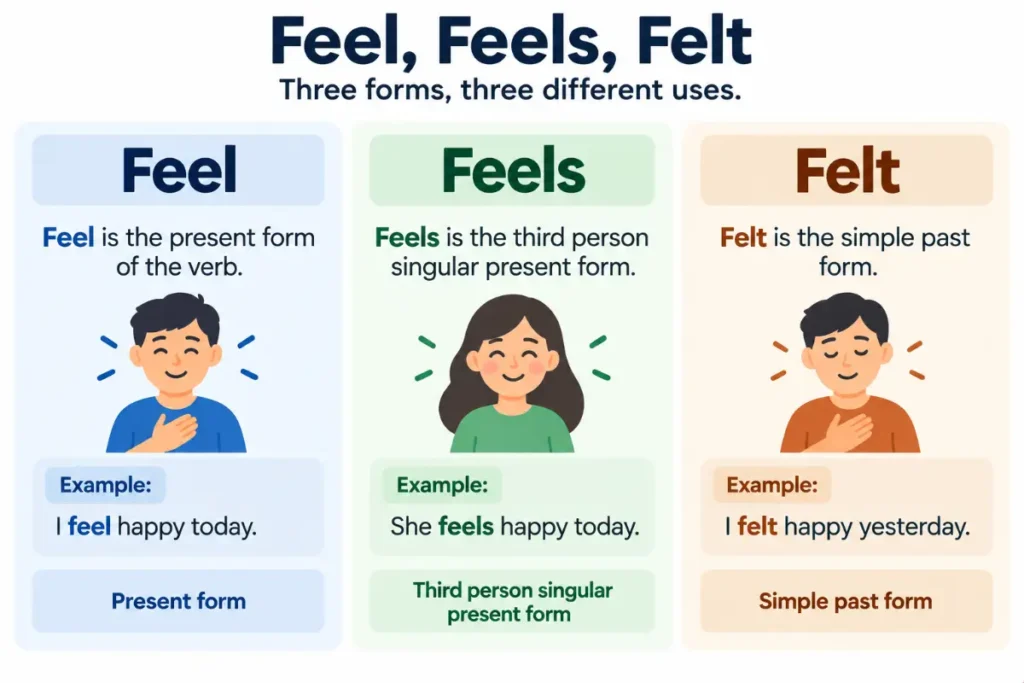
- Feel is the present form of the verb.
- Feels is the third person singular present form.
- Felt is the simple past form.
- Felt is also the past participle.
- Use feel for current or repeated experiences.
- Use felt for completed past experiences.
- After did or didn’t use feel.
- After have, has, or had use felt.
- Do not use feeled as the standard past form.
- The correct form depends on tense, subject, helping verbs, and context.
Conclusion
The choice between feel or felt comes down to verb tense and sentence structure. Feel describes present sensations, emotions, opinions, and general experiences. Felt describes past experiences and also serves as the past participle in constructions with helping verbs. Both forms are correct, so neither should be treated as a spelling mistake.
The key is to match the verb to the meaning and grammar of your sentence. Remember this simple rule: write I feel today and I felt yesterday. After did, use feel. After have, has, or had, use felt. These small checks will help you write clearly and confidently in everyday conversations and formal work.
FAQs.
Is Feel or Felt Correct?
Both are correct English forms of the same verb. Feel is the base form and appears in the present tense, after modal verbs, and in infinitive phrases. Felt is the simple past form and past participle. The correct choice depends on the sentence. Use I feel fine to describe the present and I felt fine to describe a past experience.
What Does Felt Mean in English?
Felt usually means experienced a physical sensation, emotion, or opinion in the past. It is also the past participle used with helping verbs such as have, has, and had. For example, I felt relieved describes a past emotion, while I have felt relieved before uses the present perfect. Felt can also name a type of fabric.
Can You Use Feel When Talking About the Past?
You can use feel in a sentence about the past when the grammar calls for the base form after a helping verb such as did. For example, Did you feel nervous yesterday is correct. However, you should use felt in a simple past statement such as I felt nervous yesterday. The helping verb determines the correct form.
How Do You Pronounce Feel and Felt?
Feel is pronounced /fiːl/, with a long ee vowel sound. Felt is pronounced /fɛlt/, with the short e sound found in bed. Both words have one syllable. To practice, say feel and then felt slowly. Pay attention to the vowel change and the final t in the second word.
Can a Sentence Start With Feel or Felt?
Yes. A sentence can begin with either form when the grammar and meaning support it. For example, Feel free to ask questions uses feel as an imperative verb. Felt nervous, she waited outside the room uses felt in a shortened descriptive construction. The second pattern is more common in formal or literary writing than in everyday conversation.
What Is a Synonym for Feel?
The best synonym depends on the meaning. Experience can describe going through an event or condition. Sense can describe detecting something. Think and believe can express opinions, while perceive can describe awareness or interpretation. None of these words replaces feel in every context. For example, I feel cold describes a sensation, while I believe cold is dangerous expresses a different idea.
Why Do People Confuse Feel and Felt?
People confuse the two forms because both describe similar experiences and differ by only a small spelling and sound change. The problem becomes more common in questions and negative sentences, where helping verbs affect the main verb. Remember that did takes feel, while a simple past statement normally uses felt. Reading the complete sentence helps reveal the correct choice.
Is Felt Appropriate in Formal Writing?
Yes. Felt is standard English and works in academic, professional, and formal writing. You can use it to report past experiences, describe reactions, or construct perfect tenses. However, formal writing often benefits from precise language. If a sentence says the participants felt that a policy was unclear, you may be able to report their specific concern more directly when the available evidence supports it.
