
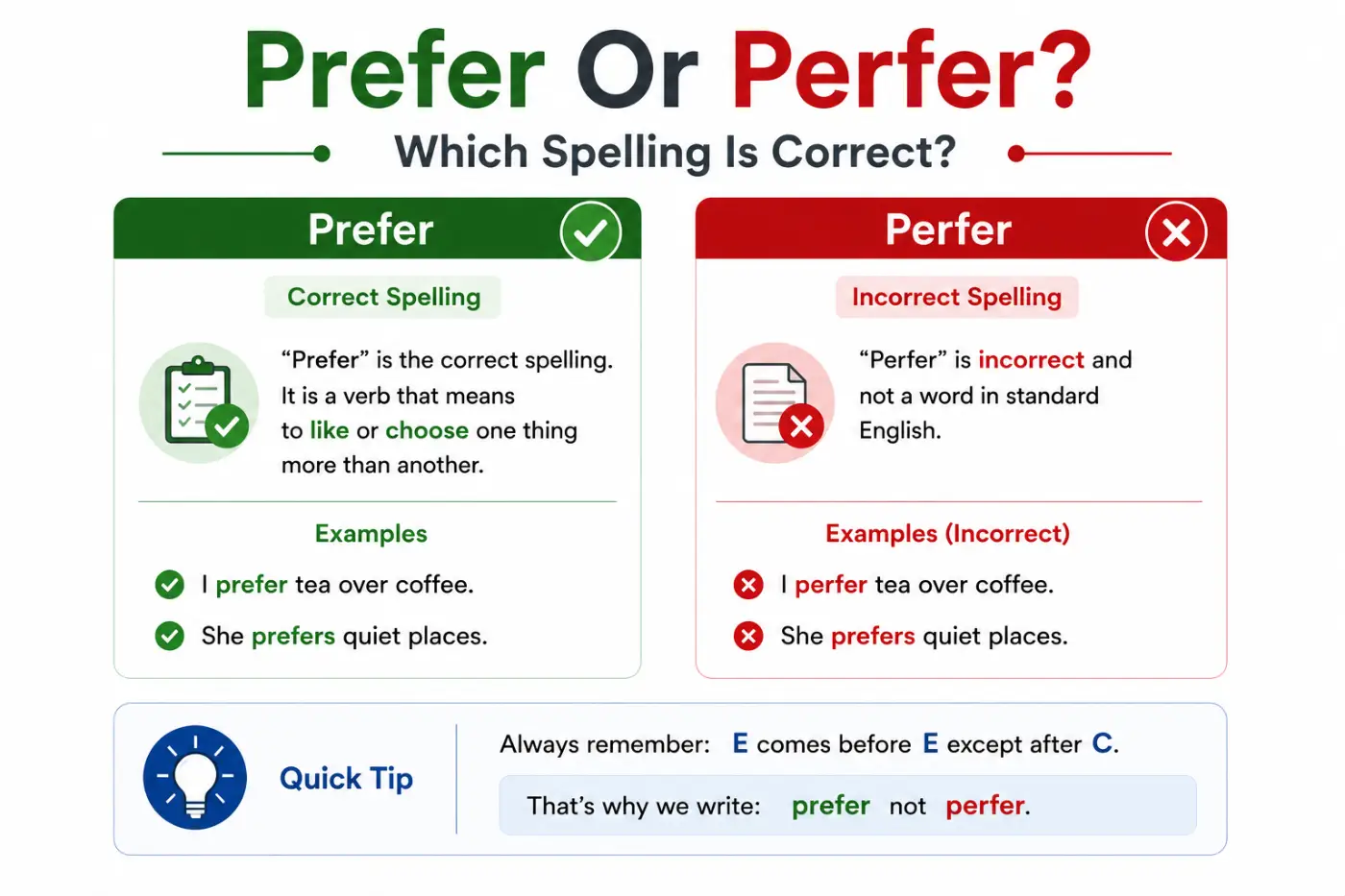
The spelling prefer or perfer often confuses people when they write quickly or rely on how a word sounds. The correct spelling is prefer, while perfer is a common misspelling. In standard American English, use prefer when you mean to like one thing more than another or favor one option over another.
The confusion is understandable because both forms look similar, and the opening letters are easy to mix up. However, the correct spelling follows a fixed pattern: p, r, e, f, e, r.
You might prefer coffee over tea, prefer working in the morning, or prefer a quiet place to study. In every case, the same spelling applies. The verb also has related forms, including prefers, preferred, and preferring.
Learning this simple spelling rule can help you avoid mistakes in emails, school assignments, work documents, text messages, and other everyday writing. It also helps you use the verb correctly and recognize related words that express personal choices and preferences.
Quick Answer
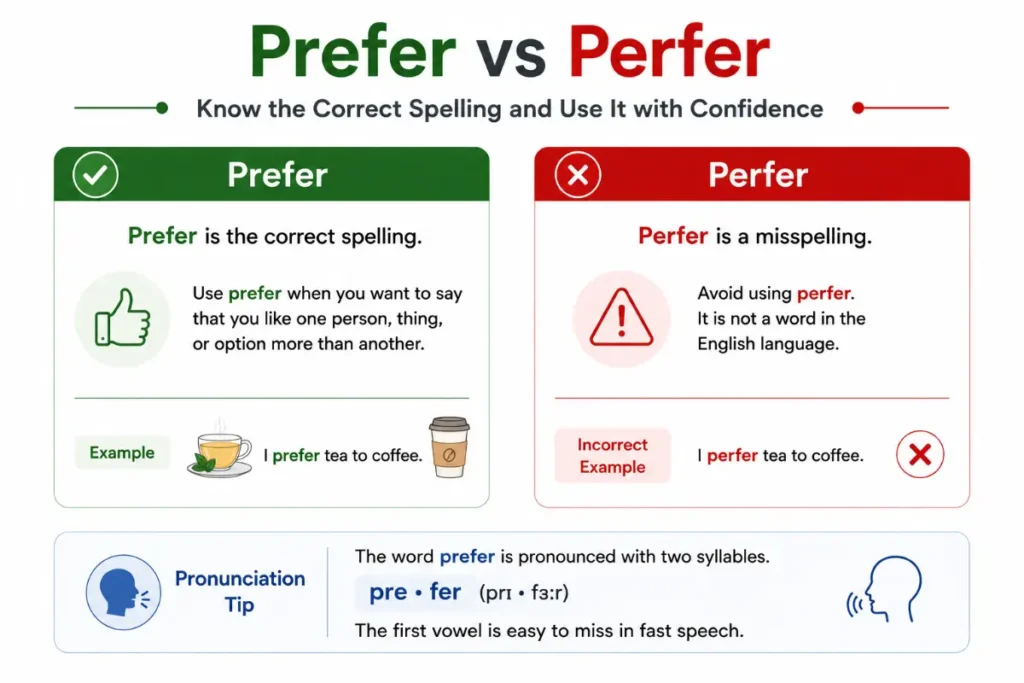
Prefer is the correct spelling in standard English. Perfer is a common misspelling and should not be used as the standard form of the verb. Use prefer to express a choice, liking, or greater interest in one thing compared with another.
Comparison Table for Prefer and Perfer
| Feature | Prefer | Perfer |
|---|---|---|
| Spelling status | Correct standard spelling | Common misspelling |
| Meaning | To like one option more than another | No standard meaning as a form of this verb |
| Part of speech | Verb | Incorrect form when used for this verb |
| Pronunciation | /prɪˈfɝː/ in American English | Not a standard alternative pronunciation |
| Formality | Suitable for formal and informal writing | Should be corrected |
| Common contexts | Conversation, school, work, and academic writing | Mistakes in typing or spelling |
| Word origin | From Latin through French and Middle English | No established origin as an accepted variant of this verb |
| Example | I prefer tea to coffee. | I perfer tea to coffee. |
The main difference is spelling, not meaning. When someone writes perfer while expressing a choice, the intended word is almost always prefer. The standard form works across everyday conversation, professional communication, and academic writing.
Meaning and Definition
What Does Prefer Mean
Prefer is a verb that means to like, choose, or want one thing more than another. It expresses a choice or a greater liking for a person, object, activity, idea, or situation.
For example, if you prefer reading at home to reading in a busy cafe, you find the home environment more appealing. You may still enjoy the cafe sometimes, but your stronger preference is for reading at home.
The word can describe simple personal choices as well as serious decisions.
- Personal choice. I prefer chocolate ice cream.
- Daily habits. She prefers to exercise in the morning.
- Work decisions. Our team prefers written updates.
- Academic choices. The student prefers practical assignments.
- Formal requests. I would prefer a meeting next week.
In each example, the verb communicates a favored option. The choice can be temporary or long lasting, and it does not always mean that every other option is disliked.
Is Perfer a Real Word
Perfer is not an accepted spelling of the standard English verb. It is best understood as a spelling mistake rather than a separate word with its own meaning.
You may see this form in online posts, informal messages, student assignments, or search queries. Its appearance in written material does not make it an accepted variant. People make typing mistakes every day, and this one is easy to recognize once you know the standard spelling.
For example, the sentence I perfer to work alone should be corrected to I prefer to work alone.
There is no need to memorize a separate definition for the incorrect form. Learn the standard verb and its common grammatical forms instead.
Key Differences Explained
Spelling
The correct word contains the letters in this order.
P R E F E R
The incorrect form changes the order of the first three letters.
P E R F E R
Remember that the beginning of the correct word is pre, not per. This small detail makes the difference between standard spelling and a common error.
Meaning
Prefer has a clear and established meaning. It describes a greater liking for one option over another.
Perfer has no separate standard meaning in this context. Readers will usually understand the intended message, but the spelling still needs correction.
Grammar
Prefer is a verb, so it can describe an action of choosing or a state of liking one option more than another.
Examples include the following.
- I prefer tea.
- He prefers to drive.
- They preferred the earlier time.
- We are discussing our preferred design.
The spelling changes to match the sentence, but the base form remains prefer.
Pronunciation
In standard American English, prefer is commonly pronounced with two syllables and stress on the second syllable. The first syllable sounds like the beginning of the word pretty, while the second has the stressed vowel sound heard in bird for many American speakers.
The spelling perfer does not represent an accepted alternative pronunciation of the standard verb. A speaker may pronounce the word unclearly or remember its sounds incorrectly, but that does not change the standard written form.
Formality
Prefer is appropriate in nearly every writing style. You can use it in casual texts, workplace emails, essays, business proposals, and formal letters.
Perfer should be corrected in all these settings when the intended meaning is the standard verb. In professional writing, even a small spelling error can distract readers from the message.
Regional Usage
American, British, Canadian, and Australian English all use prefer as the standard spelling. The word does not have separate national spellings.
Pronunciation can vary by accent, but the written form remains the same. You do not need to learn a different spelling for different English speaking audiences.
Which Form Is Correct
Prefer is correct because it is the established spelling recognized in standard English dictionaries. Perfer is a misspelling, not an accepted regional variation.
A useful way to check a doubtful spelling is to look up the word in a reputable dictionary and review its example sentences. Dictionary entries also show related forms and common grammatical patterns, helping you check more than spelling alone.
For this word, the answer is straightforward. Use prefer whenever you mean to like one thing more than another.
Sentence Examples
These examples show how the correct form works in different situations.
- Everyday conversation. I prefer tea because it helps me relax in the evening.
- Text messages. I prefer the earlier movie, so let’s meet at six.
- Workplace communication. Our manager prefers short reports with clear recommendations.
- School assignments. I prefer writing my essay in the morning when the house is quiet.
- Academic writing. Many researchers prefer methods that produce clear and repeatable results.
- Formal requests. I would prefer to receive the final document by Friday.
- Social situations. Would you prefer to sit inside or enjoy the fresh air outside.
- Online communication. I prefer using a laptop for long writing tasks.
- Shopping. She prefers comfortable shoes to fashionable shoes that hurt her feet.
- Travel planning. We prefer traveling by train because it gives us more time to enjoy the scenery.
These examples also show that the verb can appear in different grammatical patterns. You can follow it with a noun, an activity ending in ing, or an infinitive beginning with to.
The incorrect spelling does not belong in these sentences. If you see it while proofreading, replace it with the standard form before sharing your work.
Common Grammar Patterns
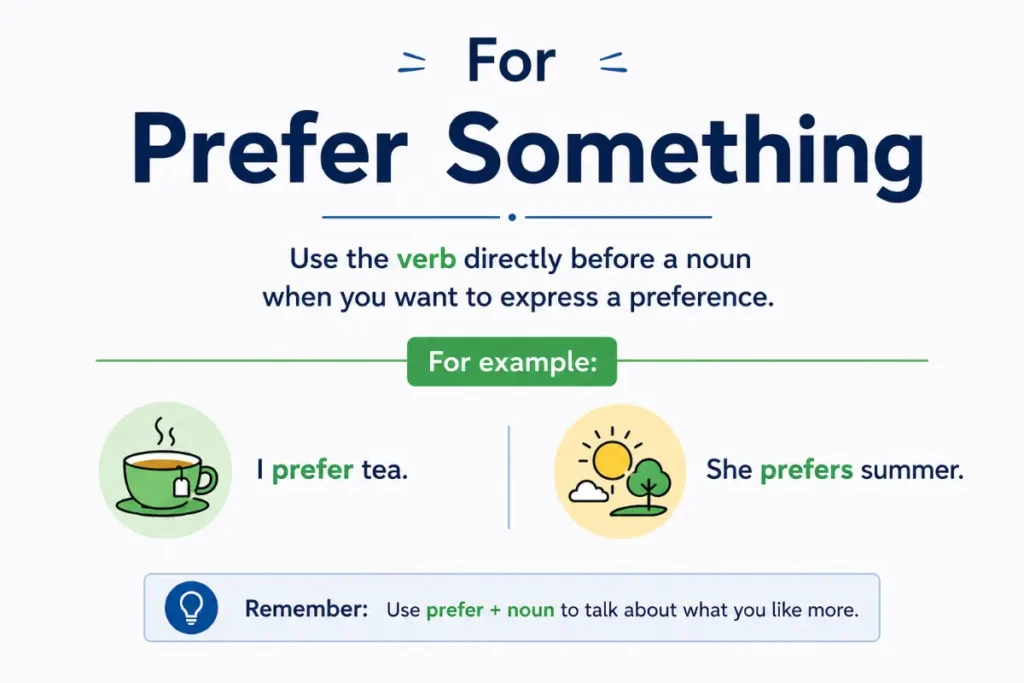
Prefer Something
Use the verb directly before a noun when you want to express a preference.
For example:
I prefer tea.
She prefers summer.
They prefer quiet places.
This structure is short and natural.
Common Mistakes and Misspellings
The spelling confusion often appears alongside other errors involving the same verb. Learning the correct forms together makes them easier to remember.
| Incorrect Form | Correct Form | Reason |
|---|---|---|
| perfer | prefer | The opening letters are in the wrong order. |
| prefered | preferred | The final consonant doubles before the ed ending. |
| prefering | preferring | The final consonant doubles before the ing ending. |
| prefer coffee than tea | prefer coffee to tea | The usual comparison pattern uses to. |
| prefer walk | prefer to walk or prefer walking | The verb needs a suitable grammatical structure. |
Mistake One With the Opening Letters
The error occurs when someone remembers the sound but not the exact letter order. The simplest fix is to memorize the base form as prefer.
Incorrect. I perfer to stay home.
Correct. I prefer to stay home.
Mistake Two With the Past Tense
The past tense requires a doubled r. This pattern may seem unusual at first, but it is part of the standard spelling of the verb.
Incorrect. We prefered the first option.
Correct. We preferred the first option.
Mistake Three With the Ing Form
The ing form also doubles the final r.
Incorrect. She is prefering the smaller room.
Correct. She is preferring the smaller room.
However, the progressive form is less common in everyday English than simple forms such as she prefers the smaller room. Choose the tense that fits the meaning of your sentence.
Mistake Four With Comparisons
When comparing two things directly, the usual pattern is prefer A to B.
Incorrect. I prefer coffee than tea.
Correct. I prefer coffee to tea.
You can also use rather than in suitable sentence structures, such as I would prefer to walk rather than drive.
Mistake Five With the Following Verb
Prefer can take a to infinitive or an ing form when describing an activity.
Incorrect. I prefer study at night.
Correct. I prefer to study at night.
Also correct. I prefer studying at night.
The right choice depends on the sentence, but the bare verb study does not normally follow prefer directly in this construction.
Pronunciation Guide
The standard American pronunciation of prefer is represented by the International Phonetic Alphabet as /prɪˈfɝː/. The mark before the second syllable indicates that the stress falls on that syllable.
Syllable Breakdown
The word has two syllables.
- First syllable. The sound is /prɪ/, similar to the opening sound in pretty.
- Second syllable. The sound is /fɝː/, with the stressed vowel sound found in bird for many American speakers.
Say the first syllable lightly and give the second syllable more emphasis. You do not need to stretch the word unnaturally. Focus on making the second syllable clear.
Why Pronunciation Can Cause Confusion
Some people remember a word by its sound before they remember its spelling. If they hear or say a word quickly, they may recall the sounds in the wrong order when typing it later.
This can help explain why someone might write perfer. The two spellings look similar, and the unstressed first syllable can be easy to overlook. However, pronunciation alone is not a reliable guide to every English spelling.
The best approach is to connect the spoken word with its written form. Say prefer aloud, then write the letters in their standard order. Repeat the process with preferred and preferring so that you remember the related forms as well.
Etymology and Word Origin
The word prefer has a long history in English. It entered English through French forms related to the Latin verb praeferre, which means to carry before or place before.
The Latin word combines prae, meaning before, with ferre, meaning to carry or bear. Over time, the word developed its modern sense of favoring one option over another.
This history offers a useful memory aid. When you prefer something, you place it ahead of other choices in your mind. You might choose one restaurant before another or favor one method over a different method.
The spelling perfer does not represent an established alternative development of this word. It is a modern spelling error that resembles the correct form.
Etymology can help you remember a word, but it should support rather than replace modern spelling rules. In practical writing, the most important point is still simple. The standard English verb begins with pre.
Regional Usage
American English
Prefer is the standard spelling in the United States. It works in conversation, business writing, school assignments, and formal documents.
American speakers commonly use expressions such as I prefer coffee to tea, I prefer to work alone, and I would prefer a later appointment. The spelling remains the same across these situations.
British English
British English also uses prefer. There is no standard British spelling that changes the opening letters to per.
Some differences in pronunciation may be noticeable between British and American speakers, but the correct written form remains unchanged.
Australian English
Australian English follows the same spelling. Prefer is the accepted form for expressing a choice or a greater liking for something.
The incorrect form should be corrected in both casual writing and formal documents.
Canadian English
Canadian English also uses prefer. Although Canadian spelling includes some differences from American and British conventions in other words, this verb is not one of them.
You can confidently use prefer for a Canadian audience without changing its spelling.
Grammar Rules and Part of Speech
Prefer is a transitive verb in common uses because it can take an object. For example, in I prefer tea, the word tea receives the action expressed by the verb. It can also appear in other sentence patterns to describe choices involving activities or future plans.
Learning a few common structures will help you use the word correctly.
Prefer With a Noun
Use prefer followed by a noun when you want to name your favored option.
Examples include the following.
- I prefer coffee.
- She prefers quiet rooms.
- They prefer online classes.
You can use this structure when the comparison is already clear from the conversation.
Prefer One Thing to Another
Use prefer A to B when comparing two things or activities.
For example, I prefer tea to coffee.
The same structure works with activities. You might say that you prefer reading to watching television or prefer walking to driving.
Avoid using than directly after prefer in this standard comparison pattern. The sentence I prefer tea than coffee is not the usual grammatical construction.
Prefer to Do Something
Use prefer to followed by the base form of a verb when talking about an activity.
For example, I prefer to study in the morning.
Other examples include she prefers to travel by train and they prefer to eat at home. This structure is common in both spoken and written English.
Prefer Doing Something
You can also use prefer followed by an ing form.
For example, I prefer studying in the morning.
Both I prefer to study in the morning and I prefer studying in the morning are grammatical. The choice between them often depends on the sentence and the emphasis you want to convey.
When directly comparing two activities, the ing form often works naturally with to, as in I prefer reading to watching television.
Use Would Prefer for Polite Choices
Would prefer is useful when making a polite request or expressing a choice about a future situation.
For example, I would prefer to meet tomorrow.
You can also ask, Would you prefer a window seat. In formal writing, this construction can sound more courteous than a direct statement of what you want.
Use the Correct Verb Form
The main forms are easy to learn.
| Verb Form | Correct Spelling | Example |
|---|---|---|
| Base form | prefer | I prefer tea. |
| Third person singular | prefers | She prefers tea. |
| Past tense | preferred | He preferred tea. |
| Past participle | preferred | I have always preferred tea. |
| Ing form | preferring | She is preferring the quieter option in this context. |
The last example is grammatically possible, but the progressive form is relatively uncommon in ordinary statements of general preference. Most people would simply say she prefers the quieter option.
Remember that the base form contains one r at the end. The final r doubles before the endings in preferred and preferring. This spelling pattern is separate from the error at the beginning of the word.
Real Life Usage Examples
Daily Conversation
In daily conversation, prefer helps people express their tastes and make simple choices.
- I prefer walking because it gives me time to think.
- Would you prefer to eat now or wait until everyone arrives.
These sentences sound natural because they use familiar words and direct sentence structures.
Email and Workplace Communication
At work, the verb can communicate preferences without sounding demanding.
- I would prefer to review the report before the meeting.
- Our team prefers written instructions for complex tasks.
The first sentence expresses a polite personal request. The second describes a general team preference.
Academic Writing
In academic writing, prefer can describe a method, approach, or research choice. Use it only when it accurately expresses the intended point.
- Some students prefer visual examples when learning new concepts.
- The research team prefers methods that allow results to be checked independently.
In formal work, correct spelling supports clarity and helps readers focus on the ideas rather than avoidable errors.
News and Journalism
News writing may use the verb to describe a person’s choice or a group’s favored approach.
- Several residents said they prefer public transportation to driving downtown.
- The organization prefers a gradual approach to changes in local policy.
These examples show how the verb can describe public views and practical decisions without adding unnecessary detail.
Literature and Storytelling
In storytelling, prefer can reveal a character’s habits, personality, or priorities.
- Maya preferred the quiet corner of the library because it helped her think.
- He would prefer to leave before sunset, but his friends wanted to stay longer.
The verb can communicate a small personal detail or help explain a choice that moves the story forward.
Related and Confused Terms
Several words express ideas close to prefer. Learning their differences can make your writing more precise.
Preference
Preference is the noun related to prefer. It describes a greater liking for one option over another.
Example. My preference is to work in the morning.
Use prefer when describing the act of favoring something. Use preference when naming the choice or liking itself.
Preferable
Preferable is an adjective meaning more suitable or desirable than another option.
Example. An earlier appointment would be preferable.
The word describes the option rather than the act of choosing it.
Preferably
Preferably is an adverb used to express the desired choice or condition.
Example. Please submit the form by Friday, preferably in the morning.
It often helps communicate a preference without making the request sound absolute.
Preferred
Preferred is the past tense and past participle of prefer. It can also work as an adjective describing a favored option.
Example. The preferred meeting time is 10 a.m.
The spelling contains two r letters before the ed ending.
Preferring
Preferring is the ing form of prefer. It can appear in participial constructions and in grammatical forms that require an ing word.
Example. Preferring written instructions, the student asked for a printed copy.
The word has two r letters before the ing ending.
Choose
Choose means to select something from available options. It overlaps with prefer, but the meanings are not identical.
Example. I choose the blue shirt.
Choose focuses on making a selection. Prefer focuses on liking one option more than another. You can prefer the blue shirt without having made a final choice yet.
Favor
Favor can mean to support or show a preference for someone or something.
Example. The committee favors the simpler design.
It often appears in discussions of decisions, policies, and competing proposals. Prefer is more common for everyday statements of personal liking.
Rather
Rather can help express preference when used in a suitable sentence structure.
Example. I would rather stay home tonight.
This sentence is similar in meaning to I would prefer to stay home tonight. However, the grammar differs. Would rather is followed by the base form of the verb, while would prefer commonly takes a to infinitive.
When To Use Prefer In Formal Writing
You can safely use prefer in formal writing.
It works in:
Academic essays.
Business emails.
Reports.
Expert Editor Insight
An experienced editor treats this spelling question as a simple correction rather than a complex grammar problem. The main task is to preserve the writer’s intended meaning while correcting the letter order. Editors also check related forms such as preferred and preferring because those spellings follow a different pattern at the end of the word. Spell checkers can catch many errors, but they cannot always explain why a form is wrong or identify every grammatical problem. A quick review of the sentence and its surrounding context is still valuable. The most reliable habit is to learn the correct base form and check the complete sentence before publishing.
Conclusion
The spelling question prefer or perfer has a clear answer. Prefer is the correct form, and perfer is a common misspelling. The standard verb means to like, choose, or want one option more than another, and it works in both everyday conversation and formal writing. Remember the base form before learning its related forms.
Prefer becomes preferred in the past tense and preferring in the ing form. For a quick memory trick, focus on the opening letters: P R E. When you proofread an email, assignment, or report, check that the letters appear in the right order. That small habit can prevent a common mistake.
FAQs
Is Perfer a Correct English Word?
Perfer is not the accepted spelling of the standard English verb. The correct form is prefer, which means to like or choose one thing more than another. If you see the incorrect form in a school assignment, email, article, or text message, replace it with prefer. Do not treat it as an accepted spelling variation.
What Does Prefer Mean?
Prefer means to like, choose, or want one thing more than another. For example, if you prefer tea to coffee, tea is your favored option. You can use the verb to talk about food, hobbies, work habits, travel plans, and many other choices. It works in both casual conversation and formal writing.
Which Is Correct Prefer or Perfer?
Prefer is correct. Perfer is a common misspelling caused by confusion about the order of the opening letters. Standard English uses prefer in American, British, Canadian, and Australian writing. If you want to express a liking for one option over another, always use the standard form and its appropriate grammatical variations.
How Do You Pronounce Prefer?
In standard American English, prefer is pronounced /prɪˈfɝː/. It has two syllables, with the main stress on the second syllable. The first part sounds similar to the opening of pretty, while the stressed part has the vowel sound found in bird for many American speakers. Practicing the spoken form alongside its spelling can help you remember it.
Can Prefer Start a Sentence?
Yes. Prefer can begin a sentence when the subject is understood from the context, particularly in instructions or short statements. For example, Prefer a quiet room when you need to concentrate is grammatically possible as an instruction. In an ordinary statement, you would usually include a subject, as in I prefer a quiet room.
What Is a Synonym for Prefer?
Common alternatives include favor, choose, and like better. However, each word has a slightly different use. Choose emphasizes selecting an option, while favor often expresses support or a preference. Like better is a simple conversational alternative. The best choice depends on the sentence and the exact meaning you want to communicate.
Why Do People Misspell Prefer?
People may confuse the spelling because the two forms look similar and the opening sounds can be easy to misremember. Typing quickly can also cause letters to appear in the wrong order. Related forms such as preferred and preferring add another layer of confusion because they double the final r. Remembering the base spelling helps prevent the error.
Is Prefer Appropriate for Formal Writing?
Yes. Prefer is a standard verb suitable for professional emails, academic essays, business reports, applications, and formal requests. Expressions such as I would prefer to discuss this in person sound polite and clear. The incorrect form should be corrected before submission or publication. Using the right spelling helps your writing look careful and professional.
