
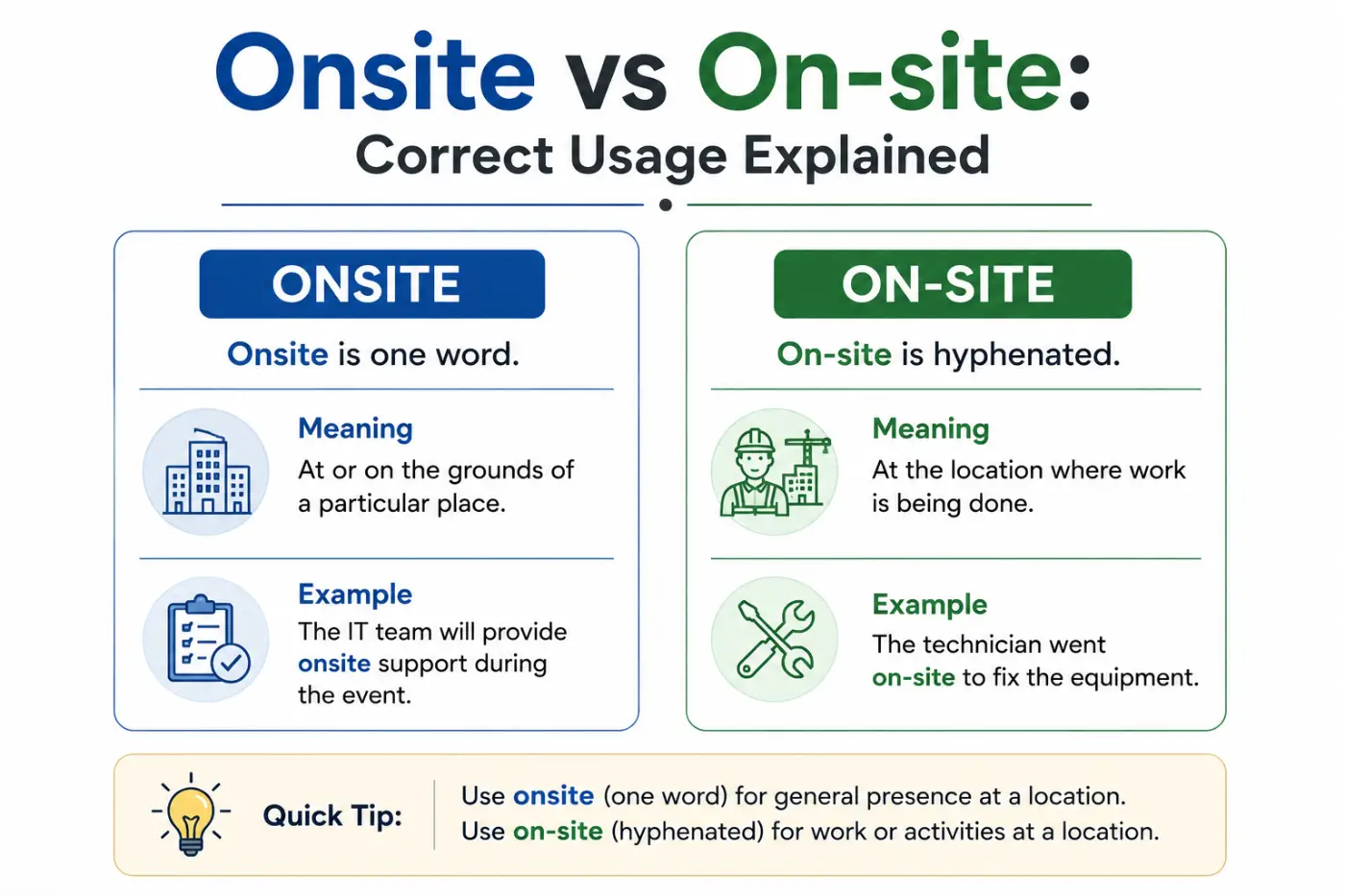
Onsite vs on-site is a common spelling question in American English because writers often see both forms in professional documents, job descriptions, websites, and everyday communication. The difference usually comes down to style and sentence structure rather than a major difference in meaning. All three forms can refer to something happening at or located at a particular place.
The main challenge is knowing which spelling fits your sentence and keeping it consistent throughout your writing. For example, a company might advertise onsite support, while another might describe the same service as on-site support. Both versions communicate that help is available at the customer’s location, but a particular organization may prefer one spelling over the other.
For most professional writing, on-site is a dependable choice when the phrase modifies a noun, as in on-site training or on-site assistance. Use on site when you mean at the location, as in The technician is on site. You can also use onsite if your organization’s style guide or established usage favors the closed compound. The key is to understand the grammatical role of the phrase and follow one consistent style.
Short Answer
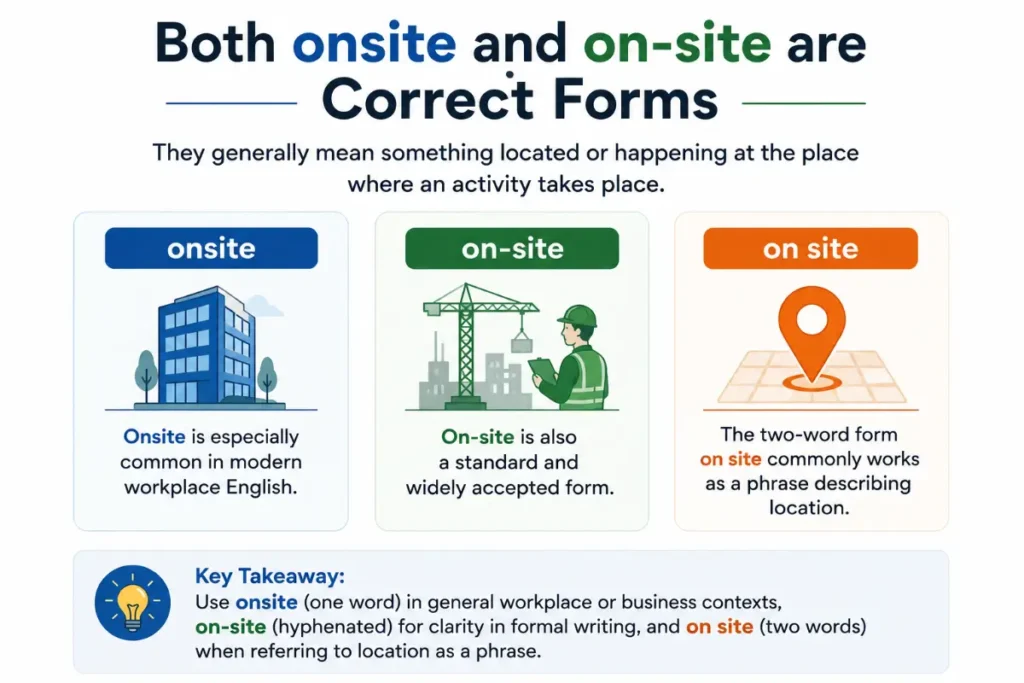
Onsite and on site can both be correct, but the best choice depends on your writing style and the dictionary or style guide you follow. In American English, on-site is a common standard spelling when the phrase describes something located or happening at a particular place. Onsite is also widely used, especially in business and technology writing. The open form on site is common when the words function as a phrase meaning at a location.
Table of Contents
- What Onsite and On Site Mean.
- Is Onsite or On Site Correct.
- Onsite vs On Site vs On Site With a Hyphen.
- How to Use Each Form Correctly.
- Onsite vs On Site Comparison Table.
- American and British English Usage.
- Onsite and On Site in Professional Writing.
- Examples in Everyday English.
- Common Spelling Mistakes.
- Memory Tips for Choosing the Right Form.
- Related Grammar and Usage Rules.
- Frequently Asked Questions.
- Key Takeaways.
- Conclusion.
What Onsite and On Site Mean
The expressions onsite, on site, and on-site generally describe a person, service, activity, or event located at or taking place at a particular location. The location might be an office, school, construction project, hospital, factory, customer facility, or event venue.
For example, an employee might attend training at the company’s office rather than through an online course. That training could be called onsite training or on-site training. Both expressions communicate that the training takes place at a physical location.
The Meaning of Onsite
Onsite is a closed compound formed from the words on and site. It commonly functions as an adjective and sometimes as an adverb in modern business and technical writing.
Consider this sentence.
The company provides onsite technical support.
Here, onsite describes the type of technical support the company provides. It tells readers that a technician can assist customers at a physical location instead of providing help exclusively by phone or online.
You may encounter onsite in company policies, service descriptions, job advertisements, software documentation, and workplace communication. Its popularity reflects a broader tendency in English to combine frequently used expressions into single words.
However, widespread use does not mean every dictionary or editorial style guide treats onsite as the preferred spelling. When accuracy and consistency matter, check the style guide used by your organization or publication.
The Meaning of On Site
On site is an open phrase made up of two separate words. It often functions adverbially and means at a particular place or location.
Consider this example.
The engineer is on site.
The phrase on site tells readers where the engineer is. It describes the engineer’s location rather than directly modifying a following noun.
Here is another example.
The team completed the inspection on site.
In this sentence, on site explains where the team completed the inspection. The words remain separate because they function as a phrase within the sentence.
The open form is especially natural when you want to describe someone’s presence at a location or explain where an activity happens.
The Meaning of On Site With a Hyphen
On-site is a hyphenated compound that commonly works as an adjective before a noun. It describes something provided, performed, or located at a specific place.
For example.
The company offers on-site repairs.
The hyphen connects the words into a compound modifier that describes the repairs. It makes the relationship between the words easy to recognize.
You can also write the following.
Employees must complete on-site safety training.
Here, on-site describes the training and indicates that employees must attend it at a designated physical location.
The hyphenated form is widely accepted in edited American English. It is a practical choice for formal writing, particularly when the phrase appears directly before a noun.
Is Onsite or On Site Correct
Both onsite and on site are used in standard English. The hyphenated form on-site is also established and widely accepted. The right choice depends on your sentence, the style guide you follow, and the spelling conventions of the publication or organization you’re writing for.
The question of onsite vs on-site isn’t simply a matter of one spelling being correct and the other being wrong. English compounds often develop several accepted forms over time. Some dictionaries and style guides prefer a hyphen, while many businesses use the closed form in their everyday communications.
When Onsite Is Correct
Use onsite when your chosen style guide accepts the closed compound and you want a compact spelling.
Examples include the following.
1. The hospital has onsite parking for patients and visitors.
Onsite describes the parking and tells readers that the parking is available at the hospital.
2. Our company provides onsite IT support.
Onsite describes where the IT support is provided. It distinguishes in person assistance at a facility from remote technical help.
3. The school offers onsite counseling services.
Onsite tells readers that counseling services are available at the school itself.
4. We hired an onsite coordinator for the event.
Onsite describes the coordinator’s role and suggests that the person will work at the event location.
These examples show how the closed spelling works in professional and everyday English. If your company uses onsite consistently, there’s usually no need to change every instance to on-site unless a publication’s rules require it.
When On Site Is Correct
Use on site when you want to express the location of a person, activity, or event as a separate phrase.
Examples include the following.
1. The contractor is on site today.
On site tells readers where the contractor is. The phrase functions as an adverbial expression describing location.
2. The inspection will take place on site.
On site explains where the inspection will happen.
3. Our manager arrived on site before the workers.
On site describes the manager’s location after arriving.
4. The technician can solve the problem on site.
On site explains where the technician can solve the problem. It means the technician can address it at the location rather than requiring the equipment to be taken elsewhere.
The open form is especially useful when the words follow a verb and describe location. It also reads naturally in reports, instructions, and workplace updates.
When On Site With a Hyphen Is Correct
Use on-site when your style guide favors the hyphenated compound, especially when the phrase comes before a noun.
Examples include the following.
1. We arranged on-site training for new employees.
On-site describes the training and indicates that employees will attend at a physical location.
2. The building requires on-site security.
On-site describes the security service and indicates that security personnel must be present at the building.
3. The client requested an on-site assessment.
On-site describes the assessment and distinguishes it from an evaluation performed remotely.
4. The company provides on-site maintenance.
On-site describes the maintenance service and indicates that the work is performed at the customer’s location.
In edited writing, this hyphenated form is an effective choice because it clearly connects the two words before the noun they modify.
Onsite vs On Site vs On Site With a Hyphen
Understanding the difference becomes easier when you look at the grammatical job the expression performs. The closed and hyphenated forms often function as adjectives, while the open form frequently describes location.
The distinction isn’t absolute because modern English usage varies. The following comparison gives you a reliable starting point.
| Form | Common function | Example | Main idea |
|---|---|---|---|
| Onsite | Adjective or adverb | We offer onsite support. | Support available at the location. |
| On site | Adverbial phrase | The technician is on site. | The technician is present at the location. |
| On-site | Compound adjective | We offer on-site support. | Support provided at the location. |
The examples share a similar meaning, but their spelling differs. The important point is to choose the form that fits your sentence and your chosen editorial style.
Why English Has Three Forms
English spelling changes as words and expressions become more common. A phrase may begin as two separate words, later appear with a hyphen, and eventually develop a closed spelling in some contexts.
This pattern appears in many familiar English compounds. For example, online is now commonly written as one word, while in person remains an open phrase. Some compounds also retain hyphens in particular styles or grammatical positions.
Onsite vs on-site follows this broader pattern of variation. The closed form is popular in business communication, the hyphenated form is familiar in edited prose, and the open form remains natural when the words express location.
This doesn’t mean that all three spellings are interchangeable in every sentence. Grammar, clarity, and house style still matter.
Does the Hyphen Change the Meaning
Usually, no. Onsite and on-site generally communicate the same idea when they describe a service, facility, activity, or person associated with a particular location.
For example, onsite training and on-site training both refer to training provided at a physical location. The difference is mainly spelling preference rather than meaning.
The open phrase on site commonly emphasizes where an activity occurs or where someone is present. For example, The supervisor is on site tells readers that the supervisor is physically at the location.
Think of the hyphen as a guide for readers. It connects two words when they work together to describe a noun. It doesn’t automatically create a different meaning.
How to Use Each Form Correctly
You can make the right spelling choice by looking at the words around the expression. The sentence structure often provides a useful clue, even when your style guide allows more than one form.
Use the Adjective Before a Noun
When the expression directly describes a noun, on-site is a clear choice in formal American English.
For example.
The company provides on-site consultations.
The phrase on-site describes consultations. It tells the reader that the consultations take place at the relevant facility or customer’s location.
Other examples include on-site support, on-site repairs, on-site training, and on-site inspections. Each expression identifies a service or activity associated with a physical location.
You may use onsite instead when your publication or organization prefers closed compounds. The key is to apply that preference consistently.
Use the Open Form to Describe Location
When the expression follows a verb and answers the question where, on site is often the most natural choice.
For example.
The technician remains on site until the repairs are complete.
The phrase on site answers the question Where does the technician remain. It functions as an adverbial phrase and describes the technician’s location.
Consider another sentence.
The project manager arrived on site at eight in the morning.
The phrase on site tells readers where the project manager arrived. It doesn’t directly modify a noun that follows it.
This is a useful pattern for reports and updates because it makes the location clear without adding unnecessary words.
Follow Your Organization’s Style Guide
If you’re writing for a company, school, newspaper, or academic institution, check its preferred spelling before making a final decision. An organization may choose onsite to simplify its writing or on-site to follow a particular dictionary or editorial standard.
For example, a company might use onsite in its service descriptions, website navigation, and job listings. A magazine might prefer on-site in edited articles. Neither preference automatically makes the other spelling incorrect.
Consistency matters because readers should focus on your message rather than notice different spellings of the same expression throughout a document.
If no style guide exists, choose a clear form that suits your sentence. For formal American English, on-site before a noun and on site when describing location provide a practical default.
Keep the Spelling Consistent
Imagine you’re writing a company page that advertises technical assistance at customer facilities. You might begin with the sentence Our team provides on-site support. Later, you might write Contact us to schedule onsite assistance.
Both sentences are understandable, but switching spellings without a reason can make the page look unedited. A reader may wonder if the two forms refer to different services.
Choose one adjective form for the page and use it consistently. You can still use on site in sentences where the expression functions naturally as a location phrase.
Consistency doesn’t mean forcing every sentence into the same pattern. It means applying the same spelling policy to the same grammatical use.
American and British English Usage
American and British English share the same basic meaning for onsite, on-site, and on site. The main difference is that spelling preferences can vary between publishers, dictionaries, and organizations rather than following one universal national rule.
Usage in American English
In the United States, on-site is a familiar spelling in professional and edited writing. You may see it in employee handbooks, technical documentation, service agreements, and workplace policies.
For example, a company might advertise on-site installation services. The hyphenated compound describes installation performed at a customer’s location.
The closed spelling onsite is also common in American business writing. You may encounter it in job titles, software interfaces, and service descriptions, particularly when an organization favors compact compound words.
The open form on site is natural in sentences such as The inspector is on site. It clearly expresses physical presence at a location.
Usage in British English
British English also uses on-site and on site. The closed form onsite appears in British business and general writing as well, although individual dictionaries and publications may differ in their preferences.
For example, a British company might advertise on-site repairs or explain that an engineer is on site. Both expressions communicate that the work or person is associated with a physical location.
The safest approach is to follow the dictionary and editorial rules used by your intended audience. Don’t assume that every American publication prefers one form or that every British publication uses another.
Which Form Should International Writers Choose
If your content targets readers in several English speaking countries, consistency is more useful than trying to assign one spelling to each country.
For example, an international company could use on-site support across its website and documentation. That choice is familiar to readers in both the United States and the United Kingdom.
If your company already uses onsite throughout its published materials, keeping that spelling may be the better editorial decision. Changing it without a clear reason can create unnecessary work and inconsistent branding.
The goal is straightforward. Use a recognized spelling, make the meaning clear, and follow the style guide that governs the document.
Onsite and On Site in Professional Writing
The spelling you choose can affect how polished your writing looks. Although readers usually understand all three forms, different industries may have established preferences.
Business and Customer Service
Businesses often use these expressions to distinguish in person services from remote services. The distinction is useful in advertising, customer support policies, and service agreements.
For example, a company might offer on-site installation for customers who need equipment installed at their premises. Another company might advertise onsite support as part of a service package.
Both descriptions tell customers that assistance is available at a physical location. If the service is limited to a particular area or facility, explain that limitation separately rather than relying on the spelling alone.
Human Resources and Job Descriptions
Recruiters use onsite and on-site to describe work arrangements. These terms can help candidates understand where they are expected to work.
Consider this job description.
This position requires on-site attendance five days a week.
On-site describes attendance and indicates that employees must be physically present at the designated workplace. It contrasts with remote work, which employees perform away from the employer’s usual premises.
A company might also advertise an onsite position. In that case, onsite describes the job arrangement, assuming the organization uses the closed spelling.
Writers should be precise about the actual arrangement. A job described as onsite may still involve travel to client locations, work at multiple facilities, or occasional remote days. Explain those conditions directly when they matter.
Technology and IT Support
Technology companies frequently distinguish onsite assistance from remote troubleshooting. Remote support happens through a network connection, phone call, or online session. On-site support involves a technician visiting or working at the relevant physical location.
For example.
Our technician will provide on-site assistance with the server installation.
The phrase on-site assistance tells customers that the technician will help at the facility where the equipment is installed.
Another example is The support team can resolve most issues remotely, but an onsite visit may be necessary for hardware repairs. Here, onsite follows the organization’s preferred spelling and describes a visit to the physical location.
The difference between remote and onsite support concerns how the service is delivered. The spelling itself doesn’t determine the service’s scope, cost, or response time.
Construction and Engineering
Construction professionals use on site to describe work and people at a project location. They also use on-site as a modifier before nouns such as inspection, storage, supervision, and safety training.
For example.
The engineer conducted an on-site inspection of the structure.
On-site describes the inspection and indicates that the engineer examined the structure at its location.
Another example is The construction manager remained on site throughout the concrete pour. Here, on site describes the manager’s presence at the project.
These expressions help distinguish work performed at the construction site from planning, analysis, or administrative tasks completed elsewhere.
Education and Healthcare
Schools, colleges, clinics, and hospitals also use these terms to explain where services are available.
For example, a school might offer on-site counseling, while a hospital might provide onsite diagnostic services. A university could state that a student advisor is on site during scheduled office hours.
In each case, the expression tells readers that the service or professional is available at a specified facility. If the service operates only on certain days, the writer should include that information separately.
Onsite vs On Site Comparison Table
The following table summarizes common expressions and shows how to use them in context.
| Expression | Example sentence | Why it works |
|---|---|---|
| Onsite support | We provide onsite support for business customers. | Onsite describes the type of support. |
| On-site training | All new hires must attend on-site training. | On-site modifies the noun training. |
| On site | The safety officer is on site. | On site describes the officer’s location. |
| On-site inspection | The team scheduled an on-site inspection. | On-site describes where the inspection takes place. |
| Onsite parking | The hotel offers onsite parking. | Onsite describes the location of the parking. |
| On site | The materials were stored on site. | On site indicates where the materials were stored. |
| On-site assistance | Customers can request on-site assistance. | On-site modifies assistance. |
| Onsite services | The facility offers onsite services to residents. | Onsite describes where the services are provided. |
Notice that the examples don’t suggest a major difference in meaning between onsite and on-site. The main consideration is the spelling convention adopted by the writer or publication.
The open form is especially useful when describing a location after a verb. However, context and editorial preference can affect the choice, so treat the table as a practical guide rather than an inflexible rule.
Real Life Examples of Onsite and On Site
Examples are often the quickest way to understand a spelling rule. The following sentences show how these forms work in different situations.
Workplace Examples
1. The company provides on-site training for new employees.
On-site describes the training and indicates that employees attend at the designated workplace.
2. Our manager is on site to answer questions.
On site tells readers where the manager is physically present.
3. The organization offers onsite childcare.
Onsite describes childcare provided at the organization’s facility. The closed spelling works when the chosen style accepts it.
4. All visitors must report to the on-site security office.
On-site describes the security office and identifies it as part of the relevant facility.
Technology Examples
1. The technician will install the equipment on site.
On site explains where the technician will perform the installation.
2. We provide on-site troubleshooting for network problems.
On-site modifies troubleshooting and indicates that help is available at the affected location.
3. The company employs onsite support specialists.
Onsite describes the specialists’ work arrangement or service role.
4. The engineer remained on site until the server was working again.
On site tells readers where the engineer stayed while completing the work.
Construction Examples
1. The contractor arranged on-site storage for the building materials.
On-site describes storage located at the construction project.
2. The supervisor is on site this afternoon.
On site identifies the supervisor’s location.
3. The team completed the onsite safety assessment.
Onsite describes the assessment and indicates that it was associated with the physical work location.
4. The architect will review the plans on site.
On site tells readers where the architect will review the plans.
Travel and Hospitality Examples
1. The hotel offers onsite parking for guests.
Onsite describes parking available at the hotel.
2. The restaurant provides on-site catering for private events.
On-site modifies catering and indicates that the service is provided at the event location.
3. The event coordinator will be on site before the guests arrive.
On site tells readers where the coordinator will be.
4. Guests can use the on-site fitness center.
On-site describes the fitness center and indicates that it is located at the relevant property.
These examples show that the words fit many settings. The best spelling depends on the sentence and the style you want to maintain.
Common Mistakes to Avoid
Even experienced writers can mix up these spellings. Most errors happen because people treat every use as an adjective or assume that one spelling is always correct.
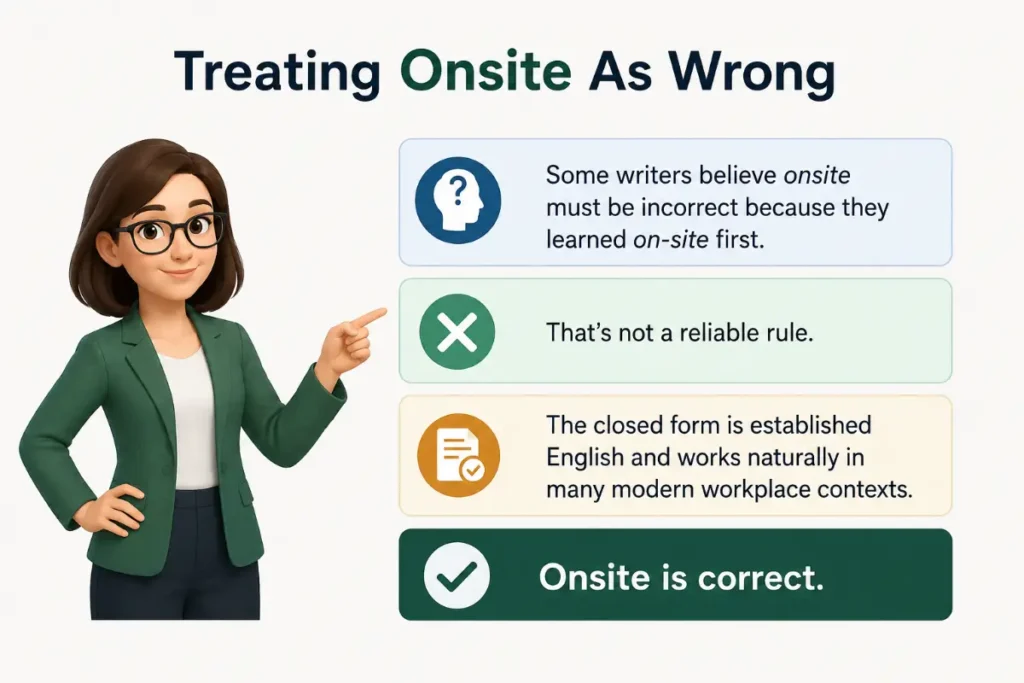
Treating Onsite as the Only Correct Spelling
A common mistake is assuming that onsite is the only acceptable form because many websites and businesses use it.
For example, writing The technician is onsite isn’t automatically wrong in every style. However, a publication that distinguishes the adjective from the location phrase may prefer The technician is on site.
The better approach is to check your style guide and use the form that fits the sentence.
Assuming On Site Is Always Two Words
Some writers use on site in every situation, even when their editorial style calls for a hyphenated compound before a noun.
For example, a formal document might use on-site training rather than on site training. The hyphen makes the compound modifier clear and follows a common editorial convention.
Remember that the open phrase and the hyphenated adjective often have different grammatical roles, even when their meanings overlap.
Switching Between Spellings Without a Reason
A document may look inconsistent if it uses onsite support in one section, on-site support in another, and on site support elsewhere without a deliberate style choice.
Readers will probably understand the intended meaning, but the inconsistency can make the content appear poorly edited.
Choose a preferred spelling for compound modifiers and apply it throughout the document. Use the open phrase naturally when describing location.
Confusing On Site With Online
On site and online describe different situations.
On site means at a particular physical location. Online generally means connected to or available through the internet.
For example, on-site training takes place at a designated location, while online training takes place through an internet based platform.
The distinction matters in job descriptions, course listings, customer service pages, and workplace instructions. Using the wrong term could give readers an inaccurate idea of what to expect.
Using the Wrong Expression for the Intended Meaning
The words should describe the actual arrangement rather than simply sound professional.
For example, a company shouldn’t advertise on-site repairs if customers must ship their equipment to another facility for service. In that situation, the service isn’t being performed at the customer’s location.
Clear wording helps customers understand what the company offers and prevents confusion about the service.
Memory Tips for Choosing the Right Form
A simple memory trick can help you choose between onsite, on-site, and on site without stopping to think about spelling every time.
Remember the Location Rule
When you’re describing someone’s physical presence, think of on site as a location phrase.
For example, The inspector is on site.
The phrase tells you where the inspector is. You can use the same pattern with arrived on site, remained on site, and worked on site.
Remember the Modifier Rule
When the expression describes a noun, consider on-site as your default in formal writing.
For example, on-site inspection, on-site training, and on-site support.
The hyphen connects the words so they work together as a modifier. If your organization’s style guide prefers onsite, use that form instead.
Remember the Consistency Rule
Think of your style guide as a map for spelling choices. Once you choose a recognized form, follow it throughout the document.
For example, a company that prefers onsite support should normally use onsite assistance and onsite services in similar contexts. It can still write The technician is on site if that is the company’s grammatical convention.
This approach keeps your writing consistent without forcing every sentence into an unnatural pattern.
Ask One Simple Question
Before publishing, ask yourself whether the expression describes a noun or identifies a location.
If it describes a noun, on-site is a useful formal default. If it tells readers where someone or something is, on site is often the natural choice.
Then check the style guide. This quick review will resolve most spelling questions.
Related Grammar and Usage Notes
Understanding related expressions makes it easier to use onsite correctly and recognize similar spelling patterns in English.
Onsite and Offsite
Offsite refers to something located or taking place away from a particular workplace or facility. Like onsite, it appears as a closed compound in many modern business contexts.
For example, The company offers offsite retreats for employees.
Offsite describes retreats held away from the usual workplace. The phrase provides a useful contrast with onsite activities.
You may also see off-site retreats and The team met off site. The same general spelling considerations apply to the opposite expression.
Onsite and In Person
Onsite and in person aren’t exact synonyms. Onsite refers to a particular location, while in person emphasizes direct physical presence rather than remote interaction.
For example, a meeting can take place in person at a customer’s office. It is both in person and onsite from the perspective of that office.
However, an employee can meet a colleague in person at a restaurant or conference center that isn’t the employee’s workplace. That meeting is in person, but it might not qualify as onsite work under the employer’s policy.
Use the expression that communicates the detail your readers need.
Onsite and Remote
Onsite and remote often appear together in employment and service descriptions. Onsite work takes place at a designated physical location, while remote work generally happens away from that location using communication tools and digital systems.
For example, The company offers both onsite and remote technical support.
The sentence contrasts two ways to deliver the same service. Onsite indicates physical assistance at the relevant facility, while remote suggests assistance from another location.
Some positions combine both arrangements. If you’re writing a job advertisement, explain the schedule and location requirements rather than relying on a single label.
Onsite and In House
Onsite and in-house can overlap, but they don’t always mean the same thing. Onsite focuses on location. In-house usually means that an organization performs an activity using its own staff or resources rather than outsourcing it.
For example, a company might employ an in-house IT team that provides remote support to employees across several locations. The team is in-house because the company employs it, but its members aren’t necessarily onsite at every facility.
A clear writer chooses the expression that reflects the actual arrangement.
Hyphenation in Compound Modifiers
English uses hyphens in many compound modifiers to show that two or more words work together to describe a noun.
Examples include full-time employee, long-term plan, and on-site inspection.
The hyphen can make the relationship between the words easier to read. However, hyphenation conventions vary by expression and style guide, and not every compound requires a hyphen in every position.
Check the relevant dictionary or house style when editing formal material. Avoid applying one universal rule to all compounds.
Pronunciation of Onsite and On Site
Onsite, on-site, and on site are generally pronounced the same way when they carry the same meaning. The spelling changes don’t normally create a difference in pronunciation.
In ordinary American English, speakers typically stress site, the main content word in the expression. The context helps listeners understand the intended meaning.
Since the pronunciation is usually identical, spelling and sentence structure do most of the work when you’re writing.
Expert Editor Insight
An experienced editor won’t automatically change onsite to on-site because both forms are established. The editor first checks the grammatical role of the expression and then considers the publication’s preferred style. Consistency matters too. If a document uses onsite for workplace services then switching randomly to on-site can make the writing look poorly edited. Good editing focuses on clarity context and consistency rather than changing words just to make them look different.
Key Takeaways
1. Onsite is a closed compound commonly used in business and technical writing.
2. On-site is a widely accepted hyphenated form, especially before a noun.
3. On site is an open phrase that commonly describes someone’s location or where an activity occurs.
4. All three forms can communicate the idea of being at a particular physical location.
5. American and British publications may differ in their preferred spelling conventions.
6. Follow your organization’s style guide and maintain consistency throughout your writing.
7. Don’t confuse onsite with online, remote, in person, or in-house. Each expression communicates a different detail.
Conclusion
Onsite vs on-site is mainly a question of spelling preference and grammatical use. Both forms are widely used, while on site remains a natural choice when describing a person’s location or explaining where an activity takes place. For formal American English, on-site before a noun and on site in a location phrase provide a practical starting point.
The easiest way to choose is to look at the sentence. If the expression modifies a noun, consider on-site. If it tells readers where someone is or where an activity happens, on site often fits naturally. When your organization prefers onsite, follow that convention instead.
Good writing depends on clarity and consistency more than on forcing every expression into one spelling pattern. Choose the form that suits your sentence, follow a recognized style guide, and make sure your readers understand exactly what you mean.
Frequently Asked Questions
Is onsite or on-site correct in American English?
Both onsite and on-site are accepted in common American English usage. On-site is a familiar choice in edited writing, while onsite is widely used in business and technical contexts. Follow your preferred dictionary or style guide.
Is onsite one word or two words?
Onsite is one word. On site is two words, and on-site is written with a hyphen. All three forms are used in English, but their preferred use can depend on sentence structure and editorial style.
What is the difference between onsite vs on-site?
The difference between onsite vs on-site is mainly spelling. Both forms commonly describe something located or performed at a particular place. Onsite is a closed compound, while on-site is a hyphenated compound. Your style guide determines which form to prefer.
Should I write on-site training or onsite training?
Both forms are used. On-site training is a dependable choice for formal writing because the hyphen connects the words that modify training. Onsite training is also common when an organization prefers closed compounds.
Is it correct to say the technician is on site?
Yes. The technician is on site is a natural and grammatically correct sentence. The phrase on site describes the technician’s physical location.
Does onsite mean in person?
Not always. Onsite means at a particular physical location, while in person emphasizes direct physical presence instead of remote interaction. An onsite meeting is generally in person, but an in person meeting can happen somewhere other than a workplace or designated facility.
Is onsite the same as remote?
No. Onsite generally refers to work or services performed at a designated physical location. Remote work or support happens from another location, often through digital communication tools.
Is on-site hyphenated in formal writing?
Yes. On-site is a widely accepted spelling in formal American English, especially when it modifies a noun. Examples include on-site inspection, on-site support, and on-site training. Follow your publication’s style guide if it specifies another form.
Can I use onsite in a professional email?
Yes. Onsite is common in professional emails, workplace updates, and business documents. Use it consistently and make sure the sentence clearly communicates the location or arrangement.
Is onsite a noun, verb, or adjective?
Onsite is most commonly used as an adjective, as in onsite services. It can also function adverbially in some modern usage, as in The technician will work onsite. It isn’t normally used as a verb or noun in standard usage.
