
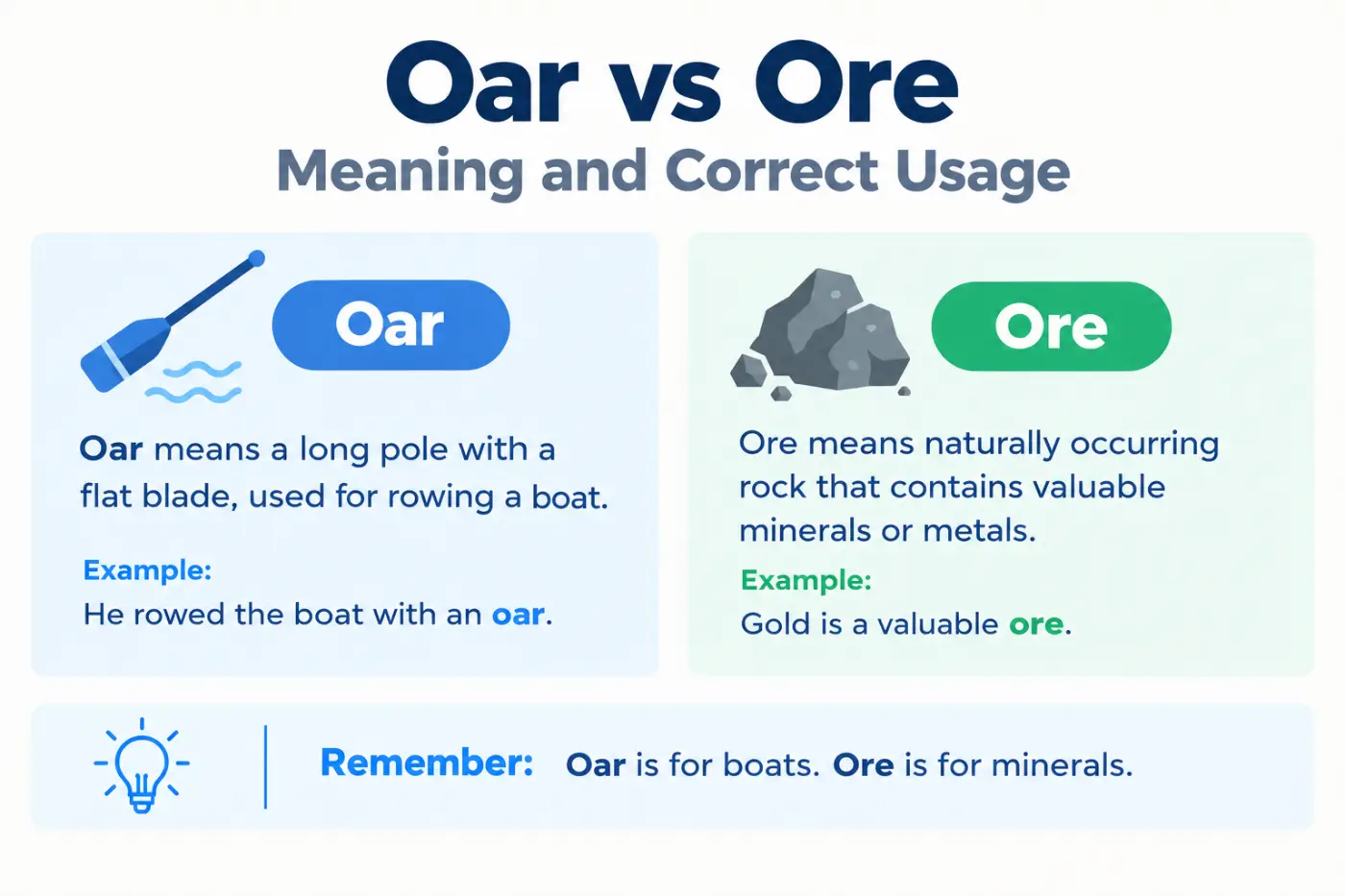
Have you ever confused oar vs ore while writing a sentence? These two words sound exactly alike in standard American English, but their meanings are completely different. An oar is a long tool used to move or steer a boat through water. Ore is rock or mineral material that contains valuable substances that people can extract.
The confusion makes sense. Both words have the same pronunciation, and neither spelling gives you an obvious clue about the sound. However, once you connect each word with a clear image, the difference becomes easy to remember.
Think of an oar as a tool that helps a boat move across a lake. Think of ore as rock that miners dig out of the ground to obtain metals such as iron or copper. One helps people travel on water, while the other provides raw materials for industry.
Understanding these words will help you avoid spelling mistakes in school assignments, workplace documents, conversations, and creative writing. You’ll also learn how to pronounce each word, use it correctly in a sentence, and remember the difference without checking a dictionary every time.
Quick Answer
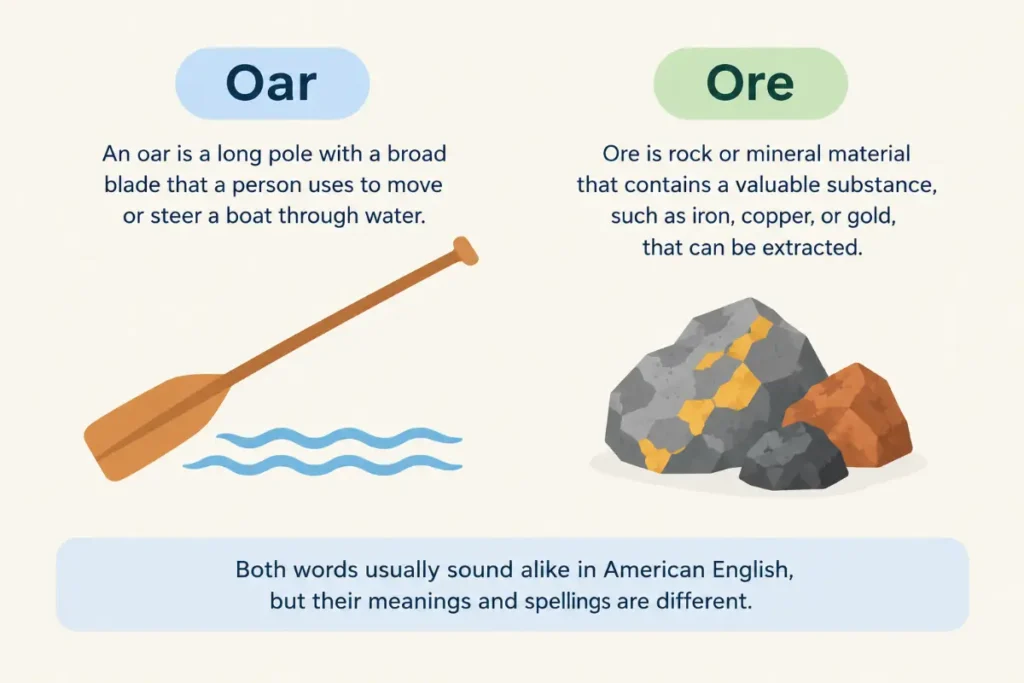
An oar is a long pole or blade used to propel or steer a boat through water. Ore is naturally occurring rock or mineral material from which valuable metals or other substances can be extracted economically. Both are correct English words, but they aren’t interchangeable because they describe different things.
Comparison Table
| Feature | Oar | Ore |
|---|---|---|
| Meaning | A tool used to row or steer a boat. | Rock or mineral material containing valuable substances. |
| Part of speech | Noun. | Noun. |
| Pronunciation | /ɔːr/ in common American dictionary transcription. | /ɔːr/ in common American dictionary transcription. |
| Plural form | Oars. | Ores. |
| Main context | Boating, rowing, and water travel. | Mining, geology, and metal production. |
| Common examples | Wooden oar, rowing oar, boat oar. | Iron ore, copper ore, gold ore. |
| Origin | From Old English and related Germanic forms. | From Old English and related Germanic forms. |
| Formality | Standard in everyday and technical English. | Standard in everyday and scientific English. |
| Example sentence | She pulled the oar through the water. | The mine produces iron ore. |
Meaning and Definition
What Does Oar Mean.
An oar is a long tool with a handle and a broad blade that a person uses to move or steer a boat through water. Traditional oars are often made of wood, although modern versions may use aluminum, fiberglass, or carbon fiber.
The person rowing places the blade in the water and pushes or pulls the handle to move the boat. Depending on the boat’s design, an oar may rest against an oarlock attached to the side of the boat or be held directly by the rower.
Oars are common in small boats, rowing shells, lifeboats, and recreational watercraft. They can also appear in historical accounts of ships that relied on human power.
For example, imagine a person crossing a quiet lake in a small wooden boat. The person uses two oars to move forward. Without those tools, the boat would need another source of power or assistance to travel across the water.
The word also appears in familiar expressions and descriptions, such as a pair of oars, a wooden oar, or a rowing boat.
What Does Ore Mean.
Ore is rock or mineral material that contains enough of a valuable substance to make its extraction worthwhile under available economic and technical conditions. That substance may be a metal such as iron, copper, or gold.
Mining companies remove ore from the ground and process it to recover useful materials. Depending on its composition, the material may undergo crushing, grinding, separation, chemical treatment, or smelting.
For example, iron ore is a major raw material used to produce iron and steel. Copper ore provides copper for electrical wiring, plumbing, electronics, and other products.
Not every rock containing a trace of metal qualifies as ore. The amount of the useful substance, the cost of extraction, the available technology, and market conditions all affect its value as a mineral resource.
You will most often encounter this word in discussions of mining, geology, manufacturing, natural resources, and industrial production.
Is Ore a Real Word.
Yes. Ore is a standard English noun, not a misspelling of the boating term. It describes mineral material that can be mined and processed to recover useful substances.
Common combinations include iron ore, copper ore, gold ore, and uranium ore. The precise meaning depends on the substance being recovered and the geological material involved.
Is Oar a Real Word.
Yes. Oar is also a standard English noun. It refers to a tool used to propel or guide a boat through water.
The plural is oars. For example, a person may use two oars to row a small boat, while a rowing team may use specialized equipment designed for competitive racing.
Neither spelling is incorrect by itself. The mistake happens when a writer uses one word in a context that requires the other.
Key Differences Explained
Spelling and Meaning.
The most important difference is what each word describes.
- Oar refers to a physical tool used in boating.
- Ore refers to mineral material that people extract and process for useful substances.
Compare these examples.
- The fisherman replaced his broken oar before leaving the dock.
- The mining company discovered a deposit of copper ore.
Both sentences are grammatically correct. Changing the spelling would change the meaning and make the sentence confusing or inaccurate.
Pronunciation.
In standard American English, both words are homophones. That means they have the same pronunciation but different meanings and spellings.
A speaker usually cannot tell which word someone intends from the sound alone. The surrounding sentence provides the clue.
For instance, if someone says they need an oar, they probably need boating equipment. If someone discusses a shipment of ore, the conversation likely involves mining or metal production.
Grammar and Part of Speech.
Both words function mainly as nouns. They name things rather than actions or qualities.
You can use them as singular nouns.
- The oar fell into the water.
- The ore contained valuable minerals.
You can also use their plural forms.
- The rower placed the oars inside the boat.
- The region contains several types of ores.
Both words can appear in compound nouns and descriptive phrases. Examples include oar blade, oar handle, iron ore, and copper ore.
Context and Formality.
Neither word is more formal or more correct than the other. The subject determines the appropriate choice.
Oar belongs naturally in discussions of boating, rowing, fishing, and water travel. Ore belongs naturally in discussions of mining, geology, engineering, and manufacturing.
Both words work in casual conversation and formal writing. A science report may discuss ore deposits, while a travel story may describe someone rowing with a wooden oar.
Standard Usage.
American, British, Canadian, and Australian English use the same basic distinction between these words. There is no major regional spelling difference that changes their meanings.
Pronunciation can vary slightly across accents. Some speakers pronounce the vowel in these words differently from others, but the distinction between the two spellings remains the same.
Which Form Is Correct.
Both forms are correct. The right choice depends on the meaning you want to express.
Use oar when referring to equipment used to move or steer a boat. Use ore when referring to rock or mineral material mined for its useful contents.
Established English dictionaries treat these as separate words with separate definitions. Their shared pronunciation does not make one a variation or misspelling of the other.
Consider the sentence, The workers loaded the ore onto a truck. It makes sense in a mining or transportation context. Replacing ore with oar would suggest that the workers loaded boating equipment instead of mineral material.
Now consider, She dropped her oar into the river. The sentence describes a boating mishap. Using ore in that sentence would change the intended meaning.
The simplest rule is to check the object you are describing. If it belongs in a boat, choose oar. If it comes from a mineral deposit, choose ore.
Sentence Examples
The following examples show how both words appear in natural American English.
Ten Examples Using Both Words Correctly.
1. Everyday conversation. Can you hand me the oar so I can move the boat away from the dock.
2. Recreation. We rented a small rowboat and used two oars to cross the lake.
3. School assignment. The student drew an oar to illustrate how people powered boats before modern engines became common.
4. Workplace communication. Please inspect the spare oars before the boating equipment is returned to storage.
5. Mining. The company transports iron ore from the mine to a processing facility.
6. Science class. Our teacher explained how copper is recovered from copper ore.
7. Academic writing. The researchers examined the mineral composition of ore samples collected from the site.
8. News reporting. The mining operation increased production after workers identified a promising deposit of gold ore.
9. Storytelling. As the storm approached, the sailor grabbed an oar and helped guide the small boat toward shore.
10. Environmental discussion. The report examined how extracting ore can affect nearby soil, water, and wildlife.
These examples show why context matters. A boating scene points toward the first word, while a mining or geology discussion points toward the second.
Five Examples of Common Usage Errors.
The following sentences show how choosing the wrong spelling can change the meaning.
1. Incorrect for boating: We used an ore to row across the lake. Correct: We used an oar to row across the lake.
2. Incorrect for mining: The workers extracted iron oar from the ground. Correct: The workers extracted iron ore from the ground.
3. Incorrect for boating: He left his ore beside the dock. Correct: He left his oar beside the dock.
4. Incorrect for mining: The shipment contained copper oars. Correct: The shipment contained copper ores.
5. Incorrect for boating: She picked up the ore and pushed the boat away from shore. Correct: She picked up the oar and pushed the boat away from shore.
In the fourth example, the plural form ores can be correct when referring to different types or occurrences of ore. The problem is using oars when the intended meaning involves mineral material.
Common Mistakes and Misspellings
Most errors involving these words come from their identical pronunciation. Writers may choose the spelling that looks familiar without checking the sentence’s meaning.
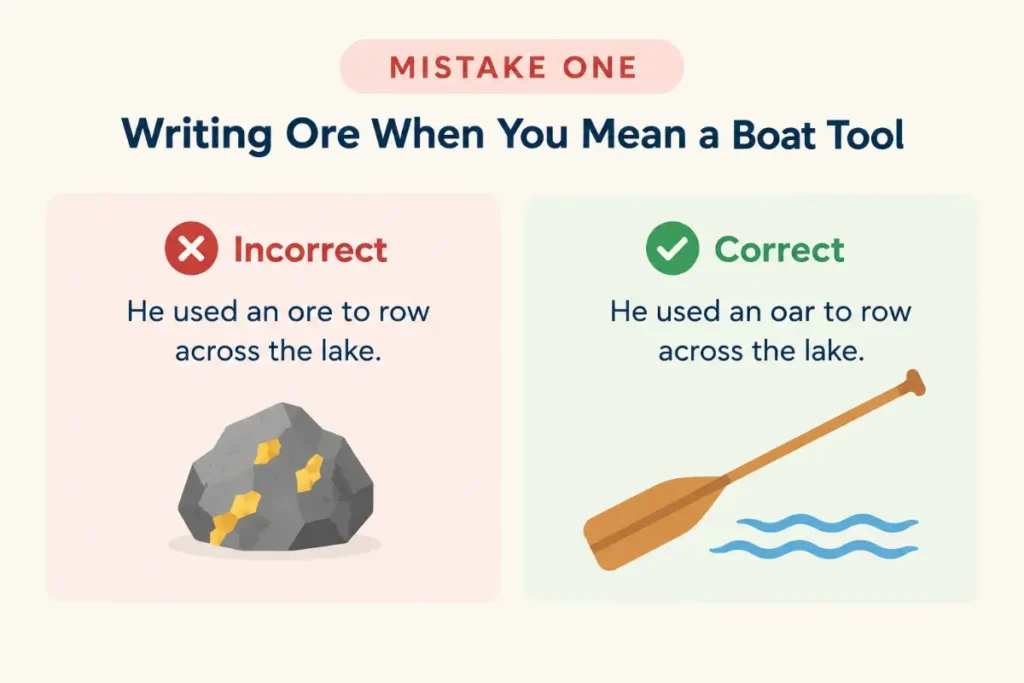
Mistake One: Using Ore for a Boat Tool.
Incorrect: He rowed the boat with an ore.
Correct: He rowed the boat with an oar.
The sentence describes a rowing action, so it needs the word for boating equipment. Ore refers to mineral material and does not fit this context.
Mistake Two: Using Oar for a Mineral Resource.
Incorrect: The factory received a shipment of iron oar.
Correct: The factory received a shipment of iron ore.
The word iron is a useful clue. Iron ore is a familiar term in mining and steel production, so ore is the correct spelling.
Mistake Three: Confusing the Plural Forms.
Incorrect: The rowers stored their ore after practice.
Correct: The rowers stored their oars after practice.
The plural of oar is oars. The plural of ore is ores. Adding the wrong ending does not solve the problem if the original word is incorrect.
Mistake Four: Assuming One Word Is a Misspelling.
Incorrect assumption: Oar is wrong because ore is the familiar spelling.
Correct understanding: Both are standard words with different meanings.
A spelling checker may accept both forms because each is a valid English word. It may not detect the error if the wrong word still fits the sentence’s grammar.
Mistake Five: Relying Only on Sound.
Incorrect: The writer chooses a spelling based only on how the word sounds.
Correct approach: Check the subject and meaning of the sentence before selecting the spelling.
Homophones create this kind of problem because pronunciation alone cannot identify the intended word. A quick review of the surrounding words usually reveals the correct choice.
Pronunciation Guide
How to Pronounce Both Words.
Both words are pronounced the same way in standard American English. They contain one syllable and share the same basic vowel sound.
Oar
IPA: /ɔr/
One syllable. Rhymes with ore and the usual American pronunciation of four.
Ore
IPA: /ɔr/
One syllable. The vowel and final r sound match those in oar.
The IPA symbols shown here represent a common American pronunciation. Some dictionaries use /ɔːr/ or other conventions depending on the accent and transcription system.
How to Say the Words Clearly.
To pronounce either word, begin with the vowel sound and move smoothly into the final r sound. Keep the word to one syllable rather than separating it into two parts.
In many American accents, the tongue moves into the r position as the vowel ends. The exact vowel quality varies by region, but that variation does not create a difference between these two words.
Common Pronunciation Mistakes.
1. Trying to pronounce the spellings differently. The letters are different, but the words normally sound alike.
2. Adding another syllable. Each word has one syllable. Avoid stretching either one into two.
3. Ignoring the sentence context. Since pronunciation cannot reliably distinguish them, listeners use the surrounding words to understand the intended meaning.
Etymology and Word Origin
Both words have long histories in English. Their spellings and meanings developed through different historical paths, even though they eventually came to share a pronunciation.
The Origin of Oar.
The word oar comes from Old English ār, a term for a rowing implement. It belongs to a wider family of Germanic words associated with rowing and boat equipment.
The term remained connected to water travel as boats and rowing practices changed over time. Its central meaning is still the same today: a tool that allows a person to move or guide a boat by working against the water.
You can see that continuity in phrases such as wooden oar, oar blade, and pair of oars. Modern materials and boat designs have changed, but the basic purpose remains familiar.
The Origin of Ore.
The word ore also comes from Old English, where ōra referred to metal or metal containing material. Its historical development is associated with the extraction and use of mineral resources.
As mining and metalworking developed, the word became established in descriptions of rocks and minerals that could provide useful substances. Its modern meaning focuses on material from which valuable components can be recovered economically.
That economic element matters. A mineral deposit may contain metal, but it does not automatically qualify as ore if recovering the metal is not practical under the conditions involved.
Why the Words Sound the Same.
The shared pronunciation is a feature of English spelling and sound rather than proof that the words mean the same thing. English has many words whose sounds overlap even though their spellings and histories differ.
In this case, the final letters do not provide a reliable pronunciation clue. The reader must use meaning and context to identify the correct word.
Regional Usage
The basic distinction remains consistent across major varieties of English. Writers do not need to learn separate regional spellings for these two terms.
American English.
In the United States, oar is the normal spelling for a rowing implement. Ore is the standard spelling for mineral material mined to recover useful substances.
You might encounter oar in boating instructions, outdoor recreation articles, and descriptions of rowing sports. Ore commonly appears in geology lessons, mining reports, manufacturing documents, and news about natural resources.
British English.
British English uses the same spellings and meanings. An article about a rower may refer to an oar, while a report on metal extraction may discuss iron ore.
Accent differences can affect the exact vowel sound, but they do not change the spelling rule.
Australian English.
Australian English also distinguishes the two words in the same way. Oar belongs to boating and rowing contexts, while ore belongs to mining and mineral production.
The distinction is especially useful in writing about outdoor activities and Australia’s mining industry, but it is not a special Australian spelling rule.
Canadian English.
Canadian English follows the same standard usage. Writers use oar for boat equipment and ore for mineral resources.
The surrounding subject provides the strongest clue in all four varieties. There is no general American, British, Australian, or Canadian rule that makes one spelling a regional substitute for the other.
Grammar Rules and Part of Speech
Both words are nouns, so they can name a person, place, thing, or concept. In these cases, each word names a physical object or material.
Using Oar in a Sentence.
The noun oar can function as a subject, direct object, or object of a preposition.
- Subject. The oar slipped from his hands.
- Direct object. She lifted the oar from the boat.
- Object of a preposition. He leaned against the oar.
The word also appears in compound nouns. An oar handle is the part a person holds, while an oar blade is the section that moves through the water.
Using Ore in a Sentence.
The noun ore can also function as a subject, direct object, or object of a preposition.
- Subject. The ore contains traces of copper.
- Direct object. The plant processes the ore.
- Object of a preposition. The samples came from a deposit of iron ore.
Ore often appears in compound terms that identify the useful substance contained in the material. Examples include copper ore, iron ore, and gold ore.
Singular and Plural Forms.
The plural forms follow the usual English pattern of adding s.
| Singular | Plural | Example |
|---|---|---|
| Oar | Oars | The rowers cleaned their oars. |
| Ore | Ores | The museum displayed samples of several ores. |
Ore can also be used as a mass noun when referring to mineral material in general. For example, The mine processes ore every day. The plural ores is useful when discussing different kinds or deposits.
Articles and Modifiers.
Both nouns can follow articles such as a, an, and the when the grammar and meaning allow them.
- A wooden oar rested beside the boat.
- The oar was damaged during the trip.
- The company discovered a rich ore deposit.
- The ore was transported to a processing plant.
Notice the phrase ore deposit. Here, ore modifies the noun deposit by identifying the kind of material involved. This is a normal English noun pattern, not a change in the meaning of ore.
Punctuation and Formal Writing.
Neither word requires special punctuation. Use normal sentence punctuation and capitalize the word only when it begins a sentence or appears in a title that calls for capitalization.
In formal writing, accuracy matters more than choosing a supposedly more professional word. A technical report should use ore for mineral material and oar for rowing equipment. Informal writing follows the same distinction.
Real Life Usage Examples
These examples show how the two words fit into different kinds of communication. The subject of the sentence usually makes the intended meaning clear.
Daily Conversation.
1. My brother forgot to bring an extra oar, so we had to take turns rowing the boat.
2. The guide explained that the dark rocks contained iron ore before showing us the old mining site.
In casual conversation, people rarely explain the spelling difference unless someone asks. They rely on context to understand the word.
Email and Workplace Communication.
1. Please check the condition of each oar before the boating equipment is issued to customers.
2. The supplier confirmed that the ore shipment would arrive at the processing facility next week.
Workplace writing benefits from precise nouns. A single spelling error can change the meaning of an inventory list, shipping note, or equipment report.
Academic Writing.
1. The experiment examined how the shape of an oar blade affected movement through water.
2. The geology report described the mineral composition of the ore and evaluated its potential for commercial extraction.
Academic writing often uses these terms in specialized ways. An oar may appear in a physics or engineering discussion, while ore may appear in geology, chemistry, or materials science.
News and Journalism.
1. Rescue workers recovered the damaged oar after bringing the stranded boat safely to shore.
2. The mining company announced plans to expand its iron ore processing operation.
News writers must choose words carefully because readers expect factual accuracy. The wrong spelling can create confusion even when the rest of the sentence is grammatically correct.
Literature and Storytelling.
1. The old fisherman dipped his oar into the cold water and guided the boat toward the distant shore.
2. Beneath the mountain, miners searched for a rich seam of ore that could change the fortunes of their village.
In stories, both words can help establish a setting. One evokes movement, water, and travel. The other suggests underground resources, labor, and industry.
Related and Confused Terms
Learning a few related words can make the distinction easier to remember. Each term below belongs to a useful group of words associated with boating or mineral resources.
Boating Terms.
1. Paddle. A paddle is a hand operated tool used to move a boat through water. Unlike many traditional oars, it is not normally supported by an oarlock.
2. Rowing. Rowing is the activity of propelling a boat with oars. It can be recreational or competitive.
3. Oarlock. An oarlock is a fitting that supports an oar against the side of a boat and allows it to pivot during rowing.
4. Oar blade. The blade is the broad part of an oar that pushes against the water. Its shape affects how the rower transfers force to the boat.
Mining and Geology Terms.
5. Mineral. A mineral is a naturally occurring substance with a characteristic chemical composition and internal structure. Some minerals contain metals that people can recover.
6. Rock. Rock is a naturally occurring solid made of one or more minerals or mineral like materials. Some rocks contain useful mineral concentrations and may qualify as ore.
7. Iron ore. Iron ore is mineral material from which iron can be extracted economically. It is a major raw material for iron and steel production.
8. Copper ore. Copper ore contains copper bearing minerals that can be processed to recover copper. The material may undergo several stages of treatment before the metal is ready for use.
These related terms also help explain why ore does not simply mean any rock. The material must contain a useful substance that can be recovered under suitable economic and technical conditions.

Expert Editor Insight
An experienced editor treats these words as a context problem rather than a simple spelling problem. Both forms are valid, so a standard spellchecker may accept the wrong choice without warning. The editor checks the sentence for clues such as boat, rowing, and water on one side, or mining, mineral, and metal on the other. A useful editing habit is to reread the complete sentence after checking spelling. That extra step catches errors that a dictionary or automatic correction tool may miss.
Conclusion
The difference between oar vs ore comes down to meaning rather than pronunciation. An oar is a tool that helps move a boat through water, while ore is mineral material from which useful substances can be extracted. Both are correct English words, and neither is a misspelling of the other. They simply belong in different contexts.
To choose the right spelling, picture the object you’re describing before you write it. If you’re talking about rowing, use oar. If you’re talking about mining or metal production, use ore. This simple memory trick will help you write with confidence and avoid confusing these two homophones in everyday and formal English.
FAQs
Is Oar or Ore the Correct Spelling?
Both spellings are correct English words. Oar refers to a tool used to row or steer a boat, while ore refers to mineral material that contains useful substances for extraction. Neither word is a misspelling of the other. Choose the spelling that matches the meaning of your sentence rather than relying on how the word sounds.
What Does Oar Mean?
An oar is a long tool with a blade that a person uses to move or steer a boat through water. Traditional versions are often made of wood, while modern versions may use other materials. Oars are common in small boats and rowing equipment. The plural form is oars, as in The rowers placed their oars inside the boat.
What Does Ore Mean?
Ore is rock or mineral material containing a useful substance that can be recovered economically. Iron ore, copper ore, and gold ore are familiar examples. The material is mined and processed to recover the desired substance. Not every rock containing a small amount of metal qualifies as ore because the cost and practicality of extraction also matter.
Are Oar and Ore Homophones?
Yes. In standard American English, the two words share the same pronunciation. They are homophones because they sound alike but have different spellings and meanings. The surrounding sentence usually reveals which word a speaker intends. For example, rowing a boat points toward oar, while extracting iron from mineral material points toward ore.
How Do You Pronounce Oar and Ore?
Both words are normally pronounced alike in standard American English. Each has one syllable and ends with an r sound. Their exact vowel quality can vary by accent, and dictionaries may use slightly different IPA conventions. The key point is that you should not try to create a pronunciation difference based only on the different spellings.
Can Oar and Ore Be Used as Verbs?
In ordinary modern English, both words are mainly used as nouns. Oar names a rowing tool, and ore names mineral material. Writers normally use verbs such as row, paddle, mine, extract, or process to describe the related actions. For example, a person rows with an oar, while workers mine ore from the ground.
What Is the Plural of Oar and Ore?
The plural of oar is oars. The plural of ore is ores. Use oars when referring to multiple rowing tools, such as the equipment stored on several boats. Use ores when discussing different kinds or occurrences of mineral material. Ore can also be used as a mass noun when referring to mineral material in general.
How Can I Remember the Difference Between Oar and Ore?
Connect each spelling with a picture. Imagine an oar moving a boat across a lake, then picture ore being removed from a mine. You can also remember the familiar phrases rowing oars and iron ore. Linking the word to its real world meaning works better than trying to remember two spellings without context.
