
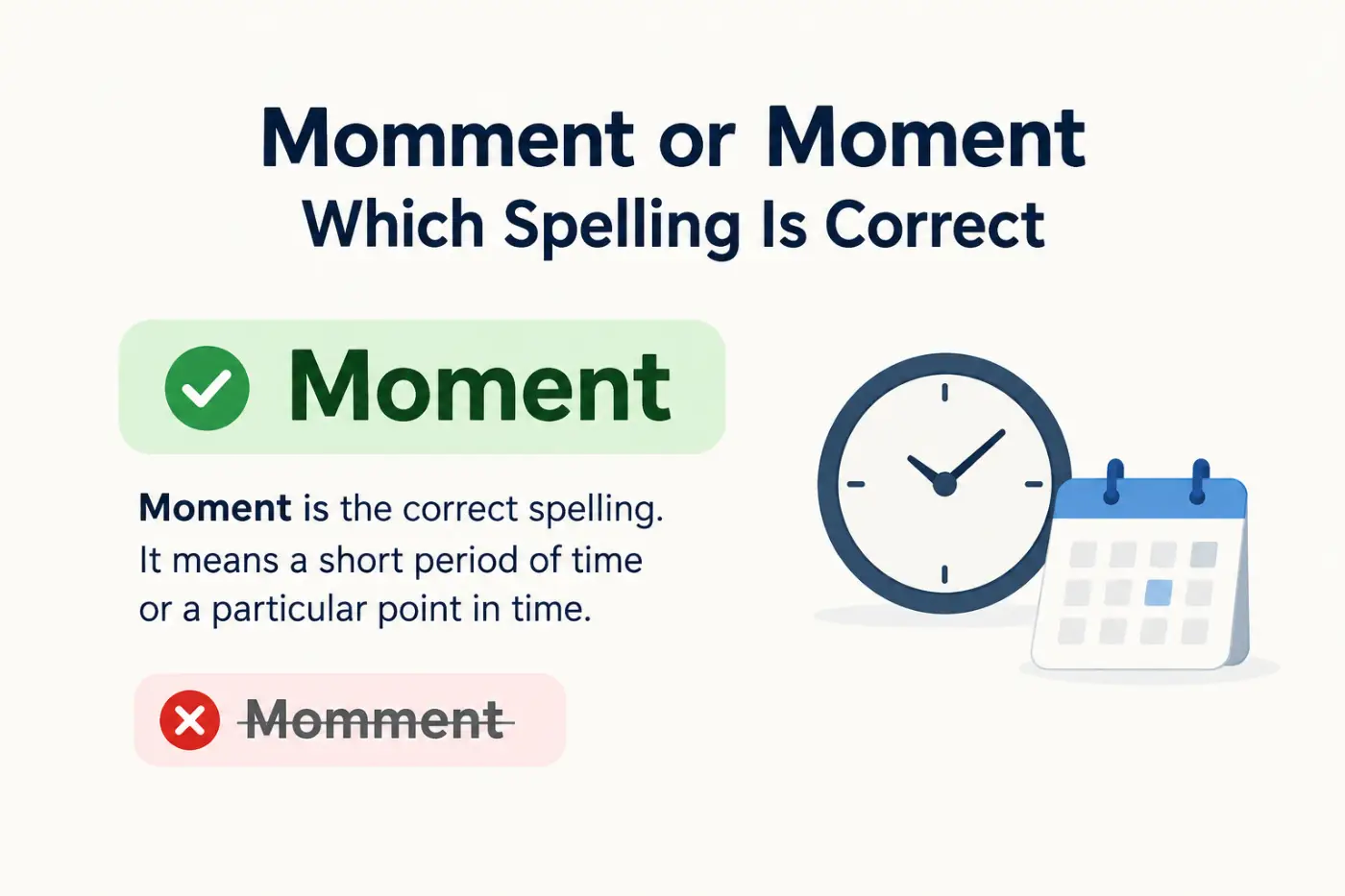
The spelling difference in momment vs moment can be confusing when you’re typing quickly or trying to remember the correct form. The answer is simple. Moment is the correct spelling in standard English, while momment is a common misspelling. The extra m doesn’t belong in the word.
The confusion often comes from English spelling patterns. Some words double their consonants, so it’s easy to assume this word follows the same rule. However, moment needs only one m at the beginning and one in the middle.
You’ll see this word in everyday conversations, text messages, school assignments, emails, and professional documents. Its spelling stays the same in American and British English.
Understanding the correct form will help you avoid common typing mistakes and write with confidence. You’ll also learn its meaning, pronunciation, grammar, word origin, and proper usage through clear explanations and practical examples.
Quick Answer
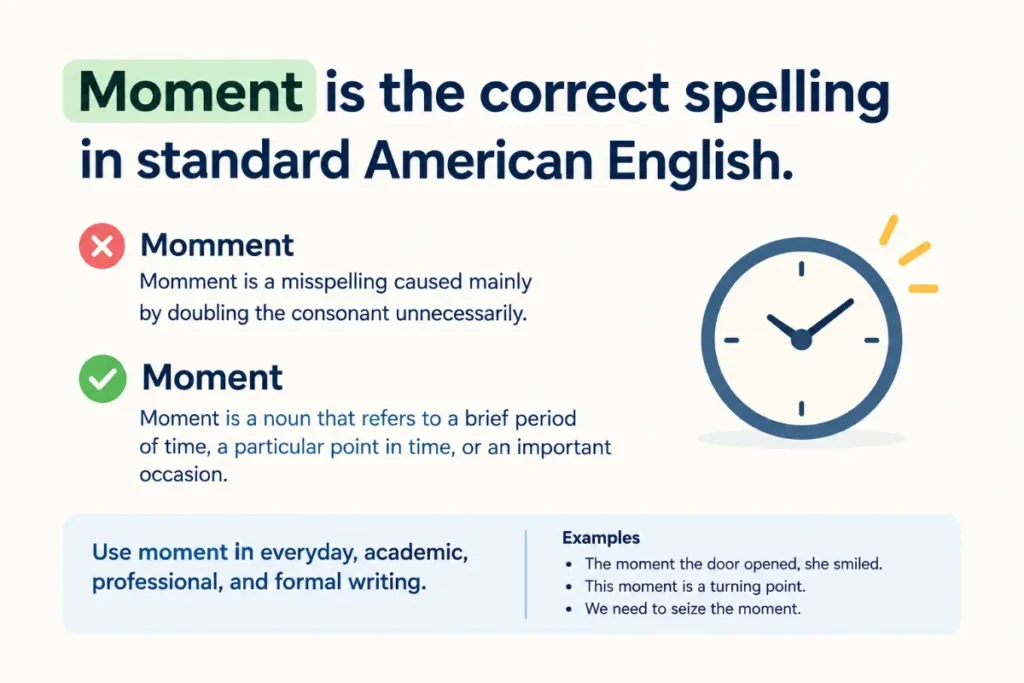
Moment is the correct spelling in standard English. It means a short period of time or a particular point in time. Momment is a misspelling of the same word and isn’t the standard spelling used in American or British English. Remember to write moment with one m at the beginning and one m in the middle.
Comparison Table
| Feature | Moment | Momment |
|---|---|---|
| Spelling status | Correct | Incorrect in standard English |
| Meaning | A short period or point in time | No standard meaning as a common English word |
| Part of speech | Noun | Misspelling of a noun |
| Pronunciation | MOH muhnt | Intended to mean the same as moment |
| American English | Standard | Nonstandard |
| British English | Standard | Nonstandard |
| Formality | Suitable for all writing styles | Should be corrected |
| Common contexts | Conversation and writing | Typing errors and spelling mistakes |
| Example | Give me a moment to finish. | Write moment instead of momment. |
Meaning and Definition
What Does Moment Mean
A moment is a short period of time or a specific point in time. The word can describe something that lasts only a little while or an event that stands out in someone’s memory.
For example, if a friend says, “Wait a moment,” they mean you should wait for a short time. If someone says, “That was a special moment,” they mean a particular experience felt important or memorable.
The word has several common uses.
1. A short period of time. You might need a moment to answer a question, finish a task, or collect your thoughts.
2. A specific point in time. You can refer to the moment a door opened or the moment you received good news.
3. A memorable experience. A graduation ceremony, a family reunion, or a personal achievement can create a moment you remember for years.
4. A suitable or important time. The phrase at the moment means now or at the present time. The phrase at that moment points to a particular time in the past.
5. Importance or significance. In expressions such as a moment of truth, the word refers to a time when something important becomes clear.
The exact meaning depends on the sentence, but the central idea stays connected to time or significance.
What Does Momment Mean
Momment is not the standard spelling of the common English noun. In ordinary writing, it usually appears as a typing error or a spelling mistake made by someone who intends to write moment.
It doesn’t have a separate, widely recognized meaning in standard American English. You shouldn’t use it in schoolwork, business emails, articles, reports, or other formal documents to express the idea of a short period.
You may occasionally see this spelling in a username, an invented brand name, a fictional character’s name, or an informal online post. Those special cases don’t make it the standard spelling of the English word.
For everyday writing, correct it to moment.
Key Differences Explained
Spelling
The main difference is the extra letter in the incorrect form. The standard spelling is m o m e n t. The misspelling adds another m, producing m o m m e n t.
That extra consonant doesn’t belong in the standard word. Unlike some English words that require doubled consonants, this one uses a single m in the middle.
Meaning
The correct form has several established meanings related to time, memorable experiences, and importance. The misspelled form doesn’t have a separate standard meaning that you need to learn.
If you encounter the incorrect version in a sentence such as “Give me a momment,” the intended meaning is almost always clear. Still, readers expect the standard spelling.
Grammar
Moment is a noun. It can act as the main noun in a sentence, follow a preposition, or appear as part of a familiar expression.
For example, you can say, “The moment passed quickly,” or “I’ll call you in a moment.” The spelling remains the same in both sentences because the grammatical function doesn’t change the word.
Pronunciation
The standard word has two syllables and usually receives stress on the first syllable. The extra m in the misspelling doesn’t represent a different standard pronunciation.
Formality and Context
The correct form works in casual and formal writing alike. You can use it in a text message, a business proposal, an academic paper, or a newspaper article.
The misspelled form should be corrected in all these settings unless it appears intentionally as a name or a quoted example of an error.
Regional Usage
American and British English use the same standard spelling. There is no accepted regional spelling rule that adds another m to this word.
Which Form Is Correct
Moment is correct because it follows the established spelling of the English word. Standard dictionaries recognize moment as a noun. The extra m in momment is not part of the standard spelling.
English spelling can be tricky because some words double their final consonant when adding a suffix. For example, run becomes running, and begin becomes beginning. However, those spelling changes follow specific patterns involving suffixes. They don’t mean you should double consonants in unrelated words.
The word moment doesn’t need an extra m. It is already complete in its standard form.
Use these examples as a guide.
- Correct: Please give me a moment.
- Incorrect: Please give me a momment.
- Correct: I’ll be ready in a moment.
- Incorrect: I’ll be ready in a momment.
If a spelling checker flags the incorrect form, replace it with moment. If the sentence is important, read it once more to make sure the correction fits the intended meaning.
Sentence Examples
The following sentences show how to use the correct spelling naturally in different situations.
1. Everyday conversation. Give me a moment while I find my keys.
2. Text messages. I’ll call you back in a moment.
3. Workplace communication. Please give me a moment to review the latest figures.
4. School assignments. The moment the experiment began, the students started recording their observations.
5. Academic writing. This moment marked a major change in the development of the theory.
6. Formal writing. We appreciate your patience and will respond in a moment.
7. Social situations. That was a wonderful moment to share with my family.
8. Online communication. Just a moment, and I’ll send you the file.
9. Personal reflection. I knew at that moment that I had made the right decision.
10. Storytelling. For a moment, the room fell silent as everyone waited for the announcement.
Notice that the same spelling works in every example. You don’t need a different version for formal writing, casual speech, or online messages.
Examples of the Common Misspelling
These examples show the error for correction purposes only.
1. Incorrect: Please wait one momment. Correct: Please wait one moment.
2. Incorrect: I’ll be there in a momment. Correct: I’ll be there in a moment.
3. Incorrect: Give me a momment to think. Correct: Give me a moment to think.
4. Incorrect: It was the happiest momment of my life. Correct: It was the happiest moment of my life.
5. Incorrect: At that momment, everyone started laughing. Correct: At that moment, everyone started laughing.
The pattern is consistent. Remove the extra m, and the word returns to its standard spelling.
Common Misspellings
The most common errors are usually caused by adding, removing, or rearranging letters.
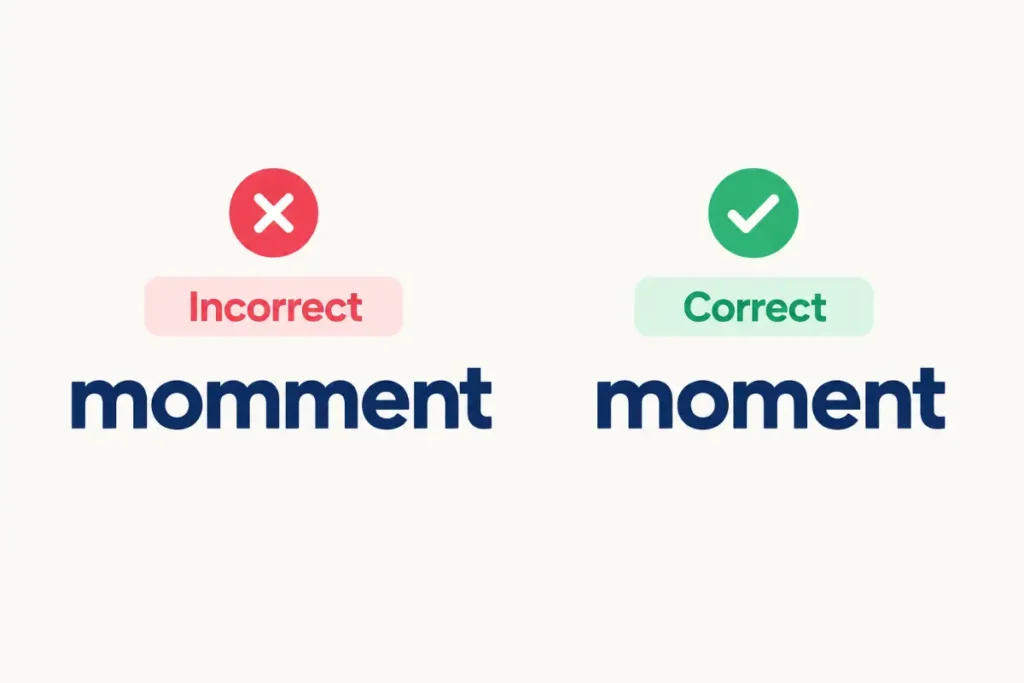
Momment
Incorrect:
momment
Correct:
moment
The extra m is the main mistake behind this particular spelling question.
Common Mistakes and Misspellings
Spelling errors often happen when people type quickly, rely on memory, or apply a familiar spelling pattern to the wrong word. Here are five mistakes to watch for when writing moment.
Adding an Extra M
Incorrect: momment.
Correct: moment.
This is the main error discussed in this guide. Writers may accidentally repeat the middle consonant, especially when typing quickly. Remember that the standard word contains only one m in the middle.
Confusing Spelling With Pronunciation
Some writers assume that a word needs an extra letter because they hear a strong consonant sound. However, English spelling doesn’t always match the way a word sounds. Pronouncing a consonant clearly doesn’t mean you should write it twice.
Typing the Same Letter Twice
An accidental double keystroke can produce the incorrect form. This often happens during fast typing or when someone edits a sentence without reviewing it. A quick proofreading pass can catch this error before the text reaches a reader.
Trusting Autocorrect Without Reviewing the Sentence
Spelling tools can help, but they aren’t perfect. A tool might miss an error in some settings or behave differently when the word appears in a name or specialized context. Review the final sentence instead of assuming every suggestion is correct.
Applying the Wrong Spelling Pattern
English has many words with doubled consonants, so writers may overgeneralize that pattern. Words such as running and stopped contain doubled consonants because of how their forms are built. The ordinary noun moment doesn’t follow that pattern.
Pronunciation Guide
The correct spelling becomes easier to remember when you connect it to the way the word sounds.
IPA and Syllable Breakdown
The word moment has two syllables.
- IPA in American English: /ˈmoʊ.mənt/.
- Easy pronunciation: MOH muhnt.
- Syllable breakdown: mo ment.
- Stress pattern: The first syllable receives the main stress.
Start with the long o sound in go. Then move into the second syllable, which sounds like the beginning of mother followed by an nt ending. Say the word smoothly rather than separating the syllables too sharply.
Common Pronunciation Mistakes
Some speakers may pronounce the second syllable too strongly or stretch the word longer than needed. Others may assume the extra m in the misspelling changes the pronunciation. In standard English, the extra letter doesn’t create a separate accepted pronunciation for the common noun.
For clear speech, place the stress on the first syllable and keep the second syllable light. You don’t need to emphasize the middle consonant.
Etymology and Word Origin
The history of moment helps explain why its spelling has remained stable.
The word entered English through Old French, which took it from Latin momentum. In Latin, the word could refer to movement, a moving force, or a brief period. Over time, its meaning developed to include a short interval and a particular point in time.
The Latin form is also related historically to the idea of movement and changing circumstances. That connection appears in the way English uses the word today. A moment can be a brief interval, a turning point, or an event that changes what happens next.
Modern English keeps the established spelling moment. The common misspelling with an additional m doesn’t reflect the word’s accepted historical form.
You don’t need to memorize the Latin history to spell the word correctly. Still, knowing that English inherited an established form can help explain why writers shouldn’t add letters based on guesswork.
Regional Usage
American English
In the United States, moment is the standard spelling in everyday speech and writing. People use it in expressions such as just a moment, at the moment, and a moment ago.
The spelling stays the same in school assignments, workplace emails, news articles, and professional reports. The incorrect form should be edited out of standard writing.
British English
British English uses the same spelling. There is no standard British variation that adds an extra m.
The pronunciation may vary slightly by accent, particularly in the vowel sounds, but that variation doesn’t change the spelling.
Australian English
Australian English also uses moment as the standard form. The ordinary noun follows the same spelling convention used in American and British English.
Canadian English
Canadian English uses the same standard spelling as well. Writers in Canada don’t need to change the word based on regional spelling preferences.
Across these varieties, the rule is simple. Use moment in standard English, regardless of your audience’s location.
Grammar Rules and Part of Speech
How the Word Functions in a Sentence
Moment is a countable noun. That means you can refer to one moment or several moments.
For example, you can write, “Give me a moment,” or “We shared many happy moments.” The singular form refers to one instance or interval. The plural form adds s to describe more than one.
The word can appear in several common grammatical patterns.
1. With an article. “A moment of silence followed the announcement.” The article a introduces one moment.
2. With a possessive. “That was my favorite moment.” The possessive word my identifies whose experience it was.
3. After a preposition. “We arrived at the moment the show began.” The noun forms part of a phrase that identifies time.
4. In a plural phrase. “Those moments helped us grow.” The plural form refers to multiple experiences.
Common Expressions
Several familiar phrases use the word in a specific way.
1. At the moment. This means now or at the present time. For example, “I’m busy at the moment.”
2. In a moment. This usually means very soon. For example, “The meeting will begin in a moment.”
3. For a moment. This refers to a brief period. For example, “She stopped for a moment to catch her breath.”
4. At that moment. This points to a particular time. For example, “At that moment, the lights went out.”
5. A moment of truth. This describes a time when a difficult decision or important fact becomes clear.
These expressions are common in both conversation and formal writing. Their meaning comes from the surrounding words, so pay attention to context.
Punctuation and Sentence Position
The noun can appear at the beginning, middle, or end of a sentence. Its position doesn’t change its spelling.
For example, “The moment arrived at last” begins with the noun. “I remember that moment clearly” places it in the middle. “Please wait a moment” places it at the end.
Use commas according to the sentence structure, not because the word itself requires special punctuation. For instance, “At that moment, the phone rang” uses a comma after an introductory phrase. The comma isn’t part of the word’s spelling.
Singular and Plural Forms
The plural form is moments. Add s to the standard singular form.
Correct: We enjoyed several memorable moments together.
Incorrect: We enjoyed several memorable momments together.
The spelling error doesn’t become correct when the noun becomes plural. Start with the standard form and add the normal plural ending.
Real Life Usage Examples
Seeing the word in realistic situations helps you understand how people use it outside a grammar lesson.
Daily Conversation
People often use the word to ask for a little time or describe a brief experience.
- “Hold on a moment while I check the address.”
- “I’ll never forget the moment we first met.”
The first sentence asks someone to wait briefly. The second points to a memorable event.
Email and Workplace Communication
In professional settings, the word can make a request sound polite and measured.
- “Please give me a moment to review your request before I respond.”
- “That moment helped our team understand the value of careful planning.”
Both examples are suitable for workplace communication. The word doesn’t sound overly formal or too casual.
Academic Writing
Students and researchers can use the noun to identify a point in time or describe a significant event in a process.
- “The moment the temperature changed, the researchers recorded the result.”
- “This moment in the experiment provided useful evidence for the hypothesis.”
In academic writing, be specific about the time or event you’re describing. If precision matters, an exact date, duration, or timestamp may be more useful than a general reference to a moment.
News and Journalism
Journalists often use the word to highlight a key event or a point when circumstances changed.
- “The moment the final vote was announced, supporters began to cheer.”
- “Officials described the decision as a defining moment for the community.”
The word can create a clear sense of timing and importance. However, news writing should still provide concrete details when the exact time or sequence matters.
Literature and Storytelling
Writers use moments to slow a scene down, highlight emotions, or mark a turning point.
- “For one quiet moment, she forgot about the storm outside.”
- “He knew this was the moment he had been waiting for.”
These examples show how a brief interval can carry emotional weight. A moment may last only seconds, yet it can change how a character sees the world.
Related and Confused Terms
Several words and expressions connect to the meaning of moment. Some refer to time, while others describe importance or a short experience. Learning their differences helps you choose the right word for your sentence.
1. Instant. An instant is an extremely short period of time. For example, “The screen went dark in an instant.” It often suggests something happened almost immediately.
2. Second. A second is a precise unit of time. In everyday speech, people also use it to mean a short wait, as in “Give me a second.” Unlike moment, it can refer to a defined measurement.
3. Minute. A minute is a unit of time equal to 60 seconds. People sometimes use it informally to mean a short period, as in “I’ll be there in a minute.” The actual wait may be longer.
4. While. A while refers to a period of time that isn’t always precisely defined. For example, “We talked for a while.” It usually describes a stretch of time rather than one particular point.
5. Occasion. An occasion is an event or a particular time when something happens. For example, “It was a special occasion for the whole family.” It often carries more emphasis on the event itself than on its duration.
6. Instance. An instance is a particular example or occurrence of something. For example, “That was an instance of excellent teamwork.” It focuses on an event or example rather than the length of time involved.
7. Turning point. A turning point is an event or stage that causes a major change in a situation. For example, “The conversation became a turning point in their relationship.” A turning point may be a moment, but it emphasizes change and consequence.
8. Milestone. A milestone is an important achievement or stage in progress. For example, “Graduating from college was a major milestone.” A milestone marks progress or accomplishment, while a moment can describe any brief period or specific point in time.
Key Takeaways
- Moment is the correct standard spelling.
- Momment is a common misspelling.
- Moment is a noun.
- The word can mean a short period of time.
- It can also mean a particular point in time.
- It can describe an important or memorable occasion.
- The standard American pronunciation has two syllables.
- The primary stress falls on the first syllable.
- The plural form is moments.
- The word is standard in American, British, Canadian, and Australian English.
- The easiest spelling memory is mo + ment.
- Do not add another m after the first m o m sequence.
Expert Editor Insight
An experienced editor treats moment as a straightforward spelling choice. The extra m in the incorrect form usually comes from a typing slip or an attempt to apply a familiar consonant pattern to the wrong word. In professional editing, context matters, but the correction is simple when the writer means a brief period of time. Spelling checkers often catch this error, although results can vary by tool and context. For an important document, use a spell checker and read the sentence yourself. A quick human review catches errors that automated tools may miss.
Conclusion
The spelling difference in moment vs momment is simple. Moment is the correct standard English word, while momment is a common misspelling. The correct form describes a brief period of time, a specific point in time, or an important experience. Its spelling stays the same in American, British, Canadian, and Australian English.
You can use it confidently in text messages, school assignments, professional emails, and formal writing. To remember the correct form, think of the word as having just one m in the middle. Before sending an important message, give your writing a quick review to catch extra letters and other small mistakes.
FAQs
Is Momment a Real Word?
Momment isn’t the standard spelling of the common English noun. You may encounter it as an invented name, username, or intentional spelling choice, but that doesn’t make it correct in ordinary writing. If you mean a short period of time or a particular point in time, use moment in schoolwork, emails, articles, and professional documents.
What Does Moment Mean?
A moment is a short period of time or a particular point in time. It can also describe an important or memorable experience. For example, “Wait a moment” asks someone to pause briefly, while “That was a proud moment” describes an experience with personal significance. The exact meaning depends on how the word appears in the sentence.
Which Spelling Should I Use in American English?
Use moment. It is the standard spelling in American English and is appropriate for casual messages, academic assignments, workplace communication, and formal documents. The extra m in momment is a spelling error in ordinary usage. You don’t need to change the spelling based on the audience or the level of formality.
How Do You Pronounce Moment?
In American English, the word is commonly pronounced MOH muhnt, with the main stress on the first syllable. Its IPA transcription is /ˈmoʊ.mənt/. Say the first syllable with the long o sound found in go, then finish with a lighter second syllable. The incorrect spelling doesn’t create a separate standard pronunciation.
Can Moment Start a Sentence?
Yes. You can begin a sentence with the noun or with a phrase that contains it. For example, “Moments like these remind us to appreciate our friends” begins with the plural noun. You could also write, “At that moment, the audience stood up.” Use a comma after an introductory phrase when the sentence structure calls for one.
What Is a Synonym for Moment?
Useful alternatives include instant, second, minute, while, and occasion. The best choice depends on your intended meaning. An instant usually suggests an extremely short time, while an occasion often refers to an event. A moment can describe a brief interval, a particular point in time, or a memorable experience.
Why Do People Misspell Moment?
People may add an extra m because they type quickly, accidentally repeat a key, or apply a familiar spelling pattern to the wrong word. English contains many words with doubled consonants, which can make spelling less predictable. However, the ordinary noun uses one m at the beginning and one m in the middle. Proofreading helps catch the mistake.
Is Moment Appropriate for Formal Writing?
Yes. Moment is a standard English noun that works in formal and informal contexts. You can use it in a business email, an academic paper, a news report, or a personal message. The main consideration is precision. If a specific duration or exact time matters, provide that information instead of relying on the general word alone.
