
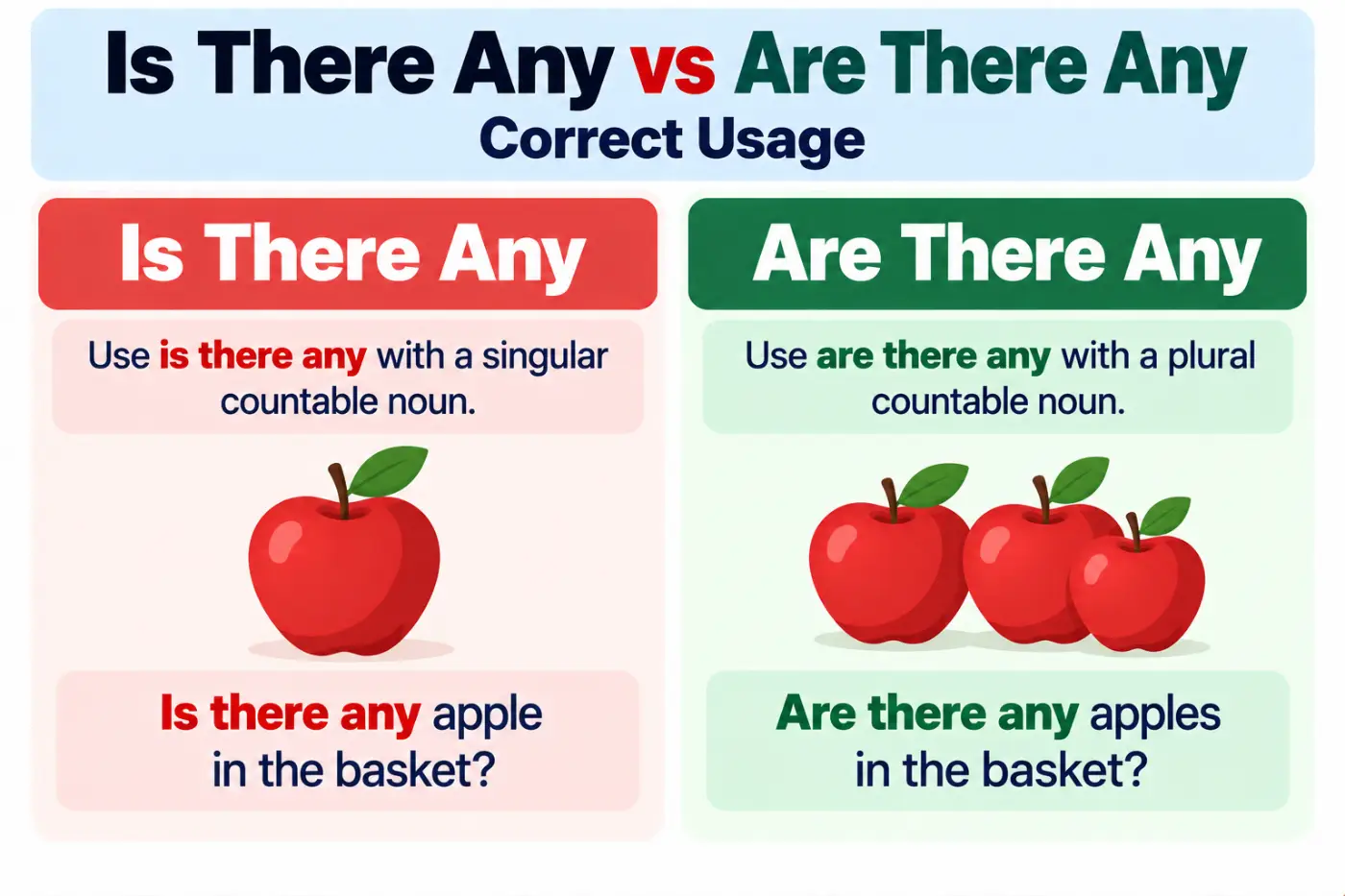
The choice between is there any vs are there any depends mainly on the noun that follows any. Use is there any with an uncountable noun or a singular noun in a suitable context. Use are there any with a plural countable noun. For example, you can say, “Is there any water?” but “Are there any bottles?”
The confusion happens because any can appear with both singular and plural nouns, as well as uncountable nouns. The word itself does not decide whether the verb should be is or are. The noun that follows it determines the number of the noun phrase, so the verb must agree with that noun.
This distinction is useful in everyday questions, workplace conversations, school writing, emails, and formal English. Once you identify the noun after any, the correct form becomes much easier to choose.
Quick Answer
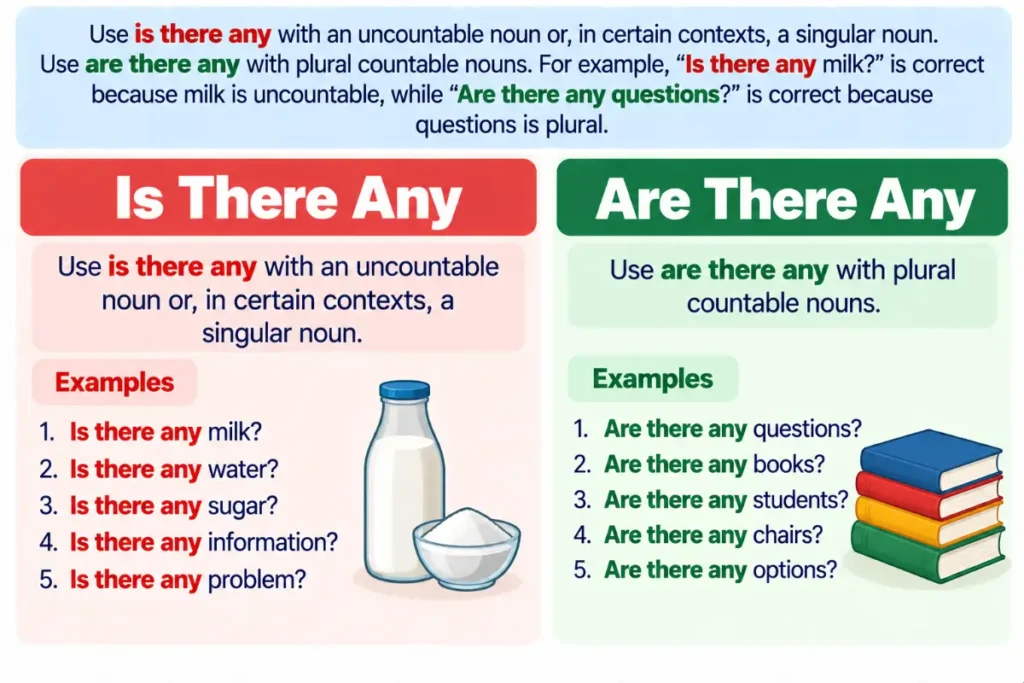
Use is there any with an uncountable noun or, in certain contexts, a singular noun. Use are there any with plural countable nouns. For example, “Is there any milk?” is correct because milk is uncountable, while “Are there any questions?” is correct because questions is plural.
Quick Answer
The simplest rule is to look at the noun after any.
- Is there any + uncountable noun?
“Is there any coffee left?” - Are there any + plural countable noun?
“Are there any seats available?” - Is there a + singular countable noun?
“Is there a seat available?”
The important point is that any does not control the verb. The noun does.
If you are asking about one countable item, use is there a rather than normally using is there any. If you are asking about several countable items, are there any is the natural choice.
Is There Any vs Are There Any
| Form | Noun Pattern | Meaning | Grammar | Common Context | Example |
|---|---|---|---|---|---|
| Is there any | Uncountable noun | Asks if some amount exists | Singular verb | Food, money, information, time, water | Is there any water? |
| Are there any | Plural countable noun | Asks if one or more items exist | Plural verb | Books, questions, people, seats | Are there any seats? |
| Is there a | Singular countable noun | Asks if one item exists | Singular verb | One object or person | Is there a seat? |
| Is there any + singular noun | Special or context dependent | Can refer to an individual or type | Singular verb | Limited contexts | Is there any reason to worry? |
The table shows why simply memorizing one phrase can cause mistakes. The noun determines the grammatical pattern.
Why The Verb Changes
English uses subject verb agreement. A singular subject normally takes is, while a plural subject takes are.
Consider these statements:
There is some water in the bottle.
There are some bottles on the table.
When you turn these statements into questions, the same agreement remains:
Is there any water in the bottle?
Are there any bottles on the table?
The words there is and there are are often called existential constructions because they introduce the existence or presence of something. In these questions, there does not determine the number. The noun phrase that follows the verb does.
That is why the correct choice is not based on the word any. You need to identify the noun.
What Does Any Mean
Any is a determiner that commonly refers to an unspecified amount or number. It appears frequently in questions and negative statements.
For example:
“Do you have any questions?”
“I don’t have any questions.”
“Is there any information available?”
“Are there any tickets left?”
The meaning of any changes slightly depending on the sentence and context, but the grammar remains tied to the noun.
With an uncountable noun, any usually refers to an unspecified amount.
“Is there any rice left?”
Here, rice is treated as an uncountable noun, so is is used.
With a plural countable noun, any refers to an unspecified number.
“Are there any students outside?”
Here, students is plural and countable, so are is required.
When To Use Is There Any
Use is there any when the noun is normally uncountable.
Common examples include:
- Water.
- Milk.
- Coffee.
- Sugar.
- Money.
- Information.
- Advice.
- Time.
- Traffic.
- Evidence.
- Furniture.
- Equipment.
For example:
“Is there any coffee left?”
“Is there any time before lunch?”
These nouns generally describe substances, ideas, amounts, or categories that English does not normally count as separate individual units.
You can make some of these nouns countable by adding a suitable unit or container.
Instead of saying “three informations,” standard English normally says “three pieces of information.”
Instead of “two advices,” say “two pieces of advice.”
This matters because the grammatical form changes when the noun changes.
“Is there any information?”
“Are there any pieces of information?”
The first question treats information as uncountable. The second treats pieces as plural countable nouns.
When To Use Are There Any
Use are there any with plural countable nouns.
A countable noun can refer to separate things that you can count individually.
For example:
“Are there any chairs available?”
“Are there any problems with the report?”
The nouns chairs, students, messages, stores, and problems are all plural countable nouns. Because the subject is plural, the verb must be are.
A useful test is to remove any and look at the noun.
“Are there chairs available?”
“Are there messages for me?”
The plural form remains clear, so are is required.
What About Singular Countable Nouns
Singular countable nouns need special attention.
In ordinary questions about one specific item, English normally uses is there a rather than is there any.
For example:
“Is there a problem?”
These questions ask about one possible person, thing, place, problem, or solution.
However, any can occur with a singular countable noun in specific meanings and structures. This is why it would be too simple to say that any can never be followed by a singular noun.
For example:
“Is there any reason to leave?”
Here, reason is singular, but the phrase is perfectly natural. The question means something like, “Is there even one reason to leave?”
Another example is:
“Is there any chance of rain?”
The speaker is asking if there is even one possibility or amount of chance.
This use often gives any an emphatic meaning. It can suggest “even one,” “at all,” or “any possible.”
So the practical rule is not “any always requires a plural noun.” Instead, look at the meaning and the noun structure.
The Main Grammar Rule
The most useful rule is simple:
Singular or uncountable noun → is.
Plural countable noun → are.
Compare these pairs:
“Is there any water?”
“Are there any bottles?”
“Is there any information?”
“Are there any details?”
“Is there any furniture?”
“Are there any chairs?”
“Is there any traffic?”
“Are there any cars?”
The pattern becomes clear when you focus on the noun.
This is also why saying are there any information is incorrect in standard English. Information is uncountable, so the correct question is:
“Is there any information?”
If you want a plural countable structure, use a noun such as details, facts, or pieces of information.
Sentence Examples
Here are natural examples showing how the two patterns work in real situations.
- “Is there any coffee left in the pot?”
- “Are there any clean cups in the kitchen?”
- “Is there any information about the new schedule?”
- “Are there any changes to the meeting time?”
- “Is there any money in your wallet?”
- “Are there any stores open after midnight?”
- “Is there any reason we should wait?”
- “Are there any questions before we finish?”
- “Is there any parking near the building?”
- “Are there any documents I need to sign?”
Each sentence follows the same basic principle. The verb agrees with the noun phrase that follows it.
Common Mistakes
Several errors appear because speakers focus on any instead of the noun.
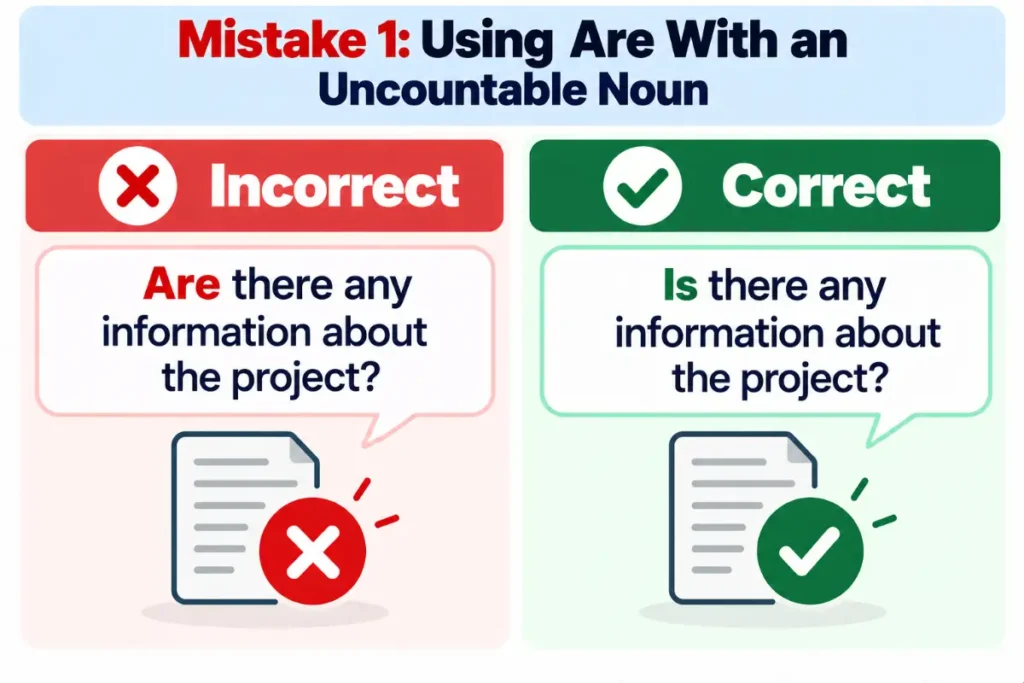
Mistake 1: Using Are With an Uncountable Noun
Incorrect: “Are there any information about the project?”
Correct: “Is there any information about the project?”
Information is normally uncountable in English. The singular verb is is therefore appropriate.
Mistake 2: Using Is With a Plural Noun
Incorrect: “Is there any books on the desk?”
Correct: “Are there any books on the desk?”
Books is plural, so the question needs are.
Mistake 3: Treating Any As a Plural Marker
Some learners assume that any always means several things. It does not.
Compare:
“Is there any milk?”
“Are there any bottles?”
In the first sentence, any refers to an unspecified amount. In the second, it refers to an unspecified number of individual items.
Mistake 4: Using Any Instead of A
Incorrect for a normal question about one item: “Is there any chair available?”
More natural: “Is there a chair available?”
The first sentence can work in a special context where the speaker means “even one chair,” but is there a chair is the normal choice for asking about one available chair.
Mistake 5: Forgetting That Some Nouns Are Uncountable
Learners sometimes create plural forms such as informations, advices, or furnitures.
Standard English normally uses:
“Is there any information?”
“Is there any furniture?”
If you need to count them, add a suitable countable expression:
“Are there any pieces of information?”
“Are there any pieces of furniture?”
Pronunciation Guide
The pronunciation of the phrases is straightforward, but connected speech can make the words sound different from how they look on the page.
Is there any can be pronounced approximately as:
iz thair EN-ee
Are there any can be pronounced approximately as:
ar thair EN-ee
The word any is usually pronounced with two syllables:
an y
IPA for any is commonly represented as /ˈɛni/ in American English.
The first syllable receives the main stress, so it sounds like EN ee, not en EE.
In natural conversation, speakers may reduce some sounds. That can make is there any and are there any sound less distinct than they appear in careful speech. This can contribute to confusion for English learners.
Etymology And Word Origin
The word any has a long history in English and is related to older Germanic forms. It developed from words expressing ideas such as “one,” “some,” or “one or more,” with its modern uses expanding over time.
The word there also has Old English roots. In modern existential sentences such as “There are two books,” it does not primarily refer to a physical location. Instead, it helps introduce the existence or presence of something.
The forms is and are come from the highly irregular verb be, one of the oldest and most frequently used verbs in English.
The history of these words helps explain why modern English uses them in several different grammatical patterns. For everyday writing, though, the practical rule is more useful than memorizing their historical development.
American English
In American English, both patterns are standard.
Use is there any with uncountable nouns:
“Is there any gas in the tank?”
“Is there any news about the flight?”
Use are there any with plural countable nouns:
“Are there any flights available?”
“Are there any seats left?”
American English does not have a special alternative that replaces these basic patterns.
The same subject verb agreement rule applies in casual speech, workplace communication, school assignments, and formal writing.
British English
British English follows the same basic grammar.
“Is there any milk?”
“Are there any students waiting?”
The main distinction is not between American and British English. It is between singular or uncountable nouns and plural countable nouns.
Some vocabulary and pronunciation may differ between English varieties, but that does not change the core rule here.
Australian And Canadian English
Australian and Canadian English also use the same basic structures.
For example:
“Is there any water?”
“Are there any tickets left?”
Regional differences may affect vocabulary, pronunciation, or style in particular situations, but speakers in these varieties follow the same basic agreement pattern.
You do not need a separate grammar rule for Australian or Canadian English.
Grammar Rules And Sentence Structure
The standard question pattern is:
Is there + uncountable noun?
“Is there any food?”
The plural pattern is:
Are there + plural countable noun?
“Are there any snacks?”
The singular countable pattern is:
Is there + a + singular countable noun?
“Is there a snack?”
These structures can also include modifiers.
“Is there any good news?”
“Are there any good restaurants nearby?”
“Is there a good restaurant nearby?”
Notice how the noun phrase changes the verb.
The adjective good does not affect agreement. The noun still determines the form.
Negative Questions And Statements
The same distinction appears in negative sentences.
“I don’t have any money.”
“I don’t have any coins.”
The first sentence uses an uncountable noun. The second uses a plural countable noun.
With existential structures, you can also say:
“There isn’t any milk.”
“There aren’t any clean glasses.”
Again, isn’t goes with the uncountable noun milk, while aren’t goes with the plural noun glasses.
This gives you a useful way to remember the question forms. If the statement would naturally use there is, the question generally uses is there. If the statement would use there are, the question uses are there.
Real Life Usage Examples
Daily Conversation
People use these forms constantly in ordinary conversation.
“Is there any food left?”
“Are there any clean towels?”
“Is there any gas in the car?”
“Are there any kids outside?”
The questions are short because the context usually supplies the missing details.
Workplace Communication
In a workplace, the same structures appear in spoken and written communication.
“Is there any information we need before the meeting?”
“Are there any updates from the sales team?”
“Is there any room in the budget for this?”
“Are there any documents still waiting for approval?”
These sentences sound natural in emails, meetings, and workplace chats.
Academic Writing
Academic questions can use the same grammar, although formal writing often presents the question within a larger sentence.
“Is there any evidence supporting this claim?”
“Are there any studies that reach a different conclusion?”
“Is there any research available on this topic?”
“Are there any factors that could affect the result?”
The grammar does not become different simply because the context is academic.
News And Journalism
News writing may also use these constructions, especially in interviews, headlines with expanded questions, and quoted speech.
“Are there any new details about the investigation?”
“Is there any confirmation from officials?”
These questions are useful when the writer or speaker does not yet know if information exists.
Literature And Storytelling
Writers can use these questions naturally in dialogue.
“Is there any hope for them?”
“Are there any people still inside?”
The choice depends on the noun, even when the sentence appears in a fictional setting.
How To Choose The Correct Form Quickly
If you are unsure, use this three step check.
- Find the noun after any.
- Decide if that noun is uncountable, singular countable, or plural countable.
- Choose the verb that agrees with it.
For example:
“_____ there any advice?”
Advice is uncountable.
Answer: “Is there any advice?”
Now try:
“_____ there any suggestions?”
Suggestions is plural and countable.
Answer: “Are there any suggestions?”
Finally:
“_____ there a suggestion?”
Suggestion is singular and countable.
Answer: “Is there a suggestion?”
This method is more reliable than trying to memorize entire phrases.
Related And Confused Terms
Several expressions are closely related to these question forms.
- Is there a
Use this for one singular countable item.
“Is there a problem?”
- Are there any
Use this for plural countable items.
“Are there any problems?”
- Is there any
Use this mainly for uncountable nouns or special singular uses.
“Is there any information?”
- There is
Use this in positive statements with a singular or uncountable noun.
“There is some information here.”
- There are
Use this in positive statements with plural countable nouns.
“There are several options.”
- There isn’t any
Use this with an uncountable noun.
“There isn’t any coffee left.”
- There aren’t any
Use this with plural countable nouns.
“There aren’t any chairs available.”
- Do you have any
This is another common way to ask if someone possesses or has access to something.
“Do you have any questions?”
These expressions are related, but they do not all have exactly the same grammatical structure.
Is There Any Information Or Are There Any Information
The correct standard form is:
Is there any information?
Not:
Are there any information?
The reason is that information is normally uncountable. English does not generally treat individual pieces of information as separate “informations.”
If you want a plural noun, use details, facts, or pieces of information.
For example:
“Are there any details about the event?”
This distinction is especially useful in professional and academic writing.
Is There Any Questions Or Are There Any Questions
The correct form is:
Are there any questions?
Not:
Is there any questions?
The noun questions is plural, so are is required.
If you mean one question, say:
“Is there a question?”
This gives you a simple three way comparison:
“Is there a question?”
“Are there any questions?”
“Is there any information?”
Each sentence has a different noun pattern.
Is There Any Problem Or Are There Any Problems
Both structures can be correct, but they express different ideas.
“Is there any problem?”
This can ask if there is any problem at all. It may have a broad or emphatic meaning.
“Are there any problems?”
This asks about one or more problems and is very common when checking for issues.
“Is there a problem?”
This is the usual question when the speaker has one possible problem in mind.
Context matters here. Grammar tells you which verb agrees with the noun, but the choice between a and any can affect the meaning.
Is There Any Reason Or Are There Any Reasons
Again, both can be grammatical.
“Is there any reason to cancel the meeting?”
This asks if there is even one reason.
“Are there any reasons to cancel the meeting?”
This asks about possible reasons in the plural.
The first version is often more natural when asking about the existence of a reason in general. The second emphasizes multiple possible reasons.
This is a good example of why grammar cannot always be reduced to a simple “singular equals this phrase, plural equals that phrase” rule. Meaning and context also matter.
Formal And Informal Usage
Both forms are appropriate in formal and informal English.
In casual conversation:
“Is there any food left?”
“Are there any snacks?”
In workplace writing:
“Is there any additional information available?”
“Are there any outstanding issues?”
In academic writing:
“Is there any evidence to support this interpretation?”
“Are there any limitations that should be considered?”
The structures themselves are not informal. Their level of formality depends more on vocabulary, context, and the surrounding sentence.
How Grammar Checkers May Flag These Errors
Grammar tools often catch agreement errors involving is and are, especially when the noun is clearly singular or plural.
For example, a checker may flag:
“Is there any documents attached?”
The problem is easy to identify because documents is plural.
The corrected version is:
“Are there any documents attached?”
However, automated tools may not always understand special uses of any with singular nouns. A sentence such as “Is there any reason to worry?” is grammatical, even though reason is singular.
This is a useful reminder that grammar software can help identify patterns, but context still matters. A careful editor checks the meaning and sentence structure rather than accepting every automated suggestion without review.
Expert Editor Insight
An experienced editor usually checks the noun phrase first, not the word any. If the noun is uncountable, is there any is normally the right pattern. If the noun is plural and countable, are there any is normally required. Editors also watch for related errors such as are there any information, because learners often treat uncountable nouns as plural. The fastest editing habit is to identify the noun and test its number before choosing the verb.
A Simple Memory Trick
Think of the question as a shortened version of a statement.
If the statement is:
“There is some water.”
The question becomes:
“Is there any water?”
If the statement is:
“There are some bottles.”
The question becomes:
“Are there any bottles?”
The words some and any change because the sentence changes from a statement to a question, but is and are still follow the noun.
You can remember the pattern as:
There is → Is there
There are → Are there
This trick works in many everyday sentences.
Key Takeaways
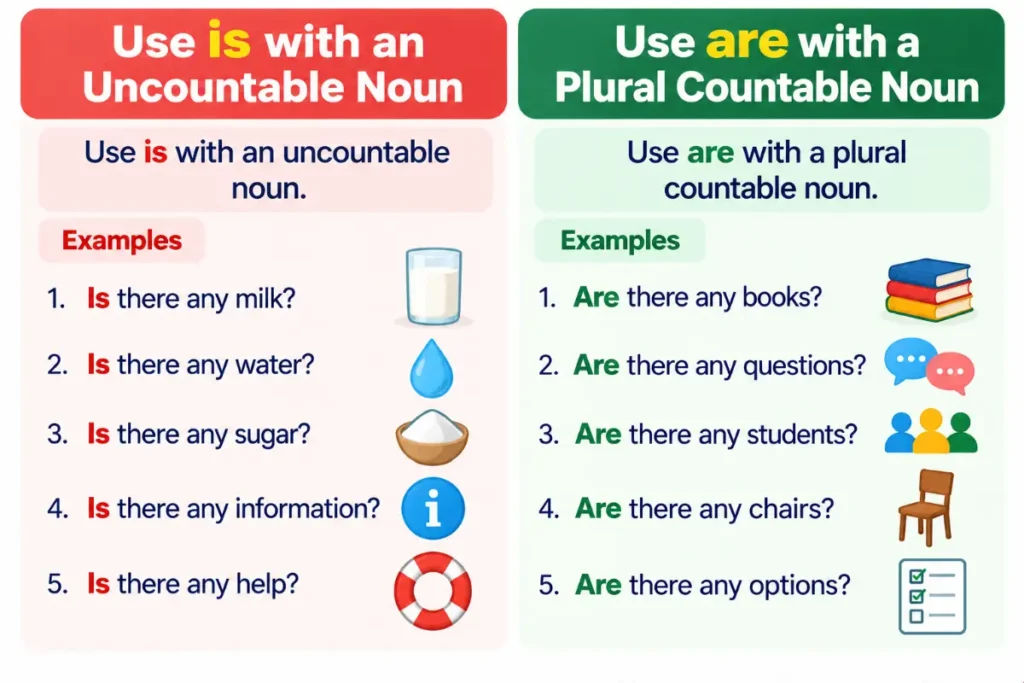
- Use is with an uncountable noun.
- Use are with a plural countable noun.
- Any can work with both types of nouns.
- Is there a is normally used for one singular countable item.
- Singular countable nouns can sometimes follow any when the meaning is “even one” or “any possible.”
- “Is there any information?” is correct.
- “Are there any questions?” is correct.
- “Are there any information?” is incorrect in standard English.
- “Is there any questions?” is incorrect when questions is plural.
- The quickest way to choose the verb is to identify the noun and check its number.
Conclusion
Understanding is there any vs are there any becomes much easier once you focus on the noun instead of any. Use is with uncountable nouns such as water, information, money, and advice. Use are with plural countable nouns such as questions, books, students, and documents.
The same agreement rule works across everyday conversation, workplace writing, academic English, and formal communication. Remember the statement behind the question: there is becomes is there, while there are becomes are there. That simple check can prevent many common grammar mistakes.
When editing your own writing, look at the noun after any before choosing the verb. If the noun is uncountable, choose is. If it is plural and countable, choose are. This small habit makes the correct form much easier to recognize.
FAQs
Which is correct is there any or are there any?
Both are correct, but they are used with different noun types. Use is there any mainly with uncountable nouns, such as water, money, or information. Use are there any with plural countable nouns, such as books, questions, or students. The noun determines the verb, not the word any.
Is there any a grammatically correct expression?
Yes. Is there any is fully grammatical. It is commonly followed by an uncountable noun, as in “Is there any milk?” It can also occur with certain singular countable nouns when any means something like “even one” or “any possible,” as in “Is there any reason to worry?”
Are there any used with plural nouns?
Yes. Are there any is commonly used with plural countable nouns. For example, “Are there any tickets left?” and “Are there any questions?” The plural noun requires the plural verb are. The phrase is common in both everyday conversation and formal writing.
Can I say is there any questions?
No, not in standard English when questions is intended as a plural noun. The correct sentence is “Are there any questions?” Because questions is plural and countable, it requires are. If you mean one question, say “Is there a question?”
Can I say are there any information?
No. The standard form is “Is there any information?” Information is normally an uncountable noun in English, so it takes is in this construction. If you need a plural countable noun, you can say “Are there any pieces of information?”
Is is there any used in formal writing?
Yes. The expression is completely suitable for formal writing when the grammar and context call for it. For example, “Is there any evidence supporting the claim?” is appropriate in academic or professional writing. The phrase itself is not informal.
Why do people confuse these two forms?
The confusion often comes from the word any, which works with both uncountable nouns and plural countable nouns. Learners may focus on any instead of the noun that follows it. Checking the noun first usually solves the problem.
How can I remember the difference?
Use the statement behind the question as a memory aid. There is changes to is there, while there are changes to are there. For example, “There is some water” becomes “Is there any water?” and “There are some bottles” becomes “Are there any bottles?”
