
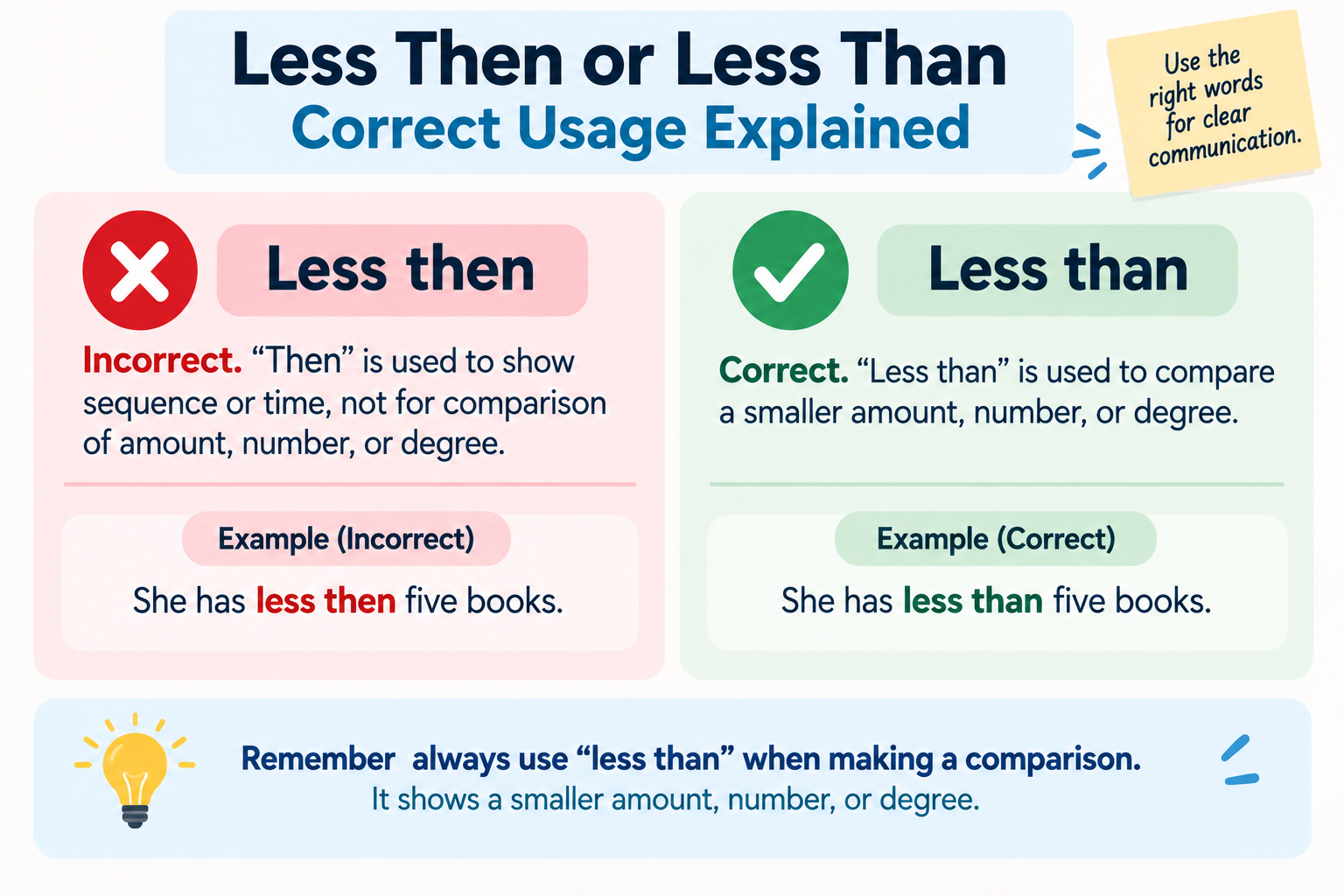
If you have ever paused over less then or less than, you are not alone. The two forms look almost identical, and then is a very common English word. However, the standard expression used for comparison is less than. You should write less than five dollars, less than an hour, or less than expected.
The key difference comes down to the job each word does. Than is used to compare two amounts, people, things, qualities, or situations. Then usually relates to time or sequence, as in first we ate, then we left. Because the words are close in sound and spelling, people sometimes type one when they mean the other.
This guide explains the rule in simple terms and shows how to use the expression naturally. You will see examples from everyday conversation, school, work, academic writing, and formal communication. You will also learn a simple memory trick that can help you choose the right word quickly.
Quick Answer
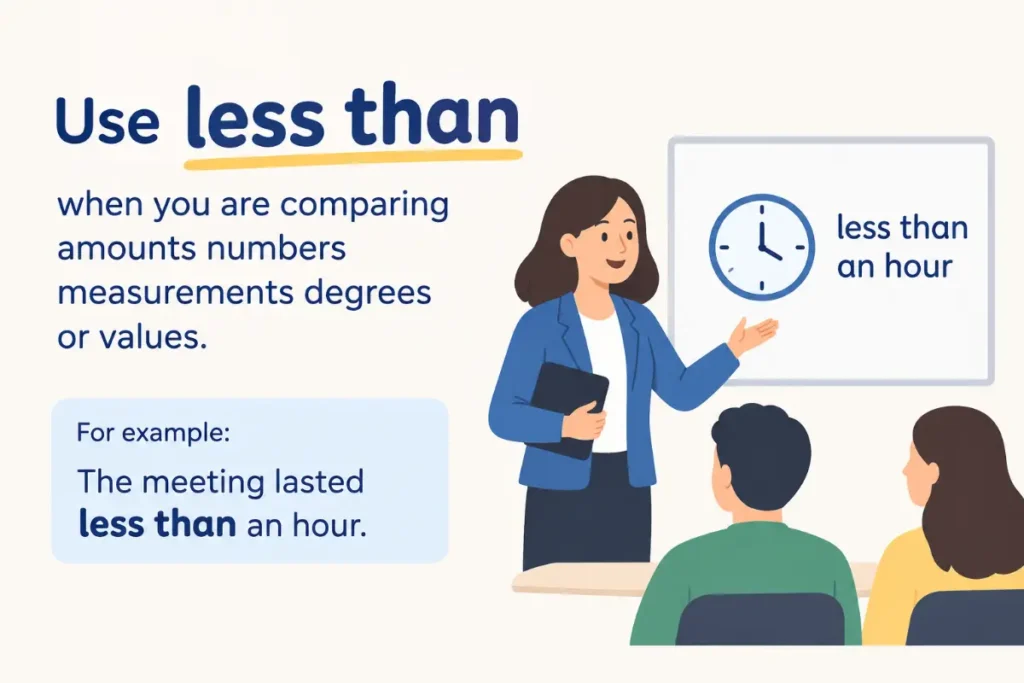
Less than is the correct expression when you are comparing a smaller amount, number, degree, or quantity. Less then is a spelling mistake in standard English. The confusion happens because than and then sound similar in some forms of speech, but they have different meanings and grammatical jobs. Use than for comparisons and then mainly for time, sequence, or the next action.
Featured Snippet Answer
Less than is the correct form for comparisons involving a smaller amount, number, degree, or quantity. For example, The bag costs less than twenty dollars and She finished in less than an hour. Less then is a common misspelling because than and then look and sound similar.
Meaning and Definition
The phrase less than expresses a comparison. It tells the reader that one amount, number, degree, or measurement is smaller than another.
Consider these examples:
- The box weighs less than ten pounds.
- We waited less than twenty minutes.
- He earns less than his brother.
- The repair took less than expected.
In each sentence, the phrase connects one value with another point of comparison.
The word less indicates a smaller amount or degree. The word than introduces the thing used for comparison. Together, they form a standard comparative expression.
By contrast, then does not normally introduce a comparison. It commonly refers to a time, a sequence, or a consequence.
For example:
- We finished dinner, then we went home.
- If you finish your work, then you can leave.
- She lived there then, but she lives somewhere else now.
The meanings are different, so replacing than with then changes the grammatical structure.
Less Then or Less Than
The correct spelling for a comparison is less than.
The form less then is not the standard spelling of this expression. It usually appears because the writer has confused the two similar words than and then.
| Form | Meaning | Part of Speech | Main Function | Standard Usage | Example |
|---|---|---|---|---|---|
| Less than | A smaller amount or degree compared with another | Comparative phrase | Makes a comparison | Standard | The trip took less than two hours. |
| Less then | No standard comparative meaning | Nonstandard combination | Usually a spelling error | Avoid in standard writing | Incorrect: The trip took less then two hours. |
| Then | At that time, next, or as a result | Adverb | Shows time, order, or consequence | Standard | We ate, then we left. |
| Than | Introduces a comparison | Conjunction or preposition depending on use | Connects things being compared | Standard | This one is cheaper than that one. |
The important point is simple: than belongs with comparisons, while then usually belongs with time or sequence.
Why The Confusion Happens
The mistake is easy to understand because than and then differ by only one letter. They also have similar pronunciations in many varieties of English, especially in fast or casual speech.
Writers may also rely on sound when typing quickly. If you hear a sentence such as It costs less than ten dollars, the final vowel sounds in less than can become less distinct in natural speech. That can make the spelling harder to recall.
Another reason is that then is more familiar to many learners because it appears in common expressions such as then and now, back then, and what happens then. When a writer needs a comparison, the brain may select the familiar word automatically.
This is a normal spelling confusion rather than a difference in meaning between two competing versions of the same phrase. The solution is to connect each word with its grammatical purpose.
Which Form Is Correct?
Use less than when you are making a comparison.
For example:
- The movie was less than two hours long.
- I paid less than fifty dollars.
- The temperature dropped to less than freezing.
- The project took less than a week.
Do not use less then for these comparisons.
The reason is grammatical. Than is the word English uses to introduce a comparison after comparative forms and expressions. Less is itself a comparative word because it indicates a smaller amount or degree.
You can think of the structure as:
less + than + comparison
Examples include:
- less expensive than
- less difficult than
- less time than
- less money than
- less common than
- less important than
The word then does not perform this comparative function.
Key Differences Explained
Spelling
The words differ by one letter.
Than is used for comparison.
Then is mainly used for time, sequence, or consequence.
A single letter changes the grammatical meaning, so spelling matters here.
Meaning
Than connects two things that are being compared.
Then usually tells you when something happened, what happened next, or what follows from a condition.
Compare these sentences:
This route is shorter than the other one.
Take this route, then turn left.
The first sentence compares two routes. The second gives instructions in sequence.
Grammar
The phrase less than functions as a comparative expression.
The word then functions mainly as an adverb.
For example:
The job took less than three days.
Here, than three days identifies the comparison.
In We worked all morning, then we went home, then indicates the next event.
Pronunciation
Both words are often pronounced with a voiced th sound, which contributes to the confusion.
Than is commonly pronounced approximately like than with a short vowel.
Then is commonly pronounced approximately like then with a short vowel that is slightly different.
In natural speech, the distinction can become less noticeable, especially when people speak quickly.
Formality
Less than is fully standard in both casual and formal English.
You can use it in:
- Text messages.
- Conversations.
- Business emails.
- School assignments.
- Academic writing.
- Reports.
- Professional documents.
- News writing.
There is no need to replace it with a more formal expression.
Context
Use less than for comparisons involving quantity, number, time, distance, money, degree, or other measurable ideas.
Examples include:
less than five miles
less than ten minutes
less than $100
less than expected
less than last year
Grammar Rules and Part of Speech
How Less Works
Less is a comparative word that generally refers to a smaller amount or degree.
For example:
I have less time today.
This task requires less effort.
The new model uses less energy.
The comparison may be stated directly or understood from context.
When you explicitly name the comparison, than commonly follows:
I have less time than yesterday.
This task requires less effort than the previous one.
The new model uses less energy than the old model.
Less Than With Numbers
The expression is common before numbers.
Examples include:
- less than five minutes
- less than ten people
- less than one hundred dollars
- less than twenty miles
- less than three years
These structures are common in both speech and writing.
Less Than With Adjectives
The phrase can also modify adjectives.
For example:
The problem is less serious than we expected.
This option is less expensive than the first one.
The second test was less difficult than the first.
In these sentences, the comparison concerns degree or quality rather than a physical quantity.
Less Than With Verbs
The phrase can also appear after verbs.
For example:
She talks less than her sister.
He sleeps less than he used to.
They travel less than they did last year.
The exact grammar changes depending on the sentence, but the comparative meaning stays the same.
Sentence Examples
Here are natural examples showing standard usage in different settings.
- Everyday conversation: I spent less than twenty dollars on lunch.
- Text message: I will be there in less than ten minutes.
- Work: The meeting lasted less than an hour.
- School: The assignment took less than two hours to complete.
- Academic writing: The study found that the treatment required less time than the standard method.
- Formal writing: The company received less than the amount originally requested.
- Social situation: We have less time than we thought.
- Online communication: The update takes less than five minutes to install.
- Financial context: The repair cost less than the original estimate.
- General comparison: This version is less expensive than the older model.
These examples show how flexible the expression is. It can refer to time, money, quantity, degree, cost, effort, and many other ideas.
Common Mistakes and Misspellings
Less Then Instead of Less Than
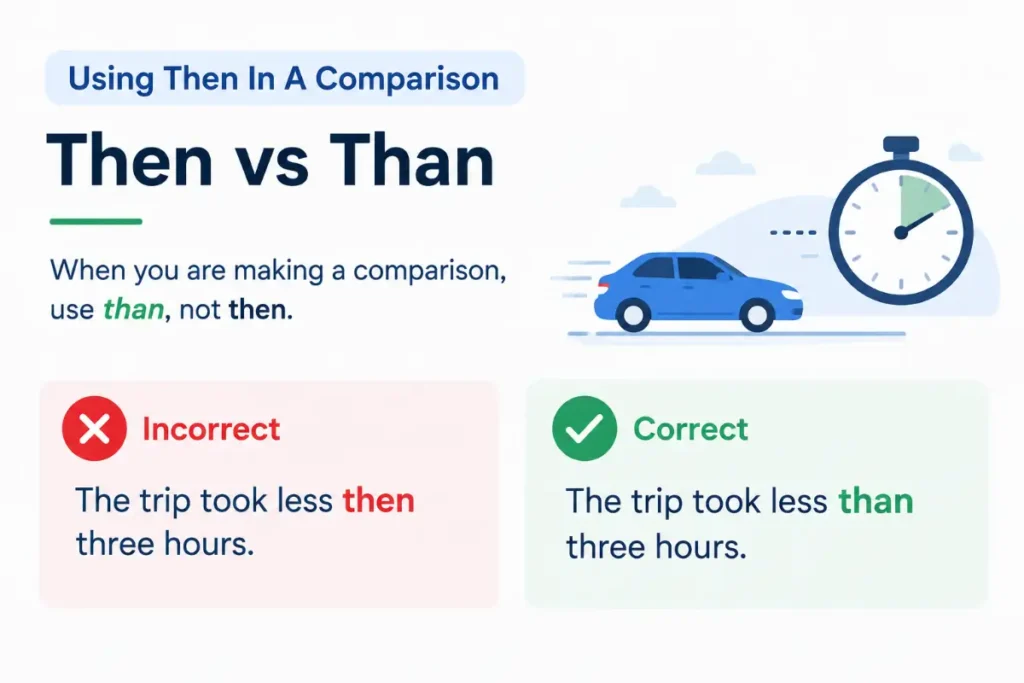
Incorrect: The trip took less then three hours.
Correct: The trip took less than three hours.
The error comes from confusing the comparison word than with the sequence word then.
Using Then For Every Comparison
Some writers remember that then sounds similar and use it after words such as more and less.
For example:
Incorrect: This costs more then that.
Correct: This costs more than that.
The same rule applies to both more and less.
Confusing Than With Then In Longer Sentences
The mistake can be harder to notice in a long sentence.
Incorrect: The final report was less then half the length of the original.
Correct: The final report was less than half the length of the original.
Reading the sentence aloud may not reveal the problem because the words can sound very similar.
Using Less Than Where Fewer Is Better
A related issue involves less and fewer.
In traditional standard usage, fewer is generally used with countable plural nouns, while less is generally used with uncountable amounts.
For example:
fewer books
fewer employees
less water
less time
However, real English usage has some established exceptions, especially with measurements, money, time, and distance.
The important point is that this is a separate issue from the spelling of than.
Forgetting The Comparison
Sometimes writers use less when they need a complete comparison.
For example:
The new version is less expensive than the old version.
The comparison is clear because the second side is stated.
In other cases, the second side can be understood:
The new version is less expensive.
Both structures can be grammatical. The surrounding context determines how much information the reader needs.
Pronunciation Guide
The word than is commonly pronounced approximately as than, with the voiced th sound found in words such as this and that.
Its IPA pronunciation is commonly represented as /ðæn/ in many American English contexts, though pronunciation can vary slightly depending on speech style and surrounding sounds.
The word then is commonly represented as /ðɛn/.
The two words are therefore close in pronunciation but are not identical.
A useful way to practice them is to say them in contrasting sentences:
Less than ten.
Finish it, then leave.
The first sentence expresses comparison. The second expresses sequence.
Etymology and Word Origin
The distinction between than and then has deep roots in the history of English.
Than developed from older English forms connected with comparison. It has long been associated with constructions that compare one thing with another.
Then also comes from Old English and has historically been associated with time and sequence. Its basic meaning has remained connected with ideas such as at that time, after that, and next.
The two words became distinct in modern standard English even though their histories and forms are related closely enough to help explain why they can still be confused.
For modern writers, the historical background is less important than the practical distinction: than compares, while then usually places something in time or sequence.
Regional Usage
American English
Less than is the normal standard expression in American English for comparisons.
For example:
The drive takes less than an hour.
The package weighs less than five pounds.
The same spelling rule applies in formal and informal American writing.
British English
British English also uses less than for comparisons. There is no standard British spelling that replaces than with then in this construction.
For example:
It took less than a week.
The comparison works the same way in British and American English.
Canadian English
Canadian English follows the same general distinction. Than is used for comparisons, while then is used mainly for time, order, or consequence.
Australian English
Australian English also uses less than as the standard comparative expression. The spelling distinction does not change because of the regional variety.
In short, this is not a meaningful regional spelling difference. Standard English varieties use than for this type of comparison.
Real Life Usage
Daily Conversation
People use the expression constantly in ordinary speech.
It will take less than an hour.
I paid less than I expected.
These sentences sound natural and do not require a formal context.
Workplace Communication
The phrase is common in professional communication.
The repair should take less than two days.
The final cost was less than the approved budget.
In workplace writing, using the correct spelling helps keep the message clear and polished.
Academic Writing
Academic writers often use comparisons involving measurements, results, time, and quantities.
The second group required less time than the first group.
The sample contained less material than the original estimate suggested.
The construction is straightforward and appropriate for formal academic prose.
News Writing
News writing frequently includes comparisons involving numbers, money, time, or measurements.
The project cost less than originally estimated.
The response time was less than five minutes.
The expression works naturally in concise factual writing.
Literature and Storytelling
Writers also use comparisons in narrative prose.
She had been there for less than a year when everything changed.
He knew the journey would take less than a day.
These examples show that the expression fits both ordinary and creative writing.
Related and Confused Terms
Several words and expressions are closely connected to this topic.
Than
Than introduces a comparison.
The blue car is faster than the red car.
Then
Then usually expresses time, order, or consequence.
We finished the work, then we went home.
More Than
More than expresses a larger amount or degree.
The project took more than three months.
Fewer Than
Fewer than is commonly used with countable plural nouns.
Fewer than twenty students attended.
Under
Under can sometimes express an amount below a stated limit.
The repair cost under $100.
In many contexts, less than $100 is also natural.
Greater Than
Greater than is a formal comparison often used in mathematics, science, and technical writing.
Five is greater than three.
Smaller Than
Smaller than directly compares physical size or, in some contexts, a numerical value.
This box is smaller than the other one.
Equal To
Equal to describes two quantities or values as the same.
The final amount is equal to the original estimate.
These related expressions can help clarify the broader pattern of comparison in English.
A Simple Memory Trick
The easiest way to remember the distinction is:
Than compares. Then moves things along.
Think of than whenever you see a comparison.
less than
more than
better than
faster than
smaller than
older than
Think of then when you mean next or at that time.
First we eat, then we leave.
I lived there then.
This small memory rule works because it focuses on meaning rather than spelling alone.
Why Grammar And Spell Checkers May Miss The Error
A basic spelling checker may not always catch a wrong choice between than and then. Both words are correctly spelled English words, so a computer may not know that you selected the wrong one for the sentence.
For example, The box weighs less then ten pounds contains two correctly spelled words from a dictionary perspective. The problem is grammatical and contextual.
More advanced grammar tools may detect the problem because they examine how the words function in the sentence. Still, automated tools are not a substitute for understanding the distinction.
A useful editing habit is to look at the meaning of the sentence. If you are comparing two things, check for than. If you are describing what happens next or referring to a particular time, check for then.
Expert Editor Insight
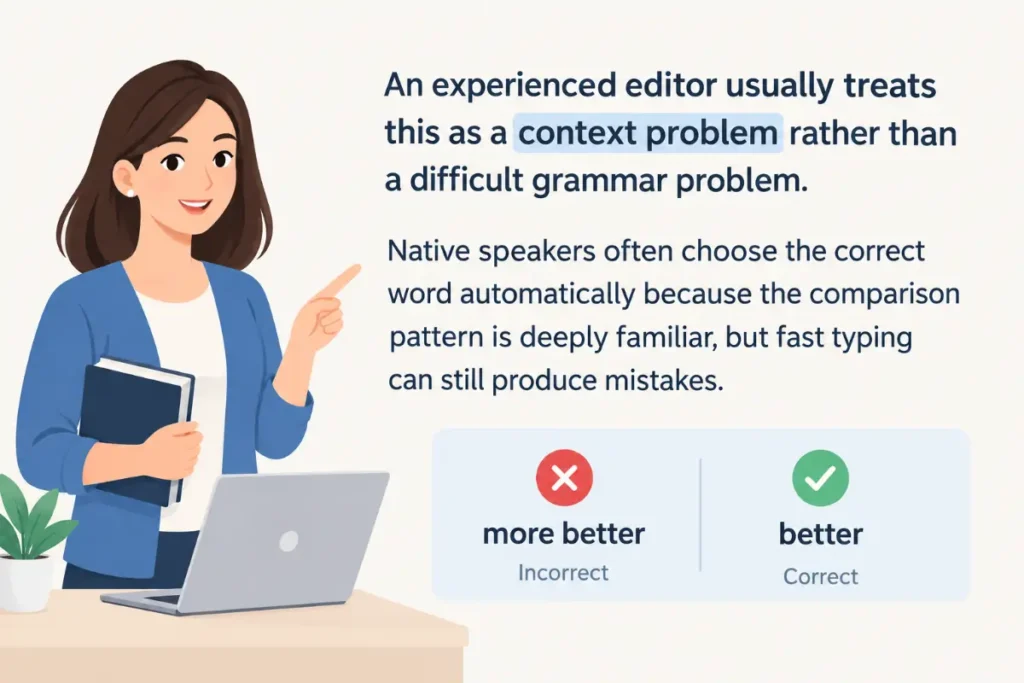
An experienced editor usually checks the meaning of the sentence instead of relying only on spelling. Since than and then are both legitimate English words, ordinary spell check can miss the error. The fastest manual test is to ask what the sentence is doing. If it compares amount, size, degree, cost, time, or another quality, than is normally the right choice. If it means next, afterward, or at that time, then is the better fit.
Conclusion
Less than is the correct form for comparisons involving a smaller amount, number, degree, or quantity. Less then is a common spelling mistake caused by confusion between than and then. The two words have different grammatical functions even though they can sound similar in everyday speech.
The simplest rule is easy to remember: than compares, while then usually refers to time or sequence. Use less than five minutes, less than $50, and less than expected when making a comparison. Use then in sentences such as We finished the work, then we left.
When editing, do not rely only on spell check because both words are correctly spelled English words. Instead, look at the meaning. If the sentence compares two things, choose than. This quick check will prevent one of the most common small errors in English writing.
FAQs
Is Less Then a real English phrase?
Less then is not the standard form used for comparison in English. It is usually a misspelling of less than. The word then is a real English word, but it normally expresses time, sequence, or consequence. For comparisons such as less than five dollars, less than an hour, or less than expected, use than.
What does Less Than mean?
Less than means a smaller amount, number, degree, or quantity compared with another value. For example, The package weighs less than ten pounds means its weight is below ten pounds. The expression can describe money, time, distance, size, degree, quantity, and many other forms of comparison.
Which is correct for a comparison?
Less than is correct for a comparison. The word than introduces the second part of the comparison, as in This option costs less than the other one. The word then does not serve this grammatical function. It usually refers to time, order, or what happens next.
How do you pronounce Than?
Than is commonly pronounced with the voiced th sound, similar to the sound at the beginning of that. In many American English contexts, its IPA pronunciation is /ðæn/. It can sound very close to then in quick speech, which helps explain why the two words are sometimes confused in writing.
Can Less Than start a sentence?
Yes. A sentence can begin with less than when the construction is complete and the context makes the comparison clear. For example, Less than five minutes later, the bus arrived is grammatical. Here, the phrase refers to an amount of time and modifies the timing of the event.
Is Less Than appropriate in formal writing?
Yes. Less than is completely appropriate in formal writing. You can use it in academic papers, business reports, professional emails, technical documents, and official communication. It is a standard English expression, so there is no need to replace it with a more complicated phrase simply to sound formal.
Why do people confuse Than and Then?
People confuse than and then because the words look similar and can sound very close in natural speech. Both contain the same initial letters and a similar th sound. Fast typing can also encourage the mistake. Remembering that than compares and then shows sequence or time makes the difference easier to remember.
Is Than only used after Less?
No. Than appears after many comparative words and expressions. Common examples include more than, better than, faster than, older than, larger than, and easier than. Its main role in these constructions is to introduce the person, thing, amount, or quality being compared.
