
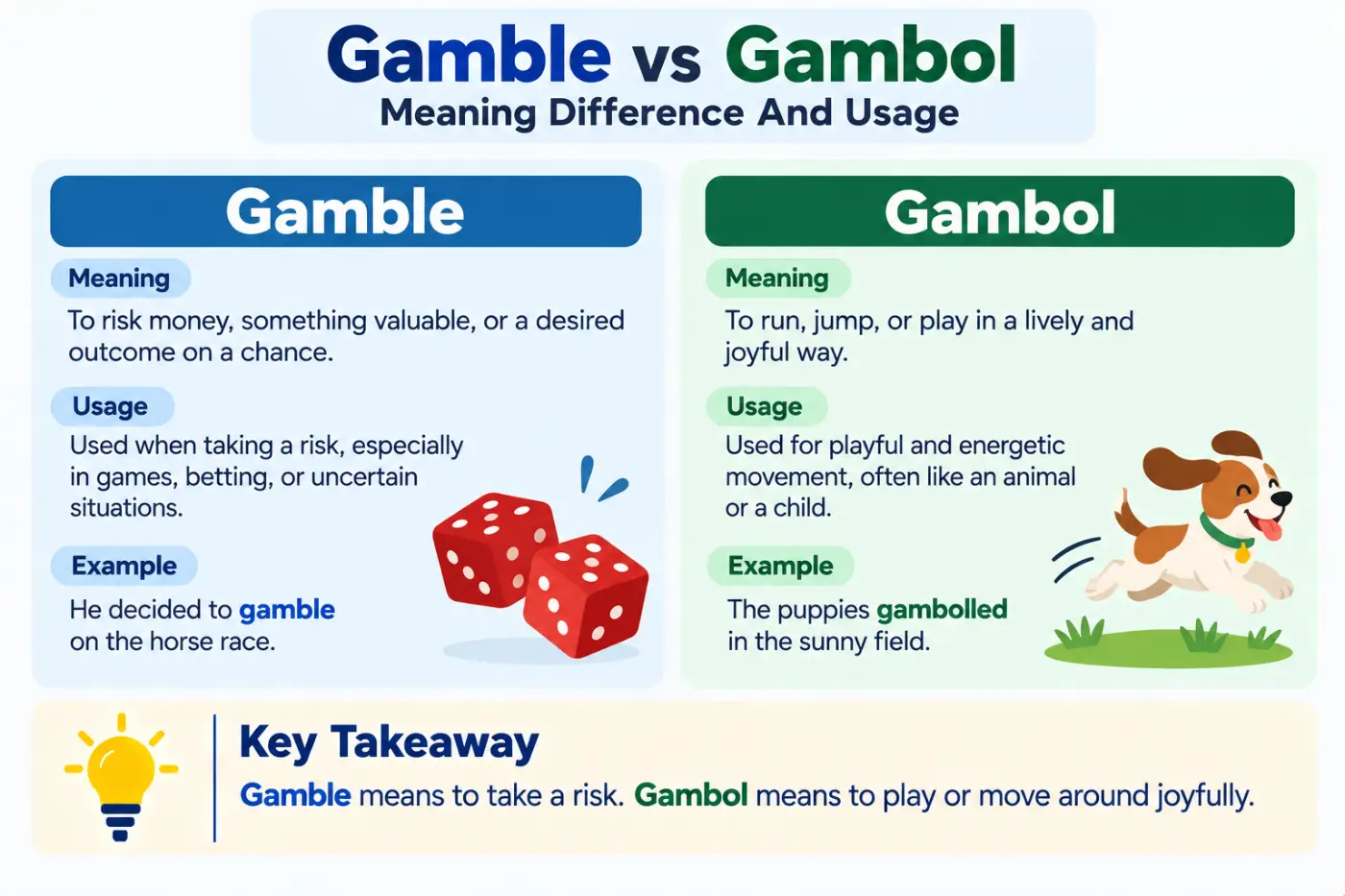
gamble vs gambol can be confusing because both words are verbs and both describe some kind of action. However, they have completely different meanings. Gamble means to risk money or something valuable on an uncertain result. Gambol means to run, jump, or move around in a playful and energetic way.
The confusion often comes from their similar spelling and pronunciation. Both words begin with gam and contain the same number of letters. A reader moving quickly through a sentence can easily mistake one for the other. Their meanings are far apart, though. One is connected with risk and chance while the other is connected with playful movement.
Knowing the difference helps you avoid an awkward vocabulary mistake. This guide explains the definitions, grammar, pronunciation, origins, common mistakes, regional usage, and natural examples of both words. You’ll also see how each term works in everyday writing and learn a simple memory trick that makes the distinction easy to remember.
Quick Definition
Gamble means to take a risk with money or something valuable in the hope of gaining something. Gambol means to move about playfully by running, jumping, or skipping. Gamble is associated with risk and chance while gambol is associated with cheerful physical movement.
Quick Answer
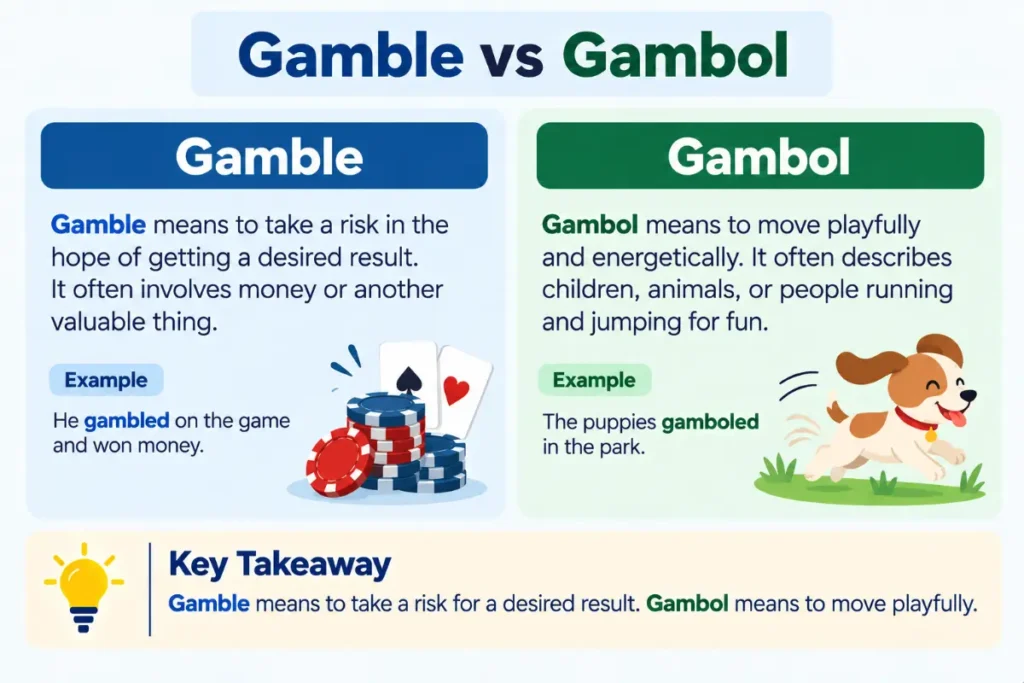
Gamble means to take a risk in the hope of getting a desired result. It often involves money or another valuable thing. Gambol means to move playfully and energetically. It often describes children, animals, or people running and jumping for fun.
For example, someone might gamble at a casino while a group of children might gambol across a field.
Both words are correct. Neither is a misspelling of the other. They simply have different meanings.
Comparison Table
| Word | Meaning | Part of Speech | Origin | Usage Frequency | Formality | Common Contexts | Example |
|---|---|---|---|---|---|---|---|
| Gamble | To risk money or something valuable on an uncertain result | Verb and noun | English usage developed from Middle English and French related forms | Very common | Neutral | Money, business, decisions, games, risk | He decided to gamble on the new business idea. |
| Gambol | To run, jump, or move playfully | Verb and noun | From Italian and French through English usage | Less common | Neutral to literary | Children, animals, fields, nature, playful movement | The puppies gambol across the yard. |
The biggest difference is meaning. Gamble describes risk while gambol describes playful movement.
Meaning And Definition
Meaning Of Gamble
Gamble is a common English word with both verb and noun uses.
As a verb, it means to risk money or something valuable on an uncertain outcome. The person taking the risk hopes to gain money, an advantage, or another benefit.
For example:
He likes to gamble on horse races.
The sentence describes someone risking money based on an uncertain result.
Gamble can also describe risk more generally. It doesn’t always involve a casino or betting. People often use the word metaphorically when someone takes a risky action.
For example:
The company gambled on a new product.
The company isn’t necessarily placing a bet in the traditional sense. Instead, it is taking a business risk and hoping the decision pays off.
As a noun, gamble can mean a risky action or decision.
Starting a business without enough savings was a big gamble.
Here, gamble refers to the risky decision itself.
The word therefore has two closely connected ideas. The literal meaning involves betting or risking something on an uncertain result. The broader meaning involves taking a chance and accepting the possibility of failure.
Meaning Of Gambol
Gambol is a less common word, but it is perfectly legitimate English.
As a verb, gambol means to move around in a lively and playful way. It often describes running, jumping, skipping, or frolicking.
For example:
The children gambolled through the grass.
The puppies gambol across the yard.
The word creates a cheerful visual image. You can almost picture the movement as you read the sentence.
Gambol can also work as a noun.
The lambs enjoyed a morning gambol in the field.
As a noun, it refers to a period or act of playful movement.
Gambol often appears in descriptive writing because it gives a sentence more energy and color. You might encounter it in literature, nature writing, storytelling, or descriptions of animals and children.
Unlike gamble, gambol has nothing to do with betting or financial risk.
Key Differences Explained
- Meaning. Gamble involves risk or chance. Gambol involves playful physical movement.
- Part of speech. Both words can function as verbs and nouns.
- Context. Gamble commonly appears in discussions of money, betting, business, decisions, and risk. Gambol commonly appears in descriptions of children, animals, nature, and movement.
- Tone. Gamble is an everyday word. Gambol is less common and can sound literary or descriptive.
- Pronunciation. The words sound similar at the beginning, but their vowels differ. Gamble has a sound similar to gam bul while gambol has a sound closer to gam buhl.
- Emotional association. Gamble suggests uncertainty and possible loss. Gambol suggests playfulness, energy, and enjoyment.
- Spelling. Gamble contains the ending ble while gambol contains bol. That final vowel difference reflects the difference in pronunciation and word history.
- Usage frequency. Gamble appears much more often in ordinary English. Gambol is familiar to many readers but appears less frequently.
A useful mental picture makes the distinction easy. Imagine someone placing money on a horse race. That person gambles. Now picture a group of puppies running and jumping across a lawn. The puppies gambol.
Which Word Is Correct?
Both gamble and gambol are correct English words. The right choice depends entirely on the meaning you want.
Use gamble when you mean risk or betting.
Use gambol when you mean playful movement.
This is not a case where one spelling is correct and the other is a mistake. They are separate words with different histories and meanings.
Dictionary based usage follows the same distinction. Standard English dictionaries recognize gamble as a word connected with betting and risk. They recognize gambol as a word describing playful movement.
The best editing test is simple. Ask yourself what action you are describing.
If the action involves taking a chance, choose gamble.
If the action involves playful running or jumping, choose gambol.
Sentence Examples
Here are natural examples using gamble.
- I wouldn’t gamble my savings on such an uncertain investment.
- The company decided to gamble on a new marketing strategy.
- He likes to gamble when he visits Las Vegas.
- Starting a business with limited experience can be a serious gamble.
- She decided to gamble on her favorite team winning the game.
Now look at examples using gambol.
- The children gambolled through the meadow on a sunny afternoon.
- The young goats gambol across the hillside.
- The puppies gambol around the garden whenever the weather is pleasant.
- The lambs began to gambol beside their mother.
- The children laughed as they gambolled along the beach.
These examples show the sharp difference between the two words. Gamble involves risk. Gambol creates an image of playful movement.
Common Mistakes
Using Gambol When You Mean Risk
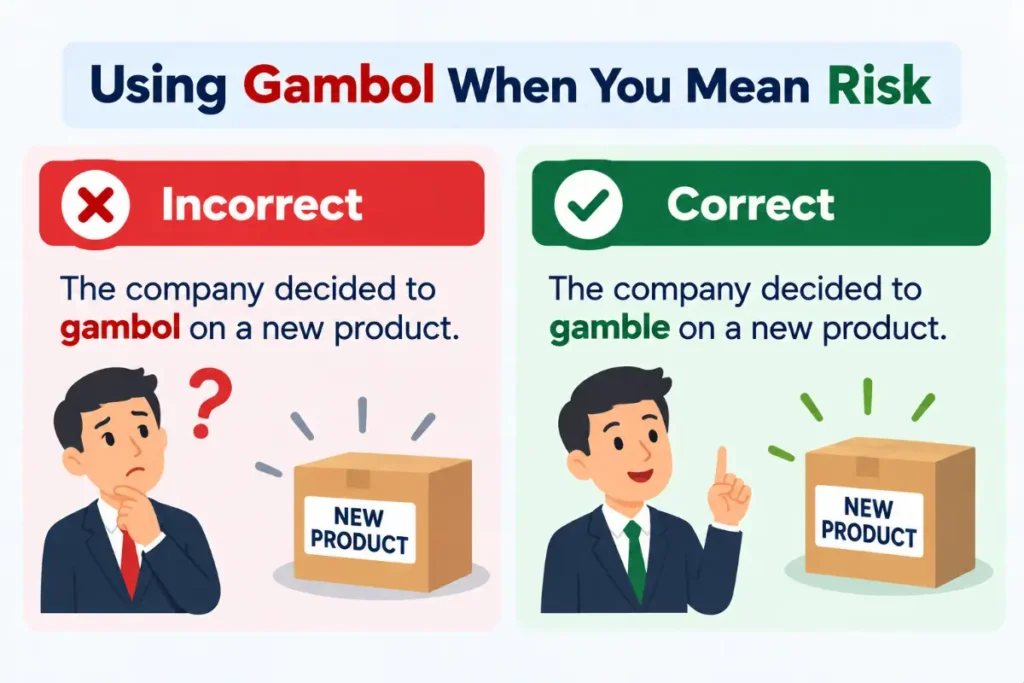
Incorrect:
The company decided to gambol on a new product.
Correct:
The company decided to gamble on a new product.
The business is taking a chance. That requires gamble.
Using Gamble For Playful Movement
Incorrect:
The puppies gambled around the garden.
Correct:
The puppies gambolled around the garden.
The puppies are moving playfully rather than taking a risk.
Confusing The Ending
The spelling difference is small but meaningful. Gamble ends with ble while gambol ends with bol.
This is a visual distinction worth remembering because the two words can look similar when you read them quickly.
Assuming Gambol Is A Typo
Gambol is not a misspelling of gamble. It is an established English word with its own meaning.
If you see gambol in a sentence describing playful movement, the unusual looking word is probably intentional.
Treating The Words As Pronunciation Variants
The words are not two pronunciations of the same term. They are separate lexical items. Their similar appearance can create what linguists call lexical confusion because readers recognize a familiar pattern and may mentally substitute the more familiar word.
That is one reason context matters so much.
Pronunciation Guide
Gamble is commonly pronounced /ˈɡæmbəl/ in American English.
A simple pronunciation guide is:
GAM bul
The main stress falls on the first syllable.
Gambol is commonly pronounced /ˈɡæmbəl/ as well in standard American pronunciation. The two words can therefore sound extremely similar in many accents.
That similarity explains much of the confusion.
The major distinction appears in spelling and meaning rather than a strong difference in everyday pronunciation. For some speakers the vowel quality in the second syllable may vary slightly, but the words are close enough in sound that you should rely on context and spelling.
This creates an interesting vocabulary situation. You can hear someone say a form that sounds like gambol and need to use the sentence context to determine which word they mean.
For example:
The children gambolled across the field.
The sentence clearly points to playful movement.
The company gambled on the new strategy.
The context clearly points to risk.
Etymology And Word Origin
The two words have different histories even though their modern forms look similar.
Gamble developed in English from older words connected with games and betting. Its history is associated with the idea of playing games for money or taking chances on uncertain outcomes. Over time the word expanded beyond literal betting and developed the broader meaning of taking a risky chance.
That broader use is now extremely common.
You can gamble on a business decision. You can gamble on a prediction. In each case the central idea is risk.
Gambol has a different path. It entered English through French and Italian forms connected with jumping and playful movement. Its historical development helped produce the modern sense of moving about in a lively and playful manner.
The difference in origin helps explain why these words should not be treated as spelling variations.
They belong to different word families even though their modern spellings happen to resemble each other.
Regional Usage
American English
Both words are recognized in American English. Gamble is extremely common in everyday communication. It appears in conversations about betting, business decisions, investments, risks, and uncertain choices.
Gambol is less common but remains standard. American writers may use it in descriptive prose, literature, nature writing, and storytelling. In everyday speech, people often choose simpler expressions such as run around, jump around, play, or frolic.
British English
British English also recognizes both terms with the same basic meanings. Gamble commonly refers to betting and risk. Gambol describes playful movement.
There is no major British spelling difference that changes the distinction.
Australian English
Australian English uses gamble in its ordinary sense of betting or taking a risk. Gambol is also recognized but occurs less often in casual communication.
A writer may use gambol in descriptive prose when a simple verb such as run does not capture the playful quality of the movement.
Canadian English
Canadian English follows the same basic distinction. Gamble is common in ordinary language while gambol is more specialized and descriptive.
The meanings remain stable across these major English varieties.
Grammar Rules And Part Of Speech
Both words can function as verbs and nouns.
Gamble As A Verb
As a verb, gamble can be followed by several useful structures.
You can say:
He gambled away his savings.
This means he lost his savings through gambling.
You can also use gamble on to describe taking a chance.
The company gambled on a quick recovery.
Another structure is gamble with.
They gambled with their future.
Here the word means to put something valuable at risk.
Gamble As A Noun
As a noun, gamble refers to a risky action or decision.
Buying the property was a gamble.
The word can also describe a betting activity.
The casino attracts people who enjoy a gamble.
The exact meaning comes from context.
Gambol As A Verb
Gambol is often used without a direct object.
The puppies gambolled across the lawn.
The children gambolled through the field.
It can be followed by phrases describing location or direction.
The lambs gambolled around the meadow.
The kittens gambolled beside their mother.
Gambol As A Noun
As a noun, gambol describes an instance or period of playful movement.
The puppies enjoyed a cheerful gambol in the garden.
This noun use is less common than the verb use.
Punctuation
Neither word requires special punctuation. Punctuation depends on the structure of the entire sentence rather than the vocabulary item itself.
For example:
The children gambolled through the park while their parents watched.
No special punctuation is needed.
Real Life Usage Examples
Daily Conversation
Gamble is easy to use in everyday discussion.
I wouldn’t gamble all my money on one investment.
Are you willing to gamble on that idea?
Gambol is less common in casual speech.
The puppies were gambolling around the yard.
The children spent the afternoon gambolling in the grass.
A speaker may choose play or run around instead of gambol in ordinary conversation.
Email And Workplace Communication
Gamble can describe a risky business decision.
The company gambled on increased demand and expanded production.
Taking this approach would be a significant gamble for the organization.
Gambol is unusual in business writing unless the subject involves animals, recreation, or descriptive material.
For example:
The report describes how young animals gambol across open pasture.
That sentence works because the word describes physical movement.
Academic Writing
Gamble can appear in academic writing when discussing risk, decision making, economics, psychology, or social behavior.
The firm gambled on consumer demand remaining strong.
The decision represented a significant financial gamble.
Gambol can appear in research involving animal behavior.
Young animals often gambol during periods of social interaction.
Researchers observed the animals as they gambolled around the enclosure.
News Writing
Journalists commonly use gamble when describing risky decisions.
The company gambled on a rapid recovery in consumer spending.
Officials gambled that the new policy would reduce costs.
Gambol is more likely to appear in nature or feature writing.
Young deer gambolled through the field as visitors watched from a distance.
Literature And Storytelling
Gambol works particularly well in descriptive writing.
The children gambolled beneath the old trees.
The young horses gambolled freely across the meadow.
Gamble also appears in storytelling when a character takes a serious chance.
He gambled everything on one final decision.
She knew she was gambling with her future.
Related And Confused Terms
Bet
Bet refers to risking money or something valuable on an uncertain result. It is closely related to the literal sense of gamble.
Risk
Risk means exposing someone or something to the possibility of harm, loss, or an unwanted result. It is broader than gamble because risk does not always involve a deliberate chance taken for a possible reward.
Wager
Wager means to risk money or something valuable on an uncertain outcome. It is more closely connected with formal betting.
Speculate
Speculate can mean taking a financial risk in the hope of gaining a profit. It can also mean forming an idea without enough evidence.
Frolic
Frolic means to play or move around in a lively and cheerful way. It is one of the closest semantic relatives of gambol.
Romp
Romp describes energetic playful movement. It is often used for children or animals.
Prance
Prance means to move with lively steps, often in a proud or energetic way. It describes a particular style of movement rather than general playful activity.
Play
Play is a broad everyday word for enjoyable activity. It can describe many kinds of behavior that might also be called gamboling.
These related words show why context matters. Gamble belongs to a semantic group involving chance and risk. Gambol belongs to a group involving movement and play.
Gamble In Figurative Language
Gamble has a much wider figurative range than gambol.
You can gamble on an idea, plan, prediction, decision, or outcome.
For example:
The manager gambled on strong holiday sales.
No money has to change hands for this sentence to make sense. The manager is taking a chance based on an uncertain prediction.
You can also say:
She gambled with her reputation.
Here the word describes putting something valuable at risk.
This figurative use is extremely common in journalism and professional writing because it gives a clear image of uncertainty.
The word can therefore describe both literal betting and broader risk taking.
Gambol In Descriptive Writing
Gambol has a narrower but vivid role.
Writers often choose it because run does not always capture the feeling of the movement.
Compare:
The puppies ran across the grass.
The puppies gambolled across the grass.
The first sentence tells you what the puppies did. The second adds a sense of playful energy.
That difference makes gambol useful in nature writing and storytelling. It gives the reader a more specific mental picture without requiring a long description.
The word is especially effective when the subject is young or playful.
Children can gambol. Puppies can gambol. Lambs can gambol. Young horses can gambol.
The word can describe people too, although its use may sound more literary than simply saying they ran or played.
Why The Words Are Easy To Confuse
The confusion is mostly visual and phonological.
Visually, both words begin with the same four letters. Their final letters are also close enough to encourage quick reading errors.
Phonologically, the words are extremely similar in many varieties of English. This means that hearing the word may not immediately tell you which spelling the speaker intended.
There is also a frequency effect. Gamble is much more familiar to most readers. When the brain encounters an unfamiliar word that resembles a familiar word, it can sometimes interpret the unfamiliar pattern through the familiar one.
This is a normal part of language processing. It does not mean the reader lacks vocabulary skills.
The best solution is context.
If the sentence involves money, betting, uncertainty, or risk, the intended word is probably gamble.
If it describes running, jumping, or playful movement, gambol is likely the right choice.
Expert Editor Insight
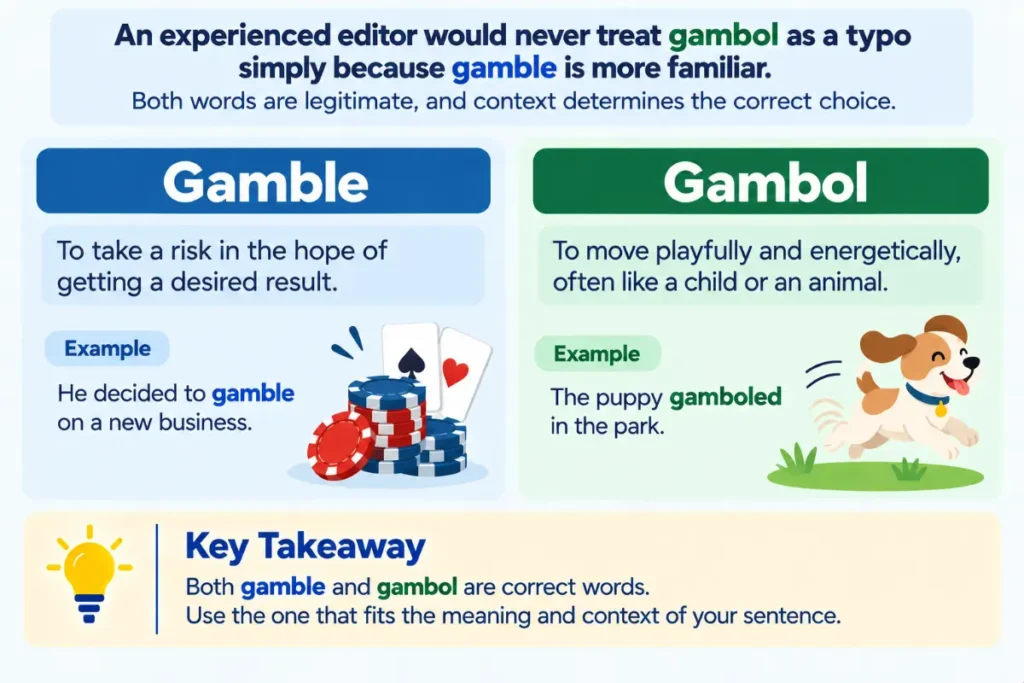
An experienced editor would never treat gambol as a typo simply because gamble is more familiar. Both words are legitimate, and context determines the correct choice. The real editing concern is semantic precision. If a sentence describes risk, gamble communicates the intended idea. If it describes playful movement, gambol gives the reader a more vivid image. Spelling tools may not always catch a substitution because both forms are valid dictionary words. That is why proofreading must consider meaning rather than spelling alone.
Conclusion
gamble vs gambol is a comparison between two genuine English words with completely different meanings. Gamble describes risk, betting, or taking a chance on an uncertain outcome. Gambol describes lively and playful movement such as running, jumping, or frolicking. Neither word is an incorrect spelling of the other.
The easiest way to remember the difference is to connect gamble with risk and gambol with play. If money, uncertainty, or a risky decision appears in the sentence, gamble is usually the right choice. If children or animals are moving happily and energetically, gambol may be the better word.
A final editing tip is to check meaning before spelling. Both words can pass a spelling checker, so context is what tells you which one belongs in your sentence.
FAQs
What is the difference between gamble and gambol?
Gamble means to take a chance or risk money, property, or another valuable thing on an uncertain outcome. Gambol means to move around playfully, often by running or jumping. Both are real English words. The easiest distinction is to associate gamble with risk and gambol with playful movement.
Is gambol a real English word?
Yes. Gambol is a legitimate English word. It functions mainly as a verb meaning to move in a lively and playful way. It can also function as a noun referring to an instance of playful movement. The word is less common than gamble, but it is standard English and often appears in descriptive or literary writing.
Does gamble always involve money?
No. Gamble can refer to literal betting with money, but it also has a broad figurative meaning. Someone can gamble on a business decision, gamble on a prediction, or gamble with their reputation. In these examples, the central idea is taking a significant risk because the outcome is uncertain.
How do you pronounce gamble and gambol?
In many varieties of American English, gamble and gambol have very similar pronunciations. Gamble is commonly represented as /ˈɡæmbəl/, while gambol is also commonly represented with a similar sound. Because they can sound nearly identical, spelling and sentence context are especially useful for telling the words apart.
Is gambol appropriate in formal writing?
Yes. Gambol is a standard English word and can appear in formal or polished writing. However, it has a more literary or descriptive feel than common verbs such as run or play. It works especially well in nature writing, storytelling, and descriptions of animals or children moving in a lively way.
What is a synonym for gambol?
Useful synonyms include frolic, romp, play, skip, prance, and caper, although each word has a slightly different shade of meaning. Frolic is particularly close because it also suggests cheerful and energetic activity. Run and jump are broader terms and do not always communicate the playful quality that gambol expresses.
What are common synonyms for gamble?
Depending on context, related words include bet, wager, risk, speculate, venture, and chance. These words are not perfect replacements in every sentence. Bet and wager usually suggest a specific stake. Risk has a broader meaning. Speculate often relates to uncertain financial activity or forming ideas without firm evidence.
Why are gamble and gambol confused?
The words are easy to confuse because they look and sound very similar. Both begin with gam and contain closely related letter patterns. Gamble is much more common, while gambol is less familiar to many readers. The best way to distinguish them is to focus on meaning. Risk points to gamble while playful movement points to gambol.
