
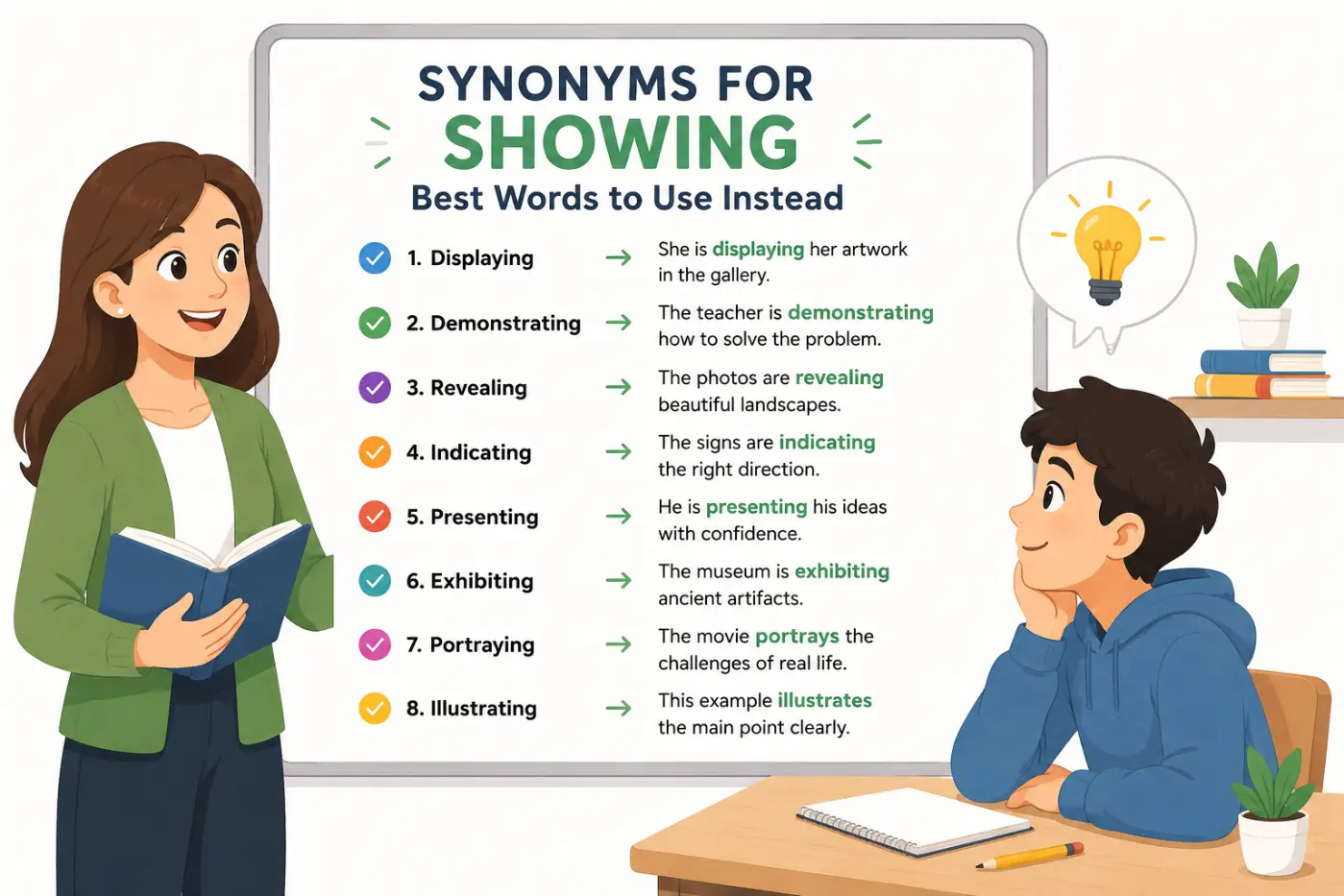
If you use showing too often, your writing can quickly sound repetitive. The good news is that English offers dozens of alternatives, each with its own meaning, tone, and purpose. Choosing the right synonym makes your writing clearer, more persuasive, and more engaging.
Many writers search for synonyms for showing because they want to improve essays, emails, business documents, creative writing, or everyday conversations. The challenge is that no single replacement works in every situation. A word that fits an academic paper may sound awkward in casual speech, while a creative synonym might feel too informal for professional writing.
This guide explains the best synonyms for showing, when to use them, how they differ, and which options work best in different contexts. You’ll also find comparison tables, practical examples, grammar guidance, editor insights, and frequently asked questions so you can choose the most natural word every time.
Quick Definition
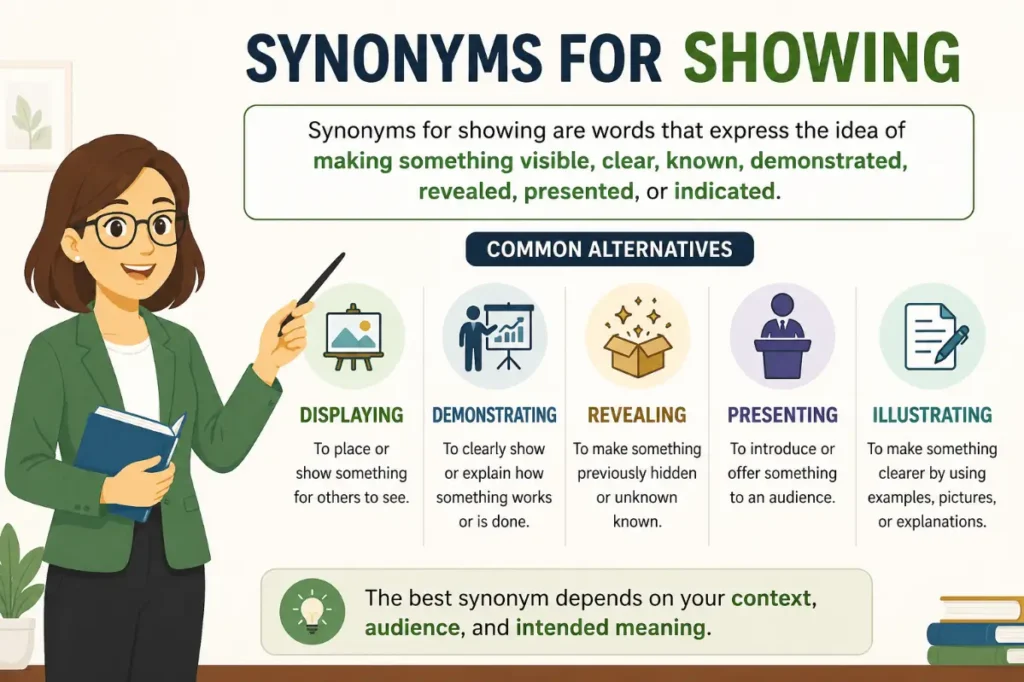
Synonyms for showing are words that express the idea of making something visible, clear, known, demonstrated, revealed, presented, or indicated. The best synonym depends on your context, audience, and intended meaning. Words like displaying, demonstrating, revealing, presenting, and illustrating are among the most common alternatives.
Quick Answer
If you’re looking for another word for showing, these are some of the strongest choices.
| Synonym | Best Used For | Tone |
|---|---|---|
| Demonstrating | Explaining proof or evidence | Formal |
| Displaying | Making something visible | Neutral |
| Revealing | Making hidden information known | Neutral |
| Presenting | Introducing information | Professional |
| Illustrating | Explaining with examples | Academic |
| Indicating | Pointing toward something | Formal |
| Exhibiting | Displaying qualities or objects | Formal |
| Expressing | Showing emotions or opinions | Neutral |
| Uncovering | Bringing hidden facts to light | Neutral |
| Highlighting | Drawing attention to something | Professional |
| Depicting | Describing visually | Creative |
| Representing | Standing for something | Formal |
| Conveying | Communicating ideas | Professional |
| Manifesting | Making something evident | Formal |
| Exposing | Revealing something hidden | Strong |
The best replacement depends on what is being shown and why it is being shown.
Comparison Table of the Best Synonyms for Showing
| Word | Primary Meaning | Part of Speech | Origin | Usage Frequency | Formality | Common Context | Example |
|---|---|---|---|---|---|---|---|
| Showing | Making something visible | Verb | Old English | Very High | Neutral | Everyday writing | She is showing the report. |
| Demonstrating | Proving or explaining | Verb | Latin | Very High | Formal | Education, science | The graph demonstrates growth. |
| Displaying | Putting something on view | Verb | Old French | High | Neutral | Products, emotions | The museum displayed paintings. |
| Revealing | Making known | Verb | Latin | High | Neutral | News, stories | The interview revealed the truth. |
| Presenting | Introducing | Verb | Latin | High | Professional | Meetings, reports | She presented the proposal. |
| Illustrating | Explaining with examples | Verb | Latin | High | Academic | Textbooks, lessons | The chart illustrates the trend. |
| Indicating | Pointing out | Verb | Latin | High | Formal | Research, reports | The data indicates improvement. |
| Highlighting | Giving emphasis | Verb | Old English | High | Professional | Reports, articles | The study highlights key findings. |
| Depicting | Representing visually | Verb | Latin | Medium | Neutral | Art, literature | The novel depicts village life. |
| Conveying | Communicating | Verb | Old French | Medium | Professional | Writing, speaking | His words conveyed confidence. |
| Exhibiting | Showing publicly | Verb | Latin | Medium | Formal | Museums, behavior | She exhibited remarkable patience. |
| Expressing | Communicating thoughts | Verb | Latin | High | Neutral | Feelings, opinions | He expressed gratitude. |
What Does Showing Mean?
The verb show means to make something visible, understandable, or known. The present participle showing describes an action that is currently happening or functions as a noun or adjective in some contexts.
Depending on the sentence, showing can refer to:
- Displaying something physically.
- Providing evidence.
- Explaining an idea.
- Revealing information.
- Expressing emotions.
- Drawing attention to something.
For example:
- She is showing the guests around the office.
- The results are showing significant improvement.
- His face was showing disappointment.
- The chart is showing monthly sales.
- The teacher is showing students how to solve the problem.
Although showing works in all of these examples, replacing it with a more precise word often creates stronger writing.
Why Writers Look for Synonyms for Showing
Repeating the same word weakens your writing. Readers notice repetition, especially in essays, reports, blog posts, and stories.
Instead of writing:
The chart is showing growth. The report is showing improvement. The data is showing a trend.
You can write:
The chart illustrates growth.
The report demonstrates improvement.
The data reveals a trend.
Each sentence becomes more natural because the verb matches the situation.
Professional editors often replace repeated verbs with more specific alternatives that better communicate the intended meaning.
The Best Synonyms for Showing by Meaning
Not every synonym carries the same idea. Some emphasize evidence, while others focus on communication, appearance, or discovery.
Synonyms That Mean Displaying Something Visually
Use these when an object, image, product, or person is visible.
- Displaying.
- Exhibiting.
- Presenting.
- Featuring.
- Unveiling.
- Showcasing.
- Exposing.
- Revealing.
- Projecting.
- Exhibiting publicly.
Example sentences:
- The gallery displayed local artwork.
- The company showcased its newest products.
- The exhibition featured ancient artifacts.
- The museum unveiled a restored sculpture.
- The website presents high quality photographs.
Synonyms That Mean Giving Evidence
These words work well in research papers, business reports, and academic writing.
- Demonstrating.
- Indicating.
- Confirming.
- Proving.
- Establishing.
- Supporting.
- Verifying.
- Validating.
- Confirming.
- Substantiating.
Examples:
- The experiment demonstrated the theory.
- The statistics indicate rising demand.
- The evidence confirms the conclusion.
- The findings support earlier research.
- The survey validates the results.
Synonyms That Mean Revealing Information
These alternatives emphasize discovery or making something known.
- Revealing.
- Uncovering.
- Exposing.
- Disclosing.
- Divulging.
- Announcing.
- Sharing.
- Communicating.
- Making known.
- Bringing to light.
Examples:
- The report revealed new evidence.
- The investigation uncovered fraud.
- The article disclosed confidential details.
- The interview brought hidden problems to light.
- The documentary exposed environmental issues.
Synonyms That Mean Explaining an Idea
When you are teaching or clarifying something, these verbs are often more accurate than showing.
- Illustrating.
- Explaining.
- Clarifying.
- Describing.
- Defining.
- Outlining.
- Interpreting.
- Presenting.
- Demonstrating.
- Teaching.
Examples:
- The diagram illustrates the process.
- The instructor explained each step.
- The speaker clarified the main idea.
- The presentation outlined the project.
- The chart demonstrates the relationship.
Formal Synonyms for Showing
Formal writing usually benefits from precise verbs instead of the general word showing.
Some of the strongest formal alternatives include:
- Demonstrating.
- Illustrating.
- Indicating.
- Presenting.
- Revealing.
- Conveying.
- Exhibiting.
- Manifesting.
- Establishing.
- Representing.
- Highlighting.
- Confirming.
- Validating.
- Depicting.
- Communicating.
Example:
Instead of:
The report is showing positive results.
Write:
The report demonstrates positive results.
Instead of:
The chart is showing a decline.
Write:
The chart indicates a decline.
These substitutions sound more professional and are common in academic journals, business reports, and technical documents.
Informal Synonyms for Showing
Everyday conversations often use simpler alternatives.
Common choices include:
- Sharing.
- Pointing out.
- Letting someone see.
- Bringing up.
- Putting on display.
- Giving a look.
- Telling.
- Pointing toward.
- Bringing attention to.
- Letting others know.
Examples:
- She shared her vacation photos.
- He pointed out the mistake.
- They let everyone see the new office.
- She brought up an important issue.
- He pointed toward the exit.
These expressions sound natural in daily speech without becoming overly formal.
Academic Synonyms for Showing
Academic writing values precision and objectivity. Because of that, certain verbs appear much more frequently in textbooks, journal articles, dissertations, and research papers.
Excellent academic alternatives include:
- Demonstrating.
- Illustrating.
- Indicating.
- Revealing.
- Establishing.
- Confirming.
- Supporting.
- Suggesting.
- Representing.
- Depicting.
- Documenting.
- Verifying.
- Validating.
- Evidencing.
- Reflecting.
For example:
Instead of writing:
The graph is showing higher productivity.
An academic writer would often write:
The graph demonstrates higher productivity.
Or:
The graph indicates higher productivity.
These verbs make the sentence sound more precise and objective without changing the meaning
Business and Professional Synonyms for Showing
Professional communication benefits from precise language. Instead of relying on showing repeatedly, choose a verb that reflects your purpose. The right word can make reports, presentations, emails, and proposals sound more polished and credible. Here are some of the strongest business alternatives.
- Presenting.
- Demonstrating.
- Highlighting.
- Illustrating.
- Communicating.
- Conveying.
- Indicating.
- Confirming.
- Reporting.
- Documenting.
- Representing.
- Explaining.
- Outlining.
- Detailing.
- Summarizing.
Examples:
- The quarterly report highlights strong revenue growth.
- The dashboard illustrates customer engagement trends.
- The presentation demonstrates the value of the proposal.
- The email outlines the next steps.
- The report documents every stage of the project.
These verbs are common in business writing because they sound precise without being overly technical.
Creative Writing Alternatives to Showing
Creative writers often replace showing with vivid verbs that create stronger imagery. A carefully chosen synonym helps readers picture a scene instead of simply reading about it.
Excellent options include:
- Revealing.
- Unveiling.
- Uncovering.
- Exposing.
- Reflecting.
- Depicting.
- Portraying.
- Painting.
- Expressing.
- Manifesting.
- Conveying.
- Signaling.
- Hinting.
- Suggesting.
- Evoking.
Examples:
- The morning light revealed the quiet valley.
- Her smile expressed genuine happiness.
- The novel portrays life during the Great Depression.
- His trembling hands revealed his nervousness.
- The poem evokes a feeling of nostalgia.
More Than 100 Synonyms for Showing
The best synonym depends on what you want to communicate. The lists below group alternatives by meaning so you can quickly find the right word.
General Synonyms
- Displaying.
- Demonstrating.
- Revealing.
- Presenting.
- Illustrating.
- Indicating.
- Exhibiting.
- Expressing.
- Highlighting.
- Depicting.
- Conveying.
- Representing.
- Manifesting.
- Exposing.
- Reflecting.
- Communicating.
- Explaining.
- Describing.
- Reporting.
- Sharing.
Synonyms for Demonstrating Evidence
- Demonstrating.
- Confirming.
- Supporting.
- Verifying.
- Validating.
- Proving.
- Establishing.
- Documenting.
- Indicating.
- Suggesting.
- Reflecting.
- Representing.
- Illustrating.
- Confirming.
- Substantiating.
Synonyms for Teaching or Explaining
- Illustrating.
- Explaining.
- Clarifying.
- Demonstrating.
- Teaching.
- Defining.
- Describing.
- Interpreting.
- Presenting.
- Outlining.
- Simplifying.
- Guiding.
- Instructing.
- Coaching.
- Educating.
Strong Action Verbs
- Reveal.
- Demonstrate.
- Showcase.
- Highlight.
- Present.
- Illustrate.
- Confirm.
- Validate.
- Portray.
- Expose.
- Document.
- Represent.
- Announce.
- Explain.
- Convey.
How to Choose the Best Synonym for Showing
Many synonyms overlap in meaning, but they are not interchangeable in every sentence.
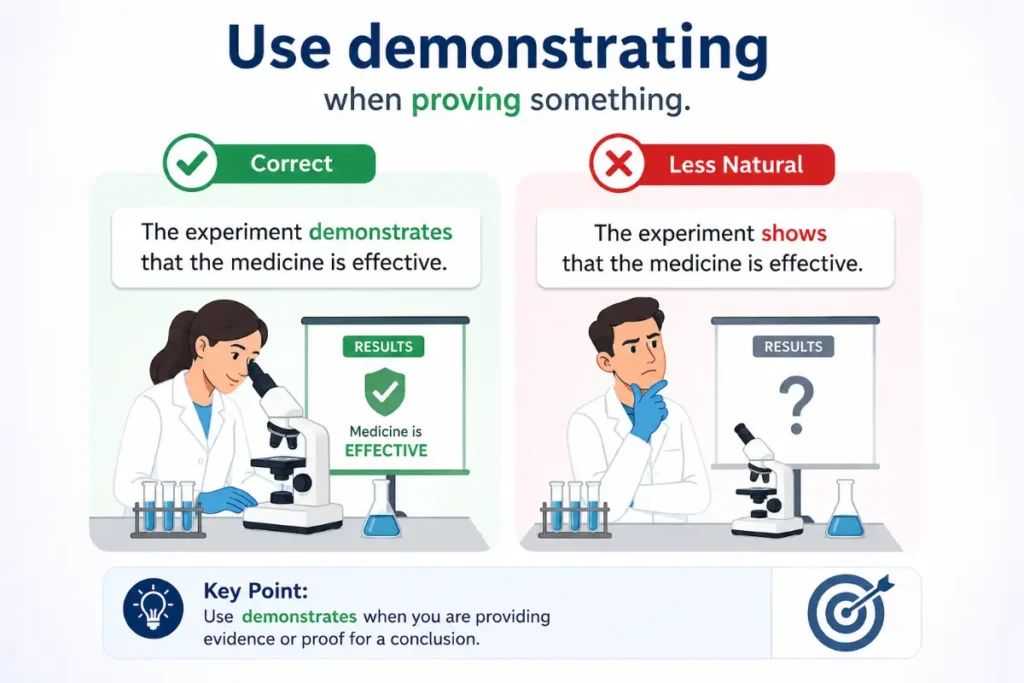
Use demonstrating when proving something.
Correct:
The experiment demonstrates that the medicine is effective.
Less natural:
The experiment shows that the medicine is effective.
Use illustrating when explaining with examples or visuals.
Correct:
The diagram illustrates the water cycle.
Use revealing when hidden information becomes known.
Correct:
The investigation revealed financial fraud.
Use displaying for physical objects.
Correct:
The museum displays ancient pottery.
Use highlighting to emphasize something important.
Correct:
The report highlights the biggest challenges.
Use expressing for emotions.
Correct:
Her eyes expressed relief.
Use conveying for ideas or messages.
Correct:
His speech conveyed hope.
Use depicting in art and literature.
Correct:
The painting depicts rural life.
Grammar Rules for Showing
The word showing comes from the verb show.
Verb forms:
| Base Form | Past Tense | Past Participle | Present Participle |
|---|---|---|---|
| Show | Showed | Shown | Showing |
Examples:
- I show the results every Friday.
- She showed us the new office.
- They have shown remarkable progress.
- He is showing the visitors around campus.
Showing as a Verb
Showing most commonly functions as the present participle.
Examples:
- She is showing the guests the conference room.
- The graph is showing a steady increase.
Showing as a Noun
Sometimes showing acts as a noun.
Examples:
- The movie had a late showing.
- We attended the afternoon showing.
Showing as an Adjective
Occasionally, showing describes another noun.
Examples:
- The showing symptoms worried the doctor.
- The showing process was carefully documented.
This use is much less common than the verbal form.
Common Mistakes When Using Showing
Using Showing Too Often
Weak:
The report is showing growth. The graph is showing growth. The survey is showing growth.
Better:
The report demonstrates growth.
The graph illustrates growth.
The survey indicates growth.
Choosing a Synonym That Changes the Meaning
Incorrect:
The teacher revealed the math lesson.
Better:
The teacher explained the math lesson.
Using Displaying for Abstract Ideas
Incorrect:
The report displayed confidence.
Better:
The report conveyed confidence.
Confusing Reveal with Demonstrate
Reveal means making hidden information known. Demonstrate means proving something through evidence.
Examples:
The investigation revealed corruption.
The evidence demonstrated corruption.
Pronunciation Guide
Show
IPA (American English): /ʃoʊ/
IPA (British English): /ʃəʊ/
Syllables:
Show
Showing
IPA (American English): /ˈʃoʊ.ɪŋ/
IPA (British English): /ˈʃəʊ.ɪŋ/
Syllable breakdown:
Show ing
Common pronunciation mistakes include dropping the second syllable or stressing the ending instead of the first syllable.
Etymology and Word Origin
The verb show comes from Old English sceawian, meaning to look at, inspect, look upon, or cause someone to see. Its Germanic roots are connected to ideas of viewing, observing, and making something visible. Over centuries, the meaning expanded beyond physical sight to include explaining, proving, revealing, and expressing ideas. Today, show remains one of the most versatile verbs in English, appearing in everyday conversation, literature, journalism, education, business, and scientific writing.
Real Life Usage Examples
Daily Conversation
- Can you show me the quickest route?
- She showed me her vacation photos.
- He’s showing everyone his new phone.
Academic Writing
- The data demonstrates a significant relationship.
- Figure 2 illustrates the research findings.
- The evidence supports the hypothesis.
Professional Communication
- The dashboard highlights sales performance.
- The report documents every milestone.
- The presentation conveys our strategic vision.
Literature
- The author depicts loneliness through vivid imagery.
- The novel reveals the character’s inner conflict.
- The dialogue expresses quiet determination.
Media
- The documentary reveals previously unknown facts.
- The interview highlighted several challenges.
- The news report presented multiple viewpoints.
Related Words and Commonly Confused Terms
These words are closely related to showing but each carries its own meaning.
| Word | Typical Meaning |
|---|---|
| Demonstrating | Proving with evidence |
| Revealing | Making hidden information known |
| Displaying | Putting something on view |
| Presenting | Introducing information |
| Illustrating | Explaining with examples |
| Highlighting | Emphasizing importance |
| Depicting | Representing visually |
| Conveying | Communicating ideas |
| Expressing | Showing emotions or thoughts |
| Indicating | Pointing toward a conclusion |
| Suggesting | Hinting without stating directly |
| Representing | Standing for or symbolizing something |
| Portraying | Describing people or events |
| Manifesting | Making something evident |
| Showcasing | Presenting something attractively |
Expert Language Insight
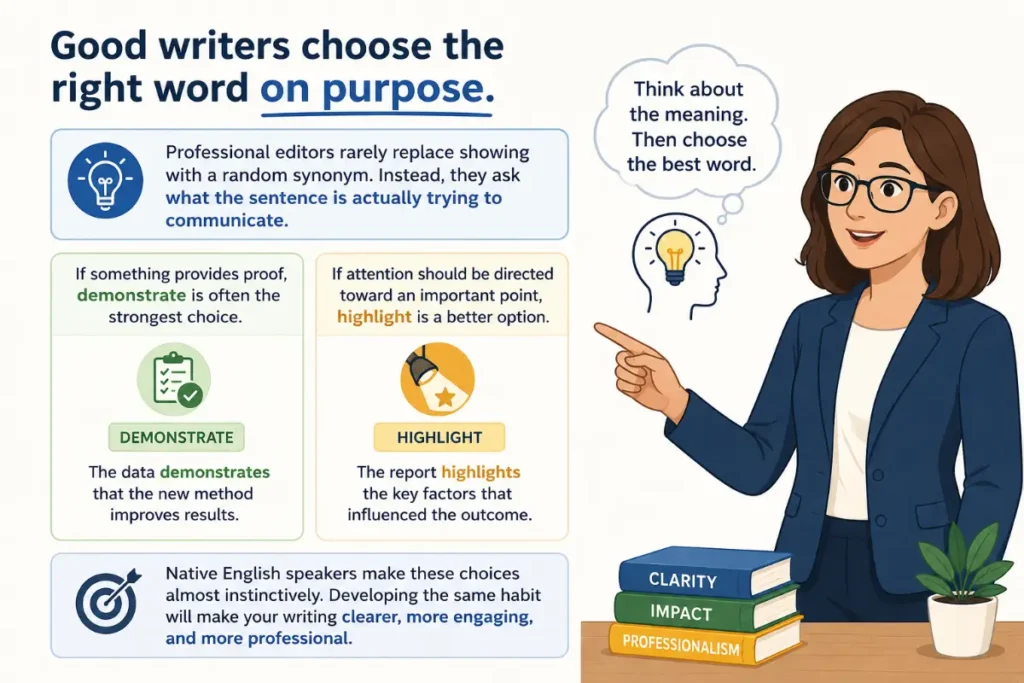
Professional editors rarely replace showing with a random synonym. Instead, they ask what the sentence is actually trying to communicate. If something provides proof, demonstrate is often the strongest choice. If attention should be directed toward an important point, highlight is a better option. Native English speakers make these choices almost instinctively. Developing the same habit will make your writing clearer, more engaging, and more professional.
Conclusion
Finding the best synonyms for showing is not about replacing one word with another at random. It is about selecting the verb that communicates your exact meaning.
Words such as demonstrate, illustrate, reveal, display, highlight, present, convey, and express each serve a different purpose. Understanding these subtle differences allows you to write with greater precision, avoid repetition, and communicate more effectively in academic, professional, creative, and everyday contexts.
The next time you find yourself using showing, pause for a moment and consider what you truly mean. A more specific synonym will often make your sentence clearer, stronger, and more memorable.
Frequently Asked Question
What is the best synonym for showing?
The best synonym depends on the context. Demonstrating, displaying, revealing, presenting, and illustrating are among the most versatile choices. Each emphasizes a slightly different meaning, so select the one that best matches your sentence.
Is demonstrating the same as showing?
Not exactly. Showing is a broad verb that covers many situations. Demonstrating usually means proving something with evidence, examples, or actions. In formal and academic writing, demonstrating is often more precise.
Which synonym sounds most professional?
Words like presenting, demonstrating, highlighting, illustrating, and conveying are common in professional writing because they sound clear, precise, and appropriate for reports, presentations, and business communication.
Can revealing replace showing?
Sometimes. Revealing works when hidden information becomes known. It is not always suitable for simple acts of displaying or explaining something, so use it only when discovery or disclosure is part of the meaning.
What is the strongest synonym for showing in essays?
For academic essays, demonstrating, illustrating, indicating, supporting, and establishing are excellent choices. They communicate ideas more precisely than the general verb showing.
Why should I avoid repeating showing?
Repeating the same verb makes writing feel monotonous. Using precise alternatives improves clarity, keeps readers engaged, and helps your writing sound more polished and professional.
Is showing always a verb?
No. Showing is usually the present participle of show, but it can also function as a noun, as in an evening showing of the film. The intended meaning depends on the sentence.
How do I choose the right synonym?
Think about what you want to express. If you’re presenting evidence, use demonstrate. If you’re emphasizing an important point, use highlight. Matching the verb to the context creates more natural and effective writing.
