
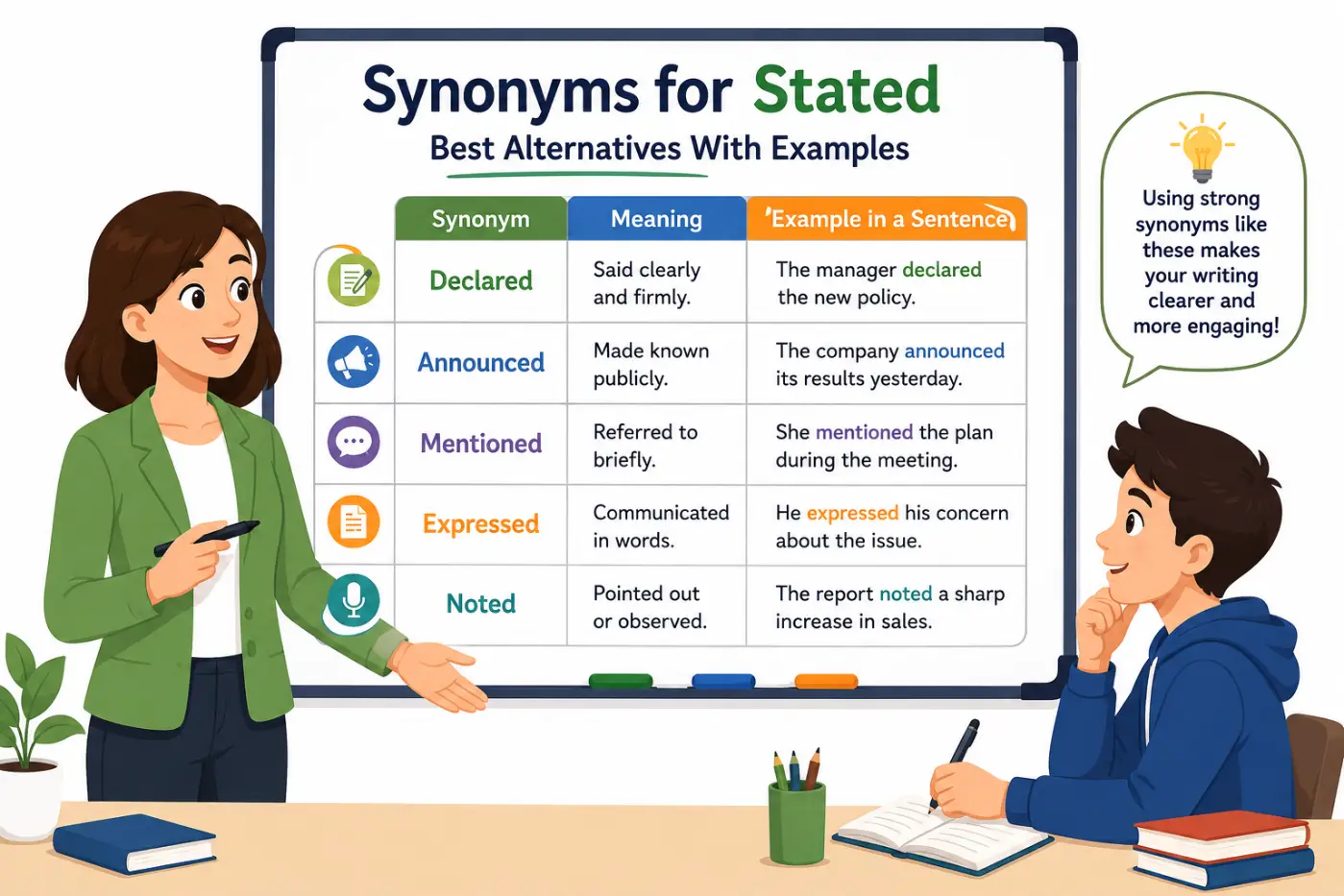
When you write the same word repeatedly, your writing quickly becomes dull. Many people search for synonyms for stated because they want stronger, clearer, or more natural alternatives in essays, business emails, academic papers, journalism, creative writing, and everyday communication.
The good news is that there isn’t just one replacement for stated. English offers dozens of excellent alternatives, but each carries a slightly different meaning. Some sound formal, others conversational. Some emphasize certainty, while others highlight explanation, opinion, or official communication.
Choosing the right synonym helps your writing sound more precise and engaging. Instead of repeating stated several times in one paragraph, you can select a word that better matches the speaker’s intention and the context.
Quick Definition
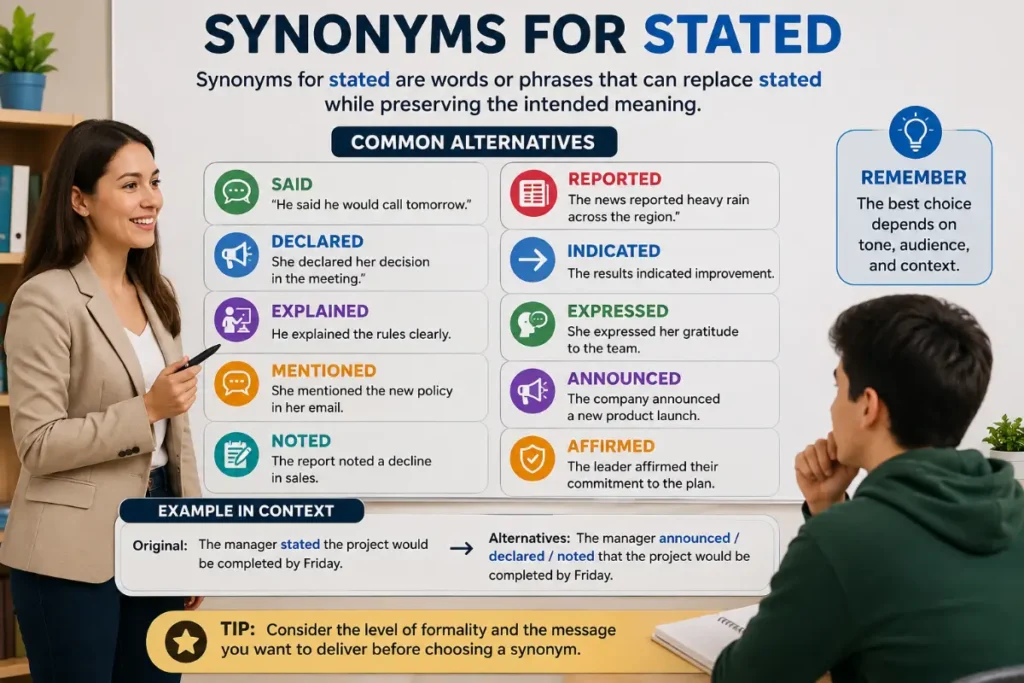
Synonyms for stated are words or phrases that can replace stated while preserving the intended meaning. Common alternatives include said, declared, explained, mentioned, noted, reported, indicated, expressed, announced, and affirmed. The best choice depends on tone, audience, and context.
Quick Answer
If you simply need another word for stated, these are among the strongest options.
- Said.
- Declared.
- Mentioned.
- Explained.
- Noted.
- Reported.
- Expressed.
- Indicated.
- Announced.
- Affirmed.
- Confirmed.
- Asserted.
- Revealed.
- Observed.
- Remarked.
Each word communicates information differently, so selecting the right synonym improves clarity and style.
Comparison Table for Synonyms for Stated
| Word | Meaning | Part of Speech | Origin | Usage Frequency | Formality | Common Context | Example |
|---|---|---|---|---|---|---|---|
| Stated | Expressed clearly | Verb | Latin | Very High | Neutral | General writing | She stated her opinion. |
| Said | Spoke words | Verb | Old English | Extremely High | Neutral | Conversation | He said hello. |
| Declared | Announced officially | Verb | Latin | High | Formal | Law Government News | The mayor declared an emergency. |
| Explained | Made understandable | Verb | Latin | High | Neutral | Education | She explained the process. |
| Mentioned | Referred briefly | Verb | Latin | Very High | Neutral | Conversation | He mentioned the meeting. |
| Reported | Gave information | Verb | Latin | High | Formal | Journalism | The witness reported the incident. |
| Noted | Pointed out | Verb | Latin | High | Formal | Academic writing | The researcher noted several trends. |
| Expressed | Communicated thoughts | Verb | Latin | High | Neutral | Personal communication | She expressed concern. |
| Announced | Made public | Verb | Latin | High | Formal | Media | The company announced new products. |
| Indicated | Suggested or showed | Verb | Latin | High | Formal | Reports | The results indicated success. |
Meaning of Stated
The verb stated means to express something clearly, directly, and intentionally. It usually introduces facts, opinions, instructions, or official information.
Examples include:
- The manager stated the new policy.
- The report stated the findings clearly.
- She stated her reasons calmly.
- The witness stated what happened.
- The contract clearly stated the payment terms.
Unlike casual words such as said, stated often suggests careful wording or official communication.
Meaning of Common Synonyms for Stated
Said
Said is the most common reporting verb in English. It works in almost every situation and sounds natural.
Example:
The teacher said the assignment was due Friday.
Declared
Declared implies authority, confidence, or an official announcement.
Example:
The governor declared a state of emergency.
Explained
Explained means someone made an idea easier to understand.
Example:
The engineer explained how the system works.
Mentioned
Mentioned suggests a brief reference instead of a detailed discussion.
Example:
She mentioned your name during the meeting.
Reported
Reported usually refers to giving information to authorities, news organizations, or supervisors.
Example:
The employee reported the issue immediately.
Noted
Noted means someone pointed out or observed something important.
Example:
The editor noted several grammatical errors.
Expressed
Expressed focuses on communicating feelings, opinions, or ideas.
Example:
He expressed gratitude after receiving the award.
Indicated
Indicated often appears in research, reports, and formal writing.
Example:
The data indicated steady growth.
Announced
Announced means making information public.
Example:
The company announced a new partnership.
Affirmed
Affirmed emphasizes confirming or supporting something confidently.
Example:
She affirmed her commitment to the project.
Synonyms for Stated by Writing Situation
Choosing the best replacement depends on your purpose.
Formal Writing
- Declared.
- Asserted.
- Affirmed.
- Reported.
- Noted.
- Indicated.
- Documented.
- Confirmed.
Academic Writing
- Observed.
- Explained.
- Reported.
- Suggested.
- Proposed.
- Concluded.
- Identified.
- Demonstrated.
Business Communication
- Explained.
- Confirmed.
- Announced.
- Shared.
- Communicated.
- Clarified.
- Informed.
- Advised.
Journalism
- Reported.
- Declared.
- Confirmed.
- Announced.
- Revealed.
- Explained.
- Told.
- Noted.
Creative Writing
- Whispered.
- Replied.
- Remarked.
- Observed.
- Commented.
- Muttered.
- Exclaimed.
- Answered.
Key Differences Between Stated and Its Synonyms
Although these words share similar meanings, they are not interchangeable in every sentence.
Stated Versus Said
Stated sounds more deliberate and formal. Said sounds natural in everyday conversation.
Stated Versus Declared
Declared often carries authority or legal significance. Stated simply communicates information clearly.
Stated Versus Explained
Explained teaches or clarifies. Stated simply presents information.
Stated Versus Mentioned
Mentioned refers briefly to something. Stated gives a complete statement.
Stated Versus Reported
Reported usually involves relaying information to another person or organization. Stated focuses on the original communication.
Tone Comparison
| Word | Tone |
|---|---|
| Said | Neutral |
| Stated | Clear and formal |
| Declared | Strong and official |
| Explained | Helpful |
| Mentioned | Casual |
| Reported | Informative |
| Expressed | Personal |
| Announced | Public |
| Indicated | Analytic |
Which Synonym for Stated Is Correct?
There is no single “correct” synonym for stated. The right choice depends on what you want to communicate. For example, if someone simply spoke words, said is usually the most natural choice. If someone clarified an idea, explained works better. If the speaker briefly referred to something, mentioned is the best option. Professional writers choose the word that matches the situation instead of replacing stated automatically.
Examples Using Stated
Here are ten natural sentences using stated.
- The company stated its refund policy on the website.
- She stated her opinion respectfully during the discussion.
- The report stated that sales increased last quarter.
- The witness stated exactly what happened.
- The professor stated the assignment requirements clearly.
- The contract stated all payment terms in detail.
- The spokesperson stated that no employees were injured.
- He stated his reasons before making the decision.
- The article stated several important facts.
- The judge stated the ruling in open court.
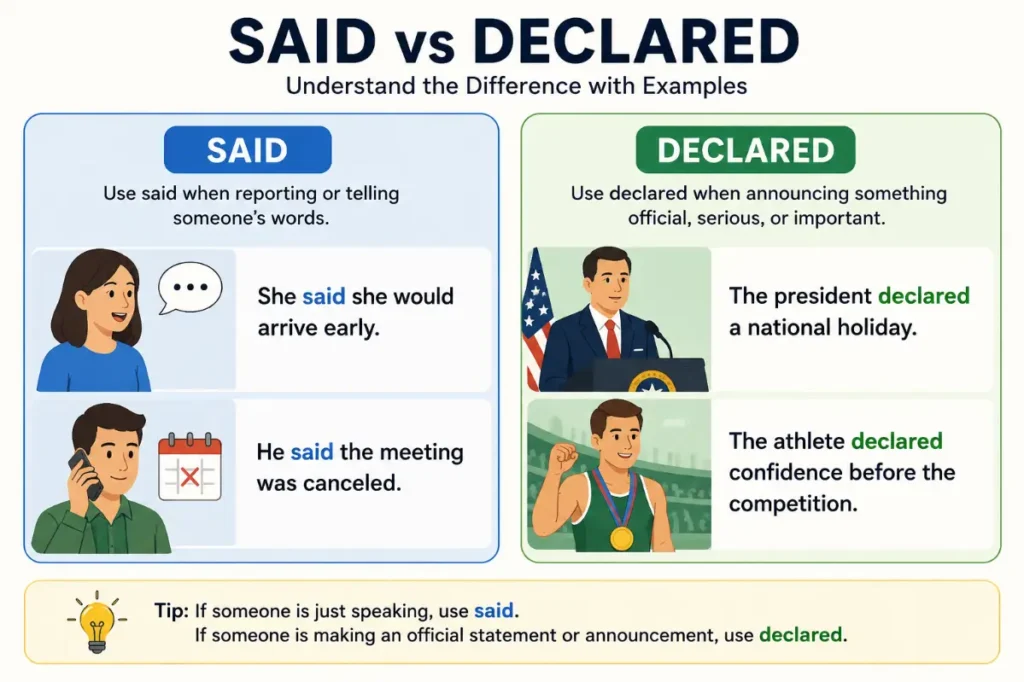
Examples Using Common Synonyms for Stated
Said
- She said she would arrive early.
- He said the meeting was canceled.
Declared
- The president declared a national holiday.
- The athlete declared confidence before the competition.
Explained
- The mechanic explained the repair process.
- The teacher explained the lesson carefully.
Mentioned
- She mentioned your idea during lunch.
- He mentioned a possible solution.
Reported
- The employee reported the safety issue immediately.
- Local newspapers reported the event accurately.
Synonyms for Stated by Tone
Choosing the right tone often matters more than finding the closest synonym.
Neutral Alternatives
These work in most situations.
- Said.
- Mentioned.
- Told.
- Shared.
- Explained.
Formal Alternatives
These fit academic, legal, or professional writing.
- Declared.
- Reported.
- Indicated.
- Confirmed.
- Noted.
- Documented.
- Asserted.
- Affirmed.
Strong Alternatives
Use these when the statement carries authority or conviction.
- Proclaimed.
- Declared.
- Asserted.
- Affirmed.
- Insisted.
- Maintained.
Gentle Alternatives
These sound softer and less forceful.
- Suggested.
- Observed.
- Commented.
- Remarked.
- Mentioned.
Common Mistakes When Choosing Synonyms for Stated
Many writers assume every synonym means exactly the same thing. That often creates awkward or inaccurate sentences.
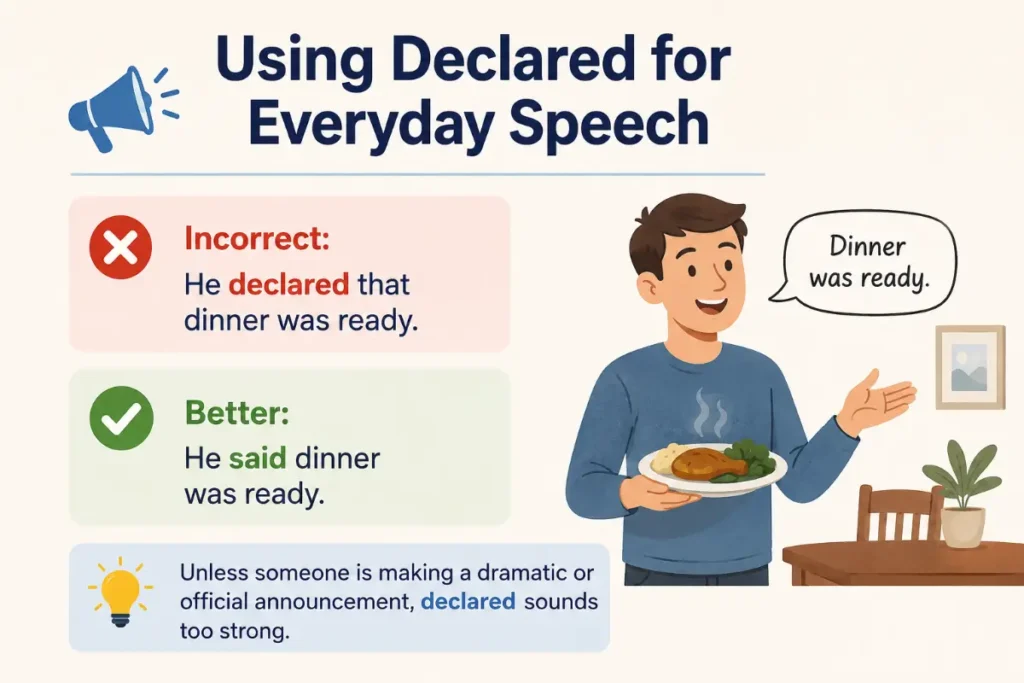
Using Declared for Everyday Speech
Incorrect:
He declared that dinner was ready.
Better:
He said dinner was ready.
Unless someone is making a dramatic or official announcement, declared sounds too strong.
Replacing Every Said With Stated
Many writers think repeating said is bad. In reality, professional editors often prefer said because readers hardly notice it. Replacing every instance with stated can make dialogue sound stiff.
Confusing Explained With Stated
Incorrect:
She explained her name.
Better:
She stated her name.
People explain ideas, but they usually state facts or names.
Using Mentioned Instead of Stated
Incorrect:
The contract mentioned all legal obligations.
Better:
The contract stated all legal obligations.
A contract usually presents information clearly, not casually.
Choosing Formal Words in Casual Writing
Words like asserted, affirmed, and proclaimed may sound unnatural in everyday conversations. Always match the vocabulary to your audience.
Pronunciation Guide
Stated
IPA: /ˈsteɪtɪd/
Syllables:
stat ed
Pronunciation:
STAY tid
Said
IPA: /sɛd/
One syllable.
Declared
IPA: /dɪˈklerd/
Two syllables.
Explained
IPA: /ɪkˈspleɪnd/
Two syllables.
Mentioned
IPA: /ˈmenʃənd/
Two syllables.
Reported
IPA: /rɪˈpɔːrtɪd/
Three syllables.
Common Pronunciation Mistakes
Some English learners pronounce stated as state-ed with three syllables. Native speakers usually pronounce it naturally as two syllables. Another common mistake is stressing the second syllable instead of the first.
Etymology and Word Origin
The verb state comes from the Latin word status, meaning “condition,” “position,” or “standing.” During the Middle English period, the word developed the meaning of expressing something formally or presenting information clearly. Over time, stated became common in legal documents, government writing, journalism, education, and business communication because it emphasizes clarity and precision. Many of its strongest synonyms also come from Latin roots.
| Word | Original Root | Original Meaning |
|---|---|---|
| State | Latin status | Condition |
| Declare | Latin declarare | Make clear |
| Explain | Latin explanare | Make plain |
| Report | Latin reportare | Carry back |
| Express | Latin exprimere | Press out |
| Announce | Latin annuntiare | Bring news |
| Affirm | Latin affirmare | Strengthen |
Understanding these origins helps explain why many formal English verbs share similar meanings while carrying slightly different shades of meaning.
Regional Usage
One advantage of stated is that it is widely understood across major English-speaking countries.
American English
American writers frequently use:
- Stated.
- Said.
- Explained.
- Reported.
- Confirmed.
Business writing often favors stated, indicated, and confirmed.
British English
British English also uses stated regularly. In newspapers, you will often see:
- Said.
- Stated.
- Added.
- Noted.
- Explained.
Canadian English
Canadian usage closely follows American English, especially in government, education, and journalism.
Australian English
Australian writers commonly alternate among:
- Said.
- Stated.
- Explained.
- Mentioned.
- Reported.
Across all four varieties of English, stated remains standard and widely accepted.
Grammar Rules
Understanding grammar helps you choose the right synonym naturally.
Part of Speech
State functions primarily as a verb.
Examples:
The witness stated the facts.
She stated her opinion politely.
The noun statement comes from the same word family.
Verb Forms
| Base Form | Past | Past Participle | Present Participle |
|---|---|---|---|
| State | Stated | Stated | Stating |
Common Sentence Structures
Subject + stated + object.
The report stated the conclusion.
Subject + stated + that clause.
The spokesperson stated that the product was safe.
Passive voice.
It was stated during the meeting.
Although grammatically correct, active voice usually sounds stronger and clearer.
Common Collocations
Professional writers often pair stated with these nouns.
- Stated clearly.
- Stated publicly.
- Stated officially.
- Stated policy.
- Stated objective.
- Stated reason.
- Stated purpose.
- Stated facts.
- Stated position.
- Stated requirement.
These combinations appear frequently in academic, legal, and business writing.
Part 3
Real Life Usage Examples of Synonyms for Stated
The best synonym often depends on where the writing appears. Professional editors choose words that match the audience and purpose instead of replacing stated automatically.
Daily Conversation
In casual speech, people usually prefer simple verbs.
Examples:
- She said she would call later.
- He mentioned a new restaurant downtown.
- My neighbor explained how to fix the fence.
- They shared their vacation plans with us.
- She told everyone the good news.
These verbs sound natural and conversational.
Academic Writing
Academic writing values precision and objectivity.
Examples:
- The researcher reported statistically significant findings.
- The study indicated a strong relationship between the variables.
- The author noted several limitations.
- The journal stated the methodology clearly.
- The paper concluded that additional research was necessary.
These choices sound formal without being overly dramatic.
Professional Communication
Business writing favors clarity and efficiency.
Examples:
- The manager confirmed the schedule.
- Human Resources announced the new policy.
- The report stated the quarterly results.
- The consultant clarified the recommendations.
- The director explained the company’s strategy.
Journalism
News writing relies on accurate reporting verbs.
Examples:
- Police reported the incident early Monday.
- The mayor declared a local emergency.
- Officials confirmed the information.
- Witnesses said they heard a loud noise.
- The company announced a product recall.
Literature and Creative Writing
Fiction benefits from varied dialogue verbs when they add meaning.
Examples:
- She whispered the secret.
- He remarked with a smile.
- The captain declared victory.
- She observed the change quietly.
- The child exclaimed with excitement.
In dialogue, however, many experienced novelists still rely on said because it is almost invisible to readers.
Related Words and Commonly Confused Terms
People searching for synonyms for stated often look for related words that fit different situations. While these words are similar, each has its own nuance.
| Word | Best Used For |
|---|---|
| Said | General conversation |
| Declared | Official announcements |
| Explained | Clarifying ideas |
| Mentioned | Brief references |
| Reported | News and official communication |
| Confirmed | Verifying information |
| Announced | Public statements |
| Revealed | New or surprising information |
| Asserted | Strong opinions or claims |
| Affirmed | Supporting or confirming something |
| Clarified | Removing confusion |
| Noted | Drawing attention to details |
| Observed | Making observations |
| Expressed | Sharing emotions or opinions |
| Communicated | General exchange of information |
| Described | Giving details |
| Commented | Offering opinions |
| Replied | Responding to someone |
| Answered | Responding to a question |
| Advised | Giving guidance |
Words That Are Not Always Good Replacements
Some words seem similar but change the meaning.
Claimed
This word may suggest doubt or skepticism.
Example:
He claimed he was innocent.
The speaker is not necessarily accepting the statement as true.
Alleged
This word is common in legal contexts and implies that something has not yet been proven.
Example:
Police investigated the alleged crime.
Suggested
This introduces an idea rather than a definite statement.
Example:
She suggested taking another route.
Insisted
This emphasizes determination or disagreement.
Example:
He insisted he had locked the door.
These words should only replace stated when their specific meanings fit the context.
Expert Language Insight
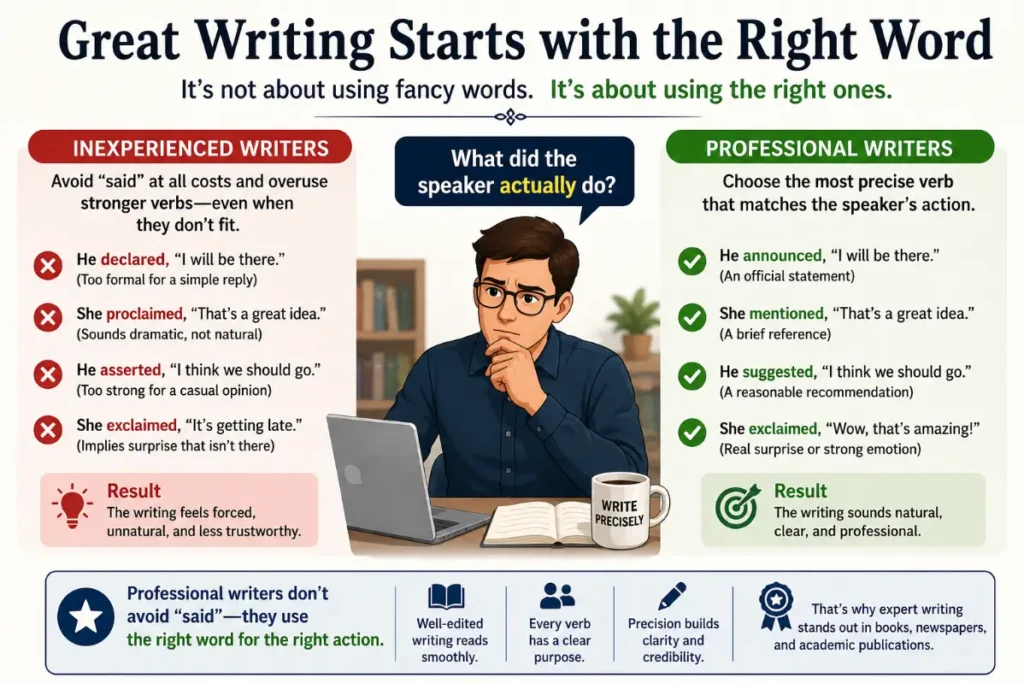
One of the biggest differences between average writing and professional writing is word choice. Many inexperienced writers believe they should avoid repeating said or stated at all costs. As a result, they fill their writing with words like declared, proclaimed, asserted, and exclaimed, even when those verbs do not match the situation. Professional editors take a different approach. They ask one simple question. What did the speaker actually do? If someone made an official announcement, declared or announced is more accurate. If someone briefly referred to a topic, mentioned is the strongest choice. Instead of searching for the fanciest synonym, experienced writers choose the most precise one. That is why well-edited books, newspapers, and academic publications read smoothly. Their vocabulary feels natural because every reporting verb has a purpose.
Best Synonyms for Stated by Situation
For Essays
- Explained.
- Noted.
- Reported.
- Indicated.
- Observed.
For Business Writing
- Confirmed.
- Announced.
- Explained.
- Clarified.
- Communicated.
Conclusion
Finding the right synonyms for stated is about more than avoiding repetition. The strongest writing uses words that match the speaker’s purpose, the audience, and the situation.
For everyday communication, said remains the most natural choice. In professional or academic writing, alternatives such as reported, indicated, noted, confirmed, and explained often provide greater precision. For official announcements, declared and announced are usually the best options.
Rather than replacing stated with the longest or most impressive word, focus on choosing the verb that communicates the intended meaning most accurately. That simple habit will make your writing clearer, more engaging, and more professional.
When in doubt, prioritize clarity over variety. Readers notice precise language far more than they notice repeated words.
Frequently Asked Questions
What is the best synonym for stated?
The best synonym depends on the context. Said is the most common choice for everyday writing, while declared, reported, explained, confirmed, and indicated work better in formal, academic, legal, or professional settings.
Can I replace stated with said?
Yes. In many sentences, said is a perfectly natural replacement for stated. However, stated often sounds more formal and deliberate, so choose the word that matches the tone of your writing.
Is stated more formal than said?
Yes. Stated generally sounds more formal and is common in reports, contracts, academic papers, and business communication. Said is appropriate for everyday conversation, fiction, and most general writing.
What is a formal alternative to stated?
Formal alternatives include declared, affirmed, asserted, confirmed, reported, indicated, specified, and documented. Each carries a slightly different meaning, so select the one that best fits your sentence.
Which synonym should I use in academic writing?
Academic writing often uses reported, noted, observed, indicated, demonstrated, identified, and concluded because they describe research findings accurately and objectively.
Is stated grammatically correct?
Yes. Stated is the standard past tense and past participle of the verb state. It is grammatically correct in both American and British English.
What is the difference between stated and explained?
Stated means expressing information clearly or directly. Explained means making something easier to understand by providing additional details or reasons. The two verbs overlap in some contexts but are not always interchangeable.
Why do professional writers use different reporting verbs?
Using different reporting verbs adds precision, improves readability, and communicates the speaker’s intention more accurately. Instead of avoiding repetition for its own sake, skilled writers choose the verb that best reflects what actually happened.
