
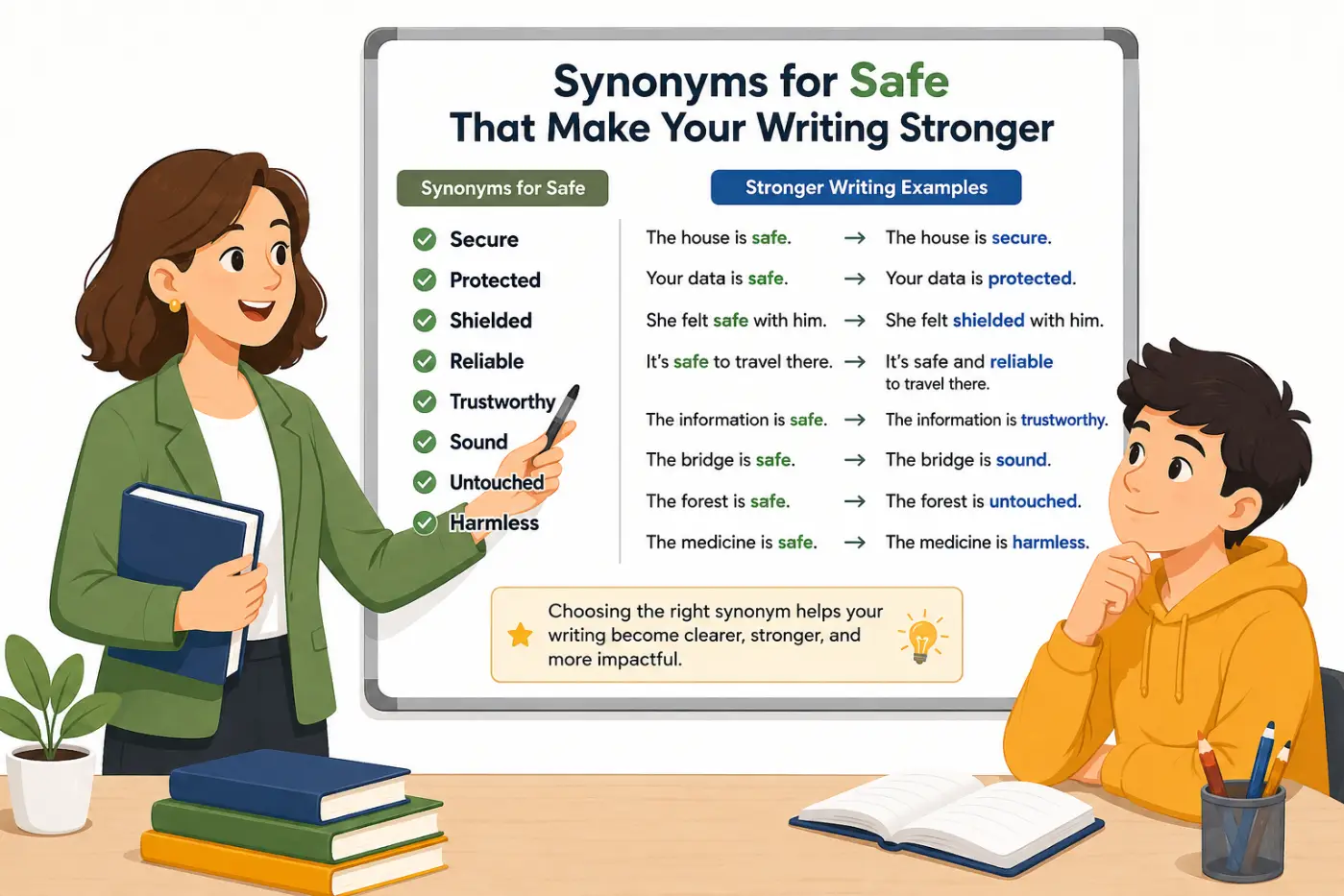
Choosing the right synonyms for safe can make your writing clearer, more precise, and more engaging. While safe is one of the most common words in English, it does not always express the exact meaning you want. A person can feel safe, a building can be safe, an investment can be safe, and a decision can be safe, but each situation may call for a different word.
Many writers rely on safe repeatedly because it feels familiar. Overusing it, though, can make sentences sound repetitive. Stronger alternatives can add variety while communicating your meaning more accurately. Some synonyms emphasize protection, others highlight security, caution, reliability, or the absence of danger.
This guide explores the best synonyms for safe, explains their meanings, shows when to use each one, and provides practical examples from everyday conversation, professional writing, academic English, and literature. By the end, you will know exactly which synonym fits your sentence instead of relying on the same word every time.
Quick Definition
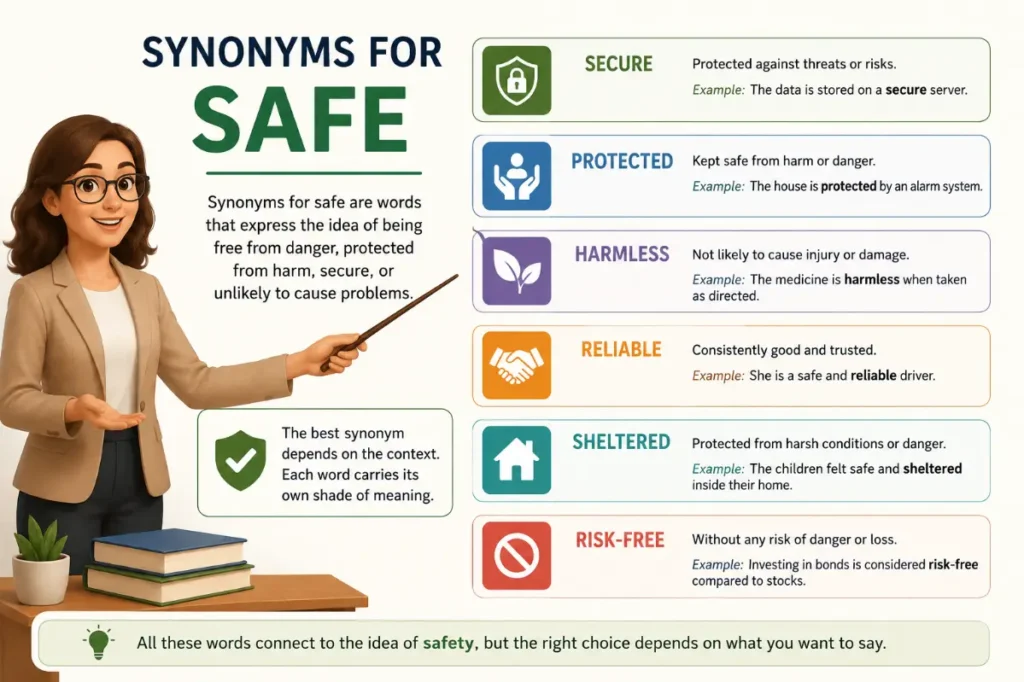
Synonyms for safe are words that express the idea of being free from danger, protected from harm, secure, or unlikely to cause problems. The best synonym depends on the context. Words such as secure, protected, harmless, reliable, sheltered, and risk-free all relate to safe, but each carries its own shade of meaning.
Quick Answer
If you need another word for safe, the best choice depends on your meaning.
- Secure for something protected against danger.
- Protected for someone or something receiving protection.
- Harmless for something that cannot cause injury.
- Reliable for something dependable.
- Risk-free for situations involving little or no chance of loss.
- Sheltered for someone protected from danger or severe conditions.
- Sound for something in good condition.
- Stable for dependable situations or conditions.
- Defensible for positions that can be protected.
- Guarded for places or people under watch.
Choosing the correct synonym makes your writing more accurate and natural.
Comparison Table of the Best Synonyms for Safe
| Word | Primary Meaning | Part of Speech | Formality | Common Contexts | Example |
|---|---|---|---|---|---|
| Safe | Free from danger | Adjective | Neutral | Everyday English | The children are safe. |
| Secure | Well protected | Adjective | Neutral | Security, technology, finance | The building is secure. |
| Protected | Defended from harm | Adjective | Neutral | Law, nature, people | The animals are protected. |
| Harmless | Unable to cause injury | Adjective | Neutral | Medicine, animals, jokes | The snake is harmless. |
| Reliable | Dependable | Adjective | Neutral | People, products, services | She is reliable. |
| Stable | Not likely to change suddenly | Adjective | Formal | Economy, health, engineering | The patient’s condition is stable. |
| Sound | In good condition | Adjective | Formal | Buildings, decisions, finance | The bridge is structurally sound. |
| Sheltered | Protected from danger | Adjective | Neutral | Housing, weather, upbringing | They stayed in a sheltered area. |
| Risk-free | Without significant risk | Adjective | Business | Finance, investment, marketing | This account is risk-free. |
| Guarded | Protected by security | Adjective | Neutral | Buildings, military | The entrance is heavily guarded. |
Understanding the Meaning of Safe
The adjective safe means free from danger, injury, loss, or unnecessary risk. It can describe people, animals, places, objects, situations, decisions, investments, and even ideas.
Examples include:
- The children are safe inside the house.
- Keep your passport in a safe place.
- We arrived home safely after the storm.
- The bridge is safe for traffic.
- This medicine is safe for adults.
Although these sentences all use safe, the underlying meanings are slightly different. Sometimes the focus is physical protection, while other times it is reliability, caution, or freedom from harm.
This is why exploring synonyms for safe helps improve both clarity and style.
The Best Synonyms for Safe and Their Meanings
Not every synonym works in every situation. Professional editors choose words based on context rather than looking for a direct replacement.
Secure
Secure emphasizes protection from outside threats.
Common uses include:
- Secure building.
- Secure network.
- Secure password.
- Secure location.
- Secure storage.
Examples:
- The museum keeps valuable paintings in a secure room.
- Use a secure password for every account.
Protected
Protected focuses on receiving protection from someone or something.
Examples:
- The forest is protected by law.
- Children should feel protected at school.
- Wildlife remains protected throughout the year.
Harmless
Harmless describes something that cannot cause injury or damage.
Examples:
- The insect looks frightening but is harmless.
- His comment was harmless.
- Most garden snakes are harmless.
Reliable
Although reliable is not always a direct synonym, it often replaces safe when discussing dependable choices.
Examples:
- This airline has an excellent safety record and is highly reliable.
- Choose a reliable source of information.
Stable
Stable suggests consistency without sudden change.
Examples:
- The patient’s condition is stable.
- The economy remains stable.
- The table is stable on uneven ground.
Sound
Sound often means structurally or financially safe.
Examples:
- The engineer confirmed the bridge is sound.
- The company has sound financial planning.
- That is a sound decision.
Sheltered
Sheltered highlights protection from difficult conditions.
Examples:
- The hikers found a sheltered valley.
- The boat rested in a sheltered harbor.
- The children grew up in a sheltered environment.
Risk-Free
This phrase commonly appears in business and finance.
Examples:
- The company advertises a risk-free trial.
- Government bonds are considered relatively risk-free.
- No investment is completely risk-free.
Guarded
Guarded means actively protected by security or watchfulness.
Examples:
- The palace remains heavily guarded.
- The entrance is guarded day and night.
- Sensitive information is carefully guarded.
Synonyms for Safe Based on Different Contexts
One reason people search for synonyms for safe is that the same word feels repetitive in different types of writing. The better approach is to choose a synonym that matches the situation.
For People
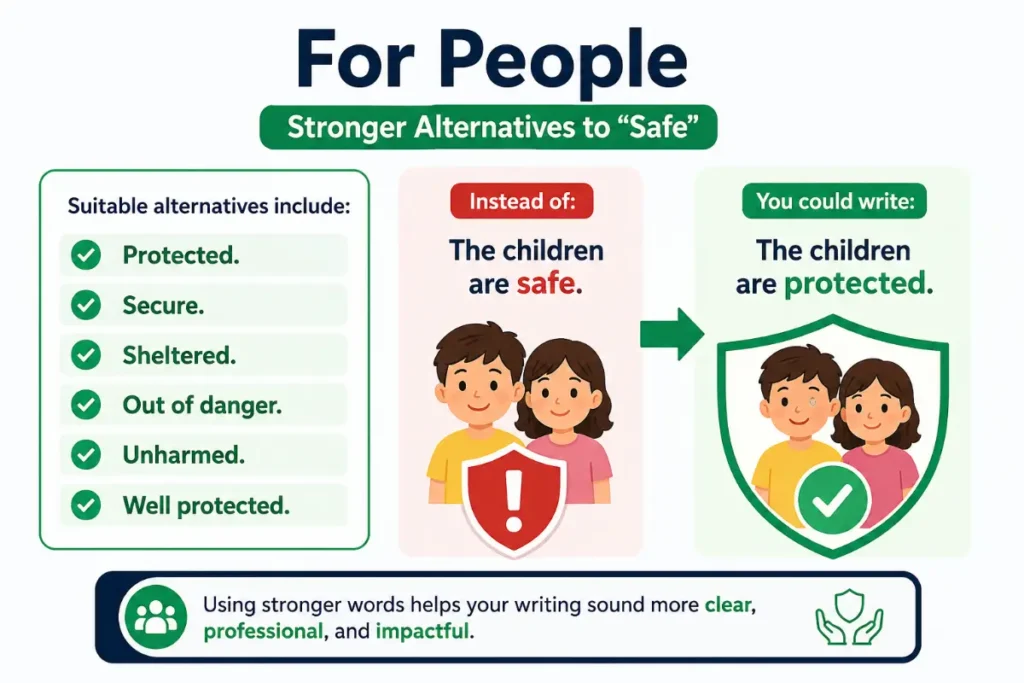
Suitable alternatives include:
- Protected.
- Secure.
- Sheltered.
- Out of danger.
- Unharmed.
- Well protected.
Example:
Instead of:
The children are safe.
You could write:
The children are protected.
For Places
Better choices include:
- Secure.
- Guarded.
- Sheltered.
- Well defended.
- Protected.
Example:
The embassy is heavily guarded.
For Investments
Good alternatives include:
- Stable.
- Reliable.
- Low risk.
- Conservative.
- Risk-free in limited contexts.
Example:
Treasury bonds are considered a stable investment.
For Technology
Common replacements include:
- Secure.
- Protected.
- Encrypted.
- Trusted.
- Reliable.
Example:
Use a secure internet connection.
For Health
Appropriate alternatives include:
- Harmless.
- Approved.
- Reliable.
- Nonhazardous.
- Tested.
Example:
This vaccine has been tested and is considered safe.
Which Synonym Should You Use?
Many learners assume every synonym can replace safe, but native speakers naturally choose words that match the situation.
Consider these examples.
Instead of:
The website is safe.
A native speaker is more likely to say:
The website is secure.
Instead of:
The investment is safe.
They often say:
The investment is stable.
Instead of:
The joke is safe for children.
They may say:
The joke is appropriate for children.
Instead of:
The chemical is safe.
Scientists often write:
The chemical is harmless under normal conditions.
Shades of Meaning Among Synonyms for Safe
Although all these words relate to protection, they are not identical.
| Synonym | Main Idea |
|---|---|
| Secure | Strong protection |
| Protected | Receiving protection |
| Stable | Consistent and dependable |
| Reliable | Trustworthy |
| Harmless | Cannot cause injury |
| Sound | Good physical or financial condition |
| Sheltered | Protected from outside conditions |
| Guarded | Under active protection |
| Risk-free | Little or no chance of loss |
Recognizing these differences helps writers avoid awkward word choices.
Why Writers Should Learn Synonyms for Safe
Using a variety of words offers several benefits.
- It improves readability.
- It avoids repetition.
- It creates more vivid descriptions.
- It increases precision.
- It strengthens academic writing.
- It improves professional communication.
- It enhances storytelling.
- It demonstrates a richer vocabulary.
Experienced editors rarely replace words randomly. They choose synonyms that match the exact meaning of each sentence. That attention to detail makes writing sound natural rather than repetitive
Examples in Sentences Using Synonyms for Safe
Seeing synonyms for safe in complete sentences makes it much easier to understand their subtle differences. Although these words share a general meaning, each fits certain situations better than others.
Secure
- The office uses a secure entry system.
- Keep your documents in a secure location.
- Our online payment system is secure.
- She locked the bicycle in a secure parking area.
- The data is stored on secure servers.
- Make sure the ladder is secure before climbing.
- The company invested in secure cloud storage.
- His future feels more secure after getting a permanent job.
- The package arrived in a secure container.
- A secure foundation helps the house withstand storms.
Protected
- The children were protected from the heavy rain.
- Rare plants are protected by environmental laws.
- The artwork is protected behind glass.
- Every employee should feel protected at work.
- The helmet protected her from serious injury.
- Marine life is protected in this conservation area.
- Password encryption keeps personal information protected.
- The campsite is protected from strong winds.
- The castle was protected by thick stone walls.
- Fire-resistant materials protected the building.
Harmless
- The puppy looks energetic but is completely harmless.
- Most spiders found here are harmless.
- It was a harmless misunderstanding.
- The joke was intended as harmless fun.
- This chemical is harmless when used correctly.
- The smoke looked alarming but proved harmless.
- The medicine has harmless side effects for most people.
- His curiosity was harmless.
- The insect is harmless to humans.
- Their friendly competition remained harmless.
Reliable
- She is one of the most reliable employees in the company.
- Choose a reliable mechanic for major repairs.
- This guide is a reliable source of information.
- We bought a reliable family car.
- Reliable equipment reduces workplace accidents.
- He has always been reliable under pressure.
- The forecast came from a reliable weather service.
- A reliable backup system protects important files.
- They hired a reliable contractor.
- Reliable transportation makes commuting easier.
Stable
- The patient’s condition is stable.
- The chair feels stable on the uneven floor.
- The economy remained stable throughout the year.
- A stable internet connection is essential.
- Their relationship has become more stable.
- Scientists monitored the volcano until conditions became stable.
- The company enjoys stable growth.
- Stable weather helped the rescue operation.
- The ladder remained stable during repairs.
- Investors often prefer stable markets.
Sound
- The bridge is structurally sound.
- She made a sound financial decision.
- The company’s business model is sound.
- The roof remains sound despite its age.
- That advice is based on sound reasoning.
- The engineer confirmed the building was sound.
- A sound investment strategy reduces unnecessary risk.
- The machine is still mechanically sound.
- They reached a sound conclusion.
- The evidence supports a sound argument.
Common Mistakes When Choosing Synonyms for Safe
Even advanced English learners sometimes misuse synonyms for safe because many of them appear similar at first glance.
Using Secure Instead of Safe Everywhere
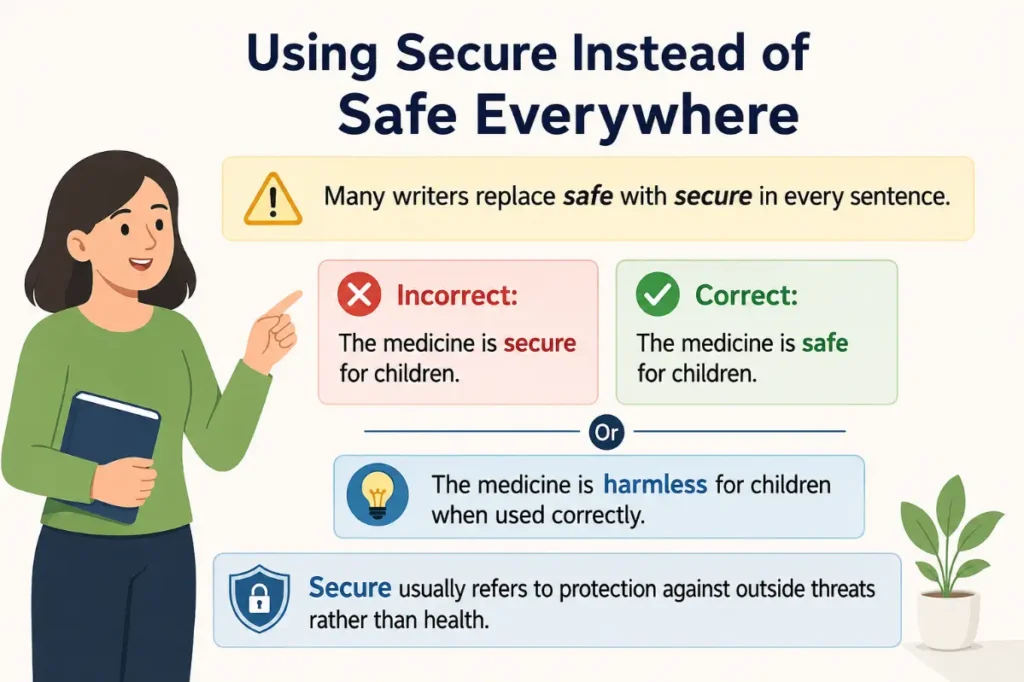
Many writers replace safe with secure in every sentence.
Incorrect:
The medicine is secure for children.
Correct:
The medicine is safe for children.
Or
The medicine is harmless for children when used correctly.
Secure usually refers to protection against outside threats rather than health.
Using Harmless for Valuable Objects
Incorrect:
My passport is harmless in the drawer.
Correct:
My passport is safe in the drawer.
Or
My passport is secure in the drawer.
Harmless describes something that cannot cause injury, not something that is protected.
Confusing Stable with Secure
Incorrect:
The password is stable.
Correct:
The password is secure.
Passwords need protection, not stability.
Assuming Risk-Free Means Absolutely Safe
Many advertisements use risk-free, but few real-life situations have zero risk. Professional writing usually prefers phrases such as:
- Low risk.
- Minimal risk.
- Relatively safe.
- Lower risk.
These expressions sound more accurate and trustworthy.
Choosing a Synonym Without Considering Context
Strong writing depends on precision.
Compare these examples.
The children are protected.
The children are safe.
Each sentence communicates a slightly different idea, even though they all relate to safety.
Pronunciation Guide
Correct pronunciation helps you sound more confident when speaking English.
| Word | IPA | Syllables |
|---|---|---|
| Safe | /seɪf/ | safe |
| Secure | /sɪˈkjʊr/ | se cure |
| Protected | /prəˈtɛktɪd/ | pro tect ed |
| Harmless | /ˈhɑːrmləs/ | harm less |
| Reliable | /rɪˈlaɪəbəl/ | re li a ble |
| Stable | /ˈsteɪbəl/ | sta ble |
| Sound | /saʊnd/ | sound |
| Sheltered | /ˈʃɛltərd/ | shel tered |
| Guarded | /ˈɡɑːrdɪd/ | guard ed |
Common Pronunciation Mistakes
- Stressing the wrong syllable in secure.
- Dropping the second syllable in reliable.
- Confusing sound with the noun referring to noise.
- Pronouncing protected too quickly and losing the middle consonants.
Listening to native speakers and repeating complete sentences is one of the fastest ways to improve pronunciation.
Etymology and Word Origin
Understanding a word’s history often explains why its meaning developed over time.
Safe
The word safe comes from the Latin salvus, meaning healthy, uninjured, or unharmed. It entered English through Old French before becoming part of Middle English. Over centuries, its meaning expanded from physical protection to include emotional security, financial stability, legal protection, and general freedom from danger.
Secure
Secure comes from the Latin securus, meaning free from care or anxiety. Originally, it described peace of mind before gradually becoming associated with protection against danger and theft.
Protected
The verb protect traces back to the Latin protegere, meaning to cover in front or defend. Modern English uses it for physical, legal, digital, and environmental protection.
Harmless
This word combines harm and the suffix less, literally meaning without harm. It has remained remarkably consistent in meaning for hundreds of years.
Stable
Stable comes from the Latin stabilis, meaning firm or standing firmly. Today it describes physical balance, emotional consistency, economic strength, and dependable conditions.
Sound
The adjective sound, meaning healthy or in good condition, developed separately from the noun referring to noise. It originates from Old English and has long described something solid, dependable, and free from defects.
Regional Usage
Most synonyms for safe are widely understood throughout the English-speaking world, but certain preferences vary slightly by region.
American English
American writers commonly use:
- Safe.
- Secure.
- Reliable.
- Stable.
- Risk-free.
Technology and cybersecurity writing strongly favors secure.
Example:
Use a secure Wi-Fi network.
British English
British English also uses safe and secure, though formal writing often includes sound when discussing buildings, engineering, or financial decisions.
Example:
The structure appears sound.
Australian English
Australian English closely follows British usage while frequently using secure in government, education, and workplace safety materials.
Canadian English
Canadian English blends British and American vocabulary. Most publications use safe, secure, and protected interchangeably according to context. Overall, there are very few regional differences. Context matters much more than geography.
Grammar Rules for Safe and Its Synonyms
Understanding grammar helps you use synonyms for safe naturally.
Parts of Speech
Most common synonyms are adjectives.
Examples include:
- Safe.
- Secure.
- Stable.
- Reliable.
- Protected.
- Harmless.
- Guarded.
- Sheltered.
- Sound.
Some related nouns include:
- Safety.
- Security.
- Protection.
- Stability.
- Reliability.
Related verbs include:
- Protect.
- Guard.
- Secure.
- Defend.
- Shelter.
Comparative and Superlative Forms
Many adjectives follow standard comparison rules.
Positive:
Safe.
Comparative:
Safer.
Superlative:
Safest.
Examples:
This route is safer.
That neighborhood is the safest in the city.
Secure becomes:
More secure.
Most secure.
Reliable becomes:
More reliable.
Most reliable.
Stable becomes:
More stable.
Most stable.
Common Sentence Patterns
Subject + be + adjective
The bridge is safe.
The website is secure.
The patient is stable.
Subject + verb + object
The police protected the neighborhood.
The password secures your account.
The walls sheltered the village.
Noun + adjective
A secure building.
A safe investment.
A reliable vehicle.
A harmless insect.
A stable economy.
Common Collocations
Native speakers often pair these words with specific nouns.
Safe:
- Safe journey.
- Safe place.
- Safe distance.
- Safe environment.
- Safe choice.
Secure:
- Secure connection.
- Secure password.
- Secure server.
- Secure facility.
- Secure payment.
Reliable:
- Reliable source.
- Reliable employee.
- Reliable evidence.
- Reliable transportation.
- Reliable system.
Stable:
- Stable economy.
- Stable condition.
- Stable relationship.
- Stable platform.
- Stable income.
Using natural collocations makes your English sound much more fluent.
Real Life Usage Examples of Synonyms for Safe
Learning synonyms for safe is most useful when you see how they appear in everyday communication. Professional writers choose different words depending on the audience, purpose, and context.
Daily Conversation
People naturally vary their vocabulary instead of repeating safe.
Examples:
- Stay safe on your trip.
- The neighborhood feels secure at night.
- Don’t worry. The kids are protected.
- That dog looks scary, but it’s harmless.
- We found a sheltered place to wait out the storm.
- This route is much safer than the highway.
- Your belongings will be secure in the locker.
- The campsite is in a safe location.
- I prefer a reliable car for long trips.
- Everything is under control now.
Academic Writing
Academic writing values precision, so authors often replace safe with more specific alternatives.
Examples:
- The treatment was considered safe after extensive testing.
- Researchers concluded that the procedure was reliable.
- The laboratory follows secure data management practices.
- Participants remained protected throughout the study.
- The structure was found to be sound after inspection.
Professional Communication
Business and workplace writing often favors words that sound precise and objective.
Examples:
- Customer information is stored on secure servers.
- The company maintains a safe working environment.
- Employees receive protective equipment before entering the site.
- The investment offers relatively stable returns.
- We use a reliable backup system for critical data.
Literature
Authors choose different synonyms to create mood and imagery.
Examples:
- The travelers finally reached a safe village.
- She rested beneath the sheltered branches.
- The castle stood behind secure walls.
- The child felt protected in her mother’s arms.
- The old bridge remained surprisingly sound despite its age.
News and Media
Journalists select words that match the topic.
Examples:
- Officials confirmed the area is now safe.
- The airport has introduced enhanced security measures.
- Emergency crews moved residents to protected shelters.
- Engineers declared the bridge structurally sound.
- Authorities described the chemical as harmless after testing.
These examples show that professional writers rarely substitute words at random. They choose the synonym that best matches the exact situation.
Related Words and Commonly Confused Terms
People searching for synonyms for safe also look for words with similar meanings. Some are true synonyms, while others overlap only in certain contexts.
Close Synonyms
- Secure.
- Protected.
- Harmless.
- Stable.
- Reliable.
- Sound.
- Sheltered.
- Guarded.
- Defended.
- Shielded.
- Preserved.
- Insulated.
- Well protected.
- Low risk.
- Risk free.
- Unharmed.
- Out of danger.
- Trustworthy.
- Dependable.
- Cautious.
Words With Related Meanings
These words are connected to safety but are not direct replacements in every sentence.
- Safety.
- Security.
- Protection.
- Defense.
- Stability.
- Reliability.
- Prevention.
- Caution.
- Preparedness.
- Assurance.
Opposites of Safe
Knowing antonyms helps clarify meaning.
- Dangerous.
- Unsafe.
- Hazardous.
- Risky.
- Perilous.
- Threatening.
- Insecure.
- Exposed.
- Vulnerable.
- Harmful.
Context Based Alternatives
Instead of safe, native speakers may choose:
For travel:
- Well lit.
- Secure.
- Protected.
Choosing the most precise word makes your writing stronger and more natural.
Expert Language Insight
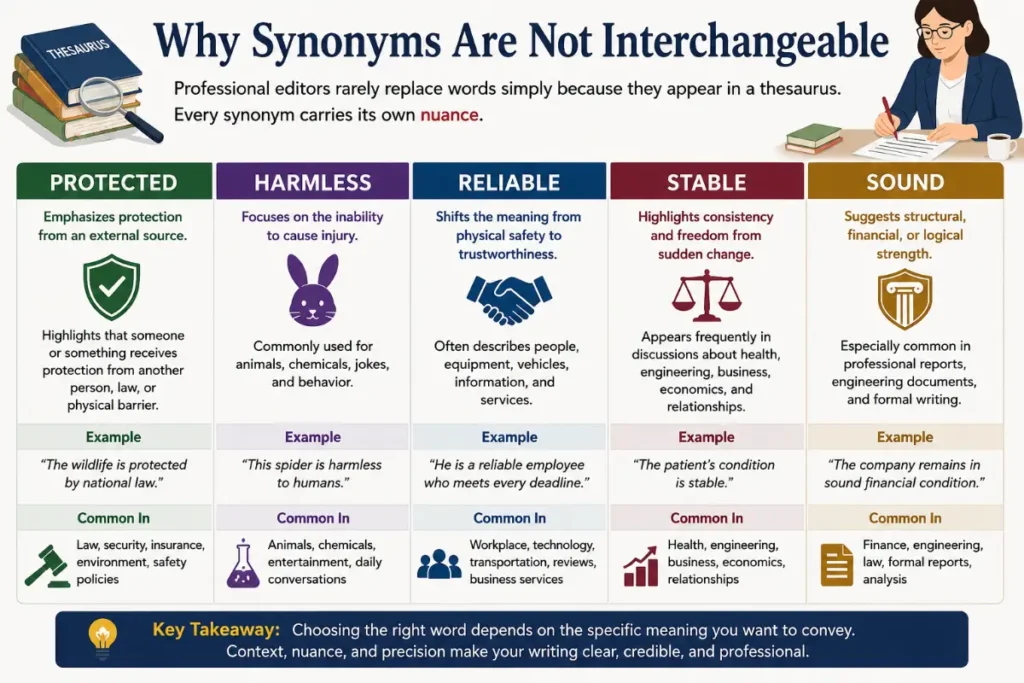
Professional editors rarely replace words simply because they appear in a thesaurus. Every synonym carries its own nuance. Protected emphasizes that someone or something receives protection from another person, law, or physical barrier. Harmless focuses on the inability to cause injury. It is commonly used for animals, chemicals, jokes, and behavior. Reliable shifts the meaning from physical safety to trustworthiness. It often describes people, equipment, vehicles, information, and services. Stable highlights consistency. It appears frequently in discussions about health, engineering, business, economics, and relationships. Sound suggests structural, financial, or logical strength. It is especially common in professional reports, engineering documents, and formal writing.
Conclusion
Learning synonyms for safe is about more than expanding your vocabulary. It helps you express ideas with greater precision, avoid repetition, and write in a way that feels natural to readers.
Although safe remains the best choice in many situations, it is not always the most specific one. Secure works well for technology and security, protected highlights defense from harm, harmless describes something that cannot cause injury, reliable emphasizes dependability, stable focuses on consistency, and sound is often the preferred term in engineering, finance, and formal writing.
The strongest writers do not replace words simply to sound more sophisticated. They choose the synonym that matches the exact meaning they want to communicate. That small decision improves clarity, strengthens credibility, and makes every sentence more effective.
Frequently Asked Questions
What are the best synonyms for safe?
Some of the best synonyms for safe include secure, protected, reliable, stable, harmless, sheltered, sound, and guarded. The right choice depends on your sentence. A secure website, a stable investment, and a harmless animal all describe different kinds of safety.
Is secure the same as safe?
Not exactly. Secure emphasizes protection against threats, while safe has a broader meaning that includes freedom from danger, injury, or loss. A website can be secure, while a medicine can be safe.
Which synonym for safe sounds most professional?
In professional writing, secure, reliable, stable, and sound are often the strongest choices. They sound precise and fit business, technical, engineering, and academic contexts.
What is a formal synonym for safe?
Formal alternatives include secure, protected, sound, stable, and low risk. These words frequently appear in reports, legal documents, academic writing, and professional communication.
What is another word for safe in academic writing?
Academic writers commonly use secure, reliable, stable, protected, and sound because these words describe specific qualities more accurately than the general adjective safe.
What is another word for safe in everyday conversation?
In everyday English, people often say secure, protected, okay, out of danger, or all right, depending on the situation. These expressions sound natural in casual conversations.
Can every synonym replace safe?
No. Synonyms are rarely interchangeable in every context. For example, harmless cannot replace safe when discussing passwords, and secure does not work naturally when describing medicine. Always consider the intended meaning before choosing a replacement.
How can I improve my vocabulary without sounding unnatural?
Read widely and pay attention to context rather than memorizing long synonym lists. Notice how experienced writers use words like secure, stable, reliable, and protected in different situations. Choosing the most accurate word is more important than choosing the most unusual one.
