
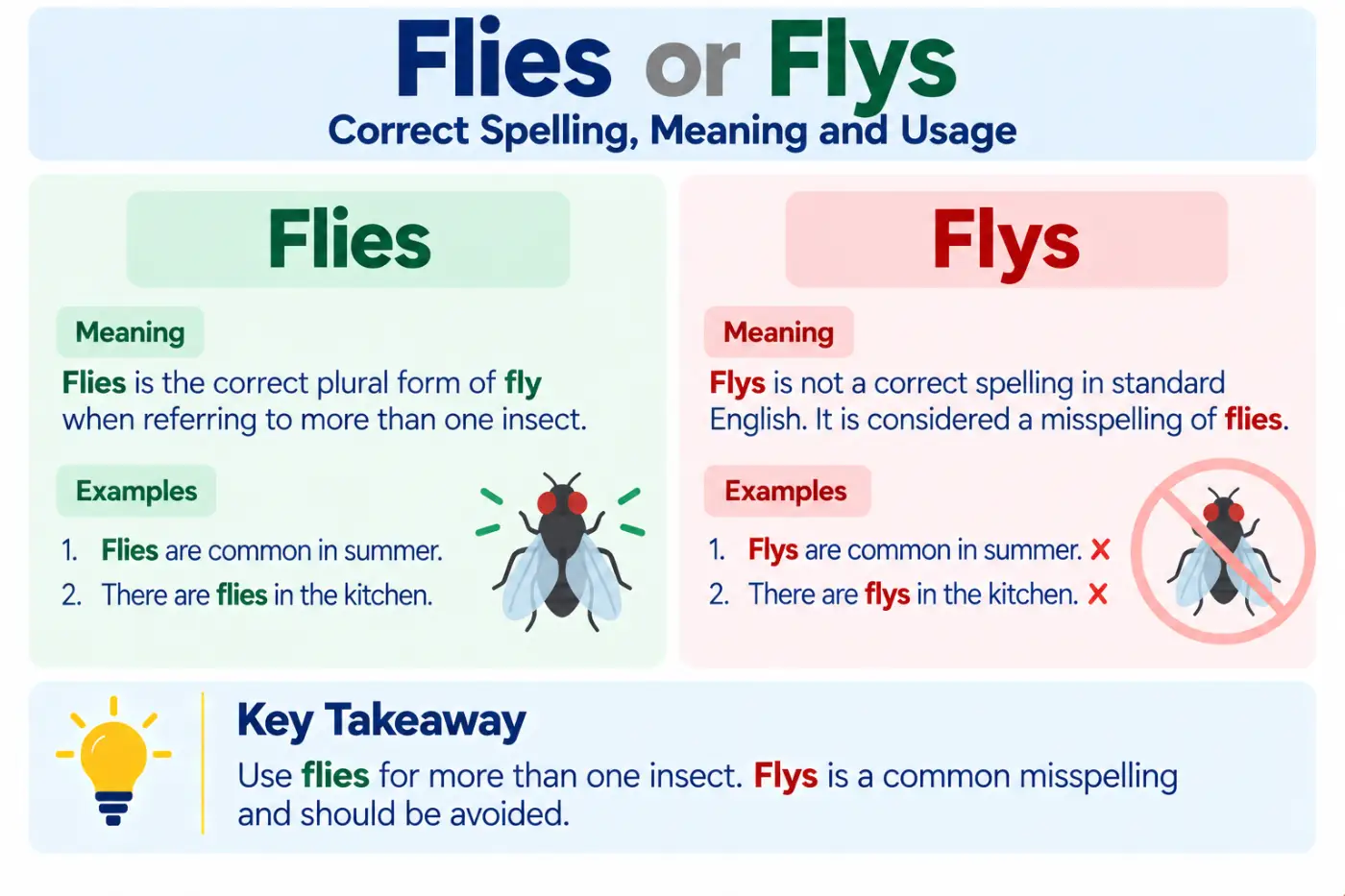
If you have ever stopped while writing and wondered about flies or flys, you’re not alone. The correct form in standard English is flies. The spelling flys is normally incorrect when you mean more than one fly or you mean that someone or something travels through the air.
The confusion makes sense because many English words form plurals by adding s. For example, cat becomes cats and book becomes books. However, words ending in consonant plus y follow a different spelling pattern. The y usually changes to i before the ending is added. That gives us fly to flies and try to tries.
This small spelling rule can save you from a surprisingly common mistake. In this guide you’ll learn why the spelling changes, how the word works as a noun and verb, how to pronounce it, and how American English uses it in everyday writing. You’ll also see clear examples, common mistakes, related words, and a simple editing trick that makes the rule easy to remember.
Quick Definition
Flies is the standard form used for the plural of the noun fly and for the third person singular present form of the verb fly. Flys is normally a spelling error in standard English. The spelling changes from y to i before the ending s is added because fly ends in a consonant followed by y.
Quick Answer
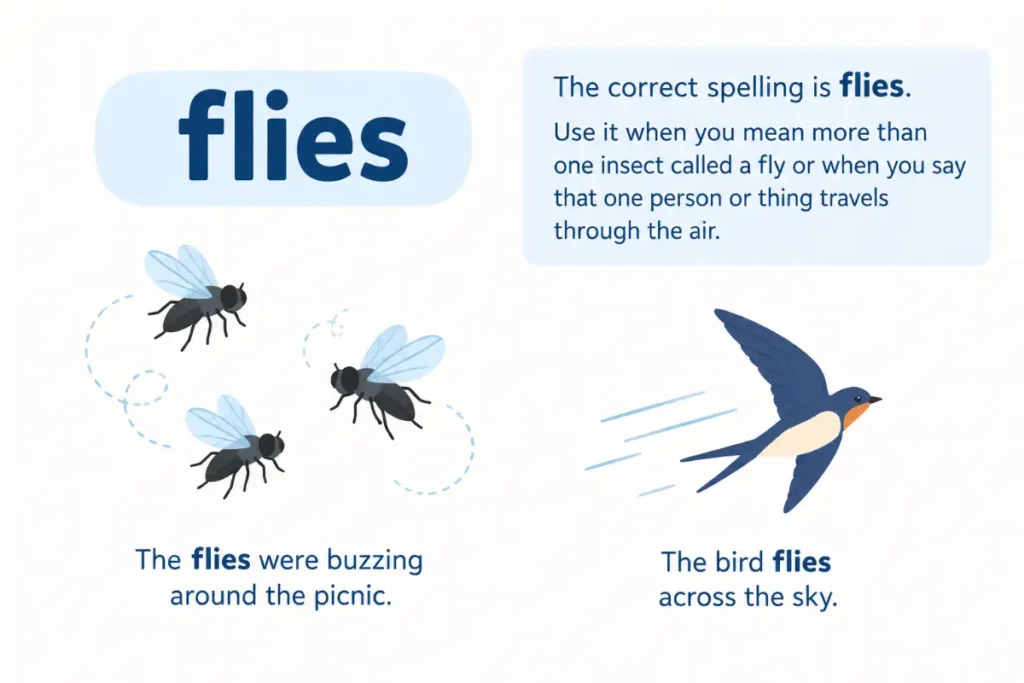
The correct spelling is flies. Use it when you mean more than one insect called a fly or when you say that one person or thing travels through the air.
For example, you can write, The flies are near the window. You can also write, She flies to Chicago every month.
Comparison Table
| Form | Meaning | Part of Speech | Origin | Usage Frequency | Formality | Common Contexts | Example |
|---|---|---|---|---|---|---|---|
| Flies | More than one fly or the third person singular form of fly | Noun or verb | From Old English flyge and flygan | Very common | Standard | Conversation, school, work, journalism, literature | The bird flies over the lake. |
| Flys | Usually an incorrect spelling of flies | Nonstandard spelling | Modern spelling error | Uncommon as a standard form | Nonstandard | Typing mistakes and informal errors | The correct sentence is The bird flies over the lake. |
Meaning and Definition
Meaning of Flies as a Noun
As a noun, flies is the plural form of fly.
A fly is a small flying insect. The word can refer to the common housefly or to other insects that belong to groups commonly called flies. The plural simply tells the reader that there is more than one.
For example:
There are flies in the kitchen.
The word flies refers to several insects. The singular form would be fly.
One fly landed on the table.
Several flies landed on the table.
The meaning stays connected to the same noun. The spelling changes because English uses a special plural rule for words ending in consonant plus y.
Meaning of Flies as a Verb
Flies is also a verb form.
It is the third person singular present form of fly. The subject must normally be he, she, it, or another singular noun.
For example:
She flies to New York every summer.
The eagle flies above the mountains.
The plane flies across the country.
The verb fly has several meanings. It can describe moving through the air. It can also describe traveling by airplane.
He flies to Boston for work.
The word can also appear in figurative expressions.
Time flies when you’re having fun.
In that sentence, flies doesn’t describe physical flight. It expresses the idea that time seems to pass quickly.
Meaning of Flys
Flys is normally not the standard spelling you want in ordinary English writing.
If you are trying to write the plural of fly, use flies. If you are trying to write the third person singular form of the verb fly, use flies as well.
You may occasionally encounter flys as part of a specialized name, brand, username, title, or other proper label. A special name can follow its own naming conventions. That does not make flys the standard plural or verb form in general English.
For normal school work, professional writing, essays, emails, articles, and everyday communication, choose flies.
Key Differences Explained
- Spelling. The standard form is flies. The spelling changes the final y to i before the plural or verb ending is added.
- Meaning. Flies can refer to several insects or to something that moves through the air in the third person singular present tense.
- Grammar. As a noun, flies is a plural noun. As a verb, it is the third person singular present form of fly.
- Pronunciation. Flies is pronounced like flies and rhymes with tries and cries.
- Formality. Flies is standard in both casual and formal English. Flys is normally treated as a spelling error.
- Context. You can use flies in conversations, essays, emails, reports, news writing, stories, and academic work.
- Regional usage. Standard American English uses flies. British English and other major varieties of English also use flies.
- Spelling pattern. The important rule is consonant plus y. When a word ends in consonant plus y, the y commonly changes to i before an ending such as es is added.
This is why fly becomes flies rather than flys.
Which Form Is Correct?
Flies is the correct standard form for the two uses discussed here.
The spelling follows a familiar English pattern. When a word ends in a consonant followed by y, the y commonly changes to i when forming certain grammatical forms.
Consider these examples.
- Fly becomes flies.
- Try becomes tries.
- Cry becomes cries.
- Carry becomes carries.
- Study becomes studies.
Notice the shared pattern. The final y changes to i and the ending becomes es.
There is an important exception to remember. If a word ends in a vowel followed by y, the y normally stays.
For example:
- Play becomes plays.
- Enjoy becomes enjoys.
- Stay becomes stays.
- Boy becomes boys.
This gives you a useful spelling test. Look at the letter immediately before the y. If it is a consonant, the y commonly changes when you add this kind of ending. If it is a vowel, the y usually stays.
The Spelling Rule Behind the Difference
The spelling rule becomes much easier once you see a few patterns together.
Words ending in consonant plus y often change y to i before an ending such as es.
For example:
- Fly becomes flies.
- Try becomes tries.
- Hurry becomes hurries.
- Worry becomes worries.
- Reply becomes replies.
The reason writers sometimes choose flys is that adding s feels like the most natural plural rule. English uses that simple pattern for many nouns.
Dog becomes dogs.
Car becomes cars.
House becomes houses.
But English has several spelling patterns that depend on the final letters of a word. Fly belongs to the consonant plus y pattern.
There is another useful point. The same spelling change appears in verb forms.
The verb fly becomes flies with a singular third person subject.
I fly.
You fly.
We fly.
They fly.
He flies.
She flies.
It flies.
This means you can use the same rule for both the noun and verb forms.
Sentence Examples
Here are natural examples showing how the standard form works in different situations.
- The flies are gathering near the window.
- My brother flies to Texas for work several times a year.
- A small bird flies across the garden every morning.
- Time flies when you’re enjoying yourself.
- The pilot flies this route twice a week.
- We need to keep the food covered because flies can get inside.
- She flies home every December to visit her family.
- The butterfly flies from one flower to another.
- The scientist studies how the insect flies and feeds.
- As the sun rises, the bird flies toward the trees.
These examples show why context matters. The same spelling can represent two different grammatical functions. In some sentences it is a plural noun. In others it is a verb.
Common Mistakes and Misspellings
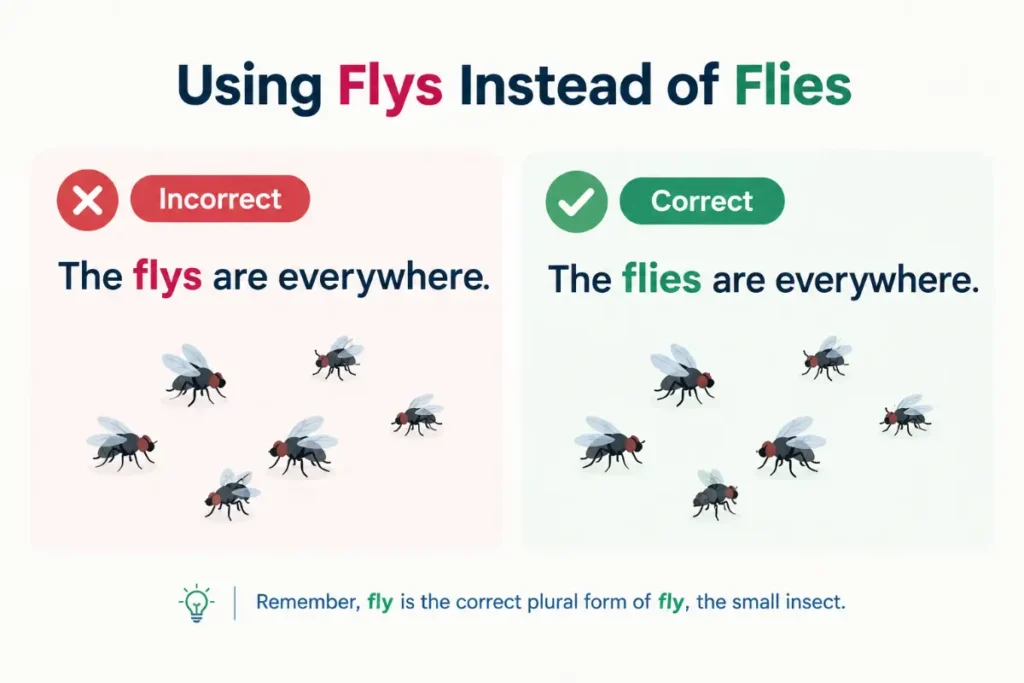
Using Flys Instead of Flies
Incorrect: The flies are everywhere.
Correct: The flies are everywhere.
The mistake happens because writers may simply add s to the base word. The spelling rule requires the y to change before the ending is added.
Forgetting the Es Ending
Incorrect: She flys to California every week.
Correct: She flies to California every week.
Here the word is a verb rather than a noun. The same spelling rule still applies.
Changing the Y in the Wrong Situation
Some writers learn the y rule and then apply it too broadly.
For example:
Incorrect: He trys to help.
Correct: He tries to help.
But:
Correct: He plays soccer.
Play ends with vowel plus y. The y stays.
Confusing Singular and Plural
A common mistake is using flies when only one insect is meant.
One fly is on the wall.
Several flies are on the wall.
The singular noun is fly. The plural noun is flies.
Confusing Noun and Verb Forms
The word flies can act as either a noun or a verb.
The flies are annoying.
Here flies is a noun.
The bird flies south.
Here flies is a verb.
The surrounding words usually make the grammatical role clear.
Pronunciation Guide
Flies is pronounced /flaɪz/.
It has one syllable.
A simple pronunciation guide is:
flyz
The vowel sound is the same as the word fly. The final sound is a voiced z sound.
The word rhymes with:
- Eyes.
- Rise.
- Wise.
- Cries.
- Tries.
A common pronunciation mistake is treating the ending as a separate syllable. Standard pronunciation does not add another full syllable after fly.
The singular noun fly is pronounced /flaɪ/. The plural flies adds the final /z/ sound.
You can hear the difference clearly in these pairs:
One fly.
Two flies.
The spelling changes, but the main vowel sound stays the same.
Etymology and Word Origin
The word fly has very old Germanic roots.
The noun connected to the insect comes from Old English forms such as flyge. The verb meaning to move through the air comes from Old English flygan. These words developed through the history of English into the modern forms fly and flies.
The two meanings are historically connected through the idea of movement through the air. The insect name refers to a creature that flies, while the verb describes the action itself.
Over time English developed regular spelling conventions for changing y to i before certain endings. The modern spelling flies reflects that broader pattern.
You do not need to memorize the historical development to spell the word correctly. Still, knowing that fly belongs to an old and established English word family explains why the modern form looks the way it does.
Regional Usage
American English
American English uses flies as the standard spelling. The form works for both the plural noun and the third person singular verb.
Examples include:
The flies are near the door.
She flies to Denver tomorrow.
There is no standard American English rule that changes flies to flys.
British English
British English also uses flies in the same grammatical situations. The spelling distinction remains the same.
A British writer would use flies for the plural of fly and for the third person singular form of the verb.
Australian English
Australian English follows the same standard spelling pattern. Flies is the normal form in school writing, professional communication, journalism, and everyday English.
The spelling does not change to flys simply because of regional usage.
Canadian English
Canadian English also uses flies as the standard form. The same consonant plus y spelling rule applies.
There is no major regional spelling difference here. Writers across these English varieties use the standard form.
Grammar Rules and Part of Speech
The most useful grammar point is that flies has two main roles.
Flies as a Plural Noun
When flies refers to more than one insect, it is a plural noun.
For example:
The flies are near the fruit.
The word are helps show that flies is plural.
Compare:
The fly is near the fruit.
The flies are near the fruit.
The difference is simple. Fly means one. Flies means more than one.
Flies as a Verb
When flies describes an action performed by one third person subject, it is a verb.
For example:
The bird flies south.
The plane flies over the city.
My sister flies to Chicago every month.
The subject is singular, so the verb takes the s or es form.
Compare:
I fly to Chicago.
They fly to Chicago.
She flies to Chicago.
The base verb stays unchanged with I, you, we, and they. The third person singular form changes to flies.
Sentence Position
As a noun, flies can appear as the subject or object of a sentence.
Flies can spread germs.
We need to remove the flies.
As a verb, flies normally appears after a singular subject.
The eagle flies high.
The plane flies at night.
Punctuation
The word itself does not require special punctuation. Normal sentence punctuation applies.
For example:
The bird flies over the lake.
The flies are inside the house.
In a question:
Why does the bird fly so low?
Notice something important here. After does, use the base verb fly rather than flies.
Incorrect:
Why does the bird flies so low?
Correct:
Why does the bird fly so low?
This is a grammar issue rather than a spelling issue. The helping verb does already carries the third person singular marking, so the main verb returns to its base form.
Real Life Usage Examples
Daily Conversation
In everyday speech, you might say:
There are flies in the kitchen, so close the window.
My dad flies to work several times a month.
The first example uses the word as a plural noun. The second uses it as a verb.
Email and Workplace Communication
Professional writing can use the word naturally.
The technician flies to the site tomorrow morning.
The report explains how the insects spread and why flies are attracted to the area.
There is nothing informal about the standard form. Context determines the tone.
Academic Writing
Academic writing may use flies when discussing biology, animal behavior, ecology, aviation, or other subjects.
The study examines how flies respond to changes in temperature.
The aircraft flies at a higher altitude during the second stage of the test.
In academic writing, precise grammatical forms matter because a small spelling mistake can distract readers from the information.
News Writing
News reports can use the word in many settings.
The airline flies to several international destinations.
Officials warned residents to keep food covered because flies can carry harmful organisms.
The surrounding context tells readers which meaning applies.
Literature and Storytelling
Stories often use flies to describe movement or insects.
The bird flies above the quiet field as the sun begins to set.
Several flies gathered around the old wooden table.
The word is common enough that it rarely needs special explanation.
Related and Confused Terms
Fly
Fly is the singular noun and the base form of the verb.
One fly landed on the wall.
I fly home tomorrow.
Flies
Flies is the plural noun and the third person singular present form of the verb.
Several flies entered the room.
She flies home tomorrow.
Flying
Flying can function as a present participle, gerund, or adjective depending on the sentence.
The bird is flying south.
Flew
Flew is the simple past form of fly.
The bird flew across the lake.
It does not take the spelling pattern used in the present tense.
Flown
Flown is the past participle of fly.
The plane has flown across the country.
It normally appears with a helping verb such as has, have, or had.
Flight
Flight is a noun related to flying.
The flight leaves at eight.
It can refer to air travel or the act of moving through the air.
Flyer
Flyer can refer to a person who flies or to a printed promotional sheet. The exact meaning depends on context.
Flier
Flier is another accepted spelling in some uses, especially for a person who flies or someone with experience in air travel. The distinction between flier and flyer can vary by style and context.
A Simple Way to Remember the Spelling
The easiest trick is to look at the letters before the y.
Fly ends with consonant plus y.
When you form flies, change y to i and add es.
Think:
fly → flies
You can apply the same pattern to many familiar words.
Try → tries.
Cry → cries.
Study → studies.
Carry → carries.
This creates a useful mental group. Once you recognize the pattern, you don’t need to memorize each word separately.
However, keep the vowel plus y rule in mind too.
Play → plays.
Stay → stays.
Enjoy → enjoys.
The difference comes from the letter before y.
If the y follows a consonant, the spelling often changes. If the y follows a vowel, the y usually remains.
Why Flys Looks Plausible
English learners and native speakers alike can make spelling mistakes when a word seems to follow a familiar pattern.
Adding s is one of the most common ways English forms plurals. That makes flys look reasonable at first glance.
The same thing happens during fast typing. Your brain knows the meaning before your fingers finish entering the word. When the word contains a spelling change that you don’t consciously notice, it is easy to type the simpler looking version.
Speech can also contribute to the problem. You hear the word as one syllable, so you don’t hear the spelling change between fly and flies. The pronunciation gives you the sound but not the letters.
This is why reading the word in context helps. Visual familiarity strengthens the correct spelling over time.
An Editor’s Tip for Catching the Error
A useful proofreading habit is to check words ending in y whenever you add an s or another grammatical ending.
Don’t automatically add s.
First look at the letter before y.
If you see a consonant, check the spelling rule. If you see a vowel, the y may stay.
This takes only a second and catches many errors.
For example:
Fly → flies.
Try → tries.
Copy → copies.
But:
Play → plays.
Enjoy → enjoys.
Buy → buys.
This approach is more reliable than memorizing isolated words because it gives you a pattern you can reuse.
Expert Editor Insight
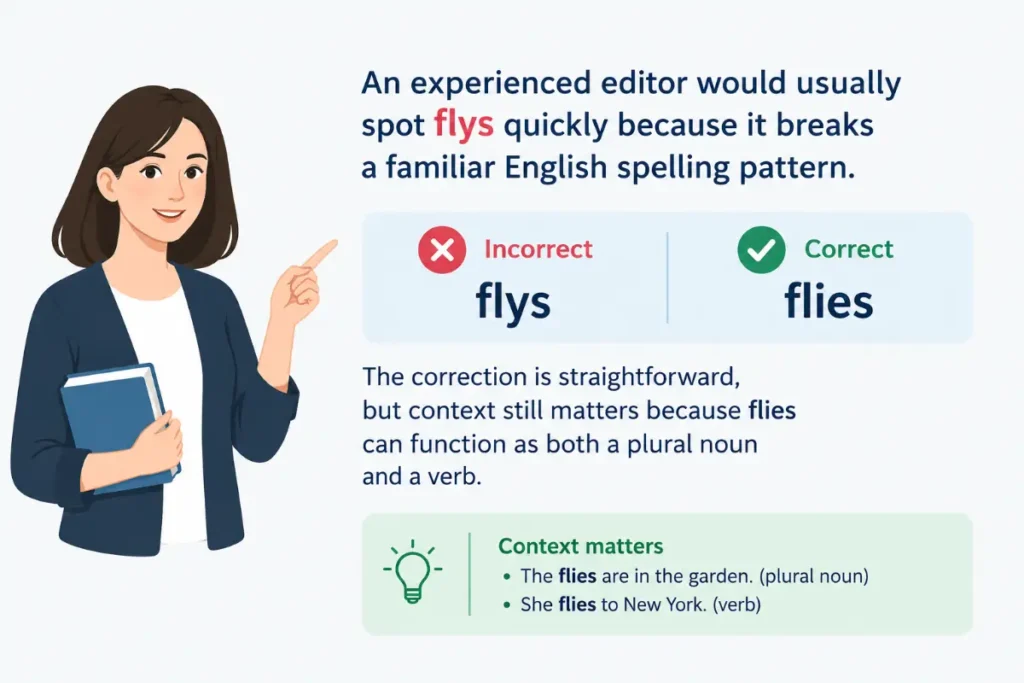
An experienced editor would usually spot flys quickly because it breaks a familiar English spelling pattern. The correction is straightforward, but context still matters because flies can function as both a plural noun and a verb. Grammar tools and spellcheckers commonly flag the nonstandard form in ordinary text, but good proofreading goes beyond automatic correction. An editor checks the whole sentence to confirm that the writer needs the plural noun, the third person singular verb, or another form such as fly, flew, flown, or flying.
Conclusion
Flies or flys has a clear answer in standard English. Flies is the correct form for the plural of fly and for the third person singular present form of the verb. Flys is normally a spelling error. The key rule is simple. When fly takes this ending, the y changes to i and es is added.
The same pattern appears in words such as try and tries, cry and cries, and study and studies. At the same time, words ending in vowel plus y usually keep the y, as in play and plays. Knowing the difference gives you a useful spelling pattern instead of a rule you have to memorize one word at a time.
For proofreading, look at the letter before y before adding an ending. If you remember fly becoming flies, you can use that pattern in many other words. It takes only a moment to check and can prevent an easy spelling mistake in school, work, or everyday writing.
FAQs
Is flys a correct English word?
Flys is normally not the standard spelling for the plural of fly or the third person singular present form of the verb fly. Standard English uses flies in both cases. You may encounter flys as part of a special name, username, or other proper label, but that does not make it the standard grammatical form.
Why does fly become flies?
Fly changes to flies because it ends in a consonant followed by y. English commonly changes the y to i and adds es when forming this type of plural or third person singular verb form. The same pattern appears in words such as try and tries, cry and cries, and study and studies.
Is flies a noun or a verb?
Flies can be either a noun or a verb. As a noun, it is the plural of fly and refers to more than one insect. As a verb, it is the third person singular present form of fly. For example, The flies are outside uses a noun, while The bird flies south uses a verb.
How do you pronounce flies?
Flies is pronounced /flaɪz/ and has one syllable. It sounds like flyz and rhymes with eyes, rise, wise, cries, and tries. The main vowel sound is the same as the word fly. The final sound is a voiced z sound rather than a separate syllable.
Is flys ever acceptable?
Flys may appear in a special name, brand, username, title, or other proper label. In standard English grammar, however, it is not the normal form for the plural of fly or the third person singular present form of the verb. For school, work, professional writing, and general communication, use flies.
What is the plural of fly?
The plural of fly is flies. One fly becomes two flies. The spelling changes because fly ends in consonant plus y. The y changes to i and es is added. This follows the same broad spelling pattern seen in words such as try and tries and cry and cries.
What is the past tense of fly?
The simple past tense of fly is flew. For example, The bird flew over the lake. The past participle is flown, as in The bird has flown away. These forms do not use the spelling pattern that creates flies in the present tense.
Why do people write flys instead of flies?
People often write flys because adding s feels like the simplest way to make a word plural or create a third person singular verb. The pronunciation also does not clearly reveal the spelling change. Fast typing and unfamiliarity with the consonant plus y rule can make the error more likely.
