
Enrol or enroll can look like a spelling mistake waiting to happen. In fact both forms are correct. The difference comes mainly from the variety of English you’re using. Enroll is the standard spelling in American English while enrol is the standard spelling in British English and is also widely used in other varieties that follow British spelling conventions.
The confusion often comes from seeing both forms in schools universities applications websites and official documents. You might see an American college asking students to enroll in a course while a British university tells students to enrol. The meaning stays the same. Only the spelling changes.
The key is consistency. If you’re writing for a US audience use enroll. If you’re following British English use enrol. This guide explains the difference in plain English and shows how each form works in real sentences. You’ll also learn the pronunciation grammar rules word history regional preferences common mistakes and related terms so you can choose the right form with confidence.
Quick Definition
Enroll and enrol are both standard English spellings of the same verb. Enroll is the usual American English form while enrol is the usual British English form. Both mean to officially join a course school program organization or activity. The main difference is regional spelling rather than meaning or grammar.
Quick Answer
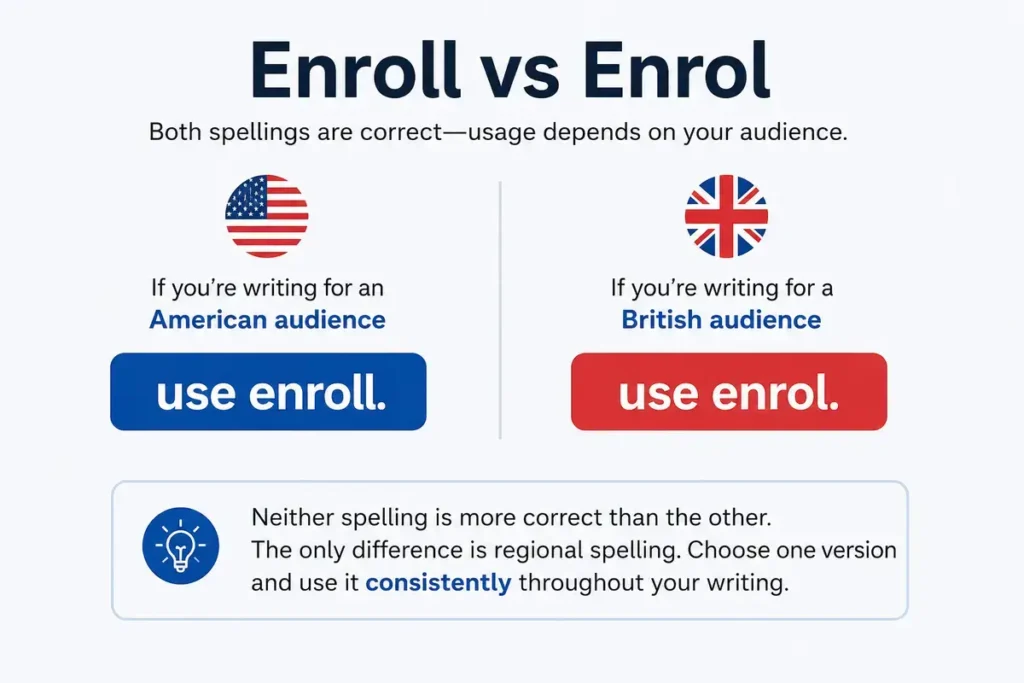
Both forms are correct.
Use enroll in American English. Use enrol in British English and in other varieties that generally follow British spelling conventions. The two forms have the same meaning and function as verbs.
For example an American writer might say:
I plan to enroll in the course next semester.
A British writer might say:
I plan to enrol in the course next semester.
Neither sentence has a different meaning. The spelling reflects the English variety being used.
Comparison Table Enrol or Enroll
| Form | Meaning | Part of Speech | Origin | Usage Frequency | Formality | Common Contexts | Example |
|---|---|---|---|---|---|---|---|
| Enroll | To officially join or register for something | Verb | From French and ultimately Latin roots | Very common in American English | Neutral and formal | Schools courses programs memberships | I need to enroll in two classes. |
| Enrol | To officially join or register for something | Verb | From French and ultimately Latin roots | Very common in British English | Neutral and formal | Schools courses programs memberships | I need to enrol in two classes. |
Meaning and Definition
Meaning of Enrol
Enrol is a standard verb meaning to officially register or become a member of a school course program organization or other activity.
British English normally uses this spelling. You may encounter it in university information school forms government documents professional training materials and general writing.
For example:
She decided to enrol in a nursing program.
The sentence means that she decided to officially register for the program.
The word can also describe adding someone to an official list.
The school enrolled the new students on Monday.
In British style that sentence would normally use enrolled as the past form of enrol.
The spelling pattern becomes especially useful when you see related forms. British English commonly writes enrol, enrolled and enrolment.
Meaning of Enroll
Enroll has exactly the same basic meaning. It means to officially register someone or to officially register yourself for a course school program organization or activity.
American English normally uses this spelling.
For example:
She decided to enroll in a nursing program.
You can also use the verb transitively when someone registers another person.
The school enrolled 200 new students this year.
It can also appear in broader contexts.
Thousands of people enrolled in the training program.
The word doesn’t have to describe education. People can enroll in programs memberships courses and other organized activities.
The meaning stays stable across English varieties. The spelling is the part that changes.
Key Differences Explained
- Spelling
American English normally uses enroll with two l letters at the end of the base form. British English normally uses enrol with one l.
- Meaning
There is no meaningful difference in definition. Both forms mean to officially register or join something.
- Grammar
Both words are verbs. They can describe a person joining something or an organization registering a person.
- Past tense
This is one of the most useful spelling differences to remember. American English uses enrolled. British English also uses enrolled.
The double l appears in the past form in both varieties.
- Noun form
American English commonly uses enrollment. British English commonly uses enrolment.
- Pronunciation
The two forms are pronounced the same in standard usage. The spelling difference doesn’t create a different basic pronunciation.
- Formality
Neither spelling is more formal. The choice depends on the English variety and the style of the publication.
- Context
Both forms work in education business training professional development memberships and other registration contexts.
- Regional usage
American publications favor enroll. British publications favor enrol. Australian English and other varieties influenced by British conventions commonly use enrol.
- Standard usage
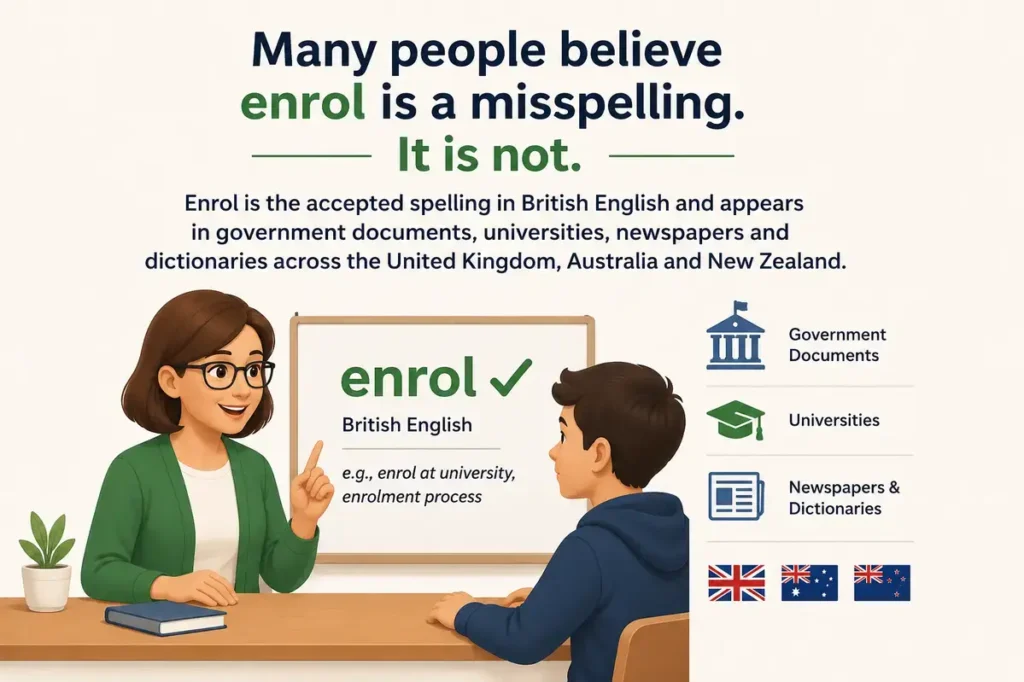
Neither spelling should be treated as an error without considering regional English. Calling enrol wrong simply because you normally see enroll would be misleading. The same applies in reverse.
Which Form Is Correct
Both enrol and enroll are correct. The correct choice depends on the variety of English you’re writing.
If your audience is primarily in the United States use enroll. This is the standard American spelling.
If you’re writing in British English use enrol. This is the standard British spelling.
The difference follows a broader pattern in English spelling. American English sometimes simplifies or changes spellings that remain more conservative in British English. Examples include color and colour, canceled and cancelled, and traveled and travelled. The pattern isn’t identical in every word but it helps explain why regional spelling differences exist.
There is also a useful point about dictionary use. Major English dictionaries distinguish regional forms rather than treating one as universally wrong. A US dictionary may list enroll as the primary form while a British dictionary may list enrol. Good dictionaries often identify regional labels such as US or British English when a spelling differs.
Professional editors therefore look at the intended audience before correcting the word. A British document containing enrol shouldn’t be changed to enroll simply because an American spelling checker prefers the latter.
Sentence Examples
Here are natural examples using the American form.
- I plan to enroll in a computer science course this fall.
- You can enroll online before the registration deadline.
- She decided to enroll her son in a local school.
- More than 500 students enrolled in the program this year.
- I need to enroll in another class to complete my degree.
- The company encourages employees to enroll in professional training.
- He enrolled in the workshop after hearing positive reviews from his friend.
- Students must enroll before they can access the online learning platform.
- My sister wants to enroll in a language course next month.
- The university allows new students to enroll during the summer.
Now compare the same ideas in British English.
- I plan to enrol in a computer science course this autumn.
- You can enrol online before the registration deadline.
- She decided to enrol her son in a local school.
- More than 500 students enrolled in the program this year.
- I need to enrol in another class to complete my degree.
Notice something important. The regional difference is most visible in the base form. The past form enrolled contains the double l in both major spelling systems.
Common Mistakes and Misspellings
The biggest mistake is assuming that one spelling must be wrong. That isn’t true here. The two forms belong to different standard varieties of English.
- Using enrol in American English without a reason
British spelling isn’t inherently wrong. Still, if you’re writing an American school application or US business document, enroll is the expected form.
Example:
I want to enroll in the program.
- Using enroll in a British document
The reverse situation can also create an inconsistency.
Example:
I want to enrol in the program.
This form fits British English better.
- Writing enrollment in British English
British English commonly uses enrolment rather than enrollment.
Example:
Student enrolment begins in September.
- Writing enrolment in American English
American English normally uses enrollment.
Example:
Student enrollment begins in September.
- Changing the spelling inside one document
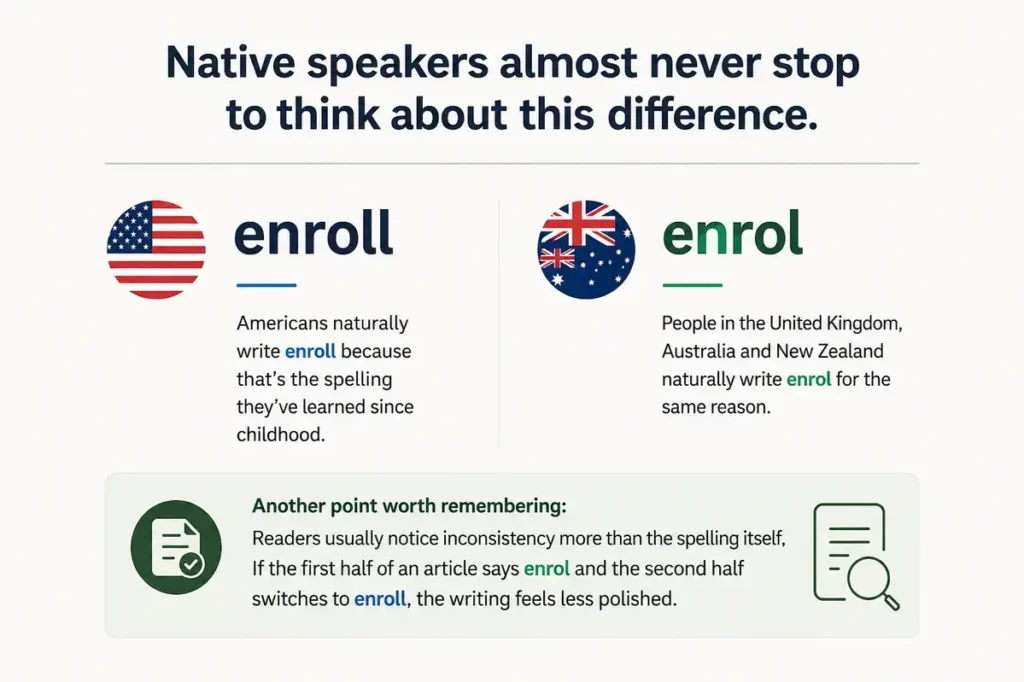
This is a subtle editing problem. A document might use enrol in one paragraph and enroll in another. If the document follows one regional style, switching between forms makes the writing look inconsistent.
Pick the appropriate variety and keep it throughout the document.
Pronunciation Guide
The pronunciation of enrol and enroll is essentially the same.
A common IPA representation is:
/ɪnˈrəʊl/ in British English.
In American English the final vowel sound may be represented differently depending on the pronunciation system used. A common representation is:
/ɪnˈroʊl/.
A simple pronunciation guide for an American speaker is:
in ROHL
The main stress falls on the second syllable.
The word has two main sound parts:
in + roll
The first syllable sounds like in. The second resembles roll.
One common learner mistake is to give the first syllable too much stress. Native speakers generally emphasize the second part.
The spelling difference doesn’t mean you need two separate pronunciation patterns. The key difference is written form rather than spoken form.
This makes the pair especially interesting for language learners. You can hear the same word in a British and American conversation and still see different spellings on the page.
Etymology and Word Origin
The history of enrol and enroll reaches back through French to Latin.
The English verb developed from French forms related to the idea of entering a name on a roll or list. The older concept connects with a roll or register containing names. That idea eventually developed into the modern meaning of officially registering someone or becoming officially registered.
The word is related to the idea of recording a person as a member of a group or participant in an activity.
The spelling difference developed through English usage on different sides of the Atlantic. British English retained enrol as the common form while American English established enroll as its usual spelling.
The additional l in the American form reflects a spelling pattern that appears in several American forms of words ending in a single consonant after a stressed vowel. American English has established spellings such as enroll and enrolled while British English uses the base form enrol but still writes enrolled with two l letters.
You don’t need to memorize the entire history to use the word correctly. Still, understanding the origin helps explain why the word is connected with a register or official list.
Regional Usage
American English
American English strongly favors enroll.
You’ll see it in college admissions pages school registration instructions workplace training documents government forms and everyday writing in the United States.
The related noun is usually enrollment.
For example:
Enrollment opens next Monday.
American style also uses enrolled as the past tense.
She enrolled in the program last year.
For a US audience, enroll is the safest and most natural choice.
British English
British English normally uses enrol.
You’ll find this spelling in schools universities professional training programs and official British documents.
The related noun is commonly enrolment.
For example:
Enrolment opens next Monday.
The past tense is enrolled.
She enrolled in the program last year.
This creates a small but useful contrast. British English uses enrol for the base form but enrolled for the past form.
Australian English
Australian English generally follows the British spelling pattern and commonly uses enrol and enrolment.
You may see these forms in educational institutions professional training materials and public information.
For an Australian audience, enrol is usually the natural choice.
Canadian English
Canadian English can show influence from both British and American spelling traditions. In practice, enroll and enrol can both appear, although usage can depend on the institution and style guide.
If you’re preparing content for a Canadian organization, follow the organization’s established spelling style. Consistency matters more than trying to force one form across every Canadian context.
Grammar Rules and Part of Speech
Both forms function as verbs.
The verb can be used in several common grammatical patterns.
Enroll in Something
The most common pattern uses the preposition in.
I enrolled in a biology course.
She wants to enrol in the training program.
The phrase means that the person officially registered for the course or program.
Enroll Someone in Something
You can also use the verb with a direct object.
They enrolled their daughter in the school.
This construction means that someone completed the registration process for another person.
Enroll Someone as Something
In some contexts the verb can describe officially registering someone as a member of a particular group.
The organization enrolled him as a new member.
This pattern is less common than enroll in something but remains grammatically possible.
Enrolled
Enrolled is the past tense and past participle.
She enrolled last week.
He has enrolled in the course.
The spelling enrolled is used in both American and British English.
Enrolling
The present participle and gerund form is enrolling.
Students are enrolling now.
Enrolling early can help you get the class you want.
The double l appears before the ing ending.
Enrollment and Enrolment
The noun forms show another regional spelling difference.
American English:
Enrollment is now open.
British English:
Enrolment is now open.
This distinction matters in formal writing because regional consistency helps establish a clear editorial style.
Punctuation
Neither form requires special punctuation.
The verb works naturally within ordinary sentences.
I decided to enroll in the evening class.
She plans to enrol next month.
No comma belongs simply because the verb appears in the sentence.
Real Life Usage Examples
Daily Conversation
People commonly use the word when talking about school classes courses and activities.
I’m going to enroll in a photography class this summer.
My brother wants to enrol in a cooking course.
In conversation the word sounds ordinary and practical. It doesn’t have a strongly formal tone.
Email and Workplace Communication
The verb appears often in workplace messages about training and professional development.
Please enroll in the required safety course before Friday.
Staff can enrol in the leadership workshop through the internal training system.
The choice of spelling should follow the company’s regional style.
Academic Writing
Academic writing often uses the word when discussing students programs and participation.
Students must enroll in the required courses before the semester begins.
New students must enrol in their selected modules before classes start.
The verb is appropriate in both formal and informal academic contexts.
News and Journalism
News reports may use the word when discussing education programs or public initiatives.
Thousands of students enrolled in online courses this year.
More students have enrolled in vocational training programs across the region.
Journalists generally follow the spelling conventions of the publication they work for.
Literature and Storytelling
In storytelling the word can describe a character joining a school or organized activity.
After finishing high school she enrolled in a small art academy.
He chose to enrol in the program despite his doubts.
The verb is less colorful than words such as joined or entered but it gives the sentence a precise sense of official registration.
Related and Confused Terms
Several words sit close to the meaning of enrol and enroll. Knowing the differences can help you choose the most natural expression.
- Register
Register is one of the closest alternatives. It often means officially entering your name or details into a system or list.
I registered for the class yesterday.
Register can sound slightly more administrative than enroll.
- Join
Join is broader and more conversational.
I joined the club last year.
You can join a club group organization or activity. You generally enroll in something that has an official registration process.
- Sign up
Sign up is informal and extremely common in everyday American English.
I signed up for the workshop.
It usually sounds less formal than enroll.
- Admission
Admission refers to being allowed to enter an institution or program.
She received admission to the university.
Admission isn’t a direct synonym for the act of registering.
- Registration
Registration is the noun connected with officially recording participation.
Registration closes Friday.
You might register before you enroll or use the terms almost interchangeably depending on the institution.
- Matriculate
Matriculate is a more specialized academic term. It refers to formally entering a college or university as a student.
She matriculated at the university in September.
It’s much less common in everyday conversation.
- Attendance
Attendance means being present. It doesn’t necessarily mean official registration.
His attendance was excellent.
Someone can enroll in a course and still have poor attendance.
- Membership
Membership refers to the state of belonging to an organization or group.
Her membership in the association began last year.
Enrollment can create participation or registration but doesn’t always mean membership.
Why The Spelling Changes
English spelling differences between countries often look more complicated than they really are.
One reason is that English developed across different regions with different editorial traditions. American English developed its own spelling preferences while British English retained many traditional forms.
Words ending in l can show these differences clearly.
American English commonly uses forms such as enroll, canceled and traveled.
British English commonly uses enrol, cancelled and travelled.
The patterns aren’t perfectly predictable. That’s why it’s better to learn the accepted spelling of each word instead of assuming that one rule explains every case.
For learners the biggest lesson is simple. Regional spelling is part of standard English. Seeing a different form doesn’t automatically mean someone made a mistake.
How To Choose The Right Form
If you’re unsure which spelling to use, start with your audience.
- Writing for the United States
Choose enroll and enrollment.
- Writing for the United Kingdom
Choose enrol and enrolment.
- Writing for Australia
Enrol and enrolment are generally the natural choices.
- Writing for Canada
Check the style used by the institution or publication. Both traditions can appear.
- Writing for an international audience
Choose one consistent English variety and stick with it. American English is often a practical choice for a broad international web audience but the right decision depends on the purpose and publication style.
This approach works better than memorizing one form as correct and the other as wrong.
Enroll In Or Enroll For
A related grammar question concerns the preposition that follows the verb.
In standard usage the most common pattern is enroll in.
I enrolled in the course.
She enrolled in the program.
They enrolled in college.
People sometimes use enroll for in informal speech because sign up for is extremely common.
I signed up for the course.
That sentence is perfectly natural because sign up normally takes for.
The distinction becomes useful when editing. If you use the verb enroll or enrol, in is the standard choice for the thing someone joins.
For example:
I enrolled in a Spanish class.
Not:
I enrolled for a Spanish class.
The second sentence may occur in some regional usage or institutional contexts but enroll in is the safest standard construction for general English.
Enrolment Or Enrollment
The noun form deserves special attention because it follows the same regional divide.
American English uses enrollment.
British English uses enrolment.
For example:
College enrollment increased this year.
American readers will find this completely natural.
British readers are more likely to expect:
College enrolment increased this year.
The meaning is the same.
This distinction can matter in website copy because spelling signals the intended variety of English. If the rest of a website uses American spellings such as color and center then enrollment will usually fit better. If the site uses British forms such as colour and centre then enrolment will normally be the better match.
Enrolled Or Enroled
This is another point that often causes confusion.
The correct past tense is enrolled in both major spelling traditions.
British English does not normally change enrolled to enroled.
So you can write:
She enrolled in the course yesterday.
The same spelling works in American and British English.
This gives you an easy rule.
Base form:
American English uses enroll.
British English uses enrol.
Past form:
Both use enrolled.
Present participle:
Both use enrolling.
Noun:
American English uses enrollment.
British English uses enrolment.
Once you see the complete word family the spelling pattern becomes much easier to remember.
Expert Editor Insight
An experienced editor wouldn’t mark enrol as a spelling error without first checking the intended English variety. That is the crucial point with this pair. In US English, enroll is the natural standard form. In British English, enrol is standard. Editing tools can sometimes reflect the selected language setting, so a US spellchecker may flag enrol while a British English setting may accept it. My practical tip is to set your document language before proofreading. That prevents a regional spelling difference from being treated as an error.
Conclusion
Enrol or enroll are both correct spellings of the same verb. The main difference is regional usage. American English normally uses enroll while British English normally uses enrol. Both forms mean to officially register or join a course school program organization or other structured activity.
The related noun follows a similar pattern. American English uses enrollment while British English generally uses enrolment. However both major varieties use enrolled for the past tense and enrolling for the present participle. That makes the word family easier to remember once you know the regional pattern.
The simplest editing tip is to identify your audience before proofreading. For US readers choose enroll. For British readers choose enrol. Then keep the same regional spelling throughout the document. Consistency is the key.
FAQs
Is enrol correct English?
Yes. Enrol is correct standard English, especially in British English and varieties influenced by British spelling. It means to officially register or join a course program school or organization. American English normally uses enroll instead. The two forms have the same meaning and grammatical function. The spelling difference mainly reflects regional English conventions.
Is enroll only American English?
Enroll is strongly associated with American English but it isn’t an incorrect form in every other context. English usage can vary by country institution and publication. British English generally prefers enrol. If you’re writing specifically for readers in the United States, enroll is the natural choice. For British audiences, enrol usually fits the expected spelling.
Which spelling should I use for a US audience?
Use enroll for a US audience. American English normally writes the base verb with two l letters. The related noun is enrollment. For example you could write I plan to enroll in the program. Keeping the same American spelling throughout your document will make the text feel consistent and natural to US readers.
Which spelling is used in British English?
British English normally uses enrol. The related noun is enrolment. For example you could write She plans to enrol in the course next term. The past tense remains enrolled. This means the British spelling difference is most noticeable in the base verb and noun rather than in every form of the word.
Do enrol and enroll have different meanings?
No. The two forms have the same basic meaning. Both mean to officially register or become a participant in something such as a course school program or organization. The difference is primarily regional spelling. A British writer and an American writer can describe the same registration process using their preferred national spelling.
How do you pronounce enrol and enroll?
Both forms are pronounced essentially the same. The word has two syllables with the main stress on the second syllable. A simple American pronunciation guide is in ROHL. British pronunciation is commonly represented as /ɪnˈrəʊl/ while an American representation is often given as /ɪnˈroʊl/. The spelling difference doesn’t create a major pronunciation difference.
Is enrollment or enrolment correct?
Both are correct but they belong to different regional spelling conventions. American English normally uses enrollment while British English normally uses enrolment. The meaning is identical. If your document uses American spelling choose enrollment. If it follows British spelling choose enrolment. The most important rule is to remain consistent throughout the document.
Is enrol appropriate in formal writing?
Yes. Enrol is fully appropriate in formal British English. You can use it in academic documents official forms professional communication and institutional writing. It isn’t an informal variation. The same applies to enroll in American English. Formality doesn’t determine the choice. Regional spelling conventions determine which form fits the document.
