
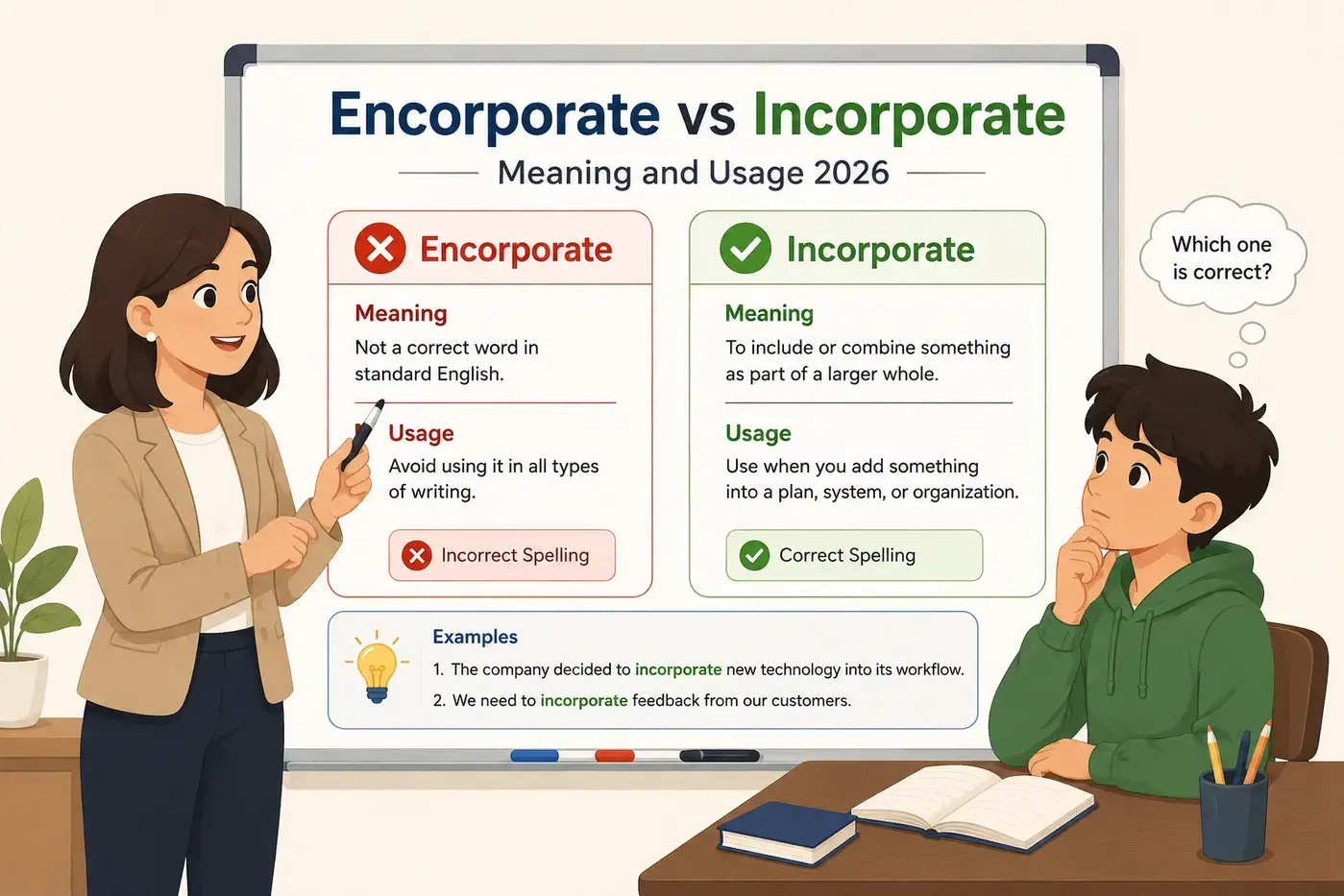
encorporate vs incorporate is an easy spelling confusion because the two forms look and sound similar at first glance. The correct form is incorporate. Encorporate is not the standard spelling of the English verb. If you need to say that something has been included as part of a larger whole then incorporate is the word you want.
The confusion usually comes from pronunciation and from the familiar prefix en that appears in many English words. When people hear the word quickly they may expect an n after the first vowel and write encorporate. English spelling does not always follow sound in a simple way. In this case the standard word begins with in rather than en.
This guide explains the difference in plain English. You’ll learn what incorporate means how to pronounce it how it works grammatically where it came from and how native speakers use it in real writing. You’ll also see common spelling mistakes related words useful examples and an editor’s practical trick for remembering the correct form.
Quick Definition
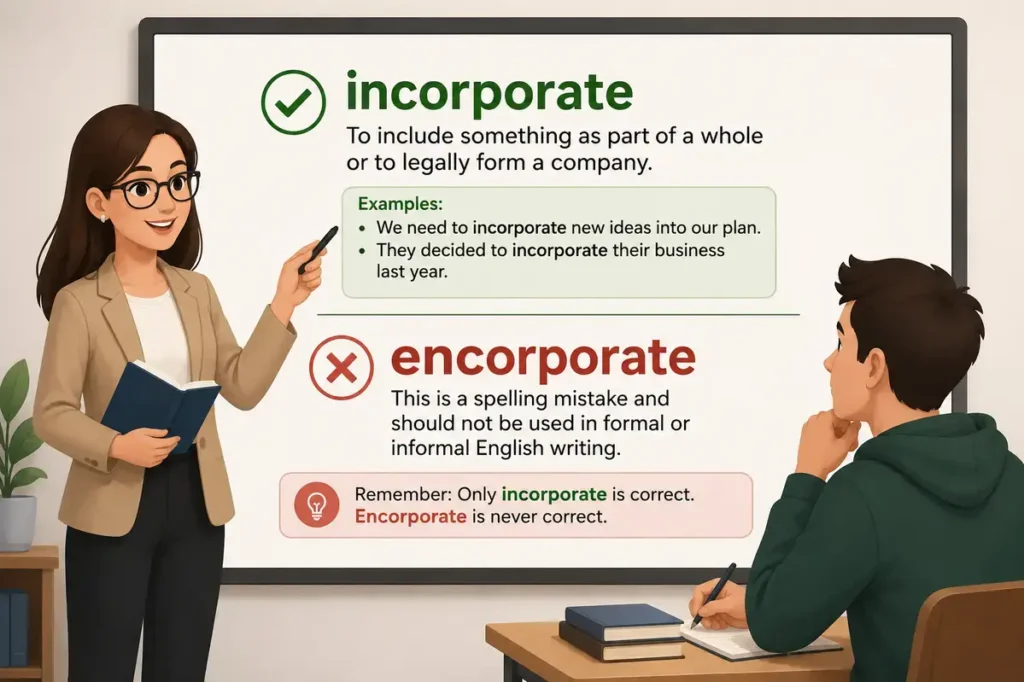
Incorporate is the correct standard English spelling. It means to include something as part of a larger whole or to combine separate elements into one thing. Encorporate is a common spelling mistake rather than a standard alternative. Use incorporate in academic writing business communication everyday English and formal documents.
Quick Answer
The correct spelling is incorporate. Encorporate is an incorrect spelling in standard English.
Incorporate is a verb meaning to include something within a larger whole or to combine parts into one complete thing. For example you might write The company plans to incorporate customer feedback into the new design.
Comparison Table encorporate vs incorporate
| Form | Meaning | Part of Speech | Origin | Usage Frequency | Formality | Common Contexts | Example |
|---|---|---|---|---|---|---|---|
| Incorporate | To include or combine something as part of a whole | Verb | Latin incorporare through French and English | Common | Neutral to formal | Business writing academic work planning design law everyday communication | We will incorporate your suggestions into the final plan. |
| Encorporate | No standard English meaning in this spelling | Verb form used incorrectly | Common spelling error based on sound and spelling pattern | Uncommon as a correct form | Nonstandard | Typing mistakes informal writing proofreading errors | Please change encorporate to incorporate. |
Meaning and Definition
Meaning of the Incorrect Form
Encorporate is generally a misspelling of incorporate. It does not function as a standard English verb with its own established meaning in ordinary modern English.
You may encounter it in emails social media posts student assignments business documents online comments or search queries. Its appearance in real writing can make it seem like a possible variant. Repeated mistakes do not create a standard spelling though.
The error makes sense from a spelling perspective. English has many words that begin with en such as encourage enable enlarge and enrich. A writer who knows the meaning of incorporate but remembers only its general sound may unconsciously choose the familiar en pattern.
That is a classic spelling trap. The brain recognizes the meaning before it checks every letter. When a word feels familiar the mind can fill in the spelling from a nearby pattern. In this case that shortcut leads to encorporate.
For standard English writing the solution is simple. Replace encorporate with incorporate.
Meaning of the Correct Form
Incorporate is a verb that means to include something as part of a larger whole. It can also mean to combine different parts into one unified thing.
Consider this sentence:
The designer incorporated several customer suggestions into the new product.
The suggestions existed separately at first. The designer then included them in the product. That is the central idea behind the verb.
The word can describe physical combination too.
The recipe incorporates fresh herbs into the sauce.
Here the herbs become part of the sauce.
It can also describe ideas information features opinions or methods.
The teacher incorporated group activities into the lesson.
In this sentence group activities become part of the teaching approach.
The verb has a useful range because it works for both concrete and abstract things. You can incorporate ingredients into food features into software ideas into an essay feedback into a plan or evidence into an argument.
In legal and business contexts the word has another established meaning. A business can incorporate as a legal corporation. In that context incorporate refers to the formal process of creating a corporation under applicable law.
For example:
The founders decided to incorporate the company.
That use is different from simply including something in a larger whole. Context tells you which meaning applies.
Key Differences Explained
- Spelling. Incorporate is the standard spelling. Encorporate is a misspelling.
- Meaning. Incorporate means to include combine or make something part of a larger whole. Encorporate has no standard meaning as an ordinary English word.
- Grammar. Incorporate is a verb. It can take a direct object such as ideas feedback features ingredients or evidence.
- Pronunciation. The first syllable begins with an in sound rather than an en sound. This pronunciation can help distinguish the standard spelling.
- Formality. Incorporate works comfortably in casual professional academic technical and formal English.
- Context. The word appears in writing about business education design cooking technology law research planning and many other subjects.
- Regional usage. American British Canadian and Australian English all use incorporate as the standard spelling.
- Standard usage. Professional editors dictionaries spell the word incorporate. The alternative form should be corrected during proofreading.
The most useful distinction is not complicated. One form is a standard English verb and the other is a spelling error.
Which Form Is Correct?
Incorporate is correct. The spelling comes from the established English word incorporate and its historical development from Latin.
The spelling can look unusual because many English words use en as a prefix. However you shouldn’t build the spelling from the sound alone. The standard form begins with in.
A dictionary based approach gives the same practical result. Standard English dictionaries list incorporate as a verb with meanings connected to combining or including something within a whole. Encorporate is not the standard dictionary form for these meanings.
There is also a useful connection with the word corporation. Both words are part of a historical word family connected with the idea of forming something into a body or whole.
That connection gives you a strong memory aid. Think of incorporate and corporation together. Both begin with incor rather than encor.
If you’re proofreading an essay or business document and see encorporate the correction is straightforward. Change it to incorporate.
Sentence Examples
The best way to understand the word is to see how naturally it works in different settings.
- We need to incorporate the new data into our report before submitting it.
- The architect plans to incorporate more natural light into the building.
- She decided to incorporate her grandmother’s recipe into the family cookbook.
- The teacher will incorporate more reading activities into the weekly lessons.
- Our team should incorporate customer feedback before launching the new service.
- The researcher incorporated several earlier findings into the discussion.
- You can incorporate these exercises into your regular study routine.
- The updated software will incorporate several useful security features.
- The chef incorporated fresh vegetables into the evening menu.
- The founders chose to incorporate the business before accepting outside investment.
Notice how the verb often appears with the preposition into. A common pattern is incorporate something into something else.
For example:
The editor incorporated the new evidence into the article.
The evidence was separate before the editing process. Afterward it became part of the article.
You can also use incorporate with an object followed by into.
The team incorporated the suggestions into the proposal.
Another common pattern uses an object without immediately naming the larger whole.
The new design incorporates several practical features.
Here the word means that the design contains or includes those features.
Examples Showing The Incorrect Spelling
The following examples show the error only so you can recognize it during proofreading.
- We need to encorporate the new information into the report.
- The designer wants to encorporate more storage space.
- Please encorporate these changes into the document.
- The course should encorporate more practical exercises.
- The company plans to encorporate customer feedback.
In all five examples the correct spelling is incorporate.
Common Mistakes and Misspellings
The incorrect form is only one of several mistakes that can occur around this word. Some errors come from pronunciation while others come from adding endings incorrectly.
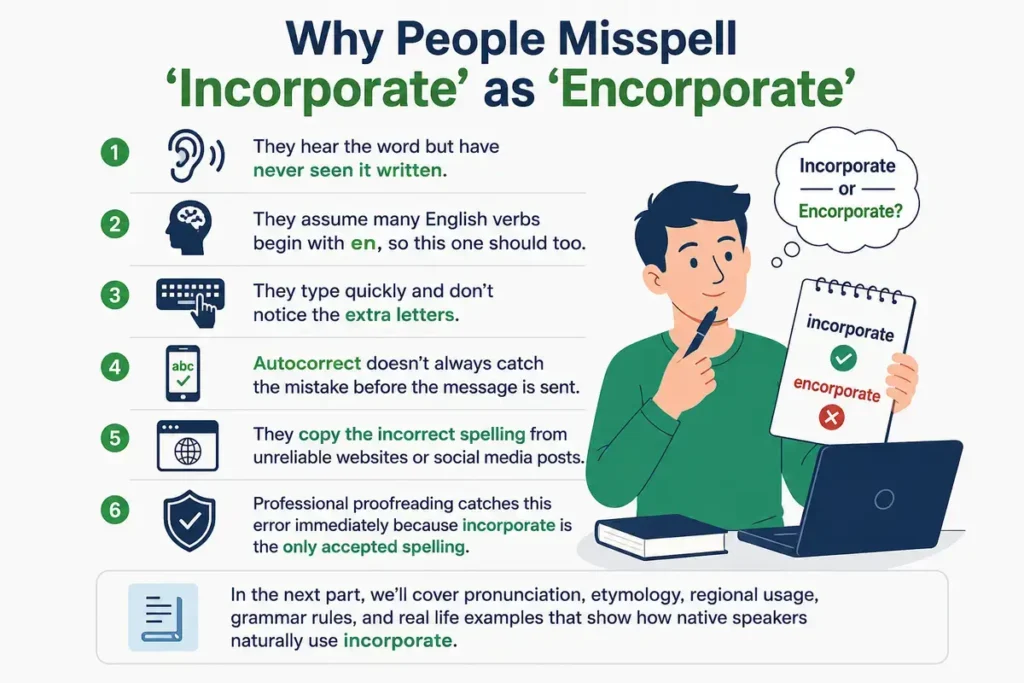
- Encorporate instead of incorporate. This is the main spelling problem. Writers often hear the first part as en and reproduce that sound in writing. The standard spelling begins with in.
- Incorperate instead of incorporate. This mistake changes the second vowel pattern. The ending should contain porate rather than perate. The error often comes from uncertainty about unstressed vowels.
- Incorporated spelled as incorporatted. The past tense and past participle are formed by adding ed to incorporate. The extra t is unnecessary.
- Incorporating spelled as incorporiting. The present participle uses ing. The final e is removed before the ending is added. The correct form is incorporating.
- Incorporation confused with incorporation meaning only inclusion. The noun incorporation can describe the act of including something in a whole. In business and legal contexts it can also refer to forming a corporation. Context determines the intended sense.
These errors show why spelling needs more than sound based guessing. The word belongs to a larger family and its related forms follow recognizable patterns.
Why The First Letters Cause Confusion
The beginning of incorporate creates the biggest problem. English has many common words that use en as a beginning pattern. Writers may therefore assume that the same pattern applies here.
Pronunciation can reinforce the mistake. In normal speech unstressed vowels are often reduced. When someone says incorporate quickly the beginning can be difficult for a learner to analyze letter by letter.
This is where language processing can work against accurate spelling. Your brain is designed to recognize familiar patterns quickly. It doesn’t always inspect every character before producing a word. A familiar spelling pattern can therefore win over the correct one.
The best solution is to remember the whole word family rather than relying only on sound.
Pronunciation Guide
Incorporate has more than one accepted pronunciation pattern depending on how it functions in a sentence and which English variety is being used.
A common American English pronunciation is approximately:
/ɪnˈkɔːrpəreɪt/
The verb can be broken into several sound groups:
in KOR puh rate
The main stress falls on the second syllable.
The first part sounds like in. This gives you a useful clue when you’re trying to remember the spelling.
Incorporate can also have a related pronunciation when used in forms such as incorporated and incorporation. The endings change the rhythm and stress pattern.
A common mistake is to pronounce the first part as en. Another is to give every vowel the same strong sound. Native speakers normally reduce some unstressed vowels in natural speech.
If pronunciation helps you remember spelling then focus on the opening sound. Think in corporate rather than en corporate.
Etymology and Word Origin
Incorporate has deep Latin roots. It comes from Latin incorporare which was built from elements connected with the idea of forming something into a body.
The Latin word corpus means body. The historical idea behind incorporate was connected with making something into a body or bringing something together as one whole.
The word passed through French before becoming established in English. Over time its meanings developed around ideas of combining joining and including.
That history helps explain why the modern verb has several related uses.
When you incorporate an idea into an essay you make it part of the whole argument.
When a business incorporates it becomes organized as a corporation under the relevant legal system.
These meanings look different on the surface but they share an underlying idea. Separate elements become part of a larger whole.
The word corporation comes from the same broad historical family. This relationship can be useful for vocabulary building as well as spelling.
Regional Usage
American English
Incorporate is completely standard in American English. It appears in everyday writing as well as professional fields such as business education technology design law and science.
American speakers commonly use the verb in the pattern incorporate something into something.
For example:
The company will incorporate customer feedback into the next version.
The word also appears frequently in corporate and legal contexts where it refers to forming a corporation.
British English
British English uses incorporate as the standard spelling too. There is no meaningful spelling difference between American and British English for this word.
British writers use it in academic professional business and general contexts. The meanings also remain closely aligned with American usage.
The incorrect form does not become acceptable simply because of British usage.
Australian English
Australian English also uses incorporate as the standard form. The verb works naturally in education business government professional writing and everyday communication.
There is no established Australian spelling variant that changes the first part of the word to encorporate.
Canadian English
Canadian English follows the same standard spelling. Incorporate is used in formal documents workplace communication education business and general writing.
The spelling remains consistent across the major English varieties discussed here. That makes the correction especially straightforward.
Grammar Rules and Part of Speech
Incorporate is primarily a verb. It can function as a transitive verb when it takes a direct object.
For example:
The editor incorporated the new paragraph.
Here the editor is the subject. Incorporated is the verb. The new paragraph is the direct object.
A very common grammatical pattern is:
incorporate something into something
For example:
The company incorporated the new feature into the application.
The first something identifies what gets added. The second identifies the larger thing receiving it.
You can also use the verb without into when the context already makes the larger whole clear.
The design incorporates several new features.
Here the object several new features tells us what has been included. The larger whole is the design itself.
Present Tense
Use incorporate with I you we and they.
I incorporate feedback into my revisions.
We incorporate new evidence into our analysis.
With he she or it use incorporates.
The program incorporates several useful tools.
Past Tense
The simple past form is incorporated.
The editor incorporated the changes.
The team incorporated the new evidence.
Present Participle
The present participle is incorporating.
We are incorporating your suggestions.
The company is incorporating new safety measures.
Past Participle
The past participle is incorporated.
The recommendations have been incorporated into the final report.
The changes were incorporated after the review.
Noun Form
The noun incorporation describes the act or process of incorporating something.
The incorporation of new evidence strengthened the argument.
In a business context incorporation can refer to the legal process of forming a corporation.
Adjective Related Forms
The word incorporated can also function as an adjective in certain contexts.
An incorporated business is a business that has been legally organized as a corporation.
This meaning is especially common in business and legal writing.
Punctuation
Incorporate itself does not require special punctuation. Punctuation depends on the complete sentence.
For example:
The editor incorporated the new evidence into the report.
No comma is needed around the verb.
If an introductory phrase comes before the sentence then normal punctuation rules apply.
After reviewing the feedback the editor incorporated the changes.
A comma may be appropriate after a long introductory phrase depending on sentence structure and style.
The important point is that the spelling of the verb does not change because of punctuation.
Real Life Usage Examples
Daily Conversation
In ordinary conversation people use incorporate when they talk about adding something to a plan routine recipe or activity.
- We can incorporate your idea into the plan.
- I’m trying to incorporate more exercise into my week.
The word is slightly more formal than simply say add but it still sounds natural in everyday American English.
Email And Workplace Communication
The verb appears often in workplace messages because teams regularly revise documents plans designs and processes.
- We’ll incorporate your feedback before sending the proposal to the client.
- Please review the document and let me know if you want us to incorporate any additional changes.
These sentences sound professional without being stiff.
Academic Writing
Academic writers use incorporate to describe bringing evidence ideas methods or earlier research into an argument.
- The study incorporates data from several different sources.
- The paper incorporates historical evidence to support its central argument.
The word works especially well when the writer wants to emphasize that separate material has become part of a larger analysis.
News And Journalism
News writing may use incorporate when describing policy changes organizational decisions technology or business developments.
- The new plan incorporates several recommendations from local officials.
- The updated system incorporates features designed to improve public access.
The word gives journalists a concise way to express the idea of adding something to an existing structure.
Literature And Storytelling
In storytelling the verb can describe how a character or setting absorbs new ideas objects memories or experiences.
- The architect incorporated the old stone wall into the new house.
- Over time the village incorporated the old tradition into its annual festival.
These uses can feel more vivid because they show one element becoming part of something larger.
Related And Confused Terms
Understanding related words can make the meaning of incorporate much clearer.
- Include. Include is the closest everyday alternative. If you include something you make it part of a group set or whole. Incorporate often suggests a more deliberate process of combining something with an existing structure.
- Add. Add is broader and usually simpler. You can add sugar to coffee or add a sentence to an essay. Incorporate often emphasizes that the added element becomes integrated into the whole.
- Combine. Combine means to bring separate things together. It is useful when the focus is on joining elements rather than simply including one inside another.
- Integrate. Integrate often suggests that something becomes smoothly connected with an existing system. It is common in business technology education and social contexts.
- Merge. Merge means to combine two or more things into one. It can describe companies organizations data systems or physical flows.
- Absorb. Absorb can mean taking something in and making it part of a larger system. It often carries a stronger sense of complete assimilation.
- Contain. Contain means to have something inside or within a larger thing. It does not always imply an active process of combining.
- Assimilate. Assimilate can mean to absorb something into a larger system or culture. It has a more specialized meaning and can carry social or cultural implications.
These words overlap but they are not perfect replacements in every sentence. Incorporate is especially useful when something is deliberately added to an existing whole and becomes part of its structure.
An Easy Way To Remember The Spelling
The simplest memory trick is to connect incorporate with corporation.
Both begin with incor.
Think:
incorporate
corporation
That shared opening can stop the brain from automatically choosing en.
Another useful strategy is to connect the word with its meaning. Incorporate means bringing something into a whole. The beginning in can remind you that something goes in.
For example:
Incorporate an idea into an essay.
The idea goes in and becomes part of the essay.
This isn’t a rule that explains every English word. It’s simply a practical memory device. Good spelling tricks don’t need to explain the entire language. They just need to help you make the right choice when the word appears on the page.
Why The Mistake Happens So Easily
The error is understandable because English contains many words beginning with en. Encourage enable enlarge enrich and enforce are familiar examples.
That pattern creates a strong expectation. When someone hears incorporate without seeing it written the brain may interpret the beginning according to a familiar spelling pattern.
There is another factor. The word is often pronounced quickly in natural speech. Unstressed sounds become less distinct and that can make spelling from pronunciation unreliable.
English learners face this issue frequently. Native speakers can also make the mistake during fast typing because typing depends on memory and pattern recognition rather than careful letter by letter analysis.
The important lesson is simple. Pronunciation can help with spelling but it should not always control spelling.
If you’re unsure write the word slowly in your mind:
in corporate
Then check the first four letters.
incor
That small pause is often enough to prevent the error.
Expert Editor Insight
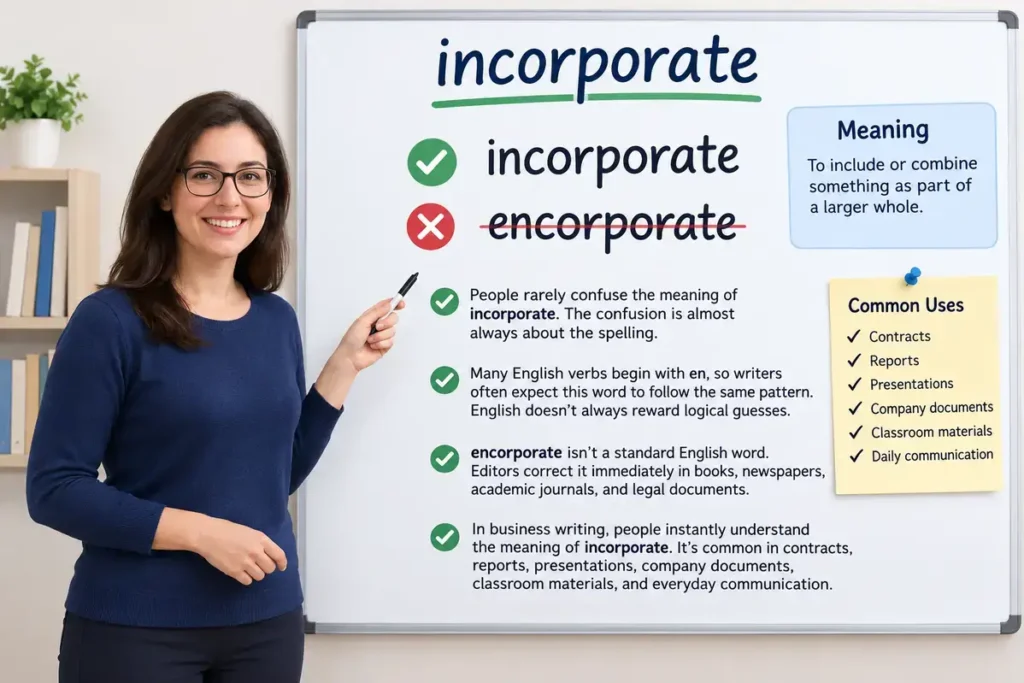
An experienced editor would treat encorporate as a straightforward spelling error and correct it to incorporate. Native speakers generally recognize the standard form immediately because it is an established word used across many fields. Spellcheck tools are likely to flag the incorrect form because it doesn’t match the expected dictionary entry. My practical editing tip is to remember the word family connection between incorporate and corporation. If you remember the shared incor opening you’re much less likely to insert an unnecessary e after the initial sound.
Final Takeaway
encorporate vs incorporate has one clear answer. Incorporate is the correct standard spelling and encorporate is a common spelling mistake. The verb means to include something in a larger whole or combine separate elements so they become part of that whole. It can describe ideas ingredients features evidence plans and many other things.
The word works naturally in everyday speech as well as academic professional business and formal writing. Its most common structure is incorporate something into something. Remember that the word shares its opening with corporation. That simple connection can help you avoid adding an unnecessary e and makes the correct spelling much easier to recall.
FAQs
Is encorporate a real word?
Encorporate is not the standard English spelling of the verb meaning to include or combine something with a larger whole. In ordinary writing it should be treated as a spelling mistake. The correct form is incorporate. You may encounter the incorrect version online or in informal writing but its appearance does not make it an accepted standard spelling.
What does incorporate mean?
Incorporate means to include something as part of a larger whole or to combine separate elements into one unified thing. You can incorporate an idea into an essay a feature into software an ingredient into a recipe or feedback into a plan. In business language the verb can also refer to legally forming a corporation.
Which is correct encorporate or incorporate?
Incorporate is correct and encorporate is incorrect in standard English. The standard word begins with in rather than en. It commonly appears in the pattern incorporate something into something. For example you can say The writer incorporated new evidence into the article. That form works in casual professional academic and formal English.
How do you pronounce incorporate?
In American English incorporate is commonly pronounced approximately /ɪnˈkɔːrpəreɪt/ when used as a verb. A simple pronunciation guide is in KOR puh rate. The main stress normally falls on the second syllable. Saying the opening as in can also help you remember the spelling and avoid changing the first part to en.
Can incorporate be used in formal writing?
Yes. Incorporate is completely appropriate in formal writing. It appears naturally in academic papers business reports legal documents professional emails research writing and technical material. The word can make writing precise because it clearly describes the process of adding something to an existing whole. In many formal contexts it is more precise than the simpler word add.
What is a synonym for incorporate?
Useful synonyms include include add combine integrate merge absorb and assimilate. The best choice depends on the context. Include is usually the simplest option while integrate often suggests that something becomes part of an existing system. Combine emphasizes joining separate elements. Incorporate is especially useful when you want to show that an added element becomes part of a larger structure.
Why do people spell incorporate as encorporate?
People often make this mistake because the beginning of the word can be hard to identify from quick speech. English also has many familiar words beginning with en so that spelling pattern can influence memory. Fast typing adds another layer of difficulty. Remembering the connection between incorporate and corporation is a useful way to avoid the error.
Is incorporate used differently in American and British English?
The standard spelling is incorporate in both American and British English. The basic meanings are also the same. Both varieties use the word for including something in a larger whole and for the legal process of forming a corporation. Canadian and Australian English also use the same standard form, so there is no regional spelling change to remember.
