
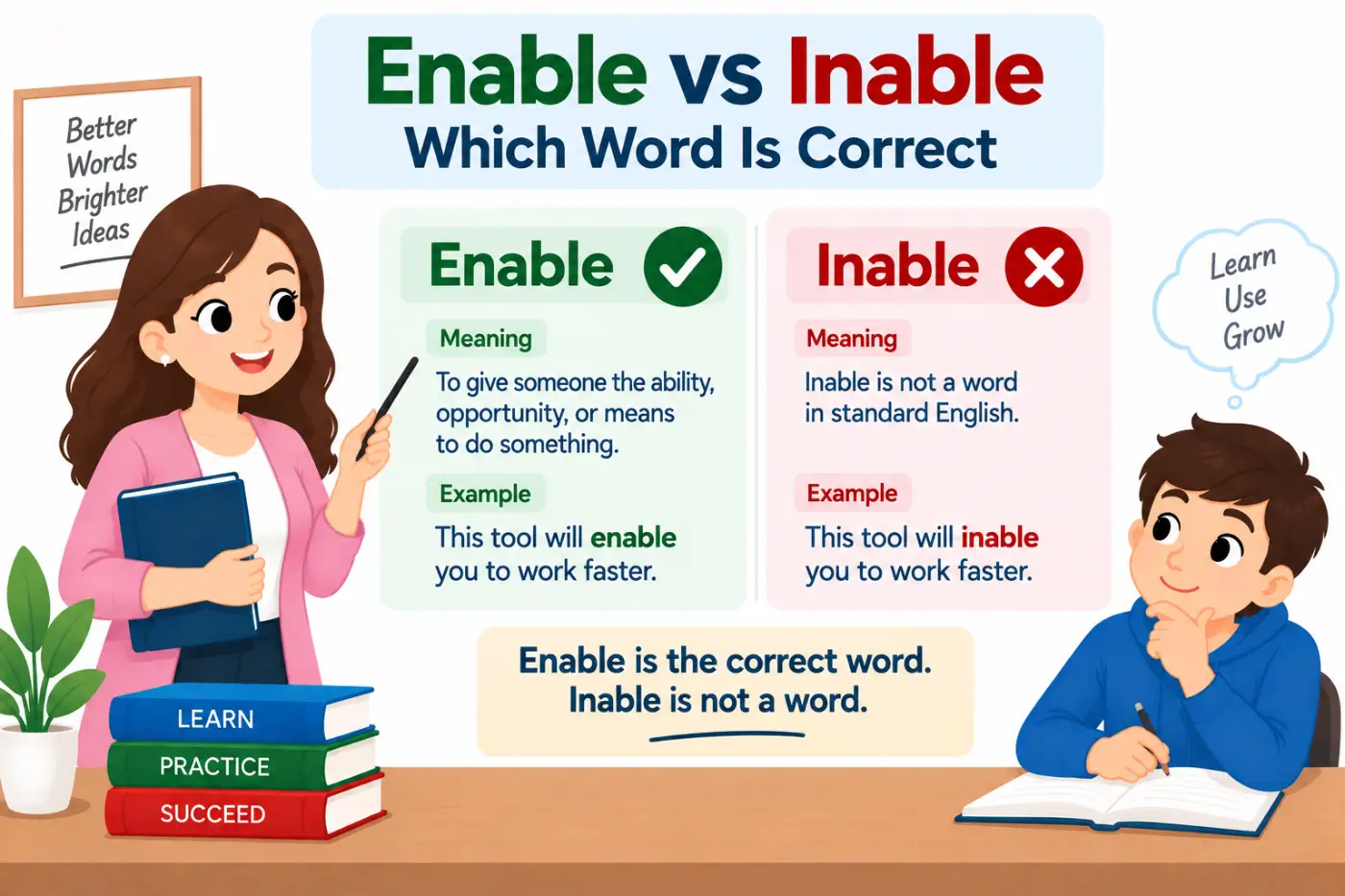
The confusion around enable vs inable usually comes from a simple spelling assumption. Enable is the standard English word when you mean to make something possible or to give someone the ability or means to do something. Inable is not normally used as a standard modern English word for that meaning. If you want to say that someone cannot do something you usually need unable instead.
The confusion becomes easier to understand once you separate the meanings of enable and unable. Enable is a verb that describes giving ability or making an action possible. Unable is an adjective that describes a person or thing that lacks the ability to do something. The word inable sometimes appears in historical or rare usage but it isn’t the normal choice in modern American English.
This distinction matters because these words can look as though they should form a simple opposite pair. They don’t. This guide explains the meanings grammar pronunciation word history spelling differences and everyday usage so you can choose the right expression without second guessing yourself.
Quick Definition
Enable is the standard modern English verb meaning to make something possible or to give someone the ability or means to do something. Inable is not the normal modern form for this purpose. If you mean not able to do something use unable. The three forms have different grammatical roles and meanings.
Quick Answer
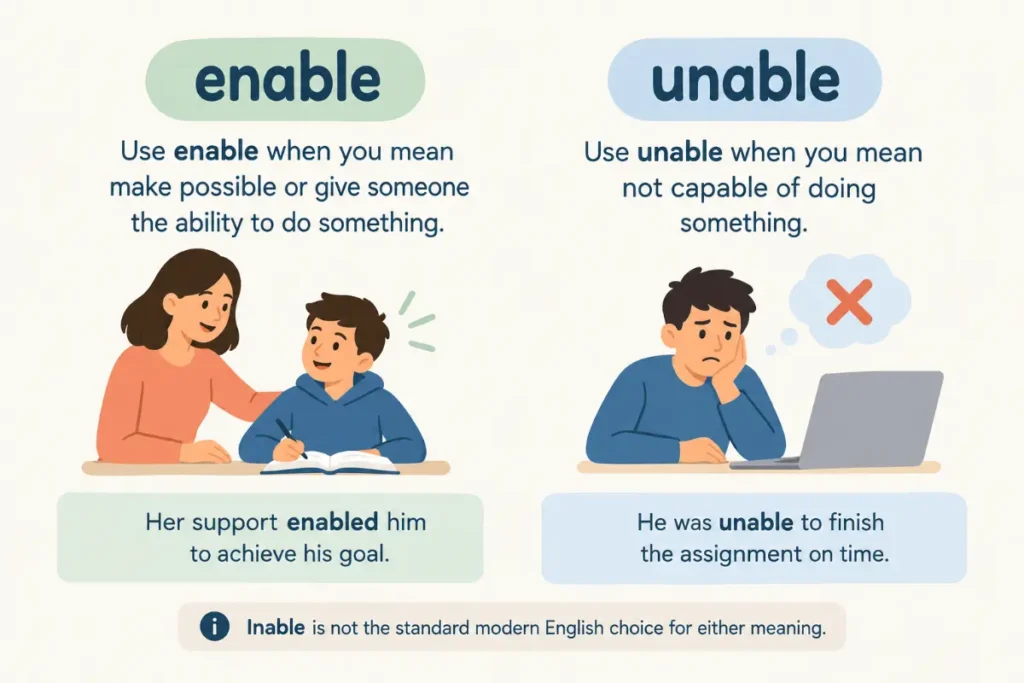
Use enable when you mean make possible or give someone the ability to do something. Use unable when you mean not capable of doing something. Inable is not the standard modern English choice for either meaning. Although historical dictionaries and older texts may contain related forms, modern American English strongly favors enable for the positive idea and unable for the negative idea.
Comparison Table
| Form | Meaning | Part of Speech | Origin | Usage Frequency | Formality | Common Contexts | Example |
|---|---|---|---|---|---|---|---|
| Enable | To make possible or give ability | Verb | From Old French and Latin roots related to ability | Very common | Neutral and formal | Technology work education policy everyday speech | The new feature enables users to save their work. |
| Inable | Not a normal modern standard choice | Rare or historical form | Related historically to ability and enable | Very rare | Nonstandard or historical in modern use | Historical texts or unusual usage | Modern writers normally avoid inable. |
| Unable | Not capable of doing something | Adjective | Built from able with the negative prefix un | Very common | Neutral and formal | Conversation work education reports everyday writing | She was unable to attend the meeting. |
Meaning and Definition
Meaning of Enable
Enable is a verb. Its basic meaning is to make something possible or to give someone the ability means permission or opportunity to do something.
Consider this sentence.
The new software enables employees to work remotely.
The software doesn’t perform the work on behalf of the employees. Instead it makes remote work possible.
The word can also describe giving a person the means to act.
Training enables workers to handle difficult situations.
Here training provides the knowledge or skills needed for an action.
In technology enable is extremely common. You may see buttons and settings that allow users to turn a feature on.
Enable notifications.
Enable automatic updates.
In these examples the verb means to activate or make a function available.
Enable can also appear in discussions about education health policy business and social conditions.
Education can enable people to develop new skills.
The word therefore has a broad meaning. Its central idea is possibility or ability.
Meaning of Inable
Inable is not normally the word modern English speakers choose to express the opposite of enable.
You may encounter it in older writing or unusual contexts. Some historical English sources contain forms related to inable but that doesn’t make it the preferred word in present day American English.
For practical writing the distinction is simple. Don’t use inable as a substitute for unable.
If you want to say that someone lacks the ability to perform an action write:
She was unable to attend.
Not:
She was inable to attend.
Likewise if you want to say that a tool makes something possible use enable.
The problem is understandable because English has many negative forms created with prefixes. A learner may see able and enable and assume that inable must naturally mean the opposite of enable. English doesn’t always build opposites in such a neat way.
Meaning of Unable
Unable is an adjective meaning not having the ability or capacity to do something.
She was unable to finish the project.
He was unable to open the file.
They were unable to attend the event.
The structure is usually:
unable + to + base verb
For example:
I was unable to sleep.
The adjective describes the subject. The phrase to sleep identifies the action the subject could not perform.
This is different from enable because enable is an action performed by a person thing system or situation that creates an opportunity or ability.
The software enables me to edit the file.
I’m unable to edit the file.
These two sentences fit together naturally. One describes something that makes an action possible. The other describes a person who cannot perform the action.
Key Differences Explained
- Meaning. Enable means to make something possible or give someone the means to act. Unable means not capable of doing something.
- Grammar. Enable is a verb. Unable is an adjective.
- Spelling. Enable is the standard modern spelling for the positive idea. Inable isn’t the normal modern form. Unable is the standard negative form.
- Pronunciation. Enable and unable have related sounds but different stress patterns and vowel sounds at the beginning.
- Formality. Enable and unable are both suitable for casual and formal English.
- Context. Enable is common in technology education business and general conversation. Unable appears whenever someone lacks the ability to complete an action.
- Opposition. Unable is not simply formed by changing enable into inable. The words follow different historical and grammatical patterns.
- Modern usage. Contemporary American English overwhelmingly favors enable and unable in their respective meanings.
The most useful pairing to remember is enable and unable. They work naturally as positive and negative ideas even though they aren’t perfect grammatical opposites.
Which Form Is Correct?
Enable is the correct standard verb when you mean make possible give ability or activate a feature.
Unable is the correct adjective when you mean not able or not capable.
Inable should generally be avoided in modern standard English unless you’re discussing a historical text or a specialized usage where the form has been deliberately preserved.
There’s a linguistic reason for this apparent oddity. English doesn’t create every opposite by adding the same negative prefix to a related word. The adjective able has a well established negative form unable. Meanwhile enable developed as a verb meaning to make able or make possible.
That means these forms aren’t simply a three step spelling pattern.
able → unable
enable → makes possible
This distinction becomes especially clear in sentence structure.
The training enabled her to operate the machine.
She was unable to operate the machine.
The first sentence describes something that gave her the ability. The second describes her lack of ability.
Established dictionaries treat enable as a standard verb and unable as a standard adjective. That dictionary based distinction matches ordinary modern usage and professional editing practice.
Sentence Examples
Examples With Enable
- The new app enables customers to track their orders.
- Good lighting enables drivers to see the road more clearly.
- The course enables students to develop practical skills.
- This setting enables you to receive notifications instantly.
- Regular exercise can enable people to stay active as they grow older.
- The scholarship enabled her to continue her education.
- The updated system enables employees to access their files from home.
- Clear instructions enable new users to complete the task without help.
- Better communication enables teams to solve problems faster.
- The password manager enables users to create stronger passwords.
Each example uses the verb to describe something that makes an action possible or provides the means to perform it.
Examples With The Incorrect Modern Form
These examples demonstrate the kind of construction you should normally avoid in modern standard English.
- The new system inables workers to access the database.
- She was inable to complete the assignment.
- The device inables users to control the temperature.
- He was inable to attend the meeting.
- The program inables students to practice their skills.
The first and third sentences need enables.
The second and fourth need unable.
The fifth also needs enables.
The problem isn’t simply the spelling. The intended meaning determines the correct replacement.
Common Mistakes and Misspellings
Using Inable Instead of Unable
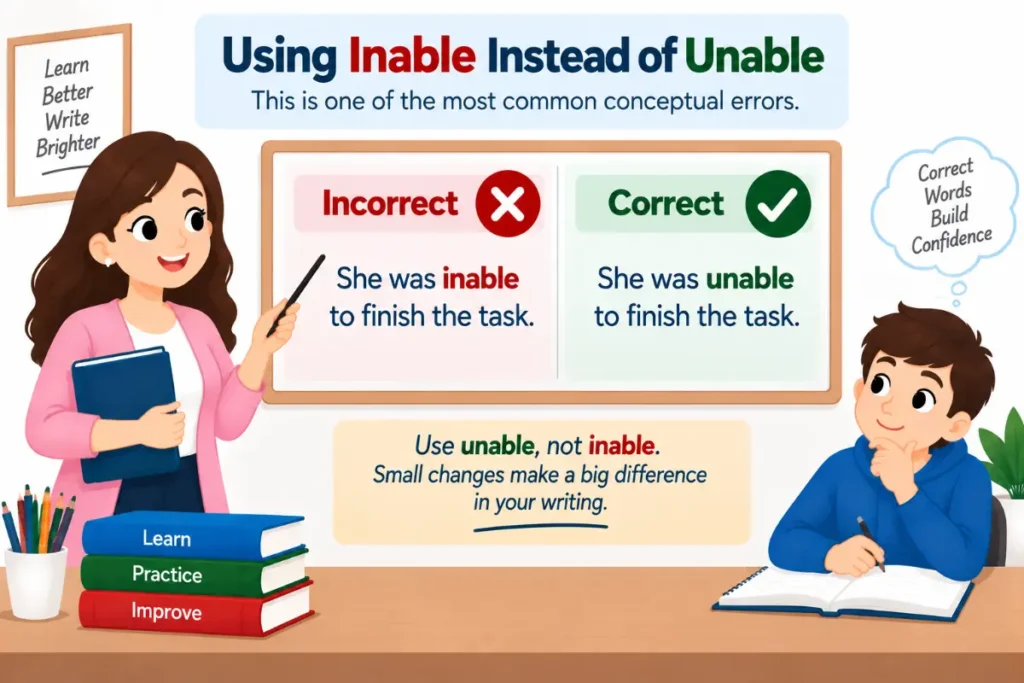
This is one of the most common conceptual errors.
Incorrect:
She was inable to finish the task.
Correct:
She was unable to finish the task.
The reason is grammatical as well as lexical. Unable is an adjective and fits naturally after forms of be.
Using Inable Instead of Enable
Another error occurs when someone wants to describe something that makes an action possible.
Incorrect:
The feature inables users to change the settings.
Correct:
The feature enables users to change the settings.
Here the intended meaning is make possible. The verb enable is the right choice.
Confusing Enable With Allow
Enable and allow can sometimes overlap but they aren’t always identical.
The new system enables employees to work from home.
The manager allowed employees to work from home.
Enable often emphasizes the means or conditions that make something possible. Allow often emphasizes permission.
That distinction can make your writing more precise.
Confusing Enable With Able
Able is an adjective.
She is able to swim.
Enable is a verb.
The training enabled her to swim confidently.
The first describes capability. The second describes something that gives or creates that capability.
Treating Prefixes as Perfect Opposites
English learners sometimes expect inable to be the direct negative of enable because English contains words such as inactive and incomplete.
That pattern doesn’t work here.
Language develops through history rather than through a perfectly organized mathematical system. A word can look as though it should exist without being the form native speakers normally use.
Pronunciation Guide
Enable
Enable is commonly pronounced /ɪˈneɪbəl/.
An easy American English approximation is:
ih NAY buhl
The main stress falls on the second syllable.
You can think of the word as three syllables:
ih NAY buhl
The first vowel is short and unstressed. The middle syllable carries the strongest emphasis.
Unable
Unable is commonly pronounced /ʌnˈeɪbəl/.
An easy approximation is:
un NAY buhl
Again the strongest stress falls on the middle syllable.
The beginning clearly contains the sound associated with un.
Inable
The form inable creates an additional pronunciation problem because it isn’t the normal modern word people expect in these contexts. If you encounter it in an older source its pronunciation should be understood from that particular historical context.
For modern English writing the safest approach is not to search for a modern pronunciation of inable. Choose the established word that expresses your intended meaning.
A useful pronunciation tip is to practice enable and unable as a pair.
enable
unable
The shared able sound can help you remember that both words relate to ability while the opening sound tells you something different about their grammatical and semantic roles.
Etymology and Word Origin
The history of these words helps explain why the spelling can feel confusing.
Able ultimately traces back through French to Latin roots associated with capability or suitability. The English word developed into the familiar adjective meaning having the skill power or capacity to do something.
Enable developed from the same broader word family. Its history is connected with the idea of making someone or something able.
The prefix en has an important function in many English verbs. It can carry the idea of putting into a condition or causing something to have a particular quality. In enable the resulting meaning is essentially to make able or make possible.
Unable developed differently. The prefix un commonly creates a negative meaning. Unable therefore means not able.
This gives us a useful historical and semantic relationship.
able expresses capability.
enable expresses making something possible or giving capability.
unable expresses lack of capability.
The form inable may be found in historical English material but it hasn’t become the ordinary modern counterpart to enable. Modern usage settled on unable for the negative adjective.
This is a good example of why English spelling and word formation can’t always be predicted simply by applying a prefix rule. Historical development matters.
Regional Usage
American English
American English uses enable as the standard verb and unable as the standard adjective. Both are common in everyday speech and formal writing.
You’ll see enable frequently in technology because software often provides settings that users can turn on. You’ll also see it in business education policy and general discussion.
Unable is equally normal when describing a lack of ability.
The form inable isn’t the usual modern American choice.
British English
British English also uses enable and unable in standard modern usage. The meanings and grammatical roles are essentially the same as in American English.
A British writer would normally say:
The new system enables users to work faster.
And:
She was unable to attend.
There isn’t a major British spelling variant that makes inable the standard choice.
Australian English
Australian English follows the same general pattern. Enable is the standard verb and unable is the normal negative adjective.
Both forms occur naturally in education business technology government writing and everyday conversation.
Inable isn’t an established mainstream Australian alternative for these meanings.
Canadian English
Canadian English likewise uses enable and unable. The distinction follows the same grammatical pattern found in American and British English.
Regional spelling differences can affect some English words but this isn’t one of those cases. The issue is word choice rather than a regional spelling variation.
Grammar Rules and Part of Speech
How Enable Works As A Verb
Enable is a transitive verb in its most common uses. That means it normally takes an object.
The software enables users to edit documents.
The object is users. The following phrase explains the action they can perform.
A very common structure is:
enable + someone + to + verb
Examples include:
The program enables students to practice pronunciation.
The device enables doctors to monitor the patient remotely.
The training enabled him to operate the equipment safely.
This construction is extremely useful in formal writing because it clearly shows who gains the ability and what action becomes possible.
Enable In Technology
Technology has made this verb especially familiar.
Enable notifications.
Enable automatic updates.
Here the word means activate or turn on a feature.
The grammatical structure is different from the earlier examples because the object can be the feature itself.
You can also write:
The setting enables notifications.
This means the setting makes notifications available or active.
How Unable Works As An Adjective
Unable describes a lack of ability.
I’m unable to attend.
She was unable to open the door.
They were unable to complete the test.
The most common structure is:
be + unable + to + verb
The forms of be can change according to the subject and tense.
I am unable to help.
He is unable to help.
They were unable to help.
She will be unable to help.
The adjective itself remains unable.
Enable And The Infinitive
A common grammar pattern is:
enable + object + to + base verb
For example:
The new software enables employees to collaborate.
A common mistake is to leave out to.
Incorrect:
The software enables employees collaborate.
Correct:
The software enables employees to collaborate.
This small point matters in polished writing.
Unable And The Infinitive
Unable also takes to before the following base verb.
Correct:
He was unable to finish.
Incorrect:
He was unable finish.
The pattern is consistent and easy to recognize once you’ve seen enough examples.
Punctuation
Neither enable nor unable requires special punctuation simply because of the word itself.
Punctuation depends on the larger sentence.
For example:
The update enables users to save their work automatically.
No special punctuation is needed.
The same applies to:
She was unable to attend the meeting.
The words fit naturally into the sentence without commas.
Real Life Usage Examples
Daily Conversation
In everyday speech enable often describes something that gives a person an opportunity.
This pass enables you to enter the building.
The new bus route enables us to get home earlier.
Unable commonly describes a temporary limitation.
I’m unable to come tonight.
He was unable to find his keys.
The language feels ordinary and natural in these contexts.
Email And Workplace Communication
Professional writing often uses enable to describe systems processes or resources.
The new platform enables employees to share documents more easily.
The updated schedule will enable the team to complete the project on time.
Unable is useful when explaining limitations without sounding overly casual.
I’m unable to attend the meeting this afternoon.
We’re unable to process the request until we receive the required information.
Academic Writing
Academic writing frequently uses enable when discussing conditions that make results possible.
Access to reliable data enables researchers to compare different outcomes.
The method enables students to develop stronger analytical skills.
Unable can describe limitations in a study or situation.
The researchers were unable to obtain sufficient data.
The participants were unable to complete the final stage.
News And Journalism
News writing may use enable when describing policies technology or developments.
The new law could enable businesses to expand their operations.
The system enables emergency workers to share information quickly.
Unable can describe an unsuccessful attempt or limitation.
Officials were unable to confirm the report.
The team was unable to reach the affected area.
Literature And Storytelling
In storytelling enable can describe the thing that makes an important event possible.
The discovery enabled the travelers to continue their journey.
Her kindness enabled him to begin again.
Unable often emphasizes an obstacle.
He was unable to explain what had happened.
She stood at the door unable to move.
The contrast can be powerful because enable highlights possibility while unable highlights limitation.
Related And Confused Terms
Able
Able is an adjective meaning capable of doing something.
She is able to solve the problem.
It describes the subject’s capability.
Unable
Unable is the negative form of able.
She is unable to solve the problem.
It tells us that the subject lacks the ability or capacity to perform the action.
Allow
Allow usually means give permission.
The teacher allowed students to use calculators.
Enable can sometimes overlap with allow but often focuses on making an action possible rather than granting permission.
Permit
Permit is similar to allow and often sounds more formal.
The policy permits employees to work remotely.
Again the focus is commonly on permission.
Activate
Activate means make something active or operational.
In technology contexts enable and activate can sometimes overlap but activate more directly suggests switching something into an active state.
Facilitate
Facilitate means make an action or process easier or more likely to happen.
The new system facilitates communication between departments.
It can be a useful formal alternative when you want to emphasize that something helps a process move forward.
Support
Support means help someone or something succeed or function.
The software supports remote collaboration.
Support doesn’t always mean directly making something possible. It can describe assistance instead.
Prevent
Prevent is close to the opposite idea in some contexts. It means stop something from happening.
The security system prevents unauthorized access.
Enable makes an action possible while prevent stops an action from happening.
These distinctions are useful because choosing the right verb often makes a sentence clearer than relying on broad synonyms.
Why The Confusion Happens
The main source of confusion is the appearance of the words themselves.
English has many pairs where a prefix creates an opposite.
For example:
possible and impossible.
legal and illegal.
regular and irregular.
active and inactive.
Because of patterns like these a learner may reasonably assume that enable and inable should work as opposites.
But English isn’t perfectly predictable. Words come from different historical paths and their forms become established through usage over time.
The word able creates the familiar negative adjective unable. That form is deeply established in modern English.
Enable has a different function. It means to make able or make possible.
So the natural modern pair is:
enable
and
unable
They aren’t exact opposites in grammar because one is a verb and the other is an adjective. Yet they express opposite directions of ability.
One creates or provides ability.
The other describes the absence of ability.
That difference is worth remembering because it prevents several errors at once.
Enable In Formal Writing
Enable is entirely appropriate in formal writing. It appears naturally in academic papers business reports technical documentation policy documents instructions and professional communication.
For example:
The revised process enables staff to respond more quickly.
The program enables students to access additional learning resources.
The system enables researchers to analyze large amounts of information.
In formal writing the word can sometimes be overused because it sounds polished and professional. If every sentence says that one thing enables another thing the prose may become repetitive.
Good editing means choosing the verb that communicates the exact relationship.
Use enable when something genuinely makes an action possible or gives someone the means to perform it.
Use facilitate when something makes a process easier.
This small distinction can make professional writing more precise.
Enable In Technology
Technology is one area where enable has become especially familiar.
Software settings often use enable as a direct instruction.
Enable notifications.
Enable two factor authentication.
In these cases the word means activate or turn on a feature.
The opposite instruction is commonly disable.
Disable notifications.
Disable the feature.
Notice that this creates another useful word pair.
enable and disable
This is different from:
able and unable
Understanding these two pairs can prevent a lot of confusion.
Enable and disable describe activating or deactivating something.
Able and unable describe capability.
For example:
The setting enables automatic backup.
I’m unable to access the backup.
The first sentence talks about a feature. The second talks about a person’s ability.
Expert Editor Insight
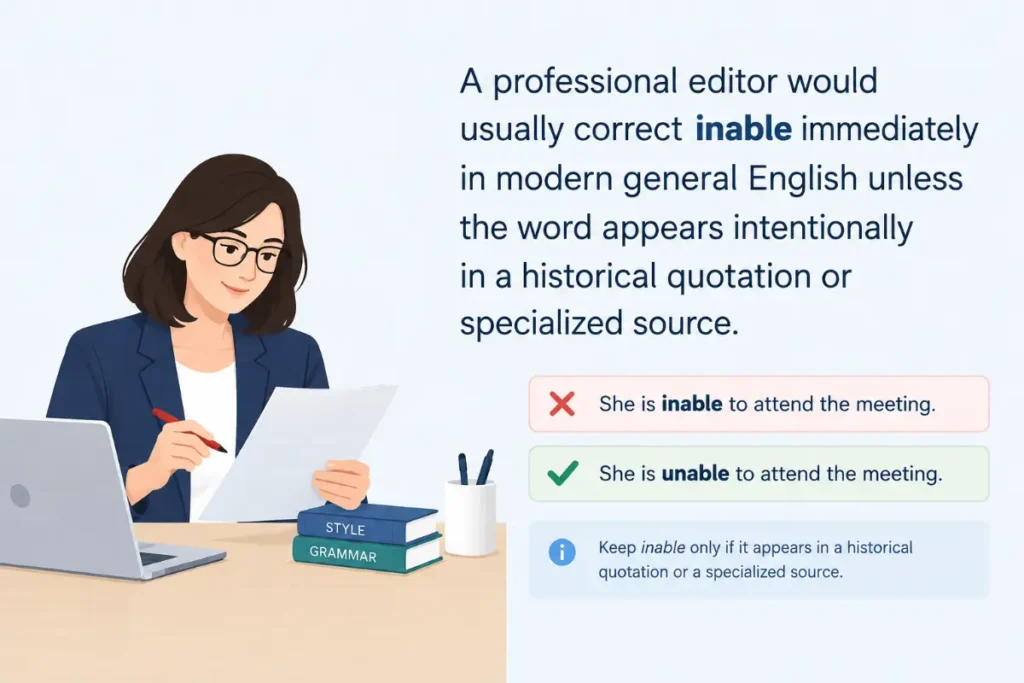
A professional editor would usually correct inable immediately in modern general English unless the word appears intentionally in a historical quotation or specialized source. The bigger issue isn’t just spelling. Editors check the intended meaning and grammatical role before choosing the replacement. If the sentence means make possible use enable. If it means not capable use unable. Spellcheckers can catch many obvious forms but context still matters because a grammatically possible word can be the wrong word for the intended idea. A useful editing habit is to replace the questionable form with a complete sentence and ask whether you mean giving ability or lacking ability.
Conclusion
Enable vs inable becomes much easier once you focus on meaning instead of appearance. Enable is the standard modern verb for making something possible or giving someone the means to do something. Unable is the standard adjective for describing a lack of ability. Inable isn’t the normal modern choice for either meaning.
The most useful distinction is grammatical as well as semantic. Enable describes an action that creates an opportunity or ability, while unable describes a person or thing that lacks the ability to act. That’s why sentences such as The training enabled her to work independently and She was unable to attend both sound natural and communicate clearly.
For an easy memory trick, connect able with unable and enable with make possible. If you mean giving ability, choose enable. If you mean lacking ability, choose unable. That simple check will keep this common confusion out of your writing.
FAQs
Is inable a real word?
Inable can be found in some historical English sources and unusual usage but it isn’t the normal modern English choice for expressing either make possible or not able. In contemporary American English use enable for the positive idea and unable for the negative idea. If you’re writing an essay email report or other standard English text inable is best avoided.
What is the difference between enable and unable?
Enable is a verb meaning to make something possible or give someone the means to do something. Unable is an adjective meaning not capable of doing something. Compare these sentences: The training enabled her to operate the machine. She was unable to operate the machine. One describes gained ability while the other describes a lack of ability.
Is enable the correct opposite of unable?
Enable and unable express contrasting ideas but they aren’t grammatical opposites. Enable is a verb that means make possible or give ability. Unable is an adjective meaning not capable. A closer grammatical comparison is enable and disable because both are verbs. Able and unable form the familiar positive and negative adjective pair.
Should I use inable instead of unable?
No. In modern standard English you should normally use unable when you mean not able or not capable. For example write She was unable to attend the meeting. Don’t write She was inable to attend the meeting. Although inable has appeared in older English usage it isn’t the normal modern choice for this construction.
Is enable appropriate in formal writing?
Yes. Enable is common and fully acceptable in formal English. Writers use it in academic work business reports technical documents policy writing and professional communication. It can describe something that makes an action possible or gives someone the means to act. Still choose alternatives such as facilitate support or permit when they express your intended meaning more precisely.
What is the opposite of enable?
The closest direct opposite of enable is usually disable when the subject is a feature system or function. For example enable notifications means turn notifications on while disable notifications means turn them off. If you’re talking about a person’s ability the relevant negative adjective is unable. The correct opposite depends on the meaning and grammatical context.
Why do people confuse enable and inable?
People often confuse them because English contains many words that use prefixes to create related or opposite meanings. It can seem logical that enable should have a negative form inable. However modern English uses unable as the negative form of able. Enable developed as a verb meaning to make able or make possible rather than as a word that contrasts directly with unable.
How can I remember the correct word?
Use a simple three word pattern: able describes capability, enable means make possible, and unable means not capable. If the subject is giving someone the ability use enable. If the subject lacks the ability use unable. This approach is more reliable than trying to decide based only on spelling because it connects the word to its meaning and grammar.
