
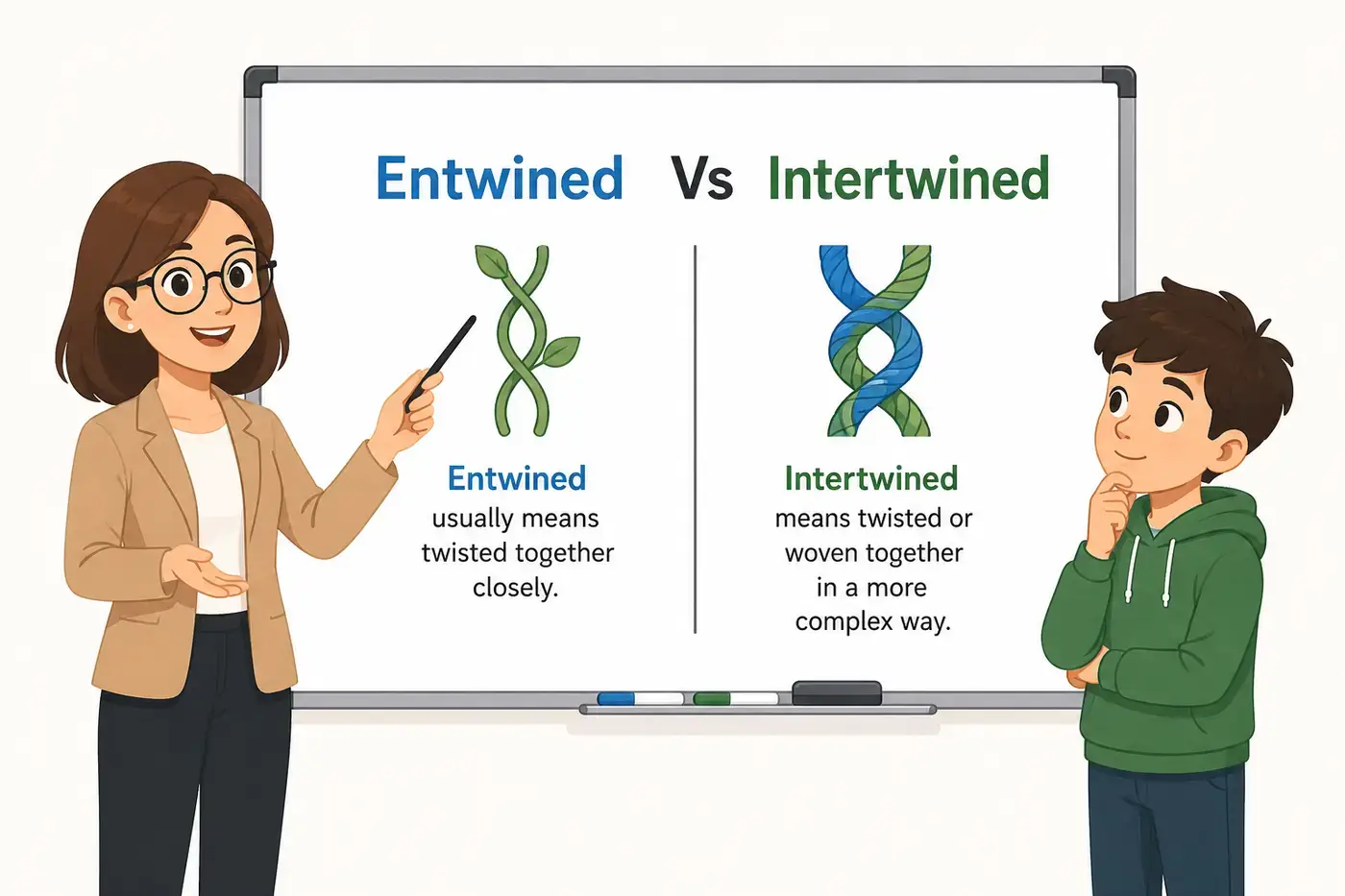
If you’re comparing entwined vs intertwined you’ve probably noticed that the two words seem almost interchangeable. They often describe things that are closely connected, twisted together, or wrapped around one another. Both forms are correct English, but they don’t always create exactly the same impression.
The main difference is subtle. Entwined often emphasizes things being twisted or wrapped together in a close connection. Intertwined strongly suggests that two or more things are woven or mixed together so closely that separating them can be difficult. The words overlap heavily, which explains why writers sometimes use them without considering the small difference in emphasis.
The good news is that you don’t need a complicated rule to choose between them. Once you understand their core meanings, grammatical forms, tone, and common contexts, the choice becomes much easier. This guide explains the distinction with natural examples from everyday speech, relationships, business, academic writing, storytelling, and formal communication.
Quick Definition
Entwined and intertwined are both correct words. Entwined usually describes things twisted or wrapped closely around each other, while intertwined often emphasizes things woven or connected together in a more complex way. They can describe physical objects as well as abstract ideas such as lives, histories, relationships, cultures, and economies.
Quick Answer
Both forms are correct.
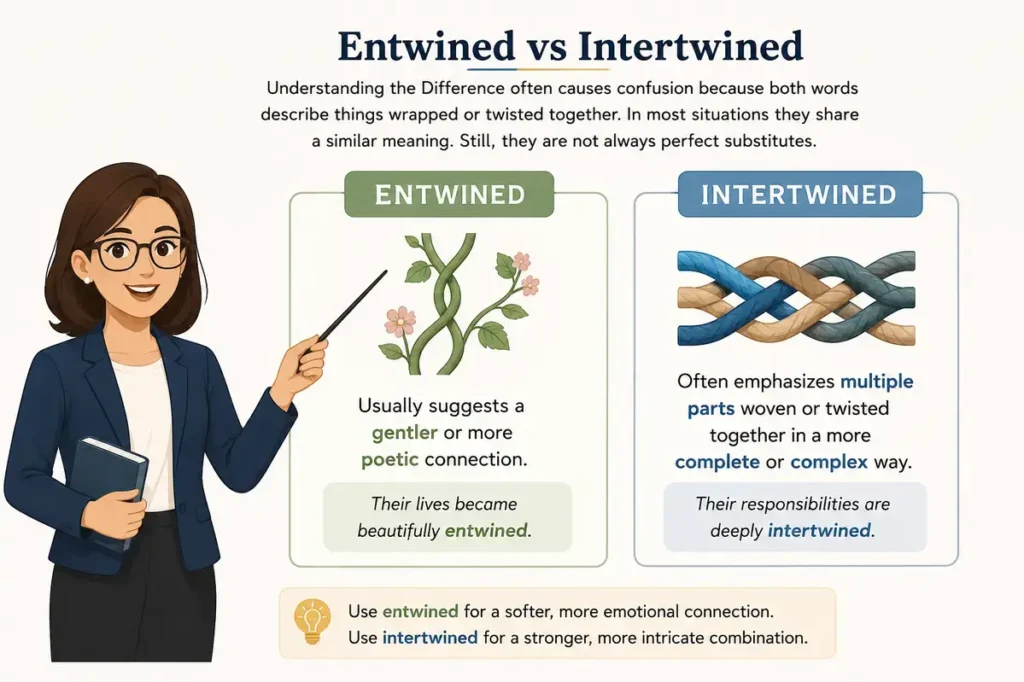
Use entwined when you want to emphasize things that are twisted, wrapped, or closely connected. Use intertwined when you want to emphasize several things that are woven together or deeply connected in a complicated way.
For many sentences, either word can work. The best choice depends on the image or relationship you want the reader to picture.
Comparison Table
| Form | Core Meaning | Part of Speech | Origin | Usage Frequency | Formality | Common Contexts | Example |
|---|---|---|---|---|---|---|---|
| Entwined | Twisted or closely wrapped together | Adjective or past participle | Germanic English word family related to twine | Common | Neutral | Relationships, plants, objects, stories, lives | The vines were entwined around the fence. |
| Intertwined | Woven or connected closely together | Adjective or past participle | Built from intertwine with inter and twine | Common | Neutral to formal | Ideas, histories, economies, relationships, objects | Their histories are deeply intertwined. |
Meaning and Definition
Meaning of Entwined
Entwined describes two or more things that have become twisted, wrapped, or closely connected.
The word comes from the verb entwine. Something can become entwined physically, such as two branches growing around each other. It can also become entwined in a figurative sense, such as two people whose lives have become closely connected.
Consider this sentence.
The branches were entwined above the doorway.
You can easily picture the branches twisting around each other. The physical image is strong and direct.
Now consider this example.
Their lives became entwined after years of friendship.
No physical twisting is happening. Instead, the word creates a metaphor. Their experiences, relationships, and choices have become closely connected.
Entwined often carries a slightly more visual or poetic quality. Writers frequently use it when they want readers to picture two things wrapping around each other.
That quality makes it especially useful in descriptions of nature, relationships, stories, emotions, and personal experiences.
Meaning of Intertwined
Intertwined describes things that are woven, mixed, or connected so closely that they form a complicated relationship.
The word comes from intertwine. The prefix inter suggests a relationship between things, while twine relates to winding or twisting.
For example.
The two cultures have intertwined over centuries.
The sentence doesn’t suggest that the cultures physically twist around one another. Instead, their traditions, languages, customs, and histories have become closely connected.
Intertwined works especially well with abstract ideas.
Technology and education are increasingly intertwined.
The company’s success is intertwined with customer trust.
Their family histories are deeply intertwined.
These examples show an important feature of the word. It can describe a relationship where several elements affect or depend on one another.
The word often feels slightly more analytical than entwined, although both remain perfectly natural in ordinary English.
The Main Difference in Meaning
The difference between the two words is one of emphasis rather than a strict grammatical rule.
Entwined emphasizes twisting or wrapping
When something is entwined, imagine strands, branches, fingers, vines, or paths becoming twisted together.
For example.
The couple sat beneath an arch of entwined roses.
The image is physical and visual. The roses have grown around and through one another.
The same idea can become figurative.
Their memories were entwined with the old house.
Here the word suggests that the memories are closely wrapped up with the place.
Intertwined emphasizes connection
Intertwined often suggests a deeper or more complex connection.
For example.
The country’s economy is intertwined with global trade.
You aren’t imagining an economy physically twisting around trade. Instead, the two systems are so closely connected that changes in one can affect the other.
That distinction makes intertwined especially common with concepts such as history, culture, politics, economics, science, identity, relationships, and social systems.
The overlap is substantial
You shouldn’t treat the distinction as an absolute rule.
Native speakers can use the words in many of the same situations. A sentence such as their lives were entwined can communicate almost the same basic idea as their lives were intertwined.
The second version may suggest a more complex network of connections. The first may sound more intimate, visual, or literary.
Think of the distinction as a difference in flavor rather than a hard grammatical boundary.
Key Differences Explained
- Both are correct. Neither word is a misspelling or grammatical error.
- Entwined focuses strongly on twisting. It works particularly well when things wrap around or through one another.
- Intertwined focuses strongly on connection. It often describes things that have become deeply linked.
- Entwined can sound more poetic. Writers often use it in descriptions involving nature, love, memory, and personal experience.
- Intertwined often sounds more analytical. It appears naturally in discussions of history, economics, society, technology, and complex relationships.
- Both can be literal. You can describe physical objects with either word.
- Both can be figurative. You can describe abstract connections with either word.
- Context determines the best choice. The surrounding sentence usually makes the intended meaning clear.
Which Form Should You Choose?
There isn’t one universally correct choice because both words are standard English.
Choose entwined when the mental picture involves twisting, wrapping, or close physical contact.
Choose intertwined when the main idea involves several elements becoming deeply connected or woven together.
Compare these examples.
The vines were entwined around the tree.
The histories of the two nations are intertwined.
The first sentence creates a clear physical image. The second focuses on a complex historical connection.
Now consider a more flexible example.
Their lives were entwined.
Their lives were intertwined.
Both sentences are correct. The first can feel more intimate or poetic. The second can suggest that their lives have become connected through many circumstances and experiences.
This is why good editing involves more than checking a dictionary definition. You also need to consider the picture and tone the sentence creates.
Sentence Examples
Here are natural examples that show how the words work in different settings.
- The vines were entwined around the wooden fence.
- Their fingers became entwined as they walked through the park.
- The story is entwined with memories from her childhood.
- The roots of the two trees had become entwined underground.
- His personal history is closely entwined with the town.
- The two families have been intertwined for generations.
- Science and technology are deeply intertwined.
- The nation’s economy is intertwined with international markets.
- Their professional and personal lives became increasingly intertwined.
- The novel explores the intertwined lives of three generations.
Notice how both words can work in figurative writing. The choice depends on the mental image and the type of connection you want to highlight.
Common Mistakes
Treating One Form as Incorrect
A common mistake is assuming that only one form is standard. Both entwined and intertwined are legitimate English words.
Assuming They Always Mean Exactly the Same Thing
They overlap, but their emphasis can differ. Entwined often brings twisting or wrapping to mind. Intertwined often highlights deep connection or interdependence.
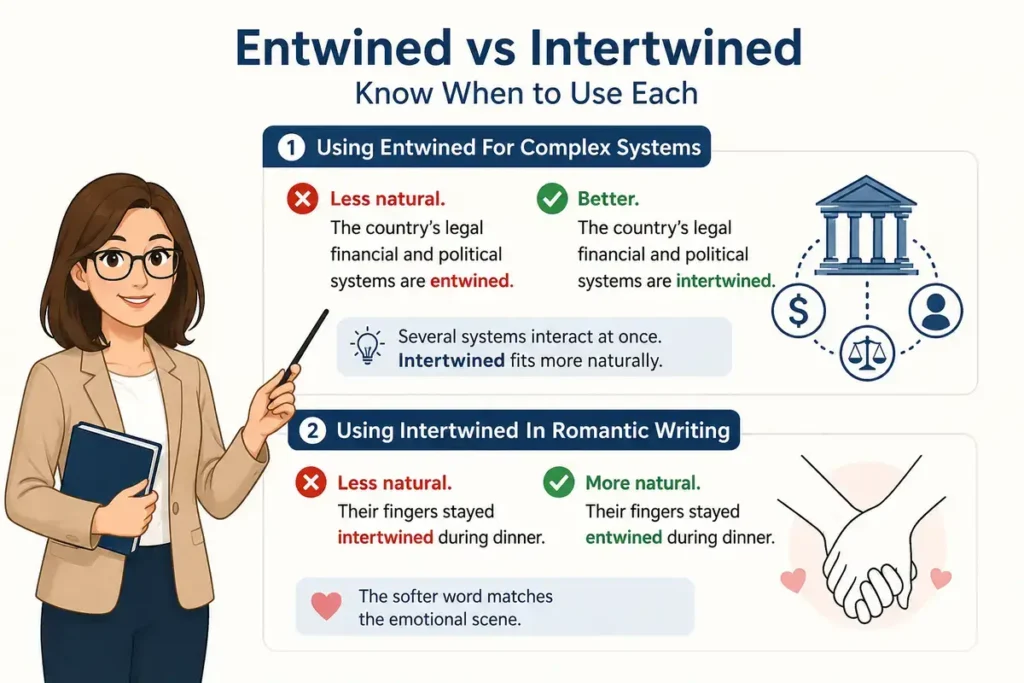
Using Intertwined for Every Context
Intertwined can work in many situations, but sometimes entwined creates a much better image.
The branches were entwined around the gate.
That sentence has a vivid physical quality that fits the context naturally.
Using Entwined in Technical Contexts Without Considering Tone
Entwined isn’t wrong in formal writing, but intertwined may sound more natural when discussing systems or relationships between abstract concepts.
The two economic systems are intertwined.
That sounds more precise than using a strongly visual expression.
Confusing Intertwined With Interrelated
Interrelated means connected or related to one another. Intertwined usually suggests a closer and more complicated connection.
The two issues are interrelated.
The two issues are intertwined.
The second sentence suggests that the issues are woven together in a way that makes them difficult to separate.
Pronunciation Guide
Entwined
The common pronunciation is:
/ɪnˈtwaɪnd/
An easy pronunciation guide is:
in TWYND
The main stress falls on the second syllable.
The word rhymes closely with find and mind in its final sound.
A common mistake is to pronounce the ending as two separate syllables. In normal English speech, entwined is generally heard as one compact word with the main stress on twined.
Intertwined
The common pronunciation is:
/ˌɪntərˈtwaɪnd/
An easy pronunciation guide is:
in ter TWYND
The strongest stress falls on twined.
The word contains the familiar sound of twine. That connection can help with pronunciation.
A useful trick is to say the word in parts first.
inter + twined
Then say it naturally as one word.
The pronunciation difference is straightforward. The longer form has the additional inter element, while both words share the twined ending.
Etymology and Word Origin
Both words belong to the same English word family built around twine.
Twine has old Germanic roots and has long referred to thread, string, or material that is twisted together. From this basic idea English developed verbs associated with winding and twisting.
Entwine combines the idea of putting something into a twisted or winding relationship with the word twine.
Intertwine adds the prefix inter, which commonly carries the sense of between or among. The resulting word expresses things twisting or weaving together.
This shared history explains why the meanings overlap so strongly.
It also explains why both words work so naturally for physical and abstract situations. A physical image of threads winding together became a useful metaphor for people, ideas, events, and systems becoming closely connected.
The modern figurative uses are therefore not random extensions. They grow naturally from the original physical image of things winding together.
Regional Usage
American English
Both words are standard in American English. Entwined appears frequently in descriptive and literary contexts, especially when writers want a visual or emotional image. Intertwined is also common and works especially well when discussing relationships, history, culture, business, economics, and systems.
American speakers generally understand the words without difficulty. There is no major American spelling difference between them.
British English
British English also recognizes both forms. The meanings and grammatical behavior remain essentially the same.
British writers may use entwined in literary descriptions and intertwined in discussions of connected events or systems. The distinction comes from context and style rather than a regional spelling rule.
Australian English
Australian English uses both forms in standard writing. No major regional difference changes the basic distinction.
A writer describing plants or physical objects may naturally choose entwined. A writer discussing society, history, or relationships may find intertwined more suitable.
Canadian English
Canadian English also uses both forms. There is no significant Canadian spelling variant that changes the comparison.
The same general guidance applies. Think about twisting when entwined fits the image and think about deep connection when intertwined better expresses the relationship.
Grammar Rules and Part of Speech
Both words can function as past participles of their corresponding verbs and as adjectives.
The verbs are:
entwine
intertwine
Their past participle forms are:
entwined
intertwined
They can appear after linking verbs.
The branches were entwined.
Their lives became intertwined.
They can also appear before nouns.
The entwined branches blocked the window.
The intertwined stories reveal a common theme.
In these examples the words describe the condition of the noun.
Using Entwined as an Adjective
Entwined often comes before a noun when the writer wants to emphasize a physical or figurative connection.
She admired the entwined branches.
The poem describes their entwined destinies.
The second example uses physical imagery metaphorically.
Using Intertwined as an Adjective
Intertwined is especially natural before nouns involving abstract relationships.
The researchers examined the intertwined factors.
The book follows their intertwined histories.
The company depends on several intertwined systems.
Using the Words After Linking Verbs
Both forms work naturally after verbs such as become, remain, seem, appear, and be.
The roots remained entwined.
Their stories became intertwined.
The two paths seemed entwined.
The political and economic issues became intertwined.
Punctuation
Neither word requires special punctuation simply because of its meaning.
If an introductory phrase comes before a sentence, punctuation depends on the structure of the entire sentence rather than the word itself.
For example.
Over the years, their careers became intertwined.
The comma belongs to the introductory phrase over the years. It isn’t required because intertwined has a special punctuation rule.
Entwined or Intertwined in Figurative Writing
Figurative usage is where the distinction becomes most interesting.
Suppose you’re writing about two people who have known each other for decades.
Their lives became entwined.
This sounds personal and somewhat poetic. You can almost picture two strands winding together.
Now consider:
Their lives became intertwined through family, work, friendship, and shared history.
This version emphasizes the many connections that hold their lives together.
The difference becomes even clearer with abstract subjects.
Love and memory became entwined.
History and identity became intertwined.
The first sentence feels emotional and image driven. The second feels broader and more analytical.
Neither sentence is superior. The right choice depends on the writer’s purpose.
Entwined or Intertwined in Formal Writing
Both forms can appear in formal writing.
However, intertwined is often a comfortable choice for analytical prose because it naturally describes complex relationships between ideas and systems.
For example:
Economic growth and environmental policy are closely intertwined.
The findings reveal two intertwined causes.
The research examines the intertwined effects of social and economic change.
Entwined can also work well in formal writing, especially when the subject has a descriptive or literary quality.
For example:
The region’s history is entwined with the development of its river system.
The important point is not that one word belongs to formal writing and the other belongs to casual writing. Both can appear across registers. The distinction mainly concerns meaning, imagery, and tone.
Real Life Usage Examples
Daily Conversation
In everyday speech, people often use both words without thinking about the subtle difference.
- Our families have been intertwined for years.
- The kids had their arms entwined as they walked home.
The first example focuses on a long social connection. The second creates a physical image.
Email and Workplace Communication
- Our marketing strategy is closely intertwined with customer feedback.
- The project’s timeline is entwined with several outside deadlines.
The first sounds particularly natural in business communication because it describes interdependence. The second works when the writer wants to emphasize a close connection between the timeline and external events.
Academic Writing
- Language and cultural identity are deeply intertwined.
- The study examines several entwined social factors.
Academic writing often favors intertwined because researchers frequently discuss systems that influence one another.
Still, entwined can work when the writer wants a more descriptive style.
News and Journalism
- The region’s economy remains intertwined with the energy industry.
- The politician’s career has become entwined with the controversy.
Journalists use these words to describe relationships between people, institutions, events, and systems.
Literature and Storytelling
- Their fates were entwined long before they met.
- The novel follows two intertwined families across three generations.
Literature makes especially rich use of both words because each can create a strong image of connection.
Related and Confused Terms
Interwoven
Interwoven means woven together. It is especially useful for stories, ideas, cultures, traditions, and physical materials.
The novel contains several interwoven stories.
It often sounds very close to intertwined.
Connected
Connected is much broader. It simply means linked or associated.
The two events are connected.
It doesn’t necessarily suggest the tight or complicated relationship implied by intertwined.
Interrelated
Interrelated means connected in such a way that the things involved have a relationship with one another.
The issues are interrelated.
This is useful in academic and analytical writing but usually creates less imagery than intertwined.
Linked
Linked is simple and direct. It can describe a relationship between people, events, ideas, or objects.
The two incidents are closely linked.
It doesn’t necessarily imply that the elements are woven together.
Entangled
Entangled suggests that things have become caught or tangled together. It can carry a negative sense of complication or difficulty.
The company became entangled in legal disputes.
That meaning is stronger and often more problematic than intertwined.
Woven Together
Woven together is a vivid phrase that can work literally or metaphorically.
Their stories were woven together over time.
It often creates a warmer or more literary image.
Associated
Associated means connected or related. It is generally weaker than intertwined.
The symptoms are associated with several factors.
This word works well in technical and formal contexts where precision matters.
Integrated
Integrated means combined into a functioning whole. It often appears in technical, organizational, educational, and business contexts.
The new system is fully integrated with the existing platform.
Integrated focuses on successful combination rather than simply being closely connected.
How Native Speakers Choose Between the Words
Native speakers rarely stop to apply a strict rule before choosing entwined or intertwined. They usually respond to the image and context created by the sentence.
If the subject involves vines, branches, fingers, ropes, or physical strands, entwined can feel particularly natural.
If the subject involves economies, histories, cultures, ideas, systems, or social relationships, intertwined often feels especially natural.
Still, these are tendencies rather than fixed rules.
Consider the phrase intertwined fingers. It sounds completely natural because fingers can physically cross and weave together.
Likewise, entwined histories sounds natural because histories can be closely connected.
English gives writers room to choose based on style. That flexibility is one reason these words can be difficult for learners. A dictionary definition can tell you what a word means, but context tells you which shade of meaning sounds best.
An Easy Way to Remember the Difference
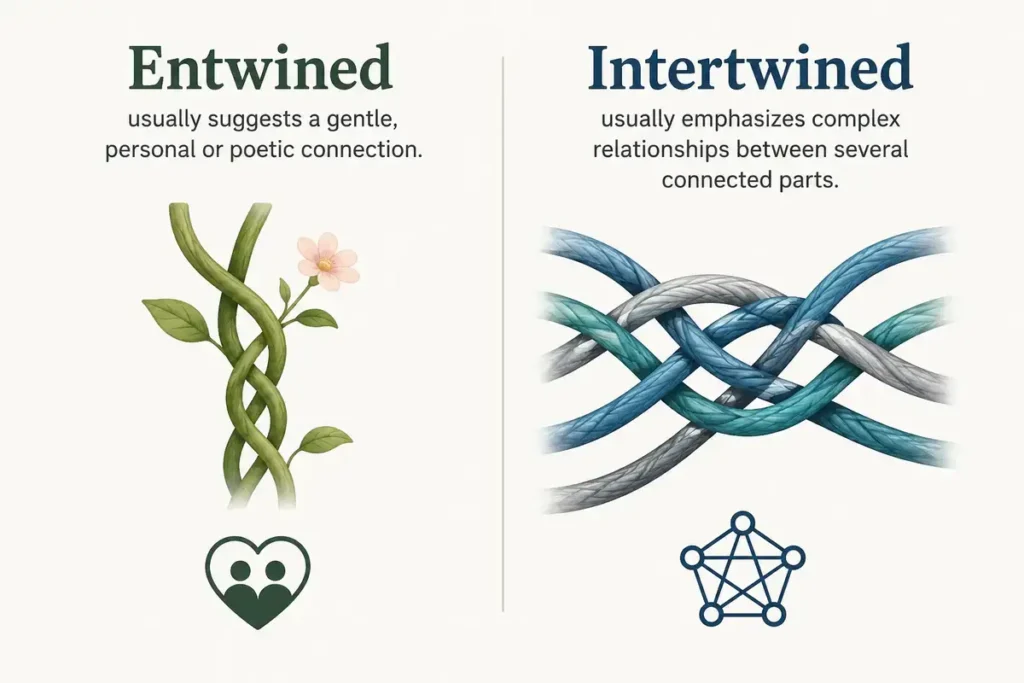
Think about twisting when you see entwined.
Think about connection when you see intertwined.
Imagine two vines winding around each other. They are entwined.
Now imagine the histories of two countries affecting each other for centuries. They are intertwined.
The images overlap, but the emphasis changes.
Another useful trick is to look at the prefix inter in intertwined. Inter often suggests something happening between or among things. That makes intertwined a natural choice for complex relationships involving several connected elements.
This isn’t a rule that decides every sentence for you. It’s simply a reliable memory aid.
Expert Editor Insight
An experienced editor wouldn’t mark either entwined or intertwined as automatically wrong. Both are established forms, so the real editorial question is one of precision and tone. I’d check the surrounding nouns first. Physical twisting often makes entwined especially vivid, while complex relationships between ideas or systems often make intertwined the stronger choice. Grammar tools generally won’t flag either form because both are standard. The better editing test is to ask what image the sentence creates and if that image matches your intended meaning.
Conclusion
The comparison entwined vs intertwined doesn’t have a simple right or wrong winner because both words are correct. Entwined usually emphasizes twisting or wrapping together, while intertwined often highlights a deep or complicated connection. That distinction is subtle, so context matters more than a rigid grammar rule.
For physical images such as vines, branches, or fingers, entwined can create a vivid sense of things winding around each other. For abstract subjects such as history, culture, economics, relationships, and ideas, intertwined often sounds more natural and precise.
A useful editing tip is to picture the relationship before choosing the word. If you see things twisting together, think entwined. If you see several elements woven into one connected system, think intertwined. That simple mental picture will help you make the right choice naturally.
FAQs
Are entwined and intertwined both correct?
Yes. Both words are correct standard English forms. They share much of their meaning and can often describe things that are closely connected or twisted together. Entwined tends to emphasize wrapping or twisting, while intertwined often emphasizes a deeper or more complex connection. Context matters more than a strict grammar rule when choosing between them.
What is the main difference between entwined and intertwined?
The main difference is emphasis. Entwined often creates an image of things twisting or wrapping around one another. Intertwined often emphasizes things becoming deeply connected or woven together. The distinction is subtle rather than absolute. In many sentences, either word can work, but one may create a more natural image or tone for the reader.
Can I use entwined for abstract ideas?
Yes. Entwined can describe abstract ideas when you want to suggest a close or almost inseparable connection. For example, memory and identity can be entwined. This usage is often more figurative and expressive. If you’re writing analytical prose about complex systems or relationships, intertwined may sound more natural, but entwined isn’t grammatically incorrect.
Is intertwined more formal than entwined?
Intertwined can sometimes sound slightly more analytical or formal, especially when it describes relationships between systems, institutions, ideas, or historical events. However, both words work in formal and informal writing. Entwined can also sound literary or poetic because it creates a vivid image of things winding around one another. Context and sentence style determine the final impression.
Can the two words be used interchangeably?
They can often be substituted for one another without making a sentence grammatically incorrect. However, the tone and mental image may change. Entwined can highlight twisting or intimate connection, while intertwined can suggest a complex relationship among several elements. Good writing considers that difference instead of treating the words as exact synonyms in every situation.
Which word is better for relationships?
Both can describe relationships. Entwined often sounds more intimate or poetic, especially when describing two people whose lives have become closely connected. Intertwined can suggest a broader and more complicated relationship involving shared history, family, work, or circumstances. For example, their lives became entwined sounds expressive, while their lives became intertwined emphasizes the depth of their connections.
Is intertwined suitable for academic writing?
Yes. Intertwined works very well in academic writing when the subject involves closely connected factors, systems, ideas, or processes. Researchers and students can use it naturally in sentences such as social and economic factors are intertwined. The word is clear enough for formal prose while still conveying a strong sense of connection and interdependence.
Which word should I use in everyday English?
Use the word that best matches your intended image. For physical things that twist or wrap around each other, entwined can sound especially natural. For connected ideas, histories, systems, or relationships, intertwined often fits better. If both seem possible, read the sentence aloud. The version that sounds clearer and creates the intended image is usually the better choice.
