
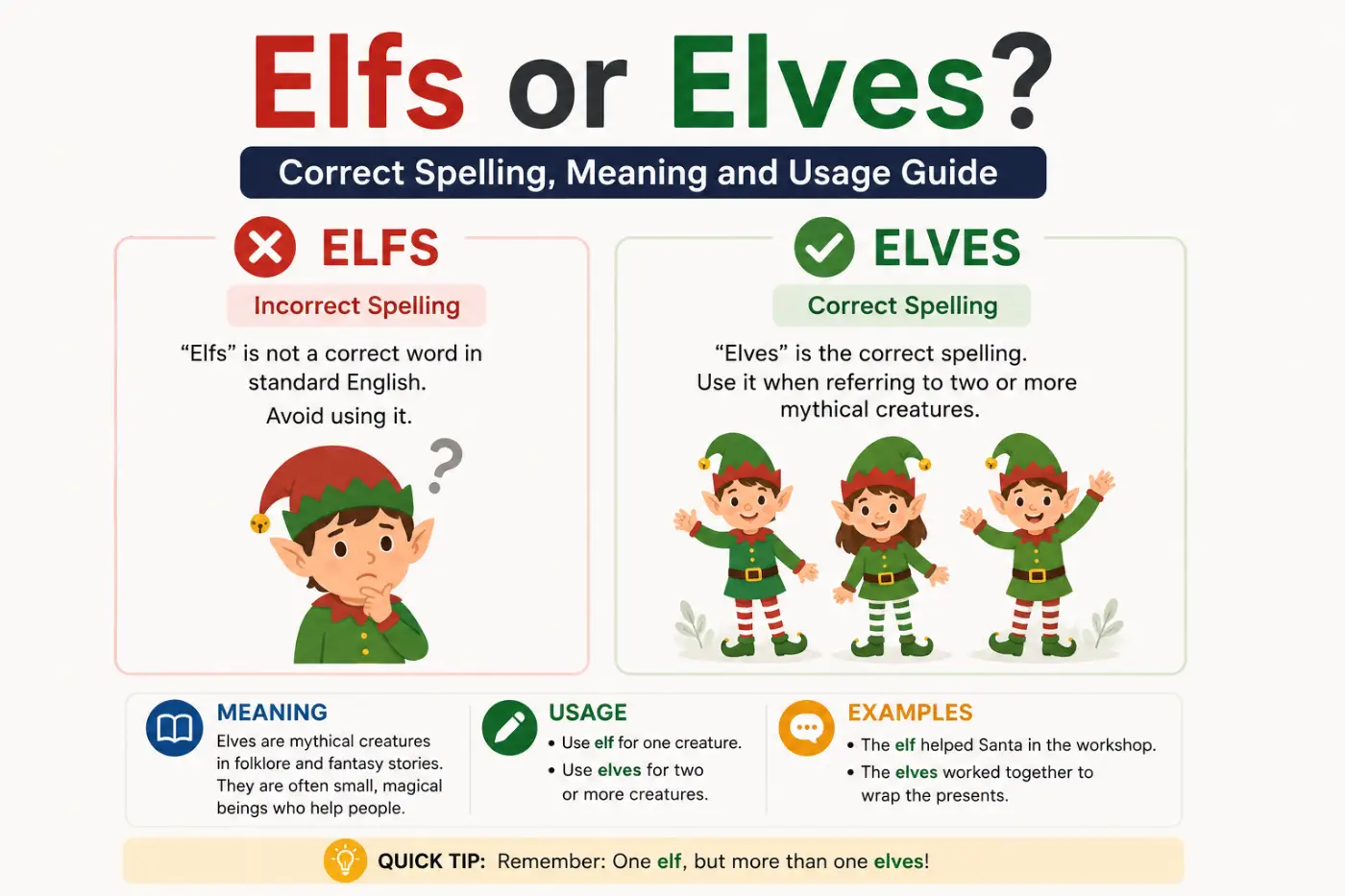
elfs or elves can be confusing because English has more than one way to form a plural. The standard plural of elf is elves. The form elfs can appear in some historical or specialized contexts but it isn’t the usual plural in modern standard English.
The reason for the change is simple once you see the pattern. Elf belongs to a small group of English nouns whose plural changes the final f sound and spelling to ves. The same pattern appears in words such as leaf and leaves and wolf and wolves. However English doesn’t apply this pattern to every word ending in f which is why learners can’t rely on one rule alone.
The good news is that everyday writing has a very clear answer. If you’re talking about several mythical creatures or several elves in a story use elves. This guide explains the plural rule the word’s meaning pronunciation history grammar regional usage and common mistakes. You’ll also see natural examples that show how the plural works in real English.
Quick Definition
Elves is the standard modern English plural of elf. It refers to two or more elves. The form elfs is uncommon in modern standard English and is generally not the form you should choose in ordinary writing. The plural changes the ending from f to ves.
Quick Answer
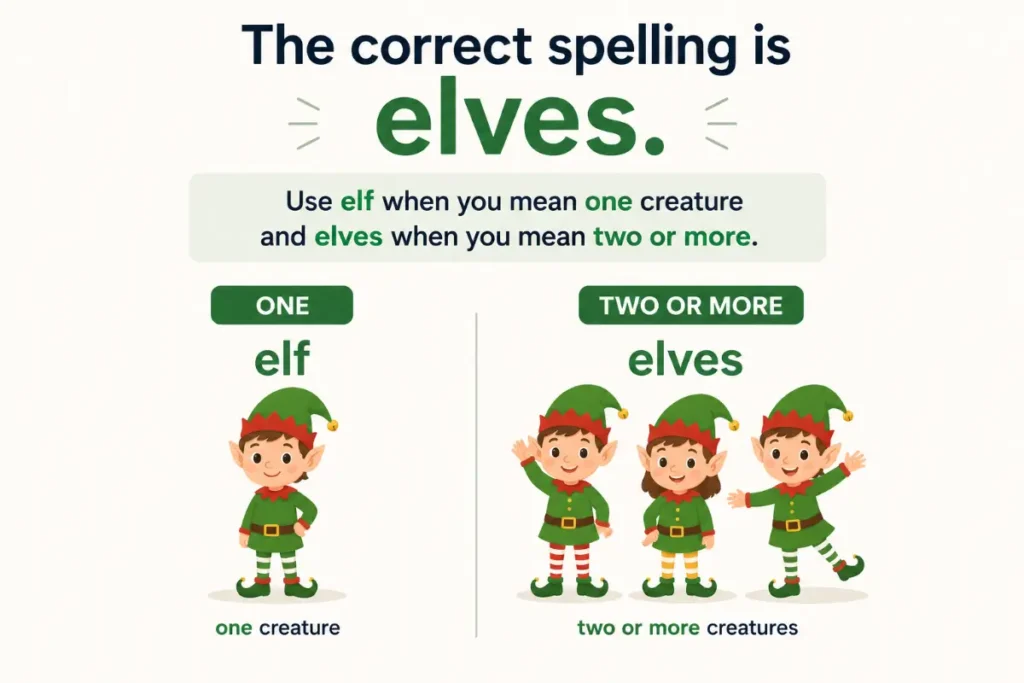
The standard plural of elf is elves.
Use elves when you mean more than one elf. For example you can write The elves helped Santa prepare the gifts.
The form elfs is not normally used as the regular plural in modern standard English. The change from f to ves is part of an older English plural pattern that survives in several common words.
Comparison Table
| Form | Meaning | Part of Speech | Origin | Usage Frequency | Formality | Common Contexts | Example |
|---|---|---|---|---|---|---|---|
| Elf | One mythical or folkloric being | Noun | Old English | Common | Neutral | Folklore fantasy literature conversation | An elf appeared in the story. |
| Elves | More than one elf | Plural noun | Historical English plural development | Common | Neutral | Fantasy stories folklore Christmas writing | The elves worked through the night. |
| Elfs | Rare or nonstandard modern plural in ordinary English | Plural noun form | Older and occasional variant usage | Uncommon | Usually inappropriate for ordinary standard writing | Historical texts specialized contexts or errors | Most modern writers use elves. |
Meaning and Definition
Meaning of Elf
An elf is a legendary or mythical being found in several traditions of European folklore. The exact appearance and character of elves have changed over time and differ across cultures and literary traditions.
In older folklore an elf could be portrayed in many ways. Some traditions described supernatural beings associated with nature magic or mysterious events. Later literature developed new images of elves and popular fantasy gave the word an even broader range of meanings.
Modern readers may immediately picture a small magical character with pointed ears. That image is strongly connected with modern fantasy and Christmas traditions but it doesn’t cover the entire history of the word.
The word can also describe fictional beings in fantasy novels games films and other stories. In those settings an elf may be tall powerful ancient graceful or highly skilled in magic. The meaning depends heavily on the fictional world.
When you have more than one such being the standard plural is elves.
Meaning of Elves
Elves is the plural noun formed from elf. It means two or more beings described as elves.
The word can appear in folklore discussions fantasy fiction Christmas stories mythology and ordinary conversation.
For example:
The elves lived deep inside the forest.
Here elves refers to a group of mythical beings.
The word can also refer to fictional races rather than individual characters.
The novel describes elves as ancient guardians of the forest.
In Christmas contexts elves often refer to the magical helpers traditionally associated with Santa Claus.
The children imagined Santa and his elves preparing toys.
The meaning changes with context but the plural form stays the same.
Is Elfs Ever Used?
Elfs has appeared in English and can be found in historical material or occasional specialized usage. It isn’t simply an impossible sequence of letters. However modern standard English overwhelmingly favors elves as the ordinary plural of elf.
This distinction matters because language history can be messy. A form may exist somewhere in written records without being the form a modern editor would recommend.
If you’re writing an essay story article school assignment email or general English text use elves.
Key Differences Explained
- Spelling. Elf is singular while elves is the standard plural. The final f changes to v and the plural ending is added.
- Meaning. Elf refers to one being. Elves refers to more than one.
- Grammar. Elf is a singular count noun. Elves is its plural count noun.
- Pronunciation. Elf ends with an f sound while elves ends with a v sound followed by a z sound.
- Formality. Elves is the normal form in both casual and formal English.
- Context. Elves appears in folklore fantasy Christmas stories literature games and everyday discussion.
- Regional usage. Major English varieties generally use elves as the standard plural.
- Standard usage. Elves is the form expected in modern edited English.
The spelling difference isn’t random. It reflects an old plural pattern that survived in several familiar English words.
Which Form Is Correct?
Elves is the standard plural form of elf.
This is an example of what linguists often call an irregular or nonproductive plural pattern. Instead of simply adding s to the singular noun the word changes part of its ending.
You can see similar patterns in several common English nouns.
- Leaf becomes leaves.
- Wolf becomes wolves.
- Wife becomes wives.
- Knife becomes knives.
- Life becomes lives.
- Half becomes halves.
These examples can help you recognize the pattern. Still the rule has exceptions. Not every noun ending in f changes to ves.
For example:
Roof becomes roofs.
Chef becomes chefs.
Chief becomes chiefs.
This is one reason English plural spelling can feel unpredictable. Different words developed through different historical paths.
For elf the established modern plural is elves.
A reliable dictionary will list elf as the singular noun and elves as its plural. That dictionary based approach is more useful than assuming every word ending in f must follow the same rule.
Why Does The F Change To V?
The change from f to v has a historical explanation.
In earlier forms of English some sounds that are now represented by f and v behaved differently depending on their position in a word. Over time English spelling and pronunciation developed in ways that preserved some older plural patterns.
In several words the plural came to be associated with a voiced consonant sound. The spelling later reflected that development.
You don’t need to memorize the historical details to use the word correctly. The practical pattern is enough.
Think of these pairs.
Elf and elves.
Wolf and wolves.
Leaf and leaves.
Wife and wives.
The spelling change becomes easier to recognize once you see it as part of a group rather than as an isolated oddity.
At the same time don’t turn the pattern into an absolute rule. English has too many exceptions for that.
A better approach is to learn common plural forms as complete vocabulary items. That gives you accuracy without forcing every noun into the same spelling pattern.
Sentence Examples
Here are ten natural examples using the standard plural.
- The elves decorated the workshop before sunrise.
- We read a story about elves who lived in a hidden forest.
- The children dressed as elves for the Christmas party.
- Several elves appeared in the fantasy game.
- The author describes the elves as wise and mysterious.
- Santa’s elves were busy preparing toys for Christmas.
- The old legend says that elves protected the forest.
- In the novel the elves formed an alliance with the humans.
- The museum displayed artwork showing elves from different folklore traditions.
- The movie presents the elves as skilled craftsmen and powerful warriors.
Now consider the less appropriate form in examples designed only to show the mistake.
- The elfs prepared the gifts.
- We saw several elfs in the fantasy story.
- The writer described the elfs as forest spirits.
- The children dressed like elfs for the play.
- The game includes several different elfs.
In standard modern English these sentences should use elves instead.
Common Mistakes and Misspellings
Using Elfs As The Regular Plural
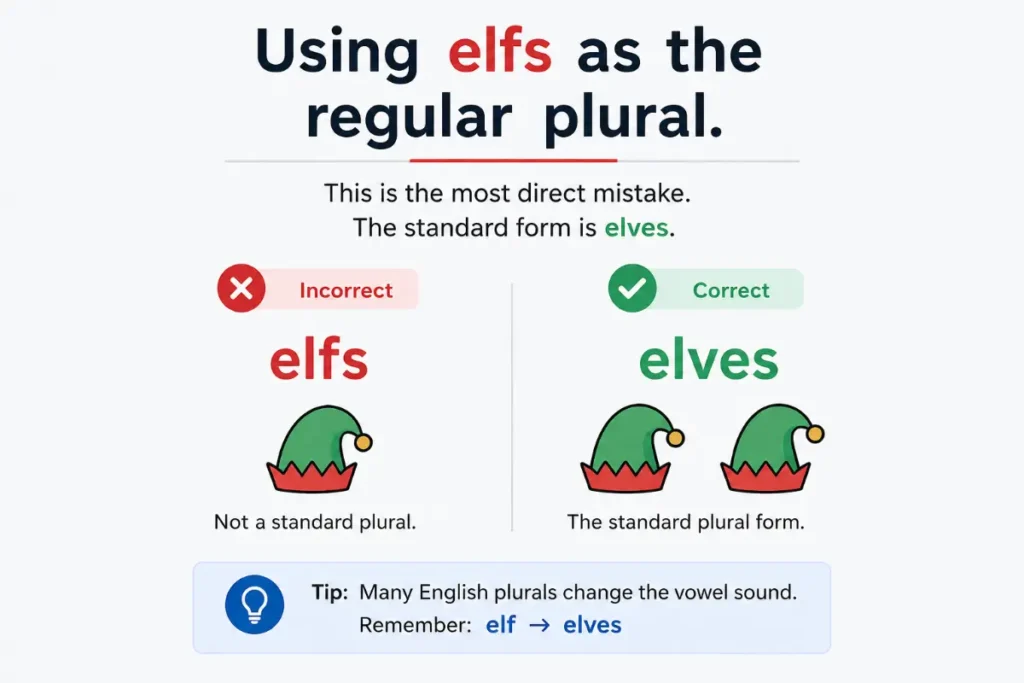
The most common mistake is simply adding s to elf.
Incorrect: Three elfs appeared in the story.
Correct: Three elves appeared in the story.
This mistake is understandable because adding s works for many English nouns. Readers naturally learn that pattern first.
Assuming Every F Word Changes To Ves
Some learners memorize a rule that says words ending in f always change to ves. That rule is too broad.
Roof becomes roofs rather than rooves in standard modern English.
Chief becomes chiefs.
Chef becomes chefs.
The correct approach is to learn the established plural of each common noun.
Confusing Elf With Other Fantasy Terms
Fantasy vocabulary can create another type of confusion. Elves are not automatically the same as fairies goblins sprites or other supernatural beings.
Authors may create fictional races with their own rules and names. The grammar of each word still depends on the intended noun.
Treating Fantasy Spelling As Standard English
Fantasy writers sometimes create unusual names or plural forms for fictional worlds. A particular novel or game might use a special form intentionally.
That doesn’t mean the same form belongs in general English.
If you’re writing about a fictional universe follow that universe’s official terminology. In ordinary English use elves.
Adding An Apostrophe
Another mistake is writing elf’s when you mean the plural.
Elf’s is normally possessive singular.
For example:
The elf’s hat was red.
This means the hat belonged to one elf.
For a plural possessive you need elves followed by an apostrophe.
The elves’ workshop was crowded.
This means the workshop belonged to multiple elves.
That small punctuation difference is worth remembering because plural and possessive forms often cause confusion.
Pronunciation Guide
Elf is commonly pronounced /ɛlf/.
Elves is commonly pronounced /ɛlvz/.
The difference is easy to hear once you focus on the final consonant.
Singular Pronunciation
Elf sounds approximately like elf in ordinary American English.
The final sound is an f.
Plural Pronunciation
Elves sounds approximately like elvz.
The final consonant changes from f to v and the plural ending has a z sound.
The pronunciation can therefore help reinforce the spelling.
Think:
Elf = elf.
Elves = elvz.
A common pronunciation mistake is to keep the f sound in the plural and say something closer to elfs. Standard pronunciation uses the v sound in elves.
Another common issue occurs with the final consonant cluster. The ending can feel quick in natural speech. Don’t add an extra vowel after the v or z sounds.
The plural has one clear syllable just like the singular.
Etymology and Word Origin
Elf has a very old history in English.
The modern word comes from Old English ælf. The term belonged to the vocabulary of Germanic languages and was associated with supernatural beings in early northern European traditions.
Related forms appear in other Germanic languages. Over centuries the word developed through different stages of English and its meaning shifted as folklore changed.
The modern concept of an elf is therefore the result of many layers of cultural and literary development.
The plural form elves also reflects the history of English rather than a modern spelling invention. The change from f to v is part of a broader group of historical plural patterns that remain visible in modern English.
Later writers helped reshape the image of elves. Medieval and early modern traditions presented supernatural beings in varied ways. Modern fantasy literature then developed highly recognizable versions of elves as fictional peoples or races.
Christmas culture created another familiar image. In contemporary American culture elves are often imagined as small magical helpers who make toys and assist Santa Claus.
The word therefore has both a deep folklore history and a strong modern popular culture presence.
Regional Usage
American English
American English uses elves as the standard plural.
The word is common in Christmas writing fantasy fiction games children’s stories and discussions of folklore.
You’ll often see phrases such as Christmas elves fantasy elves and woodland elves. The plural spelling stays the same across these contexts.
British English
British English also uses elves as the normal plural of elf.
There isn’t a major British spelling difference here. British writers can use the word in folklore academic writing fiction journalism and ordinary conversation.
Historical texts may contain different forms but modern standard usage favors elves.
Australian English
Australian English generally follows the same pattern. Elves is the normal plural form used in contemporary writing.
There is no major Australian spelling variant that would make elfs the preferred everyday plural.
Canadian English
Canadian English also uses elves as the standard plural.
Their writers may encounter the word in Christmas stories fantasy literature education and general conversation. The plural pattern remains the same.
The major English varieties therefore agree on the modern standard form.
Grammar Rules and Part of Speech
Elf is a countable noun.
That means you can talk about one elf or several elves.
One elf entered the room.
Three elves entered the room.
The singular form normally takes a determiner when used as a specific count noun.
An elf appeared in the story.
The elf appeared in the story.
The plural form doesn’t need an article when you are talking about elves generally.
Elves appear in many fantasy stories.
But you can use the with a specific group.
The elves in this story live underground.
The word can also take possessive forms.
Singular Possessive
The elf’s sword was on the table.
The apostrophe plus s shows possession by one elf.
Plural Possessive
The elves’ weapons were carefully designed.
The apostrophe comes after the s because elves is already plural.
This distinction matters in writing because elves and elf’s don’t perform the same grammatical job.
Adjectives With Elves
Adjectives can describe the plural noun naturally.
The ancient elves lived in the mountains.
Several friendly elves greeted the children.
The mysterious elves disappeared before dawn.
The adjective doesn’t change because the noun is plural.
Verbs With Elves
Because elves is plural it normally takes a plural verb.
The elves are working.
Not:
The elves is working.
Compare that with the singular.
The elf is working.
This subject verb agreement rule is straightforward once you identify the noun as singular or plural.
Real Life Usage Examples
Daily Conversation
People often use elves when talking about Christmas or fantasy stories.
- My kids love stories about elves.
- We saw a Christmas display with little elves in the window.
These uses are casual and natural.
Workplace Communication
The word can appear in workplace writing when the topic involves a themed event product design entertainment or a fictional setting.
- The design team created an illustration of elves for the holiday campaign.
- The event will feature performers dressed as elves.
The plural form remains unchanged in professional communication.
Academic Writing
Researchers and students may discuss elves in studies of folklore mythology literature or popular culture.
- Medieval sources describe supernatural beings that later influenced ideas about elves.
- Modern fantasy literature often presents elves as distinct fictional peoples.
Academic writing may use the word in a more historical or analytical sense.
News Writing
Journalists can use elves when covering holiday events entertainment or cultural traditions.
- Local volunteers dressed as elves during the holiday parade.
- The theater company brought its popular group of elves back for another Christmas production.
The word remains ordinary and easy to understand.
Literature and Storytelling
Fiction gives the word some of its richest uses.
- The elves watched silently from the edge of the forest.
- The young hero sought help from the elves before entering the mountain.
Here elves can refer to anything from small magical characters to an entire fictional society depending on the author’s world.
Related and Confused Terms
Fairies
Fairies are supernatural beings found in many European traditions. Modern fantasy sometimes treats fairies and elves as similar but they are not automatically the same creatures.
Goblins
Goblins are another type of supernatural or fantasy creature. They often appear as distinct beings from elves.
Dwarves
Dwarves are especially common in fantasy literature. They are often presented as a separate fictional people from elves.
Sprites
A sprite can refer to a small supernatural being or spirit. The exact meaning depends on folklore or fictional context.
Pixies
Pixies are legendary beings strongly associated with English folklore. Modern stories may portray them as small magical creatures.
Fairy Folk
Fairy folk is a broader expression for supernatural beings associated with folklore traditions. It can include different types of beings depending on the source.
Mythical Creatures
Mythical creatures is a broad category that can include elves along with dragons giants unicorns and many other beings.
Fantasy Characters
Fantasy characters is a broad modern term. Elves can be fantasy characters but not every fantasy character is an elf.
These terms overlap in popular culture but they shouldn’t be treated as exact synonyms. Folklore has its own history and modern fantasy often reshapes older creatures to fit a particular fictional world.
Why Elves Is An Irregular Plural
Many English nouns form plurals by adding s or es.
Book becomes books.
Box becomes boxes.
Car becomes cars.
Elf does something different. Its plural changes part of the word itself.
Elf becomes elves.
English has many irregular plural forms.
Man becomes men.
Woman becomes women.
Child becomes children.
Mouse becomes mice.
Tooth becomes teeth.
Elf is less dramatic than those examples but it still preserves an older plural pattern.
The important point is that irregular does not mean random. These forms usually have historical reasons behind them even if modern speakers don’t consciously know those reasons.
That’s why memorizing elves as the established plural is better than trying to create it from a simple modern rule.
Is Elfs Ever Acceptable?
In ordinary modern English the answer is generally no. If you’re writing a normal sentence about more than one elf use elves.
However language history deserves some nuance. Elfs has appeared as a plural form in older or specialized material. Historical texts don’t always follow the spelling conventions expected by modern editors.
There can also be fictional or deliberately stylized contexts where an author chooses a particular form. If a published fictional world specifically establishes unusual terminology then its internal rules may take priority.
That is different from saying elfs is the normal modern plural.
For everyday English the choice is easy.
One elf.
Two elves.
Many elves.
That pattern will work in almost every ordinary situation.
A Simple Memory Trick
The best way to remember the plural is to group elf with familiar f ending words that change to ves.
Think of:
Leaf becomes leaves.
Wolf becomes wolves.
Wife becomes wives.
Knife becomes knives.
Elf becomes elves.
You don’t need to memorize dozens of rules. A small group of familiar examples can make the spelling feel natural.
There is one caution. Don’t assume every f ending noun behaves this way.
Roof becomes roofs.
Chef becomes chefs.
Chief becomes chiefs.
English has exceptions because its vocabulary comes from many historical sources.
So use the pattern as a memory aid rather than an absolute rule.
Expert Editor Insight
A professional editor would normally change elfs to elves in standard contemporary prose unless the surrounding context clearly requires a historical or fictional variant. The confusion comes from a reasonable instinct to add s to a familiar singular noun. Editors also watch for related errors such as elf’s when the writer means the plural and elves’ when possession is intended. Spellcheck tools can catch some of these mistakes but context still matters. My practical tip is to memorize the pair as one unit: elf and elves. That makes the unusual plural feel as familiar as man and men or leaf and leaves.
Conclusion
Elfs or elves has a clear modern English answer. Elves is the standard plural of elf and should be your choice when you mean two or more mythical or fantasy beings. The spelling changes from f to v before the plural ending which connects this word with forms such as leaves and wolves.
The form elfs can appear in historical or unusual contexts but it isn’t the normal plural expected in contemporary standard English. Also remember that elves is plural while elf’s is a singular possessive form and elves’ is a plural possessive form.
For an easy memory trick pair elf with elves and learn them together. If you picture one elf and then a group of elves the spelling becomes much easier to recall. That small habit can save you from a very common plural mistake.
FAQs
Is elfs a correct plural of elf?
Elves is the standard modern plural of elf. Elfs has appeared in some historical and specialized contexts but it isn’t the normal form expected in contemporary standard English. If you’re writing an essay story article email or school assignment use elves for two or more of these mythical beings.
Why does elf become elves?
The change comes from an older English plural pattern that affected several nouns ending in f. In these words the final consonant changed from an f sound to a v sound in the plural and the spelling reflected that development. Similar examples include leaf and leaves and wolf and wolves. English also has exceptions to this pattern.
Is elves singular or plural?
Elves is plural. The singular form is elf. You can say one elf or an elf when talking about a single being. When talking about two or more you use elves. For example The elf entered the room refers to one while The elves entered the room refers to more than one.
How do you pronounce elves?
Elves is commonly pronounced /ɛlvz/. It sounds roughly like elvz. The singular elf ends with an f sound while the plural uses a v sound followed by a z sound. The change can help you remember the spelling because the pronunciation reflects the difference between the singular and plural forms.
Is elf’s the plural of elf?
No. Elf’s is normally the singular possessive form. It means something belongs to one elf. For example The elf’s hat was red means one elf owned or wore the hat. The plural is elves. If something belongs to several elves use the plural possessive form elves’ as in The elves’ workshop was crowded.
What is the difference between elves and dwarves?
Elves and dwarves are different nouns that often describe separate peoples or creatures in fantasy literature. Elves are commonly portrayed as magical or long lived while dwarves are often portrayed as shorter sturdy characters associated with mountains or craftsmanship. These traits depend on the fictional world and aren’t universal rules across all folklore or fantasy.
Do British and American English use the same plural?
Yes. Modern British and American English both normally use elves as the plural of elf. There is no major regional spelling difference here. Australian and Canadian English also generally use elves. You may encounter older spellings in historical material but contemporary standard writing favors the same plural across these major English varieties.
Is elves appropriate in formal writing?
Yes. Elves is completely appropriate in formal writing when the subject calls for the word. It can appear in academic discussions of folklore literary analysis professional writing about fiction and formal descriptions of cultural traditions. The key is using the word according to its meaning and grammatical role. The unusual form elfs should generally be avoided in standard formal prose.
