
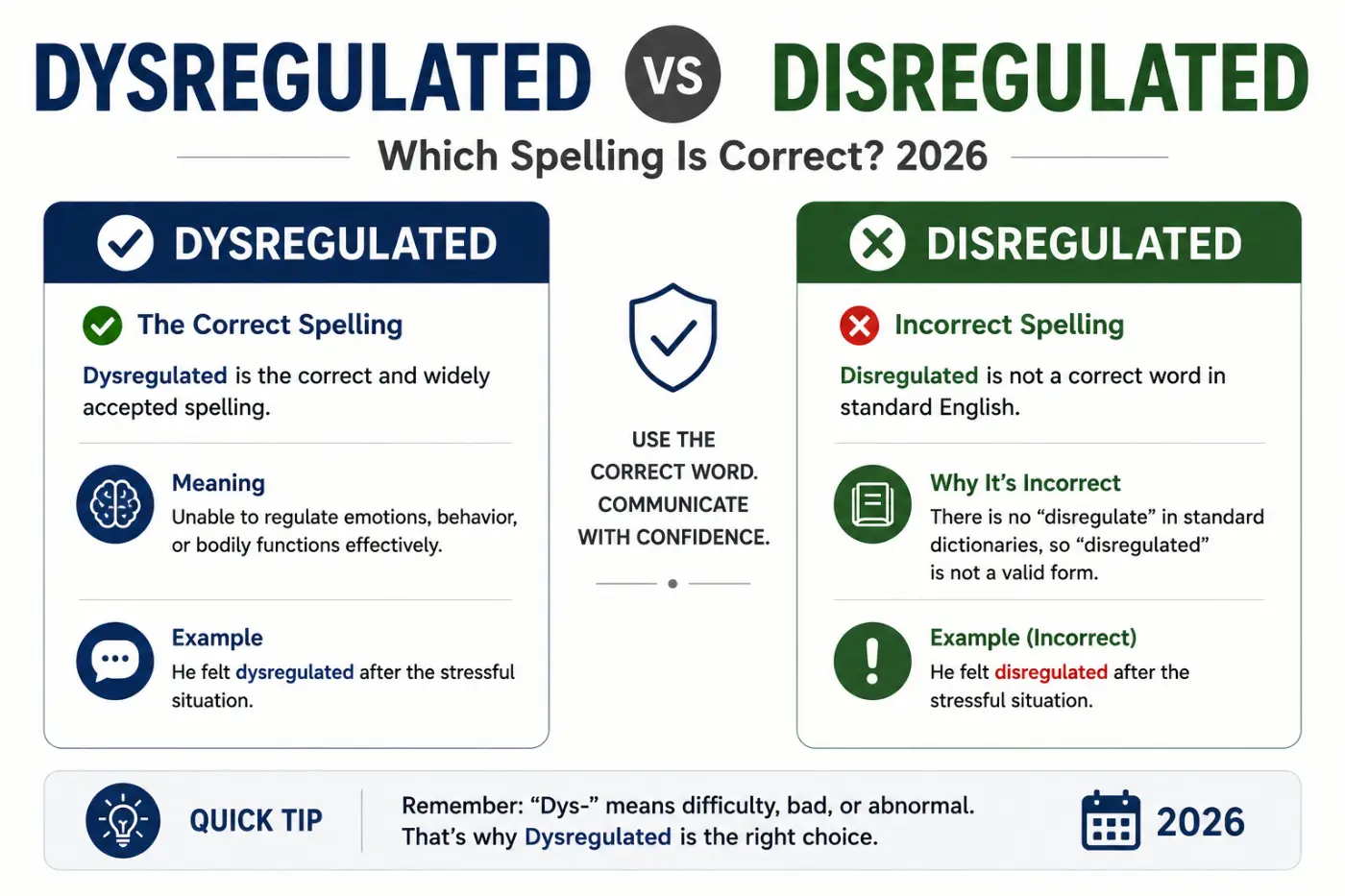
dysregulated vs disregulated is a common point of confusion because the two forms look and sound remarkably similar. The standard form is dysregulated. The spelling disregulated is generally used as a nonstandard form or mistake when writers mean a process that isn’t being regulated normally. This distinction matters most in medical psychological scientific and academic writing where precise terminology carries real weight.
The confusion usually comes from the prefixes dys and dis. The prefix dis is far more familiar in everyday English so it can feel natural to write disregulated when describing something that isn’t functioning or behaving normally. However the established term uses dys which carries the sense of difficulty abnormality or impaired functioning. Once you recognize this word pattern the spelling becomes much easier to remember.
In this guide you’ll learn what dysregulated means how it differs from the nonstandard form how to pronounce it and how to use it naturally in a sentence. You’ll also see examples from everyday communication and professional writing along with related terms such as dysregulation self regulation and emotional dysregulation. By the end you’ll know which form to choose and why.
Quick Definition
Dysregulated is the standard form used to describe a system or process whose normal regulation is impaired or disturbed. It can refer to emotional responses, behavior, biological processes, or other regulated systems. Disregulated is generally treated as a nonstandard spelling or misspelling of the established term rather than a separate word with a different meaning.
Quick Answer
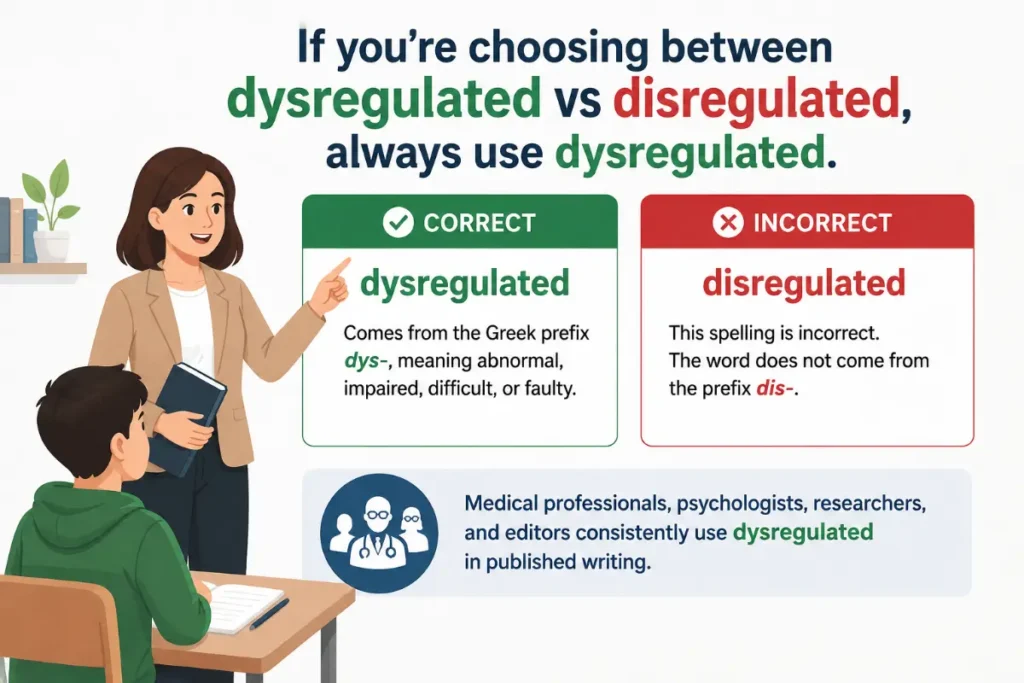
Use dysregulated in standard English. It is an established adjective used in psychology, medicine, biology, and general discussion to describe something that is not being regulated normally.
The alternative form is usually a spelling error. It does not create a useful semantic contrast with the accepted word. If you’re writing an essay, report, article, clinical document, or professional message, choose dysregulated.
Comparison Table dysregulated vs disregulated
| Form | Meaning | Part of Speech | Origin | Usage Frequency | Formality | Common Contexts | Example |
|---|---|---|---|---|---|---|---|
| Dysregulated | Not regulated normally or properly | Adjective | Formed from dysregulate and the adjective form of regulate | Established and common in specialized usage | Formal and neutral | Psychology, medicine, biology, behavior, research | The process became dysregulated after the disruption. |
| Disregulated | Usually an incorrect form of the established term | Nonstandard form | Created by analogy with common dis words | Seen as a spelling error | Nonstandard | Informal writing, typing errors, online discussion | The report should use dysregulated instead. |
Meaning and Definition
Meaning of the Nonstandard Form
Disregulated is usually not a competing technical term. In ordinary modern English it appears mainly as a mistaken version of dysregulated. Reference sources that discuss the form generally identify it as a misspelling rather than an independent word with a distinct established meaning.
That distinction matters because you may occasionally see the alternative spelling in real writing. A word appearing online doesn’t automatically make it standard. People make predictable spelling errors, and those errors can spread simply because readers copy what they have already seen.
The mistake is especially easy to understand from a language pattern perspective. English contains many familiar words beginning with dis such as disagree, disconnect, disorder, and disapprove. Dys is much less common in everyday vocabulary. When a speaker knows the meaning but isn’t sure about the spelling, the brain may reach for the more familiar pattern.
This is a form of lexical pattern confusion. The writer isn’t necessarily misunderstanding the concept. They may simply be selecting a familiar spelling pattern that looks and sounds plausible.
For polished writing, the practical answer is simple. Replace disregulated with dysregulated when the intended meaning is impaired or abnormal regulation.
Meaning of the Correct Form
Dysregulated is an adjective derived from the verb dysregulate. Dictionary sources describe it as a term used for a process or system that is not controlled in the way it normally should be. Cambridge specifically gives medical and psychology related uses involving bodily processes, emotions, and behavior.
The word can describe many kinds of regulation.
A biological process can become dysregulated.
An emotional response can become dysregulated.
Behavior can be described as dysregulated in a psychological context.
A signaling pathway can become dysregulated in medical or biological writing.
The central idea stays consistent. A system that normally has some form of regulation is no longer operating within its expected pattern.
That does not necessarily mean the system has stopped working completely. In many contexts the system continues to function but its control has become impaired, unstable, excessive, insufficient, or otherwise abnormal.
For example:
The immune response became dysregulated.
The sentence does not mean the immune system disappeared. It means its normal regulation has been disturbed.
The same principle applies to emotional language.
She felt emotionally dysregulated after the argument.
Here the adjective describes difficulty maintaining the expected level of emotional control or balance in that situation.
The word is therefore broader than simply saying upset, stressed, or uncontrolled. Context determines exactly what kind of regulation has changed.
Key Differences Explained
Spelling
The accepted form uses dys at the beginning.
The nonstandard form uses dis.
That single vowel change is the main visible difference. It also reflects two different prefix traditions in English.
Meaning
The accepted word refers to impaired or abnormal regulation. The alternative spelling usually intends the same meaning but does not function as the established standard term.
Grammar
Dysregulated is an adjective.
It can describe a noun directly:
A dysregulated response can affect the process.
It can also appear after a linking verb:
The response became dysregulated.
Pronunciation
The two spellings can sound almost identical in quick speech. That similarity contributes to the confusion. Cambridge gives the US pronunciation as /dɪsˈrɛɡjəleɪtɪd/ with stress on the second major syllable.
Formality
Dysregulated is appropriate in specialized professional writing when the concept fits the context. It also appears in general discussions of emotional regulation and behavior.
The alternative spelling should be avoided in formal work.
Context
The accepted term is especially common around regulation of emotions, behavior, physiological processes, cellular activity, metabolism, and other biological systems. Cambridge specifically lists medical and psychology uses.
Regional Usage
There is no major American versus British spelling difference here. The established form remains dysregulated across the major English varieties.
Standard Versus Nonstandard Usage
The most useful distinction is standard versus nonstandard rather than two competing meanings. If you are choosing a form for edited English, dysregulated is the clear choice.
Why The Prefix Causes So Much Confusion
The biggest clue lies in the first three letters.
English has the prefix dis in many everyday words. It can express ideas such as separation, opposition, reversal, or absence depending on the word. Examples include disagree, disconnect, and disapprove.
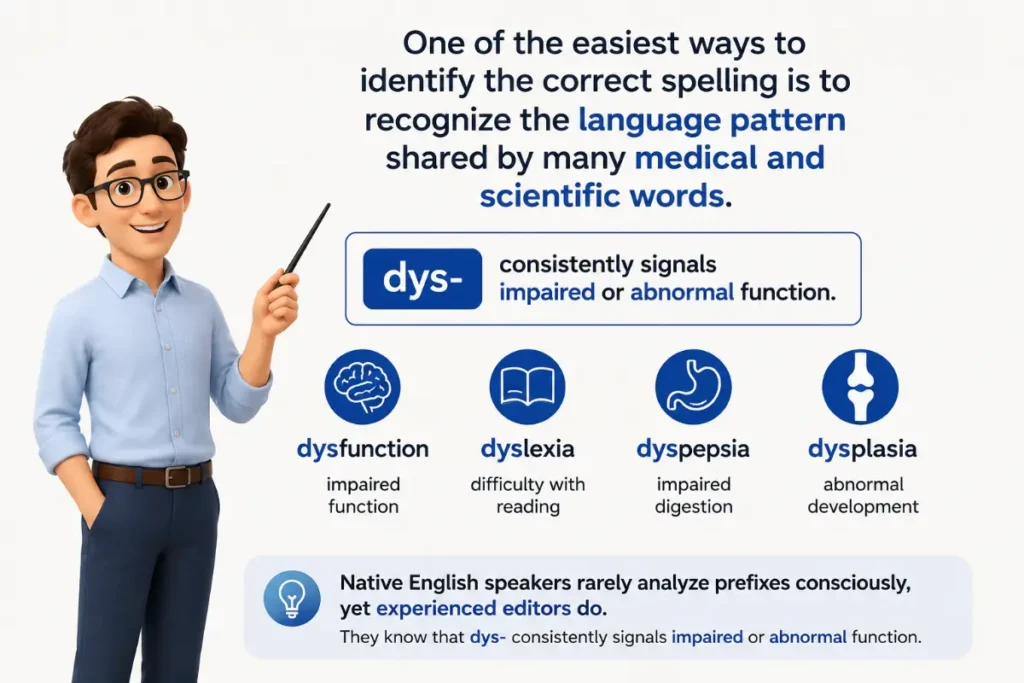
The prefix dys comes from Greek and is associated with ideas such as difficulty, abnormality, or impaired functioning. It appears in specialized vocabulary such as dysfunction and dyslexia.
That difference helps explain why the established term uses dys.
Regulation already describes a process of controlling or maintaining something within an expected range. Dysregulation therefore points toward a problem or disturbance in that regulatory process.
The word does not need the more familiar dis prefix simply because the meaning involves something going wrong.
This is a common feature of English vocabulary. Prefixes are not always interchangeable based on their broad meanings. A writer can’t simply choose the prefix that feels most familiar.
Think of the difference between these two patterns.
Dysfunction describes impaired functioning.
Dysregulated describes impaired regulation.
That relationship makes the spelling easier to remember.
Which Form Is Correct?
Dysregulated is the preferred standard form.
Cambridge lists it as an established adjective and provides both medical and psychology related meanings. Dictionary.com also lists dysregulate as a verb and gives dysregulated as its past tense and past participle form.
That grammatical relationship is useful.
The base verb is dysregulate.
The past tense is dysregulated.
The present participle is dysregulating.
The related noun is dysregulation.
These forms belong to the same word family.
So if you see a sentence such as:
Stress may dysregulate the system.
You can write:
The system became dysregulated.
Or:
The process showed signs of dysregulation.
The alternative spelling does not provide a separate grammatical form that you need to learn.
One caution is useful here. Dictionaries develop through usage and editorial decisions, so it is better to say that the alternative form is nonstandard in ordinary contemporary English rather than making sweeping claims about every possible historical or specialized appearance. For normal professional writing, the choice is straightforward.
Sentence Examples
Here are natural examples using the established form.
- The child became emotionally dysregulated after the unexpected change in routine.
- Researchers observed a dysregulated response during the experiment.
- Chronic stress can affect normal patterns of emotional regulation.
- The report described a dysregulated immune response.
- She felt dysregulated after several difficult conversations in one day.
- The treatment was designed to address the underlying regulatory problem.
- The researchers studied how sleep disruption can affect biological regulation.
- His behavior became more dysregulated as the situation became increasingly stressful.
- The article explains how a dysregulated system may respond differently to normal signals.
- The doctor discussed the possibility of an abnormal regulatory process.
Here are examples showing the common mistake. These are included only to make the spelling difference clear.
- Incorrect: The patient showed a disregulated response.
- Incorrect: Her emotions felt disregulated after the argument.
- Incorrect: The article discussed a disregulated nervous system.
- Incorrect: The researchers observed a disregulated process.
- Incorrect: His behavior became disregulated during the transition.
In each example, the standard form is dysregulated.
Common Mistakes and Spelling Problems
Replacing Dys With Dis
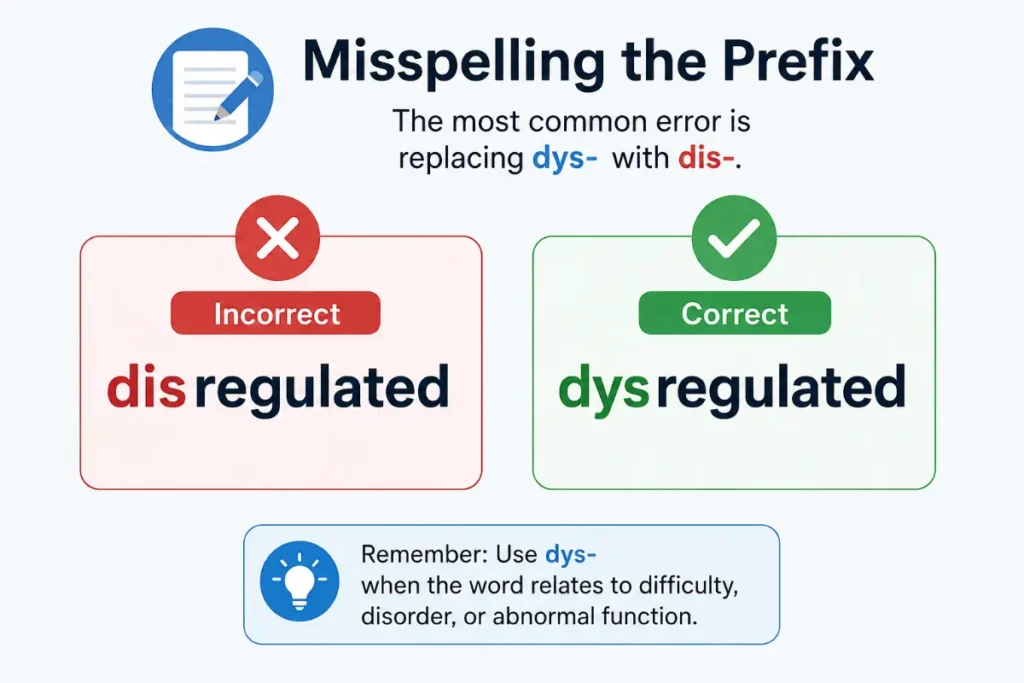
This is the central error.
Incorrect: disregulated.
Correct: dysregulated.
The mistake happens because dis is a much more familiar prefix in everyday English. The brain often relies on familiar spelling patterns when producing a word quickly.
Assuming The Prefix Should Mean Not
A reader may see regulate and think the opposite must be disregulate because dis often appears in words involving negation or reversal.
English doesn’t work that mechanically.
A prefix must belong to the established word. You cannot create a standard word simply by attaching a familiar prefix to a base word.
Spelling From Sound
The beginning of the word can sound like dis in ordinary speech. That makes it difficult to tell from pronunciation alone which spelling belongs on the page.
This is a classic example of why English spelling cannot always be predicted perfectly from sound.
Copying An Existing Error
Online writing contains plenty of informal spelling mistakes. If someone repeatedly sees the same incorrect form they may begin to treat it as normal.
This is especially common with specialized vocabulary because readers may encounter a new term in informal discussion before seeing it in edited professional writing.
Confusing Regulation With Organization
Dysregulated does not simply mean disorganized.
A system can be highly organized and still have impaired regulation. Regulation is about control adjustment and maintaining an expected pattern.
That distinction matters in technical writing.
Pronunciation Guide
The commonly listed US pronunciation is:
/dɪsˈrɛɡjəleɪtɪd/
Cambridge gives the UK form as /dɪsˈreɡjəleɪtɪd/ and the US form as /dɪsˈreɡjəleɪtɪd/ with differences in the exact phonetic representation between the varieties.
For an easy pronunciation guide, think:
dis REG yuh lay tid
The strongest stress falls on REG.
The first part sounds like dis. That is one reason the spelling confusion is so easy to understand. Someone hearing the word without seeing it may naturally assume the word begins with dis.
The middle portion comes from regulate.
You can mentally build the word from:
dys + regulate + ed
That approach helps connect pronunciation to spelling without trying to pronounce every letter separately.
A common mistake is to assume that similar sound means similar spelling. It doesn’t. English has many words where different spellings represent similar sounds, especially in specialized vocabulary.
Etymology and Word Origin
The most useful way to understand the history of the word is to look at its parts.
The prefix dys comes from Greek. It has long been used in English scientific and medical vocabulary to express difficulty, abnormality, or impaired functioning.
The word regulate has a different history. It ultimately comes through Latin and is connected with ideas of directing, controlling, or governing.
Dysregulate is therefore a modern English formation built from an established prefix and the verb regulate. Its related forms include dysregulation and dysregulated.
The historical background also explains why the spelling should not be changed to dis simply because the pronunciation resembles that prefix.
English contains many learned words formed from Greek and Latin elements. Some become ordinary vocabulary while others remain especially common in scientific or medical contexts.
Dysregulated belongs to the latter group but has increasingly become familiar in everyday discussions of emotional and behavioral regulation.
The important point for a writer is that the spelling reflects an established word formation. It is not an arbitrary choice between two interchangeable prefixes.
Regional Usage
American English
Dysregulated is established in American English and appears in psychology, medicine, biology, education, and general discussions of emotional regulation.
It can describe biological processes:
The immune response became dysregulated.
It can also describe behavior or emotions:
He became emotionally dysregulated after the stressful event.
The spelling does not change in American usage.
British English
British English uses the same standard form. The spelling remains dysregulated.
The word appears in medical and psychology related contexts as well as broader discussions of emotional and behavioral regulation.
There is no major British spelling alternative that changes dys to dis.
Australian English
Australian English also uses dysregulated as the standard form.
Specialized vocabulary can travel across national varieties with very little spelling change, and this is a good example. The scientific and psychological meaning remains broadly consistent.
Canadian English
Canadian English follows the same general pattern. Dysregulated is the established form used in professional and specialized contexts.
There is no useful regional distinction that would make the alternative spelling preferable.
Across these varieties the real issue is not regional spelling. It is familiarity with the correct word formation.
Grammar Rules and Part of Speech
Dysregulated is an adjective.
Its job is to describe a noun or a state.
For example:
The dysregulated response continued for several hours.
Here the adjective describes response.
It can also follow a linking verb.
The response became dysregulated.
In this sentence became connects the subject with its resulting state.
The word can also appear with nouns describing different types of regulation.
Examples include:
dysregulated emotions
dysregulated behavior
The adjective is particularly common in technical writing because it allows a writer to describe a change in regulatory function without using a long explanation every time.
You can also use the related noun dysregulation.
For example:
The study examined emotional dysregulation.
The adjective describes something:
The child displayed dysregulated behavior.
The noun names the broader condition or process:
The study examined dysregulation of emotional responses.
The verb is dysregulate.
For example:
Certain conditions may dysregulate normal physiological processes.
These three forms work as a useful word family.
Dysregulate is the verb.
Dysregulated is the adjective or past participle.
Dysregulation is the noun.
This distinction can make technical writing cleaner because you can choose the form that fits the sentence rather than repeatedly using a vague phrase such as not working normally.
Formal And Informal Usage
Dysregulated is perfectly suitable for formal writing when the subject calls for it.
You may see it in research discussions, clinical language, scientific writing, educational material, and professional explanations.
For example:
The researchers examined markers associated with dysregulated immune activity.
That sentence has a technical tone because the subject itself is technical.
The word can also appear in informal speech.
I felt completely dysregulated after that conversation.
Here the speaker is using specialized language in a personal way.
That kind of movement from specialist vocabulary into everyday speech happens often. Words that begin in medicine or psychology can become common in ordinary conversation as people become more familiar with the ideas they describe.
Still, context matters. If you’re writing for a general audience, it can help to explain the term the first time you use it.
For example:
The patient showed signs of emotional dysregulation, meaning that normal emotional control was harder to maintain.
That approach keeps the language accurate without assuming every reader already knows the term.
Real Life Usage Examples
Daily Conversation
In casual conversation, the word is often connected with emotions and reactions.
I felt dysregulated after everything that happened today.
The kids got dysregulated when the schedule changed suddenly.
These examples are conversational rather than clinical. The speaker is using the word to describe a state in which emotional control or balance feels difficult.
Email And Workplace Communication
Professional writing may use the word when discussing behavior or processes.
The student appeared increasingly dysregulated during the transition between activities.
The report identified signs of dysregulated behavior during the final stage of the session.
In a workplace or educational setting, clarity matters more than sounding technical. Use the word when it communicates something specific. If a simpler expression works better for the audience, use that instead.
Academic Writing
Academic writing often uses the term in research about psychology biology medicine or behavior.
The study examined factors associated with dysregulated emotional responses.
The researchers investigated changes in physiological regulation following prolonged stress.
Here the term carries a specific technical meaning and fits naturally with nouns such as response process system and activity.
News And Journalism
Journalists may use the word when reporting on scientific or medical findings.
The researchers reported evidence of dysregulated immune activity.
The study examined patterns associated with dysregulated emotional responses.
A general news audience may need additional context because the term is more specialized than words such as unstable or impaired.
Literature And Storytelling
The term can also appear in modern storytelling when a writer wants to describe an intense internal state.
After the argument she felt emotionally dysregulated and struggled to settle down.
The sudden change left him dysregulated for the rest of the evening.
In literary writing, simpler words may sometimes create a stronger effect. The best choice depends on the voice of the narrator and the intended audience.
Related And Confused Terms
Dysregulation
Dysregulation is the noun form. It refers to impaired or abnormal regulation.
Example:
The discussion focused on emotional dysregulation.
Regulated
Regulated is the ordinary positive counterpart. It describes something controlled or maintained according to an expected pattern.
Example:
The system remained well regulated.
Regulation
Regulation is the process of controlling or maintaining something.
Example:
Temperature regulation helps maintain a stable internal environment.
Dysregulate
Dysregulate is the verb.
Example:
Certain factors may dysregulate normal biological processes.
Emotional Dysregulation
This phrase refers to difficulty maintaining expected emotional control or flexibility. It is common in psychology and mental health discussions.
Self Regulation
Self regulation describes the ability to manage thoughts, emotions, behavior, attention, or responses in a way that supports a particular goal or situation.
Underregulated
Underregulated can be useful when the specific meaning is insufficient regulation. It is not simply a replacement for dysregulated because the two words can carry different shades of meaning.
Overregulated
Overregulated suggests excessive regulation or control. Again, it is not a direct synonym because the focus is different.
These related terms show why precise word choice matters. Dysregulated is broad enough to describe impaired regulation without automatically saying that regulation is completely absent or that it is specifically too weak.
Why The Incorrect Form Feels Natural
There is a good linguistic reason the alternative spelling looks believable.
The prefix dis is highly familiar. English speakers see it in dozens of common words from childhood onward. Dys appears much less often in everyday vocabulary and is strongly associated with specialized terms.
When two prefixes sound similar, the more familiar pattern can become the default choice during fast language production.
This is especially likely when someone has learned the word mainly through speech. They may understand exactly what the speaker means but have never had to write the term.
Another factor is exposure. If a person encounters the incorrect form repeatedly online, it can begin to look legitimate.
That is why repeated exposure isn’t always a reliable test of correctness.
The better test is established usage and dictionary evidence.
Cambridge recognizes dysregulated as a specialized adjective and gives medical and psychology meanings. Dictionary.com recognizes dysregulate and lists dysregulated among its forms.
Expert Editor Insight
An experienced editor would treat this as a word choice and spelling issue rather than a meaningful comparison between two established terms. The accepted form is especially important in professional writing because the surrounding subject matter often involves medicine, psychology, biology, or education, where terminology needs to be precise. A spellchecker may flag the nonstandard form, but editors still check the intended meaning and context instead of relying on software alone. My practical tip is to connect dysregulated with dysfunction and dysregulation. That word family makes the unusual prefix easier to remember and helps prevent the familiar dis pattern from taking over.
Conclusion
Dysregulated vs disregulated has a clear practical answer. Dysregulated is the established form for describing impaired or abnormal regulation, while disregulated is generally treated as a nonstandard spelling rather than a separate term. The accepted word appears in medical, psychological, biological, and everyday discussions where a normally regulated process has become disturbed.
The confusion mainly comes from the familiar dis prefix and the similar pronunciation of the two forms. That makes the incorrect version look convincing even though it doesn’t carry the same standard status. Context also matters because dysregulated can describe emotions, behavior, biological systems, metabolism, signaling, and other regulated processes.
For an easy memory trick, connect the word with dysfunction and dysregulation. All three use the same unusual prefix pattern. If you’re proofreading professional or academic writing, check the first three letters carefully. That quick check will help you choose the established form with confidence.
FAQs
Is disregulated a real word?
In ordinary standard English, disregulated is generally treated as a nonstandard form or misspelling of dysregulated rather than an established alternative with its own meaning. Some dictionary style resources may record the form only to identify the spelling error. For professional writing, especially in medical, psychological, or scientific contexts, use dysregulated.
What does dysregulated mean?
Dysregulated describes a system or process whose normal regulation has become impaired or disturbed. The term can describe emotional responses, behavior, metabolism, immune activity, signaling, and other regulated processes. In psychology it can describe difficulty controlling emotional responses. In medical and biological contexts it can describe a process that is not functioning within its expected regulatory pattern.
dysregulated vs disregulated which is correct?
Dysregulated is the standard form. The alternative spelling usually results from confusion between the prefixes dys and dis. The accepted word appears in established dictionary sources and is used in medical and psychology contexts. If you are writing an academic paper, professional report, educational resource, or formal document, dysregulated is the appropriate choice.
How do you pronounce dysregulated?
The common US pronunciation is represented as /dɪsˈrɛɡjəleɪtɪd/. You can think of it approximately as dis REG yuh lay tid. The main stress falls on the syllable that begins with reg. Because the opening sound resembles the familiar dis prefix, pronunciation alone can make the spelling confusing. Learning the word with its related forms can help.
Can dysregulated describe emotions?
Yes. The word is commonly used in psychology to describe emotional responses or behavior that a person has difficulty controlling or managing in a typical way. Cambridge specifically includes a psychology sense involving people who cannot control emotions in the same way others can. The exact meaning depends on context and should not be treated as a diagnosis by itself.
What is a synonym for dysregulated?
There is no single perfect synonym for every context. Depending on the sentence, possible alternatives include poorly regulated, impaired, disturbed, unstable, uncontrolled, or out of balance. However, these words can change the meaning slightly. In technical writing, replacing the established term with a general synonym may remove useful information about the specific idea of impaired regulation.
Why do people write disregulated?
The most likely reason is prefix confusion. Dis is far more familiar in everyday English than dys, so writers may automatically choose the familiar spelling. The two forms also sound very similar in speech. Fast typing, unfamiliarity with specialized vocabulary, and repeated exposure to online errors can reinforce the mistake. The problem is usually spelling rather than a misunderstanding of the underlying concept.
Is dysregulated appropriate in formal writing?
Yes. The word is appropriate in formal writing when the subject involves regulation and the term accurately describes the process. It appears in specialized medical and psychology contexts and can also be used in academic, educational, and professional writing. For a general audience, consider explaining the term the first time it appears so readers understand exactly what you mean.
