
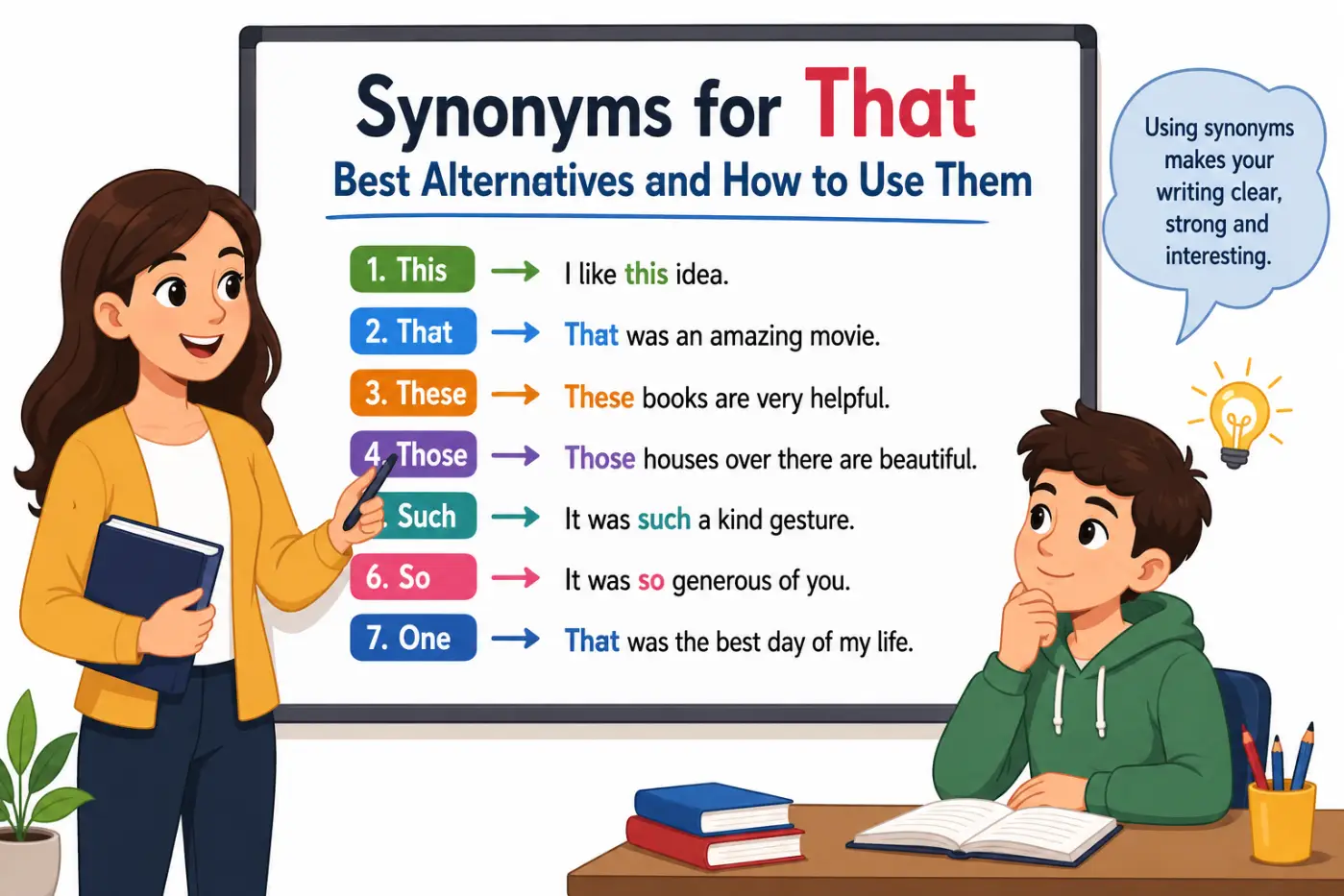
Finding the right synonyms for that can instantly make your writing clearer, smoother, and more engaging. The word that is one of the most common words in English, but repeating it too often can make sentences feel repetitive or awkward. In many situations, you can replace it with a more precise word, while in others, removing it completely creates stronger writing.
The confusion comes from the fact that that serves several different grammatical roles. It can act as a pronoun, determiner, conjunction, adverb, or relative pronoun. Since it performs so many jobs, there isn’t a single replacement that works everywhere. The best synonym depends entirely on how the word is being used in a sentence.
In this guide, you’ll discover the best synonyms for that, learn when each alternative works naturally, understand the grammar behind them, and see dozens of real-world examples. You’ll also learn common mistakes, regional preferences, pronunciation, expert writing tips, and practical editing advice that professional writers use every day.
Quick Definition
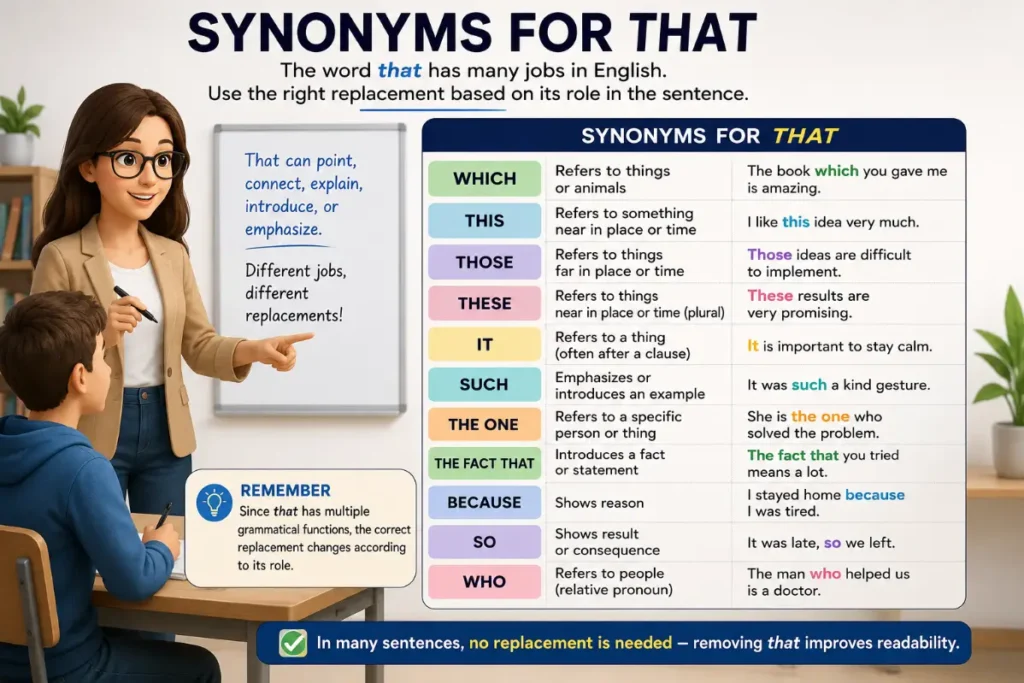
Synonyms for that include which, this, those, these, it, such, the one, the fact that, because, so, and who, depending on the sentence. Since that has multiple grammatical functions, the correct replacement changes according to its role. In many sentences, no replacement is needed because removing that improves readability.
Quick Answer
There is no universal synonym for that. The best alternative depends on its function in the sentence.
Common replacements include:
- Which.
- This.
- Those.
- These.
- It.
- Such.
- The one.
- Who.
- Whom.
- Because.
- So.
- The fact that.
Sometimes the strongest choice is simply deleting that altogether.
Synonyms for That Comparison Table
| Word or Phrase | Best Use | Part of Speech | Typical Context | Formality | Example |
|---|---|---|---|---|---|
| That | General reference | Pronoun, conjunction, determiner | Everyday English | Neutral | I know that answer. |
| Which | Relative clauses | Relative pronoun | Formal writing | Neutral | The book which I borrowed. |
| This | Near reference | Demonstrative pronoun | Conversation | Neutral | This is amazing. |
| Those | Plural distant reference | Demonstrative pronoun | Everyday English | Neutral | Those are mine. |
| These | Plural nearby reference | Demonstrative pronoun | Everyday English | Neutral | These look fresh. |
| It | Previously mentioned thing | Pronoun | All writing | Neutral | It was unexpected. |
| Such | Degree or type | Determiner | Formal writing | Formal | Such behavior is rare. |
| The one | Specific object | Pronoun phrase | Speech and writing | Neutral | The one you wanted. |
| Who | Referring to people | Relative pronoun | Standard English | Neutral | The teacher who helped. |
| Because | Explaining reason | Conjunction | All writing | Neutral | I left because it rained. |
| So | Result | Conjunction | Informal writing | Informal | It was late so we left. |
| The fact that | Formal emphasis | Noun phrase | Academic writing | Formal | The fact that prices rose. |
Meaning of That
The word that is one of the most versatile words in English. It performs several grammatical functions depending on the sentence.
As a Demonstrative Pronoun
It refers to a specific thing or idea that is farther away in time, place, or thought.
Examples include:
- That belongs to Sarah.
- That looks expensive.
As a Demonstrative Determiner
It modifies a noun.
Examples include:
- That house is beautiful.
- That movie was unforgettable.
As a Relative Pronoun
It introduces a clause describing a noun.
Examples include:
- The book that changed my life.
- The student that won the prize.
As a Conjunction
It connects clauses.
Examples include:
- She said that she was ready.
- I know that he called.
As an Adverb
It indicates degree.
Example:
- I didn’t know it was that difficult.
Synonyms for That as a Pronoun
When that replaces a noun, these alternatives often work.
This
Use this for something close in distance or thought.
Examples:
- This is my favorite.
- This tastes wonderful.
It
Use it after the subject has already been introduced.
Examples:
- It surprised everyone.
- It works perfectly.
The One
Useful when identifying something specific.
Examples:
- The one on the shelf.
- The one you recommended.
Such
Common in formal writing.
Examples:
- Such decisions require patience.
- Such opportunities are rare.
Synonyms for That as a Relative Pronoun
Relative clauses often allow several alternatives.
Which
Usually refers to animals or things.
1.Example: The laptop which I bought last week works perfectly.
Who
Used for people.
1.Example: The teacher who encouraged me inspired my career.
Whom
Used in formal object positions.
1. Example: The professor whom everyone respected retired.
Omission
In many restrictive clauses, that can simply disappear.
1.Original: The book that I borrowed was excellent.
2.Revised: The book I borrowed was excellent.
The revised sentence sounds more natural while keeping the same meaning.
Synonyms for That as a Conjunction
When that introduces another clause, several alternatives exist depending on the sentence.
The Fact That
Adds emphasis.
Example: The fact that sales increased impressed investors.
Because
When introducing a reason.
Instead of: I stayed because that it was raining.
Correct: I stayed because it was raining.
So
Introduces a result.
1.Example: It became dark so we went home.
Zero Conjunction
Professional editors frequently remove that.
2.Original: She believed that the project would succeed.
2.Improved: She believed the project would succeed. The second version flows more naturally.
Synonyms for That in Academic Writing
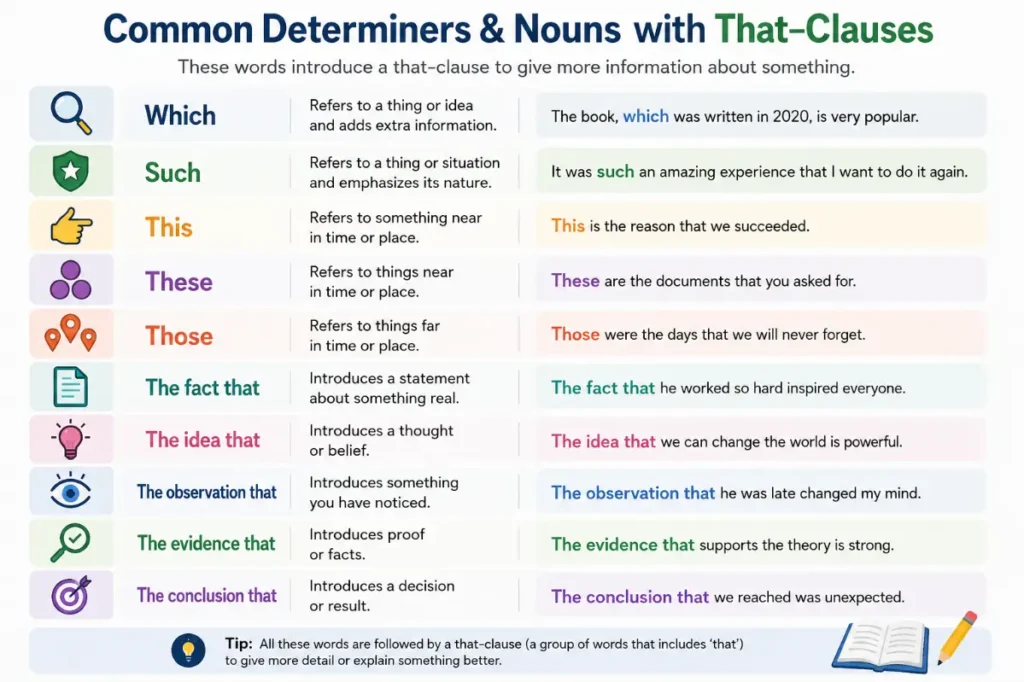
Academic writing often benefits from more precise wording. Instead of repeating that, writers may choose:
- Which.
- Such.
- This.
- These.
- Those.
- The fact that.
- The idea that.
- The observation that.
- The evidence that.
- The conclusion that.
These choices reduce repetition while increasing precision.
Synonyms for That in Professional Writing
Business communication values clarity over complexity. Instead of repeatedly using that, professionals often write:
- This.
- It.
- The item.
- The proposal.
- The report.
- The agreement.
- The document.
- The project.
- The recommendation.
- The decision.
Replacing vague references with specific nouns usually makes documents easier to understand.
Key Differences Between That and Its Alternatives
Although many words can replace that, they are not interchangeable in every sentence.
- This refers to something close, while that usually points to something more distant.
- Which normally introduces information about things, while who refers to people.
- It replaces a previously mentioned noun instead of introducing a new reference.
- Such emphasizes type or degree rather than pointing to a specific object.
- Sometimes no replacement is needed because deleting that produces a cleaner sentence.
These differences explain why choosing the correct synonym depends more on grammar than vocabulary.
Which Synonym Is Correct for That
The correct synonym for that depends on the job the word performs in your sentence. Unlike words with a single meaning, that serves several grammatical purposes. It can introduce a clause, identify a person or thing, modify a noun, or emphasize an idea. Because of that flexibility, no single replacement works in every situation.vProfessional editors rarely ask, “What is another word for that?” Instead, they ask, “What role is that playing in this sentence?” Once you identify its function, choosing the right alternative becomes much easier.
Here are some common situations.
| If that is… | Best replacement |
|---|---|
| Referring to a nearby thing | This |
| Referring to a distant thing | That usually stays |
| Referring to people | Who |
| Referring to things | Which |
| Introducing a clause | Often remove it |
| Showing emphasis | The fact that |
| Showing a result | So |
| Showing a reason | Because |
The most natural replacement is not always another word. In many sentences, removing that entirely creates smoother English. For example: Less natural: She believed that the meeting would finish early. More natural: She believed the meeting would finish early. Native English speakers make this kind of edit constantly because it improves flow without changing meaning.
Examples Using That
These examples show how that works naturally in everyday English.
- That painting belongs to my grandfather.
- I didn’t know that you were coming today.
- The book that changed my career is still on my shelf.
- That restaurant serves incredible seafood.
- She said that everything was under control.
- That idea deserves more attention.
- The phone that I ordered arrived yesterday.
- That was the happiest day of my life.
- He promised that he would call tomorrow.
- That solution solved the problem immediately.
Examples Using Synonyms for That
These sentences replace that with suitable alternatives.
- This notebook is mine.
- Which option seems better to you?
- The teacher who inspired me retired last year.
- The fact that sales increased surprised everyone.
- Such behavior is unacceptable in the workplace.
- The one you recommended worked perfectly.
- It exceeded everyone’s expectations.
- These flowers smell wonderful.
- Those buildings are over one hundred years old.
- Because the weather improved, we continued hiking.
Each example uses a different substitute because the grammatical role changes from sentence to sentence.
Common Mistakes When Replacing That
Replacing that without considering grammar can create awkward or incorrect sentences. These are the mistakes editors see most often.
Using Which Instead of Who
1.Incorrect: The student which won the scholarship.
2.Correct: The student who won the scholarship. People take who, not which.
Replacing That With This Incorrectly
Incorrect: I saw this mountain yesterday. Correct if the mountain is nearby. If the mountain is farther away in conversation or memory, that may be more appropriate.
Keeping That When It Is Unnecessary
Wordy: She believes that the company will expand. Better: She believes the company will expand. Many unnecessary instances of that can safely disappear.
Removing That When Clarity Suffers
Sometimes that prevents confusion. Clear: The manager announced that employees would receive bonuses. Without that, some long sentences become harder to understand. Good editing balances brevity with clarity.
Assuming Every That Needs Replacement
Many writers think repeated words automatically weaken writing. They do not. Sometimes that is already the clearest and most natural choice. Replacing it simply for variety can reduce readability.
Pronunciation Guide
The pronunciation of that changes slightly depending on accent, but the standard pronunciation remains consistent.
IPA
/ðæt/
Syllables
That
One syllable.
Sounds
The word begins with the voiced th sound.
It ends with a crisp t sound.
Common Pronunciation Mistakes
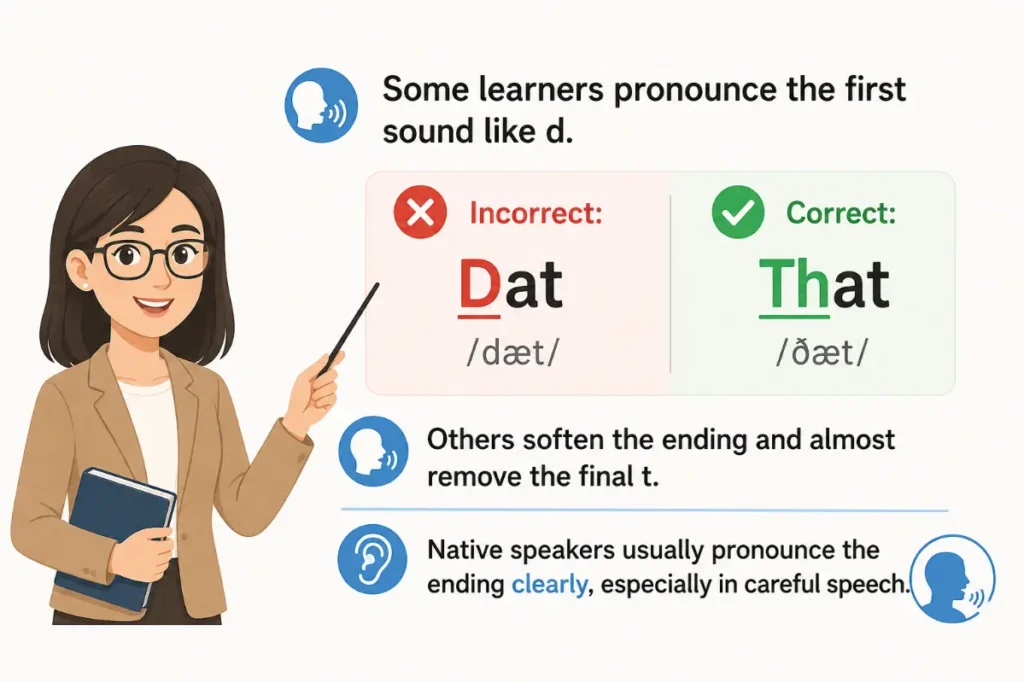
Some learners pronounce the first sound like d. Incorrect: Dat Correct: That Others soften the ending and almost remove the final t. Native speakers usually pronounce the ending clearly, especially in careful speech.
Etymology and Word Origin
The word that has one of the oldest histories in the English language. It comes from Old English þæt, which functioned as both a pronoun and conjunction. Linguists trace it back to Proto Germanic roots shared with German, Dutch, and several Scandinavian languages. Over centuries, that expanded into one of English’s most flexible words.
Its roles gradually included:
- Demonstrative pronoun.
- Demonstrative adjective or determiner.
- Relative pronoun.
- Conjunction.
- Adverb.
Because it developed across multiple grammatical categories, modern English still uses that in many different ways.
Regional Usage
English-speaking countries use that almost identically, although style preferences vary slightly.
American English
American writers frequently omit unnecessary instances of that, especially in journalism, marketing, and business writing.
Example:
1.I think we should leave now.
2.This sounds perfectly natural.
British English
British English also allows omission but often keeps that slightly more often in formal writing.
1.Example: She explained that the proposal required approval. Both styles are considered correct.
Canadian English
Canadian English generally follows American conventions while retaining some British influences in formal documents.
Australian English
Australian English uses that much like British English but often omits it in everyday conversation. Across all major English varieties, the grammar remains virtually identical.
Grammar Rules for That
Understanding grammar makes choosing synonyms much easier.
As a Demonstrative Pronoun
Examples:
1.That belongs to me.
2.That looks expensive.
As a Determiner
Examples:
1.That book.
2.That chair.
3.That opportunity.
As a Relative Pronoun
1.Examples: he movie that everyone recommended. The article that explained everything.
As a Conjunction
1.Examples: She admitted that she made a mistake. We know that practice improves performance.
As an Adverb
1.Example: It was not that difficult. Each role may require a different synonym.
Real Life Usage Examples
Professional writers choose alternatives according to context instead of replacing that mechanically.
Daily Conversation
1.I think you’re right.
2.That’s exactly what I wanted.
3.This tastes amazing.
4.Who told you that?
Academic Writing
The evidence that supports this conclusion remains strong. The fact that participants improved was statistically significant. Such findings deserve additional research.
Professional Communication
The proposal that you submitted has been approved. The report shows that customer satisfaction increased. This recommendation should be implemented immediately.
Literature
Authors often keep that because it creates a natural rhythm in dialogue. Novelists also remove it when faster pacing is desired.
Media
Journalists regularly delete unnecessary instances of that to make headlines and news stories shorter and easier to read.
1.For example: Company Announces New Expansion Plan.
2.Instead of: Company Announces That It Will Expand. This editorial habit makes news writing concise and direct.
Related Words and Confused Terms
People searching for synonyms for that often look for related words that serve similar grammatical functions. Some of these words can replace that in certain situations, while others have completely different purposes.
Demonstrative Words
These words point to people, places, or things.
- This.
- That.
- These.
- Those.
Example:
1.This book is mine.
2.That book belongs to my sister.
Relative Pronouns
These introduce clauses that describe nouns.
- Who.
- Whom.
- Which.
- That.
- Whose.
Example:
1.The woman who called earlier is waiting outside.
2.The bicycle which I bought last month already needs repairs.
Pronouns That Can Replace That
Depending on the sentence, you may use:
- It.
- One.
- Ones.
- The one.
- Those.
- These.
Each option refers to something already mentioned or clearly understood from context.
Formal Alternatives
Professional and academic writing sometimes replaces that with more specific phrases.
- The fact that.
- The idea that.
- The belief that.
- The observation that.
- The conclusion that.
- The evidence that.
- The possibility that.
- The assumption that.
These expressions add precision and often make complex ideas easier to understand.
Words That Are Not True Synonyms
Some words appear similar but cannot replace that in most sentences.
- Which is not always interchangeable with that.
- This indicates something closer than that.
- It replaces a noun but cannot introduce every relative clause.
- Such emphasizes a type or degree instead of identifying a specific person or thing.
Understanding these distinctions helps you choose the most natural wording instead of relying on simple word substitution.
Expert Language Insight
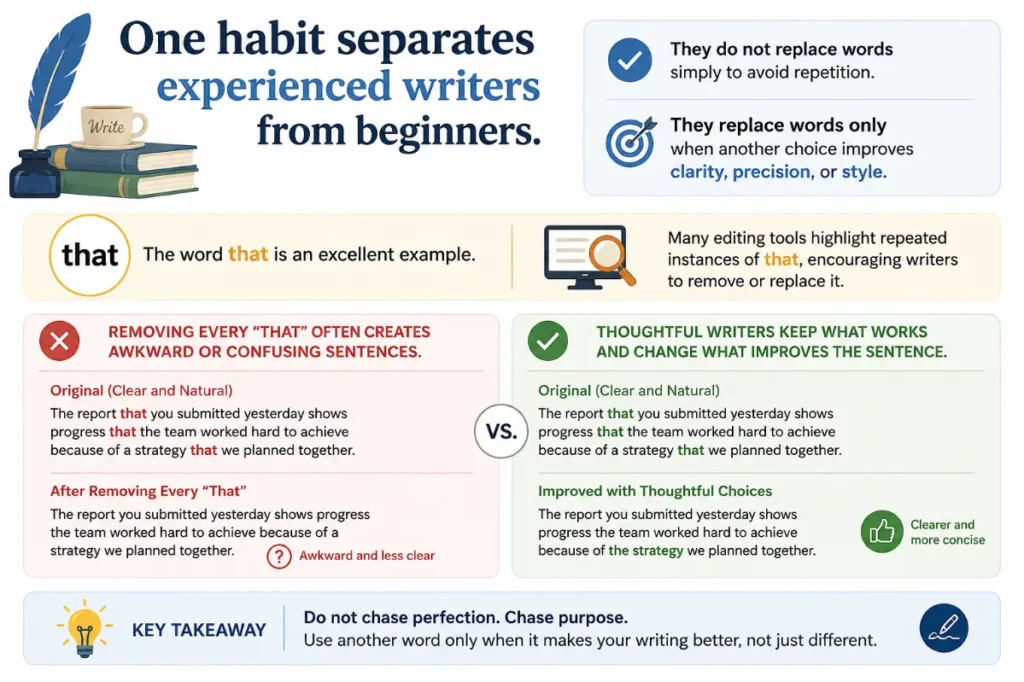
One habit separates experienced writers from beginners. They do not replace words simply to avoid repetition. They replace words only when another choice improves clarity, precision, or style. The word that is an excellent example. Many editing tools highlight repeated instances of that, encouraging writers to remove or replace it. While reducing unnecessary repetition is helpful, deleting every occurrence often creates awkward or confusing sentences.
Professional editors usually follow these principles.
- Keep that when it prevents ambiguity.
- Remove that when the sentence remains perfectly clear.
- Replace that only if another word communicates the idea more precisely.
- Prefer specific nouns over vague pronouns whenever possible.
- Read the sentence aloud. If removing that sounds natural, the shorter version is often the better choice.
Native speakers rarely think about these rules consciously. They develop an instinct through years of reading and writing. Fortunately, you can build the same instinct by recognizing the grammatical role of that before deciding to keep, remove, or replace it.
Conclusion
Finding the right synonyms for that is less about memorizing a list of alternatives and more about understanding how the word functions in a sentence. Since that can act as a pronoun, determiner, conjunction, relative pronoun, or adverb, no single replacement works in every situation. The best choice depends on grammar, context, and the meaning you want to express.
Words like which, who, this, those, these, it, and such can all replace that in the right circumstances. In many sentences, removing that altogether creates smoother, more natural English. Strong writing comes from choosing the clearest option instead of replacing words simply for variety.
As a practical rule, identify the role of that before editing. Keep it when it improves clarity, replace it when another word is more precise, and remove it when the sentence remains clear without it. This approach produces writing that sounds natural, professional, and easy to read.
Frequently Asked Questions
What is the best synonym for that?
There is no single best synonym for that. The correct alternative depends on its grammatical role. Common replacements include which, who, this, those, these, it, such, and the fact that. In many cases, you can simply remove that without changing the meaning.
Can I remove that from a sentence?
Yes. In many sentences, especially after verbs like think, believe, know, or say, that is optional. Removing it often creates smoother, more natural writing. However, keep that when omitting it could make the sentence confusing.
Is which a synonym for that?
Sometimes. Which can replace that in certain relative clauses, but the two words are not always interchangeable. Style guides also treat restrictive and nonrestrictive clauses differently, so the best choice depends on the sentence.
What words can replace that in formal writing?
Formal writing often uses phrases such as the fact that, the idea that, the observation that, the conclusion that, and the evidence that. These alternatives add precision and are common in academic, legal, and professional documents.
Is that a pronoun or a conjunction?
It can be both. That functions as a demonstrative pronoun, determiner, relative pronoun, conjunction, and even an adverb. Its role depends entirely on how it is used within a sentence.
Why is that used so often in English?
That is one of the most versatile words in the language. It connects clauses, identifies people or things, introduces explanations, and points to ideas. Because it serves several grammatical functions, it naturally appears frequently in both speech and writing.
Is it wrong to repeat that several times?
Not necessarily. Repetition is only a problem when it distracts readers or makes sentences sound awkward. If that is the clearest word for the job, keeping it is better than forcing an unnatural synonym.
How do professional editors decide when to remove that?
Editors look for clarity first. If deleting that keeps the sentence clear and easy to read, they often remove it. If the sentence becomes ambiguous or difficult to follow, they leave it in place. The goal is always readability rather than eliminating a particular word.
