
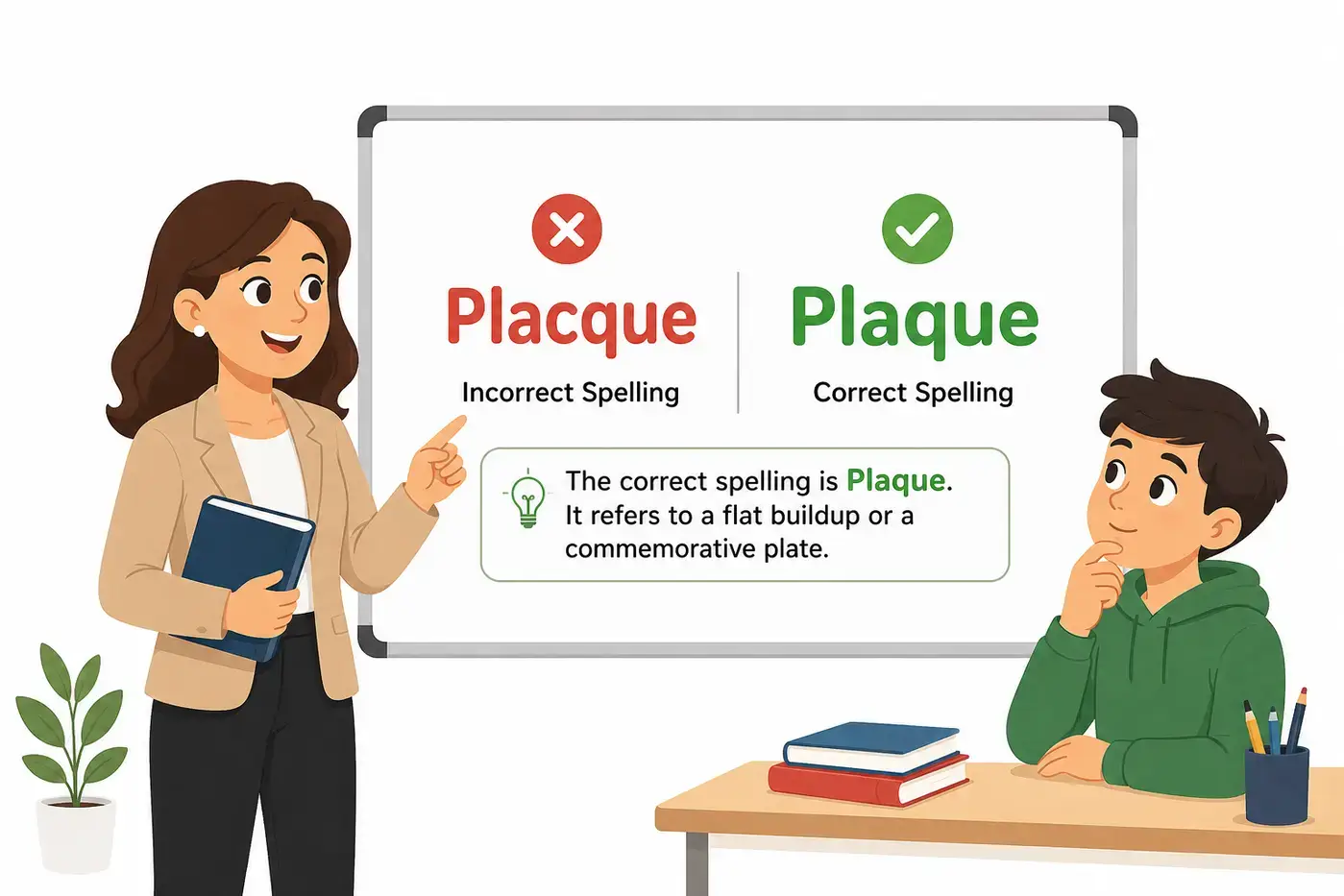
If you’ve ever paused while writing the word for an award plate, a memorial sign, or the buildup that forms on teeth, you’re not alone. The spelling placque may look right because English often uses the letters que in words borrowed from French. However, the standard spelling is plaque, without the extra c before the final que.
The confusion comes from the way English words preserve unusual spelling patterns. Words such as unique and antique end in que, so adding another c may seem reasonable. Yet spelling follows established word forms rather than a single pattern that works for every word. In this case, the accepted spelling is short and direct.
Knowing the correct form helps you write clearly in school assignments, workplace documents, award descriptions, historical accounts, and health related material. It also helps you avoid a spelling error in an important inscription or a formal message. Once you learn the word’s meaning and remember its spelling, you’ll have a simple way to choose the right form every time.
Quick Answer
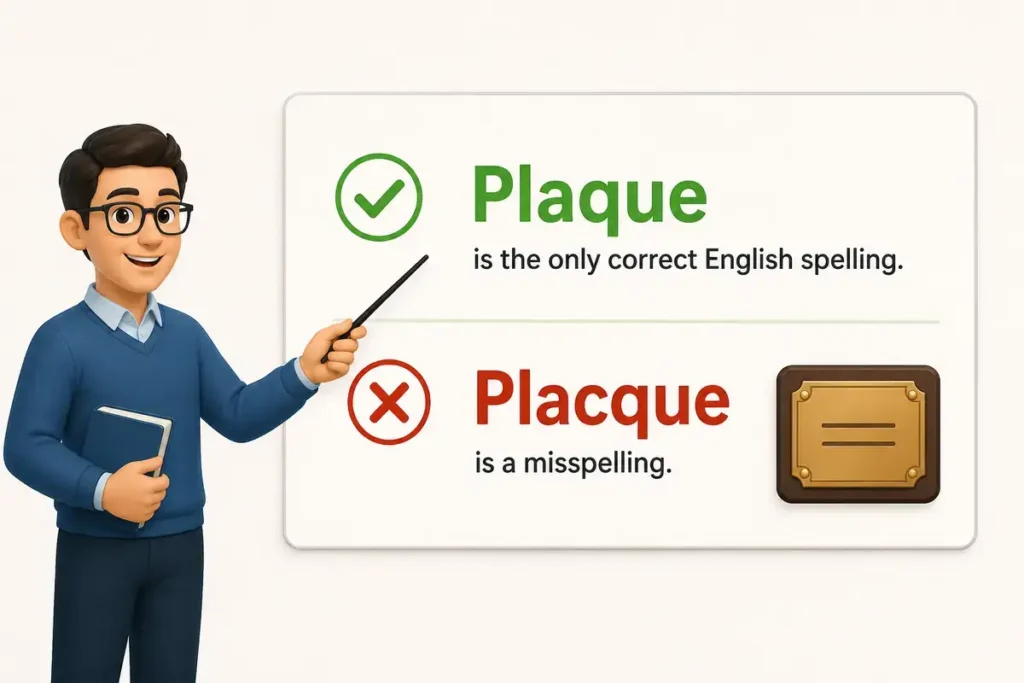
Plaque is the correct standard English spelling. Placque is a common misspelling and is not the standard form used in modern English dictionaries. A plaque is a flat plate made of metal, stone, wood, or another material that displays a name, message, award, or memorial inscription. The word also refers to a sticky film of bacteria that can build up on teeth.
Meaning and Definition
What Does Plaque Mean
A plaque is a flat or slightly raised plate that carries information, honors someone, marks an event, or identifies a place. Plaques are commonly made from brass, bronze, wood, marble, stone, glass, or other durable materials. They may be attached to walls, buildings, monuments, desks, or other surfaces.
The word also has a medical and dental meaning. In dentistry, plaque is a soft, sticky film of bacteria that forms on teeth. In medicine, the term can describe a patch or deposit of material on a surface or within tissue.
Here are the main meanings.
- An award or recognition plate. A school may give a plaque to a student who wins a competition.
- A memorial marker. A historical building may have a plaque that honors a person or records an important event.
- An identification plate. A plaque outside an office may display the name of a business or professional.
- Dental plaque. This is a sticky bacterial film that builds up on teeth and can contribute to tooth decay and gum disease.
- A medical deposit or patch. In some medical contexts, a plaque is a distinct area of material or a visible patch associated with a condition.
The meaning depends on the context. When someone talks about receiving a plaque, they probably mean an award. When a dentist mentions plaque, the discussion concerns oral health.
Is Placque a Real Word
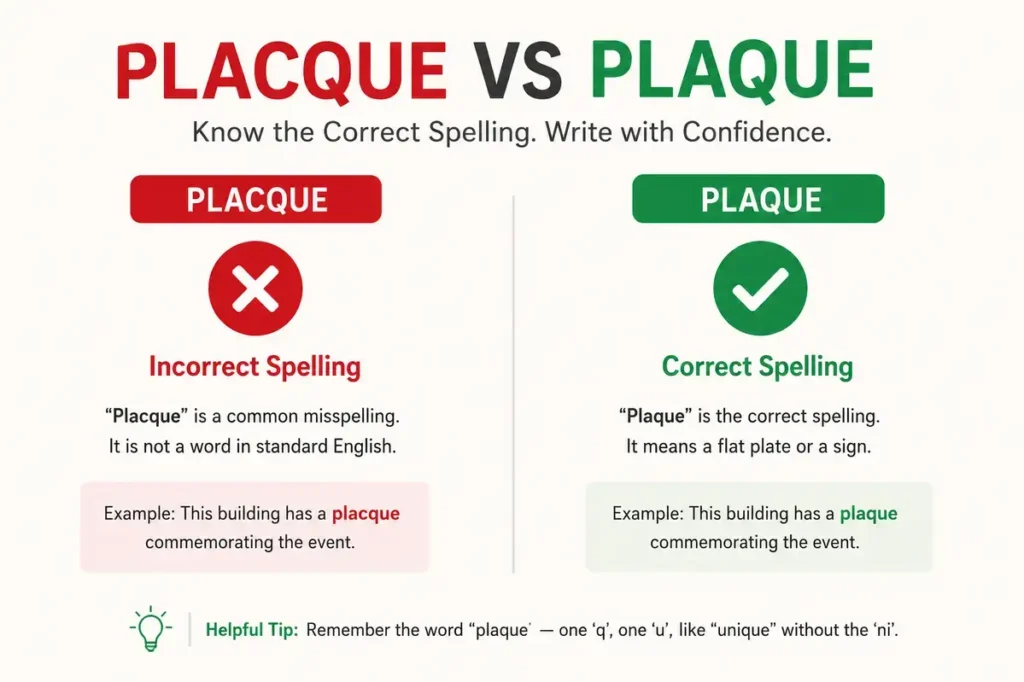
Placque is not the standard spelling of the word described above. In ordinary English writing, it is treated as a misspelling of plaque.
You may encounter the incorrect form in online posts, product descriptions, informal messages, or text written by someone who is unsure of the spelling. Its appearance on a website or in a search result does not make it an accepted standard variant.
There is also a difference between an ordinary spelling error and a name chosen by a business or individual. A company might use an unusual spelling as part of a brand name. That special use does not change the standard spelling of the common noun.
For regular writing, use plaque for the award plate, memorial marker, or dental deposit.
The Key Differences Explained
The difference between the two forms is mainly a matter of standard spelling. They do not have separate meanings in ordinary English.
| Feature | Plaque | Placque |
|---|---|---|
| Standard spelling | Yes | No |
| Meaning | An inscribed plate or a deposit on a surface | No separate standard meaning |
| Part of speech | Noun | Usually an attempted spelling of the noun |
| Pronunciation | Commonly pronounced plak | Intended to represent the same word |
| Formal writing | Correct | Incorrect |
| Common contexts | Awards, memorials, dentistry, medicine | Typing and spelling errors |
| Recommended use | Use this form | Correct it to plaque |
The extra letter in the incorrect form serves no purpose in the standard spelling. English does contain words with similar letter patterns, but that does not mean every related sound requires the same spelling.
For example, plaque and antique both end in the letters que. That similarity may help explain the confusion, but it does not justify inserting an extra c into plaque.
Which Form Is Correct
The correct spelling is plaque. Standard English dictionaries recognize this form for both the inscribed plate and the dental or medical meaning.
The spelling does not change between American and British English. Writers in both varieties use plaque.
Consider these examples.
- The mayor unveiled a plaque outside the library.
- My dentist explained how plaque forms on teeth.
- The school displayed a plaque honoring its first principal.
- A bronze plaque marks the entrance to the historic building.
- Brushing twice a day helps remove dental plaque.
In every sentence, the standard spelling is the same.
The incorrect form may appear in writing because people remember the sound but not the exact letters. Spellcheckers can catch many instances, although the result depends on the software and its dictionary. A reliable dictionary remains useful when a word looks unfamiliar.
How to Use Plaque Correctly
Use the word as a noun when you refer to a plate, marker, or deposit.
For Awards and Recognition
Organizations often give plaques to recognize achievements. Schools, sports clubs, workplaces, and community groups may present them at ceremonies.
For example, a company might give an employee a plaque for years of service. The plate could include the employee’s name, the award title, and the date.
The word can refer to the object itself, regardless of the material used to make it.
For Memorials and Historical Sites
Plaques often preserve a short record of a person, event, or place. They may be placed on buildings, statues, bridges, or monuments.
For example, a plaque on a historic house might explain who lived there. A plaque in a park might honor a local community leader.
In these contexts, the word often appears with verbs such as install, display, dedicate, unveil, and read.
For Dental Health
Dentists use the word to describe the sticky film that develops on teeth. Dental plaque contains bacteria and can build up along the gumline and between teeth.
Regular brushing and cleaning between teeth help control its buildup. If plaque remains on the teeth, it can harden into tartar, which generally requires professional dental cleaning to remove.
In this context, the word appears in phrases such as dental plaque, plaque buildup, and plaque removal.
For Medical Writing
In medical language, a plaque may refer to a distinct patch or deposit in tissue. The precise meaning depends on the condition being discussed.
For example, a medical professional might describe plaques associated with a skin condition or deposits in blood vessels. These uses are more specialized than the everyday meaning of an award plate.
Writers should use the surrounding medical context to make the intended meaning clear.
Ten Correct Example Sentences
The following examples show how the standard spelling works in different situations.
1. Everyday conversation: My parents gave me a plaque for graduating from college. The word refers to an award presented to recognize an achievement.
2. School: The principal placed a plaque near the entrance to honor the school’s founder. Here, the plaque serves as a permanent memorial.
3. Workplace: The company presented Maria with a plaque for twenty years of service. The noun identifies the award she received.
4. Formal writing: A bronze plaque commemorates the opening of the public library. The sentence uses the word to describe a historical marker.
5. History: Visitors stopped to read the plaque outside the old courthouse. The plaque provides information about the building.
6. Dentistry: The dentist showed me how plaque collects along the gumline. In this example, the word describes a bacterial film on teeth.
7. Text message: Don’t forget to pick up the award plaque before the ceremony. The word refers to a physical item needed for an event.
8. Community event: Volunteers installed a plaque in the park to recognize local donors. The plaque records the donors’ contribution.
9. Academic writing: Researchers examined the role of dental plaque in oral health. The phrase identifies the subject of a scientific discussion.
10. Medical context: The report described a plaque on the patient’s skin. Here, the meaning depends on the medical condition being discussed.
Each example uses the same spelling. The meaning changes with the context, but the written form stays constant.
Common Spelling Mistakes
The main mistake is adding an unnecessary letter. Other errors can occur when writers rely on sound or confuse the word with a related term.
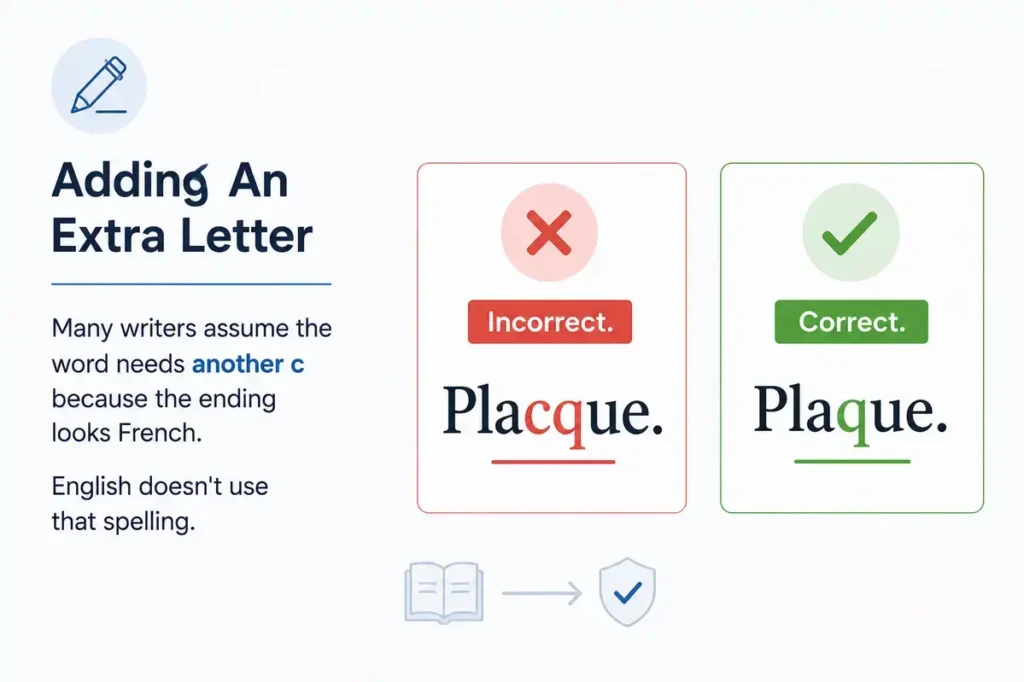
Adding an Extra C
Incorrect: The school installed a placque in the hallway.
Correct: The school installed a plaque in the hallway.
The incorrect version adds a letter that does not belong in the standard spelling. Remember that the word ends with que, not cque.
Replacing the Q With a K
Incorrect: The school presented him with a plake.
Correct: The school presented him with a plaque.
The word sounds like it ends with a k sound, but English spelling does not always match pronunciation letter for letter. The standard ending is que.
Confusing Plaque With Plague
Incorrect: The dentist removed the plague from my teeth.
Correct: The dentist removed the plaque from my teeth.
Plague usually refers to a serious infectious disease or a widespread source of trouble. Plaque is the correct word for the bacterial film on teeth.
The two words sound similar, but their meanings differ.
Using the Wrong Word for an Award
Incorrect: The coach presented the team with a plague.
Correct: The coach presented the team with a plaque.
An award plate is a plaque. A plague is not an award, so choosing the wrong spelling changes the meaning of the sentence.
Copying an Incorrect Online Spelling
Incorrect: The product listing advertised a custom placque for a wedding.
Correct: The product listing advertised a custom plaque for a wedding.
Online listings can contain spelling mistakes. Before copying a product description into a formal document, check the spelling independently.
Pronunciation Guide
The standard pronunciation of plaque is simple once you focus on the first sound and the final consonant.
American English IPA
\(/plæk/\)
Easy pronunciation
PLAK
The word has one syllable. Start with the pl sound, say the short vowel sound in cat, and finish with a k sound.
The final letters que produce the k sound. They do not create an extra syllable.
Common Pronunciation Errors
Some speakers may try to pronounce every letter separately or add a sound because they expect the spelling to work like other words. That is unnecessary. The standard pronunciation is one short syllable.
The incorrect spelling can encourage uncertainty because it appears to contain an extra consonant. Learning the standard spelling alongside the pronunciation helps prevent both errors.
Etymology and Word Origin
The word plaque entered English through French. Its history is connected with the idea of a flat plate or surface.
French has long influenced English vocabulary, particularly in areas such as art, architecture, government, and formal description. Many English words borrowed from French retain spelling patterns that may look unusual to modern readers.
The spelling plaque reflects that history. Its final letters are part of the established word form, not an invitation to add another consonant.
The dental meaning developed through the use of the word for a deposit or layer on a surface. In modern dentistry, it refers to the bacterial film that collects on teeth.
The important point for everyday writers is that the accepted spelling has remained plaque. You do not need to know the full history to use the word correctly, but understanding that English preserves borrowed spellings can explain why the letters do not follow a simple sound based pattern.
Regional Usage
American English
In the United States, plaque is the standard spelling for an award plate, memorial marker, or dental deposit. It appears in everyday conversation, workplace writing, medical information, and formal descriptions.
For example, an American school might announce that a student received a plaque for academic achievement. A dentist might explain how to prevent plaque buildup.
The spelling remains the same in both situations.
British English
British English also uses plaque. There is no standard British spelling that adds a c before the final que.
The word carries the same main meanings, including an inscribed plate and a deposit on a surface. Differences may occur in surrounding vocabulary or style, but not in the spelling of this noun.
Australian English
Australian English uses plaque as well. The spelling does not change for an award, historical marker, or dental deposit.
Canadian English
Canadian English follows the same standard spelling. Writers should use plaque in school documents, professional correspondence, historical descriptions, and health related material.
Across these English varieties, the correct form remains consistent. Regional differences do not explain the extra letter in the misspelling.
Grammar Rules and Part of Speech
The word plaque is a countable noun when it refers to a physical plate or a distinct plaque. Its plural form is plaques.
Singular and Plural Forms
Use a plaque when referring to one plate or one distinct deposit.
- The museum displayed a plaque near the entrance.
- The building has three plaques honoring local leaders.
The plural form adds s to the standard spelling. It does not require any other spelling change.
Using Articles Correctly
Because the word begins with a consonant sound, use a rather than an before the singular noun.
Correct: The committee ordered a plaque for the winner.
Incorrect: The committee ordered an plaque for the winner.
The choice of article depends on the opening sound, not simply on the first written letter.
Common Verb Combinations
Several verbs naturally appear with the word.
- Install a plaque.
- Unveil a plaque.
- Dedicate a plaque.
- Engrave a plaque.
- Read a plaque.
- Remove plaque from teeth.
- Prevent plaque buildup.
The best verb depends on the meaning. People install or unveil a memorial plaque, while dentists discuss removing or controlling dental plaque.
Compound Expressions
The word often appears in a phrase that identifies the type of plaque.
- Memorial plaque.
- Commemorative plaque.
- Brass plaque.
- Dental plaque.
- Plaque buildup.
- Plaque removal.
These phrases use the same spelling. The additional word clarifies the context.
Real Life Usage Examples
Daily Conversation
People may mention a plaque when talking about an award or a visit to the dentist.
1. I need to clean the plaque off the display case before the ceremony. In this sentence, the exact meaning depends on the speaker’s intended object, so additional context may be useful if the reference is unclear.
2. The dentist said I should pay more attention to plaque along my gumline. The context clearly points to oral health.
Email and Workplace Communication
Professional messages may discuss awards, recognition, or building signs.
1. Please confirm the spelling of the recipient’s name before we engrave the plaque. The sentence emphasizes accuracy because an engraved error can be costly to fix.
2. We plan to unveil the new plaque during Friday’s ceremony. The word identifies a commemorative object being presented publicly.
Academic Writing
In school and research, the noun may appear in historical or health related discussions.
1. The plaque provides information about the building’s original use. The sentence describes an information plate.
2. The study examined how dental plaque develops over time. Here, the word refers to the bacterial film associated with oral health.
News and Journalism
News reports often use the word when describing public memorials or community awards.
1. City officials unveiled a plaque honoring the volunteers who rebuilt the community center. The noun refers to a public tribute.
2. The historic marker includes a plaque explaining the site’s role in local history. The context identifies an informational plate.
Literature and Storytelling
Writers may use plaques to establish a setting or reveal something about a character.
1. She brushed the dust from the plaque and read her grandfather’s name. The object helps reveal a personal connection to the place.
2. Under the bright lights, the silver plaque caught his attention. The sentence uses a visual detail to describe the object.
Related and Confused Terms
Learning nearby words can help you choose the right term in context.
Plaque and Plague
A plaque is a plate or deposit. A plague is a disease or a widespread source of harm. Their pronunciation is similar, so the sentence context matters.
Plaque and Plate
A plate is a broad term for a flat object. A plaque is often a plate designed to display information, recognize an achievement, or mark a location.
Plaque and Marker
A marker identifies or marks a person, place, event, or boundary. A plaque can serve as a marker, but not every marker is a plaque.
Plaque and Trophy
A trophy is an object given as a prize or symbol of achievement. A plaque can also recognize achievement, but it usually takes the form of a flat plate.
Plaque and Medal
A medal is typically a small metal object awarded or worn as a symbol of achievement. A plaque is generally larger and intended for display.
Plaque and Inscription
An inscription is writing engraved, carved, or placed on a surface. A plaque may carry an inscription, but the two words do not mean the same thing.
Plaque and Tartar
In dental care, plaque is the soft bacterial film that forms on teeth. Tartar is hardened plaque that attaches to tooth surfaces and usually requires professional cleaning for removal.
Plaque and Patch
A patch is a distinct area that differs from the surface around it. In medical contexts, a plaque can be a defined patch or raised area, but the precise terms depend on the condition.
Expert Language Insight
An experienced editor treats plaque as the only standard spelling for the common noun and corrects the extra c without changing the intended meaning. The error is easy to make because the word contains a less familiar spelling pattern. In a formal document, check the word carefully when it appears in an award title, memorial inscription, product listing, or dental explanation. Spellcheck may flag the misspelling, but a final read through is still worthwhile, especially when the text will be engraved or printed.
Conclusion
The correct spelling is plaque, not placque. Use it for an award plate, a memorial marker, an information plate, or the bacterial film that forms on teeth. The spelling is the same in American, British, Australian, and Canadian English, and its pronunciation is one syllable.
To remember the difference, picture a flat plaque hanging on a wall and keep the spelling short. If an extra c appears before the final que, remove it. This small check can help you avoid an easy mistake in schoolwork, workplace writing, public inscriptions, and everyday communication.
FAQs
Is placque a real English word?
Placque is not the standard spelling of the common English noun. In ordinary writing, it is considered a misspelling of plaque. A brand or proper name may use unusual spelling for its own reasons, but that does not make the form a standard alternative in general English.
What does plaque mean?
A plaque is usually a flat plate that displays a name, message, award, or memorial inscription. In dentistry, it means a sticky film of bacteria that forms on teeth. In medical contexts, it can refer to a distinct patch or deposit, depending on the condition being described.
Which spelling is correct for an award?
Use plaque when referring to an award plate. A school might present a plaque to a student for academic achievement, or a company might give one to an employee for years of service. The spelling is the same for awards, memorials, and informational plates.
How do you pronounce plaque?
In standard American English, the word is pronounced /plæk/, like plak. It has one syllable and ends with a k sound. The final letters que represent that sound, so you do not pronounce an extra syllable or add another consonant sound.
Is plaque spelled the same in American and British English?
Yes. American, British, Australian, and Canadian English all use plaque as the standard spelling. There is no regular regional spelling difference that adds a c before the final que. The same form applies to memorial plates and dental plaque.
What is the difference between plaque and plague?
A plaque is a plate, marker, or deposit on a surface. A plague usually refers to a serious infectious disease or something that causes widespread trouble. The words sound similar, but their meanings are different. A dentist discusses plaque, while a history book may discuss a plague.
What is the plural of plaque?
The plural is plaques. For example, a museum might display several plaques that describe the history of a building. The spelling adds an s to the singular form without changing the rest of the word.
Why do people misspell plaque?
People may add an extra c because the final letters look unusual or because they associate the sound with other words ending in que. The correct spelling is simply plaque. Remembering the short form and checking it before publication can prevent the mistake.
