
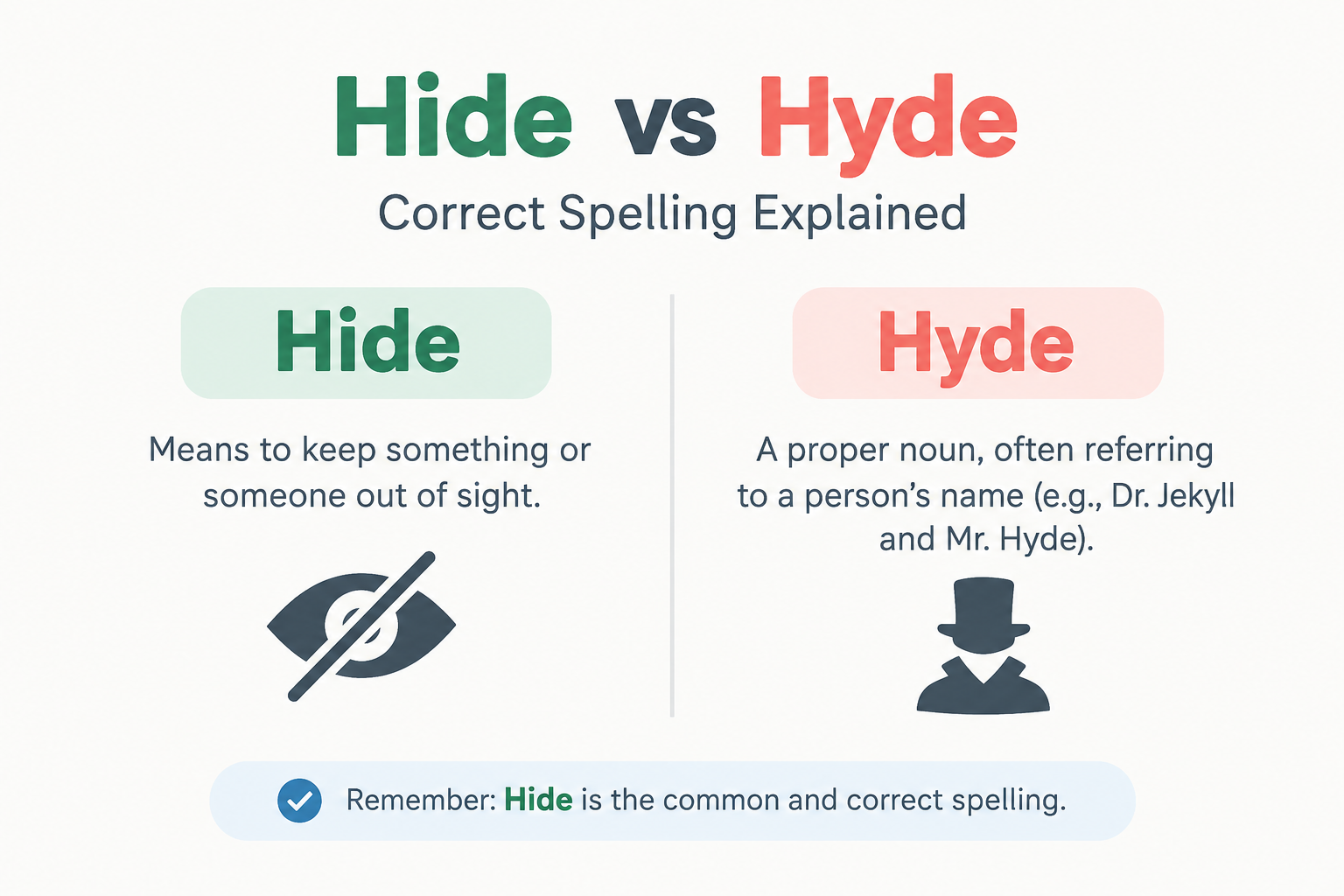
If you are unsure about hide vs hyde, the answer is straightforward. Hide is the standard English spelling for the verb meaning to put something where it cannot be seen or found. It can also mean to keep information, feelings, or another fact secret. Hyde is generally used as a proper name rather than as the ordinary English verb.
The confusion makes sense because English has many words where the letters i and y can create similar sounds. The word hide is pronounced with the long i sound, so someone hearing it without seeing the spelling may naturally wonder if hyde could also be correct. That does not make the alternative spelling standard.
This guide explains the difference in plain English. You will learn what hide means, where hyde can legitimately appear, how to pronounce the words, how the verb changes in different tenses, and which mistakes to avoid in school, work, and everyday writing.
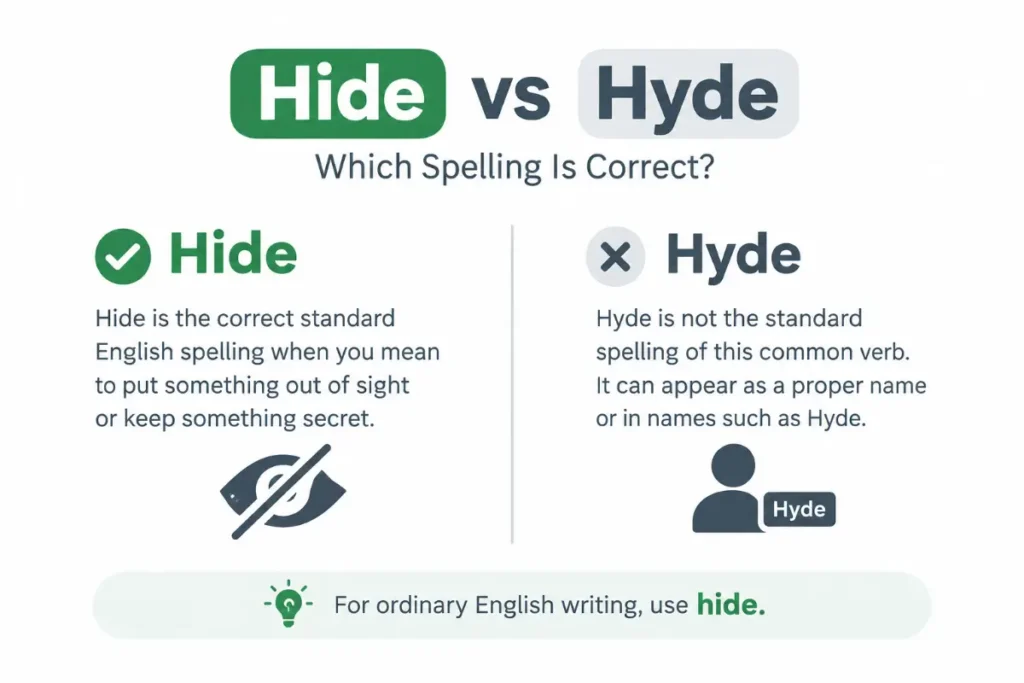
Quick Answer
Hide is the correct standard English spelling when you mean to put something out of sight or keep something secret. Hyde is not the standard spelling of this common verb. It can appear as a proper name or in names such as Hyde. For ordinary English writing, use hide.
What Hide Means
Hide is a standard English word with several related meanings. Its most common use is as a verb meaning to put someone or something in a place where it cannot easily be seen or found. It can also mean to go somewhere so other people cannot see or find you.
For example:
- She hid the keys under the sofa.
- The children hid behind the door.
- He tried to hide the gift before the party.
- The cat hid under the bed.
The word can also describe keeping information or feelings secret.
For example:
- She tried to hide her disappointment.
- He hid the truth from his parents.
- The company could not hide the problem forever.
Cambridge lists these uses of hide as a verb, including putting something or someone somewhere they cannot be seen or found and keeping information or emotions from other people.
Hide is not limited to physical objects. You can hide a person, object, feeling, fact, mistake, emotion, opinion, or piece of information. The central idea is that something is being kept from view, discovery, or knowledge.
Meaning Of Hyde
Hyde is not normally the spelling you want for the common English verb.
Instead, Hyde is most often found as a proper name. It may appear as a surname, place name, or part of the name of a person, location, organization, or fictional character.
That distinction matters because proper names follow their established spelling. If a person’s name is Hyde, you should spell it Hyde. You should not change it to Hide simply because the two forms sound similar.
For ordinary English sentences, however, the verb is hide.
Correct:
She tried to hide the letter.
Incorrect:
She tried to hyde the letter.
The second sentence uses a name like spelling where an ordinary English verb is required.
Hide vs Hyde At A Glance
| Form | Meaning | Part of Speech | Standard Everyday Use | Common Context |
|---|---|---|---|---|
| Hide | Put something out of sight or keep something secret | Verb | Yes | Everyday speech and writing |
| Hide | Skin of an animal used for leather | Noun | Yes | Leather and animal products |
| Hide | A place used to watch wildlife without being noticed | Noun | Yes | Birdwatching and wildlife |
| Hyde | Usually a proper name | Proper noun | Yes in names | Names and place names |
The important point is that hide has several established meanings. Hyde does not normally replace any of them in ordinary English.
Which Form Is Correct
Hide is the correct spelling when you need the common English verb.
Use hide in sentences such as:
- I need to hide this gift.
- The dog tried to hide under the table.
- She hid the documents in a drawer.
- He is hiding something from us.
- They had hidden the evidence before the police arrived.
Use Hyde only when it is part of a proper name or another established name.
For example, a person may have Hyde as a surname. A place may also contain Hyde in its official name. In those cases, the spelling is determined by the name itself.
The safest rule is simple. If you mean conceal, use hide. If you are writing a specific name that is officially spelled Hyde, keep Hyde.
Why The Confusion Happens
The confusion comes mainly from pronunciation and spelling patterns.
English has many words where the letter y appears in places where another spelling might seem possible. The sound in hide is the same vowel sound commonly heard in words such as time, line, ride, and side.
Because hide and Hyde can look like plausible alternatives, people sometimes assume both forms are standard words. They are not.
English spelling is not always predictable from sound alone. Several different spellings can represent similar sounds, but that does not mean every possible spelling creates a standard English word.
This is especially common with short words. When a word has only four letters, changing one letter can make it look like a legitimate alternative even when dictionaries do not recognize it as the ordinary form.
Grammar And Part Of Speech
Hide is most commonly a verb.
As a verb, it can be transitive or intransitive.
A transitive verb takes an object.
For example:
She hid the letter.
The object is the letter.
An intransitive use does not need a direct object.
For example:
The child hid behind the curtain.
The sentence tells us where the child went but does not give a direct object.
Hide has an irregular verb pattern.
The basic forms are:
- Present: hide.
- Past: hid.
- Past participle: hidden.
- Present participle: hiding.
This pattern is worth learning because the past forms do not follow the regular pattern used by verbs such as walk, walked, and walked.
Consider these examples:
I hide the presents every December.
I hid the presents yesterday.
I have hidden the presents upstairs.
She is hiding the presents now.
The spelling changes in the past and past participle, but none of these forms uses hyde.
How To Use Hide In A Sentence
The most common structure is hide plus an object.
For example:
He hid the money.
She hid the book.
They hid the gift.
The structure can also include a place.
For example:
He hid the money in a drawer.
She hid the book under the bed.
They hid the gift behind the curtain.
Another common structure is hide something from someone.
This means keeping information or an object from another person.
For example:
She hid the truth from her brother.
He hid the problem from his manager.
They hid the news from the children.
Cambridge specifically recognizes the construction hide something from someone for keeping information or something else from another person’s knowledge or sight.
You can also use hide to describe emotions.
For example:
She could not hide her excitement.
He tried to hide his anger.
I could not hide my surprise.
In these sentences, the emotion is not physically placed somewhere. The idea is that the person prevents other people from seeing the emotion.
Hide As A Noun
Hide is not only a verb. It is also a noun.
One noun meaning of hide is the strong skin of an animal, especially when it is used to make leather. Cambridge lists this meaning for both British and American English.
For example:
The leather was made from cowhide.
The workers treated the animal hide carefully.
There is also a wildlife meaning, especially in British English. A hide can be a structure or place where people watch birds or animals without being easily noticed. In American English, blind is commonly used for this type of structure.
So hide has several meanings that are completely legitimate.
That makes the spelling even more important. The same four letter word can function as a verb or noun depending on context.
Sentence Examples
Here are ten natural examples showing how the standard word works in real sentences.
- Please hide the birthday present before she gets home.
Hide is a verb because it describes the action of putting the present somewhere it will not be seen.
- The children hid behind the couch during the game.
Hid is the past tense of hide. The action happened in the past.
- I am hiding the documents in a safe place.
Hiding is the present participle and appears with am to form the present progressive.
- She hid her disappointment with a smile.
Here hide has a figurative meaning. She prevented other people from seeing how disappointed she felt.
- The dog tried to hide under the bed.
Hide is used without a direct object. The phrase under the bed tells us where the dog went.
- He has hidden the keys somewhere in the house.
Hidden is the past participle and appears with has to form the present perfect.
- Do not hide important information from your doctor.
Hide means to keep information secret or prevent someone from knowing it.
- The company cannot hide the mistake forever.
The verb refers to keeping a fact from public or internal knowledge.
- She found a quiet place to hide from the rain.
Hide refers to moving to a place where the person can stay protected or out of view.
- The photographer waited inside a wildlife hide.
Here hide is a noun referring to a place where someone can watch animals without being noticed.
These examples show why context matters. The same standard spelling can carry several connected meanings.
Common Mistakes
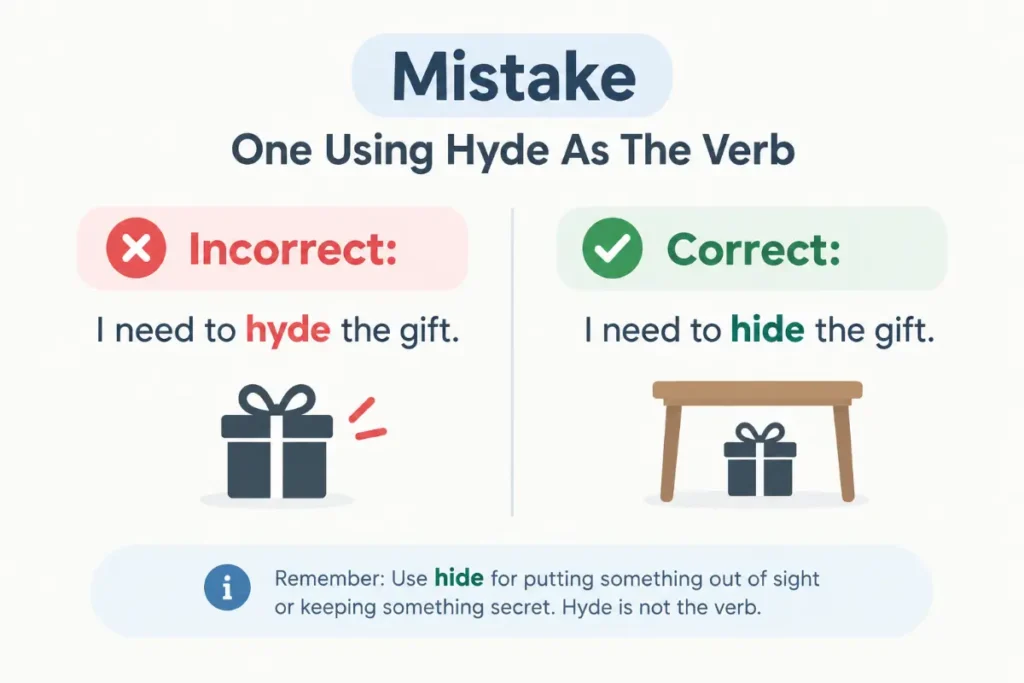
Mistake One Using Hyde As The Verb
Incorrect:
I need to hyde the gift.
Correct:
I need to hide the gift.
The mistake usually comes from treating y as an alternative spelling for the long i sound. In this word, the standard spelling is hide.
Mistake Two Writing Hyde In The Past Tense
Incorrect:
She hyde the documents yesterday.
Correct:
She hid the documents yesterday.
The past tense is hid. It is not hyde and it is not hided.
Mistake Three Using Hyde Instead Of Hidden
Incorrect:
The files were hyde in the cabinet.
Correct:
The files were hidden in the cabinet.
The past participle of hide is hidden.
Mistake Four Confusing A Name With The Verb
Hyde can be correct when it is a proper name.
For example:
Mr. Hyde arrived at the meeting.
If Hyde is the person’s surname, changing it to Hide would create a spelling error in the name.
The context determines which spelling belongs in the sentence.
Mistake Five Assuming Sound Determines Spelling
The pronunciation of a word can help you remember it, but sound alone does not determine English spelling.
Many words can share similar sounds while having different spellings. For hide, the standard written form is established as hide.
Pronunciation Guide
Hide has one syllable.
The standard American English pronunciation is /haɪd/. Cambridge gives the same pronunciation for both US and UK English.
You can think of the sound as the same vowel found in words such as eye and time, followed by a d sound.
There is no separate standard English pronunciation that turns hyde into a different ordinary verb. If Hyde is a person’s name, its pronunciation may depend on the particular name and context, but it is commonly pronounced like hide.
The word’s pronunciation is therefore one reason the spelling can cause confusion. The sounds can be the same while the written forms serve different purposes.
Etymology And Word Origin
The history of hide helps explain why the spelling is old and firmly established.
The verb comes from Old English hydan, meaning to hide or conceal. Etymological records trace it through West Germanic forms and connect it with an older root associated with covering or concealing.
Hide as a noun meaning animal skin has a related but distinct historical development. Old English had hyd, meaning the skin of an animal. Etymological sources connect this noun with older Germanic forms for animal skin.
This history shows that the spelling is not a recent convention. Hide has deep roots in English.
The modern form has remained hide even though English spelling has changed in many other words over time.
American English
In American English, hide is the standard spelling for the common verb.
You will see it in everyday speech, school writing, workplace communication, journalism, fiction, and formal prose.
Common American expressions include:
- Hide the evidence.
- Hide the truth.
- Hide the keys.
- Hide from someone.
- Hide something from someone.
- Hide your feelings.
- Hide in plain sight.
American English does not normally use hyde as an alternative spelling of the verb.
Hyde can still appear in American writing as a proper name. A name should retain its official spelling even when it sounds exactly like another English word.
British English
British English also uses hide as the standard spelling for the ordinary verb.
The basic forms remain the same:
Hide.
Hid.
Hidden.
Hiding.
British English also uses hide as a noun for animal skin. It has an additional established noun meaning for a structure used by people watching birds or wildlife. American English often uses blind for that particular wildlife structure.
The spelling of the ordinary verb does not change from American English to British English.
Canadian And Australian English
Canadian English and Australian English also use hide as the standard spelling of the ordinary verb.
There is no meaningful regional spelling difference that makes hyde an alternative standard spelling.
You should therefore write:
I hid the bag.
She is hiding behind the tree.
They have hidden the documents.
The same basic spelling applies across major standard varieties of English.
Regional vocabulary can differ in some contexts, but this particular spelling does not present a normal American versus British distinction.
Formal And Informal Usage
Hide works in both formal and informal English.
In casual conversation, you might say:
Where did you hide my phone?
In professional writing, you might say:
The report states that the information was deliberately hidden.
The verb itself is not informal. It is a normal English word suitable for serious writing.
However, some expressions using hide can have a more conversational tone.
For example:
I am going to hide out for a few days.
Hide out is a phrasal verb meaning to stay somewhere so that other people cannot find you. Cambridge lists hide out as a phrasal verb associated with the word hide.
For formal writing, you can choose more precise wording when the context calls for it. Conceal may sound more formal than hide in some sentences, although the two words are not perfect substitutes in every context.
Related Words And Expressions
Several words are closely connected to the meaning of hide. Knowing the differences can help you choose the right word.
Conceal
Conceal means to keep something from being seen or known. It is often more formal than hide.
Example:
The report concealed several important facts.
Cover
Cover can mean placing something over another thing so it cannot be seen.
Example:
She covered the box with a blanket.
Cover and hide overlap, but they are not always interchangeable.
Concealment
Concealment is the noun form connected with the act of concealing something.
Example:
The concealment of the information caused concern.
Hidden
Hidden is the past participle and an adjective derived from hide.
Example:
The documents were hidden in a drawer.
Hiding
Hiding is the present participle of hide and can also function as a noun.
Example:
The children are hiding upstairs.
Secret
A secret is information that is kept from others.
Example:
She kept the plan a secret.
A secret is not the same grammatical type as hide, but the meanings often appear together.
Disguise
Disguise means changing the appearance of something or someone so the true identity is not recognized.
Example:
He used a disguise to avoid being recognized.
Disguise and hide can overlap, but disguise focuses on appearance or identity.
Obscure
Obscure can mean making something difficult to see, understand, or notice.
Example:
The trees obscured the view.
It is often more formal than hide and has a broader range of meanings.
Real Life Usage In Daily Conversation
In everyday conversation, hide is common and natural.
You might hear:
Where did you hide the remote?
The kids are hiding upstairs.
I tried to hide my surprise.
Do not hide anything from me.
The word works well because it is short and familiar. Native speakers do not normally replace it with a more formal synonym unless the context calls for one.
In casual speech, hide often appears in playful situations too.
For example:
I know you are hiding somewhere.
Come out of hiding.
You cannot hide forever.
These expressions are natural and widely understood.
Workplace And Email Usage
Hide can also appear naturally in workplace communication.
For example:
The file was hidden in an old folder.
We should not hide important information from the client.
The software may hide certain settings by default.
The report does not hide the risks involved.
In professional writing, the verb can describe both physical visibility and information access.
If you are writing a formal report, you may sometimes choose conceal when you want a more formal tone. Still, hide is not grammatically weak or incorrect. It is a standard verb.
The important point is precision. Use hide when the meaning is clear and natural. Do not replace it simply to make a sentence sound more sophisticated.
Academic Writing
Academic writing may use hide in discussions of information, visibility, psychology, science, technology, and social behavior.
For example:
The diagram hides several smaller details.
The model can hide important differences between groups.
The researcher examined how people hide emotional responses.
The results may hide a deeper pattern.
In these examples, hide works naturally because the meaning involves something being difficult to see, recognize, or understand.
Academic writers can use conceal when the context calls for a more formal alternative, but there is no rule requiring it.
Journalism And Storytelling
Writers often use hide when describing actions, secrets, mysteries, and discoveries.
For example:
The suspect hid the documents in an abandoned building.
The missing evidence had been hidden for years.
The story revealed what officials had tried to hide.
The character hid behind the door and waited.
The word is especially useful in storytelling because it can create a simple contrast between what is visible and what remains unknown.
That makes hide a flexible word with both literal and figurative uses.
Expert Editor Insight
An experienced editor would usually treat hide and hyde as a straightforward spelling issue. If the sentence describes concealing something, hide is the standard choice. If Hyde appears with a capital letter as part of a person’s name, place name, or another established proper name, the editor checks the specific name rather than changing its spelling. Good editing also looks beyond the single word and checks related forms such as hid, hidden, and hiding because those forms are common places for spelling errors.
A Simple Memory Trick
The easiest way to remember the spelling is to connect hide with other common words that use the same long i pattern.
Think of:
Hide.
Side.
Ride.
Wide.
The spelling pattern becomes easier to recognize when you see the words together.
Another useful trick is to remember the verb forms as one family:
Hide.
Hid.
Hidden.
Hiding.
None of these standard forms contains y.
If you see hyde in an ordinary sentence such as I need to hyde the keys, pause and check the word. If you mean conceal, change it to hide.
When Hyde Is Correct
It would be misleading to call Hyde an incorrect spelling in every situation.
Hyde can be completely correct when it is part of a proper name.
For example:
- Hyde may be a person’s surname.
- Hyde may appear in a place name.
- Hyde may be part of the official name of an organization.
- Hyde may appear as the name of a fictional character.
- Hyde may occur in historical or literary names.
A proper name should not be changed simply because another ordinary English word sounds the same.
This is an important distinction in editing. The question is not always which spelling looks correct in isolation. The real question is what the word is doing in the sentence.
If the sentence says that someone wants to conceal something, use hide.
If the sentence identifies someone named Hyde, preserve Hyde.
A Practical Editing Test
When you encounter hide or hyde in a draft, use this three step test.
- Ask what the word means.
If it means conceal, keep something secret, or stay out of sight, use hide.
- Check the grammatical role.
If it is functioning as the common verb, hide is the correct spelling.
- Check if it is a proper name.
If the word identifies a person, place, character, or another named entity, Hyde may be correct.
This approach is better than relying only on how the word sounds.
Why Spelling Tools May Flag Hyde
A spelling checker may flag hyde when it appears in an ordinary sentence because many dictionaries and language databases recognize hide as the standard English verb.
However, spelling software cannot always understand context perfectly. A name such as Hyde may be completely valid even if a general dictionary does not treat it as the ordinary verb.
That is why human judgment still matters in editing.
If a document contains a person’s surname, a place name, or a fictional character named Hyde, do not automatically replace it with hide.
The goal of proofreading is not to make every word match the most common dictionary entry. The goal is to make the spelling match the intended meaning and context.
Key Differences Explained
The distinction can be reduced to a few clear points.
- Spelling. Hide is the standard spelling of the ordinary English verb. Hyde is generally used as a proper name.
- Meaning. Hide can mean conceal, stay out of sight, or keep something secret.
- Part of speech. Hide can function as a verb and also as a noun with other meanings.
- Grammar. The main verb forms are hide, hid, hidden, and hiding.
- Pronunciation. Hide is pronounced /haɪd/ in standard American and British English.
- Context. Hide belongs in ordinary sentences about concealing something. Hyde usually belongs in names.
- Regional usage. Major English varieties use hide as the standard verb spelling.
- Editing. Editors should examine context before correcting Hyde because a proper name may require that spelling.
Key Takeaways
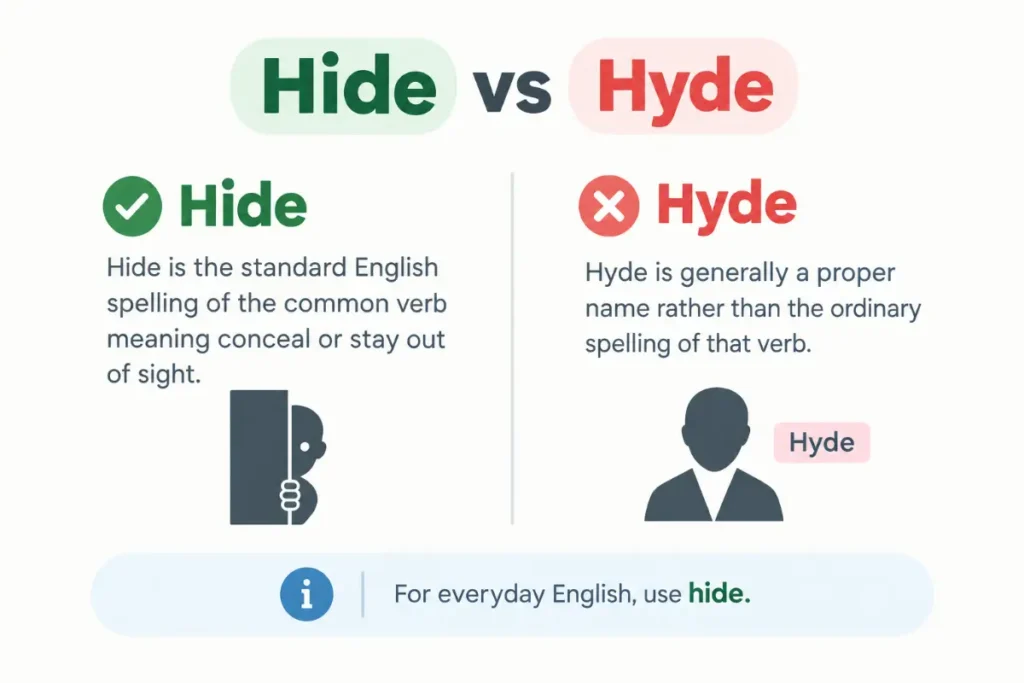
- Hide is the standard English spelling of the common verb meaning conceal or stay out of sight.
- Hyde is generally a proper name rather than the ordinary spelling of that verb.
- Hide can also be a noun meaning animal skin.
- In British English, hide can also mean a place used for watching wildlife.
- The main verb forms are hide, hid, hidden, and hiding.
- The standard pronunciation of hide is /haɪd/.
- American English and British English use hide as the standard spelling of the ordinary verb.
- Do not automatically correct Hyde when it is part of a proper name.
- If you mean conceal, use hide.
- A useful memory trick is to connect hide with side, ride, and wide.
Conclusion
The key distinction in hide vs hyde is simple. Hide is the correct standard spelling when you mean to conceal something, keep information secret, or stay out of sight. Hyde is generally a proper name and should be used only when the name itself has that spelling.
For everyday writing, remember the verb forms hide, hid, hidden, and hiding. If you are proofreading a sentence and the word means conceal, choose hide. If Hyde appears as part of a person’s name, place name, or another established name, keep its original spelling. The best editing habit is to check meaning first and spelling second. That quick check will prevent most mistakes with this easily confused pair.
FAQs
Is Hyde a real English word?
Hyde can be a legitimate proper name, but it is not the standard spelling of the ordinary English verb meaning conceal. If you mean to put something out of sight, use hide. The name Hyde can still be correct when it identifies a person, place, character, or another named entity.
Which is correct hide or hyde?
Hide is correct when you mean conceal, keep something secret, or stay out of sight. Hyde is generally used as a proper name. For example, write I will hide the keys, not I will hyde the keys. Always preserve Hyde when it is the established spelling of a name.
Is hyde a misspelling of hide?
Hyde is commonly a mistaken spelling when someone intends the verb hide. However, it is not accurate to call the form wrong in every context because Hyde can be a proper name. The sentence’s meaning and context determine the correct spelling.
What does hide mean?
Hide can mean putting something or someone somewhere they cannot be seen or found. It can also mean keeping information or feelings secret. For example, you can hide a gift under a bed, hide from another person, or hide your disappointment.
How do you pronounce hide?
Hide is pronounced /haɪd/ in American English and British English. It has one syllable. The vowel sound is the same basic sound found in words such as eye and time, followed by the d sound.
What is the past tense of hide?
The past tense of hide is hid. The past participle is hidden. For example, I hide the keys describes the present, I hid the keys describes the past, and I have hidden the keys uses the past participle.
What is the difference between hide and hidden?
Hide is the base form of the verb, while hidden is its past participle. You can write I hide the documents and The documents were hidden. Hidden is also commonly used as an adjective, as in a hidden message or hidden door.
Is hide appropriate in formal writing?
Yes. Hide is a standard English verb and is appropriate in formal writing when its meaning fits the sentence. Writers may choose conceal in some formal contexts, but hide is not an informal or incorrect word. Clear wording matters more than choosing a longer synonym.
