
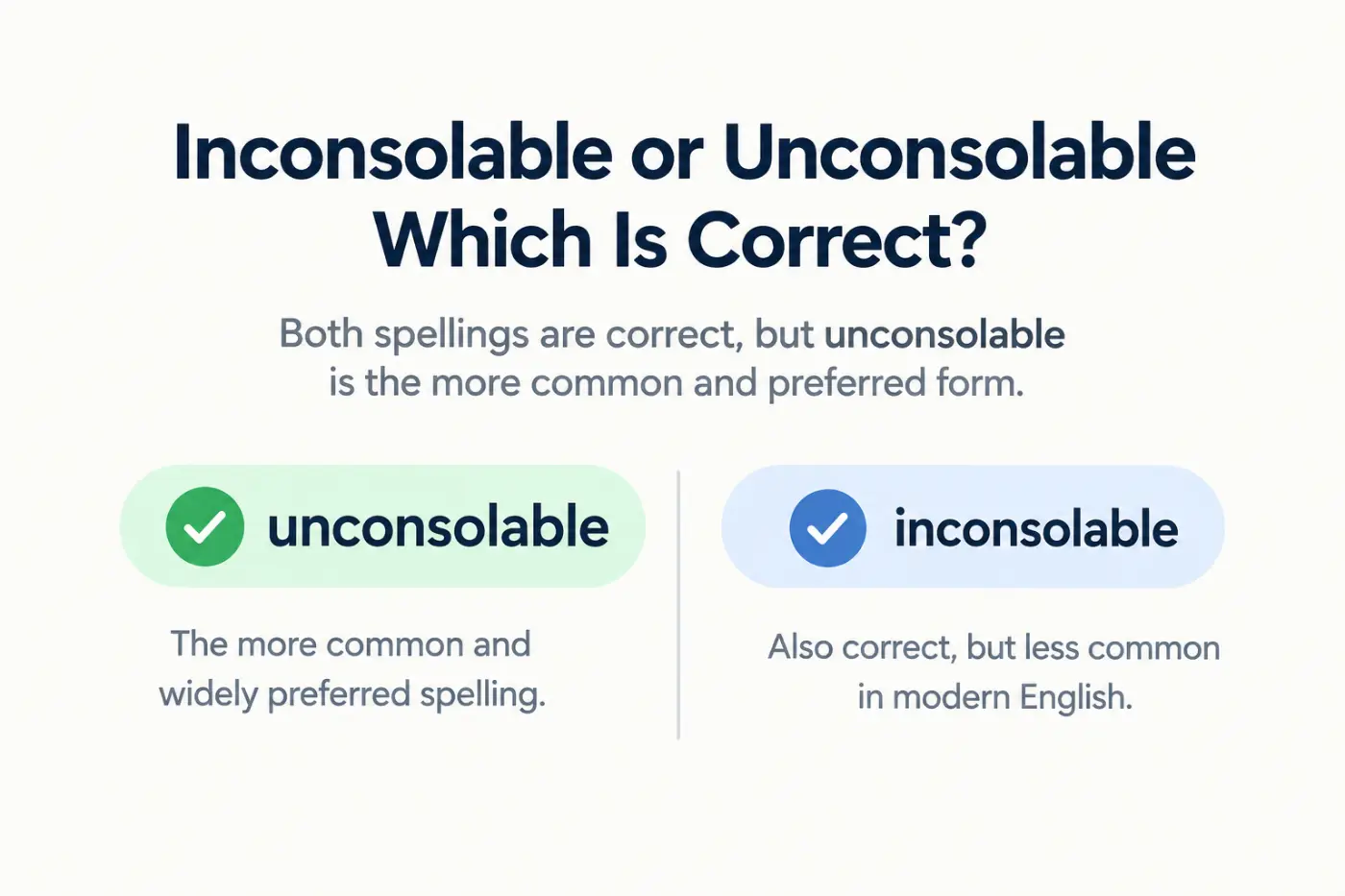
Inconsolable or unconsolable can be confusing because both forms seem to follow a familiar English pattern. The word consolable means capable of being comforted, so it is natural to wonder if adding in or un should produce two equally common forms. In standard modern English, though, the form you will see and hear most often is inconsolable.
The word describes someone who is extremely sad or distressed and cannot easily be comforted. You might describe a grieving parent as inconsolable, a child as inconsolable after losing a favorite toy, or a disappointed fan as inconsolable after a painful loss. Dictionaries define the word around the idea of being unable to receive comfort.
Unconsolable is not simply a misspelling. Oxford lists it as a less frequent form, which makes the distinction more interesting than a basic right versus wrong spelling question. For most American English writing, however, inconsolable is the safer and more familiar choice.
Quick Answer
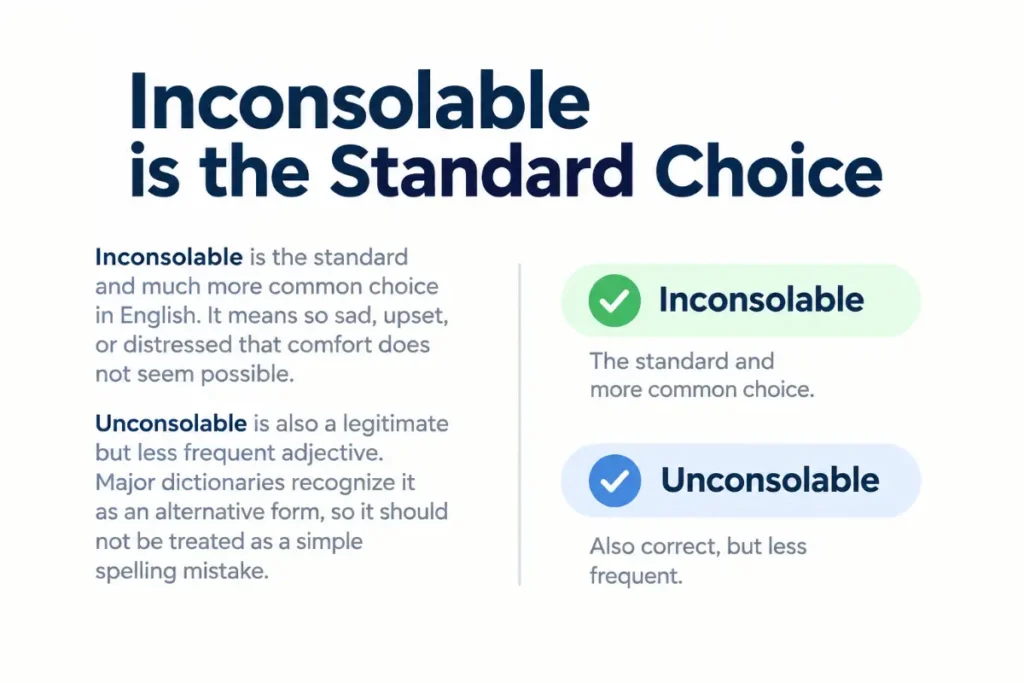
Inconsolable is the standard and much more common choice in English. It means so sad, upset, or distressed that comfort does not seem possible. Unconsolable is also a legitimate but less frequent adjective. Major dictionaries recognize it as an alternative form, so it should not be treated as a simple spelling mistake.
Meaning Of Inconsolable Or Unconsolable
Both forms express the same basic idea. They describe someone or something that cannot be consoled or comforted.
The difference is mainly one of frequency and standard usage rather than a major difference in meaning.
Inconsolable means extremely sad or distressed and unable to be comforted.
Unconsolable carries essentially the same meaning but is less frequent.
For example:
- She was inconsolable after hearing the news.
- The child became inconsolable when her mother left.
- He was inconsolable after the death of his friend.
- The team was inconsolable after losing the championship.
In each sentence, the word describes intense emotional distress that ordinary comfort cannot easily relieve.
The word does not always mean that comfort is literally impossible. It often communicates the idea that the person’s grief or distress is so strong that other people cannot make them feel better at that moment.
That distinction matters. Someone can be inconsolable for an hour and later calm down. The adjective describes the person’s emotional state at a particular time rather than making a permanent claim about their personality.
Which Form Is More Common
Inconsolable is clearly the more established and familiar form for general English use. Cambridge lists it as an adjective, and Oxford lists unconsolable as a less frequent alternative.
This makes the practical choice simple.
If you are writing an email, article, school assignment, story, report, or social media post, inconsolable is normally the best choice.
If you encounter unconsolable in published writing, you should not automatically assume the writer made a spelling error. The word exists, but it is much less common.
This is an important distinction in English. Some word pairs contain one standard word and one clear misspelling. This pair is different because both forms have dictionary recognition.
The safest editing rule is therefore not to call unconsolable wrong. Instead, describe it as a legitimate but less common alternative and recommend inconsolable for ordinary usage.
Comparison Table
| Form | Meaning | Part of Speech | Standard Status | Frequency | Formality | Common Contexts | Example |
|---|---|---|---|---|---|---|---|
| Inconsolable | Unable to be comforted because of intense sadness or distress | Adjective | Standard | Much more common | Neutral to formal | Grief, sadness, disappointment, emotional distress | She was inconsolable after the loss. |
| Unconsolable | Unable to be comforted | Adjective | Legitimate alternative | Less frequent | Neutral but less familiar | Emotional distress and literary contexts | He seemed unconsolable after the tragedy. |
The table shows why inconsolable is the better default. It is familiar to readers and strongly established in standard English.
Why The Two Spellings Exist
The difference comes partly from the way English forms negative adjectives.
English uses several negative prefixes, including in and un. They do not always work as interchangeable choices.
Words such as impossible, invisible, incomplete, and inaccurate use in. Words such as unhappy, uncertain, unfair, and unable use un.
That can make English spelling feel unpredictable.
The base word here is related to console, which means to comfort someone who is experiencing grief or emotional pain. From that base, English developed consolable, meaning capable of being comforted, and inconsolable, meaning unable to be comforted. The historical form of the word goes back to Latin.
Because un is also a common negative prefix, the form unconsolable is understandable and has entered actual English usage. It remains much less common than the established form.
This is a good example of why spelling cannot always be solved by applying one simple prefix rule.
Is Unconsolable A Real Word
Yes. Unconsolable is a real English word, although it is less frequent than inconsolable.
Oxford specifically lists unconsolable as a less frequent form under its entry for inconsolable.
That means calling it a misspelling would be too strong.
However, dictionary recognition does not mean two forms have equal status in everyday writing. English contains many legitimate alternatives that differ greatly in frequency.
For a reader in the United States, inconsolable will usually look more familiar. It is the form most writers should choose unless they have a specific reason to use the alternative.
This distinction is especially useful for editors. A spell checker might flag unconsolable because it is less common in its word list. That does not automatically prove that the word is invalid.
A good editor checks the word against reliable dictionary evidence before changing it.
Grammar And Part Of Speech
Both forms function as adjectives.
An adjective describes a person, thing, state, or condition. In this case, the adjective describes a person or emotional state marked by extreme grief, sadness, or distress.
You can place the adjective after a linking verb.
She was inconsolable.
He became inconsolable.
The child seemed inconsolable.
The adjective can also appear before a noun.
An inconsolable child cried for several minutes.
The family faced inconsolable grief.
He experienced an inconsolable sense of loss.
The word can describe people directly or modify nouns connected with emotional suffering.
Another related form is inconsolably, which is an adverb.
For example:
The child was crying inconsolably.
She sobbed inconsolably after hearing the news.
The adverb describes how someone performs an action. Cambridge lists inconsolably as an adverb meaning in a way that makes it impossible for someone to be comforted.
How To Use The Word Correctly
The adjective works best when the emotional context is strong.
You would normally use it for deep grief, severe disappointment, overwhelming sadness, or intense distress.
For example:
She was inconsolable after her beloved dog died.
The sentence communicates more than ordinary sadness. It suggests that attempts to comfort her did not work.
You can also use the word after a major disappointment.
The young player was inconsolable after missing the final shot.
Here the person is not necessarily grieving a death. The adjective can describe powerful emotional pain caused by disappointment.
The word can also describe crying.
The baby was inconsolable and cried for hours.
This is especially common in descriptions of children and infants.
Still, the adjective does not mean simply crying. Someone can cry without being inconsolable. The word adds the idea that comfort does not seem to work.
Inconsolable In Everyday English
The word is common enough to appear in ordinary conversation, although it is somewhat stronger than everyday words such as sad, upset, heartbroken, or devastated.
You might say:
I was absolutely inconsolable after my dog died.
That sounds natural in an emotional conversation.
You might also say:
She was inconsolable when she found out her best friend was moving away.
The word is useful when you want to show the depth of someone’s emotional response without explaining every detail.
In casual speech, people may also use simpler expressions.
She was completely devastated.
He was so upset that nothing could cheer him up.
The child could not be comforted.
These expressions are often more conversational. Inconsolable is slightly more vivid and precise.
Inconsolable In Formal Writing
The word works well in formal and literary writing.
For example:
The family remained inconsolable after the unexpected loss.
The report described the parents as inconsolable after receiving the news.
The novel portrays a character consumed by inconsolable grief.
It is especially useful in writing about grief, loss, tragedy, and emotional suffering.
The word can also add emotional weight to storytelling. A writer who says someone was inconsolable gives the reader a stronger picture than a simple statement that the person was sad.
Still, strong words work best when used carefully. If every unhappy character is described as inconsolable, the word loses some of its force.
Sentence Examples
Here are ten natural examples using the standard form.
- She was inconsolable after learning that her childhood home had burned down.
This sentence describes deep sadness caused by a major personal loss.
- The little boy became inconsolable when his parents left the room.
Here the word describes a child who could not easily be comforted.
- He was inconsolable after his closest friend passed away.
The adjective emphasizes the intensity of his grief.
- The losing team looked inconsolable after the final whistle.
The word describes extreme disappointment rather than grief caused by death.
- Her family tried to comfort her, but she remained inconsolable.
This example clearly shows the connection between the adjective and the inability to receive comfort.
- The puppy was inconsolable during its first night away from its owner.
The word can describe distress in an animal as well as a person.
- After hearing the terrible news, he became inconsolable.
The sentence leaves the cause unstated while making the emotional reaction clear.
- The parents found their daughter inconsolable after the accident.
Here the adjective follows the object of the verb and describes the daughter’s emotional state.
- She was inconsolable for several hours but gradually began to recover.
This shows that the condition can be temporary.
- The character is portrayed as inconsolable after losing everything he valued.
This example fits literary analysis and shows how the word can describe a character’s emotional state.
Common Spelling Mistakes
Several spelling mistakes can appear around this word.
Using Unconsolable As If It Were The Only Correct Form
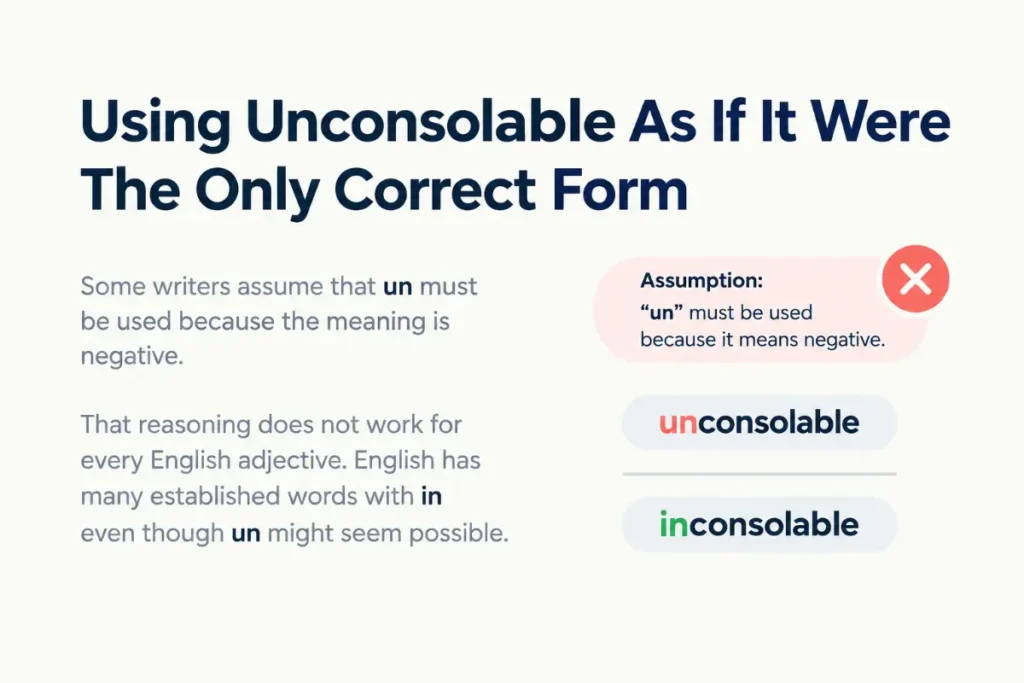
Some writers assume that un must be used because the meaning is negative.
That reasoning does not work for every English adjective. English has many established words with in even though un might seem possible.
For standard general writing, choose inconsolable.
Treating Inconsolable As Inconsolable
A common typing mistake is to lose one of the letters in the middle of the word.
Correct spelling:
Inconsolable.
The word contains the sequence consol because it comes from the same family as console and consolation.
Connecting the word with its related forms can help you remember the spelling.
Writing Inconsolable With An Extra Letter
Some writers insert an extra vowel because the word is long and unfamiliar.
The correct spelling has one o after the c and follows the base consol.
Breaking the word into meaningful parts can make it easier to spell.
in + consol + able
The structure also helps connect the word with console.
Confusing Inconsolable With Inconsolable
Fast typing can cause repeated letters or omitted letters.
The best solution is to check the base word rather than trying to memorize every letter separately.
Think of:
console.
consolable.
inconsolable.
The spelling becomes much easier when you see the family.
Assuming Unconsolable Is Always Wrong
This is a usage mistake rather than a spelling mistake.
Because unconsolable is recognized as a less frequent form, automatically marking it as nonexistent is inaccurate. Oxford explicitly lists it as an alternative.
For most writing, though, inconsolable remains the better default.
Pronunciation Guide
The American English pronunciation of inconsolable is approximately represented by this IPA form:
/ˌɪn.kənˈsoʊ.lə.bəl/
It has four syllables:
in con so la ble
The strongest stress falls on the third syllable.
The beginning sounds like the familiar prefix in.
The middle connects clearly with console.
The final part resembles the ending found in adjectives such as comfortable and understandable, although the exact sound pattern differs.
A common pronunciation mistake is putting too much stress on the first syllable. The strongest beat belongs later in the word.
The related adverb inconsolably adds the adverb ending and is commonly used to describe intense crying or grief. Cambridge gives examples involving people who cry or sob inconsolably.
Etymology And Word Origin
The history of the word helps explain its spelling.
Inconsolable dates to the late sixteenth century. Etymological sources trace it to Latin inconsolabilis, built from in meaning not and consolabilis meaning capable of being comforted. The deeper root is the Latin verb consolari, meaning to comfort or offer solace.
The word therefore carries a fairly direct historical meaning.
Someone who is inconsolable is not able to be consoled.
The related verb console entered English through French and ultimately traces back to Latin. The history connects the modern words console, consolation, consolable, and inconsolable.
This word family gives you a useful spelling clue. If you know how to spell console, you already have the central letters needed for inconsolable.
Regional Usage
American English
In American English, inconsolable is the normal and familiar form. It appears in everyday descriptions of grief, disappointment, crying, and emotional distress.
Unconsolable is possible but much less familiar.
For American readers, use inconsolable when you want the most recognizable standard choice.
British English
British English also uses inconsolable as the standard familiar form. Oxford recognizes unconsolable as a less frequent alternative, so the distinction is not simply American versus British spelling.
The main difference is frequency rather than regional meaning.
Canadian English
Canadian English generally follows the same distinction. Inconsolable is the familiar standard form, while unconsolable is much less common.
There is no major regional spelling rule that makes the two forms equal in everyday use.
Australian English
Australian English also uses inconsolable for the standard meaning. The alternative form can exist, but it is not the usual choice for general writing.
The safest international choice remains inconsolable.
Related Words And Expressions
Several words overlap with the meaning of this adjective, but they are not perfect replacements.
Consolable
Consolable means capable of being comforted. It is much less common in ordinary conversation than words such as comforted or reassured.
The contrast is straightforward.
Someone can be consolable when comfort works.
Someone can be inconsolable when comfort does not seem to work.
Inconsolably
Inconsolably is the adverb form.
She cried inconsolably.
The word tells us how she cried.
Heartbroken
Heartbroken describes extreme emotional pain, often caused by loss, rejection, or the end of a relationship.
Someone can be heartbroken without being inconsolable.
Devastated
Devastated means extremely upset or shocked by something painful or disappointing.
It is common in everyday American English.
Distraught
Distraught describes someone who is extremely upset, worried, or emotionally overwhelmed.
It can describe anxiety and distress as well as grief.
Grief Stricken
Grief stricken describes someone deeply affected by grief, especially after a death or serious loss.
It focuses strongly on grief.
Disconsolate
Disconsolate means very sad and disappointed. Cambridge identifies it as a formal adjective and gives inconsolable as a synonym.
It can sound more literary or formal than inconsolable.
Comfortless
Comfortless means lacking comfort or relief.
It can describe a person, situation, place, or emotional state and has a broader range of use.
Related Word Families
Understanding the word family can improve both spelling and vocabulary.
Console is a verb meaning to comfort someone.
Consolation is comfort received after sadness or disappointment.
Consoling describes something that provides comfort.
Consolable means capable of being comforted.
Inconsolable describes someone who cannot easily be comforted.
Inconsolably is the adverb form.
These words share a common core.
For example:
Her friends tried to console her.
Their presence offered some consolation.
Their words were consoling.
At first, she was consolable.
Later, she became inconsolable.
She cried inconsolably.
Learning words as a family is often easier than memorizing each spelling separately.
Real Life Usage In Conversation
In everyday conversation, the word often appears when people describe a strong emotional reaction.
For example:
My daughter was inconsolable after her favorite toy broke.
This sounds natural because the situation involves a child who cannot be comforted.
Another example is:
He was inconsolable after the breakup.
This is also natural because romantic loss can cause intense emotional pain.
The word can sound dramatic if the situation is minor.
For instance, saying someone was inconsolable because they ran out of their favorite snack would usually be humorous or exaggerated.
That is not a grammatical problem. It is a question of tone.
English speakers often use strong emotional adjectives for effect. Context tells the reader if the statement is literal, dramatic, or playful.
Real Life Usage In Workplace Writing
The word is less common in ordinary business communication because professional messages usually focus on facts rather than emotional description.
Still, it can appear in sensitive workplace communication.
For example:
The staff were deeply affected by the loss, and several employees were inconsolable.
A news report about a workplace tragedy might also use the word.
In most routine business writing, simpler terms are better.
Instead of:
The customer became inconsolable over the delay.
A professional complaint record might say:
The customer was extremely distressed by the delay.
The second version is more neutral and precise.
Good writing is not just about using a correct word. It is also about choosing the right level of emotional force.
Real Life Usage In Academic Writing
Academic writing can use the word when discussing literature, psychology, history, journalism, or descriptions of emotional behavior.
For example:
The novel presents the protagonist as inconsolable after the death of his brother.
This sentence works because the writer is analyzing a character’s emotional state.
Another example:
The article describes the parents as inconsolable after the loss.
The word is appropriate because it reports a strong emotional response.
In technical or scientific writing, however, the word may be less useful unless the subject specifically involves emotional behavior.
Real Life Usage In Journalism
Journalistic writing often uses strong descriptive language when reporting tragedies or major emotional events.
For example:
Family members were inconsolable after receiving the news.
The team appeared inconsolable after the unexpected defeat.
These examples show why the word has value. It communicates a high level of distress in a single adjective.
Still, responsible reporting should avoid exaggerating people’s emotional states. If the writer has direct evidence of the reaction, the adjective can be appropriate. If not, a more neutral description may be better.
Real Life Usage In Storytelling
Writers often use this adjective because it creates a strong emotional image.
Compare these sentences.
She was sad after her father died.
She was inconsolable after her father died.
The second sentence gives the reader a much stronger emotional signal.
That does not automatically make it better. The best word depends on the scene.
If the character is quietly grieving, devastated or heartbroken might fit better.
If the character is openly crying and cannot accept comfort, inconsolable is especially effective.
Good storytelling depends on precision. Strong words should earn their place.
How To Remember The Correct Spelling
The easiest memory trick is to connect the word with console.
Start with:
Console.
Then add:
Consolable.
Then add the negative prefix:
Inconsolable.
You can picture the structure as:
in + consol + able
The meaning follows the structure.
Someone who is consolable can be comforted.
Someone who is inconsolable cannot easily be comforted.
Another useful trick is to remember that inconsolable is the form you are most likely to encounter in standard dictionaries and ordinary writing. Oxford lists the other form as less frequent.
If you are editing a sentence and have only a second to choose, go with inconsolable.
Expert Editor Insight
An experienced editor would usually keep inconsolable unless the writer has a deliberate reason for choosing the less common alternative. The main issue is not that the alternative is impossible. It is that readers are far more familiar with the established form. Editors also look at context and tone. If a sentence describes deep grief or intense emotional distress, the adjective can be precise and powerful. If the situation is mild, a simpler word such as upset or disappointed may communicate the idea more naturally.
Common Questions About The Two Forms
The biggest source of confusion is the negative prefix. English has many words formed with un, so writers may expect that pattern to work here too. But English vocabulary develops through history rather than through one perfectly consistent set of rules.
Another source of confusion is the word consolable. Once people recognize that word, unconsolable feels perfectly logical. That does not make the alternative incorrect. It simply means that the language has more than one form, with one being much more common.
This is why dictionary evidence matters when judging unusual spellings. A word that looks unfamiliar is not automatically a mistake.
Key Takeaways
- Inconsolable is the standard and much more common form.
- Unconsolable is a legitimate but less frequent alternative.
- Both words mean unable to be comforted.
- The word is an adjective.
- It commonly describes intense grief, sadness, disappointment, or emotional distress.
- It can appear before a noun or after a linking verb.
- Inconsolably is the related adverb.
- The word is connected to console, consolation, and consolable.
- Its history traces back through French and Latin roots connected with comfort and consolation.
- For American English writing, inconsolable is the best default choice.
- Do not automatically label unconsolable as a misspelling because dictionaries recognize it as an alternative.
- If you need one simple memory rule, connect the spelling with console and choose inconsolable for normal writing.
Conclusion
Inconsolable is the standard and more common choice for describing someone who is so deeply upset that comfort does not seem to work. Unconsolable is also a legitimate word, but it appears much less often, so most writers will be better served by the familiar form. The two words have essentially the same meaning and function as adjectives.
The spelling becomes easier when you connect the word with console and consolable. Think of the word family as console, consolation, consolable, and inconsolable. For everyday American English, professional writing, schoolwork, and general publishing, choosing inconsolable gives readers the clearest and most familiar form.
FAQs
Is inconsolable the correct spelling?
Yes. Inconsolable is the standard and much more common spelling. It describes someone who is so sad, distressed, or disappointed that they cannot easily be comforted. Major dictionaries recognize it as a standard adjective. Oxford also lists unconsolable as a less frequent alternative.
Is unconsolable a real word?
Yes. Unconsolable is a legitimate English adjective, but it is less frequent than inconsolable. It carries essentially the same meaning. For most American English writing, inconsolable is the more familiar and safer choice because readers are much more likely to recognize it immediately.
What does inconsolable mean?
It means extremely sad, upset, or distressed and unable to be comforted easily. The word often describes grief after a death or serious loss, but it can also describe intense disappointment or emotional distress. Someone can be inconsolable for a period of time without remaining that way permanently.
Which is better for formal writing?
Inconsolable is normally the better choice for formal writing because it is much more common and immediately recognizable. Unconsolable is legitimate, but its lower frequency can make it look unusual to some readers. If clarity and familiarity are your main goals, choose the established form.
How do you pronounce inconsolable?
In American English, inconsolable is commonly pronounced with four syllables and the strongest stress on the third syllable. Its IPA representation is approximately /ˌɪn.kənˈsoʊ.lə.bəl/. The word is related in sound and spelling to console, which can help you remember its structure.
What is a synonym for inconsolable?
Useful near synonyms include heartbroken, devastated, distraught, disconsolate, grief stricken, and comfortless. They are not perfect substitutes in every sentence. Inconsolable specifically emphasizes that the person’s emotional distress is so strong that comfort does not seem to work.
Why do people confuse the two spellings?
People often confuse them because English uses both in and un as negative prefixes. The base word consolable also makes unconsolable look logical. Since unconsolable is a legitimate but less common form, the confusion is understandable. The easiest practical solution is to remember that inconsolable is the standard familiar choice.
Is inconsolable appropriate in everyday English?
Yes. Inconsolable is natural in everyday English when someone is extremely upset and cannot easily be comforted. It is stronger than words such as sad or upset, so it works best for serious grief, intense disappointment, or powerful emotional distress. It can also be used humorously when the context clearly signals exaggeration.
