
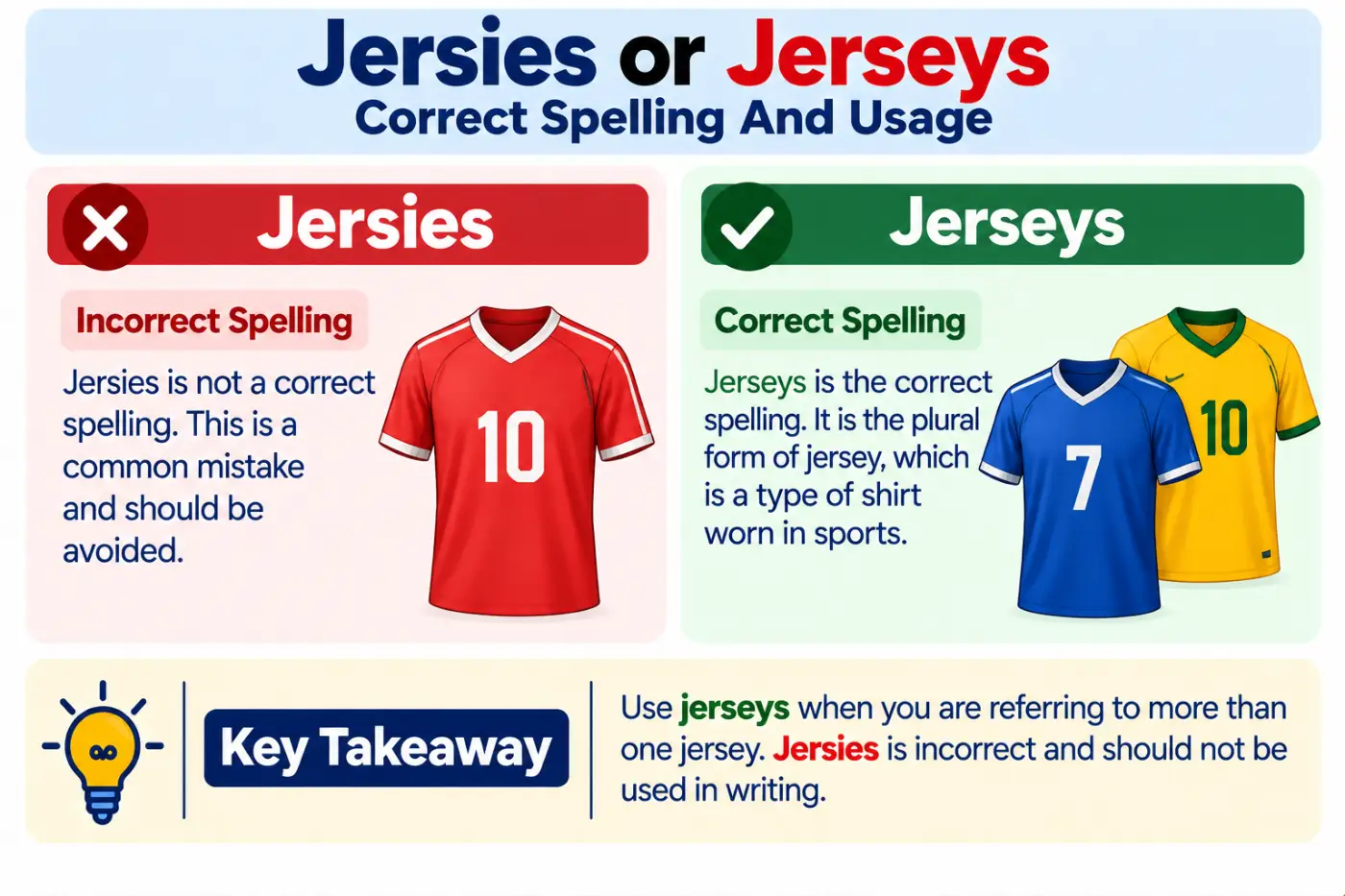
jersies or jerseys is an easy spelling question because the singular word ends in y. When people turn it into a plural, they may remember the common English rule that changes a consonant plus y to ies. In this case, that rule does not apply. Jerseys is the correct standard plural form of jersey, while jersies is a misspelling.
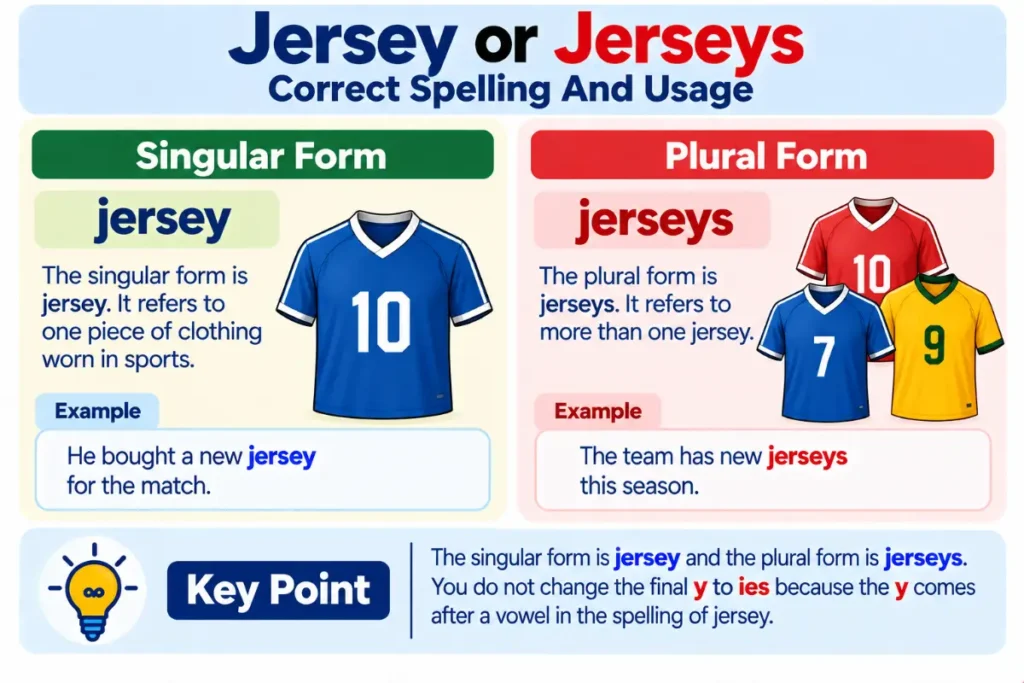
The reason is simple. Jersey ends with a vowel plus y because the letter before y is e. When a word ends in a vowel plus y, English normally adds s to form the plural. So jersey becomes jerseys. You don’t change the y to ie.
The word jersey also has several meanings. It can describe a sports shirt, a type of knitted fabric, or clothing associated with a particular team. Jersey can also refer to the island of Jersey or appear in names such as New Jersey. In this article, you’ll learn the plural rule, pronunciation, meanings, history, common mistakes, regional usage, and plenty of natural examples.
Quick Definition
Jerseys is the correct plural of jersey. Jersies is a common spelling mistake. The word jersey ends with a vowel plus y, so the plural is formed by adding s rather than changing y to ies. Jerseys can refer to multiple sports shirts, garments, or items made from jersey fabric.
Quick Answer
The correct plural spelling is jerseys.
The form jersies is not the standard plural of jersey. The spelling stays jersey and simply takes the plural ending s.
For example:
The players received their new jerseys before the game.
The word jerseys can describe more than one sports shirt or more than one garment made from jersey fabric.
Comparison Table jersies or jerseys
| Form | Meaning | Part of Speech | Origin | Usage Frequency | Formality | Common Contexts | Example |
|---|---|---|---|---|---|---|---|
| Jerseys | Plural of jersey | Noun | Connected to the name Jersey and the history of jersey fabric | Common | Neutral | Sports, clothing, fashion, textiles | The team ordered new jerseys. |
| Jersies | Nonstandard spelling of the plural | Noun spelling error | Misspelling of jerseys | Uncommon in standard writing | Not standard | Typing errors, spelling mistakes | The correct spelling is jerseys. |
The important point is that the difference is not a difference in meaning. The two forms don’t represent two different kinds of clothing. One is the standard plural spelling and the other is a spelling error.
Meaning And Definition
Meaning Of Jersies
Jersies is not the standard plural form of jersey in modern English.
People sometimes write jersies because they apply a familiar plural rule too broadly. Many English words ending in a consonant followed by y change the y to ies when they become plural.
For example:
baby becomes babies.
city becomes cities.
party becomes parties.
Because jersey also ends in y, it can look as if the same rule should apply. But jersey has an important difference. The letter immediately before y is e, which is a vowel.
That means jersey follows the vowel plus y pattern.
boy becomes boys.
key becomes keys.
journey becomes journeys.
jersey becomes jerseys.
So if you write jersies in standard English, a spelling checker or careful editor will normally treat it as an error.
Meaning Of Jerseys
Jerseys is the standard plural of jersey.
The word jersey has several meanings depending on context. In sports, a jersey is a shirt or top worn by a player or team member. It often displays a player’s number, name, team logo, or colors.
For example:
The basketball players wore their new jerseys.
Jersey can also describe a knitted fabric. A jersey fabric is usually soft and flexible and is commonly used for shirts, dresses, casual clothing, and other garments.
The word can also refer to a breed of dairy cattle or to the island of Jersey. In those cases, context determines the intended meaning.
When you use the plural jerseys, you may therefore be talking about several sports shirts, several garments made from jersey fabric, or other things described by the noun jersey.
The Main Spelling Rule
The spelling becomes much easier when you look at the letter before the final y.
English commonly uses two patterns for words ending in y.
Consonant Plus Y
When a singular noun ends in a consonant plus y, the plural often changes y to ies.
Examples include:
- baby becomes babies.
- city becomes cities.
- country becomes countries.
- story becomes stories.
- family becomes families.
In each case, the letter before y is a consonant.
Vowel Plus Y
When a singular noun ends in a vowel plus y, English normally adds s.
Examples include:
- boy becomes boys.
- toy becomes toys.
- day becomes days.
- key becomes keys.
- journey becomes journeys.
- monkey becomes monkeys.
- jersey becomes jerseys.
The spelling of jersey fits this second pattern because e comes immediately before y.
This is the key rule to remember.
Why Jersies Looks Correct At First
English spelling contains enough irregular patterns to make learners cautious. The spelling jersies looks reasonable because the change from y to ies appears in many familiar plurals.
If you know that baby becomes babies, you might naturally assume jersey should become jersies. The eye sees the same ending and expects the same transformation.
However, English plural spelling depends on the letters immediately before the final y.
Compare these words:
city → cities
party → parties
jersey → jerseys
The first two have a consonant before y. Jersey has a vowel before y.
This small distinction is easy to miss, especially when typing quickly.
The good news is that you don’t need to memorize a special exception. Jersey follows the normal vowel plus y plural pattern.
Key Differences Explained
- Spelling. Jerseys is the standard spelling. Jersies is a misspelling.
- Plural formation. Jersey takes s because it ends in a vowel plus y.
- Meaning. Jerseys means more than one jersey. Jersies does not have a separate standard meaning.
- Grammar. Jerseys is a plural count noun when it refers to separate shirts or garments.
- Pronunciation. The plural keeps the basic sound of jersey and adds a z sound at the end.
- Formality. Jerseys is appropriate in casual, academic, professional, commercial, and formal writing.
- Regional usage. Standard English varieties use jerseys as the plural spelling.
- Context. Jerseys commonly appears in sports, clothing, fashion, textile, retail, and general writing.
The distinction is therefore mainly about spelling rather than meaning.
Which Form Is Correct?
Jerseys is the correct standard plural form.
The reason comes from a basic English spelling pattern. When a word ends in a vowel followed by y, the plural usually takes s.
Jersey ends with ey. The e is a vowel, so the y remains in place.
Jersey + s = jerseys.
By contrast, words such as city and baby end in consonant plus y. Those words normally change y to ies.
City + ies pattern = cities.
Baby + ies pattern = babies.
Jersey doesn’t follow that pattern.
A useful editing habit is to look at the letter immediately before y rather than looking at the final y alone. That one step prevents many plural spelling mistakes.
Sentence Examples
Here are natural examples using the standard plural form.
- The players received their new jerseys before practice.
- I ordered two jerseys for my sons.
- The team wore matching jerseys during the championship game.
- These jerseys are made from lightweight fabric.
- The store has several new jerseys in stock.
- We washed the jerseys after the tournament.
- The fans bought jerseys with their favorite player’s number.
- The school ordered custom jerseys for the basketball team.
- Her collection includes vintage jerseys from several teams.
- The company designs custom jerseys for local sports clubs.
Here are examples that show the common spelling mistake. These forms are included only to demonstrate the error.
- The players received new jersies.
- I bought two jersies for the season.
- The store sells football jersies.
- She washed the jersies after the game.
- They ordered matching jersies for the team.
In all five examples, jersies should be replaced with jerseys.
Common Mistakes And Misspellings
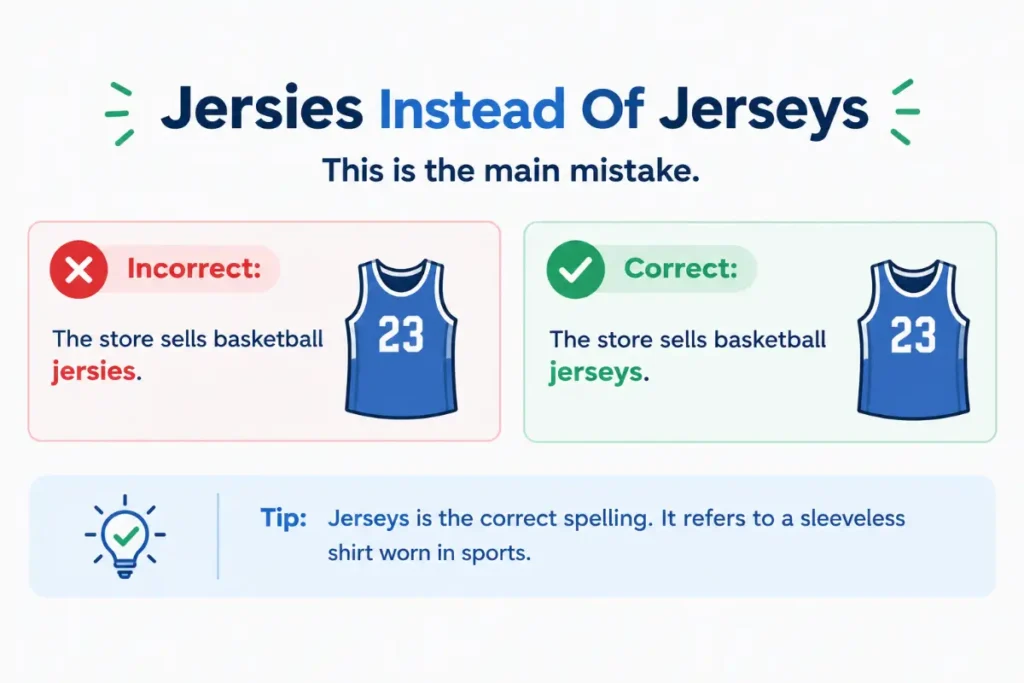
Writing Jersies Instead Of Jerseys
This is the most common error related to the word. Writers often apply the consonant plus y rule without checking the letter before y.
Correct:
The team ordered new jerseys.
Incorrect:
The team ordered new jersies.
Forgetting The Plural Ending
Another mistake is using jersey when talking about multiple items.
Incorrect:
The players received their new jersey.
Correct:
The players received their new jerseys.
The singular form is appropriate for one item. The plural form is needed for two or more.
Confusing Jersey With New Jersey
Jersey can refer to several different things. New Jersey is a place name in the United States, while Jersey is also the name of an island in the Channel Islands.
The context determines the meaning.
For example:
The player bought a new jersey.
The family moved to New Jersey.
The first sentence refers to clothing. The second refers to a US state.
Treating Every Final Y The Same Way
English plural spelling doesn’t use one single rule for every word ending in y.
Baby becomes babies.
But boy becomes boys.
Jersey follows the second pattern because it has a vowel before y.
Assuming Pronunciation Determines Spelling
The ending sound in jerseys doesn’t clearly tell you that the written form needs an s. Spelling and pronunciation don’t always map perfectly in English.
Learning the spelling pattern is more reliable than trying to spell the word from sound alone.
Pronunciation Guide
The singular word jersey is commonly pronounced /ˈdʒɜːrzi/ in American English.
A simple pronunciation guide is:
JER zee.
The plural jerseys is commonly pronounced /ˈdʒɜːrziz/.
You can think of it as:
JER zeez.
The first syllable receives the main stress.
The plural ending adds a final sound that makes jerseys sound slightly longer than jersey.
One reason learners may struggle with the spelling is that the ending doesn’t sound like a clear separate letter. The word is heard as one smooth unit in normal conversation.
A good approach is to learn the singular and plural together.
jersey → jerseys
This helps connect the written form with the pronunciation.
Etymology And Word Origin
The history of jersey is closely connected to the island of Jersey in the Channel Islands.
The word became associated with a type of knitted fabric traditionally produced in Jersey. Over time, the name of the place became connected with the material itself.
The clothing meaning developed from this association. Jersey fabric became useful for garments because knitted material can be flexible and comfortable.
The sports clothing meaning developed later. A jersey became a shirt or top worn by a player or team, especially in organized sports.
This history explains why the word can describe both material and clothing. It also explains why jersey can appear in contexts that have nothing to do with sports.
The modern plural simply follows the ordinary English rule.
Jersey becomes jerseys.
The spelling does not change the y to ies because the word ends in vowel plus y.
Different Meanings Of Jersey
Sports Shirt
This is one of the most familiar meanings in American English.
A jersey is a shirt worn by a sports player. It may show a team name, number, player name, sponsor, or logo.
For example:
I bought a Lakers jersey.
When there are several:
I bought two Lakers jerseys.
Knitted Fabric
Jersey can also refer to a type of knitted fabric.
A designer might say:
This dress is made from soft jersey.
The fabric can be used for shirts, dresses, skirts, underwear, and other garments.
Dairy Cattle
Jersey can also describe the Jersey breed of cattle.
For example:
The farm raises Jersey cows.
This use is unrelated to sports clothing.
Place Names
Jersey is also a geographical name. It can refer to Jersey in the Channel Islands. New Jersey is a US state.
This is why context matters when you see the word.
Regional Usage
American English
In American English, jerseys is the standard plural form. The word is especially common in sports and clothing contexts.
A baseball fan might talk about buying jerseys. A clothing company might advertise new jerseys. A textile professional might use the word when discussing jersey fabric.
American English does not use jersies as a standard alternative spelling.
British English
British English also uses jerseys as the standard plural. The spelling does not change simply because the variety of English changes.
British sports writing commonly uses jersey for sports clothing. The plural remains jerseys.
Australian English
Australian English follows the same spelling pattern. Jerseys is the normal plural form.
The word appears in sports, fashion, school athletics, and clothing contexts.
Canadian English
Canadian English also uses jerseys. The plural spelling follows the same vowel plus y pattern found in other major varieties of standard English.
There is no major regional spelling difference between Canadian English and American English for this plural.
Grammar Rules And Part Of Speech
Jerseys is normally a plural noun.
A noun names a person, place, thing, or idea. In this case, jerseys refers to multiple physical items or other entities described by the noun jersey.
For example:
The jerseys are ready.
The subject is jerseys.
You can also use jerseys after a determiner.
These jerseys belong to the school team.
Several jerseys were hanging in the store.
Five jerseys were delivered this morning.
When referring to one item, use jersey.
The jersey is clean.
When referring to more than one, use jerseys.
The jerseys are clean.
The plural ending does not change the basic pronunciation of the first part of the word.
Possessive Forms
You may also need to distinguish between plural and possessive forms.
Jerseys means more than one jersey.
Jersey’s means something belonging to one jersey.
For example:
The jerseys are on the bench.
The jersey’s number is faded.
For plural possession, use jerseys followed by an apostrophe.
The jerseys’ colors matched the team logo.
This means the colors belong to multiple jerseys.
These forms can look similar in fast writing, so punctuation matters.
Real Life Usage Examples
Daily Conversation
I need to wash my jerseys before Saturday’s game.
Those jerseys look great.
Sports clothing comes up often in everyday conversations, especially among athletes, fans, parents, and students.
Email And Workplace Communication
The team jerseys are ready for pickup.
Please confirm the sizes before we place the jersey order.
In workplace communication, the word may appear in messages between sports clubs, schools, clothing companies, event organizers, or retailers.
Academic Writing
The study examines how team jerseys contribute to visual identity among sports fans.
The researchers compared the materials used in modern sports jerseys.
Academic use is less common than sports or retail use, but the plural remains grammatically ordinary.
News And Journalism
The players wore special jerseys during the charity game.
Fans lined up outside the stadium to buy the team’s new jerseys.
Sports journalism uses the word frequently because uniforms are a visible part of team identity.
Literature And Storytelling
The children wore matching jerseys as they ran onto the field.
He carefully folded the old jerseys and placed them in a box.
In storytelling, the word can quickly establish a sports setting or suggest a personal connection to a team or memory.
Jerseys In Sports Culture
The word has become strongly associated with sports because team shirts often carry more than practical value.
A jersey can show which team a person supports. It can also represent a favorite player, a memorable season, or a personal connection to a sport.
That is why you may see phrases such as team jerseys, basketball jerseys, football jerseys, soccer jerseys, baseball jerseys, hockey jerseys, and custom jerseys.
The plural form stays the same regardless of the sport.
One basketball jersey becomes two basketball jerseys.
One soccer jersey becomes several soccer jerseys.
One hockey jersey becomes many hockey jerseys.
The spelling remains stable because the plural rule depends on the word jersey itself.
Related And Confused Terms
Jersey
The singular form refers to one item or one example of the word’s other meanings.
Jerseys
The standard plural form refers to multiple jerseys.
Uniform
A uniform is the complete set of clothing worn by members of a group. A jersey may be only one part of that uniform.
Shirt
A shirt is a broad clothing term. A jersey can be a type of shirt, especially in sports.
Kit
Kit can refer to a complete sports outfit in some varieties of English, particularly British English. It may include a shirt, shorts, socks, and other pieces.
Sweater
A sweater is a garment worn for warmth. In some contexts, people may use jersey for a knitted garment, but the terms are not always interchangeable.
Jersey Fabric
This refers to the knitted material rather than specifically to a sports shirt.
New Jersey
New Jersey is a US state. It is a proper name and should not be confused with a jersey used as clothing.
These related terms show why context matters. The word jersey has a wider meaning than sports clothing alone.
Jersey Versus Jersey’s
A common punctuation question involves jersey’s and jerseys.
Jerseys is the plural.
Jersey’s is usually the singular possessive.
Consider these examples:
I bought three jerseys.
The jersey’s sleeve is torn.
The first sentence means there are three shirts. The second says the sleeve belongs to one jersey.
For multiple ownership, use jerseys’.
The jerseys’ numbers were printed in large letters.
This distinction is especially useful in professional writing because an apostrophe should not be added simply to make a noun plural.
Why Spellcheckers May Flag Jersies
Modern spelling tools usually recognize common standard word forms. Because jerseys is the accepted plural, a typed form such as jersies may receive a spelling warning.
However, automated spelling tools aren’t the final authority on meaning. They can recognize patterns and suggest corrections, but the writer still needs to understand the grammar.
The best correction comes from knowing the rule.
Jersey ends in vowel plus y.
Therefore:
jersey → jerseys.
This is more useful than simply memorizing that a software tool underlines one spelling.
Expert Editor Insight
An experienced editor would correct jersies to jerseys without hesitation in standard English because the plural follows a familiar vowel plus y pattern. The common mistake comes from applying the consonant plus y rule to every word ending in y. Editors also check the surrounding context because jersey can refer to sports clothing, fabric, cattle, or a place name. A useful proofreading habit is to look at the letter immediately before y. If it is a vowel, try adding s before changing the spelling.
Conclusion
jersies or jerseys has a straightforward answer. Jerseys is the correct standard plural of jersey, while jersies is a common spelling mistake. The key reason is that jersey ends in a vowel plus y, so you add s instead of changing the y to ies.
The word can refer to sports shirts, garments made from jersey fabric, or other meanings that depend on context. In standard American English and other major English varieties, the plural spelling remains jerseys.
For an easy editing trick, look at the letter before y. If you see a vowel, as in jersey, keep the y and add s. Remembering that small pattern will help you avoid this spelling mistake in schoolwork, emails, articles, sports writing, and everyday communication.
FAQs
Is jersies a correct spelling?
No. Jersies is not the standard plural spelling of jersey. The correct form is jerseys. The mistake usually happens because writers remember that many nouns ending in consonant plus y change y to ies in the plural. Jersey has a vowel before its final y, so the correct plural simply adds s.
Why is the plural jerseys instead of jersies?
Jersey ends in vowel plus y. The letter before y is e, which is a vowel. English normally forms the plural of words ending in vowel plus y by adding s. That gives jersey plus s, resulting in jerseys. Words such as city and baby follow a different pattern because they end in consonant plus y.
How do you pronounce jerseys?
Jerseys is commonly pronounced /ˈdʒɜːrziz/ in American English. An easy approximation is JER zeez. The main stress falls on the first syllable. The plural ending adds a final sound after the basic jersey pronunciation. Hearing the word naturally can make the spelling less obvious, so learning the written form alongside the pronunciation helps.
What does jersey mean?
Jersey has several meanings. It can mean a shirt worn by a sports player, a type of knitted fabric, a breed of dairy cattle, or a geographical name connected with Jersey in the Channel Islands. Context determines the meaning. In sports and clothing, jersey commonly refers to a shirt or garment associated with a team or style.
Is jerseys the plural of jersey?
Yes. Jerseys is the standard plural of jersey. If you are talking about two or more sports shirts, garments, or other things described by the noun jersey, use jerseys. For example, The team received new jerseys is correct. The spelling does not change to jersies because jersey ends with vowel plus y.
Is jersey a noun or an adjective?
Jersey is most commonly used as a noun. It can name a sports shirt, a type of fabric, a breed of cattle, or a geographical entity depending on context. It can also appear as part of compound expressions where it helps describe something connected with Jersey. The plural form for the clothing or fabric noun is jerseys.
Can jerseys refer to clothing other than sports shirts?
Yes. Jerseys can refer to multiple garments made from jersey fabric or garments commonly described as jerseys. The exact meaning depends on context. In sports, the word usually means team shirts. In clothing and textiles, it can refer to garments made from a particular type of knitted fabric.
How can I remember the correct spelling?
Look at the letter before the final y. In jersey, that letter is e, a vowel. Words ending in vowel plus y normally form their plural by adding s. So jersey becomes jerseys. A simple reminder is this: vowel plus y keeps the y and adds s. That prevents the common mistake of writing jersies.
