
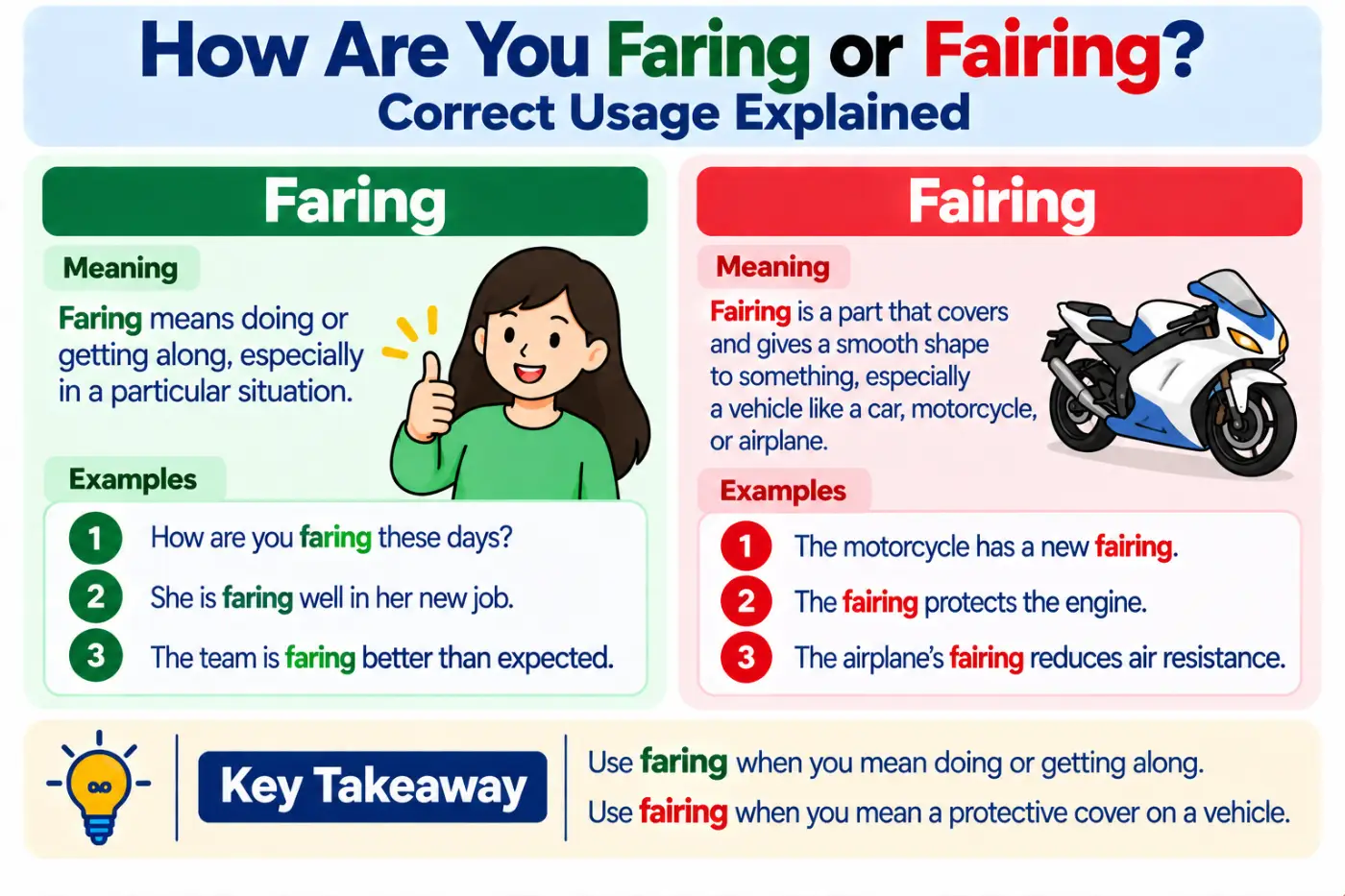
If you’ve ever wondered how are you faring or fairing is the right expression, the answer is straightforward. The correct form is how are you faring when you’re asking someone how they are doing or how they are managing a situation. Fairing is a different word with a different meaning and doesn’t fit this everyday question.
The confusion is understandable because faring and fairing sound alike in many accents. They also look almost identical when written. Yet they come from different words and serve completely different purposes. Faring comes from the verb fare, which relates to how someone is doing or how something is progressing. Fairing is connected with fair and is mainly used for a streamlined structure or covering designed to reduce resistance around a vehicle or aircraft.
Once you know that difference, the choice becomes much easier. This guide explains the meanings, grammar, pronunciation, word origins, regional usage, common mistakes, and natural examples. You’ll also learn a quick memory trick that makes the correct expression easy to remember.
Quick Definition
Use how are you faring when you want to ask how someone is doing, coping, or progressing. Faring is the present participle of fare. Fairing is a separate noun that usually refers to a streamlined covering on a vehicle or aircraft. Therefore, fairing is not correct in the common personal question.
Quick Answer
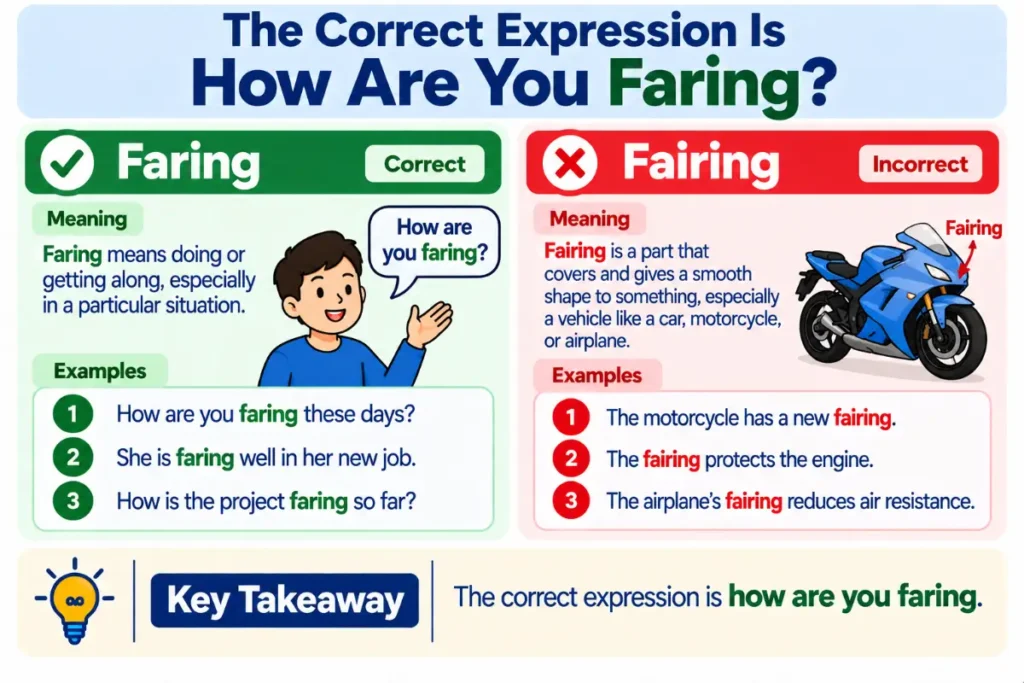
The correct expression is how are you faring.
Here, faring comes from the verb fare and means doing or managing. For example, How are you faring in your new job means How are you doing in your new job.
Fairing is a different word. It usually describes a structure or covering that helps make a vehicle or aircraft more streamlined.
Comparison Table How Are You Faring Or Fairing
| Form | Meaning | Part of Speech | Origin | Usage Frequency | Formality | Common Contexts | Example |
|---|---|---|---|---|---|---|---|
| Faring | Doing, managing, or progressing | Verb form | From Old English fare | Common in the expression how are you faring | Neutral to somewhat formal | Personal questions, writing, discussions about progress | How are you faring at your new school? |
| Fairing | A streamlined covering or structure | Noun | Derived from fair and related to making something smooth or streamlined | Less common in everyday speech | Technical | Aviation, automotive design, motorcycles, engineering | The motorcycle has a new front fairing. |
The key point is that these words are not interchangeable. They happen to sound similar in many forms of English, but their meanings and grammatical roles are different.
Meaning And Definition
Meaning Of Faring
Faring is the present participle form of the verb fare.
The verb fare can mean to do, progress, manage, or experience a particular result. When you ask someone How are you faring, you’re asking about their current situation.
For example:
How are you faring at your new job?
This means:
How are you doing at your new job?
You might also say:
How is the project faring?
That question asks about the progress or condition of the project.
Faring often appears when someone wants more than a simple yes or no answer. It can invite a person to describe how things are going.
For example, after a difficult move, a friend might ask:
How are you faring in your new city?
The question sounds slightly more thoughtful or formal than How are you doing in your new city. Both are grammatical, but they have different tones.
The word can also describe how something is progressing.
The small business is faring well despite higher costs.
Here faring means doing or performing in a particular situation.
Meaning Of Fairing
Fairing is a noun with a very different meaning.
In engineering and transportation, a fairing is a streamlined covering or structure that reduces drag or smooths the shape of an object. Fairings are common in aircraft, motorcycles, racing vehicles, bicycles, and other machines where airflow matters.
For example:
The mechanic replaced the motorcycle’s damaged fairing.
Here fairing has nothing to do with a person’s well being.
The word may also appear in specialized technical contexts involving the shape or outer covering of a machine. Its use is much narrower than the everyday verb faring.
This distinction is worth remembering because the two words sound similar but belong to different semantic groups. Faring relates to progress or experience. Fairing relates mainly to physical structure and streamlined design.
The Main Difference
The difference becomes clear once you look at the words they come from.
Faring comes from fare.
Fairing comes from fair.
Fare can describe how someone or something is doing.
Fair has several meanings, including attractive, reasonable, impartial, or smooth. In the technical word fairing, the historical connection involves making a shape smooth or streamlined.
So if you’re asking about a person’s life, health, work, school, business, recovery, or progress, faring is the word you need.
If you’re talking about a motorcycle body panel, aircraft structure, racing equipment, or aerodynamic covering, fairing may be the correct term.
The two words have separate jobs. That’s why replacing one with the other changes the meaning completely.
Why The Confusion Happens
The main reason for the confusion is pronunciation.
In many English accents, faring and fairing are pronounced alike or very nearly alike. This makes them homophones or near homophones depending on the speaker and accent.
When people learn a word mainly through conversation, they may know the sound before they know the spelling. That can create problems when two different words share the same pronunciation.
There is also a visual reason. Faring and fairing differ by only one letter. When typing quickly, it’s easy to choose the wrong form.
Another issue is the word fare itself. Many learners know fare mainly from phrases such as bus fare or taxi fare. They may not immediately connect fare with the verb meaning to do or progress.
That connection is important here.
Fare has a long history as a verb meaning to travel, get along, or experience a particular outcome. From that verb comes faring.
Which Form Is Correct?
For the question asking about someone’s condition or progress, faring is correct.
The grammatical structure is:
How + are + you + faring?
The auxiliary verb are combines with the present participle faring to form the present progressive construction.
For example:
How are you faring after the move?
How are you faring with your studies?
In each case, the speaker wants to know how the person is doing or managing.
Fairing cannot replace faring in these sentences because fairing does not carry that meaning.
This is a meaning based distinction rather than a simple spelling preference. Both words exist, but only one belongs in this particular expression.
How Faring Works In A Sentence
Faring is a verb form. More specifically, it is the present participle of fare.
It commonly appears after forms of the verb be.
I am faring well.
She is faring better now.
They are faring poorly under the new conditions.
We are faring better than expected.
In the question How are you faring, are functions as the auxiliary verb while faring carries the main lexical meaning.
You can also use faring with an adverb that describes the result.
The company is faring well.
The team is faring badly.
The patient is faring better.
The project is faring surprisingly well.
The construction can also include a phrase that identifies the situation.
How are you faring at work?
How is the new restaurant faring in its first year?
The flexibility of the verb makes it useful in many contexts.
Is How Are You Faring Formal?
The expression is completely natural English, but it can sound a little more formal than How are you doing.
Compare these examples.
How are you doing?
How are things going?
All three ask about someone’s situation. The first and third usually sound more conversational. The second can sound more polished, thoughtful, or formal.
That doesn’t mean you should avoid faring in casual communication. Native speakers do use it in ordinary conversation. It simply has a slightly different flavor.
For example, a friend might say:
How are you doing after the move?
A teacher might ask:
How are you faring with the new material?
A manager might write:
I wanted to check in and see how you are faring in your new position.
The meaning remains similar while the tone changes with the setting.
Sentence Examples
Here are natural examples using the correct form.
- How are you faring in your new job?
- How are you faring after moving to another city?
- I wanted to check in and see how you are faring.
- She is faring well despite the recent changes.
- The students are faring better than expected in the new program.
- How are you faring with your college classes?
- The company is faring well in a difficult market.
- He seems to be faring much better now.
- How are you faring after the surgery?
- The team is faring better this season than it did last year.
These sentences show that faring can describe people, groups, businesses, teams, projects, and other situations.
Now consider examples using the wrong form for this meaning.
- How are you fairing at your new job?
- How are you fairing after the move?
- I wanted to know how she was fairing at school.
- How is your business fairing this year?
- The students are fairing well in the new program.
In each example, fairing should be replaced with faring.
Common Mistakes
Writing Fairing When You Mean Doing
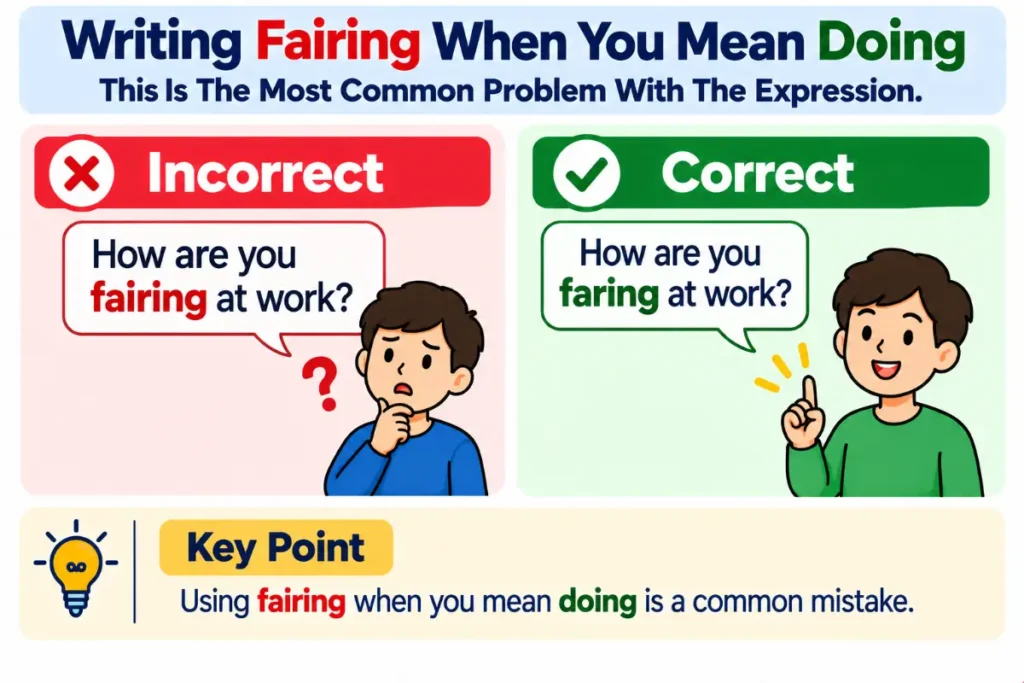
This is the most common problem with the expression.
Incorrect:
How are you fairing at work?
Correct:
How are you faring at work?
The writer has chosen fairing because it sounds like faring. The meaning of the sentence requires the verb fare.
Confusing Fare With Fair
Fare can function as a verb meaning to do or progress.
Fair can describe something reasonable, attractive, impartial, or acceptable.
The meanings are different even though the words sound similar.
Using Faring Without A Clear Context
Faring usually needs a situation or implied situation.
How are you faring?
That question works because the context can supply the missing information.
How are you faring in your new class?
This version gives the reader more detail.
Assuming Fairing Is Simply A Spelling Variant
Fairing is not an alternate spelling of faring. It is a separate word.
This distinction matters because changing one letter changes the word’s meaning and grammatical role.
Replacing Faring With Fare
Faring and fare are related but they don’t have the same grammatical function.
You can say:
How do you fare?
Or:
How are you faring?
But you cannot normally say:
How are you fare?
The auxiliary are requires the present participle faring in this construction.
Pronunciation Guide
Faring is commonly pronounced /ˈfɛrɪŋ/ in American English.
A simple pronunciation guide is:
FAIR ing
In many accents, faring and fairing sound the same. That makes pronunciation alone an unreliable way to choose the spelling.
Fairing is also commonly pronounced /ˈfɛrɪŋ/ in American English.
This is one of those situations where spelling carries information that pronunciation does not.
The stress falls on the first syllable in both words.
Say them naturally:
FAIR ing
The shared pronunciation explains why the words are easy to confuse. If you hear the expression instead of seeing it written, context becomes the main clue.
Etymology And Word Origin
Faring comes from fare. The verb fare has deep roots in Old English and Germanic language history. It was connected with traveling, going, and getting along.
Over time, fare developed broader meanings. It came to describe how someone was doing or how a situation was progressing.
That meaning survives in expressions such as:
How did you fare?
How are you faring?
The word fairing has a different development. It is related to fair in the sense of making something smooth or streamlined. The technical noun came to describe a structure that gives an object a smoother shape.
This historical difference supports the modern distinction.
Faring belongs to the semantic field of experience, progress, and outcome.
Fairing belongs mainly to the semantic field of shape, design, and engineering.
The similar sound is therefore a coincidence from the perspective of modern usage. The words do not simply represent two spellings of the same idea.
Regional Usage
American English
In American English, faring is standard in questions about how someone is doing or how something is progressing.
How are you faring?
This sounds natural, although How are you doing is more common in everyday conversation.
Fairing is also standard American English, but its meaning is technical. You may encounter it in discussions of motorcycles, aircraft, bicycles, racing vehicles, and engineering.
British English
British English uses faring in the same way when discussing someone’s progress or condition. The expression How are you faring is well established.
Fairing also has its technical meaning involving streamlined structures and coverings.
There is no major British spelling difference between these two forms.
Australian English
Australian English follows the same distinction. Faring is used with the verb fare when discussing progress or experience. Fairing is used in its technical sense.
The difference is therefore based on meaning rather than regional spelling.
Canadian English
Canadian English also keeps the two forms distinct. Faring works as the present participle of fare, while fairing functions as a technical noun.
A Canadian writer asking about someone’s situation should use faring.
Grammar Rules And Part Of Speech
Faring is a present participle. It comes from the verb fare.
The basic form is:
Fare → faring.
When used in a progressive construction, it combines with a form of be.
I am faring well.
You are faring well.
She is faring well.
We are faring well.
They are faring well.
The question form changes the word order.
How are you faring?
The auxiliary verb comes before the subject in the question.
The phrase can also include an adverb.
How are you faring financially?
How are you faring professionally?
It can include a prepositional phrase too.
How are you faring at work?
How are you faring after the move?
The word faring itself doesn’t need a special punctuation mark. If the entire sentence is a question, use a question mark.
How are you faring?
If the expression appears inside a longer sentence, normal punctuation rules apply.
She asked how I was faring after the move.
Notice that the word order changes in the embedded question. We say how I was faring rather than how was I faring.
That distinction is useful in formal writing.
Faring As A Question
The expression is often used as a check in conversation.
Someone may ask:
How are you faring?
The speaker might be asking about work, school, family, finances, recovery, travel, or another situation already known to both people.
The phrase can also sound more considerate than a quick How are you?
For example, after someone begins a challenging new job, you might say:
How are you faring in the new position?
This asks specifically about the person’s experience rather than simply requesting a general greeting response.
That makes faring useful when the situation itself matters.
Faring In Positive And Negative Contexts
Faring can describe good results, poor results, or anything in between.
Positive:
The students are faring well in the new program.
Neutral:
How are you faring with the workload?
Negative:
The business is faring poorly because of rising costs.
Improving:
The team is faring better this month.
Worsening:
The company is faring worse than expected.
This flexibility is one reason the verb remains useful in formal and analytical writing.
Real Life Usage Examples
Daily Conversation
How are you faring after the move?
I’m faring pretty well. The new neighborhood is growing on me.
In casual conversation, many Americans would probably say How are you doing or How’s it going. Still, faring is perfectly understandable and grammatically sound.
Email And Workplace Communication
I wanted to check in and see how you are faring in your new role.
The department is faring well despite the changes to the schedule.
In professional communication, faring can sound polished without being overly formal.
Academic Writing
The study examines how students are faring after the curriculum change.
Researchers found that participants were faring better when they received regular feedback.
Here the word describes outcomes or progress.
News Writing
Small businesses are faring differently as consumer spending changes.
The team is faring better than analysts expected this season.
Journalists may use faring when describing the condition or progress of a group, organization, or institution.
Literature And Storytelling
After months away from home, she wondered how her family was faring.
The travelers continued through the storm, unsure how they would fare before reaching safety.
Literary writing can use the verb family to describe how characters experience difficult situations.
Faring And Fare
Understanding fare makes the spelling much easier.
Fare can be a noun.
The bus fare increased this year.
Fare can also be a verb.
How did you fare on the exam?
The verb form can then become faring.
How are you faring on the course?
The progression is:
Fare → fared → faring.
The noun fare in bus fare is a different sense from the verb fare meaning to do or progress. English contains many words with multiple meanings, so context matters.
In the expression about someone’s situation, the verb meaning is the one that matters.
Faring And Fair
Fair has several meanings.
The weather is fair.
That price seems fair.
She received fair treatment.
He has fair hair.
None of these meanings creates the personal question How are you fairing.
Fairing is a separate derived word that appears mainly in technical contexts.
The easiest test is this:
If you could replace the word with doing, choose faring.
If you are talking about a streamlined physical covering, choose fairing.
For example:
How are you doing at school?
How are you faring at school?
These sentences are close in meaning.
But:
The motorcycle needs a new fairing.
You cannot replace fairing with faring in that sentence.
Related And Confused Terms
How Are You Doing
This is the most common everyday alternative. It asks about someone’s general condition or situation.
How Is It Going
This expression is very common in conversation. It can refer to a person’s life or a specific situation.
How Are Things Going
This phrase is casual and broad. It works well when the speaker wants a general update.
How Did You Fare
This asks how someone did in a particular situation that has already happened.
How did you fare on the exam?
Fare
Fare is the base verb from which faring comes.
Fair
Fair has several meanings but does not mean doing or progressing.
Fairing
Fairing is usually a technical noun describing a streamlined structure or covering.
Progressing
Progressing is a useful synonym in contexts involving development or improvement.
For example:
How is the project progressing?
This can be similar to How is the project faring?
How Are You Faring Vs How Are You Doing
Both expressions can ask about someone’s situation.
How are you doing?
How are you faring?
The first is more common in everyday American conversation. The second can sound more deliberate or formal.
If you’re texting a close friend, How are you doing is usually the more natural choice.
If you’re writing to someone about a difficult transition, How are you faring may sound thoughtful and appropriate.
For example:
How are you doing after the move?
How are you faring after the move?
The meaning is nearly the same, but the second version puts slightly more emphasis on how the person is managing the situation.
How To Remember The Correct Spelling
Use the word fare as your anchor.
Fare means to do or progress.
Faring means doing or progressing.
So when you ask about someone’s situation, think:
fare → faring → doing
Fairing belongs to another word family and has a technical meaning.
A second memory trick is to connect fairing with physical objects. Think of an aircraft or motorcycle with a smooth outer covering. That picture can help keep the technical noun separate from the everyday verb.
If the sentence is about a person, business, team, project, or situation and you could use doing instead, faring is probably the word you need.
Expert Editor Insight
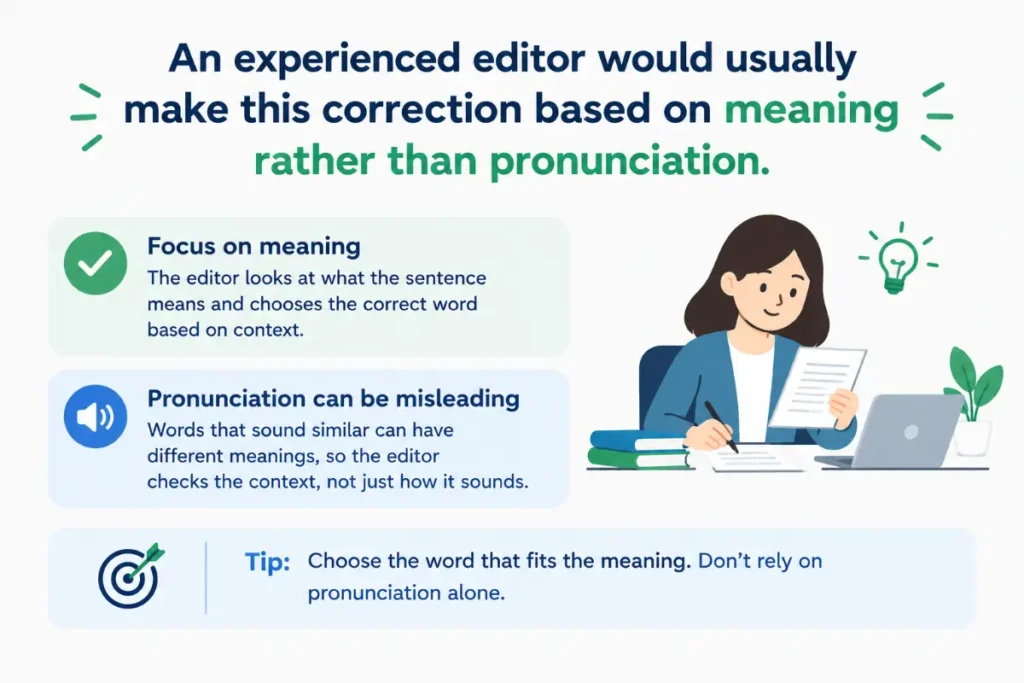
An experienced editor would usually make this correction based on meaning rather than pronunciation. Faring and fairing can sound identical, so a spelling checker may catch an incorrect form in some contexts but cannot always understand the intended meaning perfectly. The strongest editing habit is to identify the base word first. If the sentence means doing or progressing, trace the word back to fare and use faring. If it describes a streamlined physical covering, fairing is appropriate.
Conclusion
The question how are you faring or fairing has a clear answer. Use faring when you’re asking how someone is doing, managing, or progressing. The word comes from fare and functions as the present participle in the expression How are you faring. Fairing is also a real English word, but it has a different meaning.
The two forms are easy to confuse because they sound alike in many accents and differ by only one letter. Still, their meanings are far apart. Faring belongs to conversations about people, progress, situations, and results. Fairing usually belongs to technical discussions about streamlined structures and vehicle design.
For an easy memory trick, connect faring with fare and doing. If you can replace the word with doing, faring is the form you need. That small connection can save you from this common mistake.
FAQs
Is faring a real word?
Yes. Faring is the present participle of the verb fare. It can mean doing, managing, or progressing in a particular situation. You can use it in questions such as How are you faring at work? You can also use it to describe groups, businesses, projects, and other situations, as in The company is faring well this year.
Is fairing a real word?
Yes. Fairing is a real English word, but it has a different meaning. It usually refers to a streamlined covering or structure used on an aircraft, motorcycle, bicycle, racing vehicle, or another machine. It is not the correct word when you want to ask how someone is doing or managing a situation.
How do you spell the expression about asking someone how they are doing?
Use faring. The standard expression is How are you faring? The word comes from the verb fare, which can mean to do or progress. Fairing belongs to a different word family and normally refers to a physical structure. The two words can sound alike, so remembering the base word fare is a useful spelling aid.
How do you pronounce faring?
Faring is commonly pronounced like fairing in many varieties of English. In American English, it is often represented as /ˈfɛrɪŋ/. A simple guide is FAIR ing. Because the two words can sound the same, pronunciation alone doesn’t tell you which spelling to use. Context and meaning provide the important clue.
Can you say How are you faring?
Yes. How are you faring is a grammatically correct question. It asks how someone is doing, managing, or progressing. It can refer to a general situation or a specific one, such as work, school, a move, or a difficult period. In casual American conversation, How are you doing is more common, but faring remains standard English.
What is a synonym for faring?
Depending on context, useful alternatives include doing, managing, progressing, getting along, coping, and performing. For example, How are you faring at school can become How are you doing at school or How are you managing at school. The best alternative depends on the exact situation because these words can carry slightly different shades of meaning.
Why do people confuse faring and fairing?
The main reason is that the words sound alike or nearly alike in many accents. They also differ by only one letter in writing. People who learn the expression mainly through speech may not know which spelling belongs to which meaning. The distinction becomes easier once you connect faring with fare and fairing with streamlined physical structures.
Is faring appropriate in formal writing?
Yes. Faring is completely acceptable in formal writing. It can describe how a person, organization, project, or group is progressing. It may sound slightly more formal than doing, so it can work naturally in reports, professional emails, academic writing, and journalism. In very casual communication, simpler expressions such as doing or getting along may sound more conversational.
