
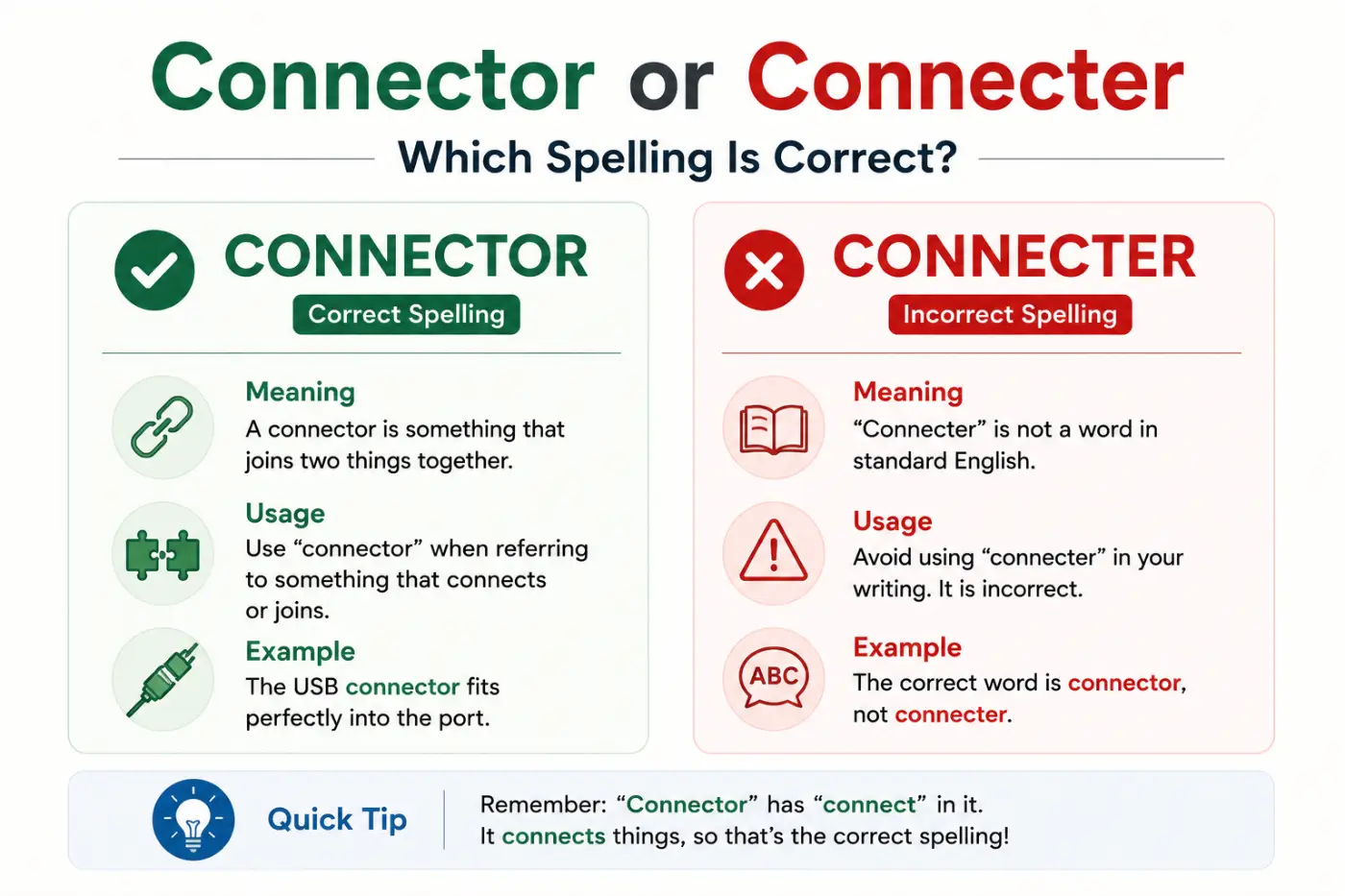
If you’re trying to choose between connector or connecter the standard choice in American English is connector. It refers to something that connects two or more things such as a cable connector a pipe connector or a person who brings people together.
The confusion is understandable because connecter looks like a logical English word. Many nouns that describe someone or something performing an action end in er. Words such as teacher writer and driver follow that pattern. Still English doesn’t always build words according to one simple formula. Established usage determines which form becomes standard.
For everyday writing connector is the form you should use. It works naturally in technical writing business communication academic writing and casual conversation. This guide explains the difference between the two forms along with their meanings pronunciation grammar history common mistakes and real world usage.
Quick Answer
Connector is the standard and preferred spelling in ordinary English. It refers to a device part person or thing that connects two or more things. Connecter can appear in limited or specialized usage but it isn’t the normal form for everyday American English.
Connector Or Connecter At A Glance
| Form | Meaning | Part of Speech | Usage | Formality | Common Contexts | Example |
|---|---|---|---|---|---|---|
| connector | A person thing or device that connects | Noun | Common | Standard | Technology plumbing business communication and social relationships | The cable needs a new connector. |
| connecter | A person or thing that connects | Noun | Uncommon | Less usual | Occasional specialized usage | The device acts as a connecter between two systems. |
The important point is that the two spellings don’t have equal status in everyday English. Connector is the established form that most readers expect.
Meaning Of Connector
Connector is a noun that describes something or someone that creates a connection.
The most familiar use refers to a physical component. A connector can join cables pipes wires tubes or electronic equipment. For example a cable may need a connector to attach it to a computer or another device.
The word also has broader meanings.
A person can be a connector when they introduce people and help them build relationships. A manager who brings different departments together may be described as a strong connector. Someone who regularly introduces friends to useful contacts can also be called a connector.
The same basic idea exists in every case. A connector creates a link.
Consider these examples.
- The technician replaced the damaged connector.
- This connector joins the two cables.
- Sarah is a natural connector who knows people across the industry.
The first two sentences describe a physical object. The third describes a person. The central meaning remains the same.
Meaning Of Connecter
Connecter can be formed naturally from the verb connect. In a literal sense it can mean a person or thing that connects something. However the fact that a word can be formed logically doesn’t automatically make it the preferred standard form.
English contains many words that don’t follow the spelling pattern a learner might expect. Connector became the established noun while connecter remained much less common. That means you shouldn’t normally replace connector with connecter in everyday writing.
If you’re writing a product description a business email a technical document or an academic paper and you need the common noun for something that connects use connector. The less common form may still appear in specialized contexts. Its existence doesn’t make it the normal choice.
The Main Difference Explained
The main difference between connector and connecter is standard usage.
Connector is the familiar established noun. It appears naturally in technology engineering plumbing communication and social contexts.
Connecter follows a spelling pattern that seems reasonable but has never become the normal everyday form.
This is a useful lesson in English spelling. A word can look perfectly logical and still be less appropriate because established usage has favored another form.
Spelling
The preferred spelling is connector.
It combines the base word connect with the ending or.
The less common form connecter uses the ending er.
At first glance connecter may seem more logical because English often uses er to form nouns from verbs. However word formation isn’t always predictable.
Meaning
Both forms can relate to the idea of connecting.
The difference is that connector has the established everyday meaning. Connecter has limited usage and may sound unusual to many readers.
Grammar
Both forms can function as nouns. In normal modern English though connector is the form that should usually appear in your sentence.
For example:
The connector is damaged.
We need a new connector.
She became a connector between the two groups.
These sentences sound natural and clear.
Pronunciation
Connector is pronounced approximately like:
kuh NEK ter
Its American English pronunciation is represented as /kəˈnɛktər/.
The main stress falls on the middle syllable.
The pronunciation is closely related to the verb connect.
Formality
Connector works in both informal and formal English.
You can use it in an academic paper.
You can use it in a business report.
Its flexibility is one reason it remains the better choice.
Context
The context determines the exact meaning.
In electronics a connector joins electrical components or cables.
In communication a connector can describe something that creates a link between ideas or systems.
The meaning changes slightly but the central concept remains connection.
Which Form Is Correct
Use connector in standard everyday English.
If you’re talking about a physical part that joins two things use connector.
If you’re writing about a device that links two systems use connector.
For example:
The audio connector doesn’t fit the port.
The plumber replaced the old connector.
Maria is an excellent connector within the business community.
The network connector needs to be replaced.
These examples show how naturally the word works across different contexts.
By comparison connecter can make ordinary writing look unusual. A reader may pause and wonder if the word is a typo.
That doesn’t mean every appearance of connecter must be treated as an error. Specialized terminology can sometimes use less common forms. Still connector is the safest and most natural choice for general writing.
Why The Spelling Causes Confusion
The confusion comes from a common English spelling pattern.
English frequently uses er to form nouns that describe people who perform an action.
A person who teaches is a teacher.
A person who runs is a runner.
So it’s easy to look at connect and assume that the person or thing performing the action must be a connecter.
English doesn’t always work that neatly.
Historical usage can determine which ending becomes established. In this case connector became the standard noun.
This is why spelling by logic alone can sometimes lead you astray. English has plenty of words that make sense according to one pattern but follow another established form.
The safest approach is to learn the conventional form rather than trying to create the noun yourself.
Sentence Examples
The following examples show how connector appears naturally in different settings.
- The technician replaced the damaged connector.
- I need a different connector for this charger.
- The plumber used a metal connector to join the two pipes.
- Please check the connector before turning on the equipment.
- Sarah is a natural connector who brings people together.
- The new system uses a secure network connector.
- The connector between the two devices wasn’t working properly.
- Make sure the connector is firmly attached before using the machine.
- The replacement part comes with a compatible connector.
- Our community connector helped several local groups work together.
These examples cover both the physical and figurative meanings.
The first group describes objects and equipment. The later examples show how the word can describe people who create relationships.
Common Mistakes And Misspellings
Using Connecter In Ordinary Writing
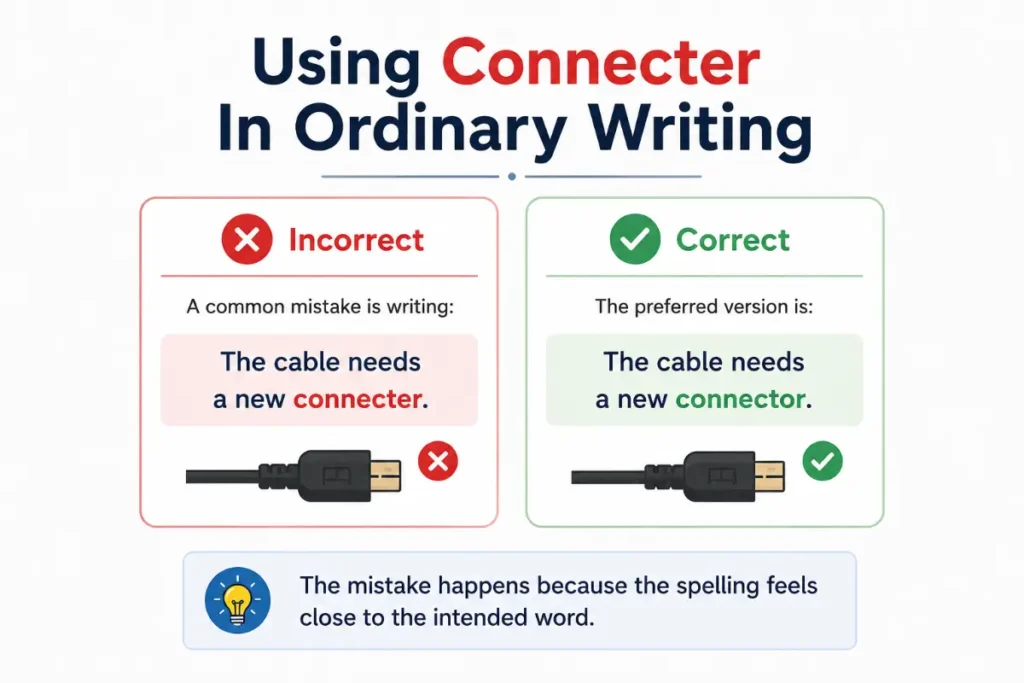
A common mistake is writing:
The cable needs a new connecter.
The preferred version is:
The cable needs a new connector.
The problem isn’t that the meaning becomes impossible to understand. Most readers can figure it out. The issue is that connecter isn’t the standard everyday form.
Confusing Connector With Connection
Connection and connector are closely related but they don’t mean exactly the same thing.
A connection is the link or relationship.
A connector is the thing that creates or enables the link.
Compare these sentences.
The connection between the devices is stable.
The connector between the devices is damaged.
The first sentence describes the link. The second describes the physical component.
Confusing Connector With Connective
Connective is another related word.
It can describe something that connects. It can also refer to a word or expression that links ideas or parts of a sentence.
For example:
The writer used a connective to show the relationship between the two ideas.
You shouldn’t automatically substitute connective for connector. The words overlap in meaning but serve different roles in many contexts.
Treating Connecter As The Normal Agent Noun
Another mistake is assuming that connecter must be correct because of the er ending.
That reasoning is understandable but incomplete.
English word formation doesn’t always produce the most predictable spelling. Established usage matters.
Using Connect As A Noun
Some writers may also confuse the verb connect with the noun connector.
For example:
The connect is damaged.
In ordinary standard English that isn’t the right noun for a physical component.
Use:
The connector is damaged.
Connect is the verb. Connector is the noun.
Pronunciation Guide
The standard pronunciation of connector in American English is:
IPA: /kəˈnɛktər/
An easy pronunciation guide is:
kuh NEK ter
The word has three syllables.
con nec tor
The middle syllable receives the strongest stress.
The first syllable is weak and the final syllable is also relatively light.
One common pronunciation mistake is giving every syllable equal stress. Natural American English usually gives the middle syllable more emphasis.
The pronunciation is closely related to connect which is pronounced approximately:
kuh NEKT
Once you know how to pronounce connect the pronunciation of connector becomes much easier.
Etymology And Word Origin
The history of connector goes back to the verb connect.
The English verb entered the language centuries ago with meanings related to joining binding or linking things together. Its deeper origin can be traced to Latin.
The Latin verb connectere carried the idea of joining or binding together. English eventually developed connect from this historical root.
The noun connector appeared later as a word describing something that connects.
Early uses referred to physical objects that joined materials. Over time the meaning expanded.
Today the word can describe electrical components plumbing parts communication systems and people who connect others.
The history is useful because it shows why spelling isn’t always predictable. English nouns don’t always form according to a single modern rule. Some forms become established through long use and then remain the standard choice.
American English
For American English writers connector is the clear practical choice.
It’s common in technical communication and everyday speech.
You might hear:
The connector is loose.
I need a new connector for this cable.
Check the connector before using the device.
You can also use the word figuratively.
She’s a great connector.
He acts as a connector between the two teams.
There isn’t a major American English spelling difference that makes connecter preferable.
If you’re writing for a US audience use connector unless a specific technical term requires something else.
British English
British English also uses connector as the normal form.
There isn’t a standard British spelling rule that changes connector to connecter.
This is different from familiar American and British spelling pairs such as color and colour.
The distinction matters because some readers assume that unusual English spellings must belong to British English. That’s not the case here.
Connector works naturally in both American and British English.
Australian English
Australian English also uses connector in standard usage.
There isn’t a widely established Australian spelling difference that makes connecter the preferred form.
If you’re writing for Australian readers the same practical rule applies. Use connector for the ordinary noun.
Canadian English
Canadian English follows the same general pattern.
Connector is the standard choice for a device part person or thing that connects.
Canadian English has influences from both British and American English but that doesn’t create a meaningful difference between these two forms.
For general Canadian writing connector remains the safest choice.
Grammar Rules And Part Of Speech
Connector is primarily a noun.
It names a person thing or component that creates a connection.
You can use it as the subject of a sentence.
The connector is loose.
You can use it as the object of a verb.
We replaced the connector.
You can also use it after a determiner.
The connector needs cleaning.
A connector can appear in technical compound expressions as well.
For example:
connector cable
connector system
The exact grammatical structure depends on the sentence but connector remains a noun.
Connector As A Physical Noun
This is one of the most common uses.
The connector joins the two cables.
The technician inspected the connector.
The connector is damaged.
These sentences describe a physical object.
Connector As A Person
The word can also describe a person who brings people together.
She’s a natural connector.
Our director is a strong connector across departments.
He’s an important connector in the local business community.
This use is figurative but completely understandable.
A physical connector joins objects. A social connector helps people form relationships.
Connector In Language
The broader idea of connecting also appears in grammar and writing.
Certain words and expressions connect ideas clauses or sentences.
For example words such as and because however and therefore can help show relationships between ideas.
The more specific term connective is often used for this grammatical function.
That distinction matters. A connector and a connective can share the idea of linking but they aren’t always interchangeable.
Real Life Usage Examples
Daily Conversation
People commonly use connector when talking about electronics household repairs and equipment.
My phone charger has the wrong connector.
The hose needs a new connector before we can use it.
These sentences are simple and natural.
Workplace Communication
The word also fits naturally into professional communication.
Please confirm that the connector matches the equipment before installation.
Daniel has become an important connector between the sales and engineering teams.
The first sentence refers to equipment. The second describes a person.
Academic Writing
Academic writing may use the word in technical discussions.
The researchers tested the connector under different operating conditions.
The device uses a specialized connector to link the two components.
The noun works well in formal writing because it gives a precise name to the component.
News And Journalism
Journalists may use the word when writing about technology business transportation or infrastructure.
The manufacturer introduced a new connector for its latest device.
The organization appointed a community connector to strengthen cooperation among local groups.
Again the context determines the meaning.
Literature And Storytelling
Writers can use the figurative sense when describing relationships.
Elena became the connector who brought the two families together.
His role as a connector helped the isolated communities find common ground.
This use gives the word a human quality while preserving its basic meaning of creating a link.
Related And Confused Terms
Connect
Connect is the verb.
It means to join link or bring things together.
Example:
Please connect the cable to the device.
Connection
Connection is the noun for a link relationship or act of connecting.
Example:
The connection between the two devices is stable.
Connecting
Connecting can work as a verb form or adjective.
Example:
The connecting cable is too short.
Connective
Connective describes something that joins. It can also refer to language that connects ideas or clauses.
Example:
The writer used a connective to link the two ideas.
Link
Link can be a noun or verb.
It has a broad everyday meaning and can often describe a relationship between people things or ideas.
Example:
The bridge links the two communities.
Join
Join is commonly used as a verb when two things become connected.
Example:
Join the two pieces before tightening the screws.
Interconnect
Interconnect is a verb that means to connect things with one another.
Example:
The system interconnects several separate networks.
Coupling
Coupling can describe a device or mechanism that joins two parts.
It is especially useful in technical contexts involving pipes machinery and mechanical systems.
Example:
The engineer replaced the damaged coupling.
It isn’t a universal synonym for connector because the exact meaning depends on the technical context.
A Simple Memory Trick
If you regularly confuse these spellings use the word connection as your memory clue.
Think:
A connector creates a connection.
The two words share the same connect base.
When you’re typing quickly and your fingers want to write connecter pause for a moment and think of connection.
Then write:
connector
This simple association works because the two words are closely related in both spelling and meaning.
You don’t need to memorize a complicated spelling rule. You only need to remember the established noun.
When Connecter May Appear
It’s useful to avoid an overly strict rule here.
Connecter can appear as a noun because English allows speakers and writers to form agent nouns from verbs. It may also occur in specialized terminology.
However the fact that a form can be found doesn’t mean it’s the best choice for general writing.
This distinction is important in professional editing.
Editors don’t judge words only by asking if someone has ever used them. They also consider frequency context audience clarity and established convention.
If you find connecter in a technical document you should look at the surrounding terminology before changing it.
If the term is part of a specific product name specialized vocabulary or established technical expression then the unusual spelling may need to remain.
The goal isn’t to label every uncommon form as wrong. The goal is to choose the form that fits the intended context.
Why Connector Is The Better Choice
There are several practical reasons to prefer connector.
- It’s the established standard noun.
- Most readers recognize it immediately.
- It works across technical and everyday contexts.
- It fits both formal and informal writing.
- It clearly connects with the related word connection.
- It avoids the impression of a spelling mistake.
- It’s widely understood across major varieties of English.
When a standard word is available there’s usually little benefit in choosing a less familiar alternative.
Clear writing isn’t about showing off unusual vocabulary. It’s about making the reader understand your meaning without stopping to decode the wording.
Connector In Technical Writing
Technical writing provides some of the clearest examples of the word.
A connector can be an electrical component.
It can join wires.
It can join sections of pipe.
The exact design varies by industry but the basic function remains the same.
For example:
The connector must be fully inserted before the system is activated.
The technician selected a connector compatible with the existing cable.
The pipe connector needs to be tightened before testing.
These sentences show why precise vocabulary matters in technical writing. A small spelling choice can affect how professional the document looks.
Connector In Business Writing
The word also has an increasingly useful figurative meaning in professional settings.
A connector can be someone who brings people together.
For example:
Maria is a strong connector within the organization.
He became a connector between the marketing and product teams.
The community hired a connector to introduce local businesses to nonprofit groups.
This meaning is especially useful when describing networking relationship building and collaboration.
It isn’t limited to business either. A person can be a connector in a school neighborhood community or social group.
Connector In Everyday English
You don’t need a technical context to use the word.
You might say:
I can’t find the right connector for this cable.
That connector doesn’t fit.
Do you have a connector for this hose?
She’s a great connector and knows everyone.
The word is flexible enough to move naturally from a repair conversation to a professional meeting.
That’s another reason connector is the better choice. It doesn’t belong to one narrow field.
How Editors Handle The Confusion
A professional editor usually starts with context.
If the writer uses connecter the editor asks what the word is supposed to mean.
If the unusual form appears inside a specialized term the editor checks the terminology before making a change.
This approach avoids blind correction.
Good editing isn’t simply about changing unfamiliar words. It’s about protecting meaning while making the writing clear and natural.
A Useful Editing Test
When you’re unsure about the spelling ask yourself one question:
Am I naming the thing or person that creates a connection?
If the answer is yes then connector is almost certainly the form you want in ordinary English.
Then look at the sentence.
The connector is broken.
She is a connector.
We replaced the connector.
If the sentence sounds natural with connector you’re probably done.
This quick test is much more useful than trying to remember a complicated grammar rule.
Expert Editor Insight
An experienced editor would normally choose connector unless the surrounding context clearly requires a specialized term. The confusion happens because connecter looks logical and follows the familiar er pattern used in many English nouns. However established usage matters more than a simple spelling formula. In ordinary professional writing connector is clearer more familiar and less likely to distract the reader. If a spelling tool flags connecter in general prose the writer should review the context and usually replace it with connector.
Conclusion
If you’re choosing between connector or connecter use connector in normal American English. It’s the established noun for a device part person or thing that connects two or more things. Connecter can appear in limited or specialized usage but it isn’t the form most readers expect.
The easiest way to remember the spelling is to connect it with connection. A connector creates a connection. That simple relationship gives you a useful mental shortcut when you’re writing quickly or editing your work.
When you see connecter in ordinary prose stop and check the context. If the word refers to something or someone that creates a connection then connector is usually the right choice. Once you remember that pattern this common spelling confusion becomes much easier to avoid.
FAQs
Is connecter a real word?
Connecter can appear as a noun meaning a person or thing that connects. However it isn’t the normal everyday form in modern standard English. For ordinary American writing connector is the preferred choice. A specialized document may use connecter in a particular context but general writers should normally choose connector.
What does connector mean?
Connector means a person thing or device that connects two or more things. It commonly refers to physical components such as cable connectors electrical connectors and pipe connectors. It can also describe a person who brings people together. The central idea is always the same because a connector creates a link.
Which spelling is correct for a cable part?
Use connector for a cable part. For example you can write The cable connector is damaged or This connector doesn’t fit the port. This spelling is standard and familiar to readers. Connecter may be understood but it isn’t the normal spelling for a cable component in everyday technical English.
How do you pronounce connector?
In American English connector is pronounced approximately kuh NEK ter. Its IPA pronunciation is /kəˈnɛktər/. The word has three syllables with the strongest stress on the middle syllable. The first and final syllables are weaker. The pronunciation closely follows the familiar verb connect.
Can connector describe a person?
Yes. Connector can describe someone who brings people together or helps establish useful relationships. For example you can say She is a natural connector in the business community. This figurative meaning follows the same basic idea as the physical meaning because a person can create links between people just as a device creates links between objects.
Is connector appropriate in formal writing?
Yes. Connector is suitable for formal writing when it accurately describes the subject. It works well in technical documents academic writing business communication and professional reports. It can also appear in casual conversation. Its broad usefulness makes it a strong choice when you need a noun for something or someone that creates a connection.
Why do people confuse connector and connecter?
People often confuse the two forms because connecter looks like a natural noun made from the verb connect. English frequently uses er to create nouns such as teacher writer and driver. That pattern can make connecter seem correct. Established English usage has instead made connector the normal noun.
What is a synonym for connector?
The best alternative depends on the context. Link can work for a broad meaning. Coupling can work in some mechanical or plumbing contexts. Intermediary can describe a person who connects groups. None of these words is a perfect replacement in every sentence. When you specifically mean something or someone that creates a connection connector is often the clearest choice.
