
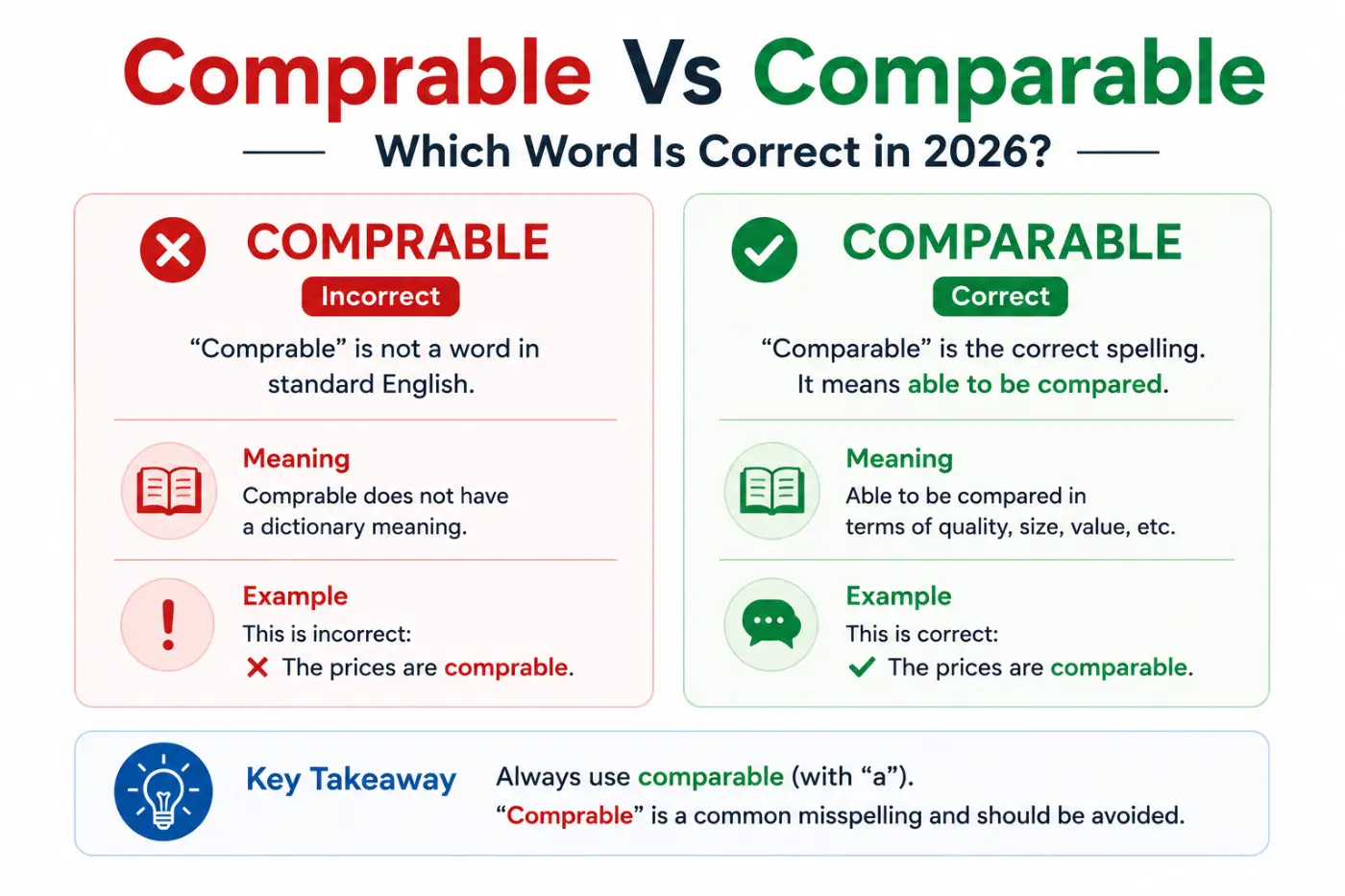
If you’ve ever typed comprable vs comparable and stopped because both forms looked almost right you’re not alone. The correct spelling is comparable. The form comprable is a common misspelling caused by leaving out the letter a in the middle of the word.
The confusion makes sense because comparable comes from the shorter word compare. English often changes a word when it takes a suffix and those changes can make spelling less predictable. In this case though the spelling stays connected to the base word compare. You need the extra a before the b.
Once you know that pattern the word becomes much easier to remember. This guide explains the meaning grammar pronunciation origin and everyday use of comparable. You’ll also see natural examples common spelling mistakes and a simple editing trick that can help you choose the correct form every time.
Quick Answer
Comparable is the correct standard English spelling. It means similar enough to be compared with something else. Comprable is a misspelling and isn’t the standard form used in American English. The easiest way to remember the spelling is to connect comparable with compare and keep the a before the b.
Quick Answer To The Spelling Question
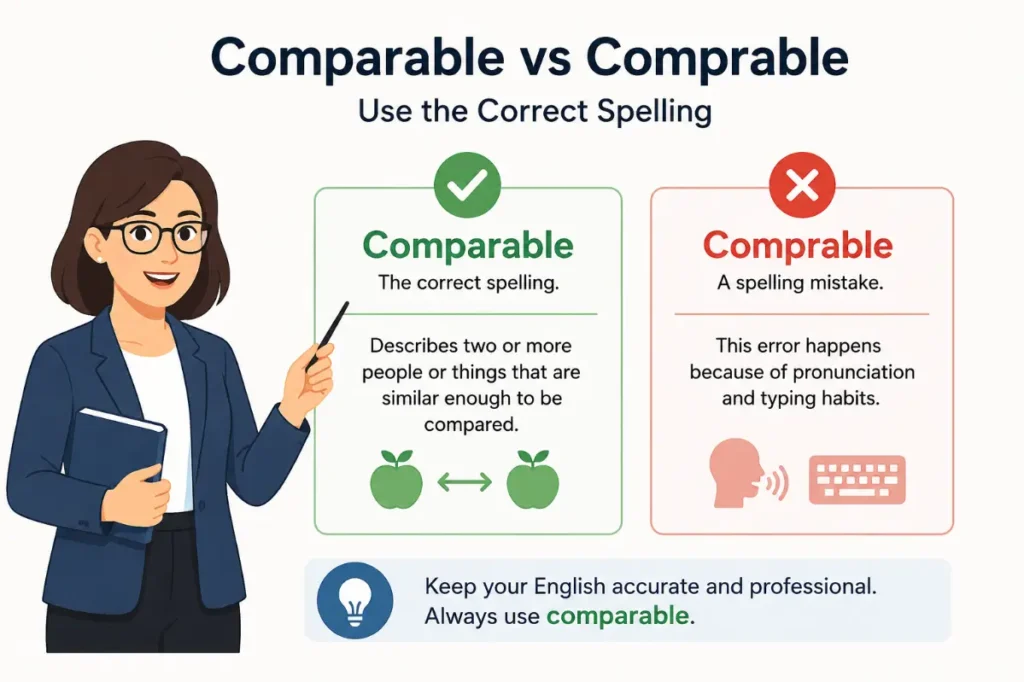
The correct form is comparable.
The incorrect form is comprable.
Comparable is an adjective. It describes two or more things that are similar enough to be compared. For example you might say that two phones have comparable features or that two houses are comparable in size.
The missing a in comprable causes the problem. The spelling can feel natural because people often say the word quickly and the middle vowel isn’t strongly heard. But pronunciation doesn’t change the standard spelling.
Comparison Table
| Form | Meaning | Part of Speech | Origin | Usage Frequency | Formality | Common Contexts | Example |
|---|---|---|---|---|---|---|---|
| Comparable | Similar enough to be compared | Adjective | From compare and Latin roots | Common | Standard | Work school shopping analysis | The two products have comparable features. |
| Comprable | No standard English meaning | Nonstandard spelling | Misspelling of comparable | Uncommon | Not standard | Typing and spelling errors | Comprable is not the standard spelling. |
The distinction is simple. One form belongs in standard English writing. The other usually appears because someone has accidentally dropped the second a.
What Does Comparable Mean
Comparable means similar enough to be compared with something else.
The word doesn’t always mean identical. In fact two things can be quite different while still being comparable. The key idea is that they share enough important features to make a comparison useful.
For example a $500 laptop and a $550 laptop may have comparable performance. They aren’t the same machine. They simply perform at a similar level.
You can also use comparable to describe size quality value speed results or other measurable or noticeable qualities.
Consider these examples.
- The two apartments have comparable monthly rents.
- Her test results were comparable to those of the top students.
- The new model offers comparable performance at a lower price.
The word often appears when someone wants to make a fair comparison between two things.
What Does Comprable Mean
Comprable isn’t the standard English word.
In most cases it is simply a misspelling of comparable. A writer may leave out the a because the middle part of the word can sound compressed during normal speech.
You shouldn’t use comprable in school assignments professional emails reports resumes or other standard English writing.
If a spelling checker flags comprable you should change it to comparable.
There isn’t a standard grammatical distinction between the two forms. The issue is spelling rather than meaning.
Why Comparable Is The Correct Spelling
The spelling becomes easier to understand when you look at the relationship between compare and comparable.
The base verb is compare.
From compare we get comparable.
The word contains the familiar sequence found in compare. Removing the a creates comprable which breaks the standard spelling pattern.
Think of it as a spelling chain.
- Compare.
- Comparable.
- Comparison.
- Comparatively.
These related words share the same core idea and spelling pattern.
That connection gives you a useful memory tool. If you’re unsure how to spell comparable think of the verb compare first. The a is easier to remember when you can see its connection to the base word.
The Meaning In Plain English
A simple way to understand comparable is similar enough to compare.
Imagine you’re shopping for a new phone. One phone costs $700 and another costs $720. They have similar cameras storage and processing power. You might call them comparable phones.
Now imagine comparing a smartphone with a refrigerator. You can compare almost anything in a broad sense but the two products aren’t normally comparable in terms of phone performance. They serve completely different purposes.
Comparable therefore suggests a meaningful basis for comparison.
This matters because the word doesn’t simply mean similar. It often carries the idea that the similarity is relevant to the comparison you’re making.
Key Differences Explained
Spelling
The biggest difference is spelling.
Comparable contains the sequence compar before the ending able.
Comprable leaves out the a.
That missing letter turns a standard word into a misspelling.
Meaning
Comparable has a clear meaning. It describes things that are similar enough to compare.
Comprable doesn’t have a standard meaning because it isn’t the accepted spelling of the adjective.
Grammar
Comparable is an adjective.
It modifies a noun or appears after a linking verb.
For example:
- The prices are comparable.
- We found comparable products.
- Their salaries are comparable.
Comprable doesn’t function as a standard adjective because the spelling is incorrect.
Pronunciation
Comparable is commonly pronounced with the main stress on the first syllable.
The pronunciation can make the spelling tricky because speakers may reduce or soften sounds in the middle of the word. That can make the a less noticeable in casual speech.
Formality
Comparable works comfortably in casual speech as well as formal writing.
You can use it in a text message.
You can also use it in everyday conversation.
Context
The word appears frequently in discussions involving price quality size performance results and standards.
A real estate agent may discuss comparable properties. A business analyst may compare comparable companies. A shopper may look for products with comparable features.
Regional Usage
There is no major spelling difference between standard American English and British English for this word.
Comparable is the standard spelling across major English varieties.
Which Form Is Correct
Comparable is correct.
The form comprable is a spelling error.
The reason is straightforward. Comparable comes from compare and retains the a found in the base word. The ending able then creates the adjective.
This is a useful example of why spelling should sometimes be checked through related words rather than sound alone.
If you can remember compare you can usually reconstruct comparable correctly.
How To Use Comparable In A Sentence
Comparable works in several common sentence patterns.
One pattern uses comparable before a noun.
The store sells comparable products at lower prices.
Another pattern uses comparable after a linking verb.
The two options are comparable in quality.
You can also use comparable to when identifying the thing being compared.
The new system is comparable to the older system.
Another common pattern is comparable with. Both constructions can occur in standard English although comparable to is very common in ordinary usage.
The word can also appear with nouns such as price performance quality size value results and features.
10 Natural Sentence Examples
- The two cars offer comparable safety features.
- Her salary is comparable to what other managers earn.
- We need a comparable product before we can make a fair decision.
- The new laptop delivers comparable performance for less money.
- These homes are comparable in size and location.
- The students achieved comparable results on the final exam.
- Both restaurants offer comparable prices and portion sizes.
- The two teams had comparable records before the game.
- This year’s sales figures are comparable to last year’s results.
- The company wants to find a comparable option before changing suppliers.
Notice how the word always describes a meaningful basis for comparison. It doesn’t suggest that the things are exactly the same.
Common Mistakes And Misspellings
Comprable
Incorrect: The two products have comprable features.
Correct: The two products have comparable features.
This is the main spelling error associated with the word. The writer drops the a before b.
Comparible
Incorrect: The results were comparible.
Correct: The results were comparable.
This error often happens because the ending can sound similar to words ending in ible. Comparable uses able.
Comparible To
Incorrect: The new model is comparible to the old one.
Correct: The new model is comparable to the old one.
The problem here combines the wrong spelling with the correct grammatical pattern.
Comparible With
Incorrect: The products are comparible with each other.
Correct: The products are comparable with each other.
Again the main problem is the spelling of the adjective.
Compairable
Incorrect: The two systems are compairable.
Correct: The two systems are comparable.
This error may come from trying to spell the word according to the way the first part sounds.
Why People Misspell Comparable
The main problem is the middle of the word.
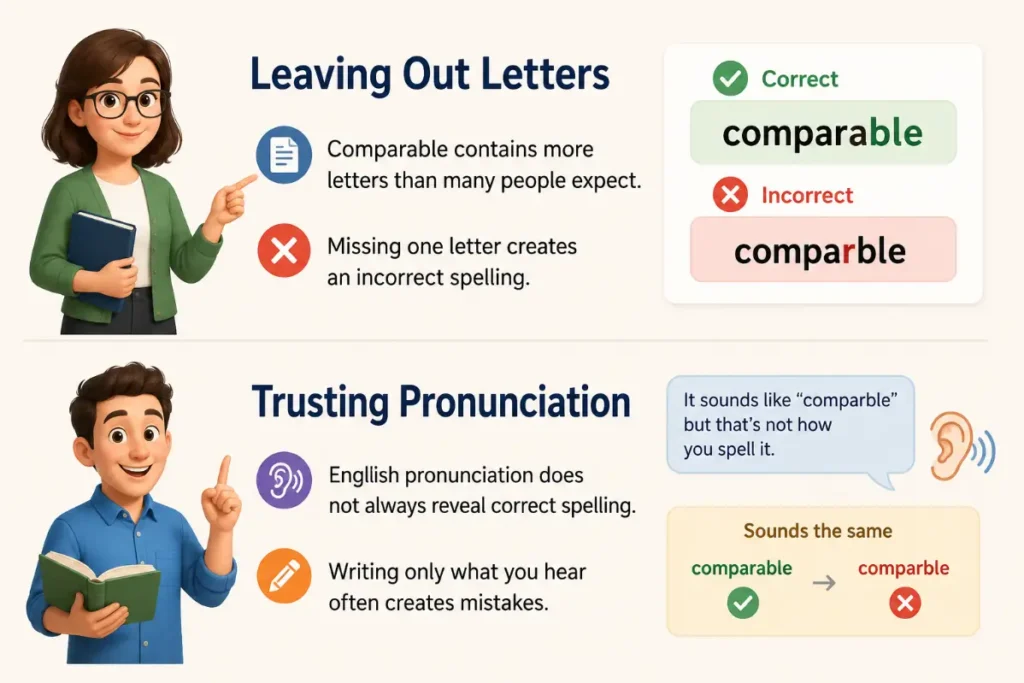
When people speak quickly they don’t pronounce every letter with equal strength. The vowel sounds inside a longer word can become less noticeable. As a result someone may remember the general sound but not the exact spelling.
There’s also a second issue. English spelling doesn’t always map neatly onto pronunciation. If you try to spell comparable only by listening to it you can easily lose the a.
The best approach is to connect the word with compare.
Compare.
Comparable.
Comparison.
Comparatively.
Once you see the family the spelling feels much less random.
Pronunciation Guide
The standard pronunciation of comparable is commonly represented in American English as:
/ˈkɑːmpərəbəl/
A simple pronunciation guide is:
KOM puh ruh buhl
The first syllable receives the strongest stress.
The word contains several reduced vowel sounds in normal speech. That’s one reason the spelling can be harder to hear than the spelling of a short word.
Don’t worry about pronouncing every letter with equal force. Natural English often reduces unstressed vowels.
The important point for spelling is this. Even though the middle a may be easy to miss when you hear the word the letter still belongs in the written form.
Etymology And Word Origin
Comparable comes from the verb compare.
Compare entered English through French from Latin. The Latin verb comparare carried the sense of matching or comparing things.
The related English forms developed around the same core idea.
Compare means to examine things in relation to each other.
Comparison refers to the act or result of comparing.
Comparable describes something that can reasonably be compared with something else.
The shared history explains why these words retain a recognizable spelling family.
You don’t need to memorize the Latin origin to spell the modern word correctly. The more useful lesson is the connection between compare and comparable.
American English
Comparable is completely standard in American English.
You’ll see it in everyday speech as well as professional and academic writing.
Americans commonly use the word to discuss price quality performance results size and value.
For example:
This car has comparable fuel economy to the smaller model.
The two candidates have comparable levels of experience.
The misspelling comprable should be corrected in standard American English writing.
British English
Comparable is also the standard spelling in British English.
There isn’t a meaningful British spelling variation that changes comparable into another form.
The same general grammatical patterns apply.
For example:
The two houses are comparable in size.
The results were comparable with previous studies.
The main difference isn’t regional. It’s simply the distinction between the standard spelling and the common misspelling.
Australian English
Australian English also uses comparable as the standard spelling.
The word works naturally in everyday communication professional writing education and business contexts.
There is no established Australian spelling that replaces comparable with comprable.
Canadian English
Canadian English uses comparable as the standard form as well.
The word can appear in formal documents casual conversation workplace communication and academic writing.
Again the spelling doesn’t change to comprable.
Grammar Rules And Part Of Speech
Comparable is an adjective.
That means it normally describes a noun or gives information about a subject.
One common structure is:
comparable + noun
Examples include:
- Comparable prices.
- Comparable results.
- Comparable products.
- Comparable salaries.
- Comparable performance.
Another common structure is:
be + comparable
For example:
The two systems are comparable.
You can also use:
comparable to + noun
For example:
The new model is comparable to the previous version.
Another structure is:
comparable with + noun
For example:
The findings are comparable with earlier results.
The choice between to and with can depend on the sentence and style. In everyday American English comparable to is often the most natural choice.
Comparable Does Not Mean Identical
This distinction matters.
If two things are comparable they don’t need to be exactly alike.
Suppose two homes have similar square footage and similar locations. One may have a newer kitchen while the other has a larger yard. They can still be comparable properties.
The word tells the reader that the similarities are strong enough to support a useful comparison.
That’s different from words such as identical and equal.
Identical means exactly the same in the relevant sense.
Equal means the same in amount value status or another specified measure.
Comparable means similar enough for a meaningful comparison.
That small distinction can make your writing more precise.
Real Life Usage Examples
Daily Conversation
People use comparable when talking about prices products choices and experiences.
These two phones are comparable in price.
I want something comparable but a little cheaper.
The word can sound slightly more precise than simply saying similar. That’s useful when you want to make a careful comparison.
Workplace Communication
Comparable is common in professional communication.
The department achieved comparable results this quarter.
Please identify three comparable vendors before we make a decision.
It works well in reports emails presentations and business discussions because it expresses similarity without suggesting that two things are identical.
Academic Writing
Academic writers often need to compare groups results studies or measurements.
The two groups showed comparable levels of improvement.
The findings were comparable to those reported in earlier research.
The word helps writers describe similarities without making a stronger claim than the evidence supports.
News And Journalism
News writing may use comparable when discussing economic figures public results prices or events.
The company reported comparable growth during the second quarter.
The new policy carries costs comparable to those of the previous program.
The word fits well because news writing often needs precise comparisons.
Literature And Storytelling
Comparable can also work in narrative writing.
Nothing in the small town was comparable to the view from the hill.
Her patience was comparable only to her kindness.
In storytelling the word can emphasize the scale or uniqueness of a quality.
Related And Confused Terms
Similar
Similar means alike in some way.
Comparable often adds the idea that the similarities make comparison reasonable.
The two bags are similar.
The two bags are comparable in quality.
Compare
Compare is the verb connected to comparable.
We compare the two products.
The products are comparable.
Remembering this relationship is one of the best spelling tricks for the word.
Comparison
Comparison is the noun form.
The comparison showed only a small difference.
Comparative
Comparative can describe something that involves comparison. In grammar it can also refer to a form such as bigger or faster.
The report provides a comparative analysis.
Comparable and comparative aren’t interchangeable in every sentence.
Equivalent
Equivalent means equal in value function meaning or effect in a particular context.
Something can be comparable without being equivalent.
Similarity
Similarity is the quality of being alike.
There is a clear similarity between the two designs.
Contrast
Contrast focuses on differences rather than similarities.
The contrast between the two products is obvious.
Identical
Identical means exactly the same.
Comparable is much weaker. Two things can be comparable while having many differences.
A Simple Memory Trick
The easiest way to remember the spelling is to start with compare.
Say the related forms together:
compare
comparable
comparison
comparative
They share the same core spelling.
If you write comprable stop and ask yourself which verb sits inside the word.
Compare.
That reminder puts the missing a back where it belongs.
Another useful trick is to think of the word in two parts:
compar + able
The ending able is familiar from many English adjectives. Once you recognize that structure the spelling becomes easier to rebuild.
Comparable In Formal Writing
Comparable is fully appropriate for formal writing.
You can use it in:
- Academic papers.
- Business reports.
- Research summaries.
- Professional emails.
- Financial analysis.
- School assignments.
- Government documents.
- Technical explanations.
The word is useful because it sounds precise without being unnecessarily complicated.
For example:
The company recorded comparable revenue during the same period last year.
That sentence communicates a specific relationship between two sets of figures.
Comparable In Informal Writing
The word also works in casual settings.
You might text a friend:
Is there anything comparable to this one for less money?
You could tell a coworker:
The other option has comparable features.
You could say:
I’ve tried both and they’re pretty comparable.
The adjective isn’t limited to formal English. Context determines how formal the sentence feels.
How Editors Handle The Spelling
An experienced editor usually catches comprable quickly because the word belongs to a familiar spelling family built around compare.
When editing a document I would first check the intended meaning. If the writer means something similar enough to compare then comparable is almost certainly the intended word.
Spelling tools may also flag comprable because it doesn’t match the standard English word. A good editor still checks the sentence rather than blindly accepting every automated suggestion. Context always matters more than a red underline.
A useful editing habit is to look for the base word behind a questionable longer word. That approach can solve many spelling problems without memorizing hundreds of isolated forms.
Why The Missing Letter Is Easy To Overlook
Long words often create visual traps.
Comparable has four syllables in many natural pronunciations. The stressed part comes early and the later syllables receive less emphasis. When you’re typing quickly your brain may focus on the sound and shape of the word rather than each individual letter.
That’s why a spelling error such as comprable can feel surprisingly convincing.
The problem isn’t that the writer doesn’t know the word. Often the writer knows exactly what they mean but simply leaves out a letter.
This happens often with words that contain unstressed vowels.
The solution is simple. Slow down for a second and connect the longer word with a familiar base word.
Compare gives you the spelling anchor.
Comparable Vs Similar
These words overlap but they aren’t always interchangeable.
Similar simply tells us that two things share characteristics.
Comparable suggests that the shared characteristics are relevant enough to make comparison useful.
For example:
The two dresses are similar.
This could mean they look alike.
The two dresses are comparable in quality.
This tells us that their quality is similar enough for a useful comparison.
Comparable therefore tends to be more specific.
Comparable Vs Equivalent
Equivalent carries a stronger meaning.
If two things are equivalent they may have the same value function or effect in a particular context.
Comparable doesn’t make that claim.
Two salaries may be comparable because they’re close in amount. That doesn’t mean they’re equal.
Two software programs may be comparable because they offer similar functions. That doesn’t mean they are equivalent.
Choosing the right word helps you avoid overstating a comparison.
Comparable Vs Identical
Identical is stronger still.
If two objects are identical they are the same in all relevant respects.
Comparable only says that the similarities support a comparison.
For example two cars can have comparable fuel economy while having different engines designs prices and interiors.
So don’t replace comparable with identical unless the evidence truly supports that stronger claim.
The Most Natural Patterns To Remember
If you’re learning how to use comparable naturally these patterns cover many everyday situations.
Comparable to something
The new model is comparable to the older version.
Comparable with something
The results are comparable with earlier findings.
Comparable in something
The two products are comparable in quality.
Comparable prices
Both stores offer comparable prices.
Comparable performance
The smaller device provides comparable performance.
These patterns are more useful than memorizing a dictionary style definition alone because they show how the adjective behaves inside real sentences.
Conclusion
The answer to comprable vs comparable is straightforward. Comparable is the correct spelling and comprable is a common misspelling. Comparable is an adjective that describes things that are similar enough to make a meaningful comparison.
The spelling becomes easier once you connect it with compare. That relationship explains why the a belongs in the middle of the word. Use comparable for products prices results performance quality size and many other situations where two things share relevant features.
For a quick editing check remember one simple pattern: compare becomes comparable. If you see comprable on the page stop for a moment and bring that missing a back into the word. That small habit can save you from an easy spelling mistake
in everything from a text message to a formal report.
Frequently Asked Questions
Is Comprable A Real Word
No. Comprable isn’t the standard English spelling of a recognized adjective. In normal writing it should be treated as a misspelling of comparable. If you see comprable in a document the intended word is almost certainly comparable. Standard spelling matters in professional school academic and formal writing.
What Does Comparable Mean
Comparable means similar enough to be compared in a meaningful way. It doesn’t mean exactly the same. Two products can have comparable prices while still having different features. Two students can have comparable results while earning different scores. The word focuses on a useful basis for comparison.
Which Is Correct Comprable Or Comparable
Comparable is the correct form. Comprable leaves out the a found in the spelling of compare and comparable. If you’re unsure while writing think of the base verb compare. That connection makes the correct spelling much easier to remember.
How Do You Pronounce Comparable
Comparable is commonly pronounced something like KOM puh ruh buhl in American English. The first syllable receives the main stress. Some of the middle vowel sounds become less distinct in natural speech. That reduced pronunciation can make the spelling harder to hear but it doesn’t change the written form.
Can Comparable Start A Sentence
Yes. Comparable can start a sentence when it directly describes the subject that follows. For example you could write Comparable results appeared in both groups. Starting a sentence with an adjective is completely normal in English as long as the sentence has a clear grammatical structure.
What Is A Synonym For Comparable
Useful alternatives include similar and alike in some contexts. Equivalent can work in specific situations but it usually suggests a stronger relationship. The best synonym depends on what you’re trying to say. Comparable is often the better choice when two things share enough relevant features for a fair comparison.
Why Do People Misspell Comparable
People often misspell comparable because the middle vowel can be difficult to hear in quick speech. The word also contains several syllables which makes it easy to drop a letter while typing. Connecting comparable with the base word compare provides a simple way to avoid the error.
Is Comparable Appropriate In Formal Writing
Yes. Comparable is completely appropriate in formal writing. It appears naturally in academic work professional reports business communication and analytical writing. It can also sound perfectly normal in everyday conversation. The word is useful when you need to describe two things that are similar enough to support a meaningful comparison.
