
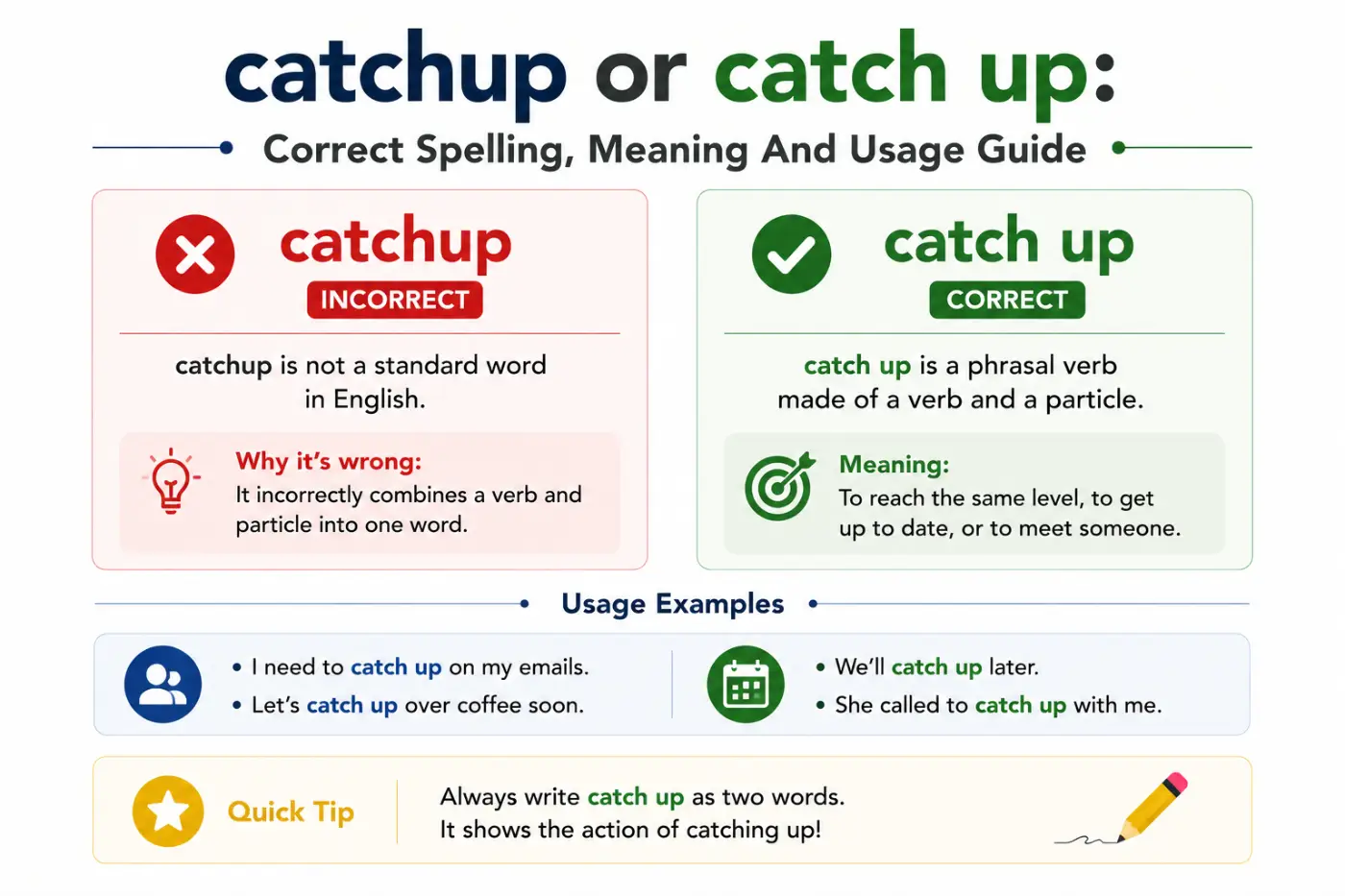
catchup or catch up can look like a tiny spelling question but it causes plenty of confusion in everyday English. You may see people write the two words as one word and wonder if that form is acceptable. The direct answer is simple. Catch up is the standard verb form when you mean to reach the same level or speed as someone else or to get updated on something. Catchup is not normally used as the standard verb spelling.
The confusion happens because English often turns phrases into single words over time. That process has happened with many familiar expressions. In this case however the verb remains written as two words in standard English. You will also see catch up used in phrases such as catch up on work and catch up with a friend. The noun form can appear as catchup in some contexts especially in informal usage and in names or specialized expressions.
This guide explains the difference clearly. You will learn the correct spelling the meanings the grammar behind the expression the pronunciation the word origin and the situations where each form appears. You will also see natural examples that show how native English speakers actually use the expression.
Quick Definition
Catch up is normally the correct two word form when it works as a verb. It means to reach someone who is ahead of you or to become up to date with information or work. Catchup can appear as a noun in some informal or specialized contexts but it should not replace the standard verb form in ordinary writing.
Quick Answer
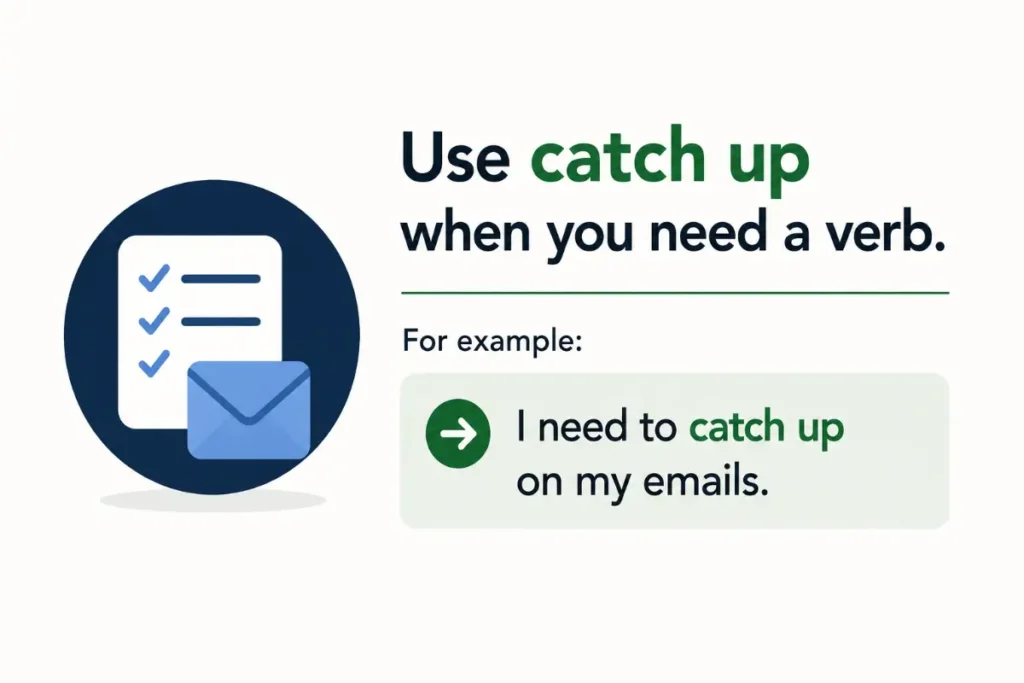
Use catch up when you need a verb.
For example:
I need to catch up on my emails.
She walked faster so we could catch up with her.
The one word form catchup is much less common and has different uses. In standard everyday English it should not be used as a replacement for the verb catch up.
Comparison Table For catchup or catch up
| Correct Form | Meaning | Part of Speech | Origin | Usage Frequency | Formality | Common Contexts | Example |
|---|---|---|---|---|---|---|---|
| catch up | Reach the same point or become current | Verb phrase | English phrasal verb built from catch and up | Very common | Standard | Work study conversation news relationships | I need to catch up on my reading. |
| catchup | A noun form found in some informal or specialized uses | Noun | Developed from the verb phrase | Much less common | Informal or specialized | Informal writing brand or product contexts | We had a quick catchup after lunch. |
The key point is grammatical rather than cosmetic. Catch up functions as a verb phrase. The two words work together to create the meaning. You cannot normally remove the space simply because the expression sounds like one unit when spoken.
Meaning And Definition
Meaning Of catchup
Catchup is not the standard spelling of the ordinary verb phrase. If you write I need to catchup on my work in standard English you are using the wrong form.
The one word version can still appear in English. Its use is generally tied to noun usage or informal writing. For example some people use catchup as a noun to describe a meeting or conversation intended to bring people up to date.
You may encounter sentences such as:
We had a quick catchup after the meeting.
The team scheduled a catchup for Friday.
This noun use is more informal than the standard verb phrase. Some dictionaries and style resources may record related noun usage while still treating catch up as the normal verb spelling.
There is another important point. Catchup can also appear in product names and other proper names. A brand or company can choose a particular spelling for its name. That does not change the standard spelling rules of English.
So if your sentence needs a verb meaning become current or reach someone who is ahead use catch up.
Meaning Of catch up
Catch up is a phrasal verb. It has several closely related meanings.
The first meaning is to reach a person who is moving ahead of you.
For example:
I walked faster to catch up with my brother.
The second meaning is to reach the same level or position as someone or something that is ahead.
For example:
She missed two classes but worked hard to catch up.
The third meaning is to become informed about something you missed.
For example:
I need to catch up on the latest news.
The fourth meaning is to complete work that has fallen behind.
For example:
I stayed home Saturday to catch up on my assignments.
The expression can also describe spending time with someone after not seeing them for a while.
For example:
Let’s catch up over coffee.
That last use is extremely common in American English. A friend may say Let’s catch up soon even when there is no specific piece of information that needs to be discussed. The phrase simply suggests reconnecting and talking about what has happened since you last met.
Key Differences Explained
- Spelling. The standard verb form is catch up. Keep the words separate when they function as a verb.
- Grammar role. Catch up is a phrasal verb. Catchup can function as an informal noun in some modern usage.
- Meaning. The verb expresses ideas such as reaching someone becoming current completing delayed work or reconnecting with someone.
- Tone. Catch up is completely natural in casual conversation and also works in professional and academic writing. The noun catchup has a more informal feel.
- Context. Use catch up on when talking about information or unfinished work. Use catch up with when talking about a person or something that is ahead of you.
These small patterns make the expression much easier to remember. Think of catch up as an action. You catch up on something or catch up with someone.
Which Spelling Is Correct?
Catch up is the correct standard form when you are using the expression as a verb.
The reason comes from English grammar. Catch is the main verb and up is a particle. Together they form the phrasal verb catch up. English contains thousands of phrasal verbs that keep their words separate.
Examples include:
pick up
give up
look up
turn up
wake up
keep up
catch up
You would not normally write pick up as pickup when using it as a verb. The same principle applies here.
Dictionary logic also supports this distinction. Major English dictionaries treat catch up as a phrasal verb and describe meanings connected with reaching someone becoming informed and completing delayed work. Some dictionaries also recognize noun uses related to the act of catching up. That difference matters because English spelling often depends on grammatical function.
An easy editor test is to look at the word after the expression. If you can put a tense on catch such as caught or are catching you are almost certainly dealing with the verb phrase.
For example:
I need to catch up.
I caught up with her.
We are catching up on our work.
The space stays in all three forms.
Sentence Examples
Here are natural examples that show how the standard verb phrase works.
- I need to catch up on my emails before the afternoon meeting.
- Maria ran across the station to catch up with her friends.
- After missing several classes I had to work hard to catch up.
- We watched the last three episodes so we could catch up with the series.
- I called my old college friend because we had not caught up in months.
- The company is hiring extra staff to catch up on delayed orders.
- Take your time. You can catch up with us later.
- I spent Sunday morning catching up on household chores.
- He reads the newspaper every morning to catch up on current events.
- Let’s catch up after work and talk about what happened.
Now look at examples containing the common misspelling.
- Incorrect: I need to catchup on my homework.
- Incorrect: She tried to catchup with the group.
- Incorrect: We should catchup sometime next week.
- Incorrect: He stayed late to catchup on his reports.
- Incorrect: I am trying to catchup with the latest news.
In each sentence the intended meaning requires the verb phrase catch up.
Common Mistakes And Misspellings
The most common error is joining the two words when they work as a verb. Several factors can cause this mistake.
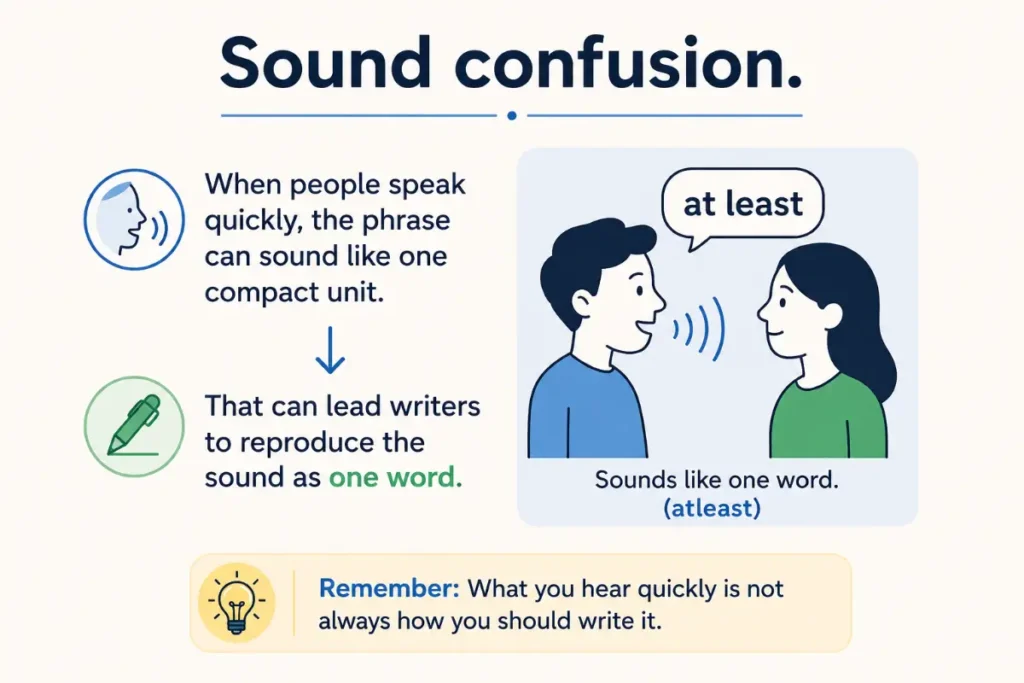
- Sound confusion. When people speak quickly the phrase can sound like one compact unit. That can lead writers to reproduce the sound as one word.
- Compound word confusion. English has many compound nouns written as one word. Writers may assume that every familiar phrase eventually becomes a compound.
- Noun and verb confusion. English sometimes changes spacing based on grammatical function. Compare makeup as a noun with make up as a verb. This pattern can make expressions such as catch up harder to remember.
- Typing habits. Autocorrect and predictive text can sometimes encourage forms that look familiar even when they don’t fit the sentence.
- NLP similarity. Search systems and language models often group related forms because they share the same semantic meaning. A search for catchup may therefore surface content containing catch up. That does not mean both spellings perform the same grammatical job.
Related confusion can also occur with phrases such as followup and follow up or backup and back up. English uses both closed compounds and open phrasal verbs. The grammatical role tells you which form belongs in the sentence.
Pronunciation Guide
The pronunciation of catch up is straightforward.
The IPA pronunciation is commonly represented as /kætʃ ʌp/ in American English.
You can think of the syllables as:
catch + up.
It has two syllables.
The first part sounds like catch. The second sounds like up.
In natural conversation the two parts often flow together so smoothly that they may sound almost like one word. That connected speech explains part of the spelling confusion. Speakers don’t normally pause clearly between every word.
Try saying:
I need to catch up.
Now say it naturally at normal speed. You will probably notice that catch and up blend closely.
The important lesson is simple. Pronunciation does not determine spelling. Many English expressions sound more compact than they look on the page.
Etymology And Word Origin
The history of catch up starts with the verb catch. English inherited this word through Anglo French and Old North French forms related to the idea of taking or seizing. The word eventually developed a wide range of meanings in English.
The particle up has an old Germanic history and has long been used in English to express movement upward. Over time however particles such as up developed many abstract meanings.
When catch and up came together the resulting expression gained the idea of reaching something that had moved ahead. From there the phrase developed several connected meanings.
To catch up with a person means to reach them after they have moved ahead.
To catch up on work means to deal with work that has accumulated while you were behind.
To catch up on news means to become informed about information that appeared while you were away.
To catch up with a friend can also mean to reconnect through conversation.
This is a classic example of how English phrasal verbs expand beyond their literal meanings. The individual words provide a foundation but the complete expression develops meanings that speakers understand as a unit.
Regional Usage In The US
In American English catch up is extremely common. People use it in casual conversation professional communication education news and everyday writing.
Americans commonly say:
I need to catch up on work.
Let’s catch up sometime.
I need to catch up with the latest news.
The verb remains two words. The informal noun catchup may appear in workplace messages or casual writing but it is less established than the verb phrase.
Regional Usage In The UK
British English also uses catch up as the standard verb form. The meanings are essentially the same as those found in American English.
You can catch up with a friend catch up on reading or catch up after falling behind.
The spelling difference between British and American English does not create a different standard verb form here. Both varieties use catch up.
Regional Usage In Australia
Australian English follows the same basic pattern. Catch up is used as a phrasal verb in everyday conversation and formal writing.
The expression is particularly natural when talking about reconnecting with friends or completing missed work.
The one word noun may appear in informal communication but it should not be treated as the normal verb spelling.
Regional Usage In Canada
Canadian English also uses catch up as the standard verb form. Canadian speakers use it for reaching someone becoming current completing work and reconnecting socially.
There is no major regional spelling rule that changes the standard verb into catchup.
Grammar Rules And Part Of Speech
Catch up is a phrasal verb. Understanding that structure makes the spelling much easier.
A phrasal verb contains a main verb plus a particle. In this expression catch is the verb and up is the particle.
The phrase can appear in several grammatical forms.
Present Form
I need to catch up.
Third Person Form
She catches up quickly.
Notice that the verb changes to catches. The particle remains separate.
Past Form
He caught up with the group.
Present Continuous Form
They are catching up on their work.
Present Perfect Form
I have caught up with the latest developments.
The expression also combines with different prepositions depending on the meaning.
Catch up with commonly refers to reaching a person or becoming equal to someone or something.
She caught up with her sister.
The smaller company is catching up with its competitors.
Catch up on commonly refers to information work reading or tasks.
I need to catch up on my reading.
He is catching up on missed assignments.
You can also use the expression without an object.
I was behind at first but I eventually caught up.
Sentence placement is flexible. It can appear after a subject or after a modal verb.
I need to catch up.
You should catch up.
We can catch up later.
When used at the beginning of a sentence the expression follows normal sentence capitalization.
Catch up with me after lunch.
You do not need a special comma simply because the phrase appears at the beginning. Punctuation depends on the entire sentence rather than the expression itself.
Real Life Usage Examples
Daily Talk
- I haven’t seen you in ages. Let’s catch up this weekend.
- I missed the first half of the show so I need to catch up.
In everyday speech the expression often feels warm and friendly. When someone says let’s catch up they usually mean let’s spend some time talking and reconnecting.
- I am catching up on messages this morning and will respond soon.
- Could we catch up next week to discuss the project?
The expression works naturally in professional email. It is conversational without being careless.
Academic Writing
- Students who miss several lectures may need additional time to catch up with the course material.
- The researcher reviewed earlier studies to catch up on recent developments in the field.
Academic writing can use the expression when the tone and context allow it. In highly formal prose you may sometimes choose alternatives such as become current or review recent developments. Still the phrasal verb itself is grammatically sound.
News
- Readers can catch up on the latest developments through the morning report.
- The team is trying to catch up with competitors after a slower quarter.
News writing frequently uses this expression because it communicates progress and information efficiently.
Literature
- He hurried down the road to catch up with the others.
- She spent the evening reading old letters to catch up on everything she had missed.
Literary writing can use the expression both literally and figuratively. Its flexibility has helped it remain a familiar part of English for centuries.
Expert Editor Insight
As a senior editor would tell you, the easiest way to handle this expression is to identify its job in the sentence before thinking about spelling. If it describes an action such as reaching someone becoming current or completing missed work then write catch up as two words. Native speakers rarely think about the rule while writing because the pattern is deeply familiar. Editors and grammar tools usually flag catchup when it appears where the verb phrase belongs. The noun use can be valid in informal contexts but it should not be allowed to blur the standard verb spelling.
Final Takeaway
Catchup or catch up becomes much easier once you identify the grammatical role. Use catch up as the standard verb when you mean reach someone become current complete missed work or reconnect with another person. The one word form catchup can appear as an informal noun or in specialized names but it should not replace the ordinary verb.
The most useful practical tip is simple. If the expression describes an action then keep the words separate. Write I need to catch up on my work rather than I need to catchup on my work. That small space makes a big difference in standard English.
FAQs
Is It Catchup Or Catch Up?
The correct form depends on how you use it. Catch up is the standard two word verb phrase. You can say I need to catch up on my work or She called to catch up with me. Catchup is mainly used as a noun for the tomato based condiment. It can also appear as an informal spelling in some contexts.
What Does Catch Up Mean?
Catch up means to reach the same level or position as someone else or to become current with something after falling behind. For example I need to catch up on my homework means you need to complete work you haven’t finished. It can also mean spending time talking with someone you haven’t seen recently.
Is Catch Up Hyphenated?
No. When catch up functions as a verb phrase it is normally written as two separate words without a hyphen. For example I need to catch up with my friends is correct. When the words form a noun or adjective in a particular expression the spelling can change depending on the style and context.
Is Catchup A Real Word?
Yes. Catchup can be a noun referring to a tomato based condiment and is recognized as a variant of ketchup. However, don’t use catchup as a replacement for the verb phrase catch up. Write I need to catch up rather than I need to catchup.
What Is The Difference Between Catch Up And Catchup?
Catch up is normally a verb phrase. It means to reach someone or something after being behind or to become current with missed information or work. Catchup is generally a noun associated with the condiment. For example I need to catch up on emails uses the verb phrase while He put catchup on his fries uses the noun.
Is Catch Up One Word In American English?
No. In standard American English catch up is written as two words when it functions as a verb. For example We need to catch up before the meeting is correct. Writing catchup as one word for this meaning is generally considered incorrect. The noun catchup has a separate meaning and shouldn’t be confused with the verb.
How Do You Use Catch Up In A Sentence?
You can use catch up in several common ways. I need to catch up on my reading means you need to finish missed reading. Let’s catch up after work means let’s spend time talking. He ran faster to catch up with his brother means he tried to reach his brother. The exact meaning depends on context.
Should I Write Catch Up Or Catchup In Formal Writing?
Use catch up when you mean the verb phrase in formal writing. For example The team worked late to catch up on the delayed project is correct. Use catchup only when you mean the noun associated with the condiment or in a context where that spelling is specifically established. For general professional writing catch up is the safe choice.
