
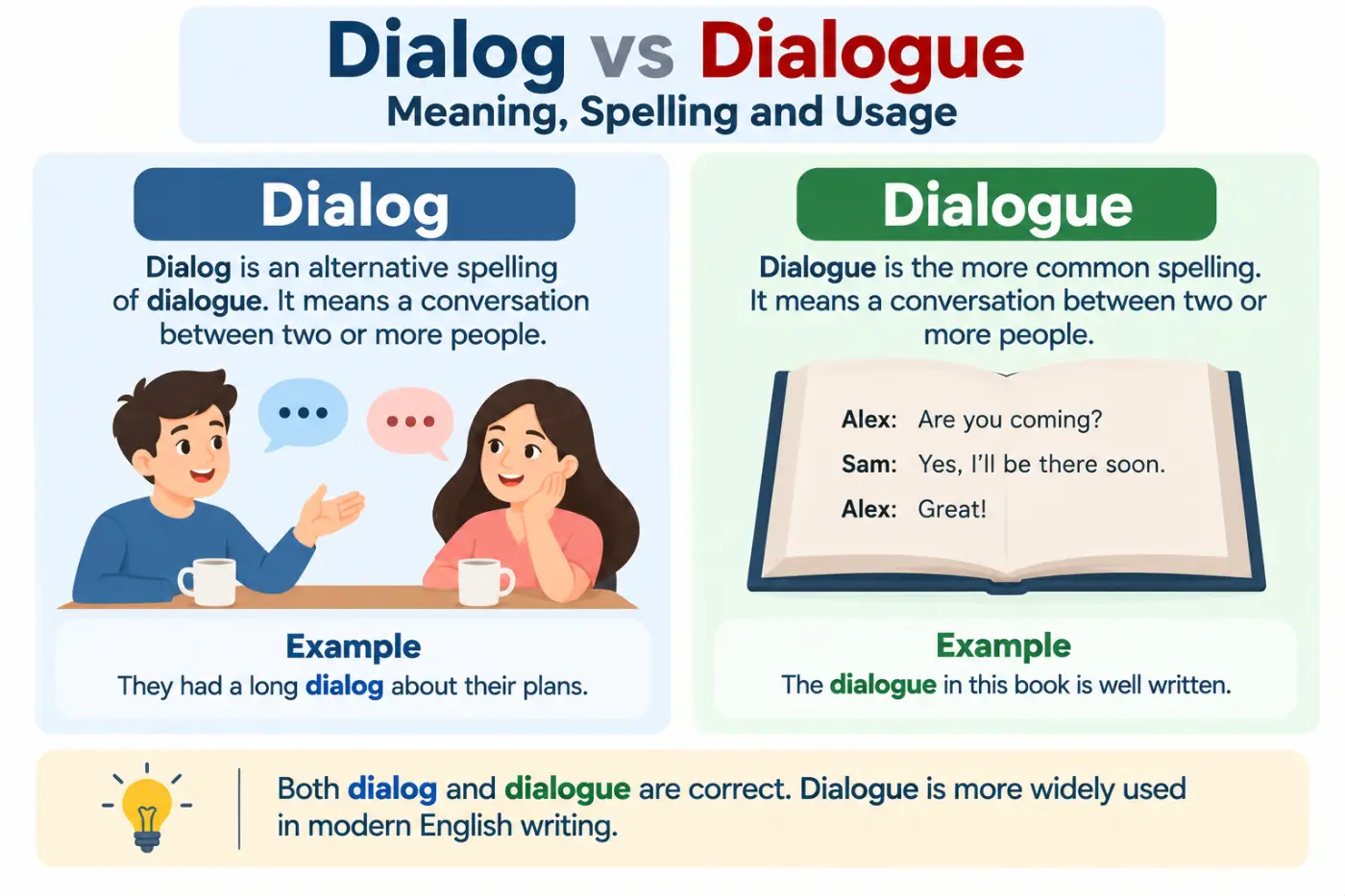
Dialog vs dialogue can look like a simple spelling question but the answer has a little more nuance. Both forms are legitimate English words and both refer to an exchange of spoken words or ideas. The key difference is usage. Dialog is especially common in American English for certain technical contexts while dialogue remains the more traditional and widely used form in general English.
That distinction matters because choosing a form can depend on what you’re writing. A novelist will normally write dialogue when describing characters speaking. A software developer may use dialog when referring to a small window or interface element. In many everyday situations either form can refer to a conversation although dialogue is generally the more common choice.
You’ll learn how each form works what it means where it came from and how American English treats the shorter spelling. You’ll also see examples from fiction business writing technology and everyday speech. By the end you’ll have a simple rule for choosing the form that fits your sentence.
Quick Definition
Dialog and dialogue are both accepted English spellings. Dialogue is the standard choice for conversations and spoken exchanges in most general writing. Dialog is also used in American English especially for computer interface windows and in some technical contexts. The two forms overlap in meaning but their preferred contexts can differ.
Quick Answer
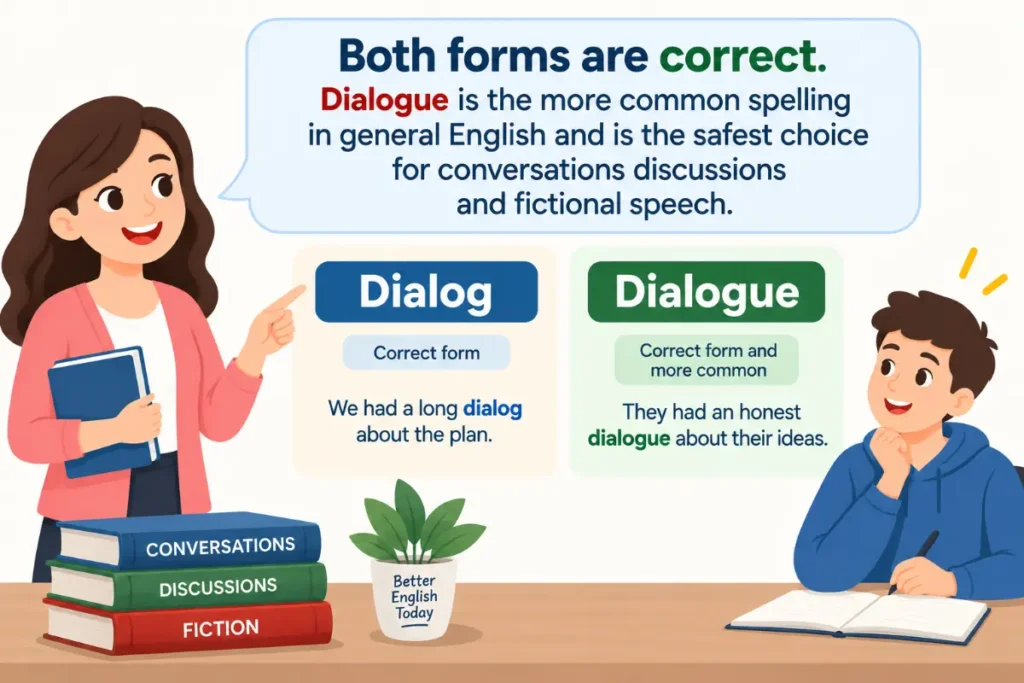
Both forms are correct. Dialogue is the more common spelling in general English and is the safest choice for conversations discussions and fictional speech.
Dialog is also legitimate especially in American English technical writing. In computing it commonly refers to a small window that asks a user to make a choice or enter information.
Comparison Table
| Form | Meaning | Part of Speech | Origin | Usage Frequency | Formality | Common Contexts | Example |
|---|---|---|---|---|---|---|---|
| Dialogue | A conversation or exchange of ideas | Noun | Greek dialogos through Latin and French | Very common | Neutral to formal | Fiction conversation discussion academic writing journalism | The characters have a tense dialogue. |
| Dialog | A conversation or exchange of ideas and a technical interface window | Noun | Shortened English form related to dialogue | Common in American technical usage | Neutral to formal | Software computing technology conversation | Close the dialog before continuing. |
Meaning and Definition
Meaning of Dialog
Dialog is a legitimate English word. It is not simply a spelling error.
Its general meaning is an exchange of words ideas or opinions between two or more people. In that sense it overlaps with dialogue.
However American English has developed a particularly strong use for dialog in computing. A dialog or dialog box is a small window that appears on a computer screen and asks the user to provide information select an option confirm an action or make a decision.
For example a program might display a dialog asking you to save changes before closing a document.
You’ll also see dialog used in technical documentation software development user interface design and programming discussions. In these fields the shorter spelling is familiar and useful.
The word can also appear in broader writing. Still many general readers expect dialogue when the subject is human conversation or fictional speech.
That doesn’t make dialog wrong. It simply means context affects which form sounds most natural.
Meaning of Dialogue
Dialogue is the traditional and broadly preferred spelling in general English.
As a noun it means a conversation between people. It can describe ordinary communication between individuals or a structured exchange between groups.
The word also has an important role in literature. In fiction dialogue refers to the spoken words exchanged by characters.
For example:
The dialogue between the two characters reveals their disagreement.
Dialogue can also describe communication intended to resolve differences or improve understanding.
The two groups began a dialogue about the proposed changes.
In this sense dialogue can be more than casual conversation. It can suggest a meaningful exchange in which people listen respond and consider different views.
The word can also refer to a written representation of speech. A screenplay novel or play may contain extensive dialogue even though the reader sees the words on a page rather than hearing them directly.
Key Differences Explained
- Spelling. Dialogue contains the longer traditional spelling. Dialog is a shorter accepted form.
- General meaning. Both can refer to an exchange of words ideas or opinions.
- Fiction. Dialogue is the standard choice for conversations between characters in novels plays screenplays and stories.
- Technology. Dialog is especially common in American computing terminology where it refers to an interface window or dialog box.
- Regional preference. American English accepts both forms while dialogue remains broadly familiar across English varieties.
- Formality. Both forms can appear in professional writing. Dialogue is usually the safer choice when you’re writing for a broad audience.
- Pronunciation. The two forms are generally pronounced the same.
- Context. The surrounding subject often tells you which spelling fits best. A novel usually calls for dialogue. A software manual may naturally use dialog.
The biggest mistake is assuming that the shorter form is always wrong. It isn’t. The better approach is to look at the subject and audience.
Which Form Is Correct?
Both are correct.
If you’re talking about people having a conversation then dialogue is usually the best choice. It is widely recognized and works naturally in everyday English academic writing journalism literature and professional communication.
If you’re talking about software then dialog is often the preferred American technical spelling. Developers and technical writers frequently use it for an interface element that asks the user to interact with a program.
There is no grammatical rule saying that one form must replace the other.
The distinction is largely one of convention and context.
Think of it this way. Dialogue is the broad general purpose form. Dialog is a shorter form with a particularly strong technical identity in American English.
If you’re unsure what to choose in ordinary writing use dialogue. It’s the most widely understood option and rarely sounds out of place.
If you’re writing technical documentation for software then follow the terminology used by the product style guide or development environment. Consistency matters more than trying to force one spelling into every context.
Why Does American English Use Dialog?
American English often favors shorter spellings in technical vocabulary. Dialog became especially established in computing because interface terminology needed concise labels and documentation.
The computing meaning developed around the idea of a computer system engaging the user in an exchange. A dialog box presents information and waits for a response. The name fits the basic concept of a conversation between the user and the program.
This technical convention became common enough that dialog is now familiar to programmers software designers technical writers and many everyday computer users.
You may encounter phrases such as dialog box open dialog save dialog print dialog and modal dialog.
These phrases are normal in American technical English.
That usage doesn’t erase the longer form. It simply gives the shorter form a specialized home where readers expect it.
Sentence Examples
Here are examples using dialogue in ordinary English.
- The two friends had an honest dialogue about their problems.
- The movie has realistic dialogue that sounds natural.
- Good dialogue can reveal a character’s personality without explaining everything directly.
- The teacher encouraged dialogue between students with different opinions.
- Their dialogue continued long after the meeting ended.
- The author uses dialogue to make the story feel more immediate.
- The two leaders opened a dialogue about the proposed agreement.
- I liked the dialogue because it sounded like something real people would say.
- The play depends heavily on dialogue rather than narration.
- The novel contains sharp dialogue and memorable characters.
Now consider technical examples using dialog.
- A confirmation dialog appears before the file is deleted.
- Close the dialog after selecting your preferred settings.
- The application opens a dialog when you click the export button.
- The error message appears inside a dialog.
- The developer redesigned the dialog to make it easier to understand.
Notice how naturally the shorter spelling fits the technology context.
Common Mistakes and Spelling Confusion
Several mistakes can happen because the two forms look and sound so similar.
Treating Dialog As A Misspelling
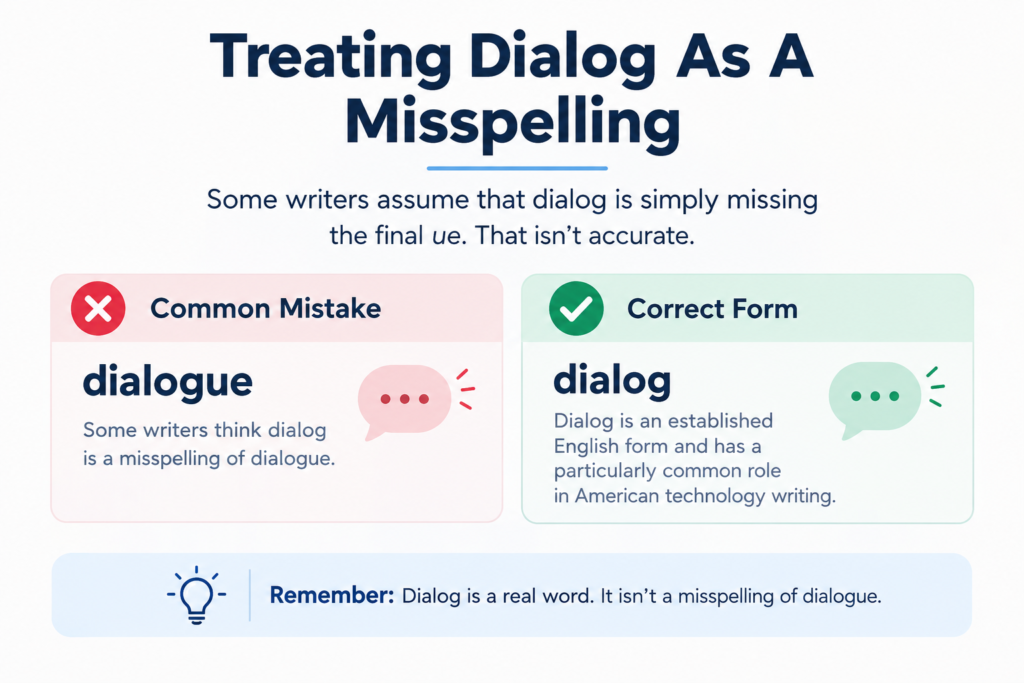
Some writers assume that dialog is simply missing the final ue. That isn’t accurate. Dialog is an established English form and has a particularly common role in American technology writing.
Treating Dialogue As Wrong
The opposite mistake also occurs. Some people see dialog in software documentation and assume it should always be changed to dialogue. That can make technical writing less consistent with common computing terminology.
Using Dialog For Fictional Speech
Although readers will understand it the meaning can look unusual when you use dialog in a novel or screenplay. Dialogue is the conventional spelling for character speech.
For example:
The character’s dialogue reveals his fear.
This is more natural than using the shorter spelling in ordinary literary writing.
Assuming Pronunciation Changes
The two spellings generally have the same pronunciation. Changing the spelling doesn’t create a major difference in spoken English.
Mixing Forms In One Document
Consistency is useful. If a software manual uses dialog throughout then suddenly switches to dialogue when referring to the same interface element readers may wonder if the writer means something different.
Pick the form that fits the context and stay consistent.
Pronunciation Guide
Both forms are generally pronounced the same.
The common pronunciation is:
Dialogue: /ˈdaɪəlɔːɡ/
Dialog: /ˈdaɪəlɔːɡ/
American speakers may pronounce the final vowel sounds slightly differently depending on speech style and regional accent. The important point is that the shorter spelling does not normally create a different spoken word.
A simple pronunciation guide is:
DYE uh log.
The first syllable receives the strongest stress.
The word has three main sound parts:
DYE + uh + log.
Many learners try to pronounce every written letter. That can make the word sound awkward. Instead learn the natural spoken pattern and remember that the longer spelling contains extra letters that don’t create extra syllables.
Etymology and Word Origin
The history of dialogue reaches back to ancient Greek.
The word comes from Greek dialogos which relates to conversation discussion or an exchange of ideas. It combines elements connected with speaking or discourse.
The word moved through Latin and French before becoming established in English.
English has used dialogue for centuries. Over time dialog developed as a shortened spelling and became particularly established in American English technical vocabulary.
The connection between the two forms is therefore historical and linguistic rather than accidental. They belong to the same word family and share the same central concept of an exchange.
The modern computing sense adds another layer to that history. A computer dialog is named for the way the system presents information and waits for a response from the user.
That metaphor is easy to understand. The computer asks something. You respond. The program continues.
Regional Usage
American English
American English accepts both spellings. Dialogue is the normal broad choice for conversations literary speech discussions and many formal contexts.
Dialog is especially established in computing and software terminology. American technical writers often use dialog box as a standard term for an interface window.
For general writing the longer spelling remains the safer option because it has a wider range of familiar uses.
British English
British English strongly favors dialogue in general writing. The word appears in fiction journalism academic writing and discussions about communication.
The technical form dialog can still appear in British computing contexts because software terminology often crosses national boundaries. However dialogue remains the familiar general form.
Australian English
Australian English generally follows the broader international preference for dialogue in ordinary writing. Technical material may use dialog when software terminology calls for it.
There isn’t a major Australian meaning difference between the forms.
Canadian English
Canadian English commonly uses dialogue for conversations and literary speech. Canadian technical writing may use dialog for computing contexts especially when following established software terminology.
Again the main distinction comes from context rather than a sharp national spelling rule.
Grammar Rules and Part of Speech
Both dialog and dialogue are primarily nouns.
They can describe a conversation between people or an exchange of ideas.
For example:
The dialogue was thoughtful.
The sentence uses dialogue as the subject of the sentence.
You can also use the word after a preposition.
They spoke through dialogue.
The word can take common noun modifiers.
A political dialogue began.
A fictional dialogue sounded natural.
A software dialog appeared.
Both forms can also be plural.
Dialogues is the plural of dialogue.
Dialogs is the plural of dialog.
The choice depends on the spelling convention you’re following.
Dialogue can also appear in expressions involving communication.
Open a dialogue.
Continue the dialogue.
Encourage dialogue.
Start a dialogue.
These patterns are common because dialogue often describes an ongoing process rather than a single spoken sentence.
In literary writing dialogue can refer to the actual words characters speak.
The dialogue in the final scene was especially powerful.
In technical writing dialog usually refers to a user interface component.
The dialog asks you to confirm the change.
These grammatical structures are straightforward. The real challenge lies in selecting the spelling that fits the context.
Dialogue In Fiction
Dialogue plays a major role in storytelling.
When characters speak directly to one another writers use dialogue to reveal personality emotion conflict relationships and information. Strong dialogue can make a scene feel alive without forcing the writer to explain every detail.
For example:
“I can’t believe you came back.”
“I said I would.”
The spoken exchange tells the reader something about the characters and their relationship.
In standard American literary usage dialogue is the natural spelling.
A professional editor would normally keep that form in a novel screenplay short story or play unless a particular publication or style guide has another preference.
The word also describes the broader craft of writing believable speech. Writers often talk about dialogue that feels natural or dialogue that sounds too stiff.
Dialog In Technology
The shorter spelling has a strong place in computing.
A dialog is often a temporary interface window that asks the user to make a decision or provide information.
You might see a dialog when you try to:
- Save a file.
- Choose a folder.
- Confirm deletion.
- Select a printer.
- Change application settings.
- Enter account information.
- Approve a security action.
A dialog may contain buttons fields checkboxes menus or other controls.
For example a program may show a confirmation dialog with buttons that allow you to continue or cancel.
The phrase dialog box is especially familiar in software terminology.
This is one of the clearest situations where the shorter form feels completely natural.
Real Life Usage Examples
Daily Conversation
People rarely discuss the spelling while speaking because both forms usually sound the same.
You might say:
We need to have a dialogue about what happened.
The two groups finally started a dialogue.
In ordinary speech the word often describes meaningful communication rather than simple small talk.
Workplace Communication
Professional writing frequently uses dialogue when discussing communication between teams or organizations.
The meeting created an opportunity for dialogue between the departments.
We need open dialogue before making a final decision.
In technical workplaces dialog may appear in software instructions.
Select the option in the dialog.
Close the dialog and restart the application.
Academic Writing
Academic writers often use dialogue when discussing communication debate or interaction.
The study examines dialogue between teachers and students.
The researchers argue that dialogue can improve understanding between groups.
In computer science writing dialog may appear when the subject is interface design.
The application displays a dialog after the user selects the command.
News Writing
Journalists often use dialogue when discussing negotiations or public communication.
The officials called for continued dialogue between the two sides.
The talks created a new opportunity for dialogue.
The technical spelling can appear in technology journalism.
The application displays a confirmation dialog before deleting the file.
Literature And Storytelling
Dialogue is standard in literary discussion.
The author uses dialogue to build tension.
The dialogue between the characters becomes more intense near the end.
A literary editor would normally expect the longer form in this context.
Related And Confused Terms
Several words and expressions connect closely with the idea of dialogue.
Conversation
A conversation is an exchange of spoken words between people. It can be casual or serious.
Discussion
A discussion usually involves talking about a particular subject. It may include several people and different opinions.
Communication
Communication is broader. It includes the exchange of information through speech writing signs gestures and other methods.
Debate
A debate usually involves opposing views. Participants present arguments and respond to one another.
Negotiation
Negotiation focuses on reaching an agreement or settling a disagreement.
Monologue
A monologue involves one person speaking for an extended period rather than an exchange between speakers.
Soliloquy
A soliloquy is a speech in which a character expresses private thoughts especially in drama.
Conversation Box
A conversation box can describe an interface element in some software contexts but it isn’t as established a technical term as dialog box.
These related words help clarify the central idea. Dialogue is broad enough to describe conversation and communication while still carrying a strong sense of exchange.
Dialogue And Conversation Are Not Always Identical
It’s easy to treat dialogue and conversation as exact synonyms but they can carry different shades of meaning.
Conversation is often casual.
Two friends can have a conversation about dinner plans.
Dialogue can sound more purposeful.
The organization opened a dialogue with local residents.
That sentence suggests an intentional effort to communicate and understand different views.
Dialogue can also describe a formal process.
The two governments entered into dialogue.
Conversation would sound less formal in that sentence.
Still the boundary isn’t rigid. People can use dialogue in ordinary situations and conversation in serious ones.
The surrounding context determines the best choice.
When To Use Each Form
A simple decision process can make the choice easy.
- If you mean people talking in a story use dialogue.
- If you mean an exchange of ideas use dialogue.
- If you’re writing about diplomacy or negotiations use dialogue.
- If you’re discussing literary speech use dialogue.
- If you’re describing a software interface window in American technical writing use dialog.
- If a software style guide specifies one spelling follow that guide consistently.
- If you’re writing general English and have no special reason to use the shorter form choose dialogue.
This approach avoids unnecessary confusion.

Expert Editor Insight
An experienced editor usually looks at context before changing either spelling. Dialogue is the natural default for general American English because readers encounter it in fiction communication journalism education and professional writing. Dialog becomes especially useful in software terminology where it has a clear established function. Spellcheckers may accept both forms because both are legitimate words. A better editing test is therefore not simply asking which spelling looks right. Ask what you’re describing. If it’s human or fictional conversation dialogue is usually the natural choice. If it’s a software interface dialog often fits better.
Conclusion
Dialog vs dialogue has a straightforward answer once you look at context. Both forms are correct and both can describe an exchange between people. Dialogue is the stronger general choice for conversations literary speech discussions and formal communication. Dialog has a particularly strong role in American technology writing where it commonly describes a software interface window.
The two forms usually sound the same so pronunciation won’t help you decide. Context is the better guide. Think about what you’re describing before choosing the spelling. If people are speaking or exchanging ideas dialogue will usually feel natural. If you’re describing a software window dialog is often the better technical choice.
The easiest editing tip is to remember that dialogue is the broad everyday form while dialog has a useful technical identity. When writing for a general audience and you have no special reason to shorten the word choose dialogue. When writing about software follow the terminology used by your field or style guide.
FAQs
Is dialog a correct English word?
Yes. Dialog is a legitimate English word. It can mean an exchange of words or ideas and it has a particularly established use in American computing terminology. In software writing a dialog often means a small interface window that asks the user to enter information or make a choice. It isn’t simply a typo created by removing letters from the longer form.
Is dialogue more correct than dialog?
Neither form is universally more correct because both are accepted. Dialogue is the standard choice for general writing and works especially well for conversations fictional speech and formal discussions. Dialog is strongly established in American technical language especially when referring to software interface elements. Context should guide your choice.
Should I use dialogue in a novel?
Yes. Dialogue is the standard spelling for spoken exchanges between characters in novels short stories plays and screenplays. It is also the form most readers expect when discussing the craft of fiction. Using dialog would not normally prevent readers from understanding you but the shorter spelling can look unusual in literary writing.
Is dialog only used in American English?
No. Dialog can appear outside the United States especially in software and computing contexts. However American English has given the shorter form a particularly strong place in technical vocabulary. Dialogue remains the more widely recognized general spelling across English varieties. The technical context often explains why you see dialog in software documentation regardless of the writer’s country.
How do you pronounce dialogue?
Dialogue is commonly pronounced like DYE uh log. Its standard pronunciation is represented in IPA as /ˈdaɪəlɔːɡ/. The shorter form dialog is generally pronounced the same way. The additional letters in dialogue don’t create extra spoken syllables. The main stress falls on the first syllable.
Can dialogue refer to written speech?
Yes. Dialogue can refer to speech presented in writing. In a novel or screenplay the reader sees the words on the page but the text represents spoken interaction between characters. Writers and editors commonly use dialogue to describe this part of storytelling. The term can also describe meaningful communication between real people or groups.
What is the difference between dialogue and conversation?
Conversation usually describes people talking with one another and can be casual or informal. Dialogue often suggests an exchange of ideas or communication with a particular purpose. The two words overlap heavily. You can have a conversation with a friend and also have a dialogue with that friend. Context and tone often determine which word sounds better.
Is dialog appropriate in formal writing?
Dialog can be appropriate in formal writing when the subject is software or another technical context where the shorter form is established. For general formal writing dialogue is usually the safer choice. Academic papers business reports and essays that discuss human communication normally use dialogue. Technical documentation should follow the terminology and style conventions of its field.
