
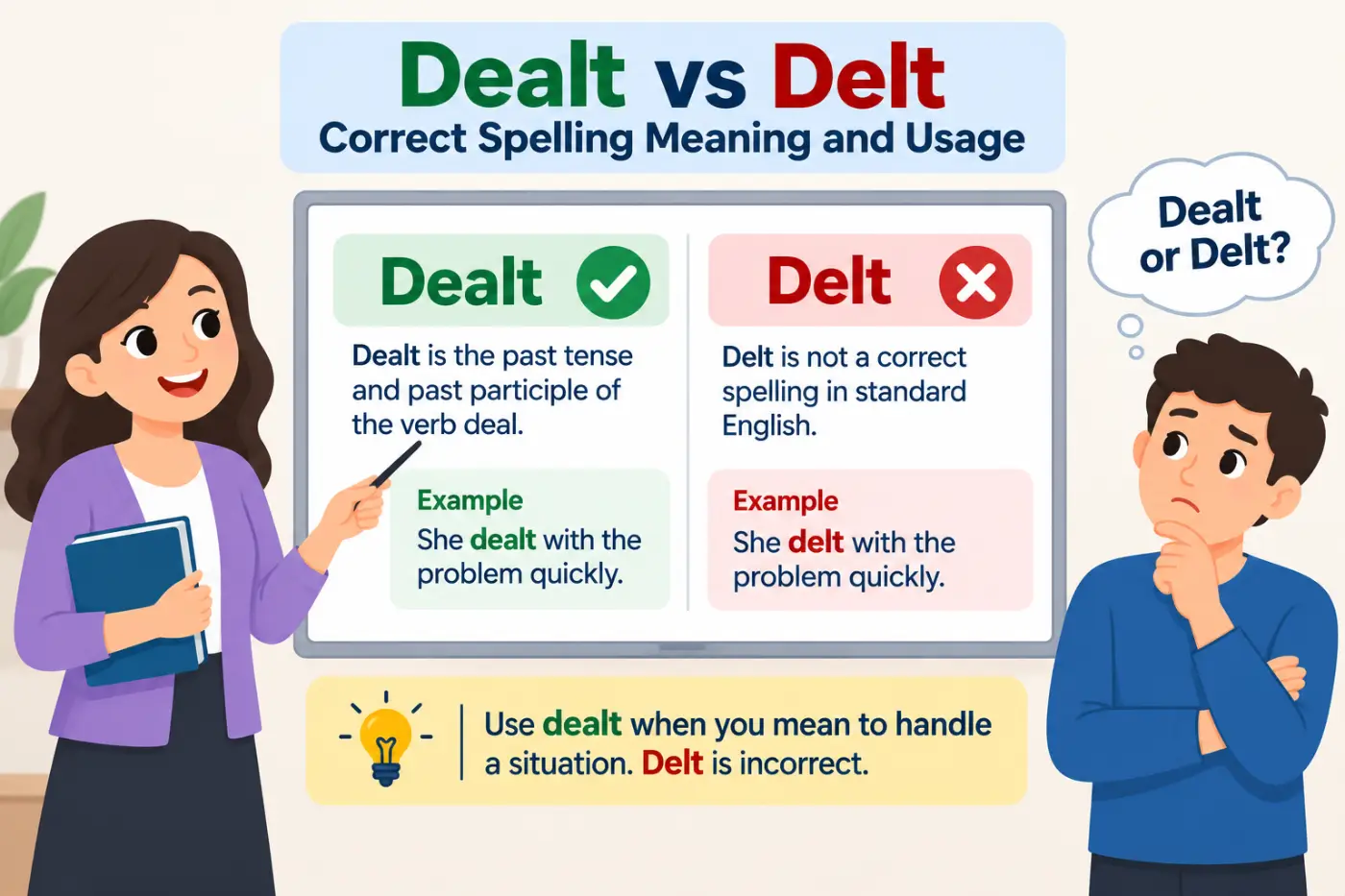
dealt vs delt can be confusing because both forms are pronounced the same in modern English. If you are trying to write the past tense of deal you should use dealt. The form delt is not the standard modern spelling of that verb. However there is a useful twist. Delt does exist as an English word in another sense and also appears as an older spelling of dealt.
The confusion usually comes from pronunciation. When you say dealt you hear a short vowel followed by an l and t sound. You don’t hear an extra sound that tells you to write the a. That makes it easy to type delt. English also has many irregular verbs where the spelling changes in ways that can’t be guessed from pronunciation alone.
This guide explains the difference clearly. You’ll learn how deal changes into dealt how delt is used today why older English sometimes used delt how both forms are pronounced and how to choose the right form in everyday writing. You’ll also see natural examples grammar patterns common mistakes and related expressions.
Quick Definition
Dealt is the standard modern past tense and past participle of deal. Delt is not the standard modern past form of deal. However delt is a legitimate informal noun meaning a deltoid muscle and it also appears as an archaic spelling of dealt. In normal modern writing use dealt for the verb.
Quick Answer
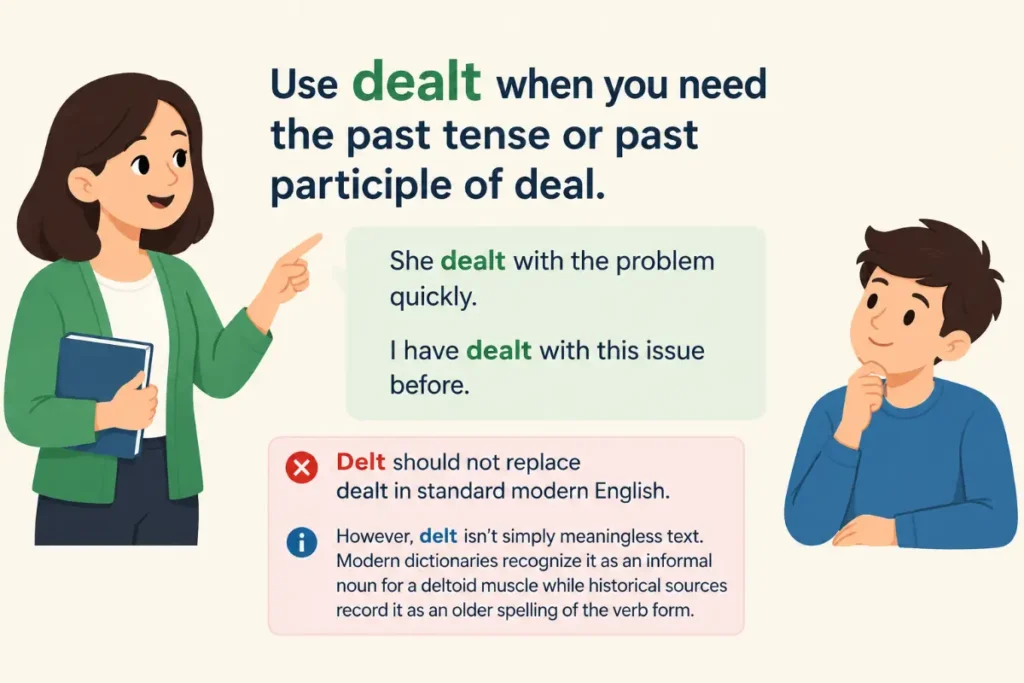
Use dealt when you need the past tense or past participle of deal. For example you can write She dealt with the problem quickly or I have dealt with this issue before. Delt should not replace dealt in standard modern English. However delt isn’t simply meaningless text. Modern dictionaries recognize it as an informal noun for a deltoid muscle while historical sources record it as an older spelling of the verb form.
Comparison Table
| Form | Meaning | Part of Speech | Origin | Usage Frequency | Formality | Common Contexts | Example |
|---|---|---|---|---|---|---|---|
| Dealt | Past tense and past participle of deal | Verb | Germanic English word family | Common | Standard | Conversation writing business school news | She dealt with the complaint quickly. |
| Delt | Informal short form of deltoid or historical spelling of dealt | Noun in modern slang and historical verb form | Modern shortening from deltoid and older English spelling history | Less common | Informal as a noun and archaic as a verb form | Fitness bodybuilding historical texts | He trained his delts at the gym. |
The table shows why simply calling delt a misspelling doesn’t tell the whole story. If you’re writing about handling a problem or giving someone cards the modern verb is dealt. If you’re talking about a shoulder muscle in an informal fitness setting delt can be perfectly legitimate.
Meaning and Definition
Meaning of Dealt
Dealt is the simple past tense and past participle of deal. It is an irregular verb form. Standard English uses the same form for both grammatical jobs.
The verb deal has several meanings. It can mean to give out cards in a card game. It can also mean to give or deliver something such as a blow.
Consider these examples.
She dealt the cards.
The manager dealt with the complaint.
They dealt with the problem yesterday.
The boxer dealt a powerful blow.
In each sentence dealt is connected to the verb deal. The surrounding words tell you which meaning applies.
The form also appears in perfect constructions.
I have dealt with this before.
They had dealt with the issue already.
The work has been dealt with.
English dictionaries consistently identify dealt as both the past tense and past participle of deal. Cambridge and Oxford both give this grammatical information.
Meaning of Delt
Delt has more than one history in English.
In modern informal American English delt is used as a shortened form of deltoid. A deltoid is the large rounded muscle around the shoulder. Fitness writers and gym users often use delt as a casual term.
For example:
He worked his left delt.
Her shoulder routine targets the rear delts.
This use is informal. It doesn’t mean that delt is an alternative spelling of the verb deal.
There is another historical use. Older English texts contain delt as a spelling of dealt. Historical records show forms such as delt appearing during earlier stages of English. Modern standard English eventually settled on dealt as the normal spelling.
So context matters. If someone writes My delt is sore after lifting weights they are probably talking about a shoulder muscle. If someone writes I delt with the problem yesterday they almost certainly intend the verb dealt and have made a spelling error in modern standard English.
Key Differences Explained
- Spelling. Dealt is the standard spelling for the past tense and past participle of deal. Delt isn’t the standard modern spelling for that verb.
- Meaning. Dealt can mean handled distributed gave or participated in a transaction depending on context. Delt commonly refers informally to a deltoid muscle in modern English.
- Grammar. Dealt functions as a verb form. Delt can function as a noun when it means deltoid.
- Pronunciation. The verb dealt is pronounced /dɛlt/. The modern noun delt is also pronounced /dɛlt/. They are homophones in standard English.
- Formality. Dealt is standard in casual and formal English. Delt is informal when it means deltoid.
- Historical usage. Delt has historical evidence as an older spelling of dealt. That doesn’t make it the preferred spelling today.
- Context. A sentence about handling a situation calls for dealt. A sentence about shoulder muscles may use delt.
The most useful rule is simple. If you’re forming the past tense of deal write dealt.
Which Form Is Correct?
If you’re talking about the past tense or past participle of deal the correct modern form is dealt.
This follows the standard conjugation of the irregular verb deal.
The basic pattern is:
- Deal is the base form.
- Dealt is the simple past form.
- Dealt is the past participle.
- Dealing is the present participle.
For example:
I deal with customer questions every day.
I am dealing with another request now.
Notice that the verb doesn’t become dealed. It changes to dealt.
Dictionaries support this pattern clearly. Cambridge identifies dealt as the past tense and past participle of deal. Oxford gives the same grammatical classification and pronunciation.
The spelling also has a long historical explanation. Deal comes from a Germanic word family connected with the idea of dividing or sharing. Historical records show several older forms of the past tense including delt before dealt became the established modern spelling.
That history explains why you may occasionally encounter delt in older texts. It doesn’t change the spelling you should use in modern standard English.
Sentence Examples
Here are natural examples that show how dealt works in different situations.
- I dealt with the customer complaint before lunch.
- She dealt the cards to everyone at the table.
- The teacher dealt with the issue calmly.
- We dealt with the problem as soon as it appeared.
- The company dealt fairly with its employees.
- He had dealt with similar situations before.
- The new policy dealt a serious blow to the small business.
- I have dealt with enough paperwork for one day.
- The manager dealt with the mistake professionally.
- They dealt with the unexpected delay better than we expected.
Now consider examples where someone might mistakenly type delt when they mean dealt.
- Incorrect: I delt with the problem yesterday.Correct: I dealt with the problem yesterday.
- Incorrect: She delt the cards to the players.Correct: She dealt the cards to the players.
- Incorrect: We delt with the complaint immediately.Correct: We dealt with the complaint immediately.
- Incorrect: He delt with the situation calmly.Correct: He dealt with the situation calmly.
- Incorrect: They delt with the issue before the meeting.Correct: They dealt with the issue before the meeting.
These examples show the main spelling issue. The mistake doesn’t change the intended meaning but it does make the sentence nonstandard.
Common Mistakes and Misspellings
Writing Delt as the Past Tense
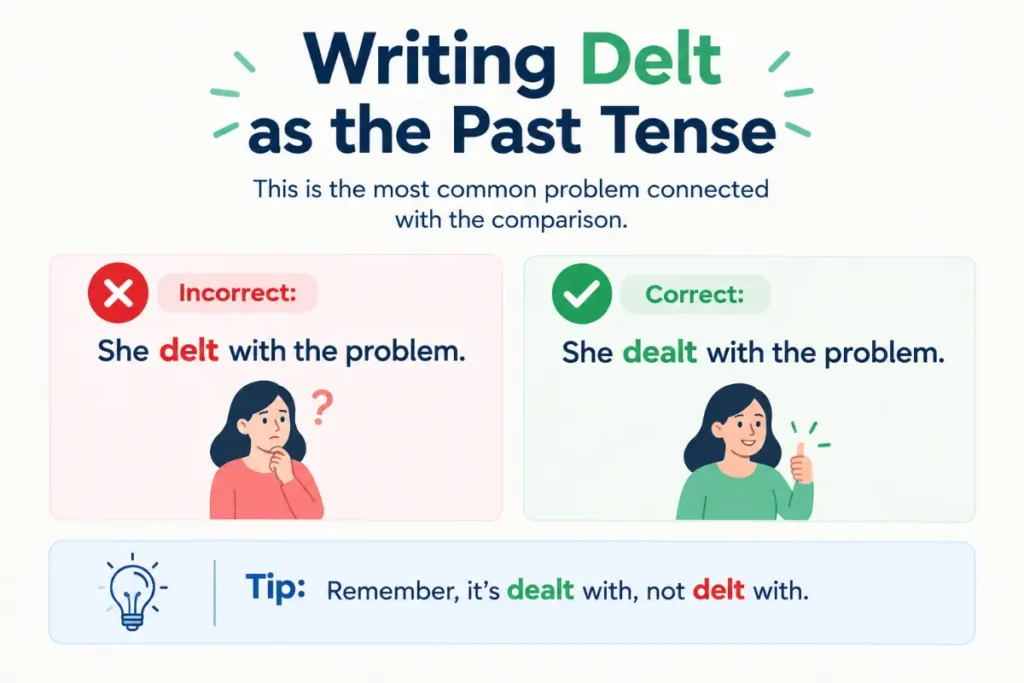
This is the most common problem connected with the comparison.
Incorrect:
She delt with the problem.
Correct:
She dealt with the problem.
The mistake happens because the pronunciation doesn’t clearly reveal the spelling. The word sounds like delt even though standard spelling uses dealt.
Writing Dealed Instead of Dealt
Some learners assume that deal follows the regular pattern of adding ed.
Incorrect:
He dealed with the issue.
Correct:
He dealt with the issue.
Deal is irregular. You need to memorize its past form instead of creating one with the regular ed ending.
Confusing Delt With Deltoid
In fitness writing delt can be a legitimate informal noun.
His rear delt was sore.
Here delt isn’t a spelling mistake. It’s a shortened form of deltoid.
The surrounding context provides the clue.
Assuming Historical Forms Are Modern Alternatives
You may find delt in older English material. Historical spelling doesn’t automatically equal modern standard spelling.
Language changes over time. A form that appears in older texts can disappear from everyday modern usage.
Relying Only on Pronunciation
This is a broader spelling trap. Dealt and delt sound alike in modern English. If you spell entirely from sound you can easily choose the wrong written form.
A better habit is to connect the form with the base verb deal. When you mean the past form of that verb remember deal becomes dealt.
Pronunciation Guide
Dealt is pronounced /dɛlt/.
A simple pronunciation guide is:
delt
It sounds like the word delt that appears in informal fitness language.
The vowel is the same short vowel heard in words such as bed and help for many American speakers. The word has one syllable.
The stress pattern is therefore simple because there is only one syllable.
Delt is also pronounced /dɛlt/ when it means deltoid. Dictionaries list this informal noun with the same basic pronunciation.
This creates a genuine homophone situation. You can hear the word and still not know which spelling the writer needs.
For example:
I dealt with the problem.
I trained my delt.
The two forms sound the same but perform different jobs.
This is why context matters so much. English spelling often preserves information that pronunciation doesn’t reveal.
Etymology and Word Origin
The history of deal reaches deep into the Germanic branch of English. The Oxford English Dictionary material describes deal as a word inherited from Germanic and connects it with Old English dǣlan and related Germanic forms associated with dividing or sharing.
The modern meaning developed across several related ideas. To deal could involve dividing something into portions. That idea fits naturally with dealing cards because cards are distributed among players. The verb later developed broader meanings involving handling situations doing business and giving something to someone.
The past form also went through spelling changes. Historical records include forms such as dǣlde and later delt along with several other spellings before dealt became established in modern English.
That history is useful because it shows that delt isn’t an invented form. It has a real place in the history of English. The important distinction is that historical existence doesn’t make a form the standard choice for modern writing.
The modern noun delt has a different development. It is a shortening of deltoid and is used informally for the shoulder muscle. Merriam Webster lists delt as an informal noun meaning deltoid and dates its first known use in that sense to the twentieth century.
Regional Usage
American English
American English uses dealt as the standard past tense and past participle of deal. You’ll see it in everyday conversation professional writing school assignments journalism and formal documents.
Delt also appears in American English as an informal fitness term for deltoid. You might hear someone at a gym talk about training their delts. That use is separate from the verb form.
British English
British English also uses dealt as the standard past form of deal. There is no modern British spelling rule that changes dealt to delt.
Delt can appear in British English as an informal term for deltoid. Collins lists this noun in British English and identifies it as an informal word for the muscle.
Australian English
Australian English follows the standard modern pattern with dealt as the past form of deal. The pronunciation remains close to /dɛlt/.
Delt may appear in fitness language because the informal noun is used across English speaking communities. It doesn’t replace dealt as the verb.
Canadian English
Canadian English also uses dealt as the standard past tense and past participle of deal. The spelling doesn’t change simply because the speaker is Canadian.
As in other English varieties delt can appear in informal fitness contexts as a shortened form of deltoid. That meaning is separate from the historical verb spelling.
Grammar Rules and Part of Speech
Dealt is a verb form. More specifically it can function as either the simple past tense or the past participle of deal.
Simple Past
Use dealt for an action completed in the past.
She dealt with the complaint yesterday.
The manager dealt with the issue quickly.
They dealt the cards before the game started.
The action happened in the past and is presented as complete.
Present Perfect
Use dealt after have or has.
I have dealt with this problem before.
She has dealt with similar cases.
The form doesn’t change after the auxiliary verb.
Past Perfect
Use dealt after had.
They had dealt with the issue before the meeting began.
The past perfect places one past action before another past event.
Passive Constructions
Dealt can also appear in passive structures.
The problem was dealt with quickly.
The cards were dealt to the players.
The complaint has been dealt with.
This pattern is especially common with deal with. The phrase means to handle address or manage something.
Common Prepositions
The most familiar pattern is deal with.
We need to deal with this issue.
She dealt with the customer politely.
Deal in has a different meaning. It means to buy sell or conduct business involving something.
The company deals in imported furniture.
Deal out can mean distribute.
The dealer dealt out the cards.
These combinations are worth learning as complete phrases because the preposition changes the meaning.
Real Life Usage Examples
Daily Conversation
In everyday speech dealt often appears in discussions about problems experiences and past events.
I dealt with that issue yesterday so you don’t need to worry about it.
She dealt with the situation much better than I expected.
The word sounds completely natural in both sentences. It doesn’t make the conversation formal or stiff.
Email and Workplace Communication
Professional writing frequently uses dealt when discussing completed tasks.
The support team dealt with the customer request this morning.
We have dealt with the main concerns and can now move forward.
The form works well in workplace communication because it clearly describes completed action.
Academic Writing
Academic writing may use dealt when describing how a study article or argument addressed a topic.
The first section dealt with the historical background of the issue.
The researchers dealt with several limitations in their discussion.
In formal writing you may also see addressed used as a synonym. Still dealt with is perfectly grammatical when it fits the context.
News Writing
News reports often use dealt when describing events decisions and consequences.
The committee dealt with the issue during a closed meeting.
The new rule dealt a major blow to the industry.
The expression dealt a blow is especially common in journalism because it describes a strong negative effect in a compact way.
Literature and Storytelling
Storytellers use dealt to describe actions and difficult experiences.
The stranger dealt the cards without saying a word.
Life had dealt him a difficult hand.
The second example uses a metaphor. It compares life to a card game where people receive cards they didn’t choose. The expression has become a familiar way to describe difficult circumstances.
Related and Confused Terms
Deal
Deal is the base form of the verb. It can mean handle distribute give or conduct business.
I deal with customer questions every day.
Dealing
Dealing is the present participle and gerund form.
She is dealing with a difficult situation.
Deal With
Deal with means handle address or manage something.
We need to deal with this problem now.
Deal In
Deal in means buy sell or conduct business involving something.
They deal in rare books.
Deal Out
Deal out can mean distribute something.
She dealt out the cards.
Deltoid
Deltoid is the full anatomical term for the large shoulder muscle.
The exercise works the deltoid muscles.
Delt
Delt is an informal shortened form of deltoid.
His left delt is stronger than his right.
Handled
Handled is a useful synonym for dealt with when the meaning is to manage or address a situation.
She handled the complaint professionally.
These related forms help clarify why context matters. A reader who sees delt in a fitness discussion may understand it immediately. A reader who sees I delt with the problem will recognize the intended meaning but should still expect dealt in standard modern writing.
Why The Spelling Causes Confusion
The biggest reason is pronunciation.
Dealt is pronounced /dɛlt/. The spelling includes a but the sound doesn’t give you a clear reason to write it. This is common in English. Written forms often preserve historical spelling patterns that aren’t fully transparent from modern pronunciation.
There is also a visual temptation to write the word exactly as it sounds. If someone says delt and you type quickly you may naturally enter delt.
The historical record adds another layer. Delt was actually used as an older spelling of dealt. That means the incorrect modern form isn’t completely random. It has a genuine history in English.
Still the modern rule is straightforward. Use dealt when you’re writing the past tense or past participle of deal.
Another source of confusion is the modern noun delt. People who have encountered delt in bodybuilding or fitness content may assume it can also work as the verb form. It can’t.
Think of the two words as separate entries that happen to sound alike.
Dealt With Versus Dealt
One of the most useful patterns to learn is dealt with.
When deal with means handle or address something the past form is dealt with.
I dealt with the problem.
She dealt with the complaint.
They dealt with the situation.
The phrase doesn’t become delt with in standard modern English.
You can also use dealt with in perfect constructions.
I have dealt with this before.
We had dealt with the issue already.
The passive form is also common.
The matter was dealt with quickly.
This phrase appears frequently in professional communication. Still you don’t need to avoid it simply because it is common. Choose it when the meaning is accurate.
Dealt In Versus Dealt With
These two expressions are easy to confuse because the preposition changes the meaning.
Dealt with usually means handled or addressed.
The manager dealt with the complaint.
Dealt in usually refers to business involving a particular product or category.
The store dealt in antiques.
The distinction becomes clear once you look at the object that follows the phrase. A complaint is something you handle. Antiques can be something a business buys and sells.
The same base verb can therefore support different meanings through different constructions.
Dealt In Card Games
Another important meaning involves cards.
The dealer dealt five cards to each player.
Here dealt means distributed cards.
You can also use dealt with an indirect object.
She dealt him three cards.
The verb describes the act of distributing cards to players.
This meaning is closely connected with the older sense of dividing or distributing something into portions. That historical connection helps explain why deal has such a wide range of modern meanings.
Dealt A Blow
Another common expression is dealt a blow.
The announcement dealt a blow to the company.
The injury dealt a serious blow to his career.
Here dealt means caused or delivered a strong negative effect.
The phrase is common in journalism and formal writing. It often creates a vivid image because it treats a setback like a physical blow.
You don’t need to understand the phrase literally to use it correctly. It has become an established figurative expression.
Expert Editor Insight
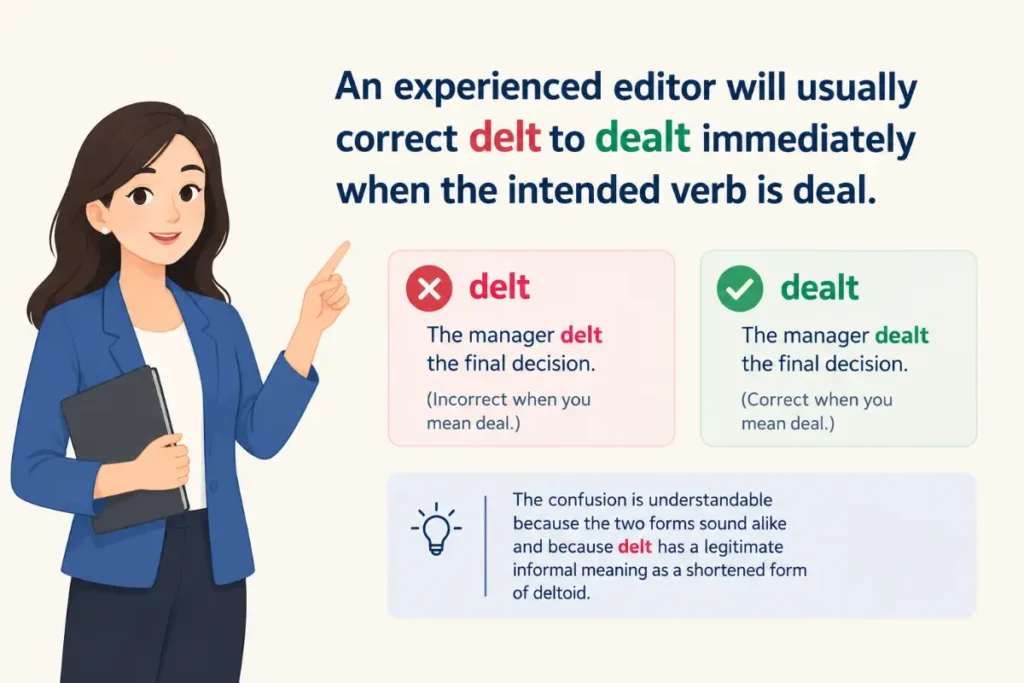
An experienced editor will usually correct delt to dealt immediately when the intended verb is deal. The confusion is understandable because the two forms sound alike and because delt has a legitimate informal meaning as a shortened form of deltoid. A useful proofreading trick is to identify the grammatical role before checking the spelling. If the word describes something someone handled distributed or gave in the past it needs to connect back to the verb deal and should appear as dealt. Modern spelling tools will generally recognize dealt as the standard verb form while treating delt according to its separate informal noun sense.
Conclusion
dealt vs delt has a straightforward answer for standard modern English. Use dealt as the past tense and past participle of deal. Delt isn’t the standard modern verb form even though historical English used it and modern English uses delt informally for a deltoid muscle.
The pronunciation creates most of the confusion because dealt and the modern noun delt sound the same. That makes spelling from sound unreliable. Context provides the key. If you’re talking about handling a problem distributing cards or giving something in the past you’re using the verb deal and its correct past form is dealt.
The easiest editing trick is to remember the pair deal and dealt. If the sentence needs the past form of that verb write dealt. Save delt for its separate informal muscle meaning or historical contexts.
FAQs
Is delt a real English word?
Yes. Delt is a real English word in at least one modern informal sense. It is used as a shortened form of deltoid meaning the shoulder muscle. Historical English also contains delt as an older spelling of dealt. However that historical form isn’t the normal spelling of the verb in modern English. Use dealt for the past tense and past participle of deal.
Is delt the past tense of deal?
No. The standard modern past tense of deal is dealt. The same form also serves as the past participle. Delt appeared as a historical spelling in earlier English but it isn’t the standard modern form. If you’re writing about something you handled or distributed in the past use dealt.
How do you pronounce dealt?
Dealt is pronounced /dɛlt/. It has one syllable and sounds like delt. The pronunciation doesn’t clearly reveal the spelling because the written a doesn’t create a separate vowel sound. This makes the word an easy spelling trap. Learning the pronunciation together with the base form deal can help you remember that the standard past form is dealt.
Why is deal changed to dealt?
Deal is an irregular verb so it doesn’t form its past tense by simply adding ed. Its standard past tense and past participle are dealt. The form developed through the historical changes of English and has been established in modern standard usage. You should learn deal and dealt as a pair rather than trying to create the past form with a regular verb rule.
Can delt mean a shoulder muscle?
Yes. In informal fitness language delt is a shortened form of deltoid. You may see singular delt when someone refers to one shoulder muscle and plural delts when referring to both or to the muscle group generally. This use is separate from the verb deal. Merriam Webster identifies delt as an informal noun meaning deltoid.
Is dealt formal or informal?
Dealt is neutral and works across a wide range of contexts. You can use it in everyday conversation professional emails academic writing journalism and formal documents. The expression dealt with is especially common when talking about handling a problem. You don’t need a more formal replacement simply because the context is professional. Choose a different word only when it gives you a more precise meaning.
What is the difference between dealt and dealt with?
Dealt is the past form of deal and can have several meanings. Dealt with is a common phrasal construction meaning handled addressed or managed something. For example She dealt the cards describes distribution while She dealt with the complaint describes handling a problem. The word stays the same but the surrounding construction changes the meaning.
How can I remember the correct spelling?
Connect the past form to the base verb. Think deal then dealt. If you mean handled distributed or gave something in the past you need dealt. Keep delt separate in your mind because it can refer informally to a deltoid muscle. This simple context based check is more reliable than trying to guess the spelling from pronunciation.
