
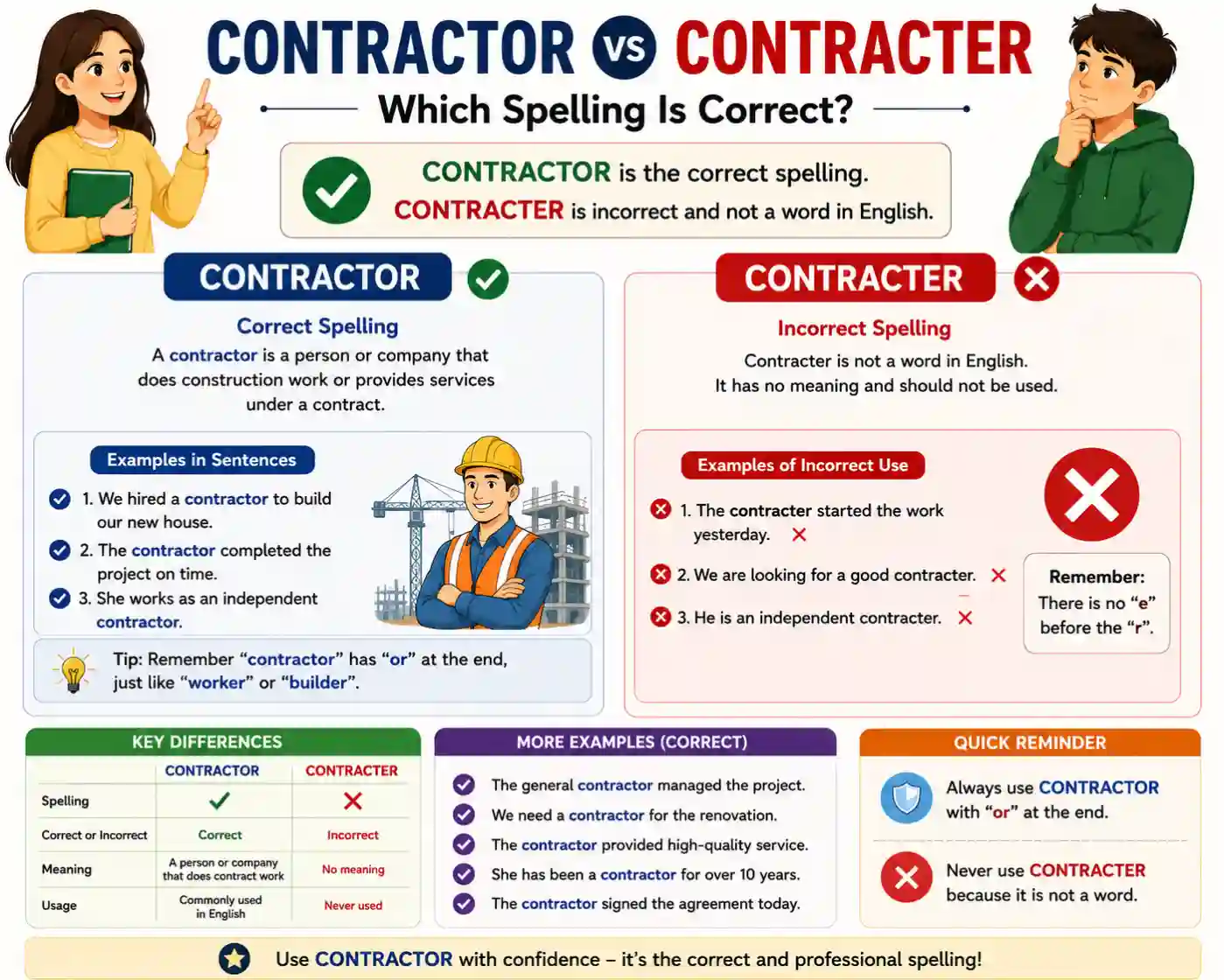
If you’re comparing contractor vs contracter because you’re unsure which spelling to use you’re looking for contractor. The spelling with or is the standard English form. Contracter is generally a misspelling caused by the way the base word contract looks and sounds.
The confusion makes sense. English often forms nouns with endings such as er and or and the choice isn’t always obvious from pronunciation alone. In this case the established noun is formed with contractor.
This guide explains what contractor means how to pronounce it why contracter causes confusion and how to use the correct form naturally in everyday speech professional writing business communication and formal English. You’ll also see practical examples and simple ways to remember the spelling.
Quick Answer
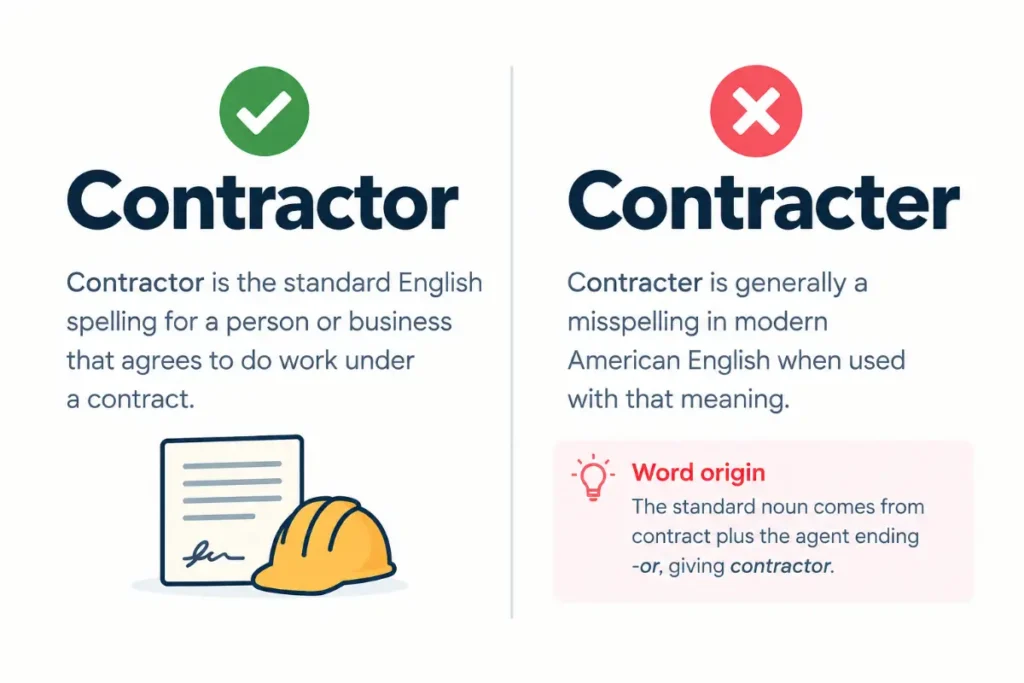
Contractor is the correct standard spelling. It means a person or company hired under a contract to provide work services materials or expertise. Contracter is not the standard spelling of this noun. If you’re writing an email resume report agreement or other formal text use contractor.
The Correct Spelling At A Glance
The answer is straightforward.
Contractor is correct.
Contracter is generally incorrect.
The accepted noun comes from contract plus the agent ending or. The word has been established in English for centuries and its spelling remains consistent across standard English varieties.
That gives you a useful rule for real world writing. If you mean a person or company that agrees to perform work under a contract write contractor.
For example:
- We hired a contractor to remodel the kitchen.
- The contractor finished the project ahead of schedule.
- She works as an independent contractor.
- The company selected a contractor for the construction project.
You wouldn’t normally write contracter in these sentences.
Comparison Table
| Form | Meaning | Part of Speech | Origin | Usage | Formality | Common Contexts | Example |
|---|---|---|---|---|---|---|---|
| Contractor | A person or company that performs work or provides goods or services under a contract | Noun | Related to Late Latin | Standard and established | Formal and informal | Construction business IT services government work consulting | The contractor completed the repairs. |
| Contracter | Not the standard noun spelling | Nonstandard form | Not the accepted formation of the word | Generally treated as a spelling error | Avoid in formal writing | Typing and spelling mistakes | Use contractor instead. |
The important point is that this isn’t a difference in meaning. You aren’t choosing between two valid English nouns with separate definitions. You’re choosing between the established spelling and a common misspelling.
What Contractor Means
A contractor is a person or company that agrees to perform work or provide goods or services under a contract.
The word has several common uses.
Construction Contractor
This is probably the meaning most people think of first.
A construction contractor may manage or perform building work such as remodeling roofing electrical work plumbing or general construction.
For example:
We hired a contractor to build the new garage.
A general contractor can take responsibility for a larger building project and may hire subcontractors to handle specialized work.
Independent Contractor
The word also appears frequently in employment and business settings.
An independent contractor provides services to a company or client without being treated as a regular employee of that organization. The exact legal meaning and tax treatment can depend on the circumstances and applicable law.
For example:
Maria works as an independent contractor for several companies.
Government Contractor
Government agencies also work with contractors that provide services materials technology security support construction and other forms of professional work.
For example:
The government awarded the project to a private contractor.
Business Contractor
The term isn’t limited to construction.
A company might hire a contractor for software development consulting marketing design maintenance accounting or technical services.
For example:
The company brought in a contractor to update its database.
That broader meaning matters because some people associate contractor only with construction. The word is much wider than that.
Why Contracter Looks Correct To Many People
The misspelling is understandable because English spelling doesn’t always follow a simple formula.
A reader sees contract and may naturally think:
contract + er = contracter
That pattern works for many English words.
Consider words such as:
- Teach becomes teacher.
- Drive becomes driver.
- Work becomes worker.
- Build becomes builder.
So someone who writes contracter may simply be applying a familiar spelling pattern.
The problem is that English also uses different noun forming endings. The established form here is contractor.
The ending or appears in many words connected to people who perform an action or function.
Examples include:
- Actor.
- Creator.
- Operator.
- Director.
- Inspector.
- Administrator.
- Contractor.
You don’t need to memorize a complicated linguistic rule to use the word correctly. The safest approach is simply to remember the established spelling contractor.
Why The Spelling Uses Or
The spelling has a historical explanation.
The noun developed from a form related to Latin contractor and ultimately connects with the Latin verb contrahere. The historical ending helped give English the modern form contractor.
The important point for everyday writing is simple. The word has an established spelling that uses or.
That history also explains why changing or to er doesn’t create the standard English noun.
Pronunciation Guide
The pronunciation of contractor can vary slightly across English varieties.
A simple American pronunciation guide is:
KON trak ter
The main stress usually falls on the first syllable in American English.
British pronunciation can place the stress differently and the vowel sounds can also vary. Still the spelling remains the same.
This difference can contribute to confusion because spoken English doesn’t clearly reveal the final spelling.
The ending sounds like ter in common American speech. But hearing a ter sound doesn’t mean the word should end in ter. English spelling often preserves forms that aren’t obvious from pronunciation.
Think of pronunciation as a guide rather than a perfect spelling map.
Is Contracter A Real Word?
For ordinary modern English use the answer is no as the standard spelling of this noun.
You may encounter contracter online because people make spelling mistakes. Seeing a spelling in written material doesn’t automatically make it a standard English word.
There’s an important distinction here.
A word can appear in writing without being standard English. Misspellings are everywhere. A form becomes part of standard vocabulary through established usage rather than simply because someone has typed it.
For normal writing use:
contractor
Avoid:
contracter
This is especially important in resumes business documents contracts reports websites professional profiles and academic work.
Which Form Is Correct?
Contractor is the correct form.
The reason is historical and lexical. English developed the noun from a form related to Latin contractor. Modern standard English uses contractor for a person or company that works under a contract.
Contracter doesn’t serve as the standard alternative spelling.
If your spell checker marks contracter as an error you should normally accept the correction to contractor.
That’s not simply a preference between American and British English. The standard spelling is used across major English varieties.
Sentence Examples
Here are ten examples showing how contractor works in different situations.
- We hired a contractor to renovate the bathroom.
- The contractor said the repairs should take about two weeks.
- She works as an independent contractor for several technology companies.
- Our contractor sent the final invoice on Friday.
- The school hired a contractor to repair the heating system.
- Please contact the contractor if you notice any problems with the installation.
- The company plans to bring in an outside contractor for the project.
- The contractor explained each stage of the construction process before work began.
- My neighbor recommended a reliable contractor who specializes in kitchen remodeling.
- The research team hired a contractor to manage the technical work.
Notice how the word fits naturally into construction business employment and professional contexts. Its meaning comes from the surrounding sentence.
Common Spelling Mistakes
The biggest mistake is simple.
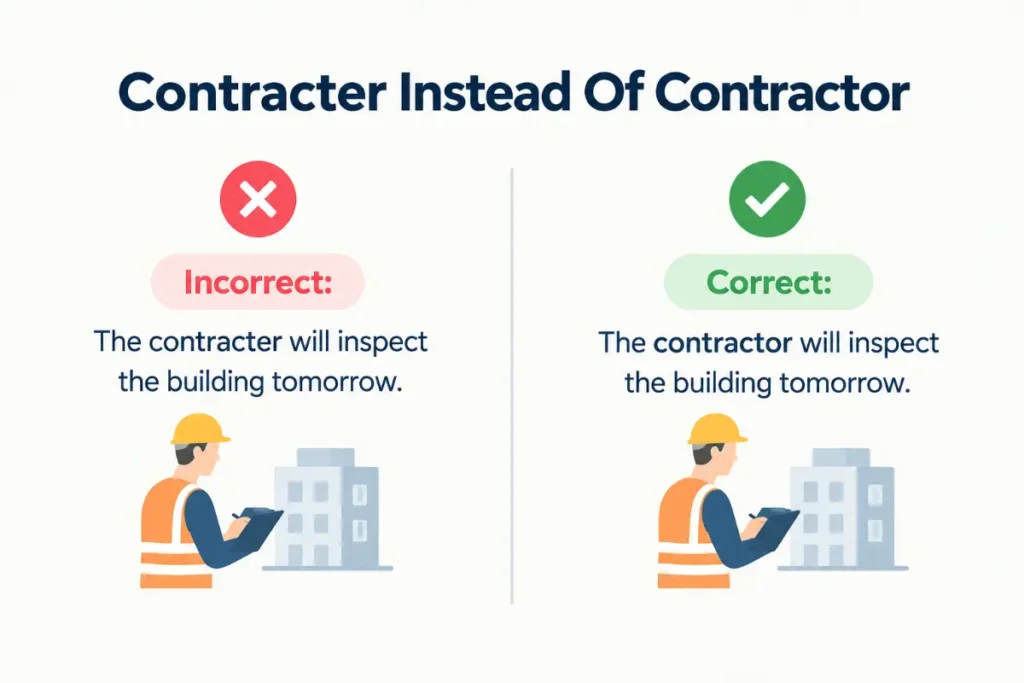
Contracter Instead Of Contractor
Incorrect:
We hired a contracter to repair the roof.
Correct:
We hired a contractor to repair the roof.
The error happens because er is a familiar ending for nouns describing people who perform actions.
Contracter In Professional Documents
Some writers may use the misspelling in a resume or business proposal without noticing it.
Incorrect:
Experienced contracter with ten years of construction experience.
Correct:
Experienced contractor with ten years of construction experience.
A spelling checker can catch this in many situations but you shouldn’t rely on software alone.
Contracters Instead Of Contractors
The plural of contractor is contractors.
Incorrect:
The company hired three contracters.
Correct:
The company hired three contractors.
The same spelling rule applies to both the singular and plural forms.
Contractor Confused With Contract
These words are related but they don’t serve the same grammatical role.
A contract is an agreement.
A contractor is a person or company that works under a contract.
For example:
We signed a contract with the contractor.
That sentence uses both words correctly.
Contractor Confused With Subcontractor
A subcontractor is a contractor hired by another contractor or organization to perform part of a larger project.
For example:
The general contractor hired a plumbing subcontractor.
These terms are related but they aren’t interchangeable in every context.
American English Usage
In American English contractor is the standard spelling.
The word is common in construction business employment technology government contracting and many other professional settings.
You’ll see phrases such as:
- General contractor.
- Independent contractor.
- Building contractor.
- Electrical contractor.
- Government contractor.
- Outside contractor.
- Private contractor.
The spelling doesn’t change to contracter in American English.
British English Usage
British English also uses contractor.
The pronunciation can differ from American English. British speakers may use different vowel sounds and stress patterns but the spelling remains the same.
British usage commonly includes phrases such as building contractor and independent contractor.
So there’s no American versus British spelling issue here.
You don’t need one version for the United States and another for the United Kingdom.
Use:
contractor
Australian And Canadian English
Australian and Canadian English also use contractor as the standard spelling.
The same basic noun appears in professional contexts involving construction services business work and contract based employment.
The main takeaway is simple. This isn’t a regional spelling pair. Contractor is the established form across major varieties of standard English.
Contractor And Contract
The relationship between these words can make the spelling easier to remember.
A contract is an agreement.
A contractor is someone who enters into or works under a contract.
Consider this sentence:
The company signed a contract with the contractor.
The two words belong together but they have different jobs.
Contract names the agreement.
Contractor names the person or company connected to that agreement.
That connection gives you a useful memory trick.
Think:
contract → contractor
The standard noun ends in or.
Contractor And Contract Worker
A contract worker is someone who works for an organization for a defined period or under a particular work arrangement.
A contractor can be an individual who provides services or a company that supplies workers or services.
These terms can overlap but they aren’t always identical.
For example:
The company hired an independent contractor.
And:
The company hired a contract worker for six months.
The exact legal or employment distinction depends on the arrangement. In ordinary conversation the terms may sometimes appear close in meaning but professional documents should use the term that accurately describes the relationship.
Contractor And Subcontractor
These words are closely related.
A contractor may take responsibility for an entire project.
A subcontractor may be hired to handle a specific portion of that project.
Imagine a home renovation.
The general contractor may coordinate the entire renovation. The general contractor could then hire a plumbing subcontractor and an electrical subcontractor.
So:
Contractor can refer to the main service provider.
Subcontractor usually refers to someone working under another contractor’s agreement.
The distinction matters in construction and other project based industries.
Related Terms You Should Know
Several words commonly appear near contractor.
Contract
A contract is an agreement between parties.
We signed the contract yesterday.
Contractual
Contractual is an adjective meaning related to a contract.
The company has contractual obligations to its clients.
Contracting
Contracting can refer to the act or business of working under contracts.
The company specializes in government contracting.
Contractor
A contractor is a person or company that provides work goods or services under a contract.
The contractor completed the installation.
Subcontractor
A subcontractor performs part of a project under an arrangement with another contractor.
The contractor hired a subcontractor for the electrical work.
General Contractor
A general contractor typically manages a construction project and coordinates subcontractors.
The general contractor handled the entire renovation.
Independent Contractor
An independent contractor provides services independently rather than working as a regular employee.
She works as an independent contractor.
Contract Worker
A contract worker works for an organization under a specific contract or limited term arrangement.
The company brought in a contract worker for the busy season.
These terms form a useful vocabulary group. Learning them together can make professional English much easier to understand.
How To Remember The Correct Spelling
If you regularly confuse contractor with contracter use a simple memory trick.
Think of the ending as or.
contract + or = contractor
You can also connect it to other familiar words:
actor
operator
creator
director
contractor
This isn’t a universal rule for every English noun. It’s simply a useful spelling memory aid for this particular word.
Another trick is to remember the phrase independent contractor. It’s one of the most common combinations in American professional English.
Once your brain gets used to seeing the pair together the spelling becomes much easier to recall.
Real Life Usage Examples
The word appears naturally in many areas of communication.
Daily Conversation
People often use the word when discussing home repairs and services.
Do you know a good contractor who can fix the kitchen?
The contractor is coming tomorrow morning.
These examples sound natural in everyday American conversation.
Workplace Communication
In an office setting the word may describe an outside professional or temporary service provider.
The contractor needs access to the project files.
Please send the updated schedule to the contractor.
The tone is professional without sounding stiff.
Academic Writing
Academic writing may use the word when discussing construction business labor or organizational relationships.
The researchers examined how contractors managed project delays.
The study compared costs among several contractors.
The noun works like any other standard countable noun.
News And Journalism
News writing often uses contractor when reporting on construction government spending infrastructure or business activity.
The city selected a contractor for the road improvement project.
The company is one of several contractors working on the facility.
The term is precise and widely understood.
Storytelling
The word can also appear in personal stories and narratives.
The contractor walked through the house and pointed out the damage.
By noon the contractor had already removed the damaged flooring.
There’s nothing overly formal about the word. Context determines the tone.
Why Spelling Matters In Professional Writing
You might wonder if this mistake really matters because readers can usually understand what contracter means.
They probably can.
Still a correct spelling matters in professional communication.
Imagine reading a proposal from a construction company. The document says:
We are an experienced contracter with twenty years of industry experience.
The meaning is clear but the spelling error immediately looks unpolished.
Now compare:
We are an experienced contractor with twenty years of industry experience.
The second version feels cleaner and more professional.
That difference becomes even more important in resumes proposals websites business profiles reports and formal correspondence.
Correct spelling builds trust quietly. Readers may never consciously think about it but polished language makes communication easier to take seriously.
Is Contractor A Noun Or An Adjective?
Contractor is primarily a noun.
It refers to a person company or entity.
For example:
The contractor submitted the proposal.
However English often allows nouns to modify other nouns. This can make a noun appear to function like an adjective.
Consider:
contractor agreement
Here contractor modifies agreement.
The word itself remains a noun even though it helps specify the type of agreement.
The same pattern appears in phrases such as:
contractor license
contractor insurance
contractor services
contractor network
This is normal English noun modification.
Can Contractor Start A Sentence?
Yes.
There is no grammatical rule preventing contractor from appearing at the beginning of a sentence.
For example:
Contractor services can vary greatly by industry.
Contractor fees depend on the type and scope of the work.
Contractor selection should reflect the needs of the project.
The key is simply to capitalize the word because it begins the sentence.
Can You Use Contractor In A Resume?
Yes.
It’s a common professional term and works naturally in resumes.
For example:
Independent Contractor
General Contractor
Construction Contractor
You might also write:
Worked as an independent contractor providing technical support to small businesses.
The exact wording should reflect your actual role and work arrangement.
Can Contractor Be Used For A Company?
Yes.
A contractor can be an individual or a company.
For example:
We hired a contractor to install the new equipment.
That contractor could be a single professional or a business with several employees.
This broad meaning is why the word appears so often in business English.
Why People Search For The Two Spellings
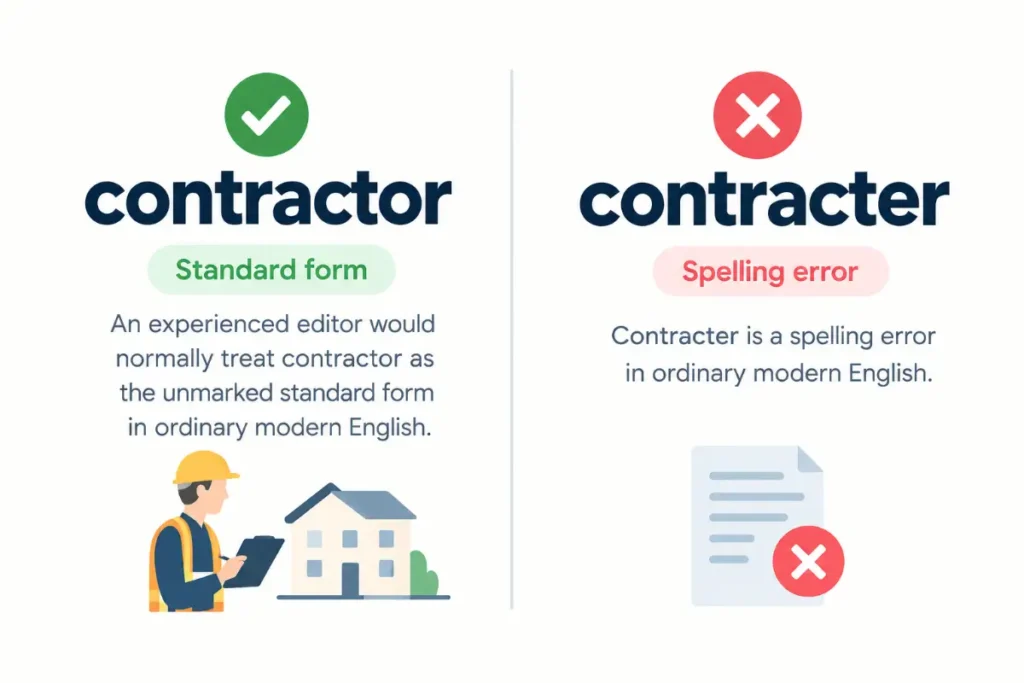
Searches comparing contractor and contracter usually come from spelling uncertainty rather than a deep grammar question.
The two forms look close.
They also sound close in everyday speech.
And English has many nouns ending in er.
That combination creates a perfect recipe for a spelling mistake.
The good news is that you don’t need to memorize a long grammar rule. Just remember that the standard noun is contractor.
If you’re writing quickly and hesitate for a second think of:
contract + or
That should point you in the right direction.
Conclusion
Contractor vs contracter has a clear answer. Contractor is the correct standard spelling for a person or company that performs work or provides goods and services under a contract. Contracter is generally a misspelling and should be avoided in standard English.
The spelling can feel tricky because English often uses er to form nouns for people who perform actions. In this case the established form uses or. Remembering the connection between contract and contractor makes the spelling much easier to recall.
A simple memory trick is contract + or = contractor. If you’re writing a resume email report proposal or formal document and you pause over the spelling choose contractor. That small choice keeps your writing accurate polished and professional.
FAQs
Is contracter a correct English word?
No. Contracter is not the standard spelling for the noun referring to a person or company that performs work under a contract. The accepted form is contractor. You should use contractor in professional writing academic work resumes business communication and everyday English.
Which is correct contractor or contracter?
Contractor is correct. The word developed from a historical form related to Latin contractor and has been established in English for centuries. Contracter is generally a misspelling created by applying the common er ending found in words such as worker and teacher.
What does contractor mean?
A contractor is a person or company that agrees to provide work goods or services under a contract. The term is common in construction but it also applies to independent professionals companies government service providers and many other types of work.
How do you pronounce contractor?
In American English contractor is commonly pronounced roughly like KON trak ter. The main stress usually falls on the first syllable. British pronunciation differs somewhat and may place stress differently. The spelling remains contractor in both major varieties.
Is contractor appropriate in formal writing?
Yes. Contractor is completely appropriate in formal and professional writing. You can use it in contracts business reports resumes proposals workplace emails academic writing and government documents. It is a standard English noun rather than a slang or informal expression.
What is the plural of contractor?
The plural is contractors. You simply add s to the singular noun. For example: The company hired three contractors for the project. The misspelled form contracters should be avoided because it carries the same spelling error as contracter.
Why do people spell contractor as contracter?
The mistake probably comes from a familiar English spelling pattern. Many nouns describing people end in er such as teacher and worker. Because contract looks like a natural base for an er noun some writers produce contracter. The established English form however uses or.
Is contractor the same as subcontractor?
Not always. A contractor can be responsible for providing work or managing a project. A subcontractor usually performs part of a project under an arrangement with another contractor. For example a general contractor might hire an electrical subcontractor to handle electrical work. The exact relationship depends on the project and agreement.
