
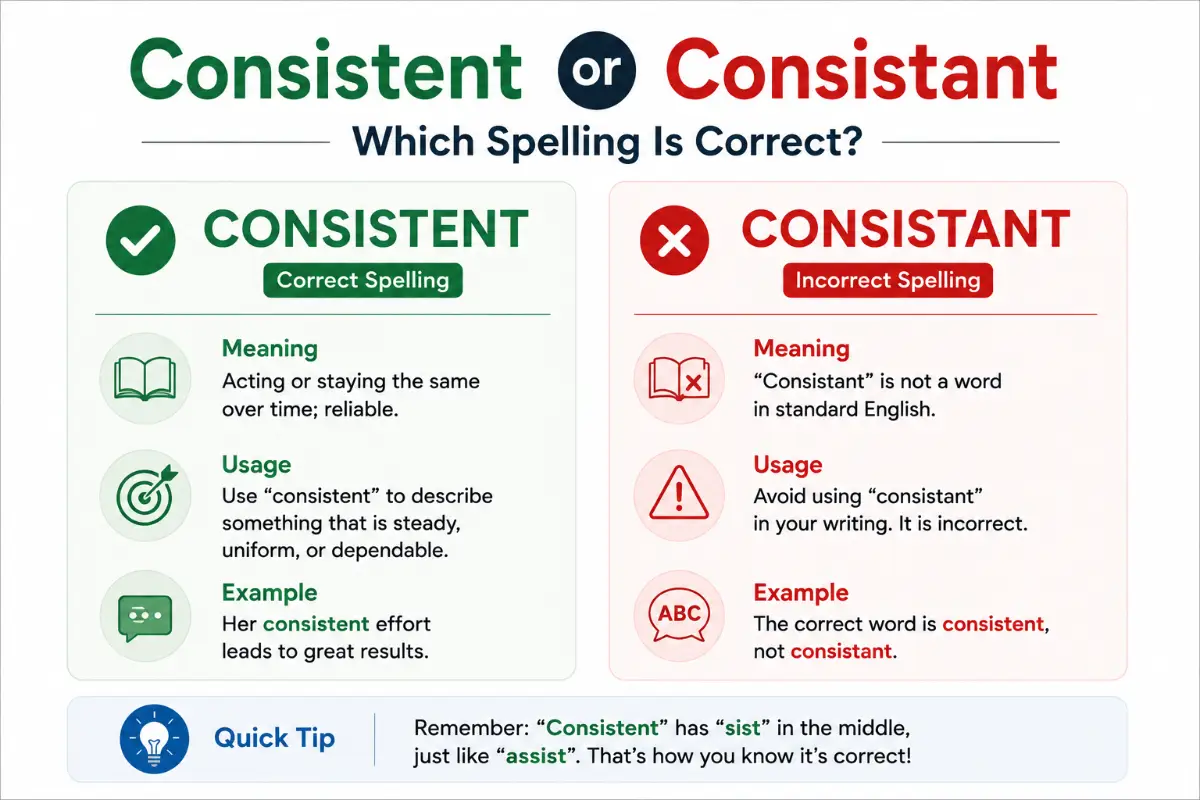
If you’re searching for consistent or consistant because the two forms look almost identical, the answer is simple. Consistent is the correct spelling in standard English. Consistant is a common misspelling and should not be used in normal English writing. Merriam Webster lists consistent as an adjective meaning steady or marked by regularity and agreement.
The confusion makes sense because the final sound can make the spelling feel less obvious than it looks on the page. English has many familiar words ending in ant such as important and assistant. That pattern can tempt writers to spell this word with an a. The standard form uses ent instead.
This guide gives you the answer first and then shows how the word works in real sentences. You’ll learn its meaning, pronunciation, grammar, word history, common mistakes, related terms, and a few easy ways to remember the correct spelling.

Quick Answer
Consistent is the correct spelling. Consistant is a common misspelling of the adjective consistent. Use consistent when you mean steady, regular, reliable, compatible, or unchanged in a relevant way. The same spelling is used in American English and British English.
The Correct Spelling
The correct form is consistent.
The incorrect form is consistant.
The difference is only one letter, but that letter matters. The standard English spelling ends with ent, not ant.
Think of the word as:
consist + ent = consistent
This spelling connects naturally with the related word consistency. It also belongs to a larger family that includes consistently and inconsistent.
The incorrect form can appear in typing, online posts, schoolwork, emails, and other informal writing. Its appearance in a sentence doesn’t make it a second accepted spelling. It is generally a spelling error. A dictionary resource that specifically tracks the form identifies consistant as a misspelling of consistent.
Comparison Table
| Form | Correct Form | Meaning | Part of Speech | Origin | Formality | Common Contexts | Example |
|---|---|---|---|---|---|---|---|
| consistent | Yes | Steady, regular, compatible, or showing little variation | Adjective | Latin through French and English development | Formal and informal | Work, school, behavior, quality, results, opinions | Her work has been consistent all year. |
| consistant | No in standard English | Common misspelling of consistent | Not a standard English adjective | Not the source of the standard English word | Avoid | Typing errors and spelling mistakes | The correct form is consistent. |
The table makes the central point clear. There is no standard English spelling choice between the two forms. If you mean the English adjective that describes something steady or compatible, choose consistent.
What Does Consistent Mean
Consistent is an adjective. It describes something that stays steady or follows the same general pattern. It can describe behavior, quality, results, opinions, actions, performance, temperature, or many other things.
For example, if someone studies for an hour every evening, you might describe that person as consistent. The idea is not that every detail must be identical. The focus is on a dependable pattern.
Consider these examples.
- She is consistent with her study routine.
- The restaurant provides consistent service.
- His grades have been consistent this semester.
- The results are consistent with the earlier findings.
- We need a more consistent approach.
The word can also describe agreement between two things. Merriam Webster gives senses related to harmony, compatibility, steady conformity, and continued development in the same way.
That broader meaning is useful because consistent does not always mean exactly the same.
If two statements are consistent, they do not conflict. If a person is consistent, their behavior tends to follow a recognizable pattern and If a product has consistent quality, customers can expect a similar standard from one purchase to another.
Meaning of the Incorrect Form
In standard English, consistant is not the spelling you should use for this adjective.
It is best understood as a misspelling of consistent. It often appears because the writer hears the word and chooses the ending that seems familiar.
This kind of mistake is common in English because spelling does not always follow pronunciation in a perfectly predictable way. Several words can sound similar while using different letter patterns.
For example, English has:
- important
- assistant
- resistant
- distant
- persistent
- consistent
The first group can make consistant look reasonable at a glance. But English spelling has to be learned word by word in many cases.
There is also an interesting linguistic detail. Consistant can appear in another language context. For example, French uses consistant as an adjective with meanings connected to thickness or substantial quality. That does not make it the standard English spelling of consistent.
For ordinary English writing, use consistent.
Meaning of the Correct Form
Consistent can carry several closely related meanings.
The first is steady or regular.
You might say:
Her performance has been consistent throughout the season.
This means her performance has remained at a similar standard.
The second is compatible or in agreement.
For example:
His explanation is consistent with the available evidence.
Here the word means that the explanation does not conflict with the evidence.
The third meaning involves behavior or character.
For example:
She has been a consistent supporter of the program.
This describes someone whose support has remained steady.
The word can also describe something that keeps developing or occurring in the same general way. Merriam Webster includes this sense in its current definition.
So the basic idea behind the word is stability or agreement. The exact meaning depends on the sentence.
Key Differences Explained
There is really only one spelling choice in standard English. Still, several useful differences are worth understanding.
Spelling
The standard spelling is:
consistent
The common misspelling is:
consistant
The key difference is the final vowel before the final consonant.
Meaning
Consistent has established meanings in English. Consistant does not serve as the standard English form of those meanings.
Part of Speech
Consistent is an adjective.
It modifies nouns or follows linking verbs.
Examples include:
- consistent results
- consistent effort
- consistent behavior
- The results are consistent.
- Her performance remains consistent.
Pronunciation
The correct word is pronounced approximately like kun SIS tunt in ordinary American English.
Merriam Webster gives the pronunciation as kənˈsi stənt.
Formality
Consistent works in both casual and formal English.
You can use it in a text message:
Try to stay consistent with your workouts.
You can also use it in academic or professional writing:
The findings were consistent with the original hypothesis.
Context
The word appears in many areas of life. You can talk about consistent behavior, consistent results, consistent quality, consistent effort, consistent temperatures, consistent opinions, or consistent standards.
Regional Usage
There is no American versus British spelling difference here. Standard English uses consistent in both varieties.
Which Form Is Correct
Consistent is correct. Consistant is incorrect in standard English.
The reason is simple. The established English adjective is consistent. Major English dictionary references recognize this spelling and define it as an adjective related to regularity, agreement, steadiness, and compatibility.
The spelling is also supported by the word’s history. Merriam Webster traces consistent to Latin consistent and the present participle of consistere. The word entered English with the spelling that developed into the modern form.
You don’t need to overthink the rule. If you are writing an email, essay, report, article, application, or social post, use consistent.
Sentence Examples
Here are natural examples showing how the word works in everyday English.
- She has been consistent with her morning routine.
- The team has delivered consistent results all season.
- Try to be consistent with your study schedule.
- His work is always consistent and dependable.
- We need consistent communication across the entire project.
- Her grades have shown consistent improvement.
- The color needs to remain consistent throughout the design.
- His explanation was consistent with the facts we already knew.
- Good habits become easier when you stay consistent.
- The teacher expects consistent effort from every student.
Notice that the word does not always mean perfect. Someone can produce consistent results that are average. Someone can also be consistently late. The word describes the pattern rather than automatically judging the quality.
That distinction matters.
For example:
He is consistent in his work.
This usually suggests reliability.
But:
He is consistently late.
This describes a reliable pattern that happens to be undesirable.
The adverb consistently makes this idea even clearer. It means something happens in a consistent manner or repeatedly in the same general way.
Common Mistakes and Misspellings
Consistant
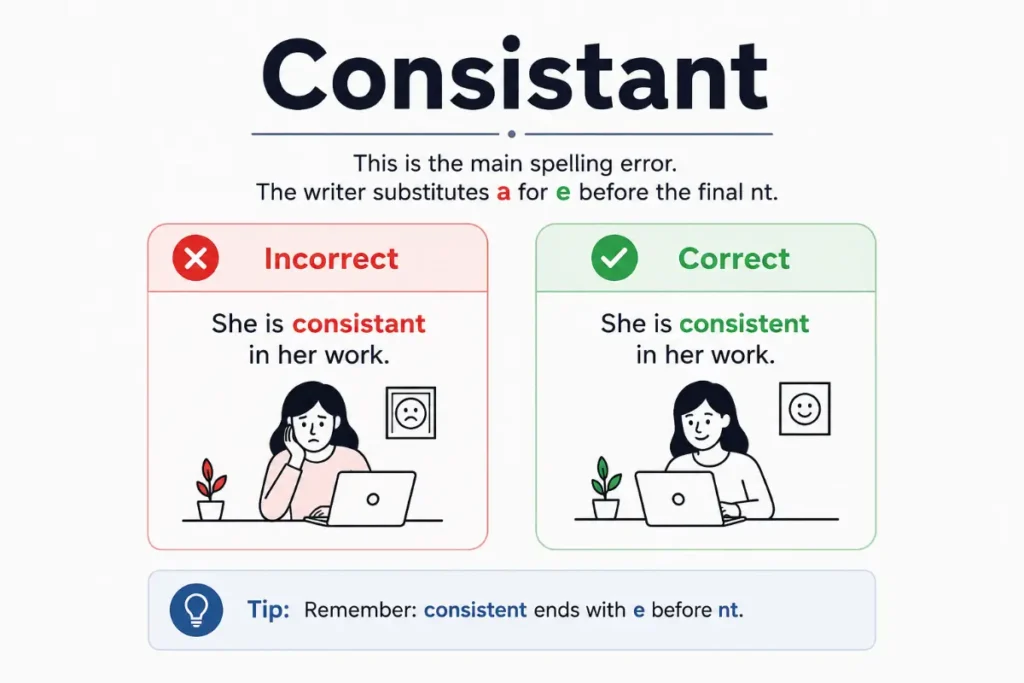
Incorrect: She is consistant in her work.
Correct: She is consistent in her work.
This is the main spelling error. The writer substitutes a for e before the final nt.
Consistancy
Incorrect: Consistency requires consistancy.
Correct: Consistency requires consistency.
The correct noun is consistency.
This mistake happens because writers may carry the incorrect a spelling into the related noun.
Consistantly
Incorrect: He consistently arrives early.
The spelling consistantly is incorrect.
The correct adverb is consistently.
Consitstent
Incorrect: The company provides consitstent service.
Correct: The company provides consistent service.
This is a typing error caused by rearranging letters in the middle of the word.
Consitent
Incorrect: Her performance has been consitent.
Correct: Her performance has been consistent.
This version drops the second s. It can happen when someone types quickly or remembers the general shape of the word without checking each letter.
These errors all point to the same lesson. Slow down for a second when a familiar word contains a spelling pattern that feels uncertain.
Pronunciation Guide
The standard pronunciation of consistent is approximately:
IPA: /kənˈsɪstənt/
A simple pronunciation guide is:
kuhn SIS tuhnt
The strongest stress falls on the second syllable.
You can divide the word roughly as:
con sis tent
In natural American speech, the first vowel is weak. That is why the beginning may sound closer to kuhn than a strong con.
The pronunciation does not give you a reliable clue about the final spelling. That is one reason people sometimes write consistant.
English contains many cases where the sound alone doesn’t tell you exactly which letters to choose. The safest approach is to learn the spelling as part of the word itself.
Say it.
consistent
Then spell it.
c o n s i s t e n t
The important part to remember is the ent ending.
Etymology and Word Origin
The history of consistent helps explain why the spelling has the form it does.
Merriam Webster traces the word to Latin consistent and consistens, the present participle of consistere. The Latin verb carried meanings connected with standing firm, remaining in a position, or being established in a particular state.
The word later developed through French and Latin usage before becoming established in English.
That historical connection fits the modern meaning surprisingly well. Something that is consistent stays in a stable state or agrees with something else.
Merriam Webster records the first known English use of consistent in 1638.
You don’t need the history to spell the word correctly, but it gives useful context. The standard English form developed with ent, not ant.
Regional Usage
American English
Consistent is the standard spelling in American English.
It is common in everyday conversation, workplace communication, school writing, journalism, academic writing, and many other settings.
Examples include:
We need consistent results.
She has been consistent with her training.
The evidence is consistent with his explanation.
British English
British English also uses consistent.
There is no standard British spelling consistant for this adjective.
So if you’re writing for readers in the United States or the United Kingdom, the spelling stays the same.
Australian English
Australian English also uses consistent as the standard form.
There is no relevant spelling change involving consistant.
Canadian English
Canadian English uses consistent as well.
This is one of those words where the major English varieties agree on the spelling.
Grammar Rules and Part of Speech
Consistent is an adjective.
That means it normally describes a noun or acts as a subject complement after a linking verb.
Before a Noun
You can place the adjective directly before a noun.
Examples include:
- consistent effort
- consistent quality
- consistent behavior
- consistent results
- consistent standards
In each phrase, consistent describes the noun that follows it.
After a Linking Verb
You can also place it after verbs such as be, remain, seem, and become.
Examples:
Her performance remains consistent.
The results seem consistent.
His behavior became more consistent.
Consistent With
One of the most useful patterns is consistent with.
It means compatible with or in agreement with something.
For example:
The results are consistent with our expectations.
His account is consistent with the available evidence.
The decision was consistent with company policy.
Merriam Webster specifically identifies consistent with as a common construction.
Consistent In
You can also use consistent in when describing a quality or behavior.
For example:
She is consistent in her approach.
He has been consistent in his efforts.
Consistent About
In some contexts, consistent about can describe someone’s regular behavior toward a subject.
For example:
She isn’t consistent about checking her email.
The best preposition depends on the meaning you want.
Consistent Does Not Mean Exactly Identical
This is an important point for accurate writing.
When something is consistent, it doesn’t have to be identical every single time.
Imagine a student who studies for about an hour every evening. The exact time may change. One night the student studies for fifty minutes. Another night the student studies for seventy minutes. The overall pattern can still be consistent.
The same idea applies to quality.
A restaurant can have consistent food quality even though every plate isn’t mathematically identical. The customer simply receives a dependable standard.
This is why consistent often connects with words such as steady, reliable, and regular.
It describes a recognizable pattern rather than perfect sameness.
Real Life Usage Examples
Daily Conversation
People use the word naturally when talking about habits, behavior, and performance.
You’ll improve faster if you stay consistent with your practice.
She’s been really consistent with her workouts lately.
In casual conversation, consistent often carries a positive sense because reliability is usually valued.
Workplace Communication
The word is common in professional settings.
We need consistent communication between the teams.
Customers expect consistent service.
It can describe standards, results, processes, performance, and communication.
Academic Writing
The word also fits naturally into academic contexts.
The findings were consistent with the earlier research.
The two studies produced consistent results.
In academic writing, the phrase consistent with is especially useful because it shows that two pieces of information agree without claiming that they are identical.
News and Journalism
Journalists may use the word when describing patterns or evidence.
The latest figures were consistent with the broader trend.
His comments remained consistent throughout the interview.
The word helps communicate stability without exaggeration.
Literature and Storytelling
Writers can use consistent to describe character behavior or details in a story.
Her actions remained consistent with the character readers had come to know.
The writer maintained a consistent tone throughout the novel.
Here the word helps describe continuity.
Related and Confused Terms
Several words are closely connected to consistent. Knowing the differences can make your writing more precise.
Consistency
Consistency is the noun form.
It refers to the quality of being consistent.
Consistency matters more than occasional bursts of effort.
Consistently
Consistently is the adverb.
It describes an action that happens in a consistent way.
She consistently meets her deadlines.
Inconsistent
Inconsistent is the opposite adjective.
It describes something that changes too much or does not agree with something else.
His results have been inconsistent.
Constant
Constant can mean continuing without interruption or changing very little.
It overlaps with consistent but isn’t always interchangeable.
The temperature remained constant.
A person can be consistent in behavior without behaving constantly every second.
Steady
Steady often means stable or dependable.
She made steady progress.
It is a close synonym in many contexts.
Reliable
Reliable focuses strongly on dependability.
He is a reliable employee.
Something can be consistent and reliable but the two words emphasize slightly different ideas.
Regular
Regular often refers to something that happens at predictable intervals or follows a pattern.
She takes regular breaks during work.
It doesn’t always carry the same sense of quality or agreement as consistent.
Uniform
Uniform emphasizes sameness or lack of variation.
The products have a uniform appearance.
This can be stronger than consistent because it may suggest a much higher degree of sameness.
How to Remember the Correct Spelling
The easiest memory trick is to focus on the ending.
Consistent ends with ent.
You can connect it with related words such as:
- consistent
- consistently
- consistency
- inconsistent
The spelling changes slightly when the suffix changes, but the main word family helps reinforce the correct pattern.
Another useful trick is to remember:
consistent = consist + ent
The base word consist is already familiar. Add ent and you get the adjective.
If you tend to write consistant, pause when you reach the final syllable. Don’t rely only on the sound. Look at the spelling pattern.
Why People Confuse The Two Forms
The confusion is easy to understand.
English has many adjectives ending in ant. Words such as important, resistant, and assistant are familiar to most writers.
English also has many adjectives ending in ent. Words such as different, persistent, dependent, and consistent belong to that group.
When you hear consistent in fast speech, the weak vowel in the final syllable doesn’t strongly announce itself. A writer who is spelling from sound may choose the wrong vowel.
There is another factor too. The related noun consistency doesn’t end in ent. Someone who knows the noun but has not fully learned the adjective can accidentally create consistant.
The mistake is understandable. It is still a mistake in standard English.
An Editor’s Practical Tip
As an editor, one of the easiest ways to catch this error is to stop treating the word as a sound and check its word family instead. If you know consistency, consistently, and inconsistent, the correct spelling becomes easier to recognize. Spellcheckers can catch many instances of consistant, but don’t depend on software alone. A spelling tool can flag a word, while understanding the pattern helps you avoid repeating the mistake.
Is Consistent Appropriate For Formal Writing
Yes. Consistent is completely appropriate in formal writing.
You can use it in:
- Academic papers.
- Business reports.
- Professional emails.
- Research discussions.
- School assignments.
- News writing.
- Technical explanations.
- Formal correspondence.
It is also perfectly natural in casual conversation.
That range makes it a useful everyday word. You don’t need a more complicated synonym just to make your writing sound formal.
In fact, choosing a familiar word often makes a sentence clearer.
Compare:
The team maintained consistent performance.
with a more complicated version that tries too hard to sound formal.
The first sentence is direct and easy to understand. Good writing doesn’t need fancy vocabulary when a simple word does the job.
Can Consistent Start A Sentence
Yes. An adjective can appear at the beginning of a sentence when it modifies a noun that follows or forms part of a larger phrase.
For example:
Consistent effort can produce better results over time.
Here consistent describes effort.
You can also begin a sentence with a phrase containing the word.
Consistent with the available evidence, the explanation seemed reasonable.
This structure is more formal and should be used carefully so the sentence remains clear.
Can You Use Consistent For People
Yes.
You can describe a person’s behavior, effort, performance, support, or habits as consistent.
For example:
She is consistent with her study schedule.
He has been consistent in his support.
She’s a consistent performer.
The word doesn’t mean the person never changes. It means their behavior or performance shows a dependable pattern in the context being discussed.
That distinction keeps the description accurate.
Is Consistent Always Positive
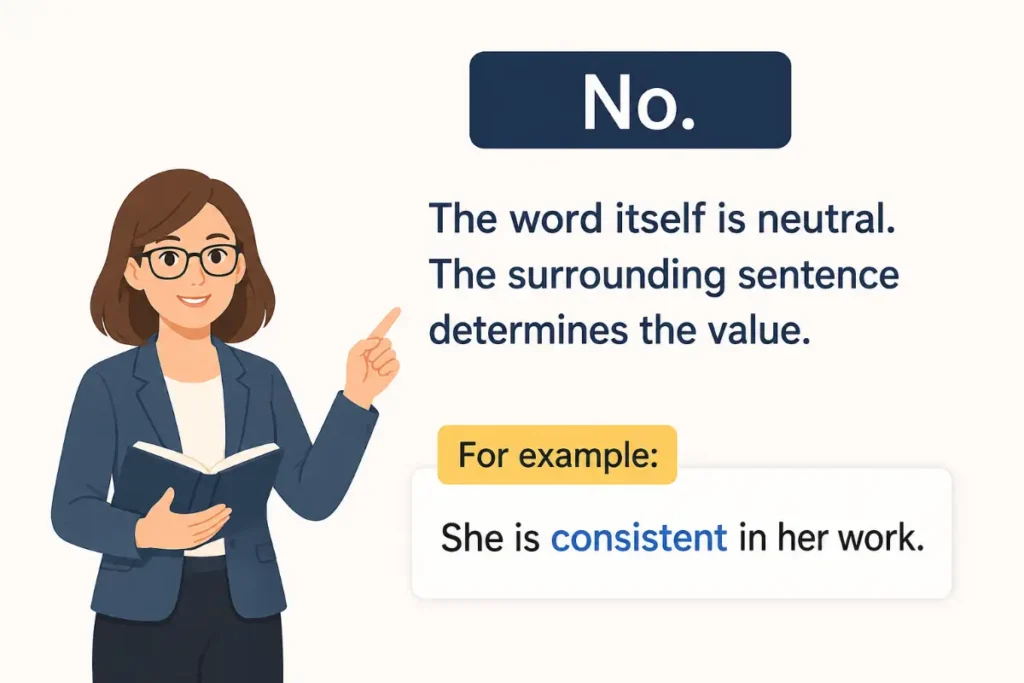
No.
The word itself is neutral. The surrounding sentence determines the value.
For example:
She is consistent in her work.
This usually sounds positive.
But:
He is consistently late.
This describes a repeated behavior that most readers would view negatively.
The word simply tells you that the pattern is stable or repeated. It doesn’t automatically say the pattern is good.
Conclusion
Consistent or consistant has a clear answer. Consistent is the correct spelling in standard English, while consistant is a common misspelling. The correct word is an adjective that describes something steady, regular, reliable, or compatible with something else.
The word works naturally in casual speech as well as formal writing. You can describe consistent effort, consistent quality, consistent results, or an explanation that is consistent with the evidence. American English and British English use the same spelling.
The easiest memory trick is to focus on the ending. Think consist + ent = consistent. When you see consistant in your draft, replace the a with e. That small correction keeps your writing accurate, polished, and clear.
FAQs
Is consistant a real English word?
In standard English, consistant is not the accepted spelling of the adjective meaning steady or compatible. It is commonly treated as a misspelling of consistent. The standard English form is consistent. A French dictionary entry may show consistant as a French adjective with different meanings, but that does not change the standard English spelling.
What does consistent mean?
Consistent is an adjective that can mean steady, regular, reliable, compatible, or in agreement with something else. For example, consistent performance means performance that remains at a similar standard. Consistent with the evidence means compatible with the evidence.
Which is correct consistent or consistant?
Consistent is correct. Consistant is a common misspelling. The standard adjective ends with ent. If you are writing an email, essay, report, application, or article, use consistent. The same spelling is standard in American English and British English.
How do you pronounce consistent?
The standard pronunciation is approximately kuhn SIS tuhnt. Merriam Webster gives the IPA as kənˈsɪstənt. The main stress falls on the second syllable. The final vowel is weak in normal speech, which can partly explain why some writers spell the word incorrectly.
What is the noun form of consistent?
The noun form is consistency. It means the quality or state of being consistent. For example, you can say, Consistency is important when learning a new skill. The adverb form is consistently, as in, She consistently meets her goals.
What is the adverb form of consistent?
The adverb is consistently. It describes something that happens in a steady or repeated way. For example, He consistently arrives early for work. The spelling uses ent before the final ly.
Is consistent good for formal writing?
Yes. Consistent is suitable for both formal and informal English. You can use it in academic writing, business communication, professional reports, school assignments, journalism, and everyday conversation. It is a clear and ordinary English word, so there is no reason to replace it with a more complicated expression.
Why do people spell consistent as consistant?
The mistake likely feels natural because English contains many familiar words ending in ant. Pronunciation can also make the final vowel difficult to identify in normal speech. Writers may also confuse the adjective with related words such as consistency. The safest solution is to remember that the standard adjective ends in ent.
