
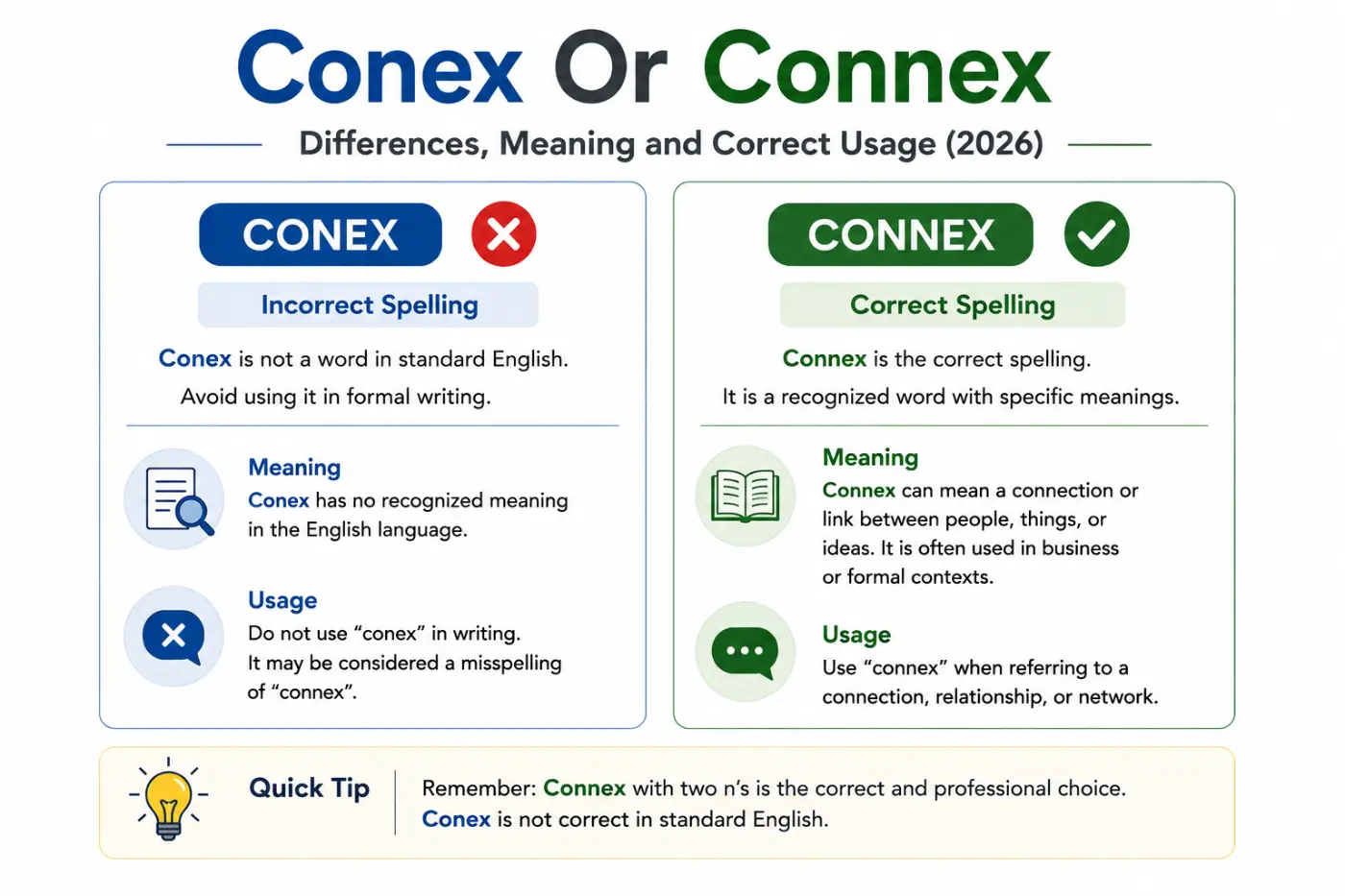
If you’ve searched for conex or connex because you need to name a shipping or storage container you’ve probably noticed that both spellings appear online. The good news is that the difference is easier to understand than it first seems. For the container meaning both spellings have a documented history but connex is the established dictionary form for a large metal cargo container used by the U.S. Army.
The confusion comes from the fact that the words look almost identical and are pronounced alike in common English use. Many modern industry listings also use conex as a shortened form for a shipping or storage container. That creates a spelling split that can make even careful writers pause before choosing a form.
This guide explains the meaning of both forms and shows how they work in American English. You’ll also see the pronunciation differences that matter in dictionaries the historical background behind the container term and the best choice for everyday writing. If you’re writing a listing email contract school paper or business document you’ll know which form fits your context.
Quick Answer
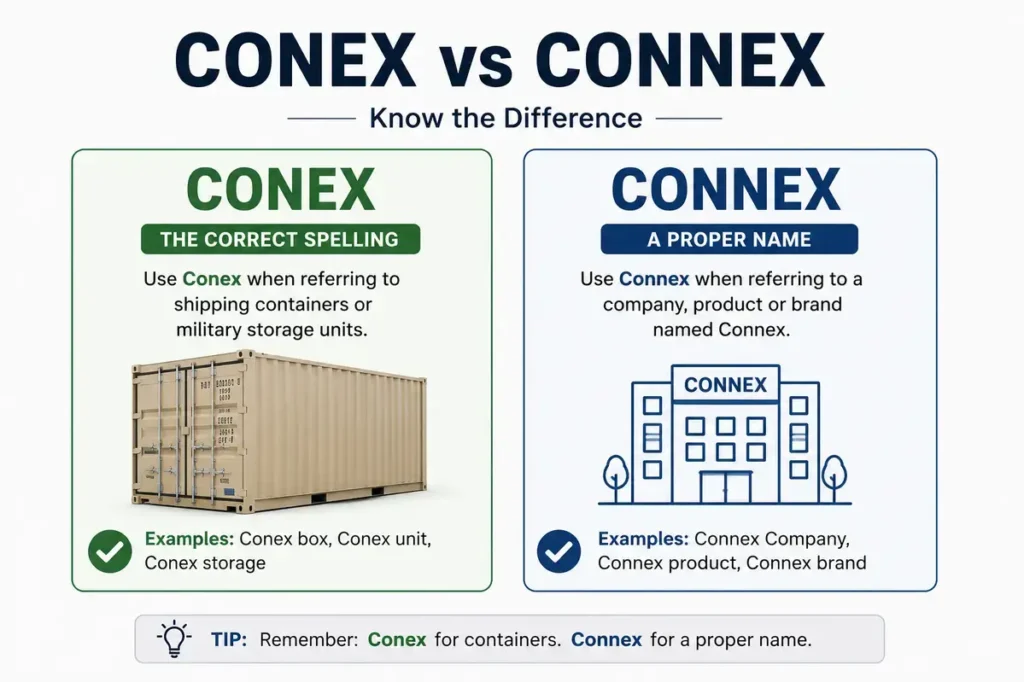
For a large metal cargo or storage container the dictionary supported spelling is connex. Conex is also widely used in the container and storage industry and is closely associated with the same type of container. So the choice depends on the context and house style. For formal dictionary based writing connex has strong support. For industry language conex is widely recognized.
Meaning of Both Forms
The two spellings create a classic English spelling problem. They look different on the page but point toward closely related usage in the container industry. At the same time connex has additional dictionary meanings that have nothing to do with shipping containers.
Understanding that distinction prevents a common mistake. You don’t want to treat every appearance of connex as a typo. You also don’t want to assume that every appearance of conex is wrong.
What Conex Means
In the shipping and storage industry conex commonly refers to a large steel cargo container used for transporting or storing goods and equipment.
You may hear phrases such as conex container or conex box in construction logistics military storage and commercial storage. In casual industry communication the word can function as a familiar noun even though the exact naming conventions can vary between companies and regions.
The term is closely connected with the military development of standardized cargo containers. Dictionary sources trace the container sense to a shortening associated with container and export terminology. In practical writing the word normally refers to a physical object.
For example:
- The contractor stored the tools inside a conex container.
- We need a conex for equipment storage at the construction site.
- The company delivered a steel conex to the warehouse.
The important point is that conex is strongly associated with the physical container in modern industry language.
What Connex Means
Connex has a more complicated history. In American English dictionaries it can refer to a large metal cargo container used by the U.S. Army for shipping supplies. Collins Dictionary and Dictionary.com both record this container sense.
Merriam Webster also records connex as a noun with older meanings as well as a verb and adjective. The older noun sense can mean a bond or connection. The verb means to connect and is marked obsolete. The adjective can mean connected or linked and appears in specialized logical and grammatical contexts.
That means connex is not simply a bad spelling. It is a legitimate dictionary word with several historical and specialized meanings. For modern general writing though you’ll rarely need the older meanings. If you mean a relationship between people or ideas you’ll normally write connection. If you mean joining things together you’ll normally write connect. The container meaning is the context in which most modern readers are likely to encounter the word.
Conex or Connex Comparison
| Feature | Conex | Connex |
|---|---|---|
| Main modern container meaning | Steel cargo or storage container | Large metal cargo container |
| Part of speech | Noun | Noun and also verb or adjective in specialized usage |
| Container context | Common in industry and storage language | Established dictionary form |
| Pronunciation | Usually pronounced like CON ex | Usually pronounced like CON ex |
| Formal general English | Specialized term | Specialized term for the container sense |
| Historical usage | Connected with container terminology | Also has older meanings related to connection |
| Common contexts | Storage construction logistics and military use | Military cargo containers plus historical and technical usage |
| Best everyday alternative | Shipping container or storage container | Shipping container or storage container |
The table reveals why a simple right or wrong answer can be misleading. The two forms overlap in the container context. However connex has broader dictionary history while conex has become familiar as an industry spelling.
Which Spelling Is Correct
If you need a single answer for a formal dictionary based explanation use connex for the large metal cargo container. That answer is supported directly by major dictionary sources. Collins defines connex as a large metal cargo container associated with U.S. Army shipping. Dictionary.com gives essentially the same container sense and explains its origin as a respelling of conex.
That last point is especially useful because it explains why the two spellings exist. The extra n in connex isn’t simply evidence that somebody added a letter by mistake. The spelling developed as a variant.
At the same time conex is firmly established in practical container terminology. If you search industry listings or talk with people involved in storage construction logistics or container sales you may encounter it frequently. So the safest editorial rule is simple.
- Use connex when you want the dictionary recorded spelling for the container term.
- Use conex when following an established industry style that specifically uses that spelling.
- If you’re writing for a broad audience use shipping container or storage container when the specialized term adds no value.
- If a company product listing or organization officially uses one spelling preserve that spelling in its proper name.
This approach keeps your writing accurate without pretending that real world usage is perfectly uniform.
Why The Spelling Causes Confusion
The confusion has several layers.
First the two forms sound almost identical. A person may hear the word in conversation long before seeing it in writing. Once that happens the spelling has to be reconstructed from sound alone.
Second both versions appear in container related writing. A search can show one form on one page and another form somewhere else. That makes the reader reasonably assume that there must be two different objects.
There usually isn’t.
Third the word has a specialized history. It isn’t a basic everyday English noun like box or truck. Specialized terms often develop through military use trade language company terminology and industry shorthand. That history can produce more than one accepted spelling.
Finally connex has meanings outside the container industry. Merriam Webster records historical noun verb and adjective uses related to connection.
So context matters more than the extra letter.
Spelling Difference Explained
The visible difference is just one letter.
Conex has one n.
Connex has two ns.
That tiny difference doesn’t change the way most speakers pronounce the container term. Cambridge gives the U.S. pronunciation of connex as /ˈkɑː.neks/.
This creates a familiar spelling trap. English has many words where pronunciation gives you too little information to reconstruct the spelling. If two forms sound alike or nearly alike then the written form has to be learned from usage.
A useful memory trick is to connect the double n with the dictionary form connex. If you are writing a formal description of the military cargo container and want the dictionary spelling that is the form to remember.
For everyday industry communication the shorter conex form may still appear and be understood.
Pronunciation Guide
The container term is commonly pronounced with two syllables.
The basic pronunciation is:
CON ex
The U.S. pronunciation listed by Cambridge for connex is /ˈkɑː.neks/. The stress falls on the first syllable. You can think of it as sounding roughly like the beginning of the word contact followed by ex without trying to force an exact spelling from the sound.
A common mistake is to pronounce the double n as though it creates a longer n sound. It doesn’t. The two ns belong to the written spelling rather than creating an extra syllable. The same basic pronunciation explains much of the spelling confusion. If someone says the word aloud you can’t reliably tell from the sound alone which written form they have in mind.
Part of Speech and Grammar
When the word refers to a cargo or storage container it functions as a noun.
That means it can appear as the subject or object of a sentence.
For example:
- The conex arrived this morning.
- We rented a connex for temporary storage.
- The crew loaded the connex with equipment.
You can also use it with an article because it is a countable noun when referring to an individual container.
You might write:
A connex was delivered to the site.
The connex is already full.
We need another connex.
The plural form can be written connexes. Merriam Webster lists connexes as the plural for its noun entry. Industry writing can also use the phrase container as a noun after the specialized term. This produces expressions such as conex container or connex container. In many cases that phrase is understood easily even though it can feel repetitive because the specialized word already identifies the object.
For general readers shipping container is often clearer.
Formal and Informal Usage
The best form depends partly on your audience. In a technical document you may want to use the dictionary supported spelling connex and define it the first time it appears.
For example:
The project requires one connex for secure equipment storage.
After that you can simply use connex if the meaning remains clear.
In a construction conversation you may hear or see conex regularly.
For example:
We’ll put the conex behind the building.
That sentence sounds natural in an industry setting.
In a general audience article the phrase shipping container may be better.
For example:
The company placed a shipping container behind the building.
This is not because the specialized word is wrong. It’s because clear language often beats specialized language when the specialist term doesn’t add useful information.
Regional Usage
American English
American English uses connex as a dictionary recorded term for the military cargo container. Collins and Dictionary.com both identify the word with the U.S. Army cargo container tradition.
You’ll also encounter conex in American industry and commercial storage contexts. The shorter spelling has become familiar in construction logistics and container sales.
For a U.S. audience both forms may therefore look familiar. The difference is more about context and editorial preference than pronunciation.
British English
British English has an additional historical connection to the spelling connex because English has used related forms such as connexion. Merriam Webster describes connexion as a chiefly British spelling of connection.
However modern British general English normally uses connection rather than the older form. You shouldn’t replace connection with connex simply because the spelling exists historically.
For shipping containers the specialized term can still appear but shipping container is usually the clearest expression for a general audience.
Canadian English
Canadian English can encounter both forms through North American industry language. There is no strong reason for a general Canadian writer to use the specialized term if shipping container communicates the idea more clearly.
Australian English
Australian readers may also encounter specialized container terminology in logistics construction and transport settings. Brand names and industry conventions can affect the preferred spelling.
The key rule remains the same. Follow the terminology used by the organization or industry when you’re writing in a specialized context.
Etymology and Word Origin
The container sense has an interesting history.
Dictionary sources describe connex as a respelling of conex and connect the word with container terminology. Dictionary.com gives the origin as an apparent respelling of conex from a shortened expression involving container and export. Collins similarly traces the word to conex.
The military connection is central to the modern container meaning. Standardized metal cargo containers became useful for moving supplies and equipment efficiently. The term then entered broader logistics and storage language.
This explains why you may see several related expressions in modern writing.
You may encounter connex box.
You may encounter conex box.
You may encounter connex container.
You may encounter conex container.
You may also see the simpler phrase shipping container.
These expressions can overlap in practical meaning but they don’t all have the same historical status.
The separate historical senses of connex have a different path. Merriam Webster traces its noun and adjective history through Middle French and Latin roots associated with connection.
That history is another reason the spelling should not be dismissed as a simple error.
Common Mistakes
Several mistakes appear again and again because the word is specialized and its spelling isn’t obvious from pronunciation.
Treating Connex As Always Wrong
This is the biggest mistake.
Some writers see connex and assume it must be a typo for conex. That isn’t accurate. Major dictionaries record connex as the container term and also document older and specialized meanings.
Treating Conex As Always Wrong
The opposite claim also causes problems.
Conex is widely used in the container and storage industry. Calling every instance incorrect ignores established practical usage.
If your company consistently uses conex in product descriptions there may be no practical reason to change every instance.
Confusing The Term With Connection
The historical word connex has meanings related to connecting. Modern writers sometimes assume it can replace connection in ordinary sentences.
That is not good modern general usage.
Write:
There is a strong connection between the two ideas.
Not:
There is a strong connex between the two ideas.
The second form may have historical or specialized support but it will sound unusual to most modern readers.
Assuming The Double N Changes The Pronunciation
It doesn’t create another syllable. Both forms used for containers are generally pronounced like CON ex. The Cambridge entry gives /ˈkɑː.neks/ for the U.S. pronunciation of connex.
Using The Specialized Term Without Context
A reader who has never encountered the word may not know what it means.
If your audience is broad you can solve that problem by writing shipping container or by defining the term on first use.
For example:
The company delivered a connex which is a large steel cargo container.
After that you can use connex without stopping to explain it again.
Sentence Examples
Here are natural examples showing how the term works in real writing.
- The contractor rented a connex for storing tools at the construction site.
- A steel connex arrived at the warehouse early Monday morning.
- The crew secured the equipment inside the connex before the storm.
- We need another connex because the first storage unit is already full.
- The military used large connex containers to move supplies and equipment.
- The company placed a connex behind the office for temporary storage.
- The project manager asked the supplier to deliver a connex by Friday.
- The old connex still provides secure storage for maintenance equipment.
- The warehouse has several connexes that hold spare parts and supplies.
- The property owner plans to remove the connex after construction ends.
These examples show why the word behaves like an ordinary countable noun when it refers to an individual container.
Real Life Usage
Daily Conversation
In everyday conversation people usually choose the shortest clear expression.
A construction worker might say:
We need to move that conex.
Another person might say:
Put the equipment in the shipping container.
Both sentences can communicate the same basic idea. The first assumes the listener understands the specialized term. The second works for almost everyone.
Workplace Communication
Workplace writing benefits from precision.
A warehouse manager might write:
The connex needs to be inspected before the next shipment.
A project manager might write:
Please confirm the delivery date for the storage container.
The first sentence suits a team that knows the terminology. The second works better for a mixed audience.
Academic Writing
Academic writing usually favors clarity over industry shorthand.
If the container itself is relevant to a research project you can define the specialized term and then use it consistently.
For example:
The study site used a connex as a temporary storage unit for field equipment.
After the definition the term can be used normally.
If the container is not central to the research then shipping container is usually simpler.
News Writing
News writing often favors terms that readers understand immediately.
A reporter covering a construction project may write:
Workers used a large shipping container to store equipment.
A reporter writing for a specialized military publication may use connex if the audience knows the term.
The choice should serve the reader rather than the writer.
Literature And Storytelling
A story can use connex when the setting makes the term natural.
For example:
The mechanic kept his spare parts inside an old connex behind the garage.
That wording gives the reader enough context to understand the object without stopping the story for a dictionary style explanation.
Related Terms
Several words and phrases sit close to this topic.
Shipping Container
This is the broadest and clearest term for a large container used to transport goods.
Storage Container
This focuses on the container’s use rather than its transportation history.
Cargo Container
This emphasizes the movement of goods or equipment.
Connex Box
This is a common expression for the container itself. The phrase appears in dictionary explanations of the term.
Conex Box
This spelling also appears in industry language and generally refers to the same type of container.
Steel Container
This describes the physical construction and can be useful when material matters.
Cargo Unit
This is a broader logistics expression and doesn’t necessarily identify the specific military container term.
Connection
This is a completely different everyday word despite its historical relationship to some uses of connex.
The last distinction matters most in general writing. If you mean a relationship or link use connection. If you mean the large metal storage or cargo unit use the appropriate container term.
When To Use Shipping Container Instead
Sometimes the best word is neither spelling.
That may sound strange after spending so much time comparing the two forms but good editing is about choosing the clearest expression.
If you’re writing for ordinary readers who have no reason to know military or logistics terminology then shipping container is often the strongest choice.
Compare these sentences:
The company delivered a connex to the property.
The company delivered a shipping container to the property.
The second sentence is instantly clear to almost everyone.
The first sentence is more specialized.
Neither sentence is automatically better. The audience decides.
Use the specialized word when it adds useful information. Use the general term when clarity matters more.
That simple principle will improve far more than this one spelling choice.
Expert Editor Insight
An experienced editor wouldn’t automatically mark every conex as wrong or every connex as correct. The first question is always context. If the text describes a military or industrial cargo container then both spellings may appear in real usage and connex has clear dictionary support. If the text uses the word to mean connection in ordinary modern English an editor would usually replace it with connection. Editing tools may also flag specialized terms because their dictionaries are built for broad general language rather than every industry vocabulary set. The smartest edit considers meaning audience consistency and the source terminology together.
Is Conex Or Connex Better For A Business Website
For a business website consistency matters almost as much as spelling.
Suppose a storage company uses conex in its product catalog. Changing some pages to connex while leaving others unchanged creates unnecessary variation. Customers may wonder if the two terms describe different products.
Pick one style for the business and use it consistently.
If the business officially markets products as conex containers then keep that form.
If the business follows a dictionary based editorial style then connex may be preferable.
You can also use shipping container as the main phrase and mention the specialized term where useful. That gives general readers an immediate definition without forcing them to know industry vocabulary.
For example:
Our steel shipping containers are also known as conex or connex containers.
After that explanation you can use shipping container throughout the page.
This is often the cleanest approach for customer facing content.
Is Connex A Real English Word
Yes.
That answer deserves emphasis because many people assume the extra n automatically makes the word incorrect.
Merriam Webster has a connex entry with noun verb and adjective forms. The noun includes obsolete meanings connected with bonds or relationships. The verb means connect and is marked obsolete. The adjective means connected and also appears in specialized contexts.
Major dictionaries also record the container sense. Collins and Dictionary.com define connex as a large metal cargo container associated with U.S. Army shipping.
So the word is unquestionably documented.
The more useful question is not simply whether the word exists. The useful question is what it means in your sentence.
That is how good word choice works.
Is Conex A Real English Word
The answer depends on what you mean by real.
Conex is widely used as a specialized container term in logistics storage construction and related industries. It has a documented relationship with the container terminology recorded in dictionaries. Dictionary sources discussing connex identify conex as part of the word’s history.
It may not have the same broad everyday status as words such as container or box. But specialized vocabulary doesn’t need to appear in ordinary conversation to be useful.
A word can be established within a professional field while remaining unfamiliar to the general public.
That is exactly what happens with many technical terms.
Why Some Sources Prefer Conex
The shorter spelling is attractive because it is simple and strongly associated with the container industry.
People who work around storage units construction sites or logistics may see the word frequently. Repeated exposure reinforces the spelling.
Industry language also tends to preserve practical shorthand. A term that began in specialized communication can become normal inside a particular trade even when general dictionaries favor another form.
That is why spelling debates can look different depending on where you search.
A dictionary may present one form.
A construction supplier may use another.
Neither result automatically proves that the other spelling is meaningless.
Context resolves the conflict.
Why Some Sources Prefer Connex
The double n has strong dictionary support.
Collins records connex as the container noun and traces its origin through conex. Dictionary.com also records the container meaning and describes the spelling as a respelling.
Merriam Webster goes even further by documenting older and specialized meanings of connex.
That gives connex a solid historical and lexicographic foundation.
For formal writing that specifically asks for a dictionary recognized form it is therefore a sensible choice.
A Simple Memory Tip
If you’re writing about the container and need the dictionary form remember this:
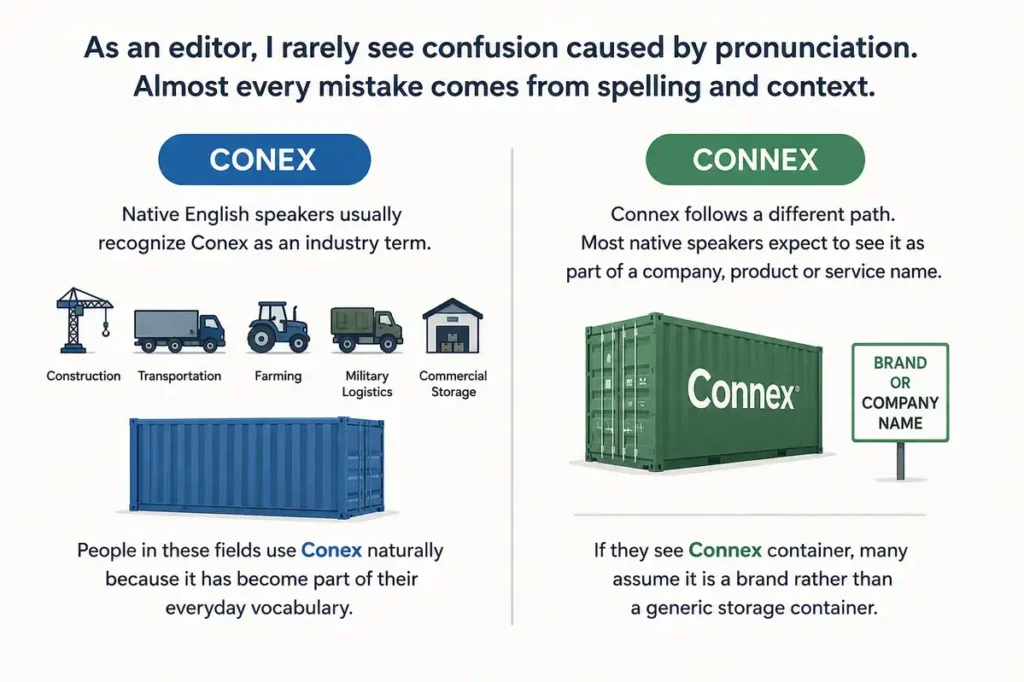
Connex has two ns and is the dictionary recorded container spelling.
If you’re writing for an industry audience and the company or trade consistently uses conex then follow that established style.
If neither specialized spelling is necessary simply write shipping container.
That last option is often the easiest one to remember.
Final Takeaway
When you’re deciding between conex or connex for a large metal cargo or storage container the safest formal choice is connex. Major dictionaries record that spelling for the container meaning while also documenting older and specialized uses.
At the same time conex is widely established in practical industry language. It isn’t helpful to label every use as a simple mistake. Your audience and the style used by your organization should guide the final choice.
The easiest editing rule is to choose one spelling and stay consistent. If the specialized term isn’t necessary use shipping container instead. Clear writing doesn’t always require the most specialized word. It requires the word that gives your reader the right meaning with the least effort.
FAQs
Is Conex Or Connex Correct For A Shipping Container?
Both spellings appear in container usage but connex has direct dictionary support for the large metal cargo container. Conex is also widely used in industry language and is connected with the historical development of the term. For formal dictionary based writing connex is the safer choice. For a company or industry style follow the established spelling used by that organization.
Is Connex A Real Word?
Yes. Connex is a real dictionary word with several recorded meanings. It can refer to a large metal cargo container and also has older or specialized meanings related to being connected or joining things. Merriam Webster records noun verb and adjective uses.
Is Conex A Misspelling?
Not necessarily. Conex is used as a specialized term for shipping and storage containers and is closely connected with the historical terminology behind connex. In a formal dictionary focused context connex may be the preferred form. In industry writing conex can be an established spelling rather than a simple typing mistake.
How Do You Pronounce Connex?
Connex is generally pronounced with two syllables as CON ex. Cambridge gives the U.S. pronunciation as /ˈkɑː.neks/. The stress falls on the first syllable. The double n does not create an additional syllable or noticeably lengthen the sound.
Does Connex Mean Connection?
It can have historical or specialized meanings related to connection but modern general English normally uses connection for that idea. Merriam Webster records connex as an older verb meaning connect and as an adjective meaning connected. Those uses are uncommon in ordinary modern writing.
Should I Write Conex Container Or Connex Container?
Use the spelling that fits your chosen style. If you want the dictionary recorded form use connex container. If you are following an industry source that consistently uses conex then use conex container. For general readers shipping container is often clearer and more natural than either specialized expression.
Is Connex Appropriate In Formal Writing?
Yes when you are referring to the documented container term or a specific technical usage. It may be less suitable when you are simply trying to say connection or connected. In formal writing the meaning should be clear from context. If a general reader may not know the term define it on first use or choose the simpler phrase shipping container.
Why Do People Confuse Conex And Connex?
The main reason is that the two forms look almost identical and sound alike. Both also appear in real container related usage. That means readers encounter conflicting spellings and may reasonably wonder if they describe different objects. The historical relationship between the forms adds another layer to the confusion.
