
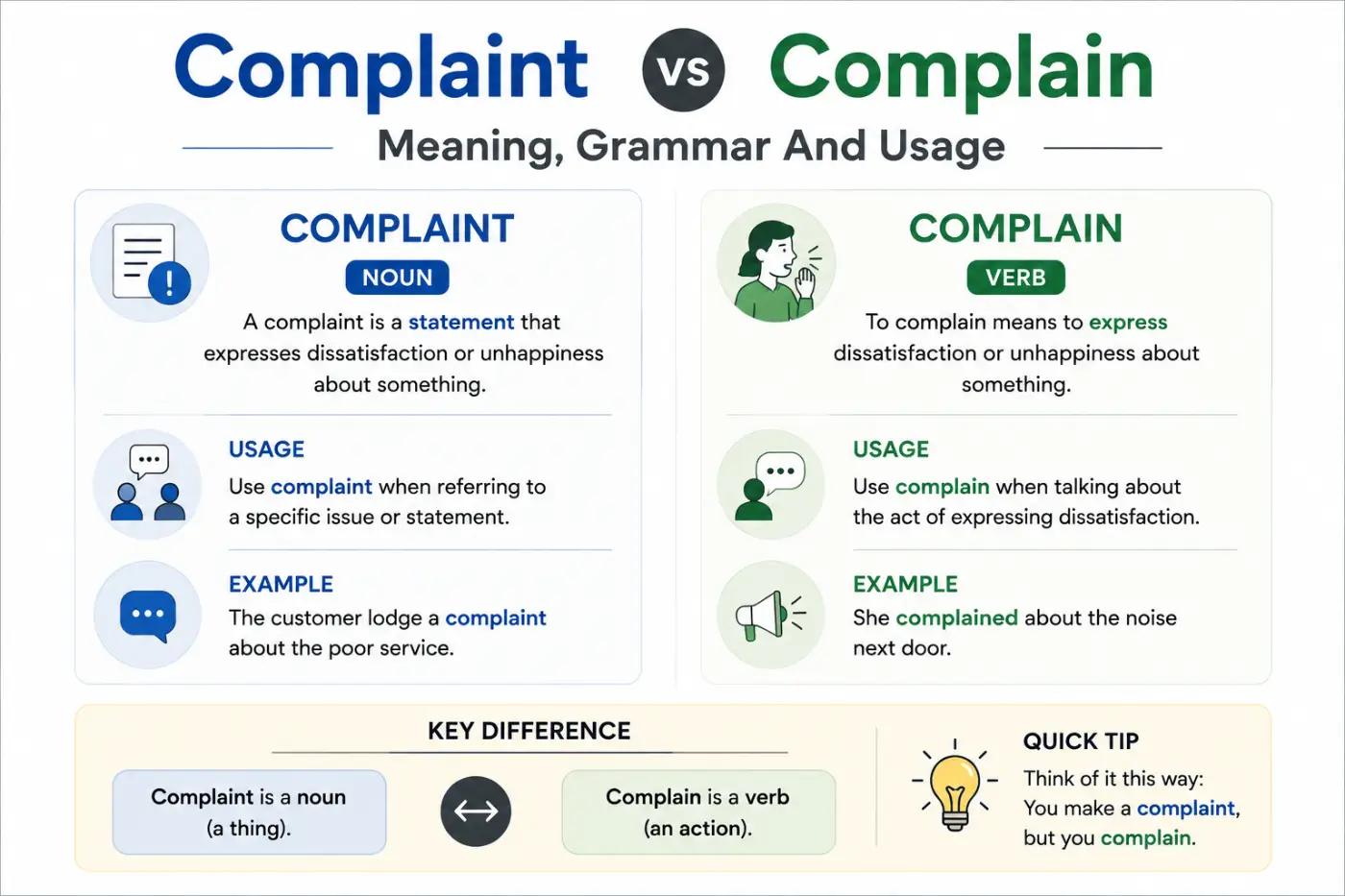
Complaint vs complain can be confusing because the two words share the same basic idea and differ by only one letter at the end. The key difference is simple: complain is a verb, while complaint is a noun. You complain about a problem. You make a complaint about that problem.
This small difference matters because English uses these words in different parts of a sentence. If you write “I complaint about the service” you’ve used a noun where a verb is needed. If you write “I made a complain” you’ve used a verb where a noun belongs. These mistakes are common because the words are closely connected in meaning and pronunciation.
Once you understand their grammatical jobs the choice becomes much easier. This guide explains the difference in plain English and shows how native speakers use both forms in everyday speech, workplace communication, school writing, formal situations, and online conversations. You’ll also see pronunciation patterns, common mistakes, word origins, related expressions, and a simple memory trick that can help you choose the right form quickly.
Quick Answer
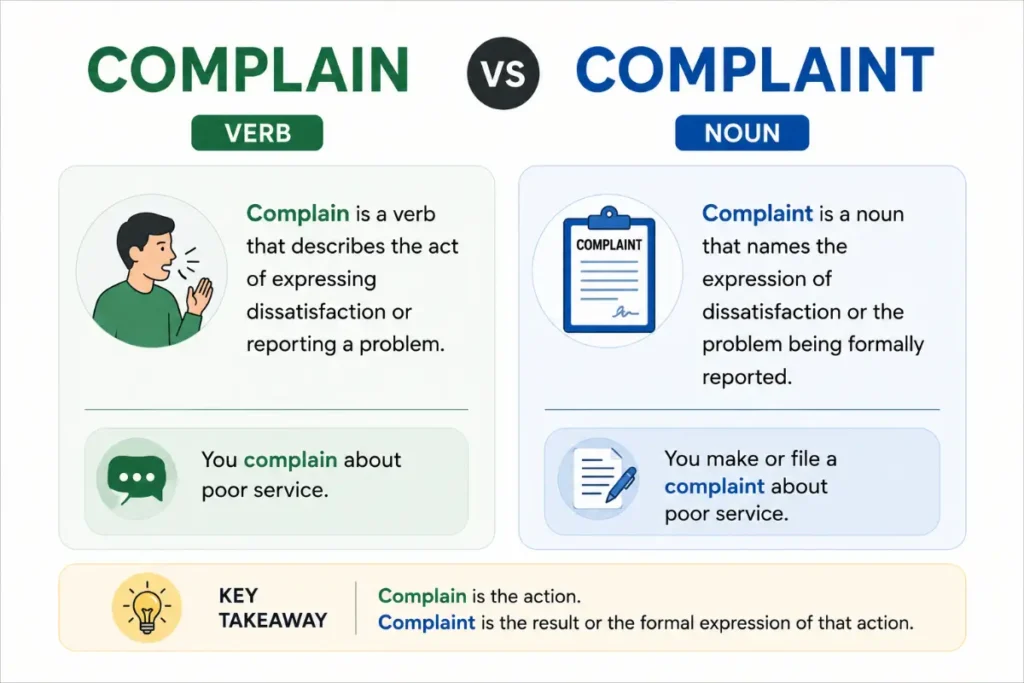
Complain is a verb that describes the act of expressing dissatisfaction or reporting a problem. Complaint is a noun that names the expression of dissatisfaction or the problem being formally reported. You complain about poor service. You make or file a complaint about poor service.
Complaint Vs Complain At A Glance
| Form | Meaning | Part Of Speech | Pronunciation | Formality | Common Contexts | Example |
|---|---|---|---|---|---|---|
| Complain | To express dissatisfaction or report a problem | Verb | /kəmˈpleɪn/ | Neutral | Conversation, work, school, formal speech | Customers complain about long waits. |
| Complaint | An expression of dissatisfaction or a reported problem | Noun | /kəmˈpleɪnt/ | Neutral | Conversation, work, customer service, legal and formal settings | The customer filed a complaint. |
Both forms are standard English. Neither is a misspelling of the other. The important point is grammatical function.
Meaning Of Complain
Complain is a verb. It describes an action.
When someone complains, they express dissatisfaction about something they dislike, believe is wrong, or think should be changed. A person can complain about a product, service, situation, person, decision, noise, delay, or many other things.
For example:
- I complained about the cold food.
- She complained about the long wait.
- Several employees complained about the new schedule.
The word can also describe reporting pain or a physical problem. In this use it often appears with of.
For example:
- The patient complained of severe back pain.
- He complained of a headache after the accident.
The verb can also introduce a full statement with that.
For example:
- The residents complained that the construction was too loud.
- She complained that nobody had informed her about the change.
A useful point to remember is that complain describes what someone does. If you can replace the word with another action such as speak up, object, protest, or report a problem, the verb form may be what you need.
Meaning Of Complaint
Complaint is a noun. It names the expression of dissatisfaction or the matter being reported.
For example:
- We received a complaint about the service.
- The manager reviewed the customer’s complaint.
- Her complaint was taken seriously.
The noun can refer to something spoken or written. It can also refer to a formal report made to an organization or authority.
For example:
- The company received a written complaint.
- The school investigated the complaint.
- He submitted a complaint to the department.
The word also has a medical meaning. A complaint can describe a health problem reported by a patient.
For example:
- The patient’s main complaint was chest discomfort.
- The doctor asked about his primary complaint.
This medical use is especially common in professional healthcare language. In ordinary conversation people are more likely to say problem, pain, symptom, or issue.
The central grammar rule remains the same. Complaint is a thing or matter that someone reports. Complain is the action of reporting or expressing dissatisfaction.
The Key Difference In Grammar
The clearest way to separate these words is to focus on their parts of speech.
Complain Is A Verb
A verb tells us what someone does. Complain describes the action of expressing dissatisfaction.
Consider this sentence:
Maria complained about the delay.
Maria is doing something. She is expressing dissatisfaction. Therefore complained is the correct verb.
You can change its tense as needed.
- I complain about the noise.
- I complained about the noise.
- I am complaining about the noise.
- I have complained about the noise.
- I will complain about the noise.
The form changes because the verb carries tense.
Complaint Is A Noun
A noun names a person, place, thing, idea, event, or matter.
In this sentence:
Maria made a complaint about the delay.
Complaint names the thing Maria made. It doesn’t describe her action by itself.
This is why English uses common noun patterns such as:
- Make a complaint.
- File a complaint.
- Submit a complaint.
- Receive a complaint.
- Investigate a complaint.
- Resolve a complaint.
- Handle a complaint.
- Withdraw a complaint.
The noun usually needs an article or another determiner when it refers to one specific complaint.
For example:
I made a complaint.
She filed a complaint.
The manager received a complaint.
Common Sentence Patterns
Learning the patterns can make the difference almost automatic.
Common Patterns With Complain
The most common structure is complain about something.
For example:
They complained about the price.
Another useful structure is complain to someone about something.
For example:
She complained to the manager about the service.
You can also use complain that before a complete clause.
For example:
The students complained that the classroom was too cold.
Another pattern is complain of something, especially in medical or formal contexts.
For example:
The patient complained of dizziness.
Notice that complain normally doesn’t take the problem as a direct object in standard English.
You wouldn’t normally say:
I complained the service.
Instead say:
I complained about the service.
Common Patterns With Complaint
The noun often appears with make.
I made a complaint.
It can also appear with file.
She filed a complaint.
Other common combinations include formal complaint, written complaint, customer complaint, complaint about, and complaint against.
For example:
The company received a formal complaint about the advertisement.
The employee submitted a complaint against the supervisor.
The exact preposition can change the meaning slightly. A complaint about something focuses on the issue. A complaint against someone or an organization focuses on the person or entity being accused or challenged.
Which Form Is Correct?
Both forms are correct because they aren’t competing spellings of the same word. They are two related words with different grammatical functions.
Use complain when you need a verb.
Customers often complain about high prices.
Use complaint when you need a noun.
Customers often make complaints about high prices.
The first sentence describes an action. The second sentence refers to the reports themselves.
A quick substitution test can help. If you can replace the word with express dissatisfaction or object, you probably need the verb complain. If you can replace it with a report of dissatisfaction or a grievance, you probably need the noun complaint.
Why The Two Words Are So Easy To Confuse
The confusion comes from their close relationship.
English often creates related nouns from verbs. In this case the noun and verb developed from the same word family. Their spelling is almost identical and their meanings overlap heavily.
Pronunciation adds another layer of confusion. Both words begin with the same sound pattern and share the stressed syllable plain. The noun simply ends with an additional t sound.
That small difference can disappear in fast speech. Writing makes the distinction more visible.
Another reason is that learners often remember the meaning before they remember the grammatical role. Someone may know that both words relate to expressing dissatisfaction but forget which one names the action and which one names the report.
This is why memorizing isolated definitions isn’t always enough. It helps more to learn each word inside a sentence pattern.
Sentence Examples
Here are ten natural examples showing how the two forms work in real English.
- I complained about the slow internet connection.
- She made a complaint about the noise next door.
- Several customers complained about the long wait.
- The manager received a complaint from a customer.
- He complained to his supervisor about the unfair schedule.
- The school investigated the parent’s complaint.
- Don’t complain about the weather if you refuse to bring a jacket.
- The airline received hundreds of complaints after the delay.
- She complained that the instructions were unclear.
- The customer service team handled the complaint quickly.
Notice how the grammatical jobs stay consistent. Complain performs the action. Complaint names the issue or report.
Common Mistakes And Misspellings
Using Complaint As A Verb
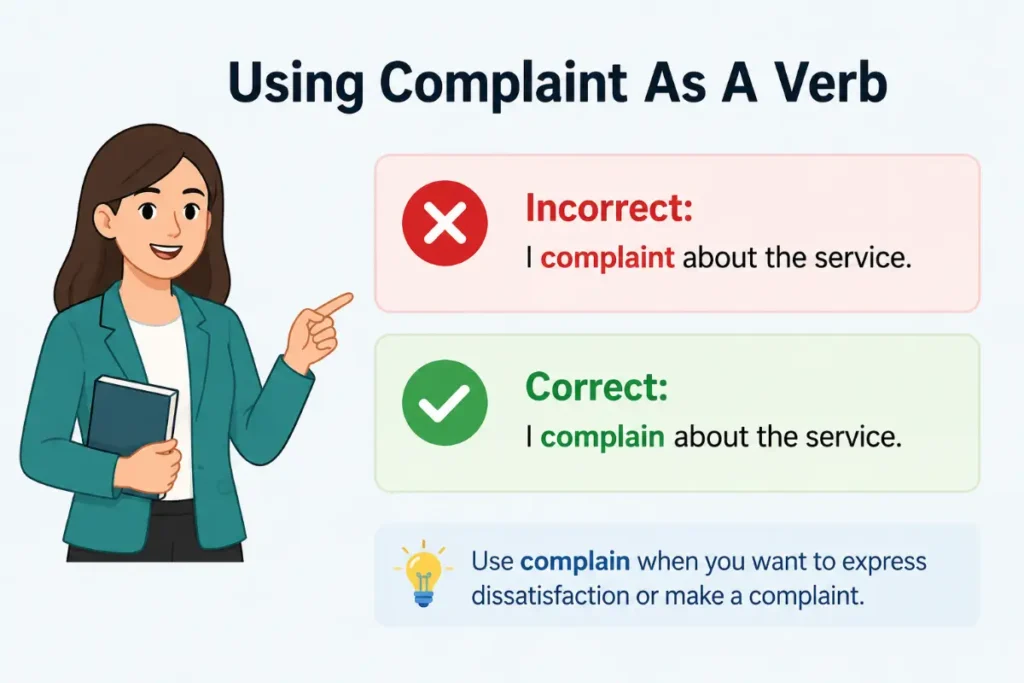
Incorrect:
I complaint about the service.
Correct:
I complain about the service.
The mistake happens because the noun and verb look so similar. Remember that the action requires the verb.
Using Complain As A Noun
Incorrect:
I made a complain.
Correct:
I made a complaint.
After made a you need a noun. The phrase make a complaint is standard.
Using Complain Without The Right Preposition
Incorrect:
She complained the noise.
Correct:
She complained about the noise.
The standard everyday pattern is complain about something.
Confusing Complained With Complaint
Incorrect:
He complaint about the decision yesterday.
Correct:
He complained about the decision yesterday.
The past tense of complain is complained. The extra t belongs to the noun complaint.
Treating The Noun Like A Verb
Incorrect:
The customer complaint about the service.
Correct:
The customer complained about the service.
A customer can make a complaint or complain. The noun and verb need different sentence structures.
Pronunciation Guide
The pronunciation difference is small but useful.
Complain is pronounced /kəmˈpleɪn/.
A simple guide is:
kuhm PLAYN
The stress falls on the second syllable.
Complaint is pronounced /kəmˈpleɪnt/.
A simple guide is:
kuhm PLAYNT
Again the stress falls on the second syllable.
The main difference is the final t sound in complaint.
The shared vowel sound is the same sound heard in words such as day, late, and train. The ending of complain finishes with an n sound. The ending of complaint adds a t after the n.
A common mistake is to pronounce the noun without clearly producing the final t. In casual speech that sound may be light. In careful speech it should still be present.
Etymology And Word Origin
The two words belong to the same historical word family.
Complain entered English through Anglo French and is connected to Old French forms related to expressing sorrow or dissatisfaction. Its deeper history reaches back to Latin complangere, which carried the sense of lamenting or mourning.
Complaint developed from the corresponding noun forms in French and Middle English. Over time the meaning broadened from expressions of grief or lament to include expressions of dissatisfaction and formal grievances.
That historical connection explains why the two modern English words remain so closely related. One developed as the verb for expressing dissatisfaction. The other developed as the noun for the expression or matter itself.
Modern English has preserved the connection while giving each word a distinct grammatical role.
Regional Usage
American English
Both complain and complaint are standard in American English.
Americans commonly use complain about in everyday conversation.
He always complains about traffic.
The noun complaint is common in customer service and workplace settings.
We received a complaint from a customer.
American English doesn’t use a different spelling for these words.
British English
Both forms are also standard in British English.
The same basic grammar applies.
She complained about the delay.
The company received a complaint.
There is no major British American spelling difference for these two words.
Australian English
Australian English also uses the same forms and grammatical distinction.
A speaker may complain about a problem or make a complaint about it. The choice depends on the role of the word in the sentence rather than regional spelling.
Canadian English
Canadian English follows the same standard distinction.
Complain functions as the verb and complaint functions as the noun. There is no meaningful regional spelling difference that changes this rule.
Grammar Rules To Remember
The most useful rules are simple.
- Use complain as a verb.
They complained about the bill.
- Use complaint as a noun.
Their complaint was reasonable.
- Use complain about for the thing causing dissatisfaction.
She complained about the service.
- Use complain to for the person or organization receiving the complaint.
She complained to the manager.
- Use complain that before a complete statement.
He complained that the room was too small.
- Use make a complaint when you need a noun.
I want to make a complaint.
- Use file a complaint in formal or administrative settings.
She filed a complaint with the department.
- Use complaint of in certain formal and medical contexts.
The patient’s main complaint was dizziness.
These patterns cover most situations you’ll encounter.
Formal And Informal Usage
The verb complain works in both casual and formal English.
In conversation you might say:
My brother always complains about traffic.
In professional writing you might say:
Several residents complained about the construction noise.
The noun complaint also works across different levels of formality.
In casual conversation:
I have a complaint about this burger.
In a formal administrative setting:
The department reviewed the complaint and issued a response.
The words themselves aren’t strongly formal or informal. The surrounding vocabulary and sentence structure usually determine the tone.
For professional writing, complaint often sounds more neutral and precise when referring to an official report.
Real Life Usage Examples
Daily Conversation
People often use complain in casual speech when they talk about things that bother them.
My neighbors complain about every little noise.
I don’t want to complain, but this coffee is cold.
The verb works naturally because the speaker is describing an action.
The noun appears when someone refers to the issue itself.
I have one complaint about the apartment.
His only complaint was the small kitchen.
Workplace Communication
Workplace English often uses both forms.
Employees complained about the new parking rules.
Human resources received several complaints about the policy.
In professional communication, the noun can make the focus clearer because it treats the issue as something that can be recorded, reviewed, and resolved.
For example:
Please submit your complaint in writing.
This sounds more formal than:
Please complain in writing.
The second sentence is grammatically possible in certain contexts but doesn’t communicate the same professional meaning.
Academic Writing
Academic writing usually favors precise descriptions of actions and claims.
Participants complained about the length of the survey.
The study recorded complaints about unclear instructions.
The choice depends entirely on grammatical function. Academic style doesn’t change the basic rule.
News And Journalism
News writing may use both forms depending on what the writer wants to describe.
Residents complained about rising traffic levels.
Officials received complaints from local residents.
The verb focuses on what residents did. The noun focuses on the reports received by officials.
Literature And Storytelling
Storytelling also uses both forms naturally.
Daniel complained about the rain as they walked home.
His constant complaints annoyed everyone at the table.
The verb can move the story forward by showing an action. The noun can describe a recurring behavior or an object of discussion.
Related And Confused Terms
Understanding nearby words can make your vocabulary more flexible.
Grumble
Grumble means to complain in a low or unclear way. It often suggests mild annoyance.
He grumbled about the early meeting.
A grumble can sound less direct than a formal complaint.
Whine
Whine means to complain in an annoying or high pitched way. It can carry a negative judgment about the speaker’s behavior.
The child kept whining about going home.
Calling someone’s speech whining can sound critical.
Protest
Protest means to express strong disagreement or opposition. It can be more forceful than complain.
Workers protested against the new rule.
A protest may involve public action rather than a simple expression of dissatisfaction.
Object
Object means to express disagreement or opposition.
Several members objected to the proposal.
It often focuses on disagreement with a decision, plan, or action.
Criticize
Criticize means to point out faults or problems.
The reviewer criticized the restaurant’s service.
Criticism doesn’t always involve a personal complaint.
Grievance
A grievance is a complaint about something believed to be unfair or wrong. The word often appears in workplace and formal settings.
The employee filed a grievance over the disciplinary action.
Complaint
A complaint is the noun that identifies an expression of dissatisfaction or a reported problem.
The manager investigated the complaint.
Complainer
A complainer is a person who complains frequently.
Nobody wanted to sit next to the constant complainer.
This word can sound negative because it suggests a repeated habit of complaining.
A Simple Memory Trick
Think of the final t in complaint as the thing being discussed.
You complain.
You make a complaint.
The verb tells us what you do. The noun tells us what you make, file, submit, receive, or investigate.
This pattern works especially well with common phrases.
I complain about the problem.
I made a complaint about the problem.
If you’re unsure while writing, ask yourself one question: Am I describing an action or naming an issue?
If you’re naming the issue or report, choose complaint.
Why Complaint Is Not The Past Tense Of Complain
This is a particularly common misunderstanding.
English verbs often change their endings to show tense. For example:
complain → complained
The word complaint doesn’t follow this pattern because it isn’t a past tense form. It’s a noun.
Compare these sentences:
She complained about the noise.
She made a complaint about the noise.
The first sentence uses a past tense verb. The second uses a noun.
The spelling difference isn’t a tense marker. The words belong to different grammatical categories.
Complain In Different Tenses
Because complain is a verb, it can appear in many tense forms.
Present
I complain when the service is poor.
Present Continuous
She is complaining about the temperature.
Past
They complained about the delay.
Past Continuous
He was complaining about the noise all morning.
Present Perfect
We have complained several times.
Future
I will complain to the manager.
This flexibility is one clear sign that complain is a verb.
By contrast, complaint remains a noun.
The complaint was serious.
The complaints were serious.
The noun changes from singular to plural but doesn’t become a verb.
Singular And Plural Forms
The singular noun is complaint.
We received a complaint.
The plural is complaints.
We received several complaints.
The plural form is especially common in customer service and workplace language.
The company tracks customer complaints.
Don’t confuse complaints with a verb form. The verb forms are complain, complains, complained, and complaining.
For example:
She complains about everything.
She complained yesterday.
She is complaining now.
These endings belong to the verb family.
Complain About Or Complaint About
Both expressions can be correct because they contain different grammatical structures.
Complain about uses the verb.
Customers complain about high prices.
Complaint about uses the noun.
Customers have complaints about high prices.
The phrase make a complaint about is also correct.
Customers can make a complaint about high prices.
The key is to look at the word before the expression. If the sentence needs an action, use the verb. If the sentence needs a noun, use the noun.
Complaint Against Or Complaint About
These two phrases can overlap but often focus on different things.
A complaint about something identifies the subject of dissatisfaction.
She made a complaint about the service.
A complaint against someone or an organization often identifies the party being challenged or accused.
The employee filed a complaint against the company.
The distinction becomes especially useful in formal workplace, legal, regulatory, or administrative contexts.
In everyday conversation, complaint about is much more common.
Can You Use Complain In Formal Writing?
Yes.
There is nothing inherently informal about complain. The word appears naturally in professional, academic, medical, administrative, and formal writing.
For example:
Several residents complained about the proposed development.
The verb is completely appropriate.
Still, formal writing may use the noun complaint when discussing a documented report.
The department reviewed the complaint before issuing a response.
The choice isn’t about avoiding the verb. It’s about choosing the form that fits the sentence.
Can You Start A Sentence With Complain?
Yes. A verb can appear at the beginning of a sentence when the sentence structure supports it.
For example:
Complain if the product arrives damaged.
This is an imperative sentence. The implied subject is you.
You can also start a sentence with an introductory phrase containing the verb.
After complaining about the delay, she asked for a refund.
However, starting a sentence with complain doesn’t automatically make the writing informal. The surrounding context determines the tone.
Can Complaint Start A Sentence?
Yes. Complaint is a noun and can easily appear at the beginning of a sentence.
For example:
The complaint was resolved within two days.
Here the noun functions as the subject.
Another example is:
A complaint about the noise was submitted yesterday.
Again, the noun phrase serves as the subject of the sentence.
This is a useful way to spot the grammatical difference. If complaint appears as the subject, it is functioning as a noun.
Expert Editor Insight
An experienced editor usually doesn’t treat these words as a spelling choice. The first question is grammatical: does the sentence need an action or a thing? Native speakers instinctively use complain for the action and complaint for the noun. Editors often catch mistakes by looking at the words around the form. Phrases such as make a, file a, and receive a strongly signal the noun, while a subject followed by an action often calls for the verb. Grammar tools can flag the wrong form because the surrounding sentence structure doesn’t support its part of speech.
A Fast Editing Test
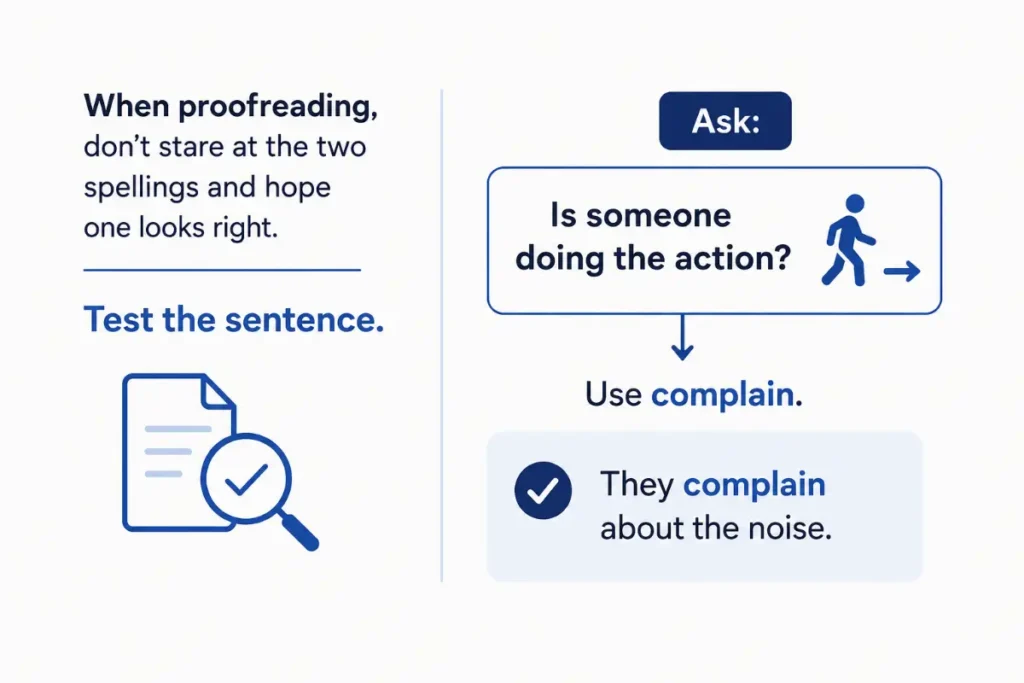
When proofreading, don’t stare at the two spellings and hope one looks right. Test the sentence.
Ask:
Is someone doing the action?
Use complain.
They complain about the noise.
Is the sentence naming the report or issue?
Use complaint.
Their complaint was investigated.
Then look at common helper verbs.
If you see made, filed, submitted, received, or investigated, the noun complaint is often the natural choice.
If you see will, did, is, was, or another verb structure requiring an action, complain or one of its tense forms may be appropriate.
This simple check can catch most mistakes in seconds.
Here’s a clear, concise conclusion you can use for your article.
Conclusion
Complaint and complain are closely related, but they serve different grammatical roles. Complain is a verb that means to express dissatisfaction or say that something is wrong. Complaint is a noun that refers to the concern, problem, or statement of dissatisfaction itself.
A simple way to remember the difference is this: you complain, but you make or file a complaint. Once you understand this basic distinction, choosing the right word becomes much easier in everyday writing and conversation.
FAQs
Which is correct complaint or complain?
Both words are correct, but they have different grammatical functions. Complain is a verb that describes the action of expressing dissatisfaction. Complaint is a noun that names the expression of dissatisfaction or the issue being reported. You can complain about poor service. You can also make a complaint about poor service.
Is complaint a verb?
No. In standard English complaint is a noun. It refers to an expression of dissatisfaction, a reported problem, or a formal grievance. The related verb is complain. For example, you can say “I complained about the service” or “I made a complaint about the service.”
Is complain a noun?
No. Complain is a verb. It describes the action of expressing dissatisfaction or reporting a problem. The related noun is complaint. You can say “They complained about the delay” but you should say “They made a complaint about the delay.”
How do you pronounce complain?
Complain is pronounced /kəmˈpleɪn/. The stress falls on the second syllable. An easy pronunciation guide is kuhm PLAYN. The final sound is n. The word rhymes closely with words such as plane and main.
How do you pronounce complaint?
Complaint is pronounced /kəmˈpleɪnt/. The stress falls on the second syllable. An easy guide is kuhm PLAYNT. The main pronunciation difference from the verb is the final t sound. That extra sound matches the extra letter in the spelling.
Can I say I made a complain?
No. In standard English you should say I made a complaint. The expression make a complaint requires the noun because the article a introduces a singular count noun. If you want to use the verb, say I complained or I complained about the problem.
Why do people confuse complain and complaint?
People confuse them because they belong to the same word family and have almost identical spelling and meaning. The pronunciation is also very similar. The easiest way to avoid confusion is to remember the grammatical roles. Complain is the action. Complaint is the thing or report.
Is complaint appropriate in formal writing?
Yes. Complaint is completely appropriate in formal writing and is especially common in customer service, workplace, administrative, legal, and medical contexts. Phrases such as formal complaint, written complaint, file a complaint, and submit a complaint are natural in professional English.
