
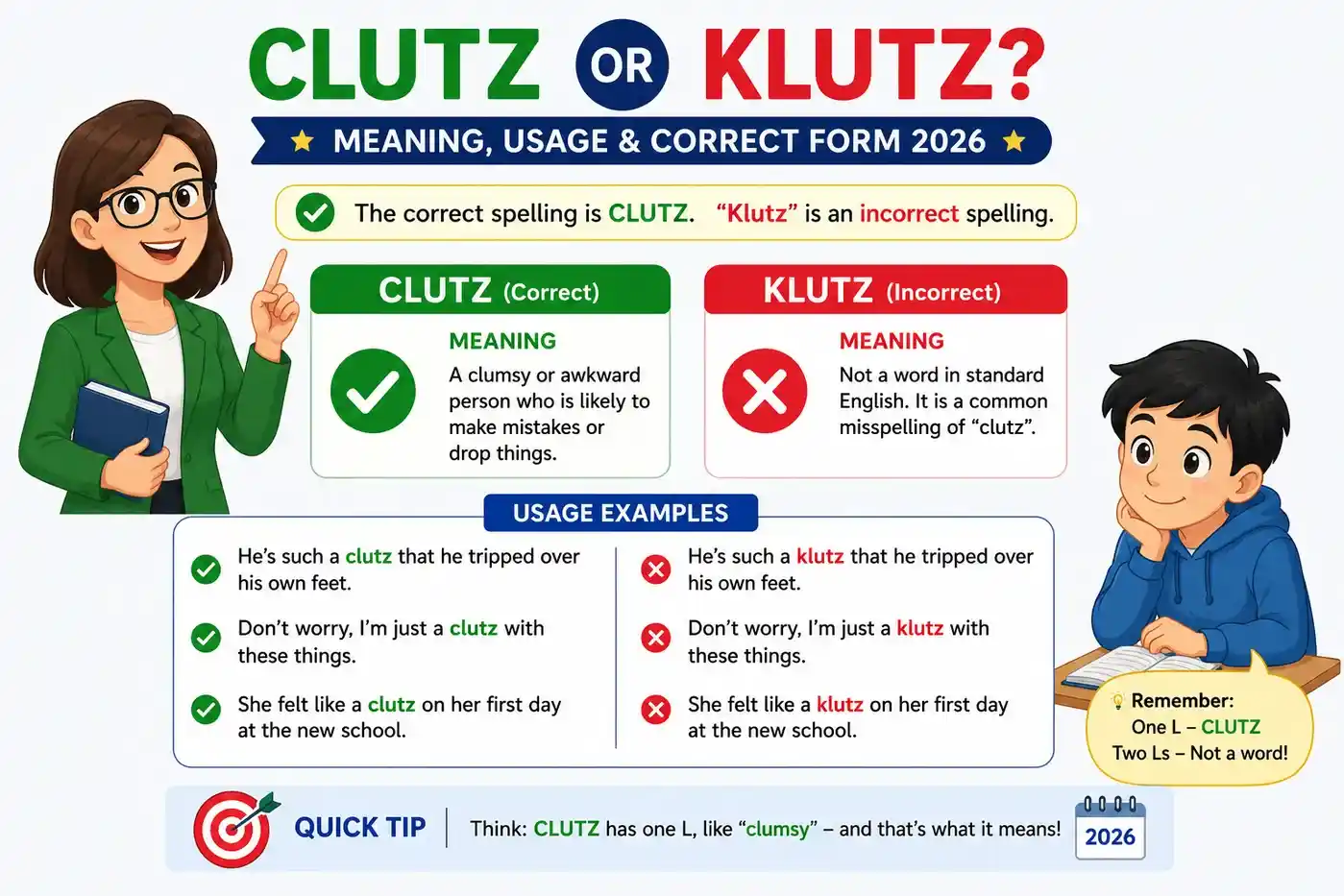
If you’ve ever typed clutz or klutz and stopped to wonder which spelling belongs in your sentence you’re not alone. The two forms look almost identical and both appear in English writing. However there’s a clear preferred spelling in standard modern English.
Klutz is the standard and widely recognized spelling. It means a clumsy person who often drops things bumps into objects or handles tasks awkwardly. Clutz also appears in dictionaries as a variant spelling in some references but klutz is the safer choice for general American English writing.
The confusion makes sense because the word is pronounced with a hard k sound. English spelling often uses c to represent that sound before certain vowels. That pattern can make clutz feel perfectly natural even though klutz has the stronger historical connection to the word’s source. If you’re writing an email school assignment article or professional document use klutz. It’s familiar to American readers and avoids unnecessary spelling questions.
Quick Answer
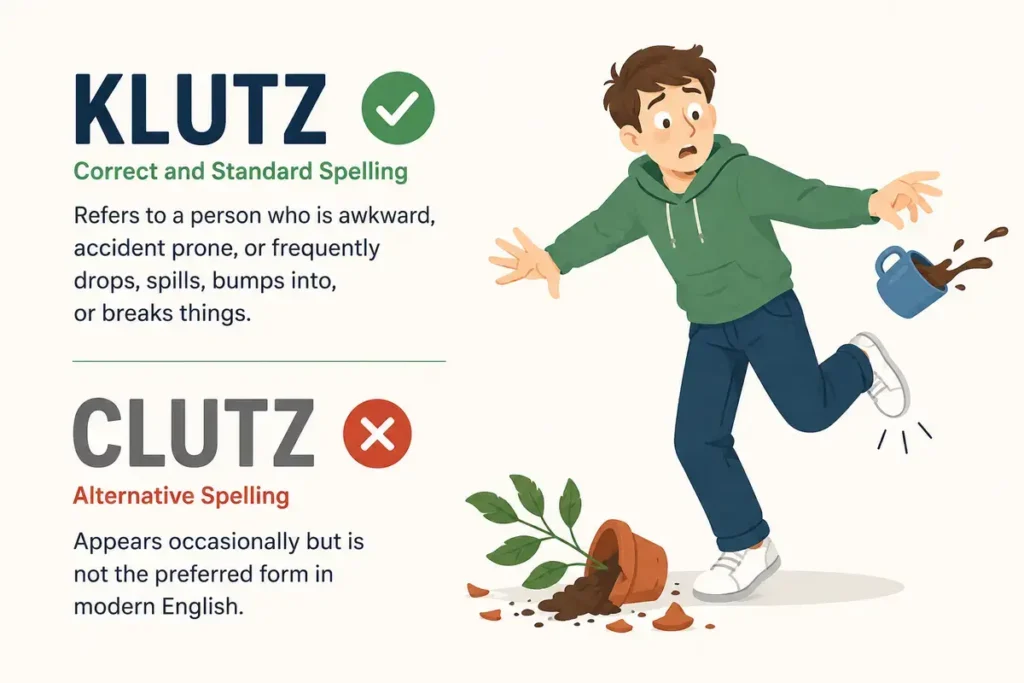
Klutz is the preferred standard spelling in modern English. It refers to a clumsy or awkward person. Clutz is also found as a variant spelling but it’s much less common. If you want the safest choice for everyday American English and formal writing use klutz.
Comparison Table
| Form | Meaning | Part of Speech | Origin | Usage Frequency | Formality | Common Contexts | Example |
|---|---|---|---|---|---|---|---|
| Klutz | A clumsy or awkward person | Noun | Yiddish | Common | Informal | Conversation writing humor storytelling | I’m such a klutz today. |
| Clutz | Same basic meaning | Noun | Variant spelling | Less common | Informal | Casual writing and spelling variation | He called himself a clutz after dropping the glass. |
The important point is that these forms don’t represent two different meanings. The main difference is spelling preference and frequency.
For most readers klutz will look familiar immediately. It has become the established form in general English. Clutz can still be encountered because English speakers sometimes spell the word according to its pronunciation rather than its historical form.
What Does Klutz Mean
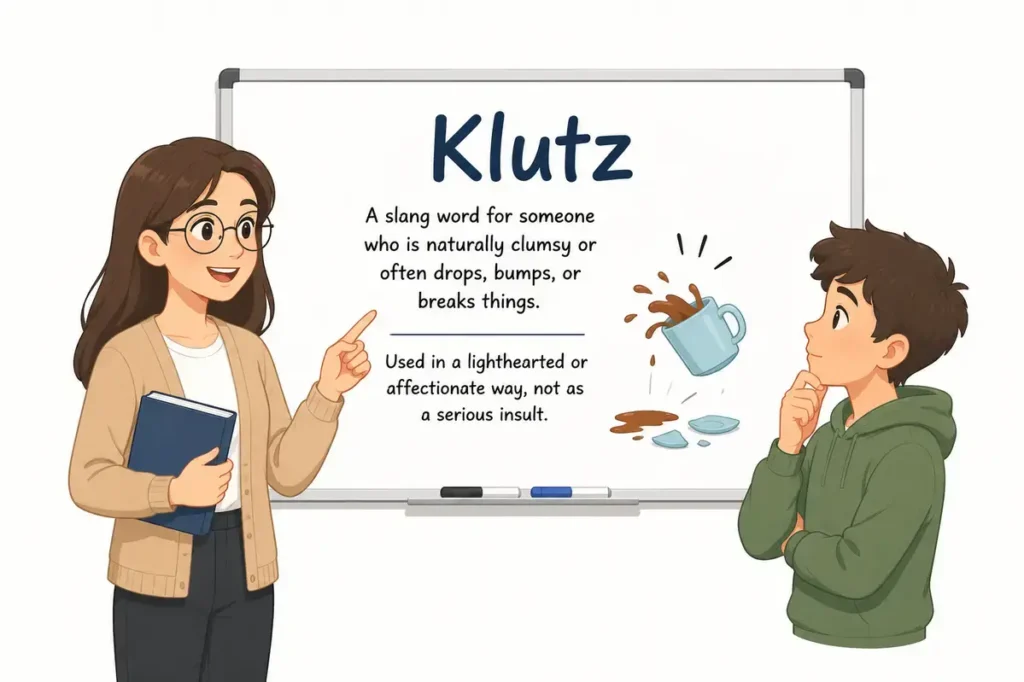
A klutz is a person who is noticeably clumsy or awkward.
The word usually describes someone who has trouble moving or handling things smoothly. A klutz might trip over a chair leg spill a drink drop a phone or knock something off a table without meaning to.
The word is usually informal and often carries a playful tone. Calling someone a klutz doesn’t always mean you think the person is seriously incapable. In many situations it’s a lighthearted way to describe an embarrassing moment.
For example someone might say that they’re a klutz after walking into a glass door. They aren’t making a serious judgment about their personality. They’re simply laughing at their own awkward mistake.
The word can also describe a person who regularly has these kinds of accidents.
You might hear:
- I’m such a klutz around the kitchen.
- He’s a great athlete but he’s a total klutz when he tries to dance.
- She felt like a klutz after dropping all the papers.
The tone depends heavily on context. Used about yourself the word often sounds humorous. Used about another person it can sound teasing or mildly insulting.
That’s why context matters.
Is Clutz Wrong
Not necessarily. Clutz is a real spelling variation that appears in English usage. However it isn’t the form most writers should choose when they simply want the standard spelling.
The distinction matters because a word can have more than one accepted spelling without both forms having equal status or frequency. English has many spelling variants. Some become dominant in everyday writing while others remain uncommon. That’s the situation here.
If your goal is clear modern American English klutz is the better choice. Think of it this way. Clutz isn’t usually a completely different word. It’s a less common spelling of the same term.
This also explains why spellcheckers may react differently depending on the dictionary they use. Some systems may recognize both forms while others may suggest klutz when you type clutz. A spelling checker isn’t always making a judgment about meaning. It may simply be using a word list that prefers one form.
Why People Spell It As Clutz
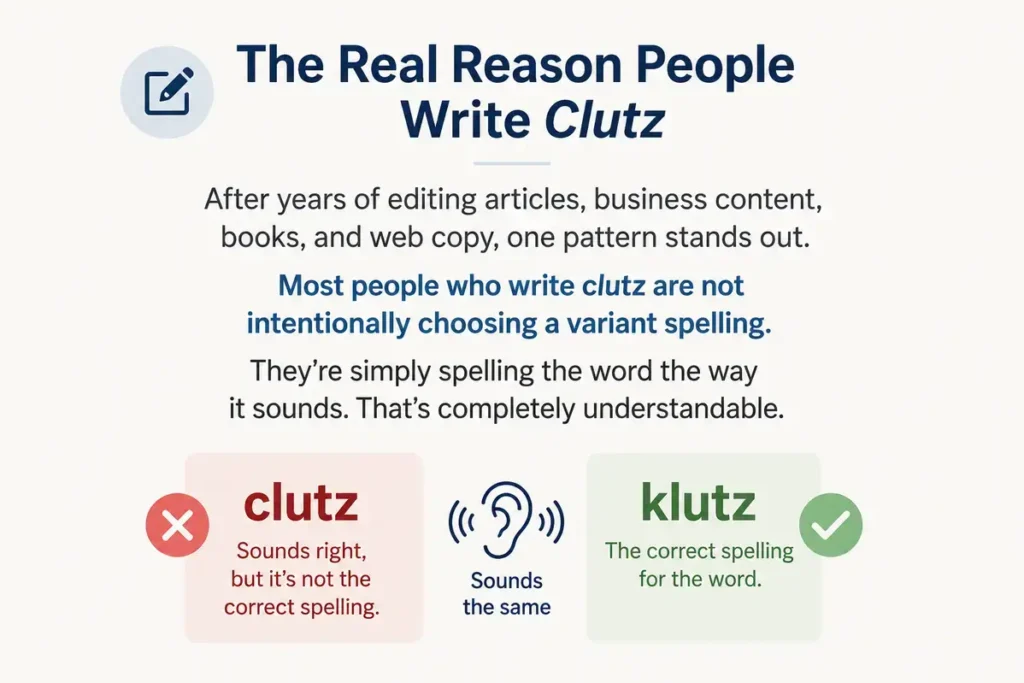
The main reason is pronunciation. The word klutz begins with a hard k sound. English readers naturally know that the letter c can sometimes represent the same sound. Words such as cat and class use c for a hard k sound.
So a person who has heard the word but hasn’t seen it written may reasonably guess clutz. That kind of mistake is common in English. People often spell unfamiliar words based on the sounds they hear. There’s another reason for the confusion. The word doesn’t look strongly English in origin. Its unusual letter combination can make the spelling harder to remember.
The kl beginning gives you a useful clue. It reflects the word’s Yiddish and German background rather than a typical English spelling pattern. Once you know that history the spelling becomes easier to remember.
Which Spelling Should You Use
Use klutz in most situations.
That includes school writing professional communication online articles general nonfiction and everyday messages.
You can use clutz if you’re intentionally following a source or style that uses that spelling. It may also appear in names titles or other specific contexts where changing the spelling would be inappropriate.
For ordinary writing there’s little reason to choose the less common form.
A professional editor who sees clutz in a normal sentence may change it to klutz if the publication follows standard modern usage.
The same principle applies to proofreading. If you’re unsure which form belongs in your sentence don’t overthink the meaning. The meaning is essentially the same. Choose the established spelling.
How To Pronounce Klutz
The pronunciation is straightforward.
IPA: /klʌts/
An easy pronunciation guide is kluts.
The word has one syllable.
The beginning sounds like the cl in clap. The middle vowel sounds like the u in cup. The final sound is similar to the ending of cuts.
The pronunciation does not change simply because someone writes the variant form as clutz.
You can think of the sound as:
kluts
The biggest pronunciation mistake is usually not a wrong vowel but overcomplicating the word because of its unusual spelling.
Say it as one short syllable.
Grammar And Part Of Speech
Klutz is primarily a noun.
It refers to a person who behaves clumsily or has a tendency to make physical mistakes.
The word commonly appears after forms of be.
For example:
I’m a klutz.
He’s a klutz.
She can be a klutz sometimes.
It can also appear after possessive words.
My brother is a klutz.
That kid is such a klutz.
The plural form is klutzes.
For example:
The two klutzes knocked over the display.
Notice that the word describes a person rather than the action itself.
You wouldn’t normally use klutz as a replacement for the adjective clumsy in every sentence.
You can say:
He is clumsy.
You can also say:
He is a klutz.
The first sentence describes his behavior or physical manner. The second labels him as a person who tends to behave clumsily.
That difference is small but useful.
Klutz As A Noun
The noun form is the most common use.
A noun names a person place thing or idea. In this case the word identifies a person known for clumsy behavior.
For example:
My friend is a klutz.
That sentence says something about the person.
You can also use it after an article.
He’s a klutz.
She’s a klutz.
I’m a klutz.
Because the word is countable you can use a before the singular noun in normal sentences.
You can also make it plural.
They’re both klutzes.
The plural ending follows the usual English pattern for many nouns.
Klutz And Clumsy Are Not Exactly The Same
These words are closely related but they don’t function in exactly the same way.
Clumsy is usually an adjective.
Klutz is a noun.
Compare these sentences:
He is clumsy.
He is a klutz.
The first describes a quality. The second identifies the person as someone who is clumsy.
You can also use clumsy in situations where no person is involved.
That was a clumsy mistake.
Her explanation was clumsy.
The word klutz doesn’t work the same way because it normally refers to a person.
This distinction helps prevent a common grammar mistake. Don’t treat the two words as interchangeable in every sentence just because they have related meanings.
Ten Natural Sentence Examples
Here are natural examples that show how the preferred spelling works in real writing.
- I’m such a klutz that I dropped my phone before breakfast.
- My brother is a klutz in the kitchen but he makes great food.
- She laughed after realizing what a klutz she had been.
- I felt like a complete klutz during my first skating lesson.
- He’s usually careful but he can be a real klutz when he’s tired.
- Don’t worry about the broken cup. I’m the klutz who knocked it over.
- The kids teased him for being a klutz after he tripped over his own backpack.
- I’m a bit of a klutz so I keep my coffee away from my laptop.
- She may be a klutz at home but she’s incredibly graceful on stage.
- His friends jokingly called him a klutz after he spilled water on the table.
These examples also show the word’s tone. It often works best in casual speech and lighthearted writing.
Common Spelling Mistakes
Several mistakes can appear around this word. Most come from pronunciation or uncertainty about its unusual spelling.
Writing Clutz In Standard General Usage
Less preferred: clutz.
Preferred: klutz.
The first spelling can be found in real usage but the second is the safer standard choice for most readers.
Adding An Extra Vowel
Some writers may produce forms such as klutze or klutzy when they’re trying to create related words.
The correct adjective is klutzy.
For example:
He’s a little klutzy today.
The ending changes because English forms adjectives from nouns in different ways.
Using Klutz As An Adjective
A sentence such as he is very klutz is grammatically wrong.
Use:
He is very clumsy.
Or:
He is a klutz.
The noun requires a structure that treats it as a person or thing being identified.
Using Klutz To Describe An Object
You generally shouldn’t call a chair a klutz.
The word refers to a person.
You can describe the chair as awkward or difficult to handle but klutz isn’t normally used for the object itself.
Confusing Klutz With Klutzy
These words are related but they have different grammatical roles.
Klutz is a noun.
Klutzy is an adjective.
You can say:
She’s a klutz.
You can also say:
She’s klutzy.
The meaning is closely connected but the sentence structure is different.
Etymology And Word Origin
The history of klutz explains its unusual spelling.
The word entered American English from Yiddish. It is connected to a Yiddish word meaning a clumsy or awkward person. The Yiddish form is related to German klotz which refers to a block or lump and developed related figurative meanings involving an awkward or clumsy person.
The word became established in American English through contact with Yiddish speaking communities and eventually entered broader everyday American vocabulary.
That history also helps explain why the spelling begins with kl.
English has borrowed thousands of words from other languages. Once borrowed words become common enough they often begin to feel completely native to English speakers. Klutz is a good example.
Today most Americans don’t need to know its Yiddish background to understand it. It has become a familiar informal word for a clumsy person.
The historical connection is still useful when you’re trying to remember the spelling.
American English Usage
In American English klutz is a familiar informal word.
You’re likely to encounter it in conversation casual writing humor personal stories and informal commentary.
It often carries a friendly or self mocking tone.
For example someone who accidentally drops their keys might laugh and say they’re a klutz.
That doesn’t necessarily mean they think they’re constantly incompetent. The word can describe one silly moment.
American English also uses related forms such as klutzy.
For example:
I’ve been feeling klutzy all morning.
That adjective describes clumsy behavior.
The noun and adjective work naturally together but they shouldn’t be confused.
British English Usage
British English speakers understand klutz but the word is strongly associated with American English.
A British speaker might choose words such as clumsy person or bungler depending on the situation.
Still klutz isn’t mysterious to British readers. It appears in English writing and can be used when the writer wants the informal term.
There’s no major meaning difference that changes the basic definition.
The bigger issue is register. The word is casual and slightly humorous. It isn’t the kind of term you’d normally choose for formal technical writing.
Canadian English Usage
Canadian English generally follows the same spelling preference as American English.
Klutz is recognizable and can be used in casual communication.
The variant clutz may also appear because speakers encounter it through informal writing or because they spell the word according to its sound.
For ordinary Canadian or American English the established form remains the better choice.
Australian English Usage
Australian readers can understand klutz but the word may feel less central to everyday vocabulary than it does in American English.
The meaning remains the same.
Local alternatives such as clumsy may sound more natural in many situations. However the spelling issue doesn’t change. If you choose this particular word klutz is the preferred form.
Formal And Informal Usage
The word is informal.
That doesn’t make it wrong. It simply means you should match it to the situation.
In a casual conversation it works perfectly.
In a friendly email it can add personality.
In a personal essay it can create a relaxed voice.
In a formal business report it may sound too casual.
For example:
I’m such a klutz. I dropped my badge again.
That sounds natural in conversation.
But in a formal workplace report you might write:
The employee accidentally dropped the equipment.
The second sentence sounds more neutral and professional.
Good writing isn’t only about choosing grammatically correct words. It’s also about choosing words that fit the setting.
Klutz In Everyday Conversation
This is where the word feels most at home.
People often use it to laugh at their own mistakes.
Imagine someone carrying three cups of coffee and dropping one. They might say:
I’m such a klutz.
The phrase is short and expressive. It tells listeners that the person recognizes the mistake and isn’t taking it too seriously.
You can also use the word to describe someone else in a playful way.
My dad is a klutz with his phone.
That sentence sounds teasing rather than harsh if the relationship supports that tone.
Still be careful. Calling another person a klutz can sound insulting if the situation is serious or the person doesn’t know you well.
Klutz In Workplace Communication
The word can work in informal workplace conversations but context matters.
A coworker might say:
I was such a klutz this morning. I spilled coffee all over my notes.
That sounds natural.
In a formal email to a client you’d probably avoid labeling yourself or another person this way.
Instead say:
I accidentally spilled coffee on the documents.
The second version communicates the same basic event without using a casual label.
Professional editors often think about tone this way. A word can be correct and still be the wrong choice for a particular audience.
Klutz In Academic Writing
Academic writing usually favors precise and neutral language.
For that reason klutz is rarely the best choice in a serious academic paper unless the word itself is the subject of analysis.
If you’re writing about language you can absolutely discuss it.
For example:
The term klutz entered American English through Yiddish.
That sentence is appropriate because the word is being discussed directly.
If you’re writing about human movement or performance you would normally use clumsy or another precise term instead.
Academic writing rewards accuracy. Informal labels can distract readers when a more exact description is available.
Klutz In News And Journalism
Journalists may use the word in informal features opinion pieces entertainment writing or humorous descriptions.
It can quickly create a picture of someone who is physically awkward.
A straight news report would usually use more neutral wording if the person’s clumsiness is relevant to the facts.
The choice depends on the publication and the purpose of the sentence.
That’s a useful lesson for any writer. Vocabulary isn’t simply correct or incorrect. Register matters.
Related Words And Confused Terms
Understanding nearby words can make this vocabulary easier to use.
Clumsy
Clumsy is the closest everyday synonym.
It can describe a person’s movements actions or even an awkward piece of writing.
Example:
He’s clumsy with his hands.
Awkward
Awkward has a broader meaning.
It can describe physical movement social situations wording or uncomfortable circumstances.
A person can be awkward without being physically clumsy.
Klutzy
Klutzy is the adjective related to klutz.
It means clumsy or awkward in movement or handling things.
Example:
I’ve been unusually klutzy today.
Bungler
A bungler is someone who repeatedly handles tasks badly.
The word can suggest poor skill rather than simple physical clumsiness.
Butterfingers
Butterfingers is an informal expression for someone who often drops things.
It focuses more specifically on poor control while holding or catching objects.
Blunderer
A blunderer is someone who makes repeated mistakes or serious errors.
The mistakes don’t have to involve physical clumsiness.
Graceful
Graceful is a useful opposite in physical contexts.
A graceful person moves smoothly and naturally.
Nimble
Nimble describes someone who moves quickly and easily.
It can also describe mental quickness.
These related words show why klutz has a particular place in English. It’s not simply another word for any kind of mistake.
Expert Editor Insight
An experienced editor would normally keep klutz when the writer wants an informal and slightly humorous word for a clumsy person. If the audience needs a neutral or professional tone then clumsy person is usually clearer. Editors also pay attention to the noun and adjective forms because klutz and klutzy serve different grammatical roles. When a spellchecker flags clutz the safest move for general English is to use klutz.
A Simple Memory Trick
If you regularly forget the spelling try connecting the word to its origin.
Think:
K starts klutz.
The unusual kl opening is part of what makes the word distinctive.
You can also connect it with klutzy.
If you remember the adjective klutzy then the noun klutz becomes easier to recall.
Another useful trick is to remember that the word looks unusual because it comes from a language background outside traditional English spelling patterns.
You don’t need to memorize its full history. Just remember that the unusual beginning is intentional.
How Dictionaries Treat The Two Spellings
Dictionary treatment can vary because dictionaries have different editorial policies and may record variants differently.
The important practical point is that klutz has become the established form in general English.
A dictionary may list clutz as a variant rather than treating it as an entirely separate word.
That distinction matters.
When a dictionary lists a variant it doesn’t automatically mean the two forms have identical popularity or suitability in every context.
Think of dictionary entries as maps of actual language use. They can record forms that people use even when one form is clearly more common.
For everyday writing you don’t need to chase every possible variant. Choose the form that readers are most likely to recognize immediately.
That form is klutz.
Why The Word Can Feel Insulting
The word is often playful but it can still hurt if used carelessly.
Calling yourself a klutz usually sounds harmless.
Calling a friend a klutz can be funny if you have a relaxed relationship.
Calling a stranger a klutz after they make a mistake can sound rude.
Tone comes from more than vocabulary. Facial expression context relationship and situation all affect how a word lands.
This is especially important with labels that describe people.
If someone is embarrassed after making a mistake there may be a better way to respond than calling them a klutz.
Language works best when the meaning and the social setting line up.
Is Klutz Appropriate In Formal Writing
Usually not.
The word is informal and conversational. It can appear in formal writing when discussing the word itself or when a quotation or deliberate informal voice requires it.
Otherwise choose a more neutral expression.
Instead of:
He was a klutz during the demonstration.
You might write:
He handled the equipment awkwardly during the demonstration.
The best choice depends on your purpose.
If you’re writing a personal story then klutz can add warmth and personality. If you’re writing a formal report then a precise description is usually better.
Can You Use Klutz In A Sentence
Yes. The word works naturally as a noun. Common sentence patterns include: I’m a klutz. He’s such a klutz. She can be a klutz sometimes. My brother is a complete klutz in the kitchen. You can also use the plural: They’re both klutzes. The word normally describes a person rather than an action or object. If you need an adjective use klutzy or clumsy instead. That simple grammar distinction will prevent most usage problems.
Final Takeaway
The answer to clutz or klutz is straightforward. Klutz is the preferred spelling in modern English and is the form you should normally use in American English writing. It means a clumsy or awkward person and usually carries an informal or humorous tone. Clutz exists as a less common spelling variant but it isn’t the safest choice when you want standard usage.
The easiest memory trick is to remember the unusual kl beginning and connect it with klutzy. If you’re proofreading your own work and see clutz in an ordinary sentence change it to klutz unless you have a specific reason to preserve the variant.
FAQs
Is clutz a real word?
Yes. Clutz appears as a spelling variant in English usage. However klutz is the preferred and more established spelling for general modern English. If you’re writing for an American audience and want the safest standard form use klutz.
What does klutz mean?
A klutz is a clumsy or awkward person. The word usually describes someone who tends to drop things bump into objects or make physical mistakes. It’s informal and often humorous. People commonly use it about themselves after an embarrassing accident.
Which is correct clutz or klutz?
Klutz is the preferred spelling. Clutz is a less common variant. The two forms have essentially the same meaning but they don’t have the same level of standard usage. For school writing professional communication and general American English choose klutz.
How do you pronounce klutz?
Klutz is pronounced with one syllable. The IPA pronunciation is /klʌts/. An easy way to say it is kluts. The beginning has a hard k sound and the final sound is similar to the ending of cuts.
Can klutz start a sentence?
Yes. There is no grammar rule that prevents the word from beginning a sentence. For example you could write Klutz is an informal noun for a clumsy person when discussing the word itself. In ordinary writing you’ll more often see it used after a subject and verb.
What is a synonym for klutz?
Useful synonyms include clumsy person and bungler. Butterfingers can work when the focus is on dropping or mishandling objects. Awkward person is broader and doesn’t always imply physical clumsiness. The best synonym depends on the exact situation and tone.
Why do people spell klutz as clutz?
The confusion mainly comes from pronunciation. The word begins with a hard k sound so people who hear it without seeing it written may naturally choose c. English allows c to represent a hard k sound in many words. The historical spelling of klutz helps explain why the k remains standard.
Is klutz appropriate in formal writing?
Usually klutz is better suited to informal writing and conversation. It can sound playful or humorous. In formal reports academic papers and professional documents a neutral term such as clumsy person is often a better choice. You can still use the word when discussing its meaning or history.
