
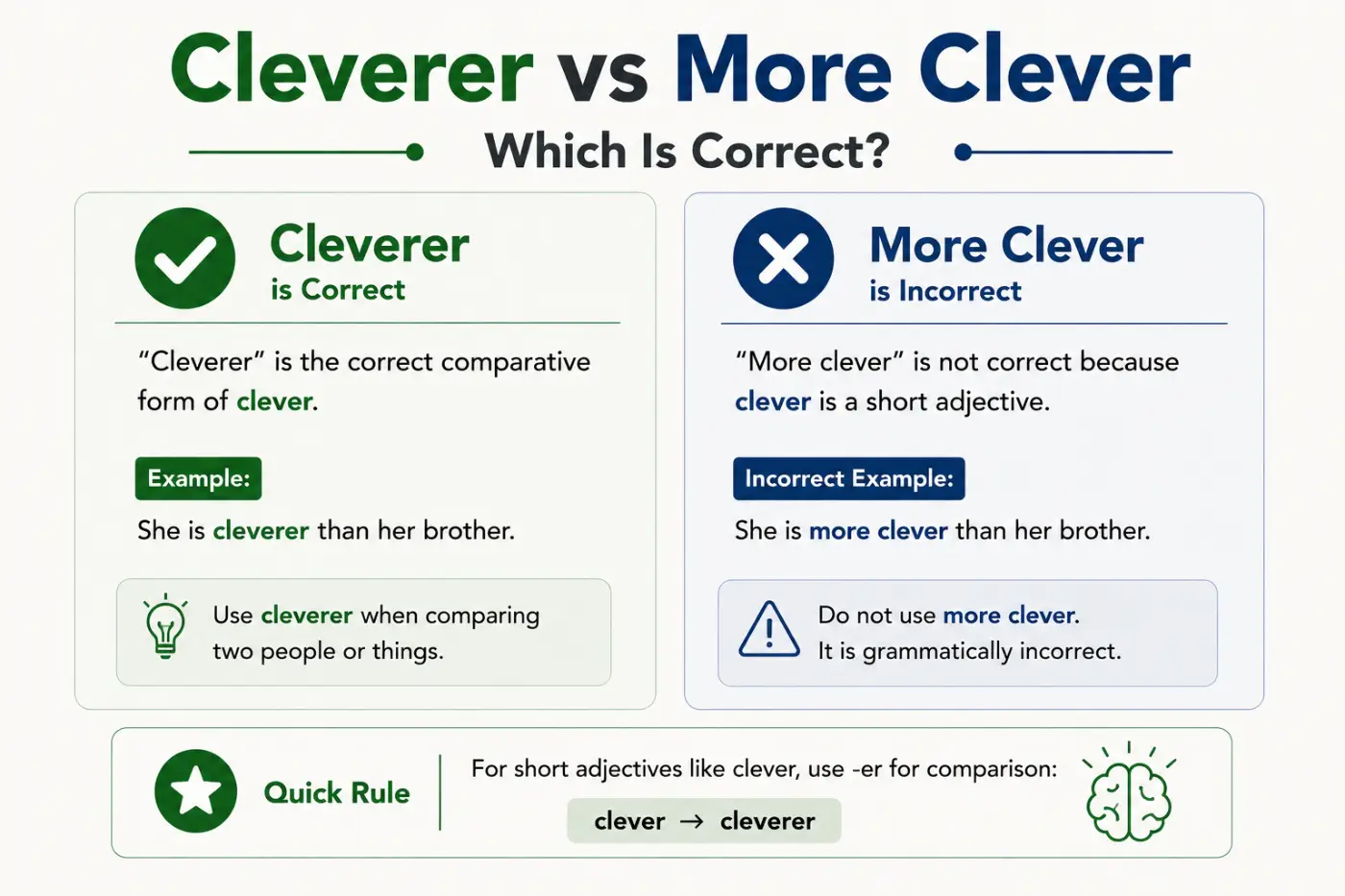
If you’ve ever stopped while writing and wondered if you should use cleverer vs more clever you’re dealing with a real feature of English grammar. Both forms are correct. Neither one is a misspelling. The difference comes from how English forms comparative adjectives and how a sentence sounds when you say it aloud.
The adjective clever has two syllables and belongs to a group of adjectives that can accept more than one comparative pattern. You can say that someone is cleverer than another person. You can also say that someone is more clever than another person. Major learner dictionaries recognize both patterns. Oxford lists cleverer as the comparative and also says that more clever can be used.
That means you don’t need to worry that one form is grammatically wrong. Instead you need to understand when each version feels natural. This guide explains the grammar behind both forms and shows you how native speakers use them in everyday speech formal writing school work workplace communication and other situations.
Quick Answer
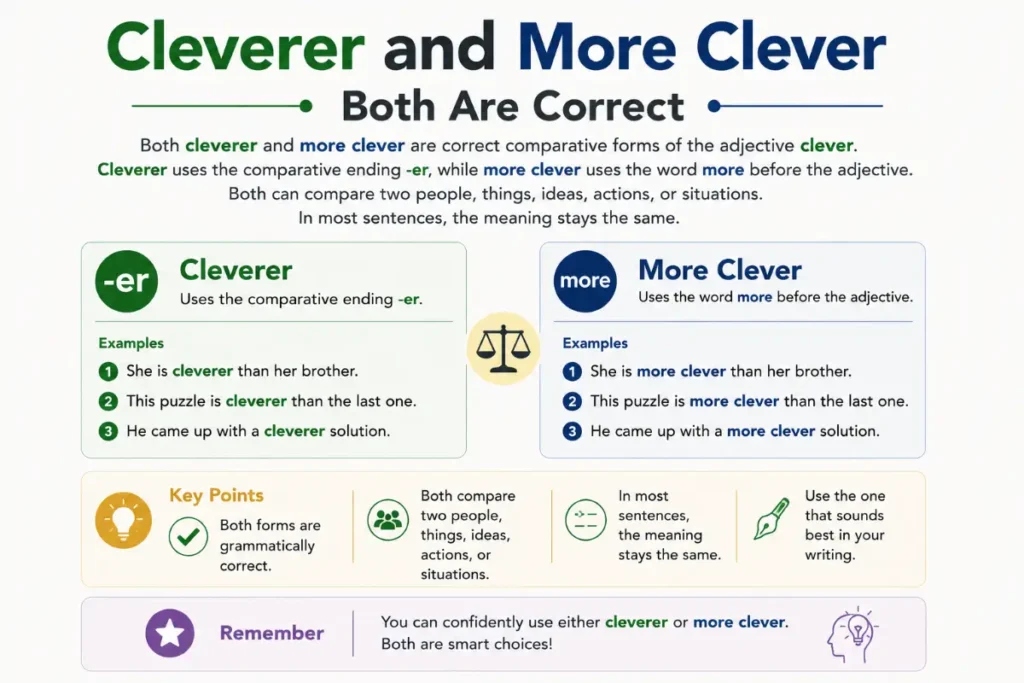
Both cleverer and more clever are correct comparative forms of the adjective clever. Cleverer uses the comparative ending er while more clever uses the word more before the adjective. Both can compare two people things ideas actions or situations. In most sentences the meaning stays the same.
Comparison Table
| Form | Meaning | Part of Speech | Comparative Pattern | Formality | Common Contexts | Example |
|---|---|---|---|---|---|---|
| Cleverer | Having a greater degree of cleverness | Adjective | clever + er | Standard | Conversation writing school work | Maya is cleverer than Jake. |
| More clever | Having a greater degree of cleverness | Adjective phrase | more + clever | Standard | Conversation writing formal prose | Maya is more clever than Jake. |
| Cleverest | Having the greatest degree of cleverness | Adjective | clever + est | Standard | Comparisons among three or more | Maya is the cleverest student here. |
| Most clever | Having the greatest degree of cleverness | Adjective phrase | most + clever | Standard | Formal and general writing | Maya is the most clever student here. |
Why Both Forms Are Correct
English has several ways to create comparative adjectives.
With many short adjectives you add er.
Tall becomes taller.
Fast becomes faster.
Bright becomes brighter.
With many longer adjectives you use more.
Careful becomes more careful.
Interesting becomes more interesting.
Expensive becomes more expensive.
The interesting part comes with some two syllable adjectives. They can accept either pattern. Clever belongs to this group. Cambridge Grammar specifically gives cleverer as an example of a two syllable adjective that can take the er form.
Oxford also gives direct support for both comparative patterns. Its American English dictionary lists cleverer and cleverest while also noting that more clever and most clever can be used.
So the grammar is not a simple rule that says every adjective with two syllables must use more. English has exceptions and flexible patterns. Native speakers learn these patterns through exposure and usage. Writers can also rely on established dictionary guidance when they need confidence.
What Clever Means
Clever is an adjective that usually describes intelligence or mental ability. It can describe someone who learns quickly understands things easily or finds effective solutions.
For example:
She is a clever student.
He found a clever solution to the problem.
That was a clever idea.
The adjective can also describe skill or ingenuity. A clever design can be well planned and effective. A clever tool can solve a problem in a simple way.
Cambridge defines clever in terms of the ability to learn and understand things quickly and easily. It also gives uses connected with skill and well designed ideas or objects.
That broader meaning matters when you use the comparative. A cleverer solution does not always mean a solution created by a person with greater intelligence. It can mean a solution that is more inventive or better designed.
Consider this sentence:
The new system is cleverer than the old one.
The writer may be talking about design rather than intelligence. The new system may solve the same problem with fewer steps or a more creative method.
How The Comparative Works
A comparative adjective expresses a higher degree of a quality between two things.
Clever becomes cleverer.
You can then add than when you name the person or thing being compared.
Sarah is cleverer than Anna.
This puzzle is cleverer than the first one.
His solution was cleverer than mine.
The other pattern uses more before the unchanged adjective.
Sarah is more clever than Anna.
This puzzle is more clever than the first one.
His solution was more clever than mine.
The basic meaning remains the same. Cambridge grammar materials recognize the two patterns for clever and note that some two syllable adjectives can use both forms.
The important point is that the comparative idea appears only once. You either create the comparison with er or create it with more.
Cleverer Or More Clever In Everyday English
In everyday conversation both forms can work naturally.
You might hear:
My brother is cleverer than me.
You might also hear:
My brother is more clever than me.
Neither sentence creates a grammar problem.
The shorter form can sound quick and direct. The longer form can sometimes fit the rhythm of a sentence more smoothly.
Say these aloud:
She is cleverer than her sister.
She is more clever than her sister.
The first has a compact rhythm. The second gives the comparison its own word. Neither one changes the basic meaning.
Good writing is not only about rules. Sound matters too. A sentence can be grammatically correct and still feel awkward because of rhythm. Experienced editors often read difficult sentences aloud for exactly this reason.
When Cleverer Sounds Natural
Cleverer often works well in short direct comparisons.
Examples include:
He is cleverer than his brother.
This student is cleverer than I expected.
The second plan is cleverer than the first.
Our new solution is cleverer and cheaper.
The word fits especially well when the sentence is already short. Adding more can make the sentence longer without adding meaning.
Cleverer also works naturally when the comparative is followed by another comparative structure.
For example:
The team became cleverer at solving difficult problems.
The designers developed cleverer ways to use the available space.
The children grew cleverer at spotting patterns.
These sentences are easy to understand because the comparative ending attaches directly to the adjective.
When More Clever Sounds Natural
More clever is also completely standard.
It can work especially well when the sentence has a contrast or a balanced structure.
For example:
The plan was more clever than practical.
Her answer was more clever than accurate.
The second design is more clever but less useful.
That approach is more clever in theory than in practice.
In these sentences more can help create a balanced rhythm. The structure also makes the degree of comparison very clear.
This is one reason writers should not treat grammar as a rigid collection of mechanical rules. Two forms can be correct while one may fit a particular sentence better.
Which Form Should You Choose
If you need a simple practical rule use the form that sounds natural in your sentence.
Cleverer is a direct and compact comparative. More clever is an equally valid alternative that may suit the rhythm or structure of a sentence better.
For most ordinary comparisons you can use either.
For example:
The new student is cleverer than the old one.
The new student is more clever than the old one.
Both are standard.
You don’t need to change one simply because the other exists.
The best editing habit is to read the complete sentence rather than judging the adjective in isolation. If the sentence flows naturally and the grammar is correct you have a good choice.
The Difference In Meaning
There is usually no difference in basic meaning between the two comparative forms.
Both can mean having more intelligence skill ingenuity or mental quickness.
Compare:
David is cleverer than Mark.
David is more clever than Mark.
Both sentences tell us that David shows a greater degree of cleverness than Mark.
The difference is grammatical form rather than core meaning.
Context can affect the exact sense of clever. A clever person may be intelligent. A clever answer may be witty. A clever design may be inventive. A clever solution may be efficient.
The comparative follows the same meaning in each case.
For example:
This is a cleverer solution.
This is a more clever solution.
Both can describe a solution that shows greater ingenuity.
Grammar And Part Of Speech
Clever is an adjective.
It can appear before a noun.
She is a clever writer.
He found a clever solution.
They built a clever device.
It can also appear after a linking verb.
She is clever.
He seems clever.
The idea sounds clever.
The comparative forms remain adjectives.
Cleverer can come before a noun.
She suggested a cleverer approach.
He found a cleverer solution.
More clever can also appear before a noun.
She suggested a more clever approach.
He found a more clever solution.
Both forms can also appear after linking verbs.
She is cleverer than her sister.
She is more clever than her sister.
The grammatical function stays the same. The adjective simply expresses a higher degree of the quality.
Comparing Two Things Correctly
Comparatives normally compare two people or things.
The word than often introduces the second part of the comparison.
For example:
Liam is cleverer than Noah.
This solution is more clever than the previous one.
Her explanation was cleverer than mine.
The final clause can sometimes be shortened when the meaning is obvious.
For example:
His answer was cleverer than expected.
The full meaning is that his answer was cleverer than people expected.
This kind of shortened comparison is common in natural English.
You can also use a comparative without naming the second item.
For example:
We need a cleverer solution.
The team needs a more clever approach.
The comparison is understood from context. The writer does not need to explain every detail.
Cleverer Than Me Or Cleverer Than I Am
This point often causes more confusion than the adjective itself.
In everyday American English you will commonly hear:
She is cleverer than me.
He is more clever than me.
These forms are natural in conversation.
A more formal version is:
She is cleverer than I am.
He is more clever than I am.
The second structure makes the grammar completely explicit. Cambridge grammar guidance also uses the pattern with a subject pronoun followed by be in more formal comparisons.
The choice depends on tone and context.
In casual conversation you might say:
My sister is smarter than me.
In formal school or professional writing you may prefer:
My sister is smarter than I am.
The same principle can apply to these comparative forms.
Do Not Double The Comparative
One of the clearest mistakes is combining more with the er ending.
Incorrect:
He is more cleverer than his brother.
Correct:
He is cleverer than his brother.
Correct:
He is more clever than his brother.
The first incorrect version creates a double comparative. The word more already marks comparison. The ending er also marks comparison. Using both together is unnecessary in standard English.
The same problem appears with other adjectives.
Incorrect:
She is more faster than me.
Correct:
She is faster than me.
Incorrect:
This method is more easier.
Correct:
This method is easier.
Incorrect:
The new version is more simpler.
Correct:
The new version is simpler.
A useful editing trick is to look for two comparative markers in the same adjective phrase. If you see more followed by an adjective that already ends in er you should check the sentence.
Sentence Examples
Here are ten natural examples showing how the comparative works in different settings.
- Emma is cleverer than her brother at solving puzzles.
- The second student offered a more clever solution to the problem.
- This design is cleverer because it uses fewer parts.
- His new business idea is more clever than his original plan.
- My daughter has become cleverer at recognizing patterns.
- The engineer created a more clever way to organize the data.
- That answer was cleverer than anything I expected from the class.
- The manager suggested a more clever approach to the scheduling problem.
- The new software uses a cleverer method for sorting large files.
- Her final argument was more clever than convincing.
These examples show an important point. The adjective can describe people ideas designs methods answers plans and solutions. You should choose the form that fits the sentence naturally.
Common Mistakes And Misspellings
Using Both Comparative Forms
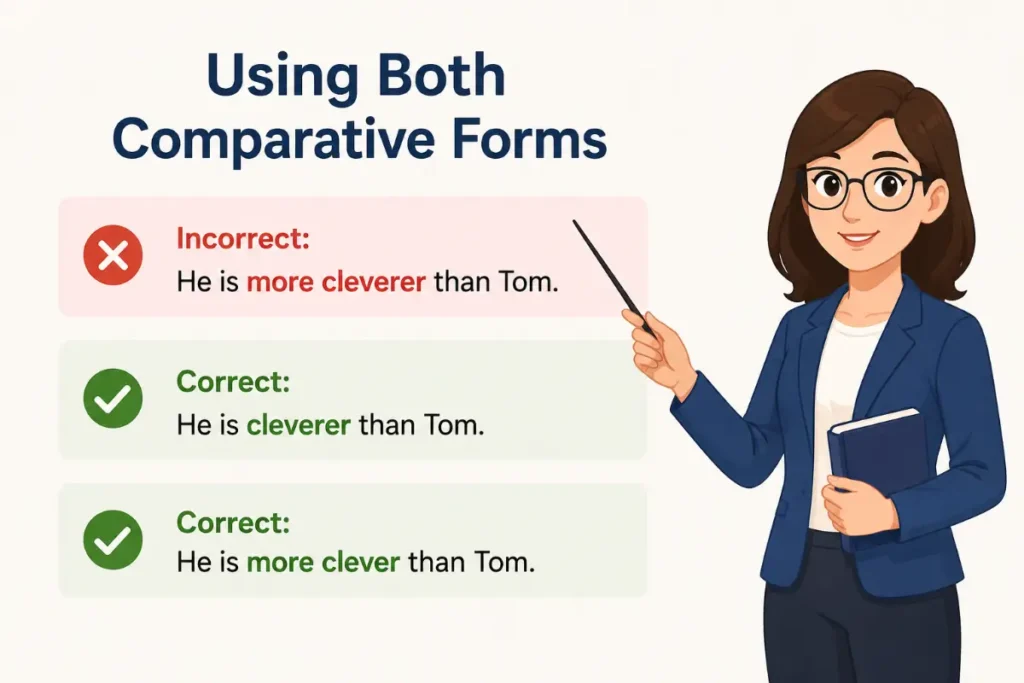
Incorrect:
He is more cleverer than Tom.
Correct:
He is cleverer than Tom.
Correct:
He is more clever than Tom.
The problem is not the word cleverer. The problem is using two comparative markers together.
Assuming More Is Required
Some learners believe that every two syllable adjective must use more.
That rule is too broad.
English allows some two syllable adjectives to take er. Clever is one of them. Cambridge explicitly lists clever among two syllable adjectives that can take the er pattern.
Assuming Er Is Required
The opposite mistake also occurs.
A writer may think that because cleverer is correct more clever must be wrong.
That is not accurate. Oxford specifically notes that more clever can also be used.
Confusing Comparative And Superlative Forms
A comparative normally compares two.
She is cleverer than her sister.
A superlative identifies the highest degree among a larger group.
She is the cleverest student in the class.
You should not use cleverest when you are making a simple comparison between two people.
Forgetting Than
A direct comparison often uses than.
He is cleverer than me.
She is more clever than her brother.
However, than does not always need to appear. Context can make the comparison clear.
For example:
We need a cleverer solution.
The writer is comparing the requested solution with the current one even though the second item is not stated.
Pronunciation Guide
In American English clever is commonly pronounced /ˈklɛvər/. The main stress falls on the first syllable.
An easy pronunciation guide is:
Clever sounds like KLEV er.
Cleverer adds another unstressed syllable:
KLEV er er.
More clever is pronounced as two separate words:
more KLEV er.
The comparative ending can make cleverer feel slightly longer than the base adjective. That does not make it incorrect. It is a normal English comparative form.
One common pronunciation mistake is trying to give every syllable equal stress. Natural English usually gives the first syllable of clever the strongest stress.
Etymology And Word Origin
The history of clever is more complicated than its simple modern meaning might suggest.
The modern adjective developed through English usage over several centuries and has had several related senses. Earlier uses were connected with ideas such as skill and dexterity before the word became strongly associated with intelligence and quick thinking.
The modern meaning covers more than raw intelligence. Depending on context clever can suggest mental ability skill ingenuity or effective design.
That explains why a clever person and a clever solution are related but not identical ideas.
A person can be clever because they understand something quickly. A plan can be clever because it solves a difficult problem in an inventive way.
The comparative follows the same broad semantic range.
American English Usage
In American English both comparative patterns are accepted.
Oxford’s American English dictionary lists cleverer as the comparative and also states that more clever can be used.
American speakers may choose one form based on sentence rhythm personal preference and context.
For example:
She is cleverer than her classmates.
She is more clever than her classmates.
Both sound understandable and grammatically acceptable.
In American English you may also find smarter more intelligent sharper brighter or more inventive used instead of either comparative form. The best synonym depends on the exact meaning.
For example smarter often sounds natural when talking about a person’s intelligence. More inventive may be better when talking about a design or solution.
British English Usage
British English also accepts both forms.
Oxford’s British learner dictionary gives cleverer as the comparative and explicitly notes that more clever is possible.
The word clever also has some usage differences across English varieties. Cambridge notes that clever can sometimes carry a mildly disapproving sense in British English when it suggests someone is being overly pleased with their own intelligence.
That does not change the comparative grammar.
A British speaker can say:
He is cleverer than his brother.
A British speaker can also say:
He is more clever than his brother.
The surrounding context determines the tone.
Australian English Usage
Australian English follows the broader English pattern here. Both comparative structures are understandable and established.
There is no major spelling rule that forces Australian writers to choose one form.
The same basic grammar applies:
She is cleverer than her friend.
She is more clever than her friend.
The choice can depend on personal style and sentence rhythm rather than a special Australian rule.
Canadian English Usage
Canadian English also follows the standard comparative patterns found across major varieties of English.
Both forms can be used.
For example:
That was a cleverer solution.
That was a more clever solution.
Canadian writers do not need to treat one form as a spelling error simply because another form may feel more familiar.
The important distinction is between accepted alternatives and genuinely incorrect constructions such as more cleverer.
Formal And Informal Writing
Both forms can appear in formal and informal writing.
You can use cleverer in a school essay.
The revised model is cleverer than the original approach.
You can also use more clever in a professional report.
The revised model is more clever than the original approach.
Neither form is automatically informal.
Still, style matters. If your sentence contains several nearby comparative structures, one version may create a smoother rhythm than the other.
Professional editors do not normally replace every instance of one form with the other. They look at the sentence as a whole.
That is a better approach than following an imaginary rule that says one form is always superior.
Real Life Usage In Conversation
In everyday conversation the choice often comes down to what feels natural in the moment.
A parent might say:
You’re getting cleverer every day.
A friend might say:
I think your idea is more clever than mine.
A teacher might say:
She is cleverer at math than I am.
Another teacher might say:
He has developed a more clever way to solve the problem.
All of these sentences can work naturally.
Real Life Usage At Work
Workplace writing often needs clear comparisons between plans methods systems and strategies.
For example:
The new process is cleverer because it removes two unnecessary steps.
The revised strategy is more clever than the original approach.
The engineering team found a cleverer solution.
The marketing team developed a more clever campaign concept.
The best choice depends on the sentence. You do not need to avoid either comparative form simply because your writing is professional.
Real Life Usage In Academic Writing
Academic writing should favor clarity over artificial formality.
You can write:
The second method provides a cleverer solution to the problem.
You can also write:
The second method provides a more clever solution to the problem.
If the word clever itself feels too informal for your academic context you might choose more precise language.
For example:
The second method provides a more efficient solution.
The second method provides a more inventive solution.
The second method provides a more sophisticated solution.
That is a vocabulary decision rather than a grammar requirement.
Real Life Usage In Storytelling
Storytelling gives writers more freedom to choose the form that fits the character and rhythm.
For example:
Maria was cleverer than anyone in the village.
Or:
Maria was more clever than anyone expected.
Both can work.
The first feels compact and direct. The second can sound slightly more deliberate.
Good prose often depends on rhythm. Sometimes a single extra syllable changes the pace of a sentence. That is one reason both forms remain useful.
Related And Confused Terms
Smarter
Smarter is a common alternative when talking about intelligence. In American English it often sounds very natural in everyday conversation.
She is smarter than her brother.
More Intelligent
More intelligent is a more explicit way to describe intellectual ability.
The researcher was more intelligent than the others expected.
It often sounds more formal than smart.
Brighter
Brighter can describe someone who learns quickly or shows strong mental ability.
He is brighter than he seems.
It can also describe light or color so context matters.
Sharper
Sharper can describe quick thinking or mental alertness.
She is mentally sharper than she was last year.
It can also describe physical edges or senses.
Wiser
Wiser refers more to judgment experience and good decisions than simple intelligence.
He became wiser after the experience.
Being clever and being wise are not the same thing.
More Inventive
More inventive works especially well when talking about ideas methods designs or solutions.
The new approach is more inventive than the old one.
It focuses on creativity rather than general intelligence.
More Skillful
More skillful describes greater ability at performing a task.
She is more skillful at negotiation than her colleague.
It is useful when clever does not capture the exact meaning.
More Resourceful
More resourceful describes someone who can find practical ways to deal with problems.
The new manager is more resourceful under pressure.
This term focuses on problem solving and adaptability.
An Easy Memory Rule
Think of clever as a flexible two syllable adjective.
You can build the comparative in two standard ways.
Clever becomes cleverer.
More comes before clever to create more clever.
The one thing you should avoid is combining both patterns.
Do not write more cleverer.
A simple mental check can help.
Ask yourself if the adjective already carries the comparative ending. If it does you usually do not need more.
Then read the complete sentence aloud.
If cleverer sounds smooth use it.
If more clever fits the rhythm better use it.
This approach keeps the grammar correct while allowing your writing to sound natural.
What Professional Editors Look For
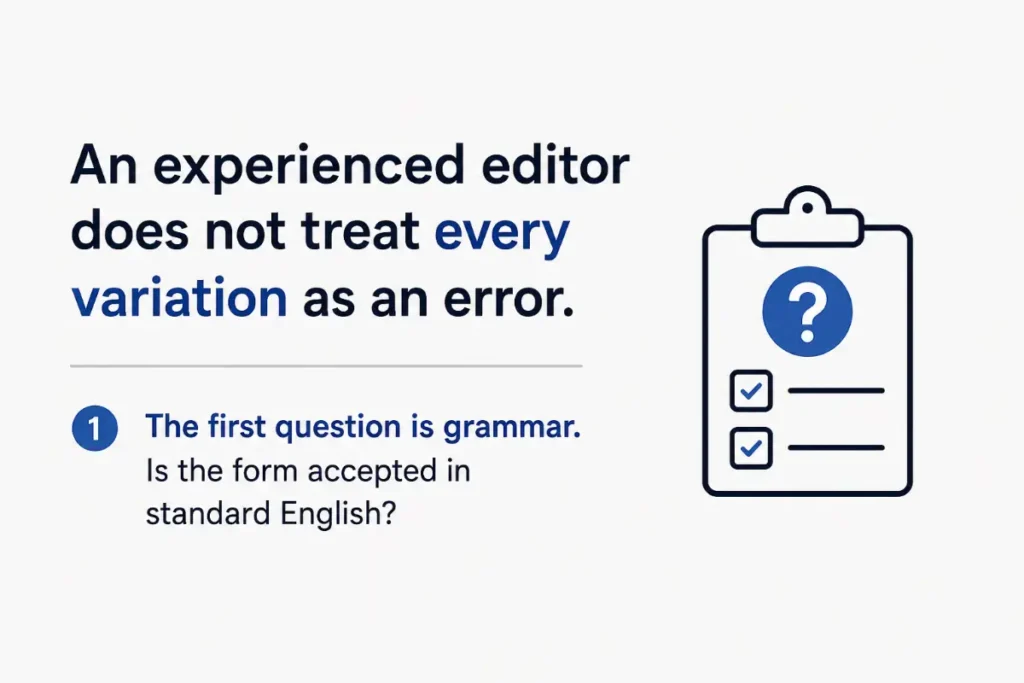
An experienced editor does not treat every variation as an error. The first question is grammar. Is the form accepted in standard English? The second question is context. Does the word express the intended meaning? The third question is rhythm. Does the sentence sound natural? The fourth question is consistency. Has the writer made a deliberate choice rather than switching forms randomly? For this particular adjective both comparative patterns are legitimate.
An editor therefore has no reason to mark one form as automatically wrong. The bigger mistake is usually more cleverer. That construction combines two comparative markers and should be corrected. Another useful editing tip is to avoid changing a correct sentence simply because another version feels more familiar. Good editing improves clarity. It does not erase valid English variation.
Final Takeaway
The choice between cleverer vs more clever is not a choice between a correct form and a mistake. Both are accepted comparative forms of clever. Cleverer uses the er ending while more clever uses more before the adjective.
For a quick direct comparison you can comfortably use cleverer. If more clever gives your sentence a better rhythm or fits a contrast more naturally you can use it instead.
The one form to avoid is more cleverer because it marks the comparative twice. When editing your sentence focus on meaning grammar and natural flow. If both options work, choose the one that sounds clearer and keep your style consistent.
FAQs
Is cleverer grammatically correct?
Yes. Cleverer is a standard comparative form of clever. Major English dictionaries recognize it. Oxford lists cleverer as the comparative form and also notes that more clever can be used.
Is more clever grammatically correct?
Yes. More clever is also a standard comparative construction. It uses more before the adjective instead of adding the er ending. The meaning is generally the same as cleverer.
Which form is more natural in American English?
Both forms can sound natural in American English. Cleverer is shorter and can feel direct. More clever can fit certain sentence rhythms better. The best choice depends on the complete sentence rather than a strict American English rule.
Can I use cleverer in formal writing?
Yes. Cleverer is acceptable in formal writing. It is not an informal or incorrect form. Still, the adjective clever itself may be less precise than terms such as intelligent inventive or effective in some formal contexts.
Can I use more clever in formal writing?
Yes. More clever can appear in formal writing because it is a grammatically valid comparative form. If the sentence reads smoothly and the meaning is clear there is no grammatical reason to reject it.
Is more cleverer correct?
No. More cleverer is not the standard comparative form. It combines more with the er ending and creates a double comparative. Use cleverer or more clever instead.
How do you pronounce cleverer?
In American English clever is commonly pronounced /ˈklɛvər/. Cleverer adds another syllable after the base form. The strongest stress remains on the first syllable. An easy guide is KLEV er er.
What is a good synonym for cleverer?
The best synonym depends on the intended meaning. Smarter works well for intelligence. More inventive fits creative ideas. More skillful fits ability. More resourceful fits practical problem solving. More intelligent is useful when you want a direct and formal reference to intellectual ability.
