
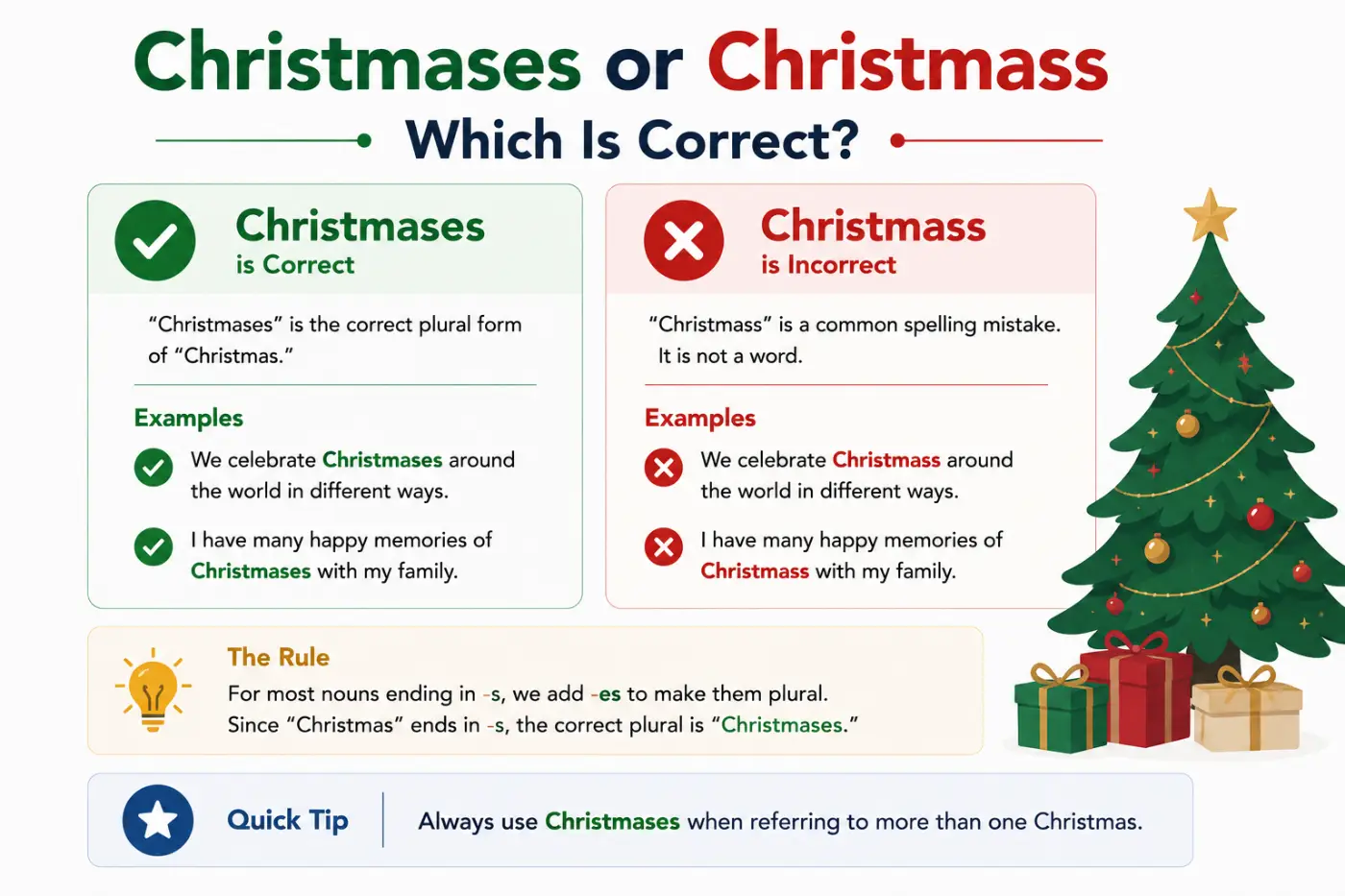
Christmases or Christmass can cause confusion because Christmas already ends with the letter s and the older history of the word makes the extra s look tempting. If you are talking about several Christmas celebrations then Christmases is the standard modern plural form. If you are talking about one celebration then the correct word is Christmas. Christmass should not be used as the normal modern spelling.
The confusion makes sense once you look at the word itself. Christmas comes from an old expression connected with Christ and Mass. Older forms of the word had several spellings and some historical forms included an additional s. Modern English settled on Christmas as the standard spelling. When you make that noun plural you normally add es to create Christmases.
This guide explains the spelling and grammar clearly so you can choose the right form without second guessing yourself. You will learn what Christmases means how to pronounce it why the plural takes es where Christmass came from how the word works in American English and how to avoid common mistakes in greetings professional writing and everyday sentences.
Short Answer
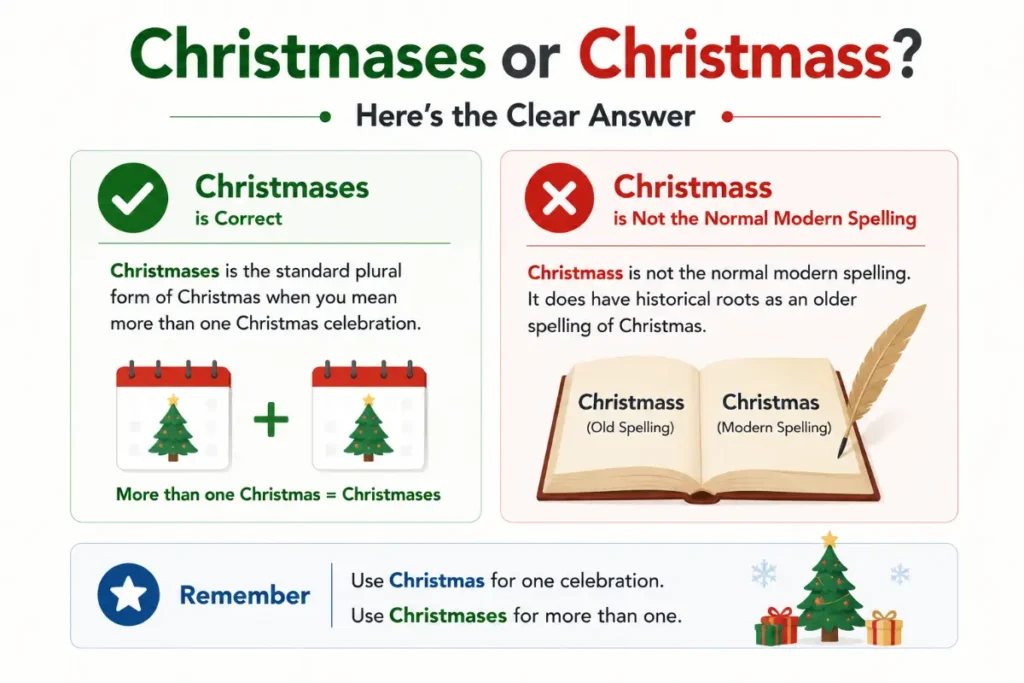
Christmases or Christmass is a spelling question with a clear answer. Christmases is the standard plural form of Christmas when you mean more than one Christmas celebration. Christmass is not the normal modern spelling. It does have historical roots as an older spelling of Christmas but you should use Christmas for one celebration and Christmases for more than one.
Table Of Contents
- The Correct Form At A Glance.
- What Christmases Means.
- What Christmass Means.
- Why Christmases Is The Standard Plural.
- Christmas Compared With Christmases.
- Christmass And Its Historical Background.
- Grammar Rules For Christmases.
- Pronunciation Guide.
- Real Life Sentence Examples.
- Common Spelling Mistakes.
- Christmases In American English.
- Christmases In British English.
- Possessive Forms And Apostrophes.
- Formal And Informal Usage.
- Memory Tips.
- Related Words And Expressions.
- Expert Editor Insight.
- Frequently Asked Questions.
- Key Takeaways.
- Conclusion.
The Correct Form At A Glance
The simplest rule is this.
Christmas means one Christmas.
Christmases means more than one Christmas.
Christmass is not the standard modern spelling you should use for the holiday.
For example:
Christmas is my favorite holiday.
We spent several Christmases with our grandparents.
The first sentence refers to one holiday. The second refers to multiple Christmas celebrations across different years or situations.
You may occasionally see Christmass in historical texts or older records. That does not make it the preferred spelling in modern English. Historical spelling and modern standard spelling are two different things.
Comparison Table
| Form | Grammatical Status | Meaning | Correct Modern Usage | Example |
|---|---|---|---|---|
| Christmas | Singular proper noun | One Christmas celebration or season | Yes | Christmas is almost here. |
| Christmases | Plural proper noun | More than one Christmas | Yes | We remember many happy Christmases. |
| Christmass | Historical spelling or modern spelling error | An older form of Christmas or an incorrect modern spelling | No for normal modern writing | Use Christmas instead. |
| Christmas’s | Singular possessive | Something belonging to or associated with Christmas | Yes in suitable contexts | Christmas’s traditions vary by family. |
| Christmases’ | Plural possessive | Something associated with multiple Christmas celebrations | Yes when grammatically needed | The Christmases’ traditions differed. |
The table shows why spelling alone doesn’t tell the whole story. Grammar also determines the form you need.
What Christmases Means
Christmases is the plural form of Christmas. It refers to two or more Christmas celebrations.
Most people naturally talk about Christmas in the singular because the holiday occurs once each year. However there are plenty of situations where you need the plural.
You might talk about Christmases from your childhood.
You might describe traditions that changed across many Christmases.
For example:
We spent three Christmases in Texas.
Those Christmases remain some of my favorite memories.
Her family celebrated different Christmases in different ways.
In each sentence the writer refers to more than one Christmas.
The plural form can also refer to different kinds of Christmas experiences. The meaning doesn’t always require a simple count of calendar dates. It can refer to separate celebrations or remembered occasions.
For example:
The Christmases of my childhood felt magical.
This sentence does not simply count several dates. It talks about the Christmas celebrations that occurred during a particular period of the writer’s life.
That is a natural and useful way to understand the plural.
What Christmass Means
Christmass is a tricky form because it isn’t simply a random modern invention. Historical records contain older spellings of Christmas that used forms resembling Christmass. English spelling was far less standardized in earlier periods than it is today.
Modern writers should not copy those historical forms into ordinary English.
If you are writing a greeting card you should write:
Merry Christmas.
If you are describing several celebrations you should write:
We had wonderful Christmases together.
You should not normally write:
Merry Christmass.
Or:
We had wonderful Christmass together.
The second spelling can sometimes appear because people connect Christmas with the word Mass. That connection is actually part of the word’s history. Yet modern spelling has settled on Christmas.
This is a useful lesson in English. A historical spelling can exist without being a suitable modern spelling.
Why Christmases Is The Standard Plural
The plural form follows a familiar English spelling pattern.
When a singular noun ends in a sound that makes a simple s ending awkward or unclear, English often uses es for the plural. Christmas ends in an s sound so Christmases provides a natural plural form.
Compare these examples:
class becomes classes.
glass becomes glasses.
bus becomes buses.
Christmas becomes Christmases.
The spelling looks unusual at first because Christmas already contains the letters mas and ends with s. Still the plural follows a recognizable pattern.
The final es also affects pronunciation.
Christmas is usually pronounced with two syllables.
Christmases has three syllables.
The extra syllable makes the plural easier to pronounce clearly.
This is one reason the spelling should not be shortened to something like Christmass when you mean multiple Christmas celebrations.
Christmas Compared With Christmases
The difference is mainly number.
Christmas is singular.
Christmases is plural.
Consider these sentences:
Christmas is coming.
Christmases have changed over the years.
The first sentence refers to the upcoming holiday. The second discusses several separate celebrations.
Another example makes the contrast even clearer:
I spent Christmas with my parents.
I spent many Christmases with my parents.
The first sentence talks about one occasion. The second describes a repeated experience across several years.
This distinction matters in professional writing too. If you are describing annual events or historical experiences then Christmases may be exactly the word you need.
For example:
The museum exhibition features Christmases from different decades.
That sentence sounds natural because the writer is comparing several holiday periods.
Christmass And Its Historical Background
The history of Christmas helps explain why Christmass can look convincing.
The modern word developed from older English expressions connected with the Mass of Christ. Old English used forms related to Cristes mæsse. Over centuries the spelling changed through Middle English and later English forms.
English spelling was not always fixed. Printers writers and regional traditions used different spellings. Historical sources show forms such as Christmass among the many spellings associated with Christmas.
That history is useful because it explains the extra s rather than treating it as a completely mysterious mistake. However historical evidence does not mean that Christmass is the recommended spelling today.
Modern standard English uses Christmas.
The plural is Christmases.
The historical path of the word also explains why learners may feel that the spelling should contain two s letters at the end. The word has a connection with Mass but modern spelling no longer writes the holiday as Christmass.
A good editor respects that history while following current standard usage.
Grammar Rules For Christmases
Christmas is a proper noun when it refers to the holiday. It normally begins with a capital C.
Christmases is the plural form and also keeps the capital C when it refers to the holiday celebrations.
For example:
Christmas is celebrated in many countries.
Many Christmases have passed since then.
The word can appear in several grammatical structures.
Singular Usage
Christmas was wonderful.
This refers to one Christmas.
Plural Usage
The past five Christmases were unforgettable.
This refers to five separate Christmas celebrations.
Possessive Singular
Christmas’s traditions differ across families.
Here the apostrophe and s show possession or association with one Christmas.
Possessive Plural
The Christmases’ traditions differed greatly.
Here the apostrophe comes after the plural form because the sentence refers to multiple Christmas celebrations.
However you do not need an apostrophe simply to make Christmas plural.
This is wrong:
We spent many Christmas’s together.
This is correct:
We spent many Christmases together.
That mistake is extremely common because writers sometimes assume an apostrophe is needed before an s. In English an apostrophe usually signals possession or omission. It does not normally create a plural.
Pronunciation Guide
Christmas is usually pronounced approximately as:
KRIS muhss.
Its common American English pronunciation is represented in IPA as /ˈkrɪsməs/.
Christmases is pronounced approximately as:
KRIS muh siz.
A common IPA representation is /ˈkrɪsməsɪz/.
The plural adds an extra syllable. That difference matters because some writers try to spell the plural as if the word simply needs another s.
When you say Christmases slowly you can hear the plural ending more clearly.
Christmas.
Christmases.
The ending sounds like iz.
This pronunciation also helps explain why Christmases is easier to understand as the plural form than Christmass. The standard plural has a distinct ending that signals grammatical number.
Real Life Sentence Examples
Here are natural examples showing how Christmases works in real writing.
Family Memories
We spent many Christmases at our grandparents’ house.
This sentence describes repeated celebrations over several years.
Those Christmases were filled with laughter and homemade food.
The plural refers to multiple holiday occasions remembered by the speaker.
Travel
We have celebrated Christmases in three different countries.
The writer is comparing several holiday experiences.
Our Christmases abroad taught us how different family traditions can be.
The plural describes separate celebrations in different locations.
Childhood
Some of my happiest Christmases happened when I was a child.
The writer is remembering multiple Christmas celebrations from childhood.
I still remember the Christmases when my cousins stayed with us.
Again the word refers to several separate years or occasions.
Literature
The novel looks back on the Christmases of a family across generations.
Here Christmases refers to holiday celebrations occurring across different periods.
The story contrasts wealthy Christmases with difficult Christmases during the war.
The plural allows the writer to compare different experiences of the holiday.
Professional Writing
The report examines how Christmases are celebrated across different communities.
The plural is appropriate because the report discusses multiple celebrations or cultural versions.
The museum has collected photographs from Christmases throughout the twentieth century.
The sentence describes several historical Christmas occasions.
Common Spelling Mistakes
Several errors appear frequently around Christmas and its plural form.
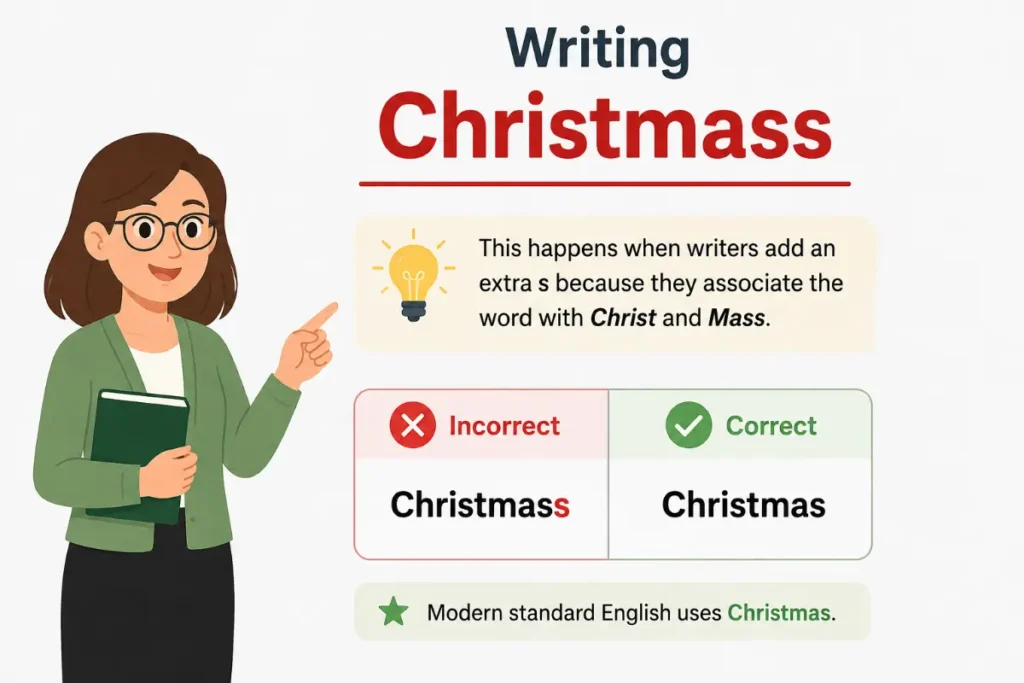
Writing Christmass
This happens when writers add an extra s because they associate the word with Christ and Mass.
Modern standard English uses Christmas.
Writing Christmasses
This form can look logical because Mass becomes masses in other contexts. However Christmases is the standard modern plural form of Christmas.
Writing Christmas’s For The Plural
The apostrophe does not normally create a plural.
Write:
We remember many Christmases.
Not:
We remember many Christmas’s.
Writing Christmases When You Mean One Holiday
If you are talking about the current holiday then Christmas is usually correct.
Write:
Christmas is next week.
Not:
Christmases is next week.
Writing Christamas
Some writers accidentally insert an extra a because the middle sounds can blur in fast speech.
The correct spelling is Christmas.
Christmases In American English
American English uses Christmas as the standard singular form and Christmases as the plural form.
In everyday American writing you may see Christmases when someone talks about memories from different years.
For example:
We spent several Christmases in Florida.
I remember those Christmases fondly.
The plural is not especially common because people often discuss the holiday as a general event or a single upcoming celebration. Still it is completely useful when the context requires more than one.
American English does not normally use Christmass as the modern spelling.
Christmases In British English
British English follows the same basic spelling pattern.
Christmas is singular.
Christmases is plural.
British writers can use the plural when discussing different celebrations or years.
For example:
They spent many Christmases with relatives in Scotland.
The Christmases of his youth remained vivid in his memory.
There is no major American versus British spelling difference here. Both varieties use Christmases as the standard modern plural.
Formal And Informal Usage
Christmases is acceptable in formal and informal writing when the meaning requires a plural.
You can use it in an academic paper:
The study compares Christmases celebrated by families in different regions.
You can use it in a newspaper article:
The photographs capture Christmases from several decades.
You can use it in personal writing:
Those Christmases were unforgettable.
You can also use it in casual conversation:
We spent a few Christmases together before moving away.
The word itself is not overly formal or overly casual. The surrounding sentence determines the tone.
Christmass is different. In modern professional writing it should generally be avoided. If you are quoting an old document or discussing historical spelling then you may need to reproduce the historical form accurately.
That is a special case. It does not make the form appropriate for ordinary modern writing.
Possessive Forms And Apostrophes
Possessive forms create another layer of confusion.
If something belongs to or is associated with one Christmas then you can use Christmas’s in contexts where a possessive is needed.
For example:
Christmas’s arrival brought excitement to the children.
However many writers prefer a different construction because Christmas is a holiday name and possessive wording can sometimes sound awkward.
You can often rewrite the sentence:
The arrival of Christmas brought excitement to the children.
For several Christmas celebrations the plural possessive is Christmases’.
For example:
The Christmases’ traditions varied from family to family.
The apostrophe comes after the s because Christmases is already plural.
Remember the basic pattern:
Christmas means one.
Christmases means more than one.
Christmas’s means something associated with one Christmas.
Christmases’ means something associated with multiple Christmases.
Memory Tips
The easiest way to remember the correct plural is to focus on the meaning rather than the appearance.
Think:
One Christmas.
Many Christmases.
The plural ending is es.
You can also compare Christmas with other words that end in s.
One class.
Many classes.
One Christmas.
Many Christmases.
Another useful trick is to say the plural aloud.
Christmas.
Christmases.
The extra syllable helps remind you that the plural has a real grammatical ending.
If you see Christmass in modern writing then pause and ask yourself if you are discussing an old historical spelling. If not then use Christmas or Christmases.
The word already has a complicated history. Your modern spelling does not need to make it more complicated.
Related Grammar And Usage Notes
Christmas can be used as a proper noun and as an attributive noun.
For example:
Christmas music.
Christmas traditions.
In these phrases Christmas describes another noun.
The plural Christmases can also modify a phrase in some contexts but this is less common.
For example:
The Christmases of my childhood were special.
The phrase works because Christmases acts as the main noun and the following words provide additional information.
You should also distinguish Christmas from Christmas time and Christmastime.
Christmas refers directly to the holiday.
Christmastime refers to the period around Christmas.
For example:
Christmas is on December 25.
We usually travel during Christmastime.
Another related term is Christmases past. This phrase refers to Christmas celebrations that happened in earlier years.
For example:
He remembered Christmases past with great affection.
That expression often appears in literary or reflective writing.
Similar Words And Expressions
Several words and phrases can appear alongside Christmases depending on what you are trying to express.
Christmas season refers to the period associated with Christmas.
Christmas holiday refers to the holiday period.
Christmastime refers to the period around Christmas.
Christmases past refers to Christmas celebrations from earlier years.
Holiday traditions refers more broadly to customs connected with holidays.
Festive season refers to a wider period of celebration.
Yuletide is a traditional literary term associated with Christmas.
Xmas is an informal abbreviation of Christmas.
These words are related but they are not interchangeable in every sentence. Choose the word that matches the exact meaning you want.
Expert Editor Insight
From an editing perspective the biggest mistake is treating spelling as an isolated issue. The real question is what grammatical meaning you want to express. If you mean one holiday use Christmas.If you encounter Christmass in a modern sentence it will usually need correction unless the writer is deliberately reproducing a historical spelling. Good editing also means preserving context. You should not change a historical spelling inside an accurately reproduced quotation simply because modern English uses a different form.
A Simple Decision Guide
Ask yourself three questions.
Are You Talking About One Holiday
Use Christmas.
Example:
Christmas was wonderful this year.
Are You Talking About Several Celebrations
Use Christmases.
Example:
We remember those Christmases with great affection.
Are You Writing Christmass In Modern English
Change it to Christmas unless you have a specific historical reason to keep the older spelling.
Example:
Correct: Merry Christmas.
Not standard today: Merry Christmass.
This decision takes only a few seconds once you know what the word means.
Why The Extra S Causes Confusion
The spelling Christmass looks believable because Christmas has a connection with Mass.
The original expression referred to Christ’s Mass. That historical relationship makes the spelling feel logical to modern readers. But English spelling does not always preserve the visible structure of an older phrase.
Many familiar words have changed shape over centuries. Christmas is one of them.
Another source of confusion is the final s in Christmas. A writer may see that s and think an additional s should appear before the plural ending. That leads to forms such as Christmass or Christmasses.
The standard modern form avoids that problem.
Christmas.
Christmases.
Once you learn those two forms as a pair the spelling becomes much easier.
How To Use Christmases In A Sentence
The word usually appears with a plural determiner or another expression that signals more than one celebration.
Common signals include:
many Christmases.
several Christmases.
two Christmases.
past Christmases.
future Christmases.
different Christmases.
the Christmases of my childhood.
For example:
We spent many Christmases together.
The word many makes the plural meaning obvious.
Another example is:
Those Christmases changed the way I think about family traditions.
Here those clearly points to multiple celebrations.
You can also use numbers:
We spent three Christmases abroad.
The number three requires the plural.
You would not say:
We spent three Christmas.
That would be grammatically incorrect.
When Christmases Sounds Unnatural
Although Christmases is correct it is not necessary in every sentence involving several years.
Sometimes English speakers prefer a different construction.
For example:
We celebrated Christmas together every year.
This sentence refers to repeated Christmas celebrations but uses Christmas in the singular because the phrase every year already establishes repetition.
You could also write:
We celebrated Christmas in many different countries.
There is no need to force the plural.
Christmases becomes especially useful when you want to treat individual celebrations as separate experiences.
Compare:
We celebrated Christmas every year.
We remember those Christmases vividly.
The first sentence describes a repeated activity. The second treats the celebrations as distinct memories.
That difference helps you decide when the plural sounds natural.
Key Takeaways
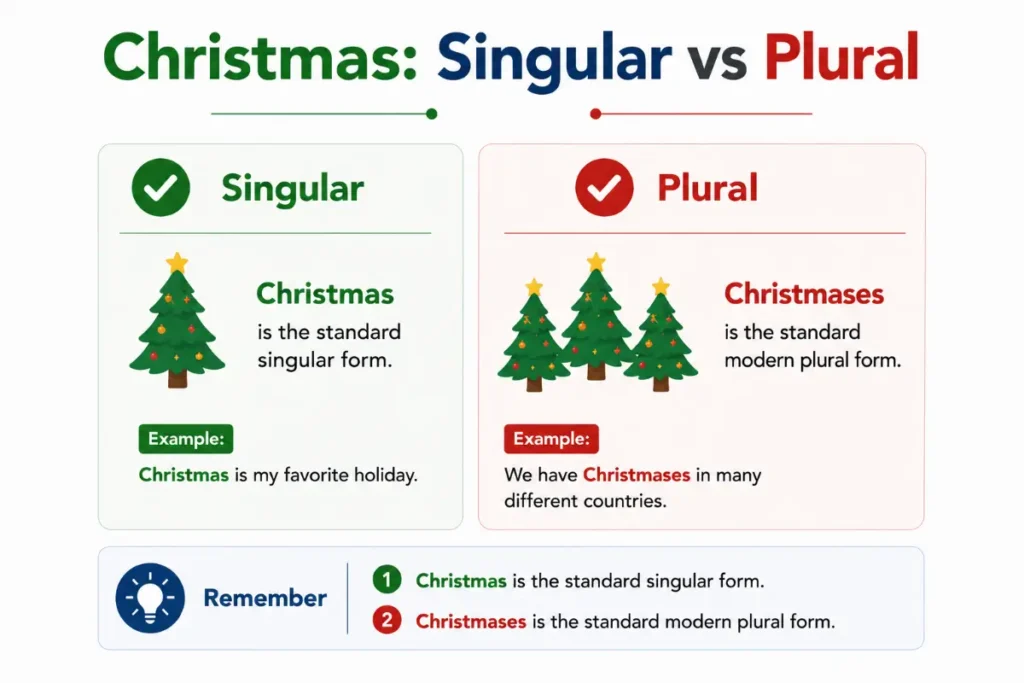
- Christmas is the standard singular form.
- Christmases is the standard modern plural form.
- Christmases refers to multiple Christmas celebrations or experiences.
- Christmass is not the normal modern spelling.
- Historical English contains older spellings that resemble Christmass.
- Modern writers should use Christmas instead of Christmass in ordinary communication.
- Do not use an apostrophe simply to make Christmas plural.
- Christmas’s is possessive singular.
- Christmases’ is possessive plural.
- American and British English use the same standard plural Christmases.
- The plural is pronounced with an additional syllable.
- Context determines if you need Christmas or Christmases.
Conclusion
Christmases or Christmass is easy to resolve once you separate modern English from historical spelling. Christmas is the standard singular form and Christmases is the standard plural form. Use Christmas when you mean one holiday and Christmases when you mean several celebrations or distinct holiday experiences. Christmass may appear in historical material because older forms of English used several spellings for the word.
The most common modern mistake is adding an extra s or using an apostrophe to create the plural. Neither is needed. Write Christmas for one celebration and Christmases for more than one. If you are writing about several Christmases from your childhood then the plural is exactly what you need. If you are sending a holiday greeting then simply write Merry Christmas.
The best memory trick is to focus on the number. One Christmas. Many Christmases. Keep that pattern in mind and the spelling becomes much easier. When you see Christmass in ordinary modern writing, treat it as a form that needs correction unless you are intentionally discussing an older spelling. That simple rule will keep your writing accurate and natural.
Frequently Asked Questions
Is Christmases a correct word?
Yes. Christmases is the standard plural form of Christmas. It refers to more than one Christmas celebration or holiday period. You can use it when talking about memories from different years, celebrations in different places, or several distinct holiday experiences. For example, We spent many Christmases together is grammatically correct.
Is Christmass a correct modern spelling?
No. Christmass is not the standard modern spelling of the holiday. Historical English contains older forms resembling Christmass, so the spelling has a genuine historical background. However modern English uses Christmas. If you are writing a greeting, article, email, school assignment, or professional document, use Christmas rather than Christmass.
Christmass or Christmases which is correct?
Christmases or Christmass has a clear modern answer. Christmases is correct when you need the plural of Christmas and Christmass is not the standard modern form. Use Christmas for one celebration and Christmases for multiple celebrations. Keep Christmass only when you are discussing or reproducing a historical spelling for a specific reason.
Why does Christmas become Christmases?
Christmas becomes Christmases because English forms the plural with es. The word already ends in an s sound, so Christmases provides the standard plural ending. Similar patterns occur in words such as class and classes or glass and glasses. The pronunciation also changes because Christmases has an additional syllable.
Can I say Merry Christmases?
Usually no. The normal greeting is Merry Christmas because you are greeting someone for the current Christmas celebration. Christmases can be correct in a sentence that refers to several celebrations but it does not normally belong in the traditional greeting. If you are addressing multiple holiday experiences then Christmases may be appropriate in another type of sentence.
Is Christmases singular or plural?
Christmases is plural. The singular form is Christmas. You use Christmases when you are referring to more than one celebration. For example, The last three Christmases were especially memorable uses the plural correctly. If you are talking about the current holiday or one specific celebration, use Christmas instead.
Do I need an apostrophe in Christmases?
No. Christmases does not need an apostrophe when it simply means more than one Christmas. An apostrophe is used for possession or contraction rather than ordinary plural formation. For example, We remember many Christmases is correct. Christmas’s can show singular possession, while Christmases’ can show plural possession.
How do you pronounce Christmases?
Christmases is commonly pronounced approximately as KRIS muh siz. A common American English IPA representation is /ˈkrɪsməsɪz/. It has three syllables. Christmas has two syllables in ordinary pronunciation. Saying the plural slowly can help you hear the final syllable and remember that the spelling ends in es.
Is Christmases used in American English?
Yes. American English uses Christmases as the standard plural of Christmas. It appears when writers discuss several celebrations, years, memories, or holiday experiences. It is less common than Christmas because people often discuss the holiday as a general event. Still, Christmases is completely standard when the context requires a plural.
Is Christmass an old spelling of Christmas?
Yes. Historical English records contain several older spellings of Christmas, including forms resembling Christmass. English spelling was not standardized in the way it is today. Modern English settled on Christmas as the standard spelling. So the historical existence of Christmass explains why the form can appear in older material but does not make it the preferred modern spelling.
What is the plural of Christmas?
The standard plural is Christmases. For example, We spent several Christmases in different cities is correct. Christmasses is sometimes encountered but Christmases is the standard modern plural form used in ordinary English. The key distinction is simple. One Christmas means one celebration. Christmases means multiple celebrations.
