
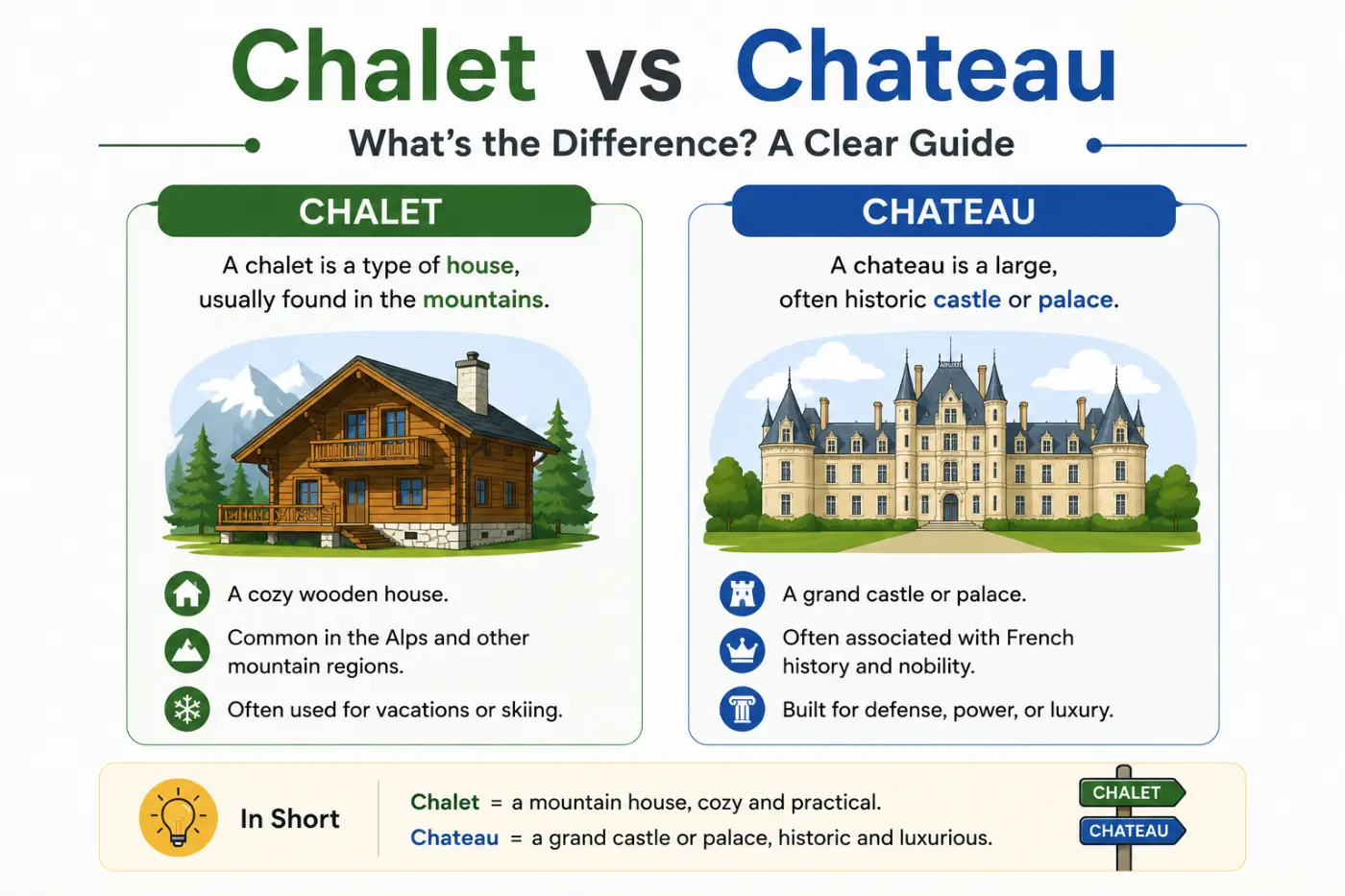
If you’ve ever wondered chalet vs chateau whats the difference the answer comes down to setting history design and purpose. A chalet is traditionally linked to the mountains especially the Alps and is known for its practical wooden construction and broad roof. A château is generally a large French residence castle or country estate and is associated with grand architecture and substantial grounds.
The two words can seem similar because both entered English from French and both can describe attractive places to live or stay. That surface similarity can make them easy to mix up. Yet they create very different mental pictures. Mention a chalet and most people imagine timber balconies snowy slopes and a warm interior. Mention a château and the picture shifts toward stone walls towers formal gardens vineyards or an impressive country residence.
This guide gives you a clear answer without making the distinction more complicated than it needs to be. You’ll learn what each word means how the buildings differ where the terms came from how native English speakers pronounce them and how their meanings have expanded in modern English. You’ll also see real examples common mistakes and simple memory tricks that make the difference stick.
Short Answer
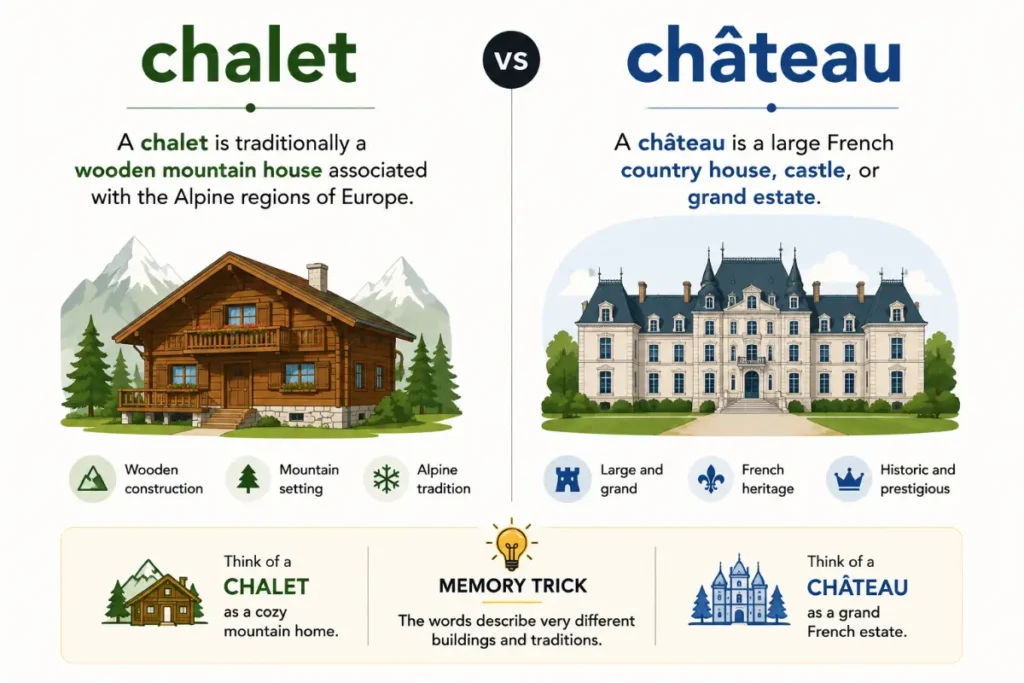
A chalet is traditionally a wooden mountain house associated with the Alpine regions of Europe. A château is a large French country house castle or grand estate. The simplest memory trick is this. Think of a chalet as a cozy mountain home and a château as a grand French estate. The words describe very different buildings and traditions.
Table Of Contents
- The basic difference between a chalet and a château.
- What chalet means.
- What château means.
- Chalet and château side by side.
- Architecture and physical appearance.
- Traditional purpose and history.
- Location and setting.
- Size and atmosphere.
- Modern uses.
- Pronunciation and spelling.
- Word origins and etymology.
- American and British English usage.
- Common mistakes.
- Real life examples.
- Memory tips.
- Related words and expressions.
- Frequently asked questions.
- Key takeaways.
- Conclusion.
The Basic Difference
The clearest distinction is simple.
A chalet is a type of house associated with Alpine mountain regions. Traditionally it was a practical building connected with herders and seasonal farming. Modern chalets are often vacation homes ski lodges or attractive mountain residences.
A château is a large house castle or grand estate associated especially with France. It may be fortified and medieval or it may be an elegant country residence with gardens and extensive grounds. In modern English the word can also describe a French style stately residence or a wine estate.
So if you need a quick visual rule remember this.
Chalet means mountain home.
Château means grand French residence or castle.
That isn’t a complete dictionary definition of either word but it is an excellent everyday shortcut.
What Chalet Means
The noun chalet refers to a building traditionally associated with the Alpine region. English dictionaries commonly describe it as a wooden house with a steep or sloping roof especially in mountain areas. The word is strongly connected with Switzerland and other Alpine regions. The traditional chalet wasn’t simply designed to look charming. Its design reflected the needs of people living and working in mountainous environments.
Wood was an important building material. Roofs were designed with the local climate in mind and wide projecting eaves became a recognizable feature. The building style developed practical solutions for life in the Alps.
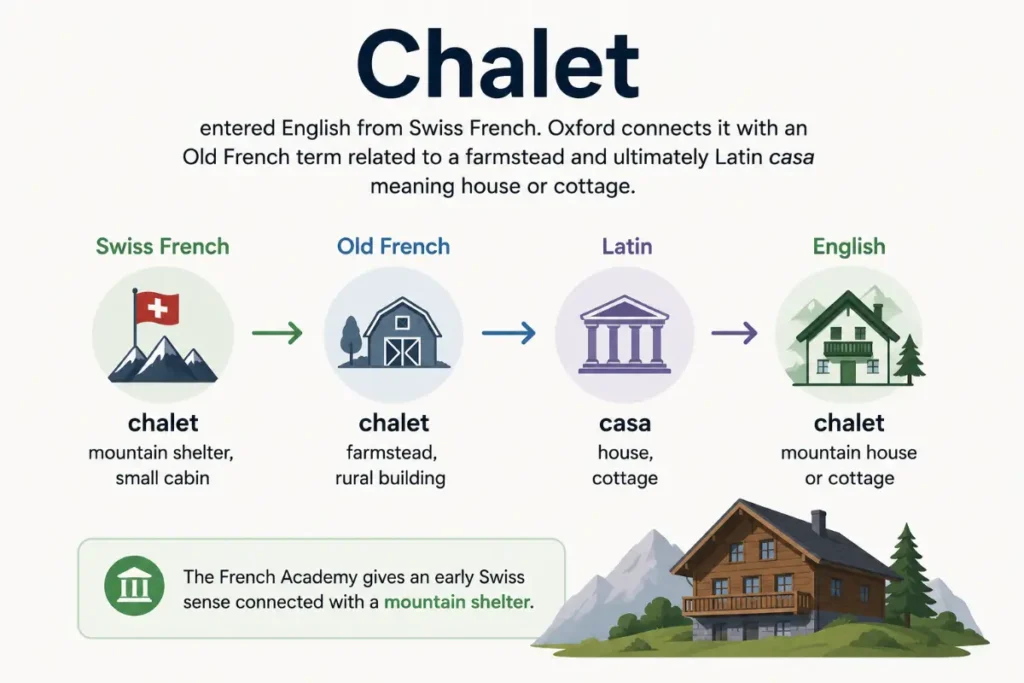
The original meaning also had a connection with herding and seasonal farming. The French Academy traces the word to the speech of French speaking Switzerland and records an early sense connected with a mountain shelter and cheese making or pastoral work.
Modern English has expanded the word.
Today a chalet might be a private mountain home. It might be a ski lodge. It might even be a building that uses the traditional Alpine style without standing in the Alps.
That last point matters. A building doesn’t have to be in Switzerland to be called a chalet in modern English. The architectural style itself can justify the term.
What Château Means
A château is a very different kind of building. In English it generally means a large house or castle in France. The word can refer to historic fortified buildings but it can also describe grand country houses that were never primarily military structures. This distinction is useful because many people assume every château must be a castle with defensive walls. That’s too narrow.
French usage is broader than the common English mental image. A château can refer to a manor house a palace a country residence or a fortified building. English often uses the word for an impressive French residence or estate. The word also has a special connection with wine.
In the Bordeaux region of France château is commonly used in the names of wine producing estates. In that context it can refer to the estate and its wine making operation rather than simply to a castle. So the word has a wider range than the simple picture of a medieval fortress.
Chalet And Château Side By Side
| Feature | Chalet | Château |
|---|---|---|
| Basic meaning | Mountain house or lodge | Large French house castle or estate |
| Traditional region | Alpine Europe | France |
| Traditional setting | Mountains | Countryside estates |
| Typical materials | Wood and stone | Stone brick masonry and other substantial materials |
| Recognizable feature | Sloping roof and projecting eaves | Grand architecture and extensive grounds |
| Historical connection | Mountain farming and herding | Nobility landownership and country residence |
| Typical size | Often small or medium although modern examples can be large | Usually large and substantial |
| Modern use | Ski lodge vacation home mountain residence | Historic property hotel private estate museum or wine estate |
| General atmosphere | Rustic cozy and practical | Grand formal historic and elegant |
| Common association | Alps skiing snow and mountain life | France castles estates gardens and vineyards |
The table gives you the broad picture but the distinction isn’t based on size alone. A huge modern mountain lodge can still be a chalet if its style and function fit the term. Likewise a château doesn’t have to be enormous simply because the word often suggests grandeur.
Architecture And Physical Appearance
Architecture is one of the easiest ways to tell the two apart.
A traditional chalet has a strong relationship with the Alpine landscape. Wood is prominent and the roof usually has a noticeable slope. Wide eaves are another familiar feature. These elements aren’t just decorative. They developed from practical building traditions in mountain regions.
Modern chalet design often keeps those visual cues. You might see exposed timber beams large windows balconies stone foundations and a roof that extends well beyond the walls.
The overall impression is usually warm and functional.
A château creates a different impression.
Its architecture may include towers courtyards ornate windows formal entrances stone façades elaborate roofs and decorative interiors. Some are medieval or partly fortified while others are elegant residences from later periods.
The word therefore points more strongly toward architectural grandeur and historical or estate status than toward one specific building shape.
A chalet says mountain.
A château says estate.
That contrast is useful because it captures the central difference without forcing every building into a rigid category.
Traditional Purpose And History
The historical backgrounds of the two words are also quite different. The chalet developed from Alpine rural life. Traditional chalets were connected with pastoral activity and seasonal movement into mountain areas. The French Academy records the word as originating in French speaking Switzerland and gives an early sense connected with a mountain shelter.
Oxford traces the English word to Swiss French and ultimately connects it with an Old French word meaning a farmstead and with Latin casa meaning house or cottage.
The château has a different history.
English château comes from French and ultimately traces back through Old French forms to Latin castellum meaning a fort or fortified place. That history helps explain its association with castles and substantial residences.
Over time French architecture produced many different kinds of châteaux. Some were defensive structures. Others became luxurious residences that reflected wealth social status and political power.
That historical development explains why a château can look more like a palace than a castle.
Location And Setting
Location provides another useful clue.
A traditional chalet belongs to the Alpine landscape. Switzerland is the classic association but the wider Alpine region includes parts of France Austria Italy Germany and Slovenia. The word has also spread beyond Europe because people now use it for buildings inspired by Alpine architecture.
A château is most strongly associated with France. French countryside estates are the classic setting.
However neither word should be treated as a strict geographical label in modern English.
You can find a chalet outside the Alps. A resort in Colorado might advertise a luxury chalet. A vacation property in Canada might use the same term because it follows a mountain lodge style.
Likewise a large residence outside France can sometimes be called a château if it deliberately follows French architectural traditions or uses the term as part of its name.
The original cultural setting still matters though. It tells readers what kind of building the word traditionally describes.
Size And Atmosphere
Size can help you distinguish the terms but it shouldn’t be your only test.
A traditional chalet is usually more modest in origin. Its design grew from practical mountain life rather than from the display of aristocratic wealth.
A modern chalet can be anything from a small wooden cabin to a large luxury ski property. The architectural style and mountain association often matter more than the actual floor area.
A château tends to suggest a larger and more imposing property. Grand grounds formal gardens courtyards and multiple rooms often form part of the mental image.
There is also a difference in atmosphere.
A chalet usually feels cozy rustic relaxed and close to nature.
A château often feels grand historic formal and stately.
Think of a crackling fireplace after a day on snowy slopes for the first word. Think of a long driveway leading through formal gardens toward an elegant stone residence for the second.
That contrast makes the vocabulary easier to remember.
Modern Uses
Modern English has stretched both terms beyond their original meanings.
A chalet can now mean a vacation property or ski lodge. It can also describe a small holiday house in some varieties of English. Oxford notes a British English use for a small house or hut especially one used by people on holiday at the seaside.
This is an interesting example of regional semantic development. The word no longer requires a snowy mountain setting in every English context.
The meaning of château has also expanded.
It can refer to a historic French building a country house a castle or a grand estate. It can also appear in the names of wine estates. Collins specifically records the wine estate sense associated with Bordeaux.
This means you should read the surrounding context.
If someone says they booked a chalet for a ski holiday the meaning is obvious.
If someone says they toured a château in France the reference could be a castle a grand country residence or a historic estate.
Chalet Vs Chateau Whats The Difference In Everyday English
When someone asks chalet vs chateau whats the difference they may actually be asking which word should appear in a travel article property description or conversation.
Use chalet when the property has a mountain lodge or Alpine character.
Use château when the property is a grand French style residence castle or estate.
Consider these examples.
- We rented a chalet near the ski slopes.
The building is a mountain vacation property so chalet is the natural choice.
- We visited a château in the Loire Valley.
The building is a grand historic French residence so château fits.
- The resort has several luxury chalets.
The plural refers to multiple mountain style accommodations.
- The château has extensive gardens.
The word suggests a grand estate rather than a simple mountain lodge.
- They restored an old chalet in the Alps.
The location and architectural tradition strongly support chalet.
- The family owns a château surrounded by vineyards.
The estate setting and French connection make château appropriate.
Pronunciation And Spelling
The two words also sound quite different.
In American English chalet is commonly pronounced something like sha LAY. Oxford gives American and British pronunciation forms and Collins records American pronunciation close to sha LAY.
The French pronunciation is closer to sha LAY with a French vowel quality.
Château is commonly pronounced something like sha TOE in American English. Cambridge gives an American pronunciation represented as /ʃæˈtoʊ/ while the French pronunciation is /ʃɑto/.
In British English the pronunciation can sound closer to SHAT oh. Cambridge records /ˈʃæt.əʊ/ for British English.
The accent mark in château is part of the French spelling. English also commonly writes chateau without the circumflex. Oxford lists both forms.
So these are both seen in English.
château
chateau
The accented form preserves the French spelling. The unaccented form is also established in English.
Word Origins And Etymology
The origins explain why these words describe such different buildings.
Chalet entered English from Swiss French. Oxford connects it with an Old French term related to a farmstead and ultimately Latin casa meaning house or cottage. The French Academy gives an early Swiss sense connected with a mountain shelter.
The word therefore carries a history rooted in rural mountain life.
Château entered English from French. Oxford traces it through Old French chastel to Latin castellum meaning fort and related to castrum.
That history connects the word with fortified places and castles.
The difference is almost built into the history of the vocabulary.
One word grew from a mountain shelter and rural farm tradition.
The other grew from a word associated with fortification and major residences.
American And British English Usage
The two terms are broadly understood in both American and British English.
The main difference is not the basic meaning but some pronunciation and secondary usage.
In American English chalet often appears in descriptions of ski resorts mountain homes and vacation properties. The word can carry a luxury travel association.
British English uses chalet in similar contexts but also has an established holiday accommodation sense. Oxford specifically identifies a British use for a small holiday house or hut at the seaside.
For château both varieties recognize the meaning of a large French house or castle.
American English commonly accepts chateau without the accent. The plural can appear as chateaus or châteaux.
British English commonly uses château and the plural châteaux although English also permits the unaccented form in appropriate contexts. Oxford records both singular spellings and both plural forms.
Common Mistakes
People usually confuse these words because both describe attractive residences and both have strong French associations.
Here are the mistakes to avoid.
- Calling every large house a chalet.
A large building isn’t automatically a chalet. The term carries an Alpine and architectural association.
- Calling every château a medieval castle.
A château can be a castle but it can also be a grand country house without major defensive features.
- Assuming a chalet must be tiny.
Modern chalets can be spacious luxury homes. Traditional origins don’t limit every modern example.
- Assuming a château must be in France.
France is the central association but English can use the term for French style properties elsewhere.
- Treating château and chalet as synonyms.
They are not synonyms. They belong to overlapping discussions about houses and architecture but describe different traditions.
- Assuming the accent is mandatory in every English sentence.
Château is the traditional French spelling but chateau is also an accepted English spelling. The appropriate choice can depend on the publication’s style.
Memory Tips
If chalet and château keep getting mixed up use a visual memory trick.
Think chalet equals chimney and snow.
Picture a wooden mountain house with a steep roof and a warm fireplace.
Then think château equals castle and countryside.
Picture stone walls formal gardens and a grand French estate.
Another useful trick is to focus on the first letter after the initial sound.
Chalet feels lighter and more rustic.
Château sounds grander and carries the French association with castles and estates.
You can also remember the original cultural backgrounds.
Chalet comes from Alpine mountain life.
Château comes from French estates and castles.
These shortcuts won’t replace dictionary definitions but they make the distinction much easier to retrieve when you’re writing.
Related Words And Usage Notes
Several words sit near these terms but don’t mean exactly the same thing.
A cottage is a small house often associated with rural areas. It doesn’t necessarily have a mountain setting or Alpine architectural style.
A cabin is usually a simple small house often made from wood. It can be located almost anywhere.
A lodge is a building used for accommodation or as a residence and can appear in mountain resorts hunting areas or parks.
A castle is a fortified residence or stronghold. Some châteaux are castles but not every château is strongly fortified.
A manor house is a large country residence historically associated with a landed estate. A palace is a grand residence especially one associated with royalty or another very high ranking ruler. An estate refers to a large property and its land. The term doesn’t describe one specific architectural style. These distinctions matter because choosing the closest familiar word isn’t always enough. Good writing uses the word that gives the reader the most accurate picture.
Real Life Examples
Here are several natural examples that show how the terms work in context.
- The family rented a chalet overlooking the ski slopes.
This clearly describes mountain accommodation.
- The chalet had exposed wooden beams and a large stone fireplace.
The architectural details reinforce the Alpine style.
- We stayed in a chalet during our winter vacation.
The word works naturally for holiday accommodation.
- The old chalet was surrounded by pine trees.
The mountain and woodland setting fits the traditional image.
- They renovated the chalet without losing its original character.
The word can describe both historic and modern mountain homes.
- The château dates back several centuries.
The sentence suggests a historic French residence.
- We spent the afternoon walking through the château gardens.
A grand estate with formal grounds is a natural setting for the word.
- The château overlooks the vineyards.
This works particularly well with the French wine estate sense.
- The family converted the château into a hotel.
The large property can have a modern hospitality use.
- Visitors traveled across the region to see its famous châteaux.
The plural refers to multiple grand French residences or castles.
Professional Writing Tips
Property descriptions need particular care because these words create strong expectations. Calling a mountain lodge a chalet can instantly give the reader an image of timber architecture snowy surroundings and a cozy atmosphere. Calling a large French residence a château creates an impression of history grandeur and substantial grounds. That makes the words useful beyond simple description. They are also culturally loaded terms. A travel writer who chooses chalet is invoking the Alpine tradition. A writer who chooses château is drawing on French architectural and historical associations. In professional writing don’t use either term simply because it sounds more luxurious. Use chalet when the architecture or setting supports it. Use château when the property genuinely fits the French estate or castle sense. Accuracy always sounds better than decoration.
Key Takeaways
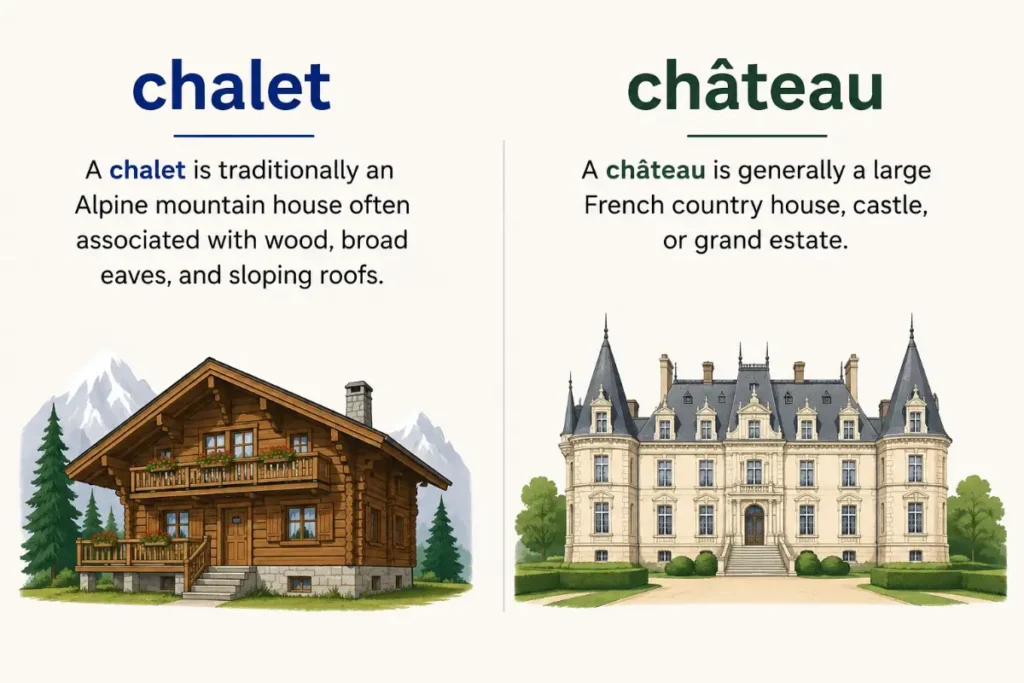
- A chalet is traditionally an Alpine mountain house often associated with wood broad eaves and sloping roofs.
- A château is generally a large French country house castle or grand estate.
- A chalet has strong connections with Switzerland and the wider Alpine region.
- A château has its strongest cultural connection with France.
- Modern chalets are often ski lodges vacation homes and mountain residences.
- Modern châteaux can serve as private homes hotels museums historic attractions or wine estates.
- Chalet and château are nouns.
- American English commonly pronounces chalet close to sha LAY and château close to sha TOE.
- English accepts both château and chateau.
- The easiest memory trick is mountain chalet and grand French estate château.
Conclusion
The simplest answer to chalet vs chateau whats the difference is that a chalet is traditionally a mountain home while a château is a grand French residence castle or estate. A chalet brings to mind Alpine landscapes timber construction wide roof eaves and cozy ski accommodation. A château suggests France stone architecture historic estates formal gardens and in some contexts vineyards. The two words may both describe beautiful properties but they belong to very different architectural and cultural traditions.
Once you connect each word with its setting the distinction becomes much easier. Think of a chalet in the Alps and a château in the French countryside. Remember that modern English has broadened both terms so a chalet can appear outside the Alps and a château doesn’t always mean a fortified castle. Context still does most of the work.
For everyday writing the best approach is to choose the word that gives your reader the right picture. Use chalet for an Alpine or mountain style home and use château for a grand French residence estate or castle. That simple distinction will keep your writing accurate and help readers understand the property you’re describing without needing a second explanation.
FAQs
What is the main difference between a chalet and a château?
A chalet is traditionally a wooden mountain house associated with the Alpine regions of Europe. A château is generally a large French country house castle or grand estate. Chalets are strongly associated with mountains rustic architecture and ski holidays. Châteaux are associated with French history grand residences gardens estates and sometimes vineyards.
Is a chalet always in the mountains?
No. The traditional chalet comes from Alpine mountain regions but modern English uses the word more broadly. A building outside the Alps can be called a chalet when it follows a similar architectural style or serves as mountain style vacation accommodation. British English also uses chalet for certain small holiday homes outside mountain areas.
Is every château a castle?
No. A château can mean a castle but it can also refer to a large country house or grand estate. English dictionaries commonly define it as a large house or castle in France. French usage can cover a wider range of major residences. So calling every château a castle can make the meaning too narrow.
How do you pronounce chalet?
In American English chalet is commonly pronounced close to sha LAY. Oxford gives the American form /ʃæˈleɪ/ and also records a British pronunciation. The French pronunciation is different in vowel quality but English speakers commonly use an anglicized pronunciation. The word has two syllables in ordinary English speech.
How do you pronounce château?
In American English château is commonly pronounced close to sha TOE and Cambridge gives /ʃæˈtoʊ/. British English commonly uses a pronunciation closer to SHAT oh. French pronunciation is /ʃɑto/. The pronunciation can therefore vary by language and English variety.
Can you use chateau without the accent?
Yes. English commonly uses both château and chateau. Oxford lists the accented and unaccented spellings. The accented form preserves the French spelling while the unaccented form is established in English usage. The same applies to plural forms where English can use chateaus alongside the French influenced châteaux.
What does chalet mean in British English?
In British English chalet can mean a small wooden house especially one used for holidays. It is strongly associated with mountain accommodation but British usage also includes certain holiday homes at the seaside. This is a useful example of how a borrowed word can develop additional meanings after entering English.
Why is a château associated with wine?
In the Bordeaux region of France château is often used in the names of wine producing estates. In that context the word can refer to the estate rather than simply to a castle or residential building. This is why wine labels may contain château even when the central idea is a vineyard and wine making property.
Which word should I use for a ski lodge?
Use chalet when the building has the traditional or modern Alpine mountain house character associated with ski resorts. A ski lodge can also be called a lodge if you want a more general term. Château would normally be inappropriate because it suggests a French country house castle or grand estate rather than a mountain lodge.
Are chalet and château synonyms?
No. They are related only in the broad sense that both can describe buildings or residences. Their meanings developed from different cultural and historical backgrounds. A chalet points toward Alpine architecture and mountain living. A château points toward French castles grand country houses and estates. Using them as interchangeable words would give readers the wrong impression.
