
Busyness vs business is a common source of confusion because the two words share the same root and look almost identical on the page. If you type quickly or hear one in conversation you may wonder which form belongs in your sentence. The answer is simple. Busyness means the state of being busy or having a lot of activity. Business usually refers to work commercial activity a company or a matter that needs attention.
The confusion makes sense because both words come from the adjective busy. They also sound remarkably similar when spoken. Still they aren’t interchangeable. One describes a condition of constant activity while the other usually points to work trade commerce or an affair.
In this guide you’ll learn exactly how these words differ. You’ll see their meanings grammar roles pronunciation histories and common contexts. You’ll also get practical examples that show how native English speakers use them in everyday speech professional writing academic work news and more. By the end the distinction should feel natural rather than something you have to memorize.
Quick Definition
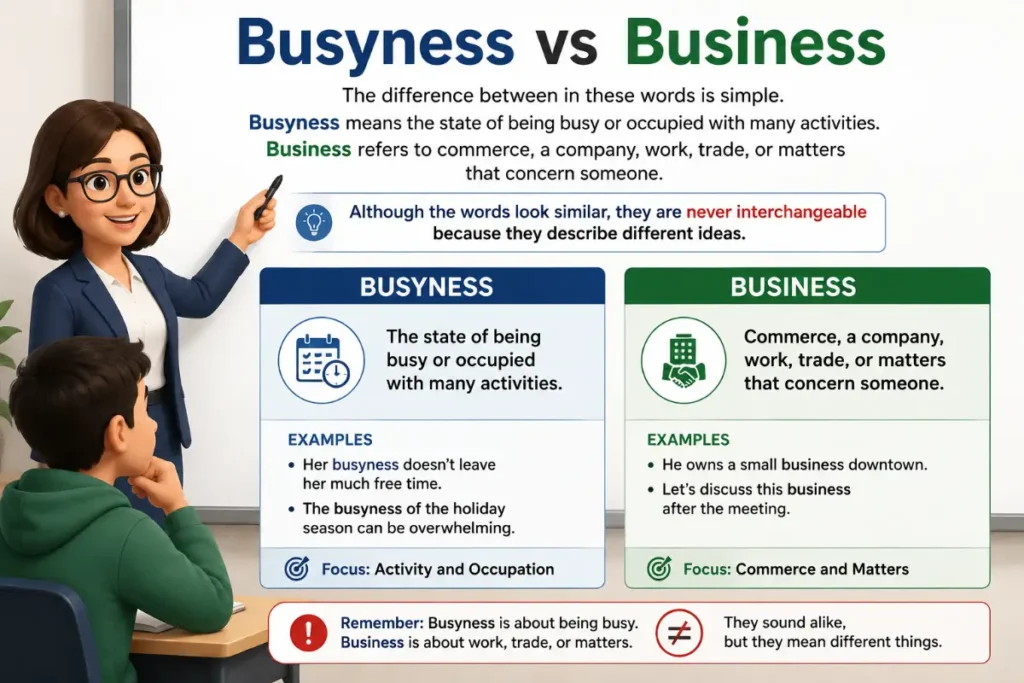
Busyness means the state or quality of being busy. It describes a condition filled with activity tasks movement or demands. Business usually means commercial activity a company professional work or a particular matter. Both are standard English words but they cannot normally replace each other in a sentence.
Quick Answer
Both busyness and business are correct English words. They have different meanings. Use busyness when you mean a state of being busy or having many activities. Use business when you mean work commerce a company professional affairs or a matter that concerns someone.
For example you can say The busyness of the office made it hard to concentrate. You can also say She owns a small business. A useful memory trick is simple. Busyness describes how busy something is. Business usually describes work commerce or an affair.
Comparison Table
| Correct Form | Meaning | Part of Speech | Origin | Usage Frequency | Formality | Common Contexts | Example |
|---|---|---|---|---|---|---|---|
| Busyness | The state of being busy | Noun | From busy plus ness | Less common | Standard | Daily activity workload crowded places personal schedules | The busyness of the store increased before the holiday. |
| Business | Work commerce a company or an affair | Noun | From Middle English bisynesse | Very common | Standard | Work companies trade professional matters everyday affairs | She started a new business last year. |
Meaning and Definition
Meaning of Busyness
Busyness is a real English word. It isn’t a typo and it isn’t limited to slang. It is a standard noun formed from the adjective busy with the suffix ness.
The word describes the condition of being busy. That can involve having many tasks a crowded schedule a noisy environment or a large amount of activity.
For example:
The busyness of the restaurant made conversation difficult.
Here busyness refers to the amount of activity happening around the speakers.
You can also use it to describe someone’s schedule.
Her busyness during the holiday season left little time for rest.
The word is useful when you specifically want to talk about the quality or condition of being busy. It appears less often than business in ordinary English. That’s one reason people sometimes suspect that it isn’t a real word.
It is also worth remembering that busyness isn’t simply another spelling of business. The two words developed from the same general root but their modern meanings have separated.
Meaning of Business
Business is one of the most common nouns in English. It has several related meanings.
The first major meaning involves commercial activity.
He runs a successful business.
In this sentence business means an organization or commercial operation.
The word can also refer to work or professional activity.
I have some business to finish before lunch.
It can describe a particular matter or concern.
That’s none of your business.
It can also refer to buying and selling goods or services.
Business has been slow this month.
The context determines the precise meaning. That flexibility makes business much more common than busyness.
The word can even appear in fixed expressions such as mind your own business, go out of business, business trip, business meeting, and business hours.
The broad idea behind these uses is activity connected with work affairs responsibilities or commerce.
Key Differences Explained
- Spelling
The spelling difference comes down to the middle of the word. Busyness keeps the spelling of busy and adds ness. Business has a historical spelling that developed differently.
This is why simply changing one letter doesn’t turn one word into the other.
- Grammar Role
Both words function primarily as nouns.
Busyness names a condition or quality.
Business names an activity company matter or area of work.
- Meaning
Busyness means the state of being busy.
Business usually means work commerce a company or an affair.
- Tone
Both words are standard and acceptable. However business appears naturally in everyday conversation and professional writing. Busyness is less frequent and often appears when a writer wants to emphasize the condition or feeling of constant activity.
- Context
You might discuss the busyness of a city when talking about crowds traffic noise or constant movement.
You might discuss the business of a city when talking about commerce companies economic activity or trade.
That small difference in meaning can completely change the sentence.
Which Spelling Is Correct
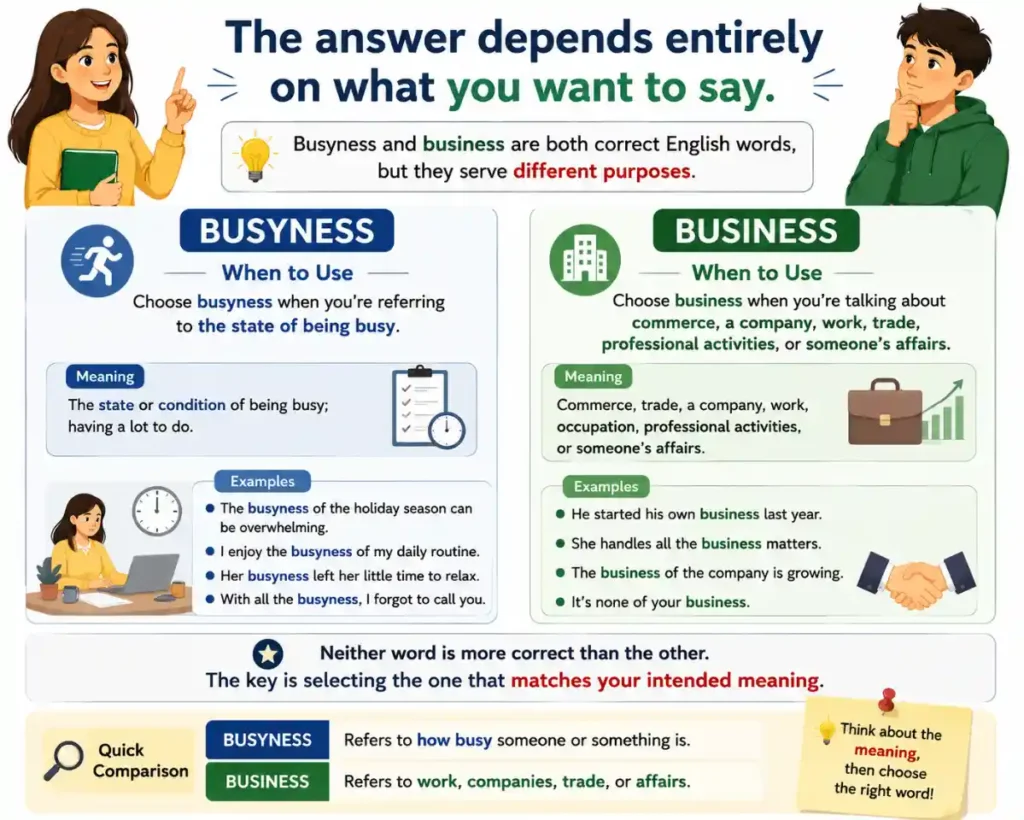
Both spellings are correct but they don’t mean the same thing.
If you’re talking about the condition of being busy use busyness.
If you’re talking about work commerce a company or a particular matter use business.
The linguistic reason is straightforward. Busyness is built from busy plus the noun forming suffix ness. Business has a longer historical development from an older form related to busy and busyness but its modern meaning expanded into work trade commercial activity and personal affairs.
A reliable dictionary approach also confirms the distinction. Major English dictionaries treat busyness as a noun meaning the state of being busy while business has several established meanings connected with work commerce companies and affairs.
As an editor I recommend checking the meaning before checking the spelling. Ask yourself what you are trying to name. If you’re naming a state of constant activity choose busyness. If you’re naming work trade a company or an affair choose business.
Sentence Examples
Examples With Busyness
- The busyness of the airport surprised me during the early morning hours.
- I couldn’t focus because of the busyness around my desk.
- The busyness of the city can feel overwhelming after a quiet weekend.
- She enjoys the energy and busyness of downtown life.
- The busyness of the office increased as the deadline approached.
- His schedule was so full that the busyness left him exhausted.
- The restaurant’s busyness dropped after the holiday season.
- The busyness of the classroom made it difficult for the teacher to hear every student.
- I miss the busyness of campus during summer break.
- The morning busyness disappeared once most commuters reached work.
Examples With Business
- She owns a small business near the city center.
- My brother wants to start his own business.
- We discussed the business plan during the meeting.
- The company has been in business for more than twenty years.
- I have some personal business to take care of today.
- Good customer service can make a major difference in business.
- They decided to expand the business into another state.
- The store’s business increased during the holiday season.
- He travels often for business.
- She studied international business at college.
Examples Showing Finaly As a Misspelling
- Finaly is a common misspelling of finally.
- Many learners type finaly because the pronunciation doesn’t clearly reveal the second l.
- A spell checker may flag finaly because standard English uses finally.
- If you write finaly in formal work you should correct it to finally.
- The correct spelling is finally with two l letters.
These examples highlight an important point. Finaly and finally belong to a different spelling issue from busyness and business. They are included here only because the spelling pattern can create similar confusion around repeated letters and suffixes.
Common Mistakes and Misspellings
- Using business when you mean busyness
This mistake changes the meaning of the sentence.
The business of the street was overwhelming could suggest commercial activity. If you mean that the street was crowded and active you probably want busyness.
- Treating busyness as a mistake
Some people see busyness and assume the writer intended business. That isn’t always true. The less common word is still legitimate English.
- Using busyness for a company
You wouldn’t normally say I started a busyness. The correct word is business.
- Assuming similar spelling means identical meaning
English contains many related words that share roots but develop different meanings. Similar spelling doesn’t guarantee interchangeable usage.
- Confusing sound with spelling
The two words can sound close in casual speech. This creates a phonological confusion where the listener has to rely on context to identify the intended word.
There is also an NLP style issue here. Language models and search systems often connect words that share morphological roots. Busy, busyness, and business belong to the same semantic neighborhood but their meanings aren’t identical. Context determines which word fits.
Pronunciation Guide
Busyness
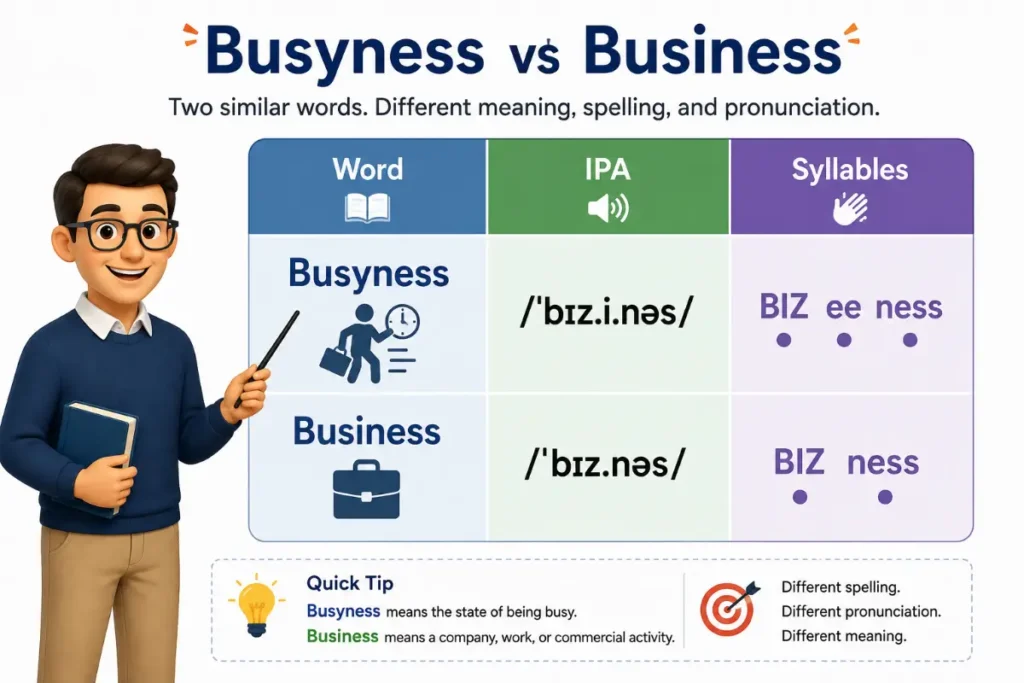
The common pronunciation is /ˈbɪz.i.nəs/.
You can think of it as:
BIZ ee ness
The first syllable sounds like biz. The middle syllable sounds like a short ee sound. The final syllable sounds like ness.
The word contains three syllables.
biz ee ness
Business
The common pronunciation is /ˈbɪz.nəs/.
A useful pronunciation guide is:
BIZ ness
The word normally has two syllables in standard modern pronunciation.
biz ness
Notice something interesting. The spelling of business contains several letters that aren’t pronounced in the way a beginner might expect. English spelling preserves historical patterns so the written form doesn’t always map neatly onto modern speech.
The pronunciation difference can help you understand why learners confuse the words. Both begin with a sound close to biz. The ending is also similar. The key difference is that busyness clearly expresses the structure of busy plus ness while business has a compressed pronunciation.
Etymology and Word Origin
The story becomes clearer when you look at the history.
Busyness is formed from busy plus ness. The suffix ness is an old and highly productive English noun forming element. It turns an adjective into a noun describing a state quality or condition.
For example:
happy becomes happiness.
kind becomes kindness.
busy becomes busyness.
The formation is therefore quite logical.
Business has a related but more complicated history. It developed from Middle English forms such as bisynesse that were connected with the adjective busy and the idea of being occupied or engaged in activity.
Over time the word developed broader meanings involving work employment commercial activity matters and affairs. That historical expansion explains why business now covers far more ground than simply being busy.
Modern English preserves traces of that history in the spelling. The pronunciation changed over centuries while the written form retained older patterns.
This is a useful reminder that English spelling isn’t always a neat mathematical system. Words carry history with them. Sometimes the spelling looks strange because earlier forms left their fingerprints on modern English.
Regional Usage
United States
American English uses both busyness and business. Business is extremely common and appears throughout everyday speech professional communication education news and commerce.
Busyness is less frequent but fully understandable and standard. American speakers may use it when emphasizing how crowded active or demanding something feels.
United Kingdom
British English also recognizes both forms. Business remains the dominant word by a wide margin because of its many meanings.
Busyness can appear in British writing when the writer specifically wants to describe a state of constant activity. It doesn’t represent a separate British spelling.
Australia
Australian English uses business in the same broad ways found in other major varieties of English.
Busyness is also available as a standard noun but occurs less often. Local context may influence how natural the word feels in a particular sentence.
Canada
Canadian English follows the same basic distinction. Business refers to commercial activity work companies or affairs. Busyness refers to the state of being busy.
There is no major regional rule that changes the core difference between these words.
Grammar Rules and Part of Speech
Both busyness and business are nouns but they behave differently because their meanings differ.
Using Busyness As A Noun
Busyness usually describes a state or quality.
You can use it after a determiner.
The busyness of the office was distracting.
You can also use it after a possessive.
Her busyness made it difficult to schedule a meeting.
The word often appears with of when describing the source of the activity.
The busyness of the city was exhausting.
It can also appear after verbs such as feel, notice, and experience.
I noticed the busyness around the station.
Using Business As A Noun
Business has several grammatical patterns.
It can be countable when referring to a company.
She owns three businesses.
It can also be uncountable when referring to commercial activity generally.
Business is improving this year.
It can refer to work or affairs.
I need to finish some business before I leave.
It can also appear in common expressions.
business hours
business trip
business partner
business meeting
business decision
Sentence Placement
Busyness can appear near the beginning middle or end of a sentence.
The busyness of the market was surprising.
I struggled with the busyness of the workplace.
The workplace had an unusual level of busyness.
Business has even more flexibility because it occurs in countless established phrases.
Punctuation
Neither word requires special punctuation simply because of its meaning. Follow the normal punctuation rules of the sentence.
If the word begins a sentence capitalize it.
Business can be unpredictable.
Busyness can make it difficult to think clearly.
You don’t need quotation marks around either word when using it normally in a sentence.
Real Life Usage Examples
Daily Talk
The busyness of this place is getting to me.
This sentence describes the amount of activity in a location.
I need to take care of some business this afternoon.
Here business means a matter or task that needs attention.
The busyness of the week has made scheduling difficult.
This works when explaining a crowded schedule.
I’ll send the business documents before the meeting.
Here business refers to professional matters.
Academic Writing
The study examines how urban busyness affects concentration and daily behavior.
The word describes a condition or quality of intense activity.
The course introduces students to international business practices.
Here business refers to a field of study.
News
The busyness of the downtown district returned after the public event.
The focus is on activity and movement.
Local business owners expect stronger sales this season.
The focus is on commercial organizations.
Literature
The busyness of the household contrasted with her quiet thoughts.
The noun helps create a vivid sense of constant movement.
He wanted nothing to do with the business of the court.
Here business can mean affairs matters or official activity.
Related and Confused Terms
- At last
This phrase often means something happened after a long wait.
At last the train arrived.
- Eventually
This means something happened after some time or a series of events.
Eventually she found the answer.
- Ultimately
This points toward the final result or conclusion.
Ultimately the decision was hers.
- At the end
This usually refers to the final point of a period event or sequence.
At the end of the movie everyone understood the mystery.
- Conclusively
This means in a way that settles an issue firmly.
The evidence did not conclusively prove the claim.
- In the end
This commonly introduces the final outcome.
In the end they chose the simpler option.
- Lastly
This introduces the final item in a sequence.
Lastly we need to review the budget.
- Finally
This can mean after a long wait at the last stage or as the final item in a sequence.
Finally the rain stopped.
These words aren’t direct synonyms for busyness or business. They are included because learners often connect them through questions about final actions and sentence meaning. Context remains the best guide.
Expert Editor Insight
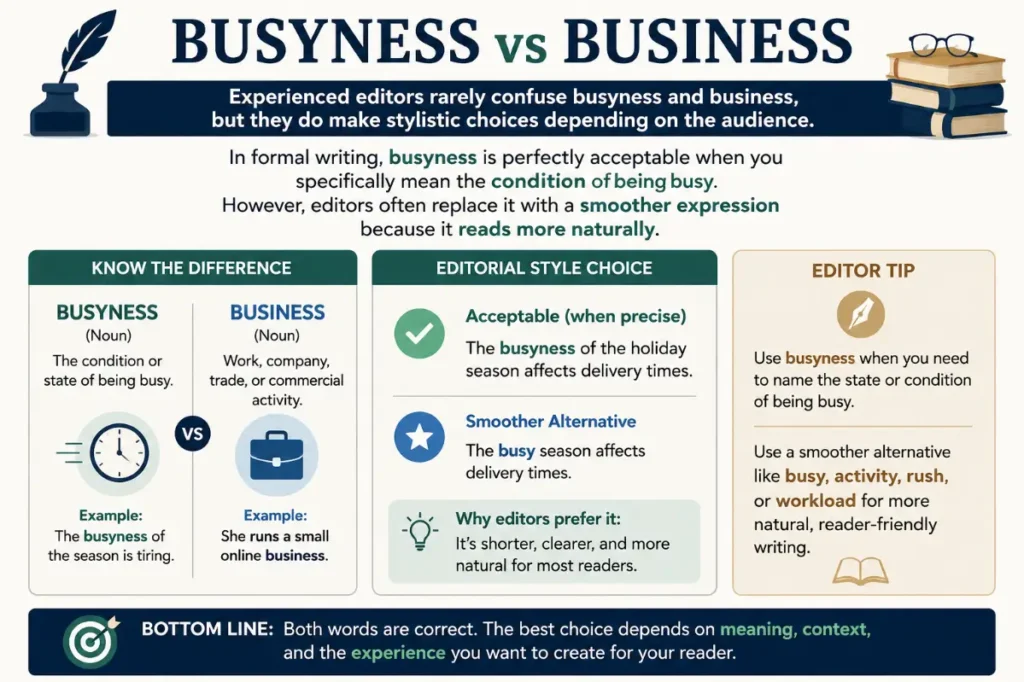
As a senior editor I’d recommend learning these words through meaning rather than visual memory. Business is the word you’ll encounter far more often because English uses it for companies work commerce and personal affairs. Busyness is narrower and describes the condition of being busy. If you aren’t sure which one belongs in a sentence replace the word mentally with a plain phrase. If the meaning is the state of being busy then busyness is probably right. If the meaning is work a company commerce or a matter then business is the natural choice. Spell checkers can catch misspellings but they can’t always understand your intended meaning. A dictionary can confirm the definition but context still makes the final decision.
Conclusion
Busyness vs business becomes much easier once you focus on meaning instead of appearance. Busyness is the noun for the state of being busy. Business usually refers to work commerce a company or a particular matter. Both words are correct standard English and both have a place in natural writing.
The biggest trap is assuming that closely related words can always replace each other. They can’t. If you’re describing a crowded schedule an active environment or a constant stream of activity use busyness. If you’re talking about a company professional work trade or an affair use business. Context does the heavy lifting.
A practical tip is to pause and ask what you’re actually describing before you type. If you can replace the word with the state of being busy then busyness is likely the right choice. If you mean work company commerce or a matter choose business. That simple test will prevent most mistakes.
FAQs
Is Busyness A Real Word?
Yes. Busyness is a real standard English noun. It means the state or condition of being busy. It can describe a crowded schedule a highly active place or a situation filled with tasks and activity. It isn’t simply a misspelling of business. Although it appears less often than business many reputable dictionaries recognize it as a legitimate word.
What Does Business Mean?
Business has several common meanings. It can refer to a company commercial activity professional work or a particular matter or affair. For example She owns a business refers to a company while I have some business to handle refers to matters that need attention. The surrounding words usually make the intended meaning clear.
Busyness Or Business Which Is Correct?
Both are correct but they express different ideas. Use busyness for the state of being busy. Use business for a company commercial activity work or an affair. If you mean that a place or schedule contains a lot of activity choose busyness. If you mean professional or commercial activity choose business.
How Do You Pronounce Busyness?
Busyness is commonly pronounced /ˈbɪz.i.nəs/. A simple way to approximate it is BIZ ee ness. It has three syllables in standard pronunciation. The first part sounds similar to the beginning of business while the middle syllable clearly reflects the sound found in busy. Listening to native speakers can help you develop a more natural rhythm.
Can Busyness Start A Sentence?
Yes. Busyness can begin a sentence when it functions as the subject. For example Busyness can make it difficult to focus. Starting a sentence with the word is grammatically correct. The main consideration isn’t its position but its meaning. Make sure you’re describing a state of being busy rather than referring to a company work or an affair.
What Is A Synonym For Busyness?
Useful alternatives for busyness include activity, bustle, hustle, commotion, constant activity, and a full schedule. The best choice depends on context. Bustle often suggests energetic movement while activity is more neutral. A full schedule works better when you’re talking about a person’s time rather than the activity of a place.
Why Do People Misspell Business?
People often struggle with business because its spelling doesn’t closely match its modern pronunciation. The letters can lead learners to expect a pronunciation that English speakers don’t actually use. The word also has a complicated historical spelling. Because busy is pronounced clearly while business sounds compressed many learners need time to connect the written form with the spoken form.
Is Business Suitable For Formal Writing?
Yes. Business is completely appropriate in formal writing. It appears frequently in academic research professional documents journalism government communication and commercial writing. The meaning depends on context. You can use it to describe companies commercial activity work or matters. The word is neither casual nor slang. It is one of the most established nouns in standard English.
