
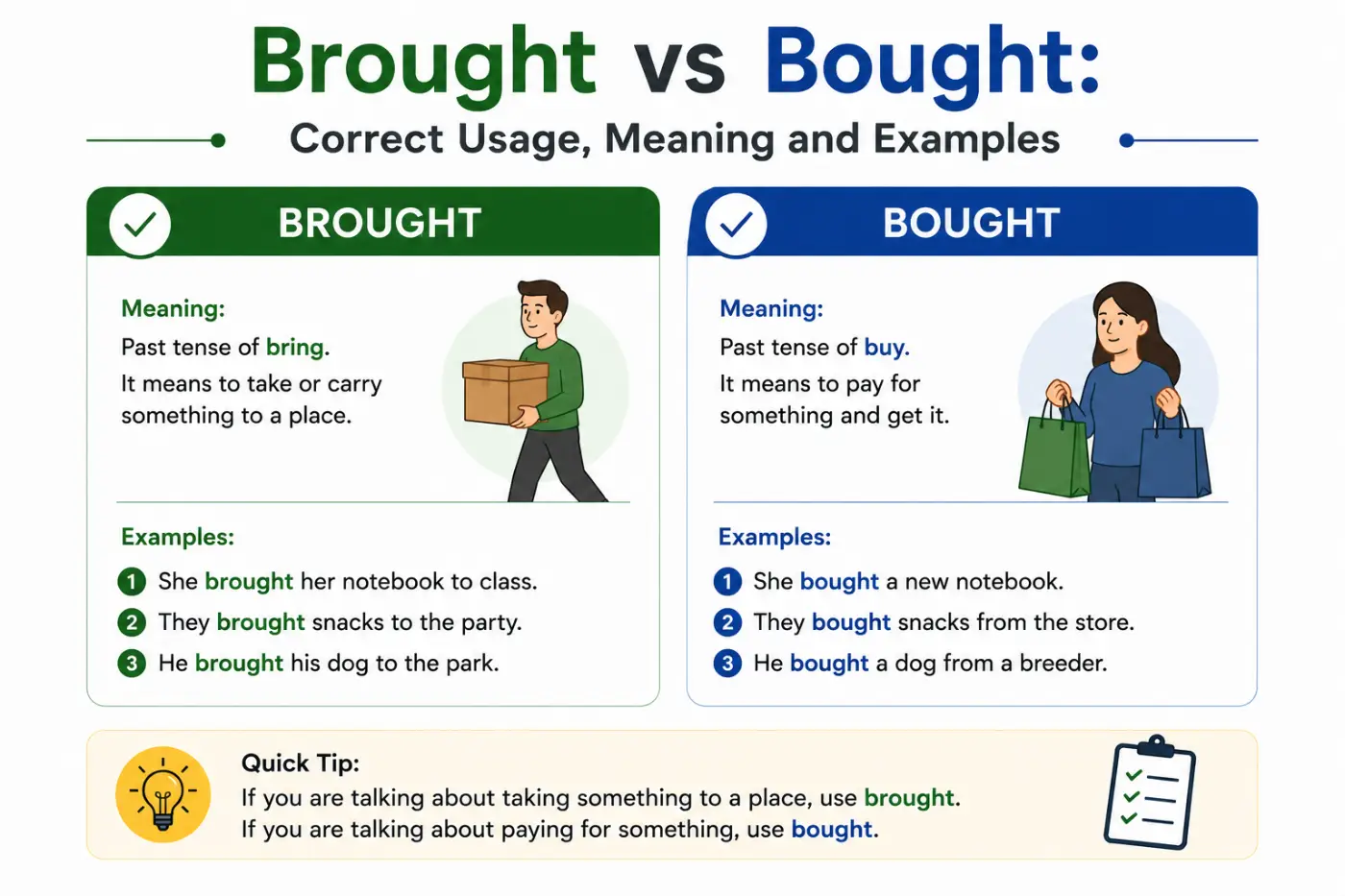
Brought vs bought is a common English confusion because the two words look almost identical and can sound surprisingly similar in fast speech. The direct answer is simple: brought is the past tense and past participle of bring, while bought is the past tense and past participle of buy. They are both correct English words, but you can’t normally substitute one for the other.
The confusion often appears when someone is writing quickly and remembers only the general shape or sound of the word. The spelling difference is small, but the meaning is completely different. If you say, “I brought a new laptop,” you mean you carried or took the laptop with you. If you say, “I bought a new laptop,” you mean you purchased it. One letter changes the word, while the verb behind it changes the entire meaning.
This guide explains the difference in plain English. You’ll learn what each word means, how its grammar works, how to pronounce it, where the words came from, and how native speakers use them. You’ll also see practical examples from conversation, email, academic writing, news, and everyday situations. By the end, choosing the right form should feel automatic.
Featured Snippet Quick Definition
Brought is the past tense and past participle of bring, meaning to carry, take, or cause something to come to a place. Bought is the past tense and past participle of buy, meaning to obtain something by paying for it. Both are correct words with different meanings.
Quick Answer
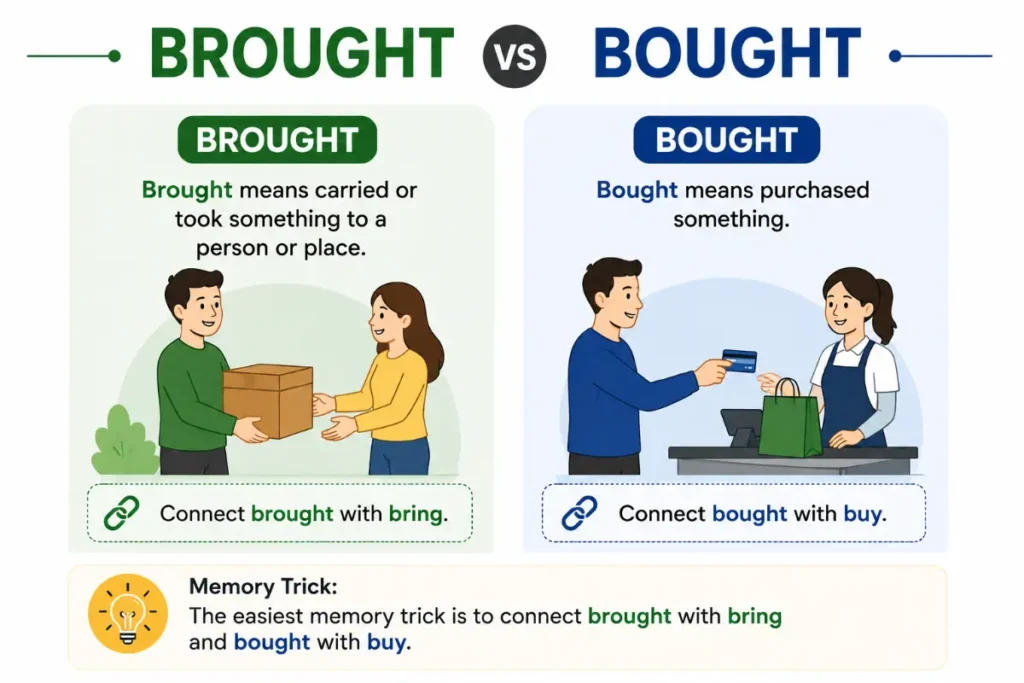
Brought means carried or took something to a person or place. Bought means purchased something. The easiest memory trick is to connect brought with bring and bought with buy.
Compare these sentences: “She brought dinner home” means she carried dinner home. “She bought dinner” means she paid for the dinner.
Comparison Table
| Correct Form | Meaning | Part of Speech | Origin | Usage Frequency | Formality | Common Contexts | Example |
|---|---|---|---|---|---|---|---|
| Brought | Carried or caused something to come | Verb | Old English roots related to bring | Very common | Neutral | Conversation, work, travel, family | I brought my notebook to class. |
| Bought | Purchased something by paying for it | Verb | Old English roots related to buy | Very common | Neutral | Shopping, business, finance, daily life | I bought a new notebook yesterday. |
Meaning and Definition
Meaning of Brought
Brought is the past tense and past participle of bring. It describes an action involving movement, delivery, introduction, or causing something or someone to come to a particular place or situation. For example, “Tom brought his sister to the party” means Tom caused or accompanied his sister to the party. “She brought coffee to the office” means she carried the coffee to the office. The word can also have figurative meanings. You can bring happiness, bring attention to a problem, bring change, bring someone comfort, or bring an issue to someone’s attention. That broader meaning makes brought more flexible than simply “carried.”
Meaning of Bought
Bought is the past tense and past participle of buy. It means that someone obtained something by paying money for it.
For example, “I bought a new phone” means I purchased a new phone. “They bought tickets for the concert” means they paid for the tickets.
The word can also appear in figurative expressions. Someone can “buy time,” meaning they gain extra time. A person can also “buy into an idea,” meaning they accept or support it.
The central idea remains acquisition through purchase.
Key Differences Explained
Spelling
The spelling difference is only one letter. Brought contains the letters r and ou before the final ght. Bought contains ou followed by ght but doesn’t contain the r. That small visual difference matters because the words come from different verbs.
Grammar Role
Both forms function as verb forms.
Brought comes from bring.
Bring → brought → brought.
Bought comes from buy.
Buy → bought → bought.
Both verbs are irregular. Their past forms don’t follow the regular pattern of adding ed.
You don’t say “bringed” in standard English. You don’t say “buyed” either.
Meaning
The meanings are entirely different. Brought relates to bringing something or someone. Bought relates to purchasing something. A useful mental test is to ask yourself what action occurred. If someone carried, delivered, or caused something to come, use brought. If someone paid money to obtain something, use bought.
Tone
Neither word is especially formal or informal. Both are ordinary English words used by native speakers in casual conversation, professional communication, journalism, academic writing, and literature.
Context
The surrounding words usually make the correct choice obvious.
“Please bring your passport.”
“I brought my passport.”
“I bought a passport cover.”
The first pair connects to movement or delivery. The second pair connects to purchasing.
Which Form Is Correct?
Both brought and bought are correct. The correct choice depends entirely on the verb and intended meaning. Use brought as the past form of bring. Use bought as the past form of buy. This distinction follows standard English dictionary and grammar conventions. Major English dictionaries treat bring and buy as separate irregular verbs, with brought and bought serving as their respective past forms. An expert editing rule makes the distinction easy: don’t choose the word by appearance alone. Identify the base verb first. If the intended verb is bring, write brought. If the intended verb is buy, write bought.
Sentence Examples
Examples With Brought
- Sarah brought her laptop to the meeting.
- I brought some snacks for everyone.
- He brought his children to the museum.
- The waiter brought us another glass of water.
- She brought an umbrella because the weather looked uncertain.
- My brother brought his friend home after school.
- The teacher brought several examples to class.
- They brought fresh flowers to the hospital.
- I brought the documents you requested.
- The experience brought a new perspective to the discussion.
Examples Showing The Common Error
- Incorrect: I bought my lunch to work.Correct: I brought my lunch to work.
- Incorrect: She brought a new dress at the store.Correct: She bought a new dress at the store.
- Incorrect: He bought his passport to the airport.Correct: He brought his passport to the airport.
- Incorrect: We brought new chairs from the furniture shop.Correct: We bought new chairs from the furniture shop.
- Incorrect: They bought some food to the party.Correct: They brought some food to the party.
These mistakes aren’t random. They usually happen because the two forms share a similar sound pattern and differ by only one consonant.
Common Mistakes and Misspellings
Confusing Purchase With Movement
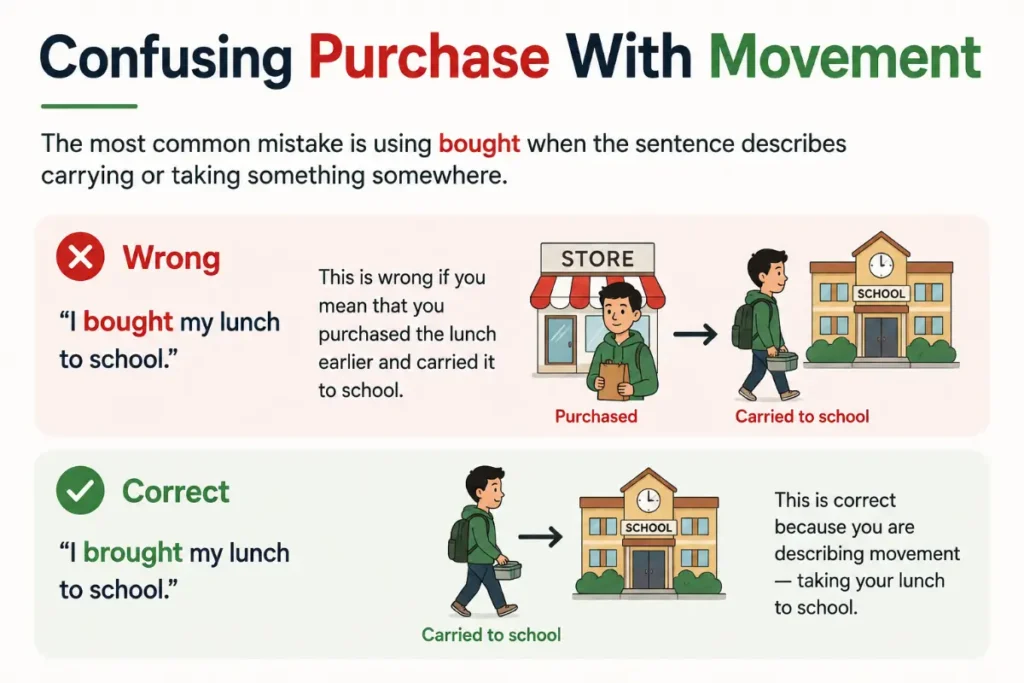
The most common mistake is using bought when the sentence describes carrying or taking something somewhere.
“I bought my lunch to school” is wrong if you mean that you purchased the lunch earlier and carried it to school.
“I brought my lunch to school” is correct.
Confusing The Base Verbs
Another problem occurs when writers don’t mentally return to the base verb.
Ask yourself:
Did I bring it?
Then the past form is brought.
Did I buy it?
Then the past form is bought.
Sound Based Spelling
Fast speech can make the distinction less obvious. This can lead to phonological confusion, especially for learners who are still developing a strong connection between English sounds and spelling.
Visual Similarity
The words share the same final ght pattern and contain similar vowel letters. That creates orthographic similarity. In simple terms, your brain recognizes a familiar visual pattern and may select the wrong word during fast writing.
Contextual Prediction
Language processing often predicts the next word from context. If you’re writing quickly, your brain may select a familiar form before you consciously check the meaning. This is one reason proofreading should involve meaning, not just spelling.
Pronunciation Guide
Brought
Brought is commonly pronounced /brɔːt/ in many varieties of English. The word has one syllable. An approximate audio style spelling for many American speakers is brawt. The beginning contains the br sound, which is the key feature distinguishing it from bought.
Bought
Bought is commonly pronounced /bɔːt/ in many varieties of English. It also has one syllable. An approximate audio style spelling is bawt. The most useful pronunciation distinction is the initial br sound in brought. For many speakers, the vowel in both words is similar or identical. That means listening for the initial r sound can help. However, pronunciation varies by accent. In some varieties of English, the distinction can be less obvious in connected speech. That’s another reason spelling should be connected to meaning rather than sound alone.
Etymology and Word Origin
The history of these words explains why they don’t resemble the modern regular past tense pattern. Bring comes from Old English bringan, a verb associated with carrying or bringing something. Over centuries, its forms changed through the natural development of English. The modern past form brought developed from earlier forms associated with the verb’s historical conjugation. Buy has Old English roots in bycgan, meaning to acquire something by payment or purchase. Its historical forms developed into the modern verb buy and the past form bought. English contains many irregular verbs because the language inherited several older verb patterns from Germanic languages. Some survived even after English adopted more regular ed forms for many verbs.
That’s why you get pairs such as:
Bring → brought.
Buy → bought.
Think → thought.
Seek → sought.
These forms may look unusual to modern learners, but they are historically established patterns rather than spelling mistakes.
Regional Usage
United States
American English uses brought and bought with the same basic meanings found throughout standard English. Both forms are extremely common in everyday conversation and professional writing. No American spelling variant replaces either word.
United Kingdom
British English also uses brought for the past form of bring and bought for the past form of buy. The distinction is standard and remains consistent across ordinary written English.
Australia
Australian English follows the same basic distinction. Speakers use brought for movement or delivery and bought for purchasing. Accent differences may affect pronunciation, but they don’t change the spelling or core meanings.
Canada
Canadian English also follows the standard distinction between the two forms. Regional pronunciation can vary, yet the written forms remain brought and bought.
No major standard English variety uses brought as the ordinary past form of buy or bought as the ordinary past form of bring.
Grammar Rules and Part of Speech
Both words are verbs, but understanding their base verbs makes their grammar much easier.
Brought As A Verb
Brought is the simple past and past participle of bring.
Simple past:
“I brought the report yesterday.”
Past participle:
“I have brought the report.”
The past participle also appears with forms of have and in passive constructions.
“I had brought everything we needed.”
“The issue was brought to the manager’s attention.”
Bought As A Verb
Bought is the simple past and past participle of buy.
Simple past:
“I bought the book yesterday.”
Past participle:
“I have bought the book.”
You can also use it with other auxiliary verbs.
“She had bought the tickets before the price increased.”
“The house was bought by a local family.”
Sentence Placement
Both words usually appear after the subject.
“I brought my keys.”
“She bought a new coat.”
They can also occur in longer constructions.
“After work, I brought the documents home.”
“Last weekend, we bought a new table.”
Punctuation
Neither word requires special punctuation simply because it appears in a sentence. Normal punctuation rules apply.
If the word begins a sentence, capitalize it.
“Brought everything you need before leaving.”
However, that sentence sounds incomplete without an understood subject in ordinary prose. A more natural sentence would be:
“I brought everything you need before leaving.”
Real Life Usage Examples
Daily Talk
“I brought some coffee for you.”
“She bought a new pair of shoes.”
These sentences represent two common everyday actions. One involves carrying or delivering something. The other involves purchasing something.
“I’ve brought the documents you asked for.”
“I bought the replacement equipment yesterday.”
Professional emails frequently use both words because meetings, deliveries, purchases, and documents are part of normal workplace communication.
Academic Writing
“The study brought attention to an overlooked issue.”
“The researcher bought the required materials before beginning the experiment.”
In academic writing, brought can have a figurative meaning involving attention, awareness, or change.
News
“The storm brought heavy rain to the region.”
“The company bought a smaller competitor last year.”
News writing commonly uses brought in descriptions of events and consequences. Bought often appears in business and financial reporting.
Literature
“The journey brought him closer to his family.”
“She bought the old house despite its condition.”
Writers use these verbs both literally and figuratively. The meaning comes from the surrounding context.
Bring And Buy
The phrase bring and buy can appear in contexts involving selling or exchanging donated items, especially in British English. It combines the two verbs but doesn’t erase their separate meanings.
Expert Editor Insight
A senior editor doesn’t correct brought and bought by memorizing isolated spellings. The better method is to identify the intended action first. Native speakers usually process these words through context automatically. If the sentence involves movement, delivery, or causing something to come, choose brought. If it involves payment and purchase, choose bought. One practical editing trick is to temporarily replace the word with its base verb. If “bring” makes sense, the past form is brought. If “buy” makes sense, the past form is bought. Spellcheckers may identify an obvious typo, but they can miss a correctly spelled word used in the wrong context.
Memory Trick
Use this simple connection:
Bring → brought.
Buy → bought.
If you can remember the base verb, the past form becomes much easier.
Another useful sentence is:
“I brought what I bought.”
This sentence puts both words together naturally.
You might say:
“I bought a cake and brought it to the party.”
The cake was bought because money was exchanged for it. It was brought because it was carried to the party.
That distinction works in countless situations.
Why The Confusion Is So Common
English learners often struggle with words that have similar spelling but unrelated meanings. This is especially true with irregular verbs. The problem here involves several layers of language processing. First, the words have strong orthographic similarity. That means their written forms look alike. Second, they have phonological similarity. Their sounds overlap significantly in many accents. Third, they are both extremely common. High frequency doesn’t always prevent mistakes. In fact, common words are often typed quickly and automatically. Fourth, the base verbs are irregular. Learners can’t simply add ed and predict the correct form. These factors combine to create a classic lexical confusion problem. The solution isn’t endless memorization. It is building a strong connection between each word and its meaning.
A Simple Decision Test
When you’re unsure, stop and ask one question:
Was something purchased?
If yes, use bought.
“I bought a new computer.”
“I bought groceries.”
“She bought a ticket.”
If something was carried, delivered, taken, or caused to arrive, use brought.
“I brought my computer.”
“I brought groceries home.”
“She brought a ticket to the office.”
This test works because it focuses on meaning rather than appearance.
Brought And Bought In Compound Expressions
Both words appear in many familiar constructions.
With brought, you may see phrases such as:
“brought back.”
“brought together.”
With bought, common expressions include:
“bought time.”
“bought into an idea.”
Conclusion
Brought vs bought becomes easy once you connect each word to its base verb. Brought is the past tense and past participle of bring, while bought is the past tense and past participle of buy. One describes bringing, carrying, delivering, or causing something to come. The other describes purchasing something.
The words look and sound similar, so confusion is understandable. Still, their meanings are completely different. “I brought the book” means I carried or delivered it. “I bought the book” means I paid for it. That single distinction solves most usage problems.
The most practical tip is to check the base verb before you write. Bring becomes brought. Buy becomes bought. If you can identify the action first, the spelling usually takes care of itself. Once that connection becomes automatic, this common English confusion largely disappears.
FAQs
Is brought a real word?
Yes. Brought is a standard English word and the past tense and past participle of bring. It describes carrying, delivering, taking, or causing something or someone to come. For example, “She brought her documents to the meeting.” It can also have figurative meanings, as in “The announcement brought attention to the issue.”
Is bought a real word?
Yes. Bought is a standard English word and the past tense and past participle of buy. It means that someone purchased or obtained something by paying for it. For example, “He bought a new phone.” The word can also appear in expressions such as “buy time” and “buy into an idea.”
Brought or bought which is correct?
Both are correct, but they have different meanings. Use brought when the base verb is bring, usually involving carrying, delivering, or causing something to come. Use bought when the base verb is buy, meaning to purchase something. The easiest test is to identify the base verb before choosing the past form.
How do you pronounce brought?
Brought is commonly pronounced /brɔːt/ in many varieties of English and has one syllable. An approximate pronunciation is “brawt.” The initial br sound is useful for distinguishing it from bought, which commonly begins with a simple b sound. Accent differences can affect the vowel, but the written distinction remains consistent.
Can brought start a sentence?
Yes, brought can appear at the beginning of a sentence, although its grammatical role depends on the sentence structure. For example, “Brought to the hospital after the accident, he received immediate care” uses brought as part of a participial construction. More commonly, a sentence begins with a subject followed by the verb, such as “She brought the documents.”
What is a synonym for brought?
The best synonym depends on the context. Possible alternatives include carried, delivered, took, introduced, provided, or caused, but they aren’t exact replacements in every sentence. For example, “She brought the package” can sometimes become “She delivered the package,” while “The speech brought attention to the issue” needs a different alternative.
Why do people confuse brought and bought?
People confuse them because they look and sound similar, especially in quick speech. Both are short irregular verb forms ending in ght, and both contain similar vowel patterns. Their base verbs are also irregular. Because of this combination of spelling similarity, sound similarity, and fast language processing, writers sometimes choose the wrong form even though both words are individually spelled correctly.
Is brought suitable for formal writing?
Yes. Brought is completely appropriate in formal writing. It appears in professional documents, academic work, journalism, reports, and formal correspondence. The same applies to bought. Neither word is informal slang. The main requirement is using the correct word for the intended meaning. Formal writing still needs precise vocabulary, so confusing the two can weaken an otherwise polished sentence.
