
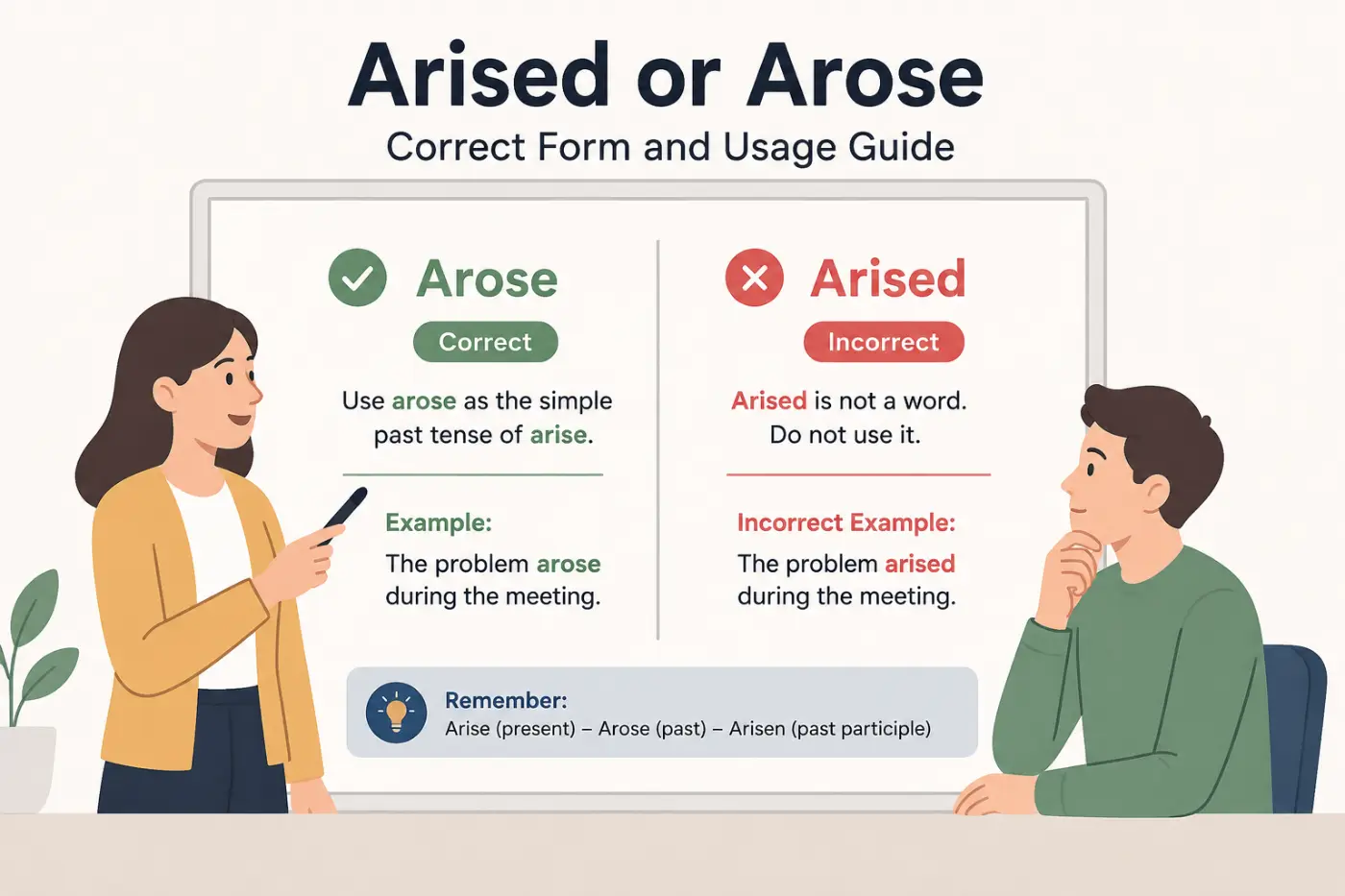
If you’re confused about arised or arose you’re not alone. The correct past tense of arise is arose. You should write The problem arose yesterday rather than The problem arised yesterday. The word arised looks tempting because many English verbs form their past tense by adding ed.
The confusion comes from a common English pattern. We learn verbs such as walk walked and open opened so our brain naturally expects a similar change with arise. But arise is an irregular verb. Its main forms are arise arose and arisen. Once you learn this pattern the difference becomes much easier to remember.
In this guide you’ll learn what arose means how to use it correctly and how it differs from arisen. You’ll also see natural examples pronunciation guidance common mistakes and practical grammar rules. By the end you’ll know exactly which form to use in everyday writing professional communication and formal English.
Quick Definition
Arose is the correct simple past form of arise. Arise means to happen to come into existence or in some formal contexts to get up or stand. Arose refers to something that happened in the past. Arisen is the past participle and normally appears with have has or had.
Quick Answer
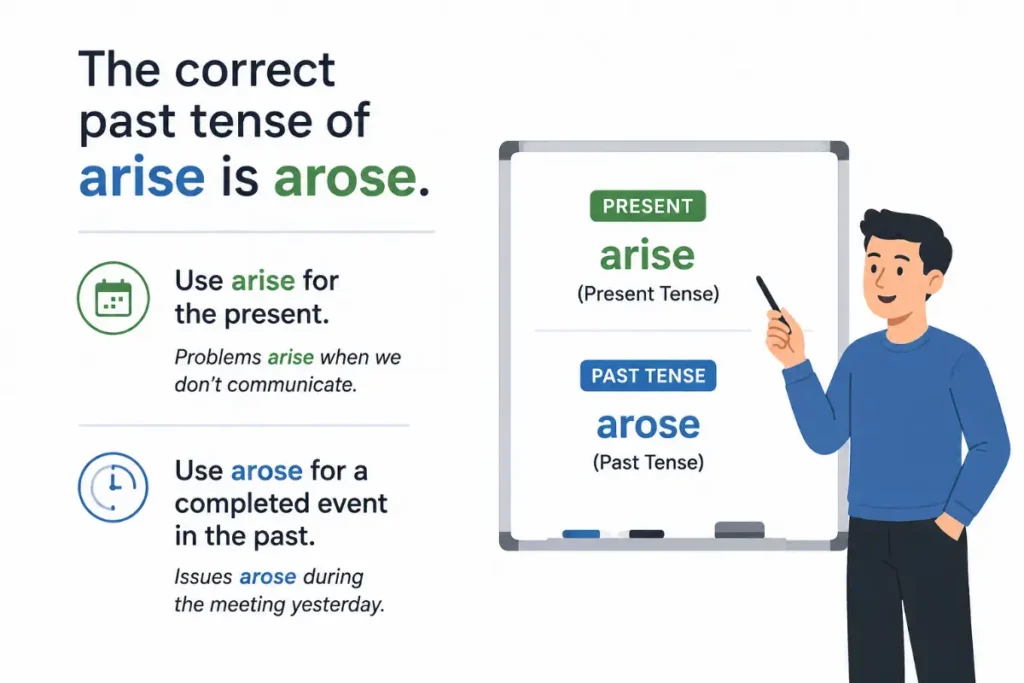
The correct past tense of arise is arose.
Use arise for the present and arose for a completed event in the past. Use arisen as the past participle with auxiliary verbs such as has have or had. Standard dictionaries including Cambridge Oxford and Collins list arise arose and arisen as the accepted forms.
Comparison Table
| Correct Form | Meaning | Part of Speech | Origin | Usage Frequency | Formality | Common Contexts | Example |
|---|---|---|---|---|---|---|---|
| Arise | To happen begin exist or get up | Verb | Old English | Common | Formal to neutral | Problems needs opportunities situations | Problems arise when communication fails. |
| Arose | The past form of arise | Verb | Old English | Common | Formal to neutral | Past events problems opportunities situations | A serious problem arose yesterday. |
| Arisen | The past participle of arise | Verb | Old English | Common | Formal to neutral | Perfect tenses causes issues developments | Several questions have arisen. |
| Arised | Nonstandard form created by regularizing arise | Verb form | Modern grammatical error pattern | Uncommon | Not recommended | Informal mistakes learner writing | The issue arised yesterday is incorrect in standard English. |
Meaning and Definition
Meaning of Arised
Arised is not the standard past tense of arise in modern English.
People sometimes create arised because they apply the regular past tense rule. They see arise and instinctively add ed. That produces a form that looks perfectly familiar on the page. English grammar does not accept that form as the standard simple past of arise.
Some dictionaries and language references may record arised as a nonstandard form. That doesn’t make it the preferred form for normal writing. Wiktionary labels it nonstandard and identifies it as a simple past and past participle form created outside the standard conjugation.
For school assignments professional emails reports essays applications and other polished writing use arose for the simple past.
For example:
- Incorrect: A problem arised during the meeting.
- Correct: A problem arose during the meeting.
- Incorrect: Several questions arised after the presentation.
- Correct: Several questions arose after the presentation.
The mistake usually comes from overregularization. That’s a useful linguistic term for a very ordinary learning pattern. The brain learns a common rule and applies it to a word that doesn’t follow that rule.
English has many irregular verbs that work this way. We say go went rather than goed. We say begin began rather than begined. In the same family of irregular patterns arise becomes arose.
Meaning of Arose
Arose is the simple past form of arise. Cambridge defines arose directly as the past simple of arise. Oxford gives the same grammatical classification.
The verb arise has several related meanings.
It can mean that something happens or begins to exist.
A problem arose during the inspection.
It can describe an opportunity that became available.
An opportunity arose after the company expanded.
It can describe a question or concern that appeared.
Several questions arose during the discussion.
It can also mean that something came from a particular cause.
The disagreement arose from a misunderstanding.
In a more formal or literary sense arise can mean get up or stand.
He arose early in the morning.
That last meaning is less common in everyday American conversation. Most people would normally say He got up early in the morning. Still the form arose remains grammatically correct.
Cambridge lists arise as an intransitive verb and gives arise arose and arisen as its three main forms. Oxford also identifies arise as an irregular verb with arose as its past form and arisen as its past participle.
Key Differences Explained
- Spelling. Arise is the base form. Arose is the simple past. Arisen is the past participle. Arised is not the standard past form.
- Grammar role. Arise describes a present or general situation. Arose describes a completed past event. Arisen normally works with an auxiliary verb such as has have or had.
- Meaning. The basic meaning stays connected across the forms. The main difference comes from tense and grammatical function.
- Tone. Arise and its related forms can sound somewhat formal because the verb appears often in professional academic legal and official writing.
- Context. Arose works naturally with past time references such as yesterday last year during the meeting or after the decision.
- Verb pattern. Arise belongs to a group of irregular verbs that don’t form the simple past by simply adding ed.
- Standard usage. Arose is accepted in standard English. Arised should be avoided in edited writing.
Which Spelling Is Correct?
If you’re choosing between arised or arose the answer is straightforward. Arose is correct when you need the simple past of arise.
The reason comes from English verb conjugation. Arise is an irregular verb. Its standard forms are arise arose arisen and arising. Cambridge explicitly lists arose as the past tense and arisen as the past participle. Oxford gives the same pattern. Collins also lists arose as the past tense and arisen as the past participle.
This matters because adding ed to an irregular verb doesn’t automatically create a valid past form.
Consider this pattern.
- Present: The problem arises.
- Simple past: The problem arose.
- Present perfect: The problem has arisen.
- Past perfect: The problem had arisen.
- Present participle: The problem is arising.
A useful editor’s rule is to memorize the three core forms together.
Arise. Arose. Arisen.
Think of them as a team. If you remember one form without the others the past tense can easily slip away when you’re writing quickly.
Sentence Examples
Here are natural examples using arose.
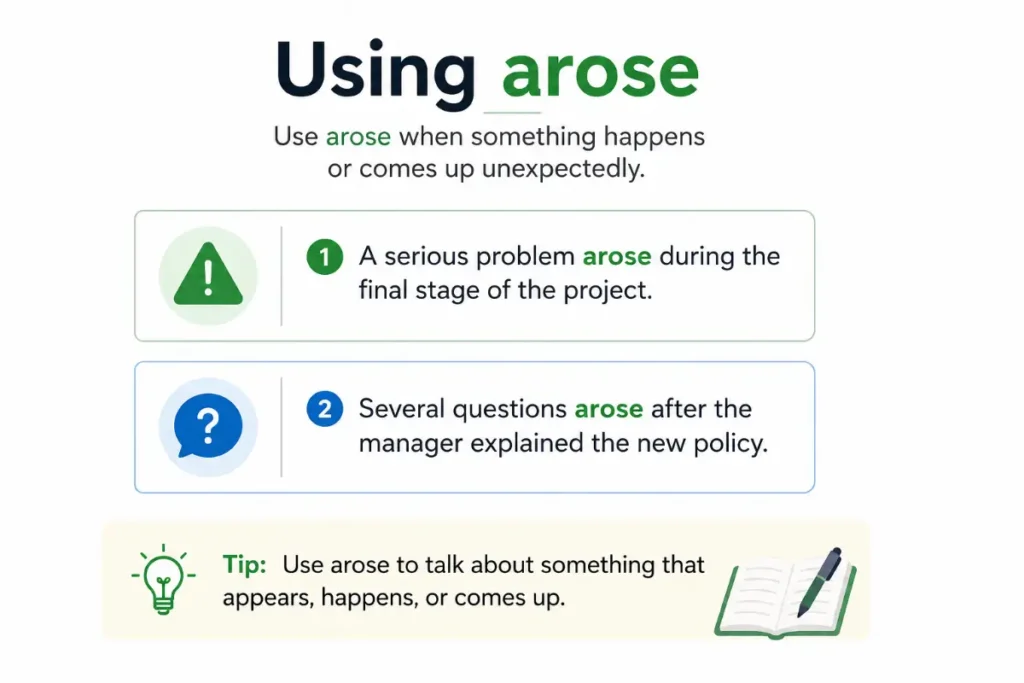
- A serious problem arose during the final stage of the project.
- Several questions arose after the manager explained the new policy.
- An unexpected opportunity arose when the company opened another office.
- The disagreement arose from a simple misunderstanding.
- A technical issue arose shortly after the update.
- No major concerns arose during the inspection.
- The need for additional funding arose after costs increased.
- A similar situation arose last summer.
- New concerns arose when the results were published.
- The discussion arose from a question about the original agreement.
Now compare those sentences with the common mistake.
- Incorrect: A serious problem arised during the project.
- Correct: A serious problem arose during the project.
- Incorrect: Several questions arised after the meeting.
- Correct: Several questions arose after the meeting.
- Incorrect: A new opportunity arised unexpectedly.
- Correct: A new opportunity arose unexpectedly.
- Incorrect: The conflict arised from poor communication.
- Correct: The conflict arose from poor communication.
- Incorrect: A concern arised during the review.
- Correct: A concern arose during the review.
The pattern is consistent. When the event happened in the past use arose.
Common Mistakes and Misspellings
Several errors tend to appear around this verb.
- Arised instead of arose. This is the most direct mistake. Writers treat arise as a regular verb and attach ed.
- Arosed instead of arose. Some writers add an extra sound or letter because arose and arouse look similar. They are different verbs.
- Arose instead of arisen. This happens when writers use the simple past after have has or had. The correct construction is The problem has arisen rather than The problem has arose.
- Arise instead of arose. This happens when a writer forgets to change the verb for a completed past event. The problem arose yesterday is correct.
- Arising instead of arose. These forms serve different grammatical purposes. Arising is the present participle and appears in continuous structures or as a modifier.
The spelling confusion also connects with several NLP style patterns. Language learners often classify an unfamiliar verb according to a familiar pattern. Once the brain learns that many verbs form the past with ed it may extend that pattern to an irregular verb.
That’s called overregularization. Children do it. Language learners do it. Native speakers can occasionally do it when speaking quickly or writing without proofreading.
The mistake isn’t random. It comes from a predictable mental shortcut.
Pronunciation Guide
The pronunciation of arise is different from the pronunciation of arose.
Arise is pronounced approximately like uh RIZE. Its IPA pronunciation is /əˈraɪz/. Cambridge gives this pronunciation for both American and British English.
Arose is pronounced approximately like uh ROHZ. Its American IPA pronunciation is /əˈroʊz/. Cambridge and Oxford provide closely matching pronunciation information.
The syllable pattern is simple.
Arise has two syllables.
A rose has two syllables when used as the verb form.
The important vowel change occurs in the stressed part of the word.
Arise sounds like uh RIZE.
Arose sounds like uh ROHZ.
Arisen has three syllables and is pronounced approximately uh RIZ un. Cambridge identifies arisen as the past participle of arise.
One common pronunciation mistake is treating arose as if it rhymes with words that contain the sound in arouse. That isn’t the standard pronunciation. Arose has the long o sound found in words such as rose.
Another useful memory trick is to connect the pronunciation with the spelling.
Arise has the i sound.
Arose has the o sound.
Arisen returns to the short i sound.
Etymology and Word Origin
The history of arise helps explain why the verb behaves differently from regular verbs.
Collins traces arise to Old English ārīsan and notes its relationship with the older Germanic family of words connected with rising. The word existed in English long before the modern regular past tense system became as familiar to learners as it is today.
The basic idea behind the word has long been connected with rising moving upward standing up and coming into existence.
Over time the meaning expanded beyond physical movement.
A person can arise from bed.
A problem can arise.
A question can arise.
An opportunity can arise.
A conflict can arise.
In each case the underlying idea involves something coming up or coming into notice.
The past form arose developed as part of the irregular verb pattern. Modern English preserved that pattern even as many other verbs moved toward simpler regular forms.
This history explains why the word doesn’t behave like a regular verb such as organize or discuss.
You don’t need to study historical linguistics to use arise correctly. Still understanding the history makes the pattern easier to remember.
The verb is old. Its irregular form is established. Modern standard English therefore uses arose rather than arised.
Regional Usage
US English
American English uses arise arose and arisen in the standard way. Oxford’s American Dictionary lists arise with arose as the past form and arisen as the past participle.
In American writing arise often appears in professional and formal contexts.
Problems may arise.
Questions arose.
Concerns have arisen.
In casual conversation Americans may choose simpler verbs such as happen come up or occur. Even so arose remains completely standard.
UK English
British English follows the same verb pattern. Cambridge lists arise arose and arisen and gives the same core meanings for the verb.
British writing may use arise more frequently in formal administrative academic and legal contexts.
Arose is therefore not an American spelling. It is the standard past form in both major varieties of English.
Australian English
Australian English also follows the standard irregular conjugation.
Arose is the accepted past form of arise. Arisen is the standard past participle.
The same grammar applies in Australian professional academic and everyday writing.
Canadian English
Canadian English follows the same standard pattern.
Use arise for the present.
There is no standard regional version that replaces arose with arised.
Grammar Rules and Part of Speech
Arise is an intransitive verb. That means it doesn’t normally take a direct object.
You can say A problem arose.
You wouldn’t normally say Someone arose a problem.
Instead use a structure such as Someone caused a problem or A problem arose.
Cambridge specifically identifies arise as an intransitive verb. Oxford also describes it as an intransitive verb and provides examples involving problems questions opportunities and situations.
The basic forms work like this.
- Present. Problems arise when communication fails.
- Simple past. Problems arose when communication failed.
- Present perfect. Problems have arisen during the project.
- Past perfect. Problems had arisen before the meeting began.
- Present participle. Problems are arising more frequently.
Notice the difference between arose and arisen.
Arose can stand alone as the simple past.
The problem arose yesterday.
Arisen normally needs an auxiliary verb.
The problem has arisen recently.
The problem had arisen before we arrived.
This distinction is one of the most useful things to remember.
There is also a common construction with from.
The problem arose from poor planning.
The dispute arose from a misunderstanding.
The need arose from changing circumstances.
You can also see arise out of in formal writing.
The claim arose out of the original agreement.
The issue arose out of a disagreement.
These structures are especially common in legal academic and professional English.

Real Life Usage Examples
Daily Talk
In everyday conversation native speakers often choose simple alternatives such as happened or came up. Still arise and arose are perfectly natural in the right context.
- A problem arose while we were trying to book the tickets.
- A question arose when we started talking about the cost.
The first sounds slightly more formal than A problem came up. Both communicate the basic idea.
Professional emails frequently use arose when describing an issue that happened earlier.
- A scheduling conflict arose this morning.
- A question arose during our review of the document.
This wording is concise and professional without sounding excessively formal.
Academic Writing
Academic writing uses arise often because researchers discuss problems causes questions and consequences.
- Several questions arose during the initial analysis.
- The disagreement arose from differences in interpretation.
These structures fit naturally into research papers reports and scholarly discussion.
News Writing
News articles frequently use arose when describing events that developed in the past.
- Concerns arose after officials released the findings.
- Questions arose about the timing of the decision.
The word works well because it describes the emergence of an issue without adding unnecessary emotion.
Literature
Literary writing can use arose in both physical and figurative senses.
- He arose before sunrise and walked toward the window.
- A strange feeling arose as she read the letter.
The first has an old fashioned literary flavor. The second is more broadly usable
The distinction matters because arise often suggests that something comes into existence or becomes noticeable. Cambridge and Collins both emphasize this meaning when discussing problems situations opportunities and events.
Expert Editor Insight
As a senior editor I would treat arised as a clear correction point in standard English. When I see it in an article report email or academic manuscript I replace it with arose if the writer means the simple past. If the sentence uses has have or had I check the context and usually change the form to arisen.
This is also a good example of why spell check alone isn’t enough. A grammar tool may flag arised because it recognizes the irregular verb pattern. But the writer still needs to understand the tense. A sentence such as The issue has arose contains a different problem from The issue arised yesterday. The first needs arisen. The second needs arose.
The most reliable editing habit is to check the whole verb phrase rather than correcting one word in isolation.
A Simple Memory Trick
If you’re still tempted to write arised remember this three word pattern.
Arise. Arose. Arisen.
Think of it as a three step ladder.
The first step is the base verb.
The second step is the simple past.
The third step is the past participle.
You can then build sentences around the pattern.
Problems arise every day.
Problems have arisen recently.
This method works better than trying to remember a complicated grammar explanation every time you write.
Another useful trick is to connect arise with other irregular verbs.
Rise becomes rose and risen.
Arise becomes arose and arisen.
The similarity can help you remember the vowel pattern.
Why Arised Sounds So Natural
The form arised feels natural because most English verbs are regular.
We say:
- Walk becomes walked.
- Call becomes called.
- Need becomes needed.
- Change becomes changed.
- Explain becomes explained.
So when someone sees arise they may automatically think the past should be arised.
That mental process is predictable. The writer isn’t randomly inventing letters. The writer is applying a productive English rule to a verb that belongs to an irregular pattern.
This is why the mistake appears frequently among English learners.
English contains many irregular verbs that must be learned individually.
Arise is one of them.
The best approach isn’t to fight the pattern in your head. Instead memorize the complete set.
Arise.
Arose.
Arisen.
Once those three forms become familiar the mistake becomes much less likely.
Arose Versus Arisen
Arose and arisen are sometimes confused because both describe past events.
The difference is grammatical.
Arose is the simple past.
A problem arose yesterday.
An opportunity arose during the meeting.
A question arose after the announcement.
Arisen is the past participle.
A problem has arisen.
Several concerns have arisen.
A new issue had arisen before the team arrived.
Cambridge identifies arose as the past simple and arisen as the past participle.
A quick test can help.
If you can use yesterday last week earlier this year or another finished past time phrase the simple past arose will often fit.
If you have has have or had immediately before the verb you normally need arisen.
Compare these sentences.
The issue arose yesterday.
The issue had arisen before the meeting.
The grammar becomes much easier once you see the auxiliary verb.
When To Use Arise
Use arise when something happens or begins to exist.
Problems arise when instructions are unclear.
Questions arise naturally during research.
New opportunities arise when conditions change.
You can also use arise for something that comes from a particular source.
The disagreement arose from a misunderstanding.
The problem arose out of poor planning.
The need arose from changing circumstances.
The verb can also describe physically getting up in formal or literary writing.
He arose from his chair.
She arose before dawn.
In ordinary American conversation get up usually sounds more natural for the physical meaning.
When To Use Arose
Use arose when the event happened in the past.
A problem arose during the meeting.
A conflict arose between the two groups.
A new opportunity arose last month.
The question arose after the announcement.
The concern arose from incomplete information.
Arose is especially useful when you want to describe the appearance or development of a problem without suggesting that someone deliberately created it.
Compare these ideas.
The manager created a problem.
A problem arose.
The first sentence directly assigns responsibility. The second simply says that the problem developed or appeared.
That subtle difference makes arise useful in professional and analytical writing.
When To Use Arisen
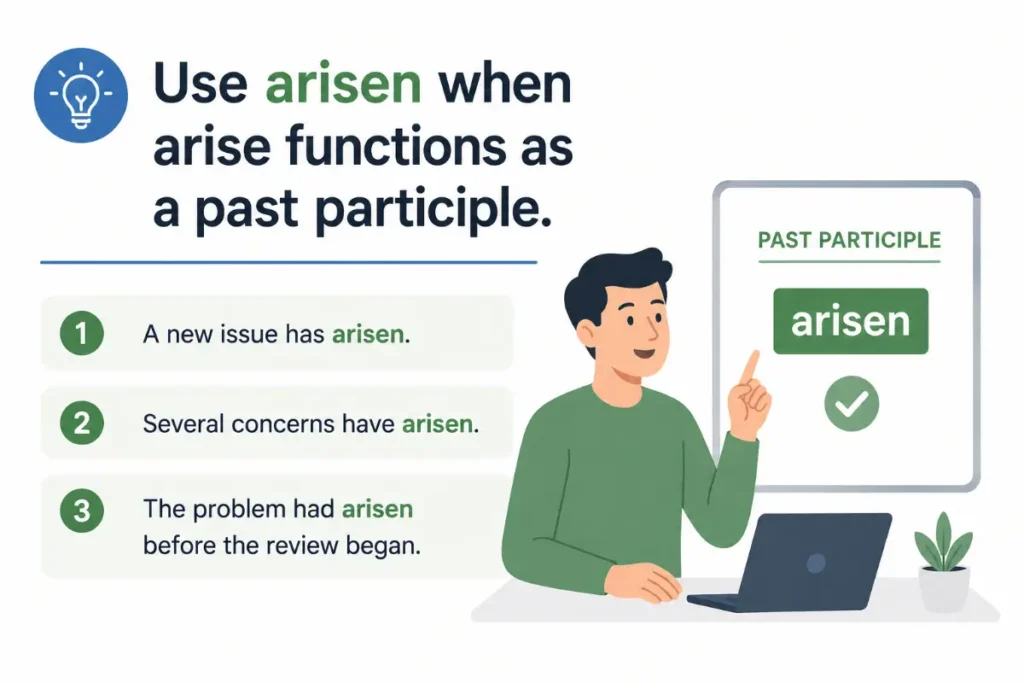
Use arisen when arise functions as a past participle.
A new issue has arisen.
Several concerns have arisen.
The problem had arisen before the review began.
No serious difficulties have arisen.
This form is especially common in formal writing because the verb frequently appears in perfect constructions.
Don’t write:
The problem has arose.
Write:
The problem has arisen.
Don’t write:
Several issues had arose.
Write:
Several issues had arisen.
The pattern is simple once you connect arose with simple past and arisen with the past participle.
Final Takeaway
The answer to arised or arose is simple. Use arose as the standard simple past form of arise. Use arise for the base form and arisen as the past participle. The form arised comes from applying the regular ed rule to an irregular verb and should be avoided in standard English. The easiest way to remember the pattern is to learn all three forms together. Arise. Arose. Arisen.
If you pause for one second before writing the past form you can usually catch the mistake. When the event happened in the past use arose. When has have or had comes before the verb use arisen. That small habit will keep your grammar clean and your writing confident.
Frequently Asked Questions
Is Arised A Real Word?
Arised can be found in some language resources as a nonstandard form of arise. However standard modern English uses arose as the simple past and arisen as the past participle. For professional writing academic work school assignments and edited content use arose rather than arised. The standard dictionary pattern is arise arose arisen.
What Does Arose Mean?
Arose is the simple past form of arise. It means that something happened began existed or became noticeable in the past.
Arised Or Arose Which Is Correct?
Arose is the correct standard form when you need the simple past of arise. Arised results from treating arise like a regular verb and adding ed. That pattern doesn’t apply here because arise is an irregular verb. Use A problem arose yesterday. Use A problem has arisen recently when you need the past participle.
How To Pronounce Arose?
Arose is pronounced approximately like uh ROHZ. The American pronunciation is represented in IPA as /əˈroʊz/. The British pronunciation is commonly represented as /əˈrəʊz/. The stressed vowel sounds like the vowel in rose. Arise has a different stressed vowel and is pronounced approximately uh RIZE.
Can Arise Start A Sentence?
Yes. Arise can begin a sentence when the grammar supports the base form. For example you can write Arise early if you want to use a formal or literary style. In everyday American English get up usually sounds more natural for physical movement. Arise can also appear at the beginning of formal instructions or conditional expressions.
What Is A Synonym Of Arise?
Common synonyms depend on the context. Happen and occur work well when arise means that something takes place. Emerge can work when something becomes visible or known. Develop can fit situations that grow over time. Begin can work when something starts. Appear may fit when something comes into notice. No single synonym works perfectly in every sentence.
Why Do People Misspell Arise?
People often write arised because they apply the regular past tense rule. English frequently forms past verbs by adding ed so the brain naturally expects arise to behave the same way. This is an example of overregularization. The established irregular pattern is arise arose arisen. Memorizing those three forms together is the easiest way to prevent the error.
Is Arose Suitable For Formal Writing?
Yes. Arose is completely suitable for formal writing. It appears naturally in academic papers professional reports business communication journalism and official documents. It can sometimes sound more formal than simpler alternatives such as happened or came up. That makes it useful when you want precise professional wording. Oxford and Cambridge both recognize arose as the standard past form of arise.
