
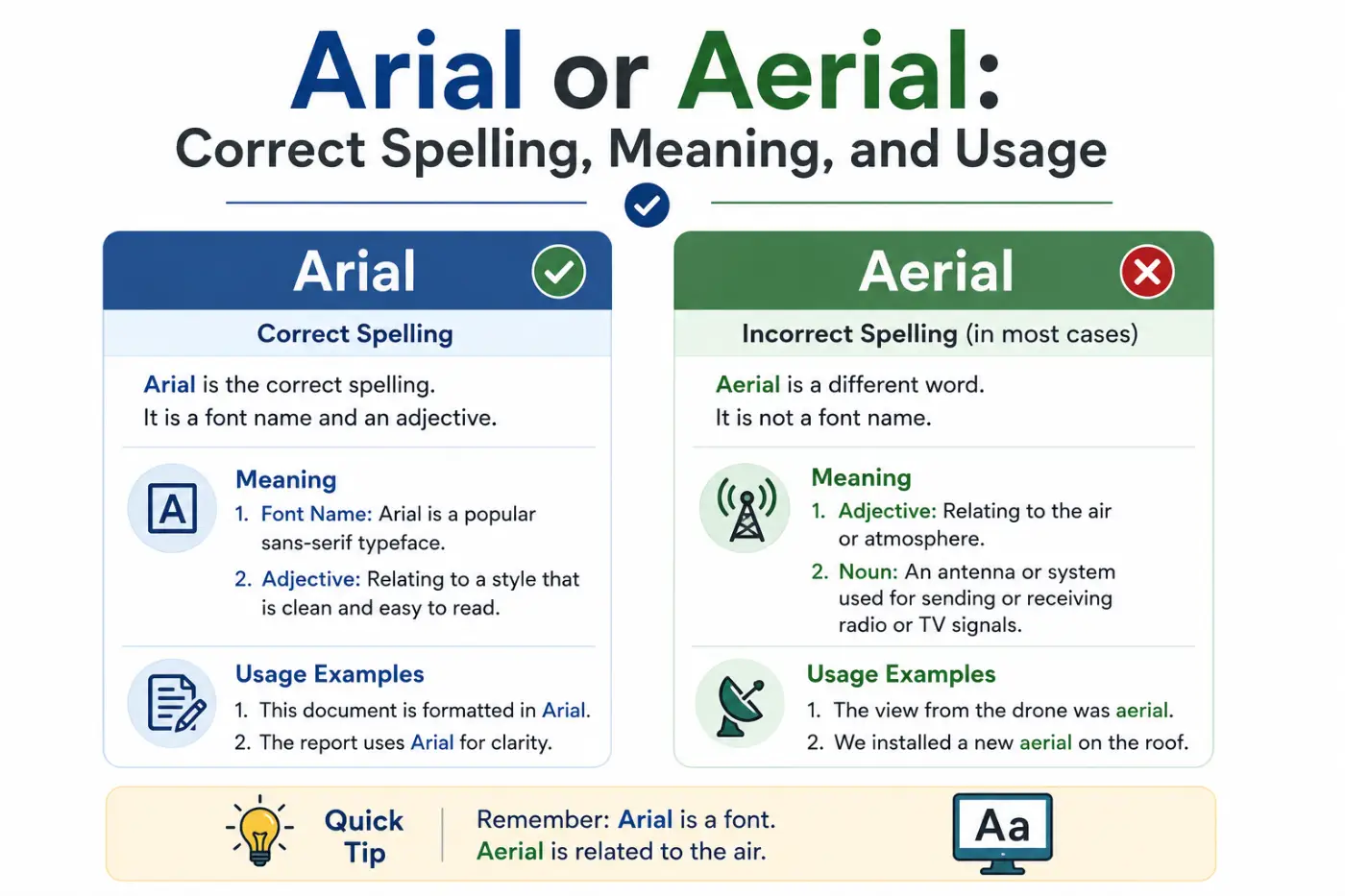
Arial and aerial are both correct English terms but they mean completely different things. Arial is mainly the name of a typeface used for written text. Aerial is a standard English word connected with the air or something that happens above the ground.
The confusion usually comes from their similar spelling and pronunciation. Both words begin with the same letters and can appear in discussions about writing or visual material. However they belong to different language categories and serve completely different purposes.
If you have ever wondered about arial or aerial you are not alone. A quick typing mistake can easily turn one word into the other. The difference becomes much easier to remember once you connect each spelling with its meaning.
Quick Definition
Arial is the name of a sans serif typeface commonly used for documents websites presentations and digital text. Aerial is an adjective or noun related to the air or something above the ground. Arial concerns typography while aerial concerns the air space above Earth.
Quick Answer
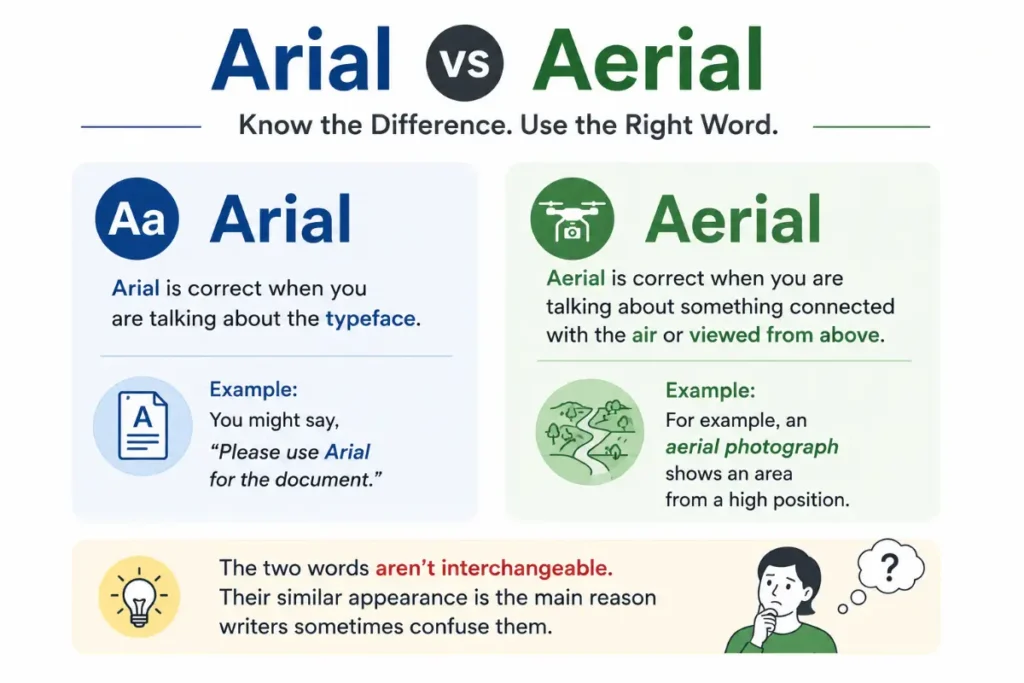
Arial is correct when you are talking about the typeface. For example you might say Please use Arial for the document. Aerial is correct when you are talking about something connected with the air or viewed from above. For example an aerial photograph shows an area from a high position. The two words aren’t interchangeable. Their similar appearance is the main reason writers sometimes confuse them.
Comparison Table: Arial or Aerial
| Correct Form | Meaning | Part of Speech | Origin | Usage Frequency | Formality | Common Contexts | Example |
|---|---|---|---|---|---|---|---|
| Arial | A sans serif typeface | Proper noun | Modern typeface name | Common in digital writing | Neutral | Documents typography design websites | The report uses Arial. |
| Aerial | Related to air or above the ground | Adjective | Latin and French roots | Common | Neutral to formal | Photography aviation geography broadcasting | We saw an aerial view of the city. |
Meaning and Definition
Meaning of Arial
Arial is the name of a typeface. It was developed in the twentieth century and became widely used in computers office software websites presentations and printed documents.
The word Arial does not normally function as an ordinary English adjective or noun in the same way that aerial does. It identifies a particular design of letters.
For example:
- The teacher asked us to use Arial for the assignment.
- The website uses Arial for its main text.
- Change the heading to Arial before printing the document.
- The presentation looks cleaner in Arial.
Notice that the meaning stays connected to typography. If someone says Please write this in Arial they are talking about the visual design of the letters.
Arial is usually capitalized because it is a specific typeface name. That capitalization provides another useful clue. You are naming a particular font rather than describing something related to the air.
The term can appear in conversations about graphic design publishing web design office documents branding and digital communication.
Meaning of Aerial
Aerial is a standard English word with several related meanings.
As an adjective it commonly describes something connected with the air or located above the ground.
For example:
- The photographer captured an aerial view of the coastline.
- The team used aerial photography to study the area.
- The aircraft performed an aerial maneuver.
- We watched an aerial display during the event.
Aerial can also function as a noun. In British English it can refer to an antenna used for receiving radio or television signals.
For example:
The television aerial needs repair.
In American English antenna is usually more common for this meaning.
Aerial also appears in terms such as aerial photography aerial view aerial survey and aerial movement. These expressions all connect to the idea of looking at or operating from above.
The word therefore has a strong relationship with air height flight and observation from above.
Key Differences Explained
- Spelling. Arial has five letters and contains only one e. Aerial contains six letters and includes e after the first a. That extra e is easy to overlook when typing quickly.
- Grammar role. Arial functions primarily as a proper name for a typeface. Aerial commonly works as an adjective and can also work as a noun in certain varieties of English.
- Meaning. Arial refers to a particular font. Aerial refers to the air or something above the ground.
- Tone. Arial is neutral and technical when discussing typography. Aerial is also generally neutral but can appear in technical subjects such as aviation geography photography and broadcasting.
- Context. Arial belongs to writing design and typography. Aerial belongs to subjects involving air height flight antennas photography and views from above.
A simple memory trick can help. Think of Arial as belonging to your keyboard and document settings. Think of aerial as belonging to the air.
Which Spelling Is Correct
Both spellings are correct. The right choice depends entirely on what you mean.
Use Arial when you mean the typeface.
Use aerial when you mean something related to the air or something positioned above the ground.
This distinction follows standard dictionary treatment. Major English dictionaries recognize aerial as an established English word with meanings related to air and height. Arial is treated as the name of a typeface rather than as a general vocabulary word with the same meaning.
That difference matters in professional writing. A sentence such as The report was written in Arial makes sense because the writer is naming a font. A sentence such as We captured an Arial photograph would normally be wrong because the intended adjective is aerial.
A useful editing test is simple. Ask yourself what you are describing.
If you are describing letters or text design use Arial.
If you are describing something connected to the air or a view from above use aerial.
This one question can prevent most mistakes.
Sentence Examples
Examples With Arial
- Please format the document in Arial.
- The report uses Arial for the main text.
- I changed the font from Times New Roman to Arial.
- The designer selected Arial for the website.
- The instructions recommend Arial for the application.
- The heading looks clear in Arial.
- Our teacher asked the class to submit the assignment in Arial.
- The presentation uses Arial throughout.
- You can select Arial from the font menu.
- The company document uses Arial for its standard text.
Each sentence connects Arial with typography. That connection is the key.
Examples Showing the Common Misspelling
- Incorrect: Please format the report in aerial.
- Correct: Please format the report in Arial.
- Incorrect: The website uses aerial as its main font.
- Correct: The website uses Arial as its main font.
- Incorrect: Change the document to aerial before printing.
- Correct: Change the document to Arial before printing.
- Incorrect: The instructions require Arial for the font.
- Correct: The instructions require Arial for the font.
The incorrect examples don’t always look obviously wrong because aerial is itself a real English word. That makes this mistake more confusing than a simple invented spelling.
A spell checker may not catch it. If you type aerial when you actually mean Arial the software can see a legitimate English word and may leave it alone.
Common Mistakes and Misspellings
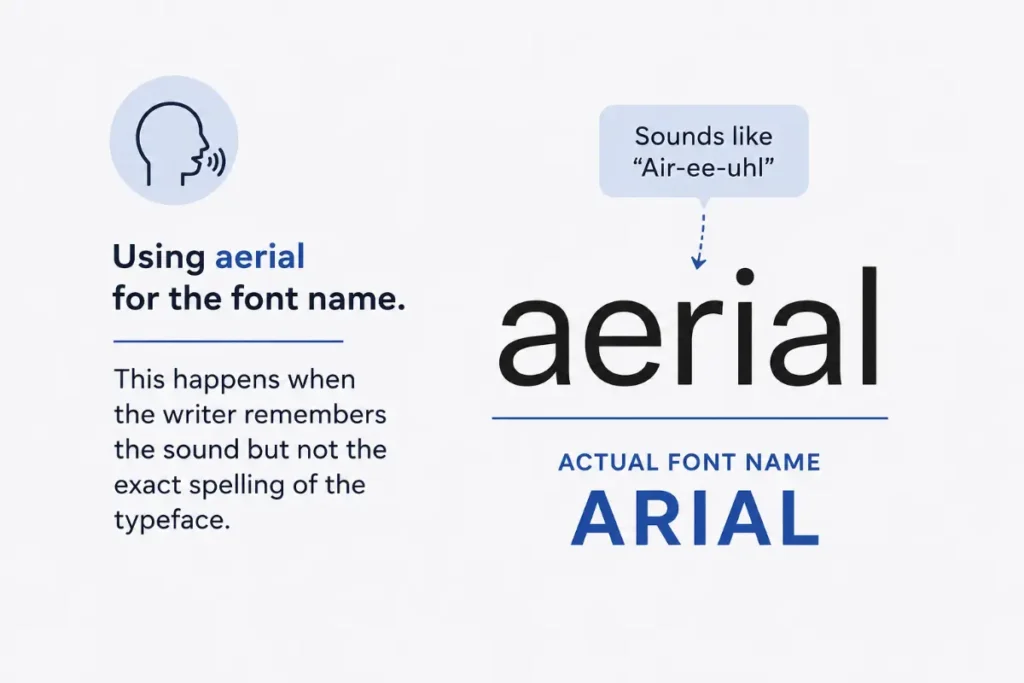
- Using aerial for the font name. This happens when the writer remembers the sound but not the exact spelling of the typeface.
- Using Arial for something related to air. A writer might accidentally say Arial photography instead of aerial photography.
- Treating the two words as synonyms. They aren’t synonyms. Their meanings belong to entirely different areas.
- Ignoring capitalization. Arial normally appears with a capital A because it is a specific typeface name. Aerial normally appears in lowercase unless it begins a sentence or appears in a title.
- Trusting spell check too much. Modern spell checkers often recognize both forms as legitimate words. They may not detect a mistake caused by choosing the wrong word.
The spelling confusion is partly an NLP problem involving similar letter patterns and similar sounds. Human readers often process familiar word shapes quickly rather than examining every letter individually. That is why a familiar word can slip into a sentence even when it doesn’t express the intended meaning.
Another factor is contextual prediction. When you are writing about fonts your brain expects a word associated with typography. When you are writing about photography or aviation it expects vocabulary connected with the air. A fast typing session can still produce the wrong form.
Pronunciation Guide
Arial and aerial can sound similar enough to cause confusion in speech. Pronunciation also varies slightly among speakers.
Arial is commonly pronounced something like AIR ee uhl.
Aerial is commonly pronounced something like AIR ee uhl as well.
The similarity is one reason the spelling problem survives even among experienced writers.
A common pronunciation guide for aerial is represented in the International Phonetic Alphabet as approximately /ˈeəriəl/ in many British pronunciation systems and /ˈeriəl/ in many American pronunciation systems.
Arial is commonly represented approximately as /ˈɛəriəl/ or /ˈɛriəl/ depending on the pronunciation system and speaker.
You don’t need to memorize the IPA symbols to use the words correctly. The practical point is that their spoken forms can overlap enough to create confusion.
When writing you should rely on meaning and context rather than sound alone.
If you are discussing Microsoft Word font settings or document formatting think Arial.
If you are discussing photography flight airspace or something viewed from above think aerial.
Etymology and Word Origin
The history of aerial reaches much further back than the history of the typeface Arial.
Aerial comes from roots connected with air. Its deeper history can be traced through Latin and French forms associated with air and the atmosphere. English adopted the term and developed several related uses.
Over time aerial became associated with things belonging to the air or taking place above the ground. This explains expressions such as aerial photography aerial navigation and aerial view.
The typeface name Arial has a much more modern history. Arial was developed in the twentieth century as a sans serif typeface. It became widely distributed through computer software and eventually became familiar to millions of people.
That modern technological history explains why Arial feels familiar to anyone who regularly works with digital documents.
The two words therefore come from very different backgrounds. Their similarity today is mainly a matter of spelling and sound rather than shared meaning.
This is a useful reminder that English contains many pairs of words that look or sound similar but have unrelated histories.
Regional Usage US
In American English aerial is widely used for things connected with the air. Common expressions include aerial photography aerial view aerial survey and aerial footage.
Antenna is generally more familiar than aerial when referring to equipment used to receive radio or television signals.
Arial is used internationally as a typeface name and appears in American schools workplaces websites software interfaces and publishing environments.
American writers should capitalize Arial when they refer to the specific typeface.
Regional Usage UK
British English uses aerial in many of the same ways as American English. The word appears in expressions involving aviation photography observation and broadcasting.
Aerial can also mean an antenna in British usage. For example someone might say that they need to replace the television aerial.
Arial remains the standard name of the typeface. The spelling does not change to match British spelling conventions.
This is worth remembering because Arial is a proper name rather than a British or American spelling variant.
Regional Usage AU
Australian English also uses aerial in connection with air travel photography observation and broadcasting.
The word can appear naturally in phrases such as aerial view aerial photography and aerial survey.
Arial remains the established typeface name in Australian digital documents and design work.
There is no regional spelling change that turns Arial into aerial or the other way around.
Regional Usage CA
Canadian English follows the same basic distinction.
Arial refers to the typeface. Aerial refers to the air or something above the ground.
Canadian writers may encounter both terms frequently because professional documents often use Arial while news reports and technical material regularly use aerial in expressions involving photography geography and aviation.
The distinction remains semantic rather than regional.
Grammar Rules and Part of Speech
Aerial has a broader grammatical role than Arial.
As an adjective aerial modifies a noun.
Examples include:
- An aerial photograph showed the entire valley.
- The researchers created an aerial map.
- We watched an aerial performance.
- The pilot completed an aerial maneuver.
In each example aerial tells the reader that the noun has a connection with the air or a position above the ground.
Aerial can also function as a noun in British English when it refers to an antenna.
For example:
The aerial on the roof was damaged during the storm.
Arial works differently. It is primarily a proper noun used to identify a particular typeface.
For example:
The document is written in Arial.
Because Arial is a typeface name it normally begins with a capital letter.
Sentence Placement
Aerial can appear before a noun as an adjective.
For example:
We ordered an aerial survey.
It can also appear after a linking verb.
For example:
The photograph is aerial.
The second construction is grammatically possible but less natural in ordinary conversation. Native speakers often choose a more specific expression such as The photograph was taken from the air.
Arial usually appears after expressions related to fonts and formatting.
For example:
The document is in Arial.
Please use Arial.
The website uses Arial.
Punctuation
Neither word requires special punctuation simply because of its meaning.
Punctuation depends on the structure of the whole sentence.
For example:
The aerial photograph showed the river clearly.
The report was prepared in Arial.
There is no special comma rule associated with either term.
Real Life Usage Examples
Daily Talk
- Arial: I usually use Arial for simple documents.
- Aerial: We got an amazing aerial view from the mountain.
In daily conversation Arial usually appears when people discuss documents or fonts. Aerial appears when people discuss views from above travel photography or aviation.
- Arial: Please use Arial when you prepare the final document.
- Aerial: The attached aerial image shows the full property.
Professional email often uses Arial because many businesses rely on standard document fonts. Aerial can appear in emails involving property surveys maps photography or engineering reports.
Academic Writing
- Arial: The instructor requested Arial for the written assignment.
- Aerial: The researchers analyzed aerial images of the region.
Academic contexts can involve both words but their meanings remain completely separate.
News
- Arial: The newsroom template uses Arial for certain digital elements.
- Aerial: Aerial footage showed the extent of the flooding.
News writing uses aerial frequently when describing footage photographs surveys and views from aircraft or drones.
Literature
- Arial: The character noticed the letter had been printed in Arial.
- Aerial: From the hill they had an aerial perspective of the valley.
Aerial can carry a descriptive quality in literary writing because it helps readers imagine a scene from above.
Expert Editor Insight
A senior editor would usually treat Arial and aerial as a context error rather than a simple spelling error. Both forms are legitimate so an ordinary spell checker may not identify the problem. This is a classic example of why proofreading requires meaning as well as spelling. If a document discusses typography and the writer uses aerial for a font name the sentence may look clean while still being wrong. Professional editing tools and grammar software can sometimes detect contextual errors but human review remains valuable because the intended meaning controls the final choice. My practical tip is to read the sentence once for spelling and then read it again asking what each important word actually means.
Why Context Matters More Than Spell Checking
Many spelling mistakes are easy for software to detect because the incorrect form isn’t a recognized word. This pair creates a different problem.
Both Arial and aerial exist.
That means a sentence can contain a perfectly spelled word that is still the wrong word.
For example:
The report was written in aerial.
Every individual letter in aerial is spelled correctly. The problem is semantic. The writer intended to name the font Arial.
This is known as a contextual word choice problem. It demonstrates why good editing involves more than checking for misspelled words.
The same issue appears throughout English. Words such as affect and effect can be spelled correctly while being used incorrectly. There are also pairs such as accept and except and principal and principle where meaning determines the correct choice.
Arial and aerial belong to this broader group of easily confused terms.
A Simple Editing Test
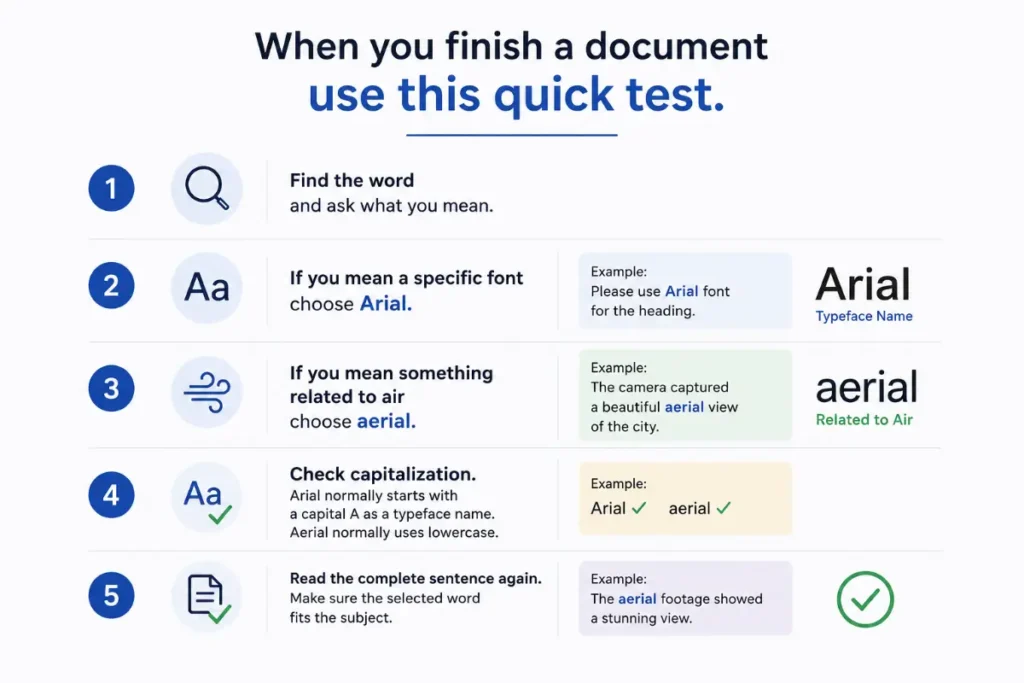
When you finish a document use this quick test.
- Find the word and ask what you mean.
- If you mean a specific font choose Arial.
- If you mean something related to air choose aerial.
- Check capitalization. Arial normally starts with a capital A as a typeface name. Aerial normally uses lowercase.
- Read the complete sentence again. Make sure the selected word fits the subject.
This takes only a few seconds but it can catch an error that an ordinary spell checker may miss.
Conclusion
Arial and aerial are both correct forms but they belong to completely different contexts. Arial is the name of a typeface used for documents digital text websites and design. Aerial describes something related to the air or something seen or positioned above the ground. The two words sound similar enough to cause confusion but their meanings make the distinction clear.
When you are discussing fonts use Arial. When you are discussing air flight height or views from above use aerial. The best practical tip is to check meaning instead of relying only on spelling software. If the sentence concerns typography choose Arial. If it concerns the air choose aerial
FAQs
Is Arial a real word?
Arial is a real name used for a specific typeface. It is not simply an alternative spelling of aerial. The typeface is widely used in digital documents websites presentations and other forms of visual communication. Because Arial identifies a particular font it is normally capitalized. If you mean something connected with the air then aerial is the correct word.
What does aerial mean?
Aerial describes something connected with the air or something located above the ground. Common examples include aerial photography aerial footage aerial views and aerial surveys. Aerial can also function as a noun in British English where it can mean an antenna used for radio or television reception. The exact meaning depends on context.
Arial or aerial which is correct?
Both are correct words but they have different meanings. Use Arial when you mean the specific typeface. Use aerial when you mean something connected with the air or something viewed from above. For example The report uses Arial is correct while We took an aerial photograph is correct. The words cannot normally replace each other.
How do you pronounce Arial?
Arial is commonly pronounced something like AIR ee uhl. Aerial can sound very similar and is also commonly pronounced like AIR ee uhl. Small differences can appear among American British Canadian and Australian speakers. Because pronunciation can overlap the safest way to distinguish the words is through context. Remember Arial for typography and aerial for air.
Can aerial start a sentence?
Yes. Aerial can start a sentence when it functions as an adjective or noun. For example Aerial photography helped researchers study the coastline. Capitalization occurs because the word begins the sentence rather than because aerial normally requires a capital letter. In normal writing aerial remains lowercase unless it appears at the beginning of a sentence or in a proper name.
What is a synonym of aerial?
The best synonym depends on the context. Words such as airborne overhead elevated and atmospheric can overlap with aerial in particular situations. For example aerial photography can sometimes be described as photography taken from above. However no single synonym works in every sentence. Aerial can also refer to an antenna in British English which creates a different meaning.
Why do people confuse Arial and aerial?
People confuse Arial and aerial because the words look and sound very similar. They also share the same opening letters. Fast typing makes the mistake even easier because the brain often recognizes familiar patterns instead of checking every individual letter. Since both forms are legitimate words spell checkers may not flag the error. Context is the best guide.
Is Arial suitable for formal writing?
Arial can be suitable for formal writing when a style guide or organization permits it. Many workplaces schools and digital publications use it because it is clear and widely available. However formal writing standards vary by institution. Always follow the required formatting instructions first. If a document specifies a particular typeface then use that exact font rather than choosing one based only on personal preference.
How to Remember the Difference?
A simple mental image can make this distinction stick.
Think about a document on your computer. You open the font menu and select Arial. The word belongs to typography.
