
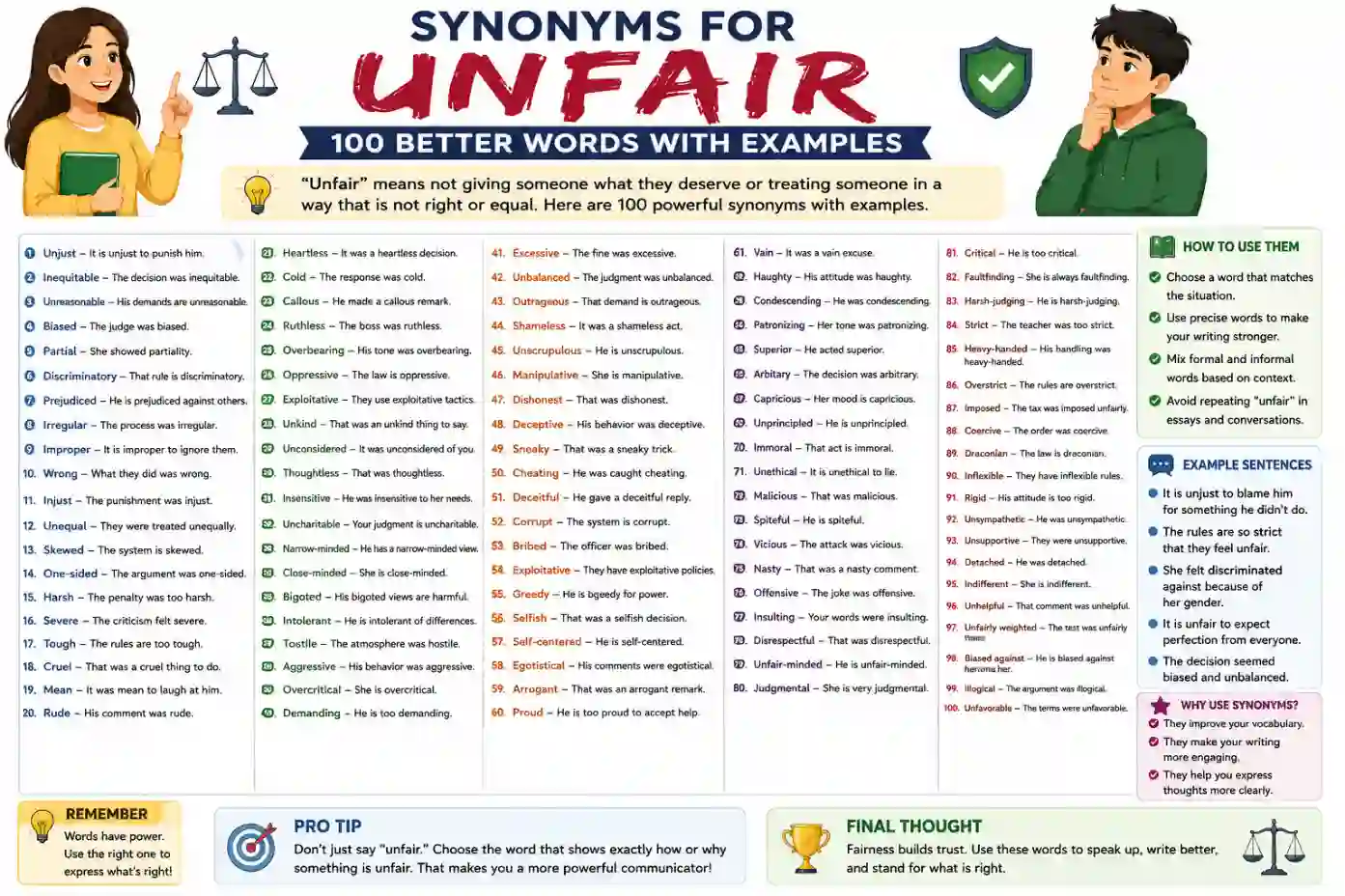
If you are searching for synonyms for unfair, you have probably noticed that one replacement does not fit every sentence. A teacher may describe an exam as unfair, a lawyer may call a decision unjust, a journalist may report discriminatory policies, and a friend may simply say something was not right. Although these words share a similar idea, each carries its own tone, level of formality, and emotional impact.
Choosing the right synonym makes your writing clearer, stronger, and more precise. Instead of repeating unfair several times, you can select a word that better matches your message. That small change often makes essays, reports, stories, emails, and everyday conversations sound more natural.
The challenge is that many dictionaries list dozens of alternatives without explaining when each one works best. Some words suggest bias. Others imply dishonesty, inequality, cruelty, or illegal treatment. Using the wrong synonym can change the meaning of your sentence.
Featured Snippet
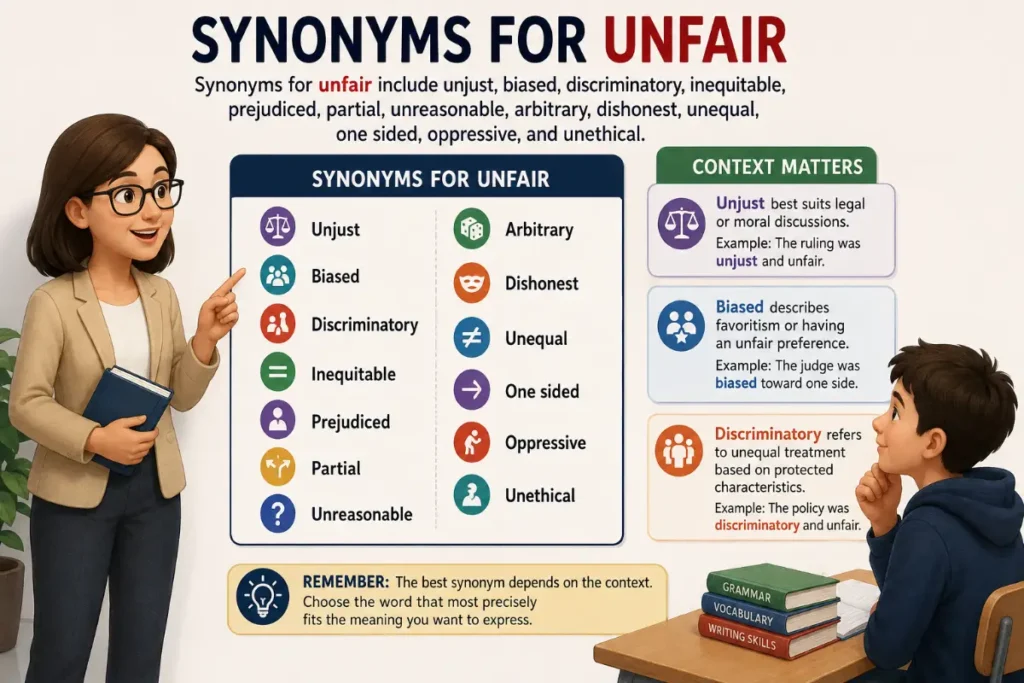
Synonyms for unfair include unjust, biased, discriminatory, inequitable, prejudiced, partial, unreasonable, arbitrary, dishonest, unequal, one sided, oppressive, and unethical. The best synonym depends on context. Unjust suits legal or moral discussions, biased describes favoritism, and discriminatory refers to unequal treatment based on protected characteristics.
Synonyms for Unfair Quick Answer
If you simply need another word for unfair, these are among the strongest choices.
| Synonym | Best Used For | Tone |
|---|---|---|
| Unjust | Moral or legal situations | Formal |
| Biased | Favoritism or prejudice | Neutral |
| Discriminatory | Unequal treatment | Formal |
| Partial | Favoring one side | Formal |
| Prejudiced | Personal bias | Neutral |
| Unequal | Imbalanced situations | Neutral |
| Arbitrary | Random decisions | Formal |
| Unreasonable | Illogical actions | Neutral |
| Oppressive | Harsh systems or rules | Strong |
| Dishonest | Lack of honesty | Neutral |
| One sided | Arguments or opinions | Everyday |
| Unethical | Violating moral standards | Formal |
| Improper | Breaking accepted standards | Formal |
| Inequitable | Lack of fairness | Formal |
| Rigged | Manipulated results | Informal |
Comparison Table of the Best Synonyms for Unfair
| Word | Meaning | Part of Speech | Origin | Usage Frequency | Formality | Common Contexts | Example |
|---|---|---|---|---|---|---|---|
| Unfair | Not just or impartial | Adjective | Old English | Very High | Neutral | Everyday speech | The decision felt unfair. |
| Unjust | Contrary to justice | Adjective | Latin | High | Formal | Law, ethics | The punishment was unjust. |
| Biased | Showing favoritism | Adjective | French | High | Neutral | News, education | The report appeared biased. |
| Discriminatory | Treating groups unequally | Adjective | Latin | Medium | Formal | Employment, law | The hiring practice was discriminatory. |
| Partial | Favoring one side | Adjective | Latin | Medium | Formal | Judging, refereeing | The judge remained partial. |
| Prejudiced | Holding unfair opinions | Adjective | Latin | High | Neutral | Social issues | His remarks sounded prejudiced. |
| Unequal | Not equal | Adjective | Latin | High | Neutral | Education, economics | Resources were unequal. |
| Arbitrary | Based on personal choice rather than reason | Adjective | Latin | Medium | Formal | Rules, government | The rule seemed arbitrary. |
| Oppressive | Harsh and unjust | Adjective | Latin | Medium | Formal | Politics, history | Citizens resisted oppressive laws. |
| Rigged | Secretly manipulated | Adjective | Middle English | High | Informal | Games, elections | Many believed the contest was rigged. |
Meaning of Unfair
The adjective unfair describes something that is not just, honest, equal, or impartial. It often refers to treatment, rules, decisions, opportunities, judgments, or behavior that gives one person or group an unreasonable advantage over another. An unfair situation usually involves one or more of these ideas.
- Unequal treatment.
- Bias or favoritism.
- Lack of justice.
- Broken rules.
- Dishonesty.
- Excessive harshness.
- Unreasonable expectations.
For example.
- The referee made an unfair call.
- It is unfair to blame one person for the entire mistake.
- Many workers felt the policy was unfair.
Although unfair is common in everyday English, professional writing often benefits from a more precise synonym.
The Best Synonyms for Unfair by Meaning
Not every synonym communicates the same idea. Some emphasize morality, while others focus on prejudice, inequality, or dishonesty.
Unjust
Unjust means lacking justice or violating moral principles. It is one of the closest and strongest synonyms for unfair.
Best contexts:
- Court decisions.
- Government policies.
- Ethical discussions.
- Human rights.
- Historical events.
Examples.
- The sentence was unjust.
- Citizens protested the unjust law.
- Many considered the ruling unjust.
Biased
Biased describes someone or something that favors one side unfairly.
Best contexts:
- News reporting.
- Teachers.
- Judges.
- Hiring decisions.
- Reviews.
Examples.
- The article seemed biased.
- The interviewer asked biased questions.
- People criticized the biased coverage.
Discriminatory
This word refers to unfair treatment based on race, gender, age, religion, disability, or other protected characteristics.
Best contexts:
- Employment.
- Education.
- Housing.
- Government.
- Human rights.
Examples.
- The company adopted discriminatory policies.
- The law was considered discriminatory.
- Employees reported discriminatory treatment.
Partial
Partial describes someone who favors one person or side instead of remaining neutral.
Examples.
- The referee appeared partial.
- A good judge should never be partial.
- Parents should avoid being partial among siblings.
Prejudiced
This synonym focuses on opinions formed without fair judgment.
Examples.
- His comments sounded prejudiced.
- The decision reflected prejudiced thinking.
- Writers should challenge prejudiced stereotypes.
Arbitrary
An arbitrary decision has little logical reason behind it.
Examples.
- The deadline seemed arbitrary.
- Employees questioned the arbitrary rule.
- The manager made arbitrary choices.
Unequal
This word highlights imbalance rather than intentional bias.
Examples.
- Funding remained unequal.
- Students had unequal access to resources.
- Opportunities were unequal.
Oppressive
This synonym suggests unfairness combined with excessive control or cruelty.
Examples.
- The country endured oppressive laws.
- Workers struggled under oppressive conditions.
- Citizens demanded freedom from oppressive policies.
Rigged
Rigged means secretly manipulated to produce a desired result.
Examples.
- Fans believed the contest was rigged.
- Players accused officials of running a rigged tournament.
- Critics claimed the bidding process was rigged.
Synonyms for Unfair by Level of Formality
Choosing the right synonym depends on your audience.
Everyday Conversation
- Not right.
- Mean.
- One sided.
- Biased.
- Rigged.
- Unequal.
Example.
“That was really not right.”
Academic Writing
- Unjust.
- Inequitable.
- Discriminatory.
- Arbitrary.
- Partial.
Example.
“The study identified inequitable access to educational resources.”
Professional Communication
- Inappropriate.
- Biased.
- Inconsistent.
- Unethical.
- Improper.
Example.
“The evaluation process appeared biased.”
Legal Writing
- Unjust.
- Discriminatory.
- Arbitrary.
- Oppressive.
- Inequitable.
These terms appear frequently in legal opinions, government reports, and policy documents.
Synonyms for Unfair by Strength
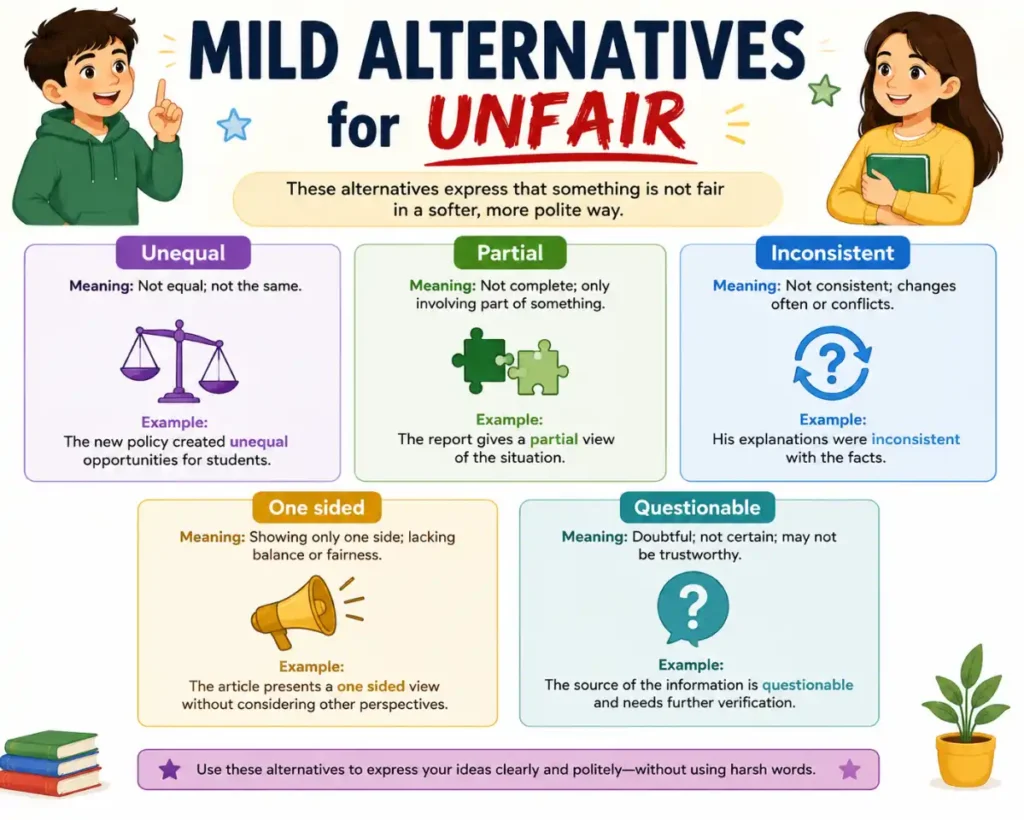
Some words express mild unfairness, while others suggest serious injustice.
Mild Alternatives
- Unequal.
- Partial.
- Inconsistent.
- One sided.
- Questionable.
Moderate Alternatives
- Biased.
- Unreasonable.
- Improper.
- Inappropriate.
- Inequitable.
Strong Alternatives
- Unjust.
- Discriminatory.
- Oppressive.
- Corrupt.
- Tyrannical.
- Exploitative.
Selecting the correct strength helps readers understand exactly how serious the situation is without exaggeration.
Synonyms for Unfair in Different Contexts
A single synonym rarely works in every situation. Native English speakers naturally choose different words depending on the subject.
School and Education
Common choices include:
- Biased.
- Unequal.
- Inconsistent.
- Unreasonable.
- Partial.
Example.
“The grading system seemed inconsistent.”
Business and Workplace
Common alternatives include:
- Unethical.
- Biased.
- Improper.
- Inequitable.
- Discriminatory.
Example.
“Employees criticized the inequitable promotion process.”
Sports
People often use:
- Rigged.
- Biased.
- One sided.
- Questionable.
- Unjust.
Example.
“The referee made several questionable calls.”
Government and Politics
Writers frequently choose:
- Oppressive.
- Arbitrary.
- Discriminatory.
- Unjust.
- Corrupt.
Example.
“The organization opposed the arbitrary restrictions.”
Examples in Sentences Using Synonyms for Unfair
One of the easiest ways to learn new vocabulary is to see it used in natural English. The examples below show how different synonyms for unfair fit everyday conversations, professional communication, academic writing, and formal situations.
Unjust Examples
- The court delivered an unjust verdict that sparked nationwide protests.
- Many historians describe the law as unjust.
- It would be unjust to punish everyone for one person’s mistake.
- The workers demanded an end to unjust labor practices.
- She refused to accept an unjust accusation.
- The community challenged the unjust policy.
- His treatment of the employees was completely unjust.
- The organization fights against unjust social systems.
- Everyone agreed the decision felt unjust.
- They appealed the unjust ruling immediately.
Biased Examples
- The report appeared biased in favor of one company.
- The interviewer asked biased questions.
- Readers criticized the biased article.
- Teachers should avoid biased grading.
- The documentary presented a biased perspective.
- His opinion was clearly biased.
- The survey produced biased results because of poor sampling.
- Many voters believed the coverage was biased.
- A judge must never appear biased.
- Scientists work hard to eliminate biased conclusions.
Discriminatory Examples
- The company ended its discriminatory hiring practices.
- Several organizations challenged the discriminatory rule.
- The policy was considered discriminatory by legal experts.
- Employees reported discriminatory behavior.
- The law protects people from discriminatory treatment.
- Schools should eliminate discriminatory policies.
- The advertisement was criticized as discriminatory.
- Courts reviewed the discriminatory regulations.
- The investigation uncovered discriminatory practices.
- Equal opportunity laws discourage discriminatory decisions.
Unequal Examples
- The two schools received unequal funding.
- Access to healthcare remains unequal in many regions.
- The workload was unequal across departments.
- They noticed unequal opportunities for advancement.
- The agreement created unequal benefits.
- Students experienced unequal access to technology.
- The distribution of resources was unequal.
- Income remains unequal across many communities.
- The competition created unequal advantages.
- Researchers examined unequal outcomes.
Arbitrary Examples
- The manager introduced arbitrary rules.
- Employees questioned the arbitrary deadline.
- The decision appeared arbitrary rather than logical.
- Customers disliked the arbitrary price increase.
- The committee rejected arbitrary standards.
- His punishment seemed arbitrary.
- The policy relied on arbitrary assumptions.
- The inspector avoided making arbitrary judgments.
- Courts often review arbitrary government actions.
- An arbitrary decision rarely earns public trust.
Common Mistakes When Using Synonyms for Unfair
Many English learners understand the meaning of unfair but struggle to choose the most accurate synonym. The mistakes below are among the most common.
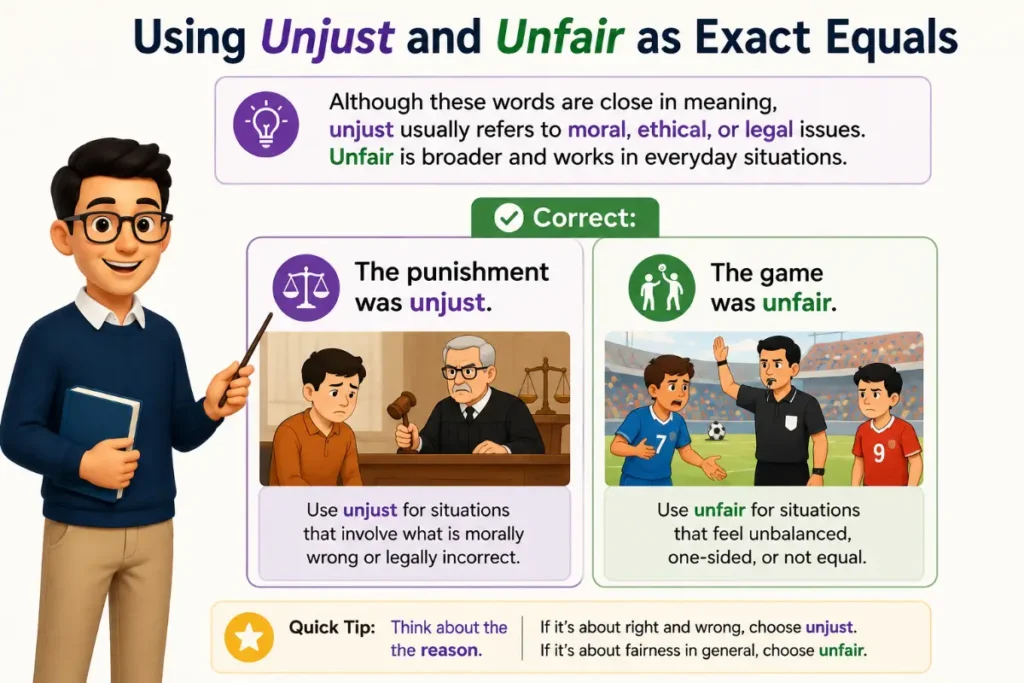
Using Unjust and Unfair as Exact Equals
Although these words are close in meaning, unjust usually refers to moral, ethical, or legal issues. Unfair is broader and works in everyday situations.
Correct:
- The punishment was unjust.
- The game was unfair.
Using Biased for Every Situation
Biased describes favoritism or prejudice. It does not describe every unfair event.
Correct:
- The newspaper published a biased article.
Less natural:
- The weather was biased.
Confusing Discriminatory with Biased
A biased person may simply favor one side. A discriminatory action unfairly treats people because of characteristics such as age, race, gender, disability, or religion.
Overusing Rigged
People often say everything is “rigged.” Native speakers usually reserve this word for situations involving manipulation, cheating, or deliberate control.
Natural examples include:
- Rigged election.
- Rigged contest.
- Rigged lottery.
- Rigged bidding process.
Choosing Overly Strong Synonyms
Calling a minor inconvenience oppressive or tyrannical sounds exaggerated. Instead, choose a word that matches the situation.
Instead of:
“The homework was oppressive.”
Say:
“The homework requirements were unreasonable.”
Pronunciation Guide
Correct pronunciation helps you sound more confident in conversation.
| Word | IPA | Syllables |
|---|---|---|
| Unfair | /ʌnˈfer/ | un fair |
| Unjust | /ʌnˈdʒʌst/ | un just |
| Biased | /ˈbaɪəst/ | bi ased |
| Arbitrary | /ˈɑːrbətreri/ | ar bi trar y |
| Unequal | /ʌnˈiːkwəl/ | un e qual |
| Partial | /ˈpɑːrʃəl/ | par tial |
| Prejudiced | /ˈpredʒədɪst/ | prej u diced |
| Oppressive | /əˈpresɪv/ | op pres sive |
| Inequitable | /ɪnˈekwɪtəbəl/ | in eq ui ta ble |
| Discriminatory | /dɪˈskrɪmɪnətɔːri/ | dis crim i na to ry |
Common Pronunciation Mistakes
- Do not pronounce biased as “buy zed.”
- Avoid stressing the first syllable of unfair.
- Many learners shorten discriminatory too much. Pronounce each syllable clearly.
- Do not confuse partial with particle.
- Keep the stress on the second syllable in unjust.
Etymology and Word Origin
Understanding where words come from often makes them easier to remember.
Unfair
The word unfair comes from Old English. The prefix un means “not,” while fair originally referred to something just, beautiful, or equitable. Together they formed the idea of something that is not just or impartial.
Unjust
Derived from the Latin injustus, meaning “not just.” It entered English through Old French and has long been associated with law, morality, and justice.
Biased
Originally connected with the idea of something slanting to one side. Over time, the meaning expanded to describe unfair opinions or favoritism.
Discriminatory
Derived from the Latin discriminare, meaning “to distinguish.” In modern English, it refers to treating people differently in an unfair or unlawful way.
Arbitrary
From the Latin arbitrarius, referring to judgment based on personal choice rather than objective rules.
Oppressive
Comes from the Latin opprimere, meaning “to press against” or “to crush.” Today it often describes harsh governments, unfair systems, or excessive control.
Regional Usage
English speakers around the world understand unfair, but some alternatives appear more often in certain regions.
| Region | Common Preferences |
|---|---|
| American English | unfair, biased, unjust, discriminatory, rigged |
| British English | unfair, unjust, partial, inequitable |
| Australian English | unfair, biased, unreasonable, unjust |
| Canadian English | unfair, discriminatory, biased, unequal |
American English
American speakers frequently use:
- Unfair.
- Rigged.
- Biased.
- Discriminatory.
- Unjust.
British English
British English often favors:
- Unjust.
- Partial.
- Inequitable.
- Unreasonable.
Australian English
Australian English commonly uses:
- Unfair.
- Biased.
- Unreasonable.
- Unequal.
Canadian English
Canadian English closely follows American usage while also using inequitable more often in government, education, and policy writing.
Grammar Rules
Knowing the grammar behind unfair and its synonyms helps you use them naturally.
Part of Speech
Most synonyms for unfair are adjectives.
Examples include:
- Unfair.
- Unjust.
- Biased.
- Unequal.
- Partial.
- Oppressive.
- Discriminatory.
- Arbitrary.
Examples:
- The decision was unfair.
- The article was biased.
- Their policy was discriminatory.
Comparative Forms
Like many two-syllable adjectives, unfair normally forms comparisons with more and most only when needed for emphasis. In everyday English, speakers commonly use more unfair and most unfair.
Examples:
- This rule is more unfair than the previous one.
- That was the most unfair decision of the season.
Adverb Forms
Several synonyms have corresponding adverbs.
| Adjective | Adverb |
|---|---|
| Unfair | Unfairly |
| Unjust | Unjustly |
| Partial | Partially |
| Arbitrary | Arbitrarily |
| Unequal | Unequally |
Examples:
- She was treated unfairly.
- The law was applied unjustly.
- Resources were distributed unequally.
Noun Forms
Many synonyms have related noun forms.
| Adjective | Noun |
|---|---|
| Unfair | Unfairness |
| Unjust | Injustice |
| Biased | Bias |
| Unequal | Inequality |
| Arbitrary | Arbitrariness |
| Oppressive | Oppression |
| Discriminatory | Discrimination |
Examples:
- Everyone noticed the unfairness.
- The organization fought against injustice.
- The report exposed widespread discrimination.
Common Sentence Patterns
Pattern 1
Subject + be + adjective.
Example:
“The decision was unjust.”
Pattern 2
Adjective + noun.
Example:
“An arbitrary rule.”
Pattern 3
Verb + adverb.
Example:
“They were treated unfairly.”
Pattern 4
Noun + of + noun.
Example:
“A clear case of discrimination.”
Synonyms for Unfair in Real Life
Native speakers rarely choose synonyms randomly. They select words that match the situation and the level of seriousness.
For example:
Instead of saying:
“The teacher was unfair.”
A student might say:
“The grading seemed inconsistent.”
Real Life Usage Examples
Learning vocabulary is much easier when you see it in authentic situations. Below are examples showing how native English speakers naturally use synonyms for unfair in everyday life.
Daily Conversation
- That deal doesn’t seem fair, but it isn’t exactly unjust either.
- I think the referee was biased toward the home team.
- It’s unreasonable to expect everyone to finish in ten minutes.
- My brother says the game was rigged.
- The teacher gave us an unequal amount of homework.
Academic Writing
- Researchers found inequitable access to educational resources.
- The study examined discriminatory hiring practices.
- Historians criticized the country’s oppressive policies.
- The report described the sentencing guidelines as unjust.
- Scholars argued that the regulation created unequal opportunities.
Professional Communication
- The review process appeared biased and should be reconsidered.
- Employees expressed concerns about an inequitable bonus structure.
- The policy may produce unintended unequal outcomes.
- Managers should avoid partial decision making.
- The company is committed to eliminating discriminatory practices.
Literature
Authors often replace unfair with stronger synonyms to create emotion and precision.
Examples include:
- An oppressive ruler.
- An unjust punishment.
- A biased narrator.
- An arbitrary law.
- An inequitable society.
News and Media
Journalists frequently use more specific alternatives instead of repeating unfair.
Common examples include:
- The investigation exposed discriminatory policies.
- Critics described the proposal as unjust.
- Experts questioned the arbitrary decision.
- Citizens protested oppressive regulations.
- Officials denied claims of a rigged election.
Related Words and Commonly Confused Terms
Many words relate to unfair, but they are not perfect synonyms. Understanding the differences helps you choose the most accurate word.
| Word | Meaning | Difference from Unfair |
|---|---|---|
| Unjust | Against justice | Strong moral or legal meaning |
| Biased | Showing favoritism | Focuses on preference |
| Prejudiced | Holding unfair opinions | Focuses on attitudes |
| Discriminatory | Treating groups unequally | Often legal or social |
| Partial | Favoring one side | Usually about judging |
| Unequal | Not equal | Focuses on imbalance |
| Unethical | Against moral standards | Focuses on ethics |
| Arbitrary | Based on personal choice | Focuses on lack of reason |
| Corrupt | Dishonest for personal gain | Stronger than unfair |
| Oppressive | Harsh and controlling | Describes severe injustice |
| Exploitative | Taking unfair advantage | Focuses on benefiting from others |
| One sided | Supporting only one viewpoint | Everyday expression |
| Inconsistent | Not applied equally | Focuses on irregularity |
| Improper | Not suitable or acceptable | Broader than unfair |
| Questionable | Open to doubt | Softer criticism |
Related Adjectives
These adjectives often appear alongside unfair in dictionaries, thesauruses, and professional writing.
- Biased.
- Unjust.
- Partial.
- Prejudiced.
- Arbitrary.
- Unequal.
- Oppressive.
- Corrupt.
- Exploitative.
- Unethical.
- Inconsistent.
- Improper.
- One sided.
- Discriminatory.
- Harsh.
Related Nouns
- Bias.
- Injustice.
- Discrimination.
- Inequality.
- Favoritism.
- Oppression.
- Corruption.
- Partiality.
- Exploitation.
- Prejudice.
Related Verbs
- Discriminate.
- Favor.
- Exploit.
- Oppress.
- Manipulate.
- Exclude.
- Mistreat.
- Misjudge.
- Ignore.
- Abuse.
Expert Language Insight
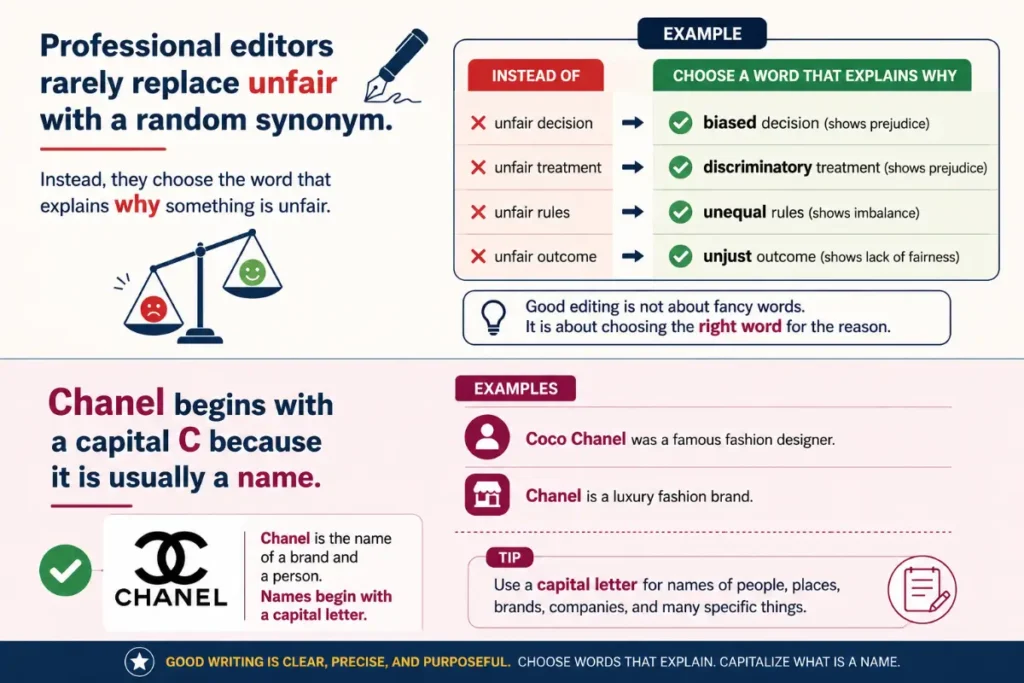
Professional editors rarely replace unfair with a random synonym. Instead, they choose the word that explains why something is unfair. For example, if a hiring manager favors one candidate without a valid reason, biased is much more accurate than unfair. If a government passes laws that violate basic rights, unjust or oppressive communicates the situation more precisely. If employees receive different salaries for the same work, inequitable is usually the best choice in formal writing.
How to Choose the Best Synonym
If you are unsure which word to use, this simple guide can help.
| If you mean… | Best Choice |
|---|---|
| Against justice | Unjust |
| Favoring one side | Biased |
| Unequal treatment | Discriminatory |
| Uneven distribution | Unequal |
| Random decision | Arbitrary |
| Harsh government | Oppressive |
| Secret manipulation | Rigged |
| Breaking ethical standards | Unethical |
| Favoring someone | Partial |
| Taking advantage of people | Exploitative |
Conclusion
Finding the right synonyms for unfair is about more than avoiding repetition. Every alternative carries its own meaning, tone, and level of intensity. While unfair remains the best general-purpose word, more specific choices often communicate your message with greater accuracy.
If your focus is justice, choose unjust. When favoritism is the issue, biased is usually the strongest option. For unequal treatment based on protected characteristics, discriminatory is the correct term. In formal writing, words such as inequitable, arbitrary, and unethical add precision and professionalism.
The strongest writing does not rely on a single synonym. Instead, it selects the word that perfectly matches the situation, audience, and intended meaning. Expanding your vocabulary with these alternatives will make your essays, reports, emails, and everyday conversations clearer, more engaging, and more effective.
Frequently Asked Question
What is the best synonym for unfair?
The best synonym depends on the context. Unjust is usually the closest replacement in legal or moral discussions. Biased works well when someone favors one side, while discriminatory is the preferred term for unequal treatment based on protected characteristics.
Is unjust stronger than unfair?
Yes. Unjust generally carries a stronger sense of moral or legal wrongdoing. Unfair is broader and can describe anything from an unfair game to an unfair workplace policy. When discussing rights or justice, unjust is often the more precise choice.
What is a formal synonym for unfair?
Formal alternatives include unjust, inequitable, discriminatory, arbitrary, partial, and unethical. These words are common in academic writing, legal documents, government reports, and professional communication.
What is the opposite of unfair?
Common antonyms include fair, just, impartial, equitable, objective, balanced, reasonable, and honest. The best opposite depends on the specific meaning of unfair in your sentence.
Can biased and unfair be used interchangeably?
Sometimes, but not always. Biased specifically describes favoritism or prejudice, while unfair has a broader meaning that includes inequality, unreasonable treatment, dishonesty, and injustice. Use biased only when favoritism is involved.
Which synonym is best for academic writing?
Words such as inequitable, unjust, discriminatory, arbitrary, and partial are excellent choices for academic and research writing because they are precise and widely accepted in formal English.
What synonym should I use instead of unfair in an essay?
Choose the synonym that matches your point. Unjust works for ethics, biased for favoritism, inequitable for unequal distribution, discriminatory for unequal treatment, and arbitrary for decisions made without clear reasoning.
Why are there so many synonyms for unfair?
English has borrowed vocabulary from Old English, French, and Latin over many centuries. As a result, several words express different kinds of unfairness, allowing speakers and writers to communicate with greater precision and nuance.
