
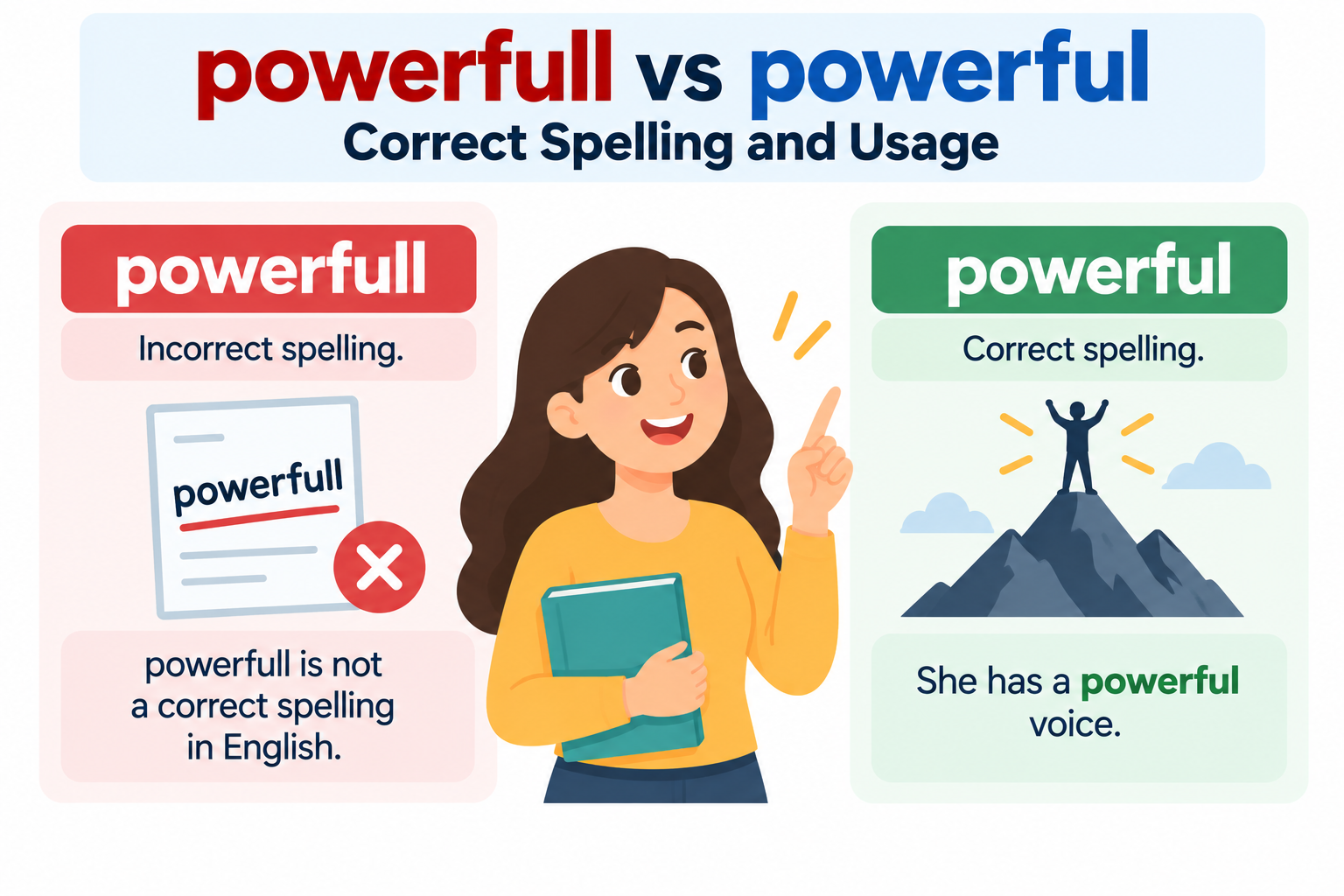
If you have ever paused while typing powerfull vs powerful, you are not alone. Many people feel unsure about these two spellings because they look almost identical. However, only powerful is the correct spelling in standard English. It has one L at the end, while powerfull with two Ls is a common spelling mistake. Although the difference is only one letter, using the correct form helps make your writing clearer and more professional.
The confusion often comes from the word full, which contains two Ls. English spelling can be tricky because some words keep their original spelling while others change when new endings are added. In this case, the suffix ful means full of or having a particular quality, and it normally contains just one L. This rule explains why we write powerful, helpful, beautiful, useful, and careful rather than adding an extra L at the end.
Understanding this spelling pattern can help you avoid common errors in school assignments, emails, reports, blog posts, social media captions, and professional documents. It can also make proofreading easier and help you feel more confident when writing in English. In this guide, you will learn why powerful is correct, why powerfull is incorrect in standard usage, how to remember the spelling, and how to use the word naturally in everyday sentences.
Quick Answer
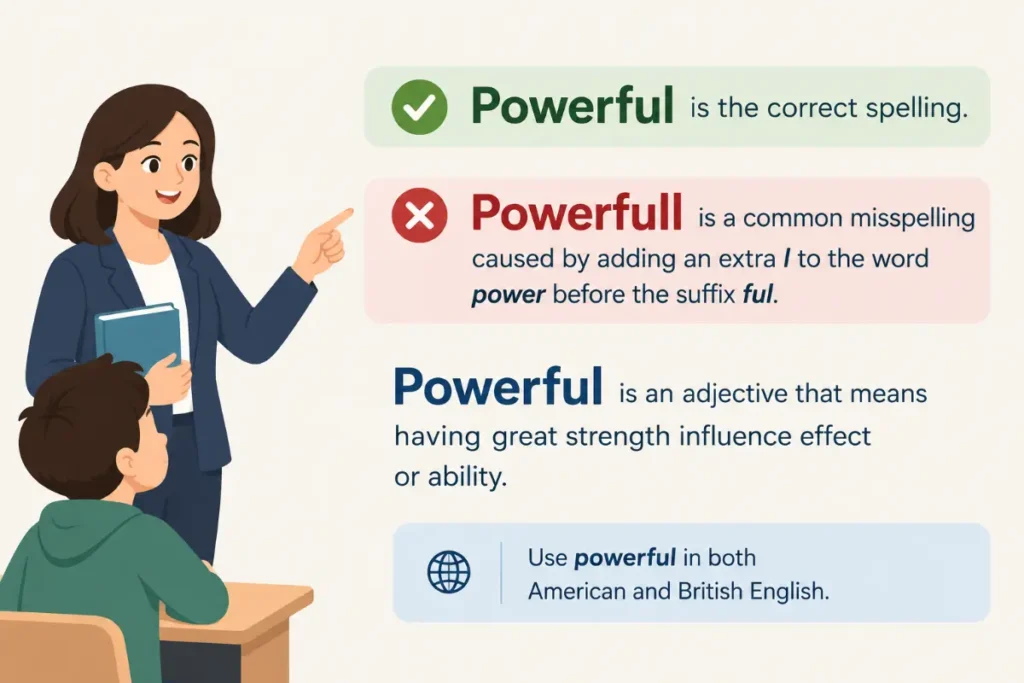
Powerful is the correct spelling in standard English. It is an adjective that describes someone or something with great strength, influence, authority, or effect. Powerfull is a common spelling error because the suffix ful takes one L, even though the standalone word full takes two.
Comparison Table for the Two Spellings
| Feature | Powerful | Powerfull |
|---|---|---|
| Spelling status | Correct standard spelling | Common misspelling |
| Meaning | Having great power or effect | No separate standard meaning in ordinary English |
| Part of speech | Adjective | Not standard as the intended adjective |
| Suffix | Ful with one L | Full with two final Ls |
| Pronunciation | /ˈpaʊərfəl/ | Usually intended to sound like powerful |
| Formality | Suitable for all writing styles | Should be corrected |
| Common contexts | Strength, influence, emotions, tools, arguments | Typing and spelling mistakes |
| Example | She gave a powerful speech. | She gave a powerfull speech. |
The main difference is spelling, not meaning. When someone writes the incorrect form, readers can usually understand the intended word from the sentence. However, using the standard spelling shows care and helps prevent errors in professional and academic writing.
Meaning and Definition
What Does Powerful Mean
Powerful is an adjective that describes a person, object, action, feeling, or idea that has considerable power. Depending on the context, that power may involve physical strength, authority, influence, emotional force, or the ability to produce a strong result.
For example, a powerful engine can produce a great deal of force. A powerful leader can influence important decisions. A powerful speech can move an audience, and a powerful argument can persuade people because its reasoning is strong.
The word doesn’t always refer to physical strength. It can describe something subtle but effective, too. A few sincere words may have a powerful effect on someone who needs encouragement.
Here are several common meanings.
- Physical strength. A powerful athlete can lift heavy weights or perform demanding physical tasks.
- Authority and influence. A powerful official can shape policies and decisions.
- Emotional impact. A powerful memory can bring back strong feelings.
- Effectiveness. A powerful treatment or tool can produce a significant result in the appropriate context.
- Persuasive force. A powerful argument can change someone’s mind through clear reasoning and evidence.
The surrounding words help you understand which meaning applies. In each case, the spelling remains the same.
What Does Powerfull Mean
Powerfull is generally a misspelling of powerful. In standard modern English, it isn’t an accepted alternative spelling of the adjective.
A reader will usually recognize the intended meaning because the sentence provides enough context. For instance, the sentence The team delivered a powerfull performance clearly refers to an impressive or forceful performance. The correct version uses one L at the end of the word.
There is no need to give the misspelled form a separate definition or treat it as a different English word. In ordinary writing, it is best to correct it rather than use it intentionally.
If you see the form in a username, brand name, product title, or other proper name, the situation may be different. Names can use unusual spellings by design. That doesn’t make the spelling standard for general English.
Key Differences Explained
Spelling
The correct spelling contains the letters P, O, W, E, R, F, U, and L. It ends with one L.
The mistake often happens because writers remember the word full and transfer its spelling to the suffix. However, the suffix in this adjective is ful, not full.
Compare these examples.
- Powerful is correct.
- Helpful is correct.
- Useful is correct.
- Beautiful is correct.
- Powerfull is incorrect in standard usage.
- Helpfull is incorrect in standard usage.
A useful rule is to look at the suffix rather than the whole word. When ful means full of or having a particular quality, it normally has one L.
Meaning
The two spellings don’t express two different ideas in standard English. The intended meaning comes from the correctly spelled word powerful.
For example, a powerful computer describes a computer with strong processing capabilities. A powerful message describes a message that has a strong effect on its audience.
Writing an extra L doesn’t create a new meaning. It simply creates a spelling error.
Grammar and Part of Speech
The standard word is an adjective. It describes a noun or follows a linking verb to describe a subject.
Consider these sentences.
- The powerful machine completed the task quickly.
- The machine is powerful.
- They developed a powerful solution.
- Her voice sounded powerful.
In the first and third examples, the adjective appears before a noun. In the second and fourth, it follows a linking verb.
The grammatical role doesn’t change the spelling. You use powerful in both positions.
Pronunciation
In standard American English, the word is commonly pronounced /ˈpaʊərfəl/. It has three syllables in a broad pronunciation guide: pow, er, ful. The first syllable receives the main stress.
The final syllable sounds like a reduced form of full. That sound may encourage writers to add a second L when spelling the word, but pronunciation doesn’t determine the number of written letters.
Both written forms may be intended to represent the same spoken word. Only one is standard.
Formality and Context
The correct spelling works in casual and formal settings. You can use it in a text message, school essay, research paper, business report, news article, or speech.
The misspelled form should be corrected in all ordinary contexts. Although readers may understand it, it can distract from the message and make the writing appear less carefully edited.
Regional Usage
There is no established regional spelling difference between American and British English for this word. The standard spelling is powerful in both varieties.
The same spelling is used in Australian and Canadian English. The extra L is not a recognized regional alternative in these varieties.
Which Form Is Correct
Powerful is the correct form because English uses the suffix ful with one L in this word. The spelling follows a common pattern found in many English adjectives, including careful, thoughtful, and successful.
The spelling rule becomes easier to understand when you separate the base word from the suffix. In powerful, the base is power and the suffix is ful. Combining them gives powerful, not powerfull.
This isn’t a rule that says every English word must contain only one L at the end. The standalone word full has two Ls, and many other words have different spelling patterns. The point is that the suffix ful has its own established spelling.
For standard writing, use the following forms.
- Write powerful when describing strength or influence.
- Write powerfully when you need the adverb.
- Write powerfulness when you need the noun form, although simpler alternatives may sound more natural in many sentences.
- Avoid powerfull unless you are reproducing a name or source that deliberately uses that exact spelling.
A spellchecker will often catch the mistake, but understanding the rule helps you correct it before the software does.
Sentence Examples
These ten examples show how to use the correct adjective naturally in different situations.
- Everyday conversation. That was a powerful performance, and the crowd loved every minute of it.
- Text messages. Your kind words had a powerful effect on me today.
- Workplace communication. The manager gave a powerful presentation about the company’s future plans.
- School assignments. The novel uses powerful imagery to help readers understand the main character’s fear.
- Academic writing. The findings provide powerful evidence for the proposed explanation.
- Formal writing. The committee issued a powerful statement in support of public education.
- Social situations. A simple apology can be a powerful step toward rebuilding trust.
- Technology. This laptop has a powerful processor that handles demanding tasks.
- Health and fitness. Regular exercise can be a powerful tool for improving physical fitness.
- Storytelling. As the storm approached, a powerful wind shook the windows and bent the trees.
Notice that the word describes different kinds of strength. It can refer to physical force, persuasive language, evidence, emotions, or a practical ability. You don’t need a different spelling for each meaning.
Common Spelling Mistakes
Several errors arise from confusion about the suffix ful and the way English words are formed. Learning these related patterns can help you avoid more than one spelling mistake.
Powerfull vs Powerful
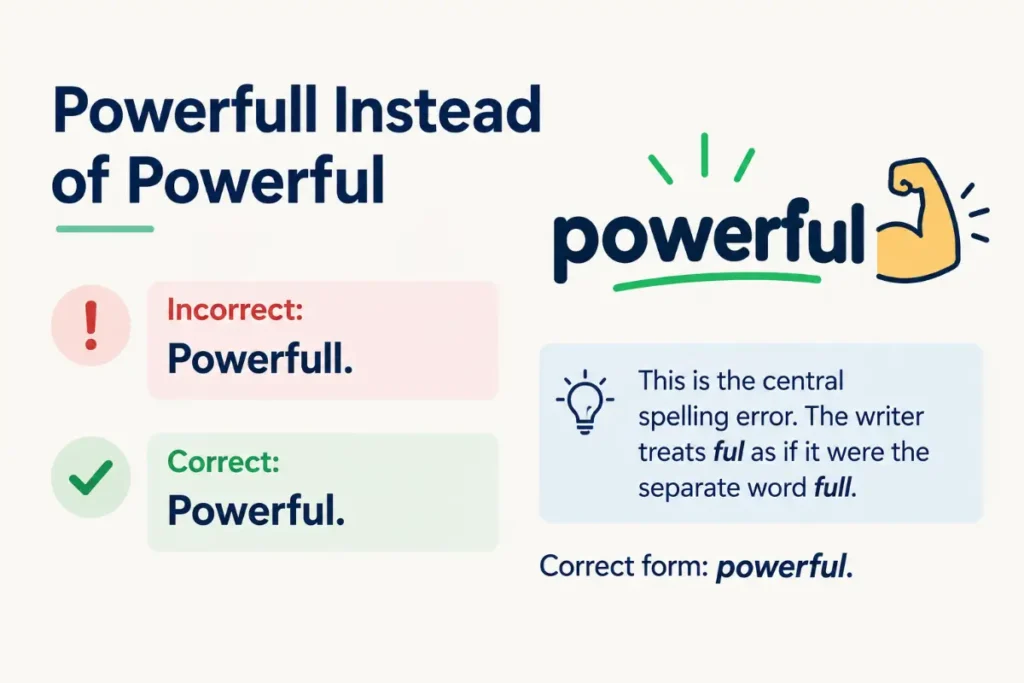
The incorrect form adds an extra L. Writers often make this mistake because they associate the ending with full.
Incorrect: The speaker delivered a powerfull message.
Correct: The speaker delivered a powerful message.
Remember that the adjective ends with one L.
Helpfull vs Helpful
The same error appears in helpful. The correct form has one L at the end.
Incorrect: Your advice was very helpfull.
Correct: Your advice was very helpful.
The suffix works in the same way as it does in powerful.
Usefull vs Useful
The word useful also takes one L at the end. The spelling doesn’t change because the word describes something that provides a benefit.
Incorrect: This guide contains usefull information.
Correct: This guide contains useful information.
Beautifull vs Beautiful
The standard adjective is beautiful, not beautifull. The word follows the same suffix pattern even though its base and history differ from those of powerful.
Incorrect: The garden looks beautifull in spring.
Correct: The garden looks beautiful in spring.
Powerfully vs Powerfullly
The correct adverb is powerfully. It is formed by adding ly to powerful. Adding an extra L before the adverb ending creates an incorrect spelling.
Incorrect: She spoke powerfullly about her experience.
Correct: She spoke powerfully about her experience.
These examples show why it helps to learn related forms together. Once you recognize the spelling of the adjective, you can form its common derivatives with greater confidence.
Pronunciation Guide
The standard pronunciation of powerful in American English is represented broadly by the International Phonetic Alphabet as /ˈpaʊərfəl/. Pronunciation can vary slightly by speaker and accent.
How to Pronounce the Word
- Syllables. A simple learning breakdown is pow, er, ful.
- Stress. Place the strongest stress on the first syllable.
- First sound. Begin with the sound in pow.
- Middle sound. Move naturally into the unstressed middle syllable.
- Ending. Finish with a light sound similar to the ending of careful.
In everyday speech, some speakers pronounce the middle vowel less distinctly. The word may sound shorter than its three syllables suggest, especially in fast conversation.
Common Pronunciation Mistakes
A common mistake is placing too much stress on the last syllable. In standard pronunciation, the main stress belongs at the beginning.
Another mistake is treating the spelling as a guide to adding an extra sound. The misspelled form doesn’t have a separate accepted pronunciation when it is intended to mean powerful.
The safest approach is to learn the spoken form and the written form together. Pronunciation helps you recognize the word, while the suffix rule helps you spell it correctly.
Etymology and Word Origin
The word powerful developed from power and the suffix ful. The base word entered English through Anglo French and Old French forms connected with the idea of having ability, authority, or force. Its deeper history traces to Latin potere, meaning to be able, through related forms in French.
The suffix ful comes from the Old English adjective full, meaning full or filled. Over time, the suffix became a common way to form adjectives that describe a person or thing as having a particular quality.
For example, helpful describes something that provides help, while careful describes someone who uses care. In the same pattern, powerful describes someone or something that possesses or expresses power.
The spelling reflects the history and development of the suffix. Although the standalone word full retains two Ls, the suffix ful normally uses one. Modern spelling follows that established pattern.
Understanding the origin can make the rule feel less arbitrary. The two forms are related, but they don’t have identical spelling functions.
Regional Usage
American English
In the United States, powerful is the standard spelling. It appears in everyday conversation, education, business, journalism, and formal documents.
American writers use it to describe physical force, political influence, persuasive evidence, emotional impact, and effective tools. The misspelled version isn’t an accepted alternative in standard American English.
British English
British English uses the same spelling. There is no standard British form that adds a second L to this adjective.
The word also carries the same main meanings. Differences in accent may affect how clearly speakers pronounce the middle syllable, but they don’t change the written form.
Australian English
Australian English also uses powerful. The spelling follows the same suffix pattern found in American and British English.
Canadian English
Canadian English uses the standard spelling powerful as well. There is no meaningful regional spelling distinction to learn for this word.
Across these varieties, the rule is consistent. If you are writing for an international audience, choose powerful.
Grammar Rules and Part of Speech
Powerful as an Adjective
An adjective describes a noun or pronoun. The word powerful can appear before a noun or after a linking verb.
Before a noun: The powerful engine made the truck easier to drive uphill.
After a linking verb: The engine is powerful.
In both cases, the spelling stays the same. The word doesn’t take a plural ending just because the noun is plural.
For example, you can write powerful machines or a powerful machine. The adjective itself doesn’t change.
Using Powerful With Common Nouns
The word works with many nouns, but the best combination depends on the meaning you want to express.
- Powerful argument. An argument with strong reasoning or persuasive force.
- Powerful leader. A person with considerable authority or influence.
- Powerful engine. A machine capable of producing substantial force.
- Powerful emotion. A feeling that is intense or difficult to ignore.
- Powerful image. A picture or description that creates a strong impression.
These combinations are natural because the adjective adds a sense of strength or impact to the noun.
Powerful and Powerfully
The adjective powerful describes a person or thing. The adverb powerfully describes how an action happens or how something is expressed.
Compare these examples.
- She has a powerful voice.
- She sings powerfully.
The first sentence describes the voice. The second describes the way she sings.
The adjective also has the noun form powerfulness, which refers to the quality of being powerful. However, writers often prefer a more direct expression such as great power or strong influence.
Can Powerful Start a Sentence
Yes. An adjective can begin a sentence when it is part of a descriptive phrase.
For example, Powerful and determined, the team continued despite the setbacks.
Here, the opening words describe the team. The spelling remains unchanged because sentence position doesn’t affect the adjective’s form.
Does Powerful Need a Hyphen
The word powerful does not need a hyphen by itself. It is a single adjective.
For example, write a powerful argument, not a power ful argument. If another word appears beside it in a compound expression, punctuation depends on the construction. Don’t add a hyphen merely because the adjective appears before a noun.
Real Life Usage Examples
The following examples show how the word fits into different kinds of communication. They also demonstrate that its meaning depends on the situation rather than the spelling.
Daily Conversation
- My grandfather has a powerful way of telling stories that keeps everyone listening.
- That small fan is surprisingly powerful for its size.
In conversation, the word often adds emphasis. It can describe physical ability or explain why something makes a strong impression.
Email and Workplace Communication
- Your report presents a powerful case for improving customer support.
- The new training program could be a powerful resource for our team.
In workplace writing, the adjective can help describe persuasive evidence, useful resources, or influential ideas. Use it when the strength of the subject matters to your message.
Academic Writing
- The author uses powerful examples to explain the effects of social change.
- The results offer powerful evidence for further investigation.
In academic writing, the word can be appropriate when the evidence supports the claim. However, avoid using it as a substitute for precise details. Explain what makes the evidence convincing or significant.
News and Journalism
- The mayor delivered a powerful speech during the public meeting.
- The storm brought powerful winds to several coastal communities.
Journalists use the adjective to describe force, impact, and influence. The meaning may be literal, as with strong winds, or figurative, as with a speech that affects public opinion.
Literature and Storytelling
- A powerful silence filled the room after the final announcement.
- The writer created a powerful image of a village struggling through winter.
In storytelling, the word helps convey mood and intensity. It can describe something that readers or characters experience emotionally, even when no physical force is involved.
Related and Confused Terms
Learning related words helps you choose a precise expression instead of relying on one adjective for every situation.
Strong
Strong describes physical strength, intensity, reliability, or force. It is often a simpler alternative to powerful.
Example: She made a strong argument.
Use strong when you want a broad and familiar description. Choose powerful when you want to emphasize the ability to influence or create a significant effect.
Forceful
Forceful describes someone or something that expresses ideas with energy and determination or acts with considerable force.
Example: He made a forceful case for change.
The word often focuses on the way a person speaks or acts. Powerful can cover a wider range of meanings, including authority, physical ability, and emotional impact.
Influential
Influential describes someone or something that can affect decisions, opinions, or behavior.
Example: She is an influential voice in education.
A person can be influential without being physically strong. This term is useful when the main idea is the ability to shape what other people think or do.
Effective
Effective means producing the intended result.
Example: The new method is effective at reducing waste.
An effective tool works well for its purpose. A powerful tool may have great capability, but that capability doesn’t automatically make it effective for every task.
Potent
Potent describes something with a strong effect or a high degree of strength. It is often used for substances, medicines, arguments, and other things that can produce a marked result.
Example: The chemical has a potent effect at low concentrations.
The word can carry technical or specialized meanings. Use it when intensity or strength of effect is the central point.
Mighty
Mighty means very strong or powerful. It often appears in storytelling, dramatic descriptions, and expressive speech.
Example: The mighty river flowed through the valley.
Compared with powerful, it can sound more dramatic or traditional. It may be a good choice when you want a vivid or elevated tone.
Empowering
Empowering describes something that gives a person more confidence, freedom, ability, or control.
Example: The workshop was an empowering experience.
This word focuses on helping someone gain power or control. It doesn’t simply mean that the experience itself is strong or intense.
Powerfully
Powerfully is the adverb form of powerful. It describes how an action is performed or how an effect occurs.
Example: The actor spoke powerfully during the final scene.
Remember the spelling pattern. Start with powerful, then add ly to form powerfully. Don’t add another L to the adjective before adding the ending.
Expert Editor Insight
An experienced editor will normally correct powerfull to powerful without changing the rest of the sentence. The error is easy to understand because the standalone word full has two Ls, while the suffix ful has one. Spellcheckers often catch this mistake, but editors also review the surrounding sentence to make sure the intended meaning is clear. A useful editing habit is to check related words together. If you know helpful, useful, and careful, you already know a pattern that supports the correct spelling of this adjective.
Key Takeaway
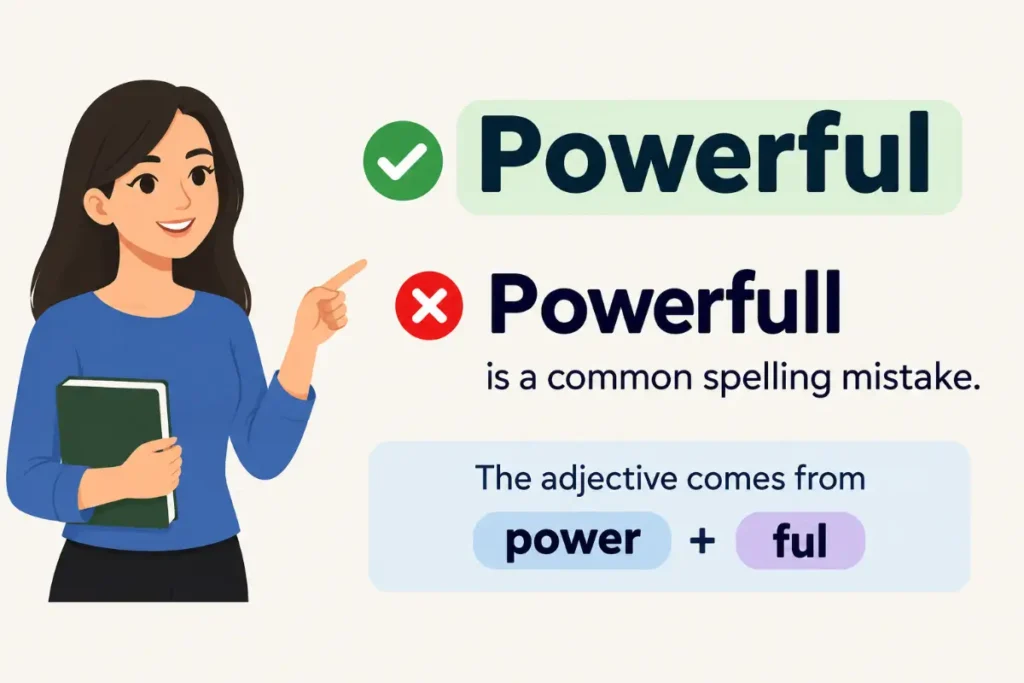
- Powerful is the correct spelling.
- Powerfull is a common spelling mistake.
- The adjective comes from power plus the suffix ful.
- The suffix ful has one l.
- Powerful can describe physical strength influence authority emotional impact or persuasive force.
- Powerful is an adjective.
- Power is commonly used as the related noun.
- Powerfully is the related adverb.
- The standard spelling is the same in American British Australian and Canadian English.
- The easiest memory trick is power plus ful equals powerful.
Conclusion
The spelling comparison powerfull vs powerful has a simple answer. Powerful is correct, while powerfull is a common misspelling in standard English. The word describes strength, authority, influence, or a strong effect, and it works in both everyday conversation and formal writing.
The easiest way to remember the spelling is to focus on the suffix ful. Although full ends with two Ls, the suffix normally uses only one. Apply the same pattern to helpful, useful, and careful. When editing your work, check for an extra L before you submit an assignment, send an email, or publish a document. A small spelling habit can make your writing clearer and more professional.
FAQs
Is Powerfull a Real Word?
Powerfull is not the standard spelling of the adjective used to describe strength or influence. It is generally treated as a misspelling of powerful. You may encounter it in usernames, brand names, or other intentionally unusual spellings, but those special cases don’t make it a standard alternative for ordinary English writing.
What Does Powerful Mean?
Powerful means having great strength, influence, authority, or ability to produce an effect. It can describe a strong engine, an influential leader, a convincing argument, or an emotional experience. The exact meaning depends on the context, but the spelling remains the same in all these uses.
Which Is Correct in American English?
Powerful is the correct spelling in American English. The word ends with one L because it uses the suffix ful. Adding another L creates a spelling error in ordinary writing. American writers use the same standard spelling in school assignments, business communication, articles, and everyday messages.
How Do You Pronounce Powerful?
In American English, powerful is commonly represented as /ˈpaʊərfəl/ in the International Phonetic Alphabet. The word is often taught in three syllables, with the main stress on the first. The ending sounds similar to the ending in careful. The spelling has one final L regardless of accent.
Can Powerful Start a Sentence?
Yes. Powerful can begin a sentence as part of a descriptive phrase. For example, Powerful and determined, the speaker continued addressing the crowd. The adjective describes the speaker, and its spelling doesn’t change because it appears at the beginning of the sentence.
What Is a Synonym for Powerful?
Useful synonyms include strong, forceful, influential, effective, potent, and mighty. Each word has a slightly different meaning. Influential focuses on the ability to affect people or decisions, while effective emphasizes producing a desired result. Choose the word that best matches your intended meaning.
Why Do People Misspell Powerful?
People often add an extra L because they associate the suffix with the word full. However, the suffix ful normally has one L when it forms adjectives such as powerful, helpful, and useful. Remembering the suffix pattern can prevent this mistake and help you spell many related words correctly.
Is Powerful Appropriate in Formal Writing?
Yes. Powerful is a standard adjective suitable for formal and informal writing. You can use it in reports, essays, presentations, professional emails, and articles. In academic or technical writing, make sure the word accurately reflects the evidence. A precise explanation of why something has a strong effect can make your writing more convincing.
